
Nominee shareholder Sri Lanka: beneficial ownership for foreigners
Why a local nominee cannot hide a foreign owner under the 2025 rules, what foreign-owned companies file, and our own no-nominee practice.
On this page
Last verified against the primary sources on 21 October 2026; the late filing charge was rechecked on 22 October 2026.
Updated 22 October 2026: the late beneficial ownership charge is now Rs 1,000 a week under Regulations No. 1(II) of 2026 (Gazette 2511/47).
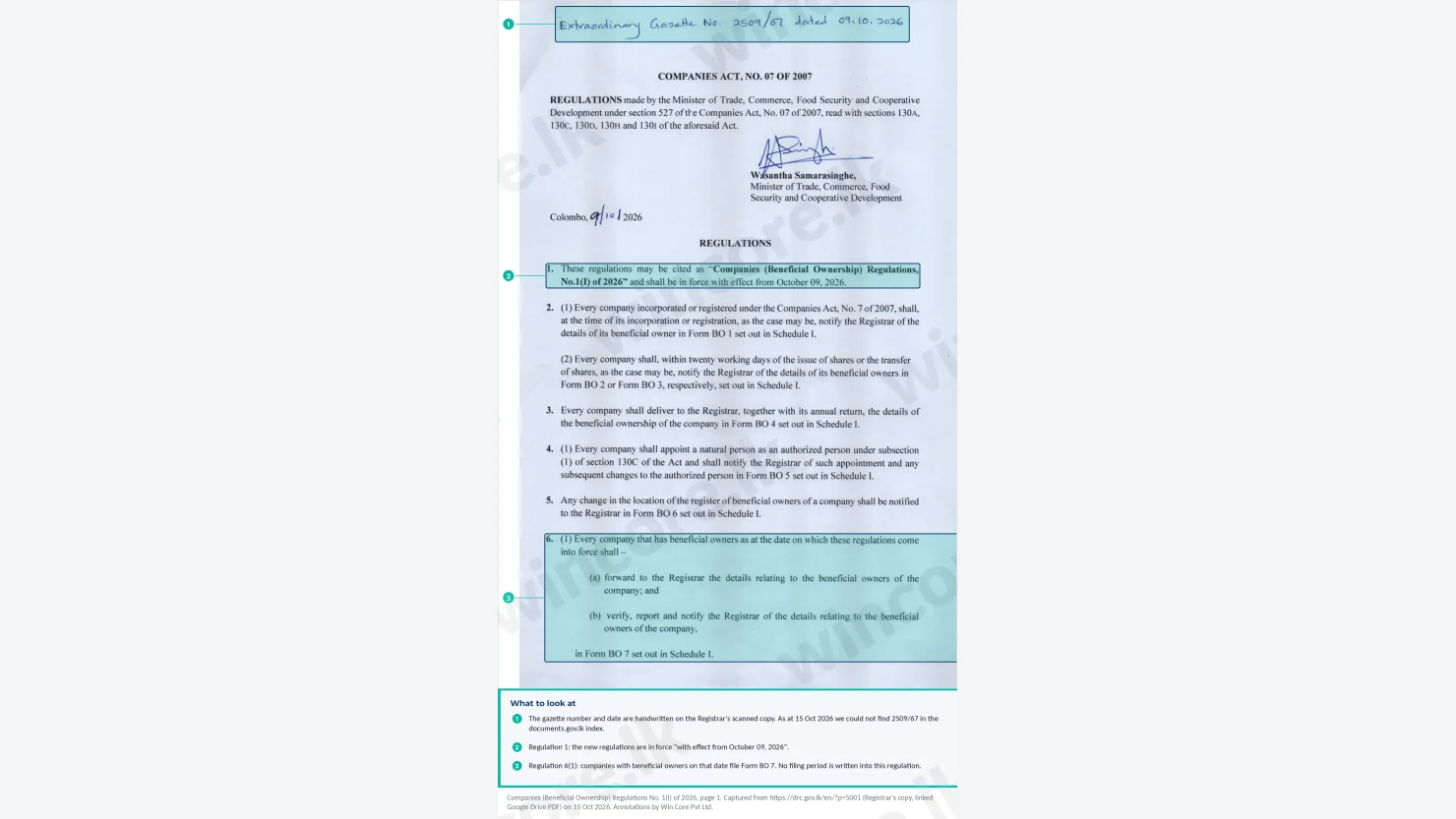
A nominee shareholder in Sri Lanka cannot keep a foreign owner off the record. Since 30 March 2026, sections 130A to 130J of the Companies Act, inserted by the Companies (Amendment) Act No. 12 of 2025, require every shareholder to give the company the details of the natural persons who ultimately own or control 10 percent or more within ten working days of a subscription or transfer, and section 130F says an undisclosed beneficial interest may not be "recognised for any lawful purpose" [1]. The forms are set by the Companies (Beneficial Ownership) Regulations, No. 1(I) of 2026, in force from 9 October 2026 [2].
This piece is for companies whose owners live abroad: subsidiaries of foreign groups, branches registered as overseas companies, and companies owned by individuals outside Sri Lanka. For the 10 percent look-through and the full list of forms, read our guide to beneficial ownership and the 10 percent test. For the October 2026 regulations and what a late BO 7 now costs, read what Gazette 2509/67 changed. Here we look at what is different for foreign owners, and set out our own practice: WinCore does not supply nominee shareholders or nominee directors. That is our practice. It is not a claim that the law bans nominees.
A beneficial owner is always an individual at 10 percent or with control
Section 130J defines a beneficial owner as "a natural person who ultimately owns or controls ten per cent or more of a company, in whole or in part, through, direct or indirect ownership or control of shares or voting rights or other ownership interest in that company", and the definition "also includes a natural person who exercises effective control through other means" [1]. "Effective control" includes control exercised "through a chain of ownership or by appointment or removal of a director" or by "the ability to take strategic decision that affects the operation of the company" [1].
Three points follow for a foreign-owned company:
- Only natural persons. A foreign parent company is never the beneficial owner. The filing has to reach the individuals behind it, through every layer.
- 10 percent, not 25. Ownership forms built for other countries often use 25 percent. Sri Lanka uses 10 [1].
- Control counts without shares. A person who can appoint or remove the board is caught with no shareholding at all [1].
The word "ultimately" does the cross-border work. A foreign group with a holding company, a fund and a family trust above it has to follow the chain until it reaches people. The Act does not say how to count percentages through several layers, or how to treat a trust where no individual reaches 10 percent. Our evergreen guide multiplies down the chain, which on our reading is the natural meaning of "indirect ownership", but the Act gives no worked rule.
Foreign-owned companies, branches and offshore companies all file
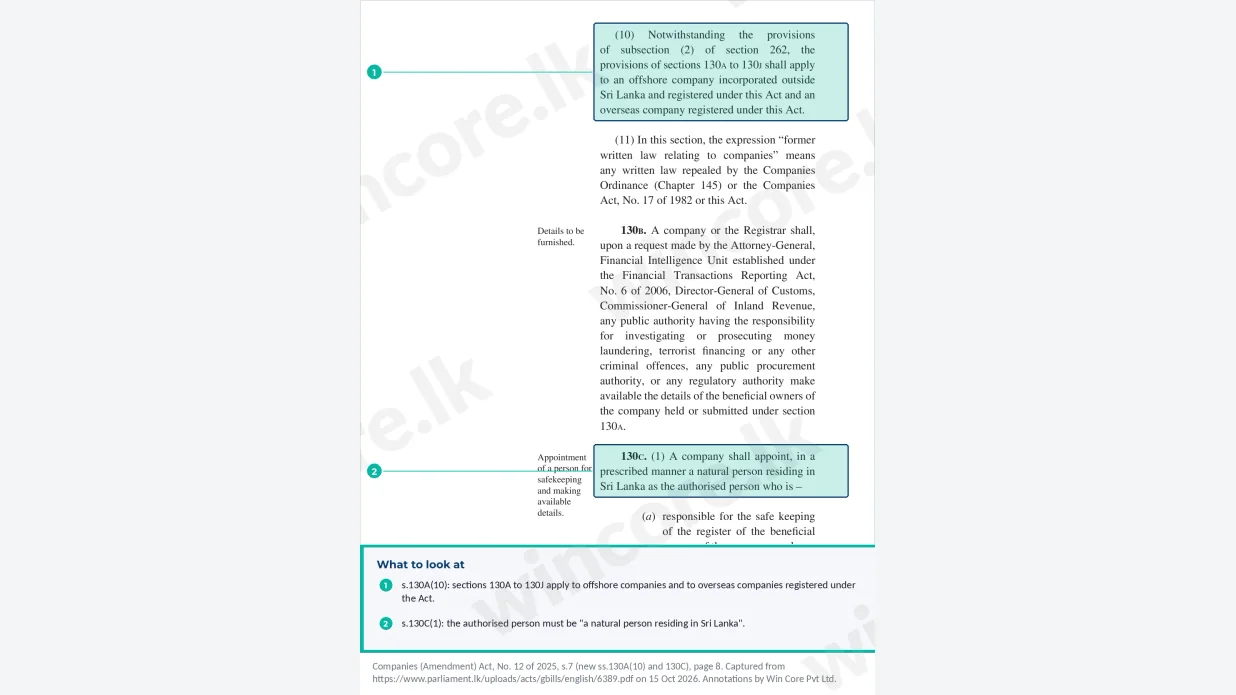
Section 130A(10) says that, notwithstanding section 262(2), "the provisions of sections 130A to 130J shall apply to an offshore company incorporated outside Sri Lanka and registered under this Act and an overseas company registered under this Act" [1]. A local subsidiary is a company incorporated under the Act and is covered by section 130A(1) directly. A branch of a foreign company, registered as an overseas company, is covered by subsection (10). Our comparison of a subsidiary vs branch in Sri Lanka explains those vehicles.
What a foreign-owned company files, and why the authorised person must live here
Section 130A(1) requires notice to the Registrar "at the time of incorporation or within twenty working days of the issue of any shares or transfer of shares", giving each beneficial owner's names, dates and places of birth, "nationalities, countries of residence", addresses, "the National Identity Card numbers, Tax Identification Numbers, or passport numbers and the countries of issuance", contact details and "a full statement describing the nature and the extent of the beneficial ownership" [1]. For a foreign owner, the passport and its country of issue do the work an NIC does for a local one.
The regulations map the duties to forms: BO 1 at incorporation, BO 2 or BO 3 within twenty working days of an issue or transfer, BO 4 with the annual return, BO 5 for the authorised person, BO 7 for companies that existed when the regulations came into force, and BO 8 for a change in a beneficial owner's details within fourteen working days [2]. The Registrar's notice for new incorporations tells applicants to file BO 1 and BO 5 through the online beneficial ownership system [3].
Three other duties land on people, not only on the company:
- Shareholders. "Every shareholder shall, within ten working days of the subscription of any shares or transfer of shares give the details specified in subsection (1) to the company" (s.130A(2)) [1].
- Directors and secretary. Each must disclose the beneficial owner details to the Registrar "when such director or secretary becomes aware of such details" (s.130A(3)) [1]. For what the Companies Act asks of every director, see director duties.
- Register and records. The company keeps the register at its registered office and keeps the records "for a period of at least ten years after the date on which the record was made" (s.130A(4), (5)) [1].
The authorised person is where foreign owners most often get stuck. Section 130C(1): "A company shall appoint, in a prescribed manner a natural person residing in Sri Lanka as the authorised person", responsible for the safe keeping of the register and for making the details available to the authorities listed in section 130B, which include the Financial Intelligence Unit, Customs and the Inland Revenue [1]. A company whose directors and owners all live abroad must still find a real person here to hold that role. The role carries personal exposure, which is why we return to it below.
A nominee shareholder in Sri Lanka must disclose the person behind the shares
Take a hypothetical engineering contractor living overseas who has a business associate in Sri Lanka hold 30 percent of the shares in a new engineering firm, with a private side letter saying those shares are really the contractor's. Three provisions meet that plan.
- The nominee must disclose. As a shareholder, the nominee must give the company the beneficial owner's details within ten working days (s.130A(2)) [1]. A shareholder who fails to do so commits an offence under section 130G(3) [1].
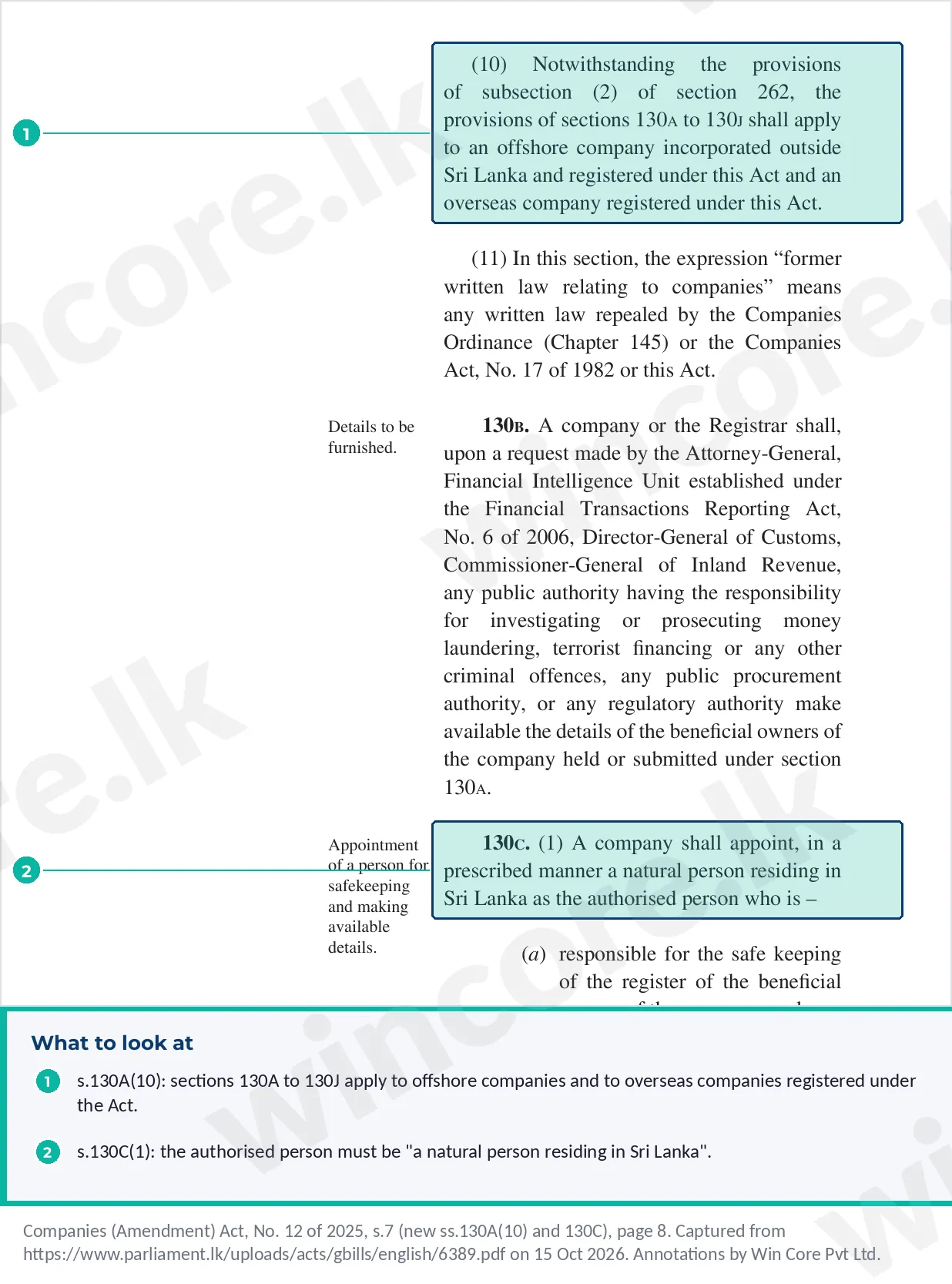
- Hiding is a separate offence for the company. Section 130G(1)(b) to (d) cover a company that "knowingly provides false or misleading details about a beneficial owner", "knowingly withholds details of a beneficial owner" that should be on the register, or "knowingly makes a false entry into the register" [1].
- The hidden owner loses protection. Section 130F: "Notwithstanding anything to the contrary in any other written law, a claim to beneficial ownership of a company may not be claimed or be recognised for any lawful purpose, unless such beneficial ownership is disclosed and registered in the manner set out under this heading" [1].
The third point is the one founders miss. A nominee arrangement has traditionally rested on a private trust deed or side letter. Section 129(1) of the Companies Act already keeps trusts off the share register: "no notice of any trust, expressed, implied or constructive, shall be entered on the share register or be receivable by the Registrar" [4]. The 2025 Act leaves that rule in place; its schedule only corrects a typing error in it [1]. But section 130F now says an undisclosed beneficial interest cannot be relied on "for any lawful purpose", and it applies "notwithstanding anything to the contrary in any other written law". On our reading, a founder who keeps the arrangement quiet risks losing the very claim the side letter was meant to protect.
Does the Act ban nominee shareholders? We searched the 2025 amending Act for "nominee" on 21 October 2026 and found no provision that bans them. On our reading, a disclosed nominee holding is lawful. A nominee used to hide the owner is an offence.
Each beneficial ownership default has its own penalty section
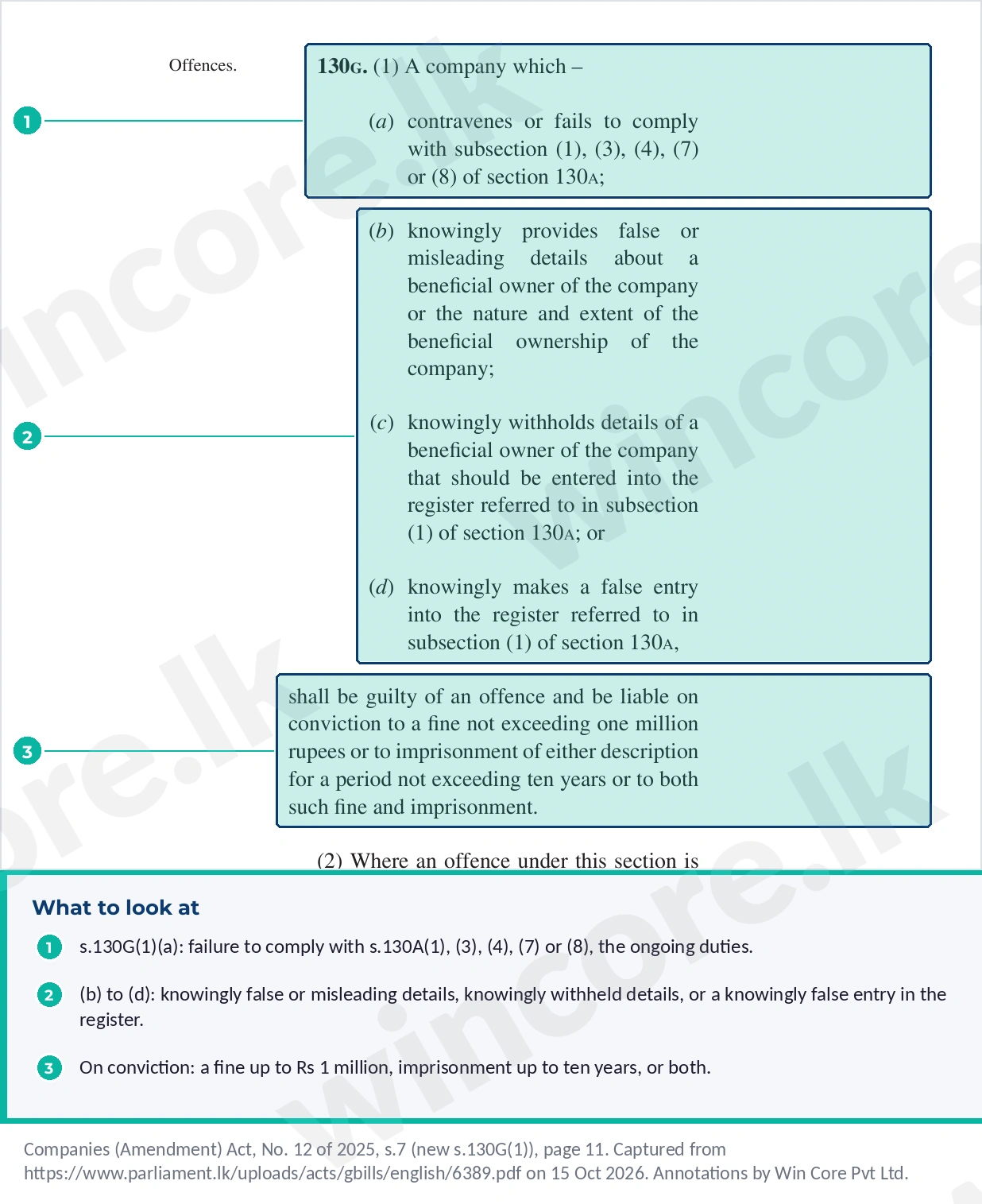
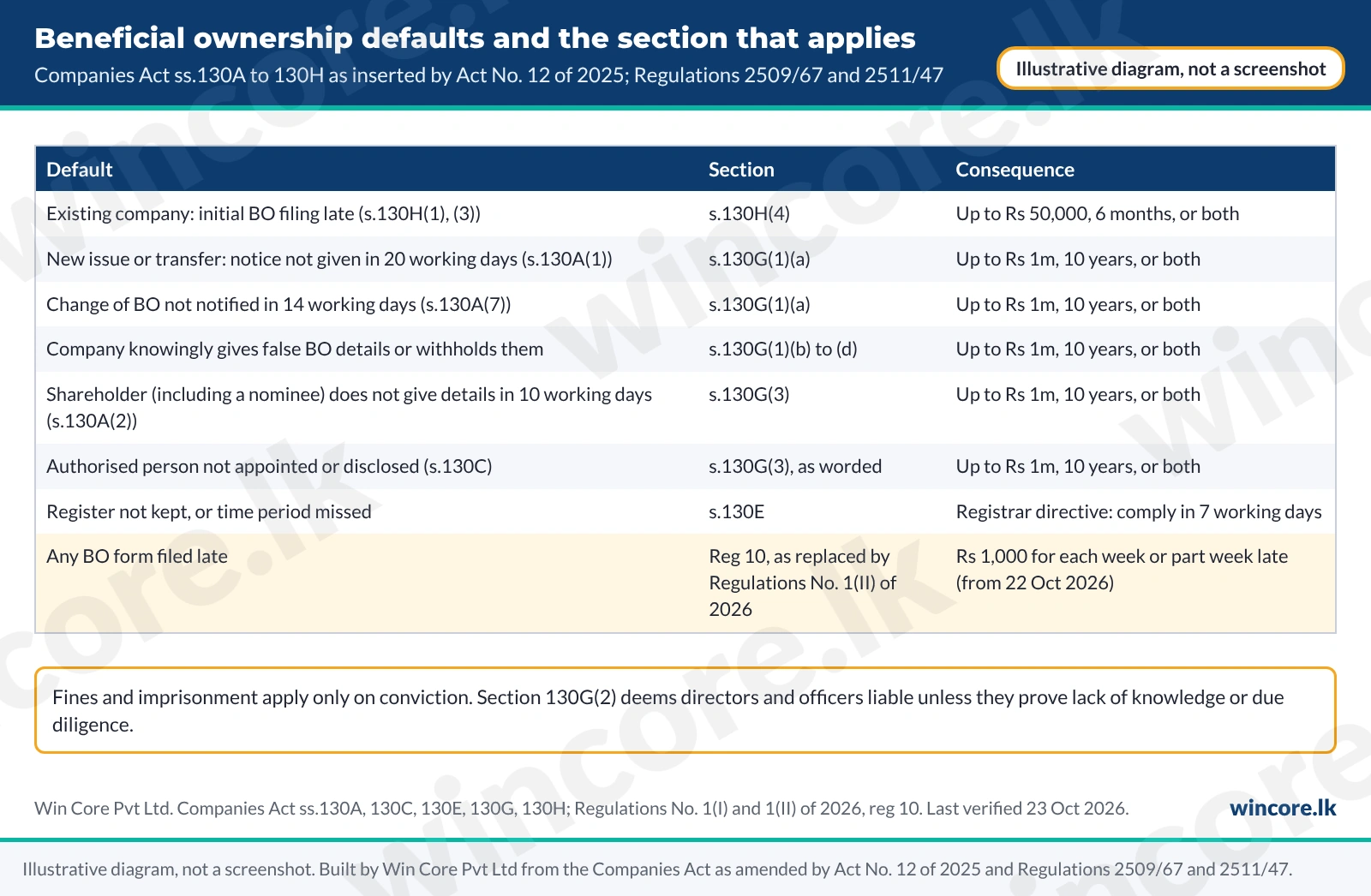
The two penalty sections cover different defaults, and confusing them overstates the risk of a late first filing.
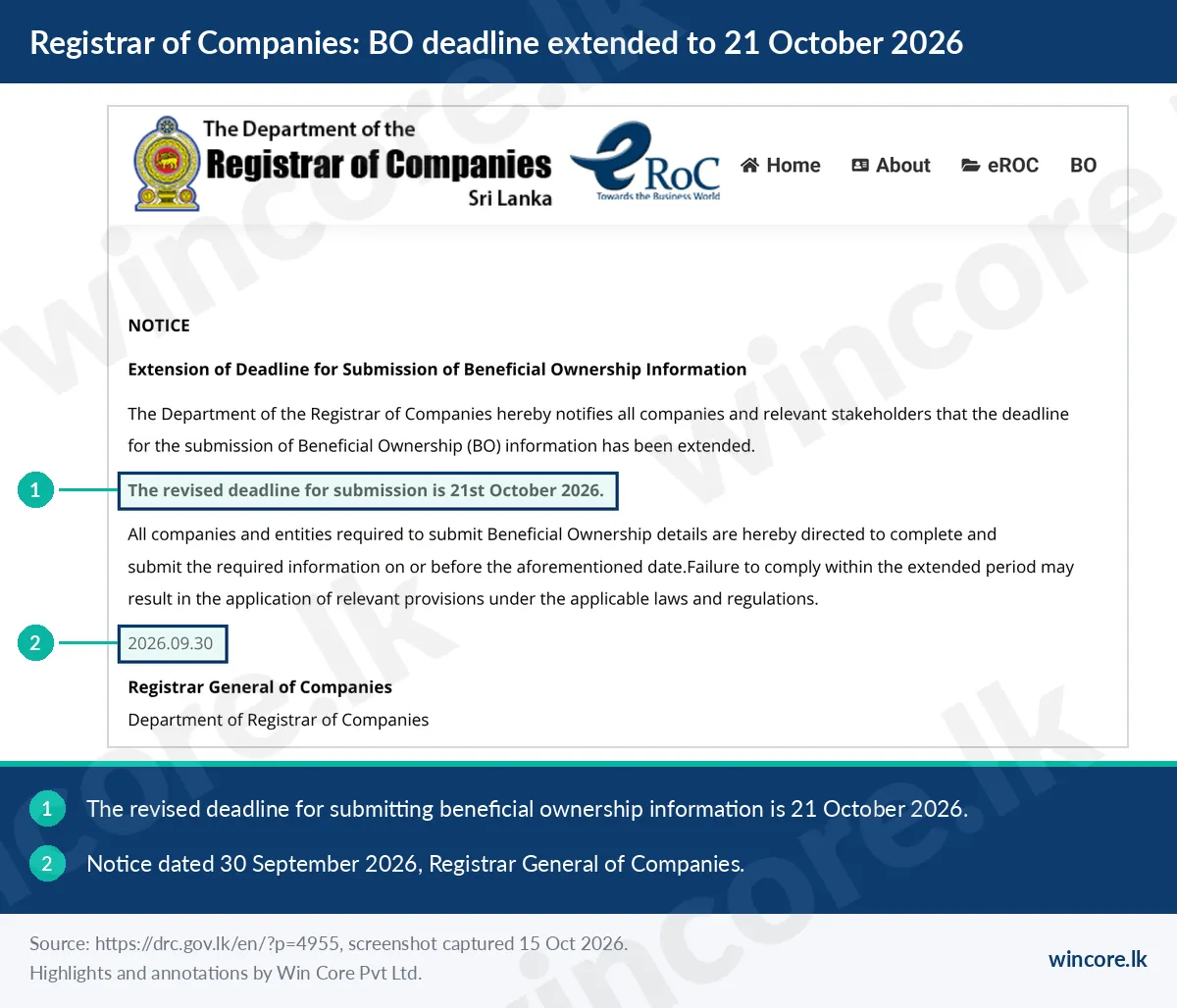
- Late first filing by an existing company. Section 130H(1) gave companies that had beneficial owners when the Act came into operation on 30 March 2026 six months to report them, which runs to 30 September 2026 on our count, and section 130H(3) adds a thirty day duty to verify and notify. The Registrar extended the submission date administratively to 21 October 2026, and that date has now passed [5]. The penalty for failing to comply with section 130H is in section 130H(4): "a fine not exceeding fifty thousand rupees or to imprisonment of either description for a period not exceeding six months, or to both" [1]. It is not section 130G.
- Ongoing company duties. Failing to comply with section 130A(1), (3), (4), (7) or (8) falls under section 130G(1)(a): a fine up to Rs 1 million, imprisonment up to ten years, or both, on conviction [1].
- False or withheld details. Section 130G(1)(b) to (d), same penalty [1].
- Shareholder, secretary or authorised person. Section 130G(3) applies the same penalty to "A shareholder, secretary or authorised person who contravenes or fails to comply with the provisions under subsection (2) of section 130A or subsection (3) of section 130A or 130C" [1].
- Directors and officers. Section 130G(2) deems every director and officer to have committed the company's offence unless they prove it was committed "without such person's knowledge" or that they "exercised all due diligence to prevent the commission of such offence" [1].
- Registrar's directive. Under section 130E, a company that has not kept the register or met a section 130A time limit receives a written directive to comply "within a period of seven working days from the date of receiving the directive" [1].
- Late forms. From 22 October 2026, regulation 10 as replaced by Regulations No. 1(II) of 2026 charges Rs 1,000 for each week or part week a form is late [6]. It replaced a doubling compounding charge that applied from 9 to 21 October [2]. Our article on the 2026 regulations covers the change.
Why we do not supply nominees or act as authorised person
This section is our practice, not a rule of law.
- We do not supply nominee shareholders. Shares registered in someone's name belong to that person, and recovering them needs that person to sign a transfer. We will not put a founder in that position.
- We do not supply nominee directors. A director carries personal duties under the Companies Act and, under section 130G(2), personal exposure for the company's beneficial ownership offences [1].
- We do not sit as the authorised person. Section 130C gives that person custody of the register, and section 130G(3) names the authorised person among those who can commit an offence [1]. It should be someone the owners choose and trust.
What we do is the filing. Our company secretarial solutions prepare and file BO 1 and BO 5 at incorporation and the later BO forms, and our foreign branch registration team handles overseas company registrations. For a company with owners abroad, the useful work is mapping the chain to individuals, collecting passport details before incorporation, and keeping the twenty and fourteen working day clocks.
Checklist: documents needed
- Group structure chart with percentages at every layer up to individuals
- For each beneficial owner: full names, dates and places of birth, nationality, country of residence, addresses, passport number and country of issue, contact details
- A statement of the nature and extent of each person's ownership or control
- Any nominee, trust or side-letter arrangement, so it can be disclosed
- Board resolution appointing the authorised person, a natural person residing in Sri Lanka, and that person's consent
- The BO form for each event (BO 1 and BO 5 at incorporation; BO 2 or BO 3, BO 4, BO 8 later)
What this means for you
- List every individual at 10 percent or more, or with control, through every layer of the group.
- Collect passport details and countries of issue before incorporation, not after.
- Choose a real authorised person who lives in Sri Lanka and understands the role.
- If anyone holds shares for someone else, disclose it. Section 130F protects only disclosed and registered ownership.
- Diary the clocks: twenty working days after every issue or transfer, fourteen working days after any change, and BO 4 with each annual return. Our annual filing checklist is a place to start.
Open points we have not settled
- Indirect percentages. Neither the Act nor the regulations sets a rule for multiplying through layers; our reading is in the evergreen guide.
- Trusts and funds where no individual reaches 10 percent: who exercises "effective control"? The definition's examples help, but there is no test for these cases.
- Section 130G(3) and section 130C. The words "or 130C" appear to cover the authorised person's duties, but section 130C puts the duty to appoint on the company. Who is liable for a missed appointment is not settled.
FAQ
Is a nominee shareholder illegal in Sri Lanka?
We found no provision that bans a disclosed nominee. The nominee must still give the company the beneficial owner's details within ten working days under section 130A(2), failure is an offence under section 130G(3), and a company that knowingly withholds or falsifies those details commits an offence under section 130G(1). Concealment, not the nominee holding itself, is what the Act punishes [1].
Is a foreign parent company the beneficial owner of its Sri Lankan subsidiary?
No, because only natural persons can be beneficial owners under section 130J. The subsidiary must look through the parent, and any holding companies above it, to the individuals who ultimately own or control 10 percent or more, or who exercise effective control by other means such as the right to appoint or remove directors [1].
Can a director living abroad be the authorised person?
No. Section 130C(1) requires the company to appoint "a natural person residing in Sri Lanka" as the authorised person who keeps the register and makes it available to the authorities in section 130B. A company with all its directors overseas still needs one resident individual for this role, notified on Form BO 5 [1] [2].
What happens to an undisclosed beneficial owner's claim?
It may not be recognised. Section 130F says a claim to beneficial ownership "may not be claimed or be recognised for any lawful purpose" unless it is disclosed and registered under the beneficial ownership heading, and it applies notwithstanding any other written law. On our reading, a private side letter alone is a weak protection [1].
What is the penalty for a late first BO filing by an existing company?
Section 130H(4) applies: on conviction, a fine up to Rs 50,000, imprisonment up to six months, or both. The heavier section 130G penalty covers ongoing duties and false details. A late form also attracts the regulation 10 penalty of Rs 1,000 a week from 22 October 2026 [1] [6].
Talk to us. If you are setting up a foreign-owned company and want the beneficial ownership filings right from day one, our contact page.
WinCore Pvt Ltd
This article is general information on the law as at 21 October 2026 and is not advice on your specific transaction.
References
- Parliament of Sri Lanka. Companies (Amendment) Act, No. 12 of 2025 (certified 4 August 2025), s.7 (new ss.130A to 130J) and Schedule item 27. https://www.parliament.lk/uploads/acts/gbills/english/6389.pdf . Primary. Accessed 21 October 2026.
- Minister of Trade, Commerce, Food Security and Co-operative Development. Companies (Beneficial Ownership) Regulations, No. 1(I) of 2026, Extraordinary Gazette No. 2509/67 (9 October 2026, number handwritten on the Registrar's copy), regs 2 to 7 and 10, as posted at https://drc.gov.lk/en/?p=5001 with the text at https://drive.google.com/file/d/1v3jBw9yrmEX3U1g-dvD_q_jtAq5lL5hH/view . Primary. Accessed 15 October 2026.
- Department of the Registrar of Companies. Mandatory beneficial ownership submission for new company incorporations (31 March 2026). https://drc.gov.lk/en/?p=4678 . Primary (administrative). Accessed 15 October 2026.
- Parliament of Sri Lanka. Companies Act, No. 7 of 2007, s.129(1). http://www.drc.gov.lk/en/wp-content/uploads/2018/04/Act-7-of-2007-English.pdf . Primary. Accessed 15 October 2026.
- Department of the Registrar of Companies. Extension of deadline for submission of beneficial ownership information (30 September 2026). https://drc.gov.lk/en/?p=4955 . Primary (administrative). Accessed 15 October 2026.
- Acting Minister of Trade, Commerce, Food Security and Cooperative Development. Companies (Beneficial Ownership) Regulations, No. 1(II) of 2026, Extraordinary Gazette No. 2511/47 (21 October 2026, number handwritten on the Registrar's copy), regs 1 to 4. https://drive.google.com/file/d/1zQMPo8yAMzOb6PH4rzVxxEcoLN_S6Kc2/view . Primary. Accessed 22 October 2026.
Put these insights to work
WinCore specialists can review your current workflow, document gaps, and build a practical 90-day action plan.
Book a free consultationContinue reading
Explore more WinCore analysis to keep your finance, tax, and compliance roadmap moving.
Who counts as a beneficial owner at 10 percent, the forms in the October 2026 regulations, and what existing companies face after the 21 October deadline.
The October 2026 BO regulations replaced the March set, and from 22 October a late form costs Rs 1,000 a week. What a late BO 7 filing now costs.
Four ways a foreign company can enter Sri Lanka, set side by side: what each may do, the money each needs, how each is taxed, and what is still open.