
Resident director in Sri Lanka: the Act versus the Registrar
The Act is silent on where directors live. Registrar practice is not. What the law requires locally, and what a foreign founder should plan for.
On this page
Last verified against the primary sources on 22 October 2026.
Does a Sri Lankan company need a resident director? The Companies Act, No. 7 of 2007 sets no residence or citizenship test for directors: section 202 lists the disqualifications and residence is not one of them, and the Companies (Amendment) Act, No. 12 of 2025, in force since 30 March 2026, did not change that. In practice the answer is different. In our filing experience the Registrar of Companies does not accept the incorporation of an ordinary private company unless at least one director is resident in Sri Lanka. Separately, the law itself requires two local seats: a Sri Lanka resident authorised person for beneficial ownership (s.130C) and, above a low threshold, a secretary who is a Sri Lankan citizen holding a Certificate of Practice.
Most of what you will read online stops at the first half of that answer. This piece gives both halves and keeps them apart: what the statute says, and what we see at the Registrar's counter.
The resident director rule in Sri Lanka is practice, not statute
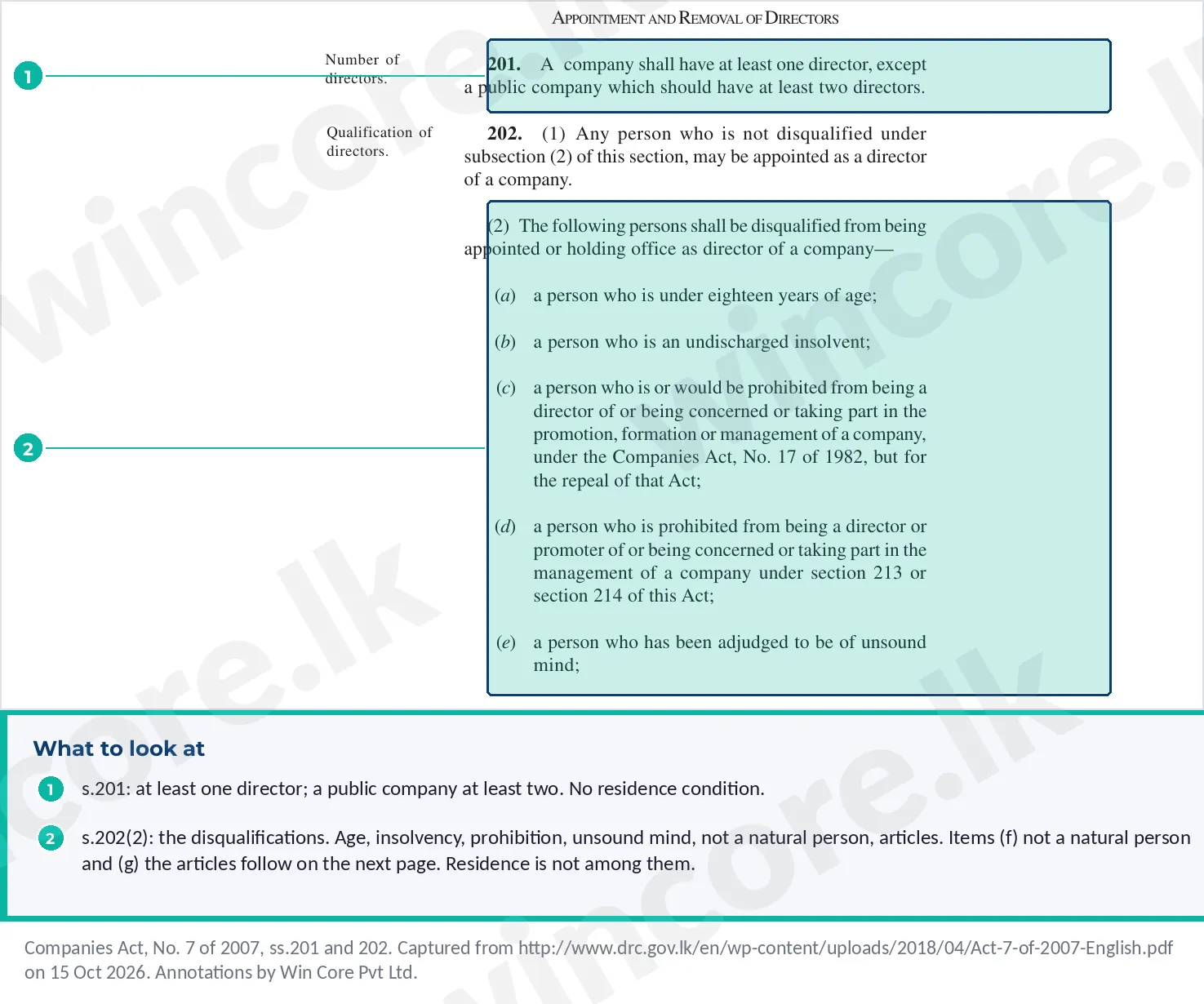
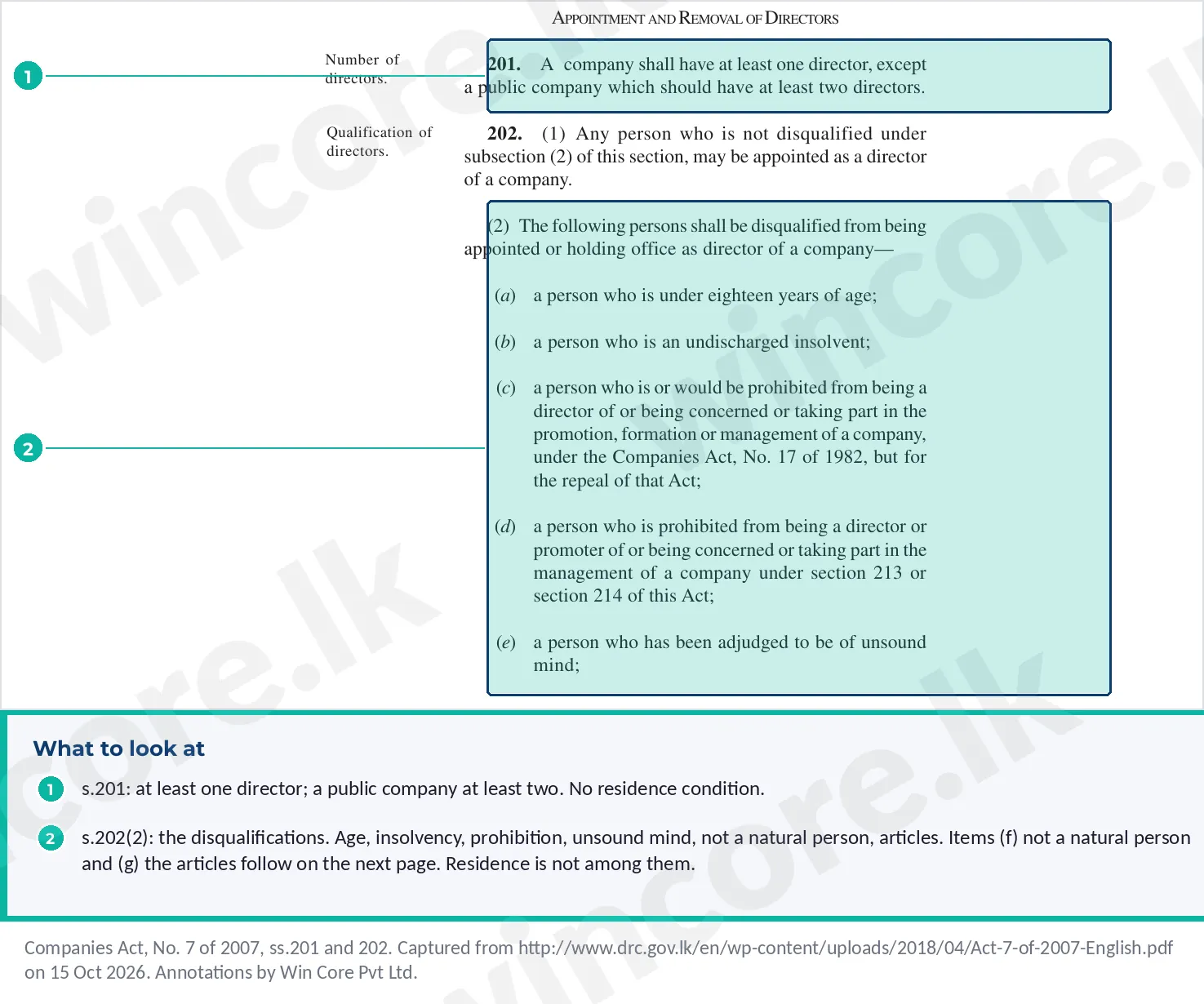
Start with the text. "A company shall have at least one director, except a public company which should have at least two directors" (s.201) [1]. Any person not disqualified under s.202(2) may be appointed (s.202(1)). The disqualifications are: under eighteen; an undischarged insolvent; prohibited under the 1982 Act or under s.213 or s.214; "adjudged to be of unsound mind"; "a person that is not a natural person"; and a person who does not meet "any qualifications for directors contained in the articles of that company" [1]. Residence and citizenship are not on the list.
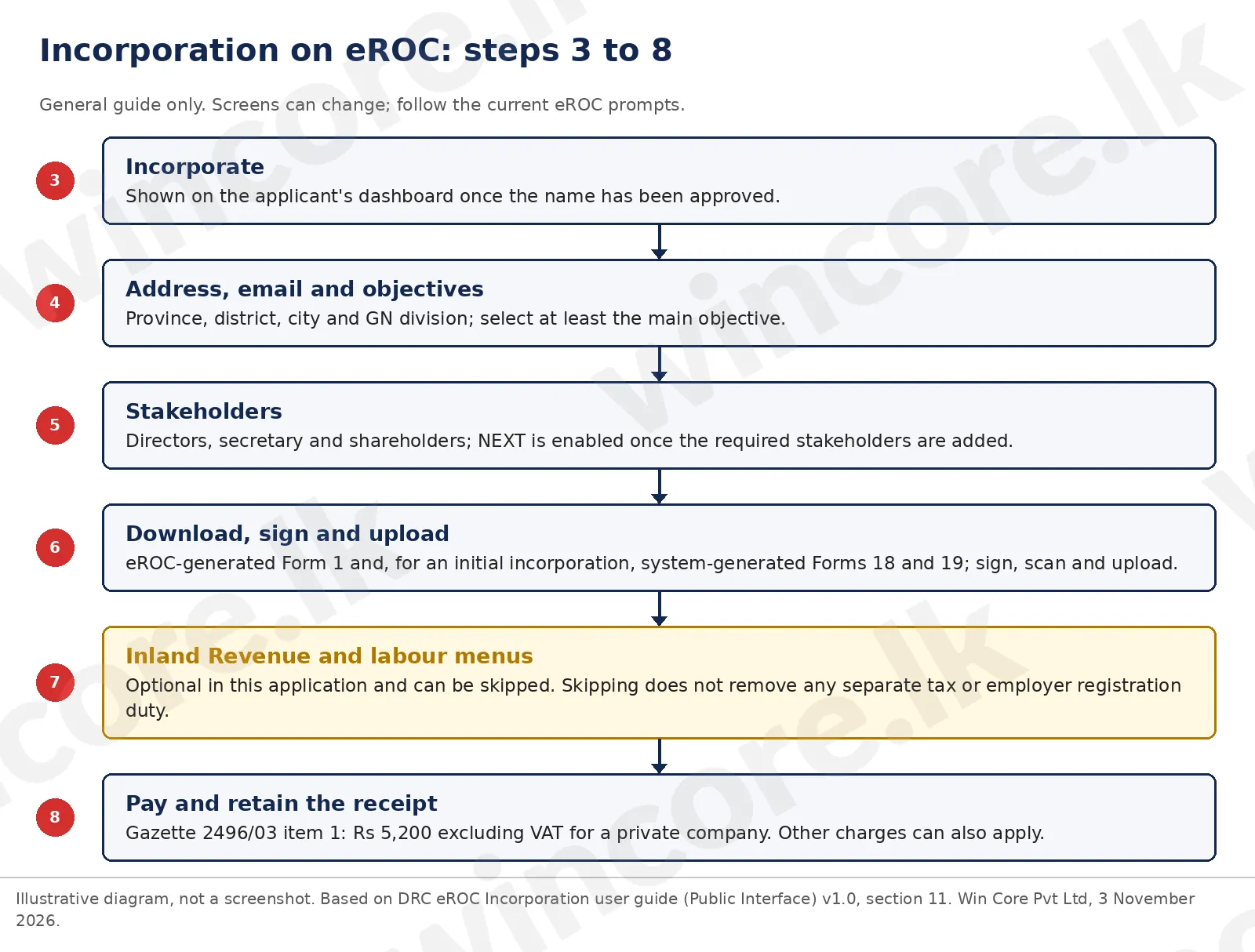
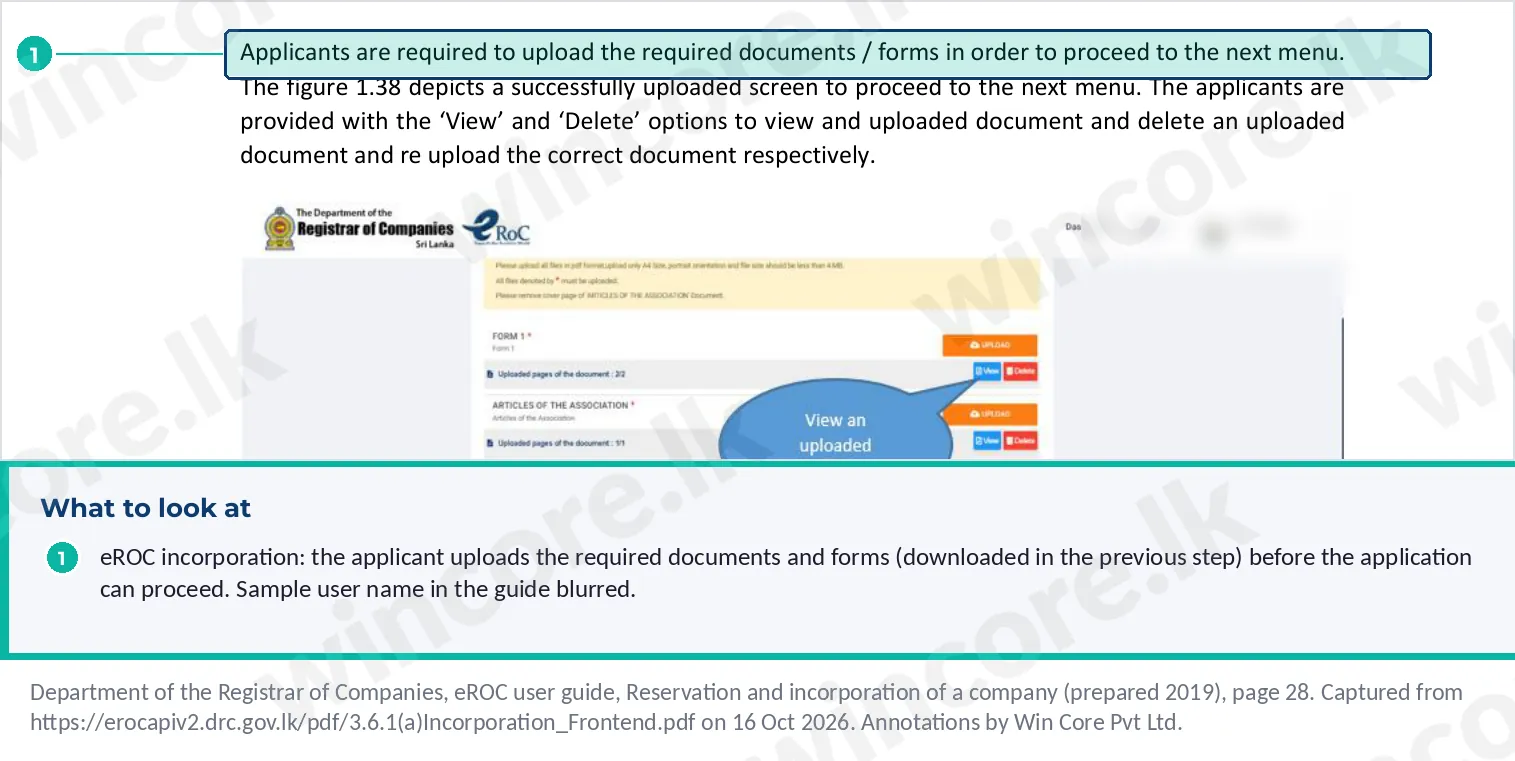
Each director consents and certifies that they are not disqualified in the prescribed form (s.203), which the Registrar lists as "Form 18 - Consent of Directors" [1] [4]. We checked the amending Act on 22 October 2026: it amends ss.4, 11, 51, 52, 206, 211 and others, but not ss.201, 202 or 203 [2].
Now the practice. In our filing experience, an incorporation of an ordinary trading private company where no director is resident in Sri Lanka is not accepted. The resident director's Form 18 is signed in person in Sri Lanka before the filing goes in. Structures approved under a separate regime may be treated differently, and we check those individually. This is our experience of what the Registrar accepts, not a rule we can cite, and the Registrar can change its practice without notice.
Where does the practice come from? We searched drc.gov.lk on 22 October 2026 and found no published notice, guideline or form note that requires a resident director for a local company. The Registrar's incorporation document list and its beneficial ownership notice do not mention one [3] [4]. We keep the source of the practice as an open point.
When arranging local support, distinguish the director role from the duties covered by a company secretary retainer.
Plan for the practice, because it decides your timeline
A rule you cannot cite can still stop a filing. So plan as if it applies:
- Choose the resident director early. The filing cannot go in until that person has signed, so leave time for it.
- Who counts as resident. In our practice, a Sri Lankan citizen living here, or a foreign national living here on a valid residence or work visa.
- What the seat does not do. A resident director does not need to hold shares. 100 percent foreign ownership remains possible outside the restricted lists, and voting control stays with the shareholders.
- What the seat does do. A director owes the statutory duties of a director. Pick someone you trust and who understands that.
WinCore does not supply nominee directors or nominee shareholders, and we do not sit in a client's authorised person seat. That is our practice, not a legal bar. The client nominates the people; we prepare and file the forms. Our piece on nominee shareholders and beneficial ownership explains why the beneficial ownership rules make nominee structures risky.
The law requires a resident authorised person under section 130C
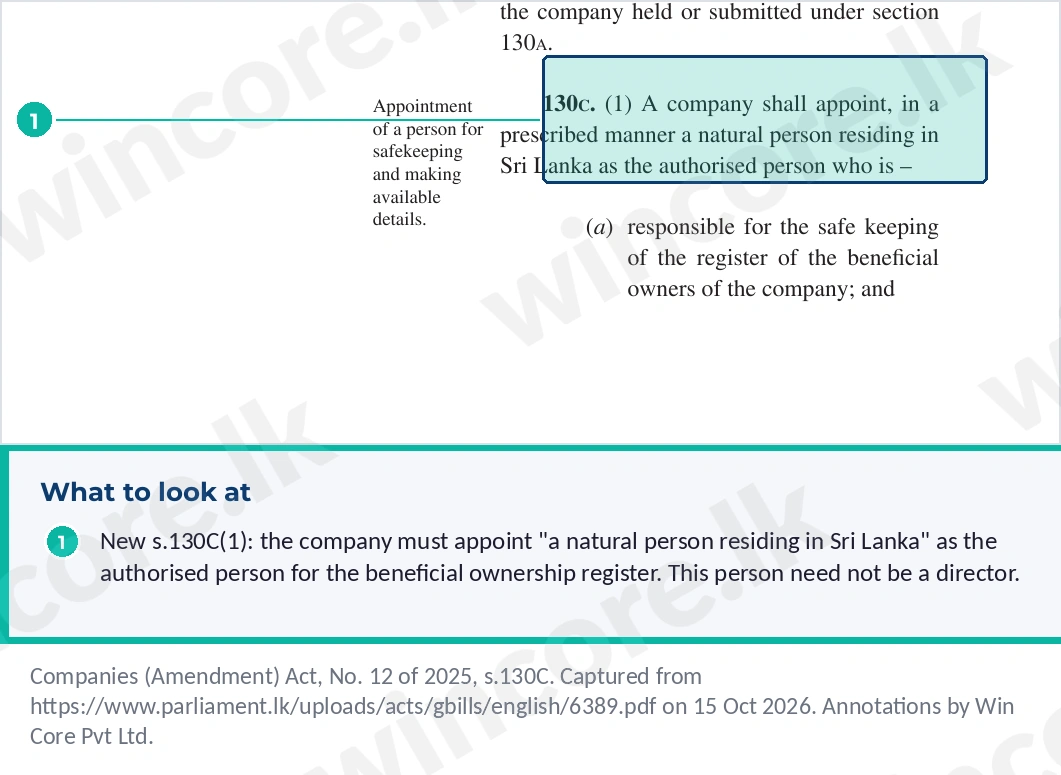
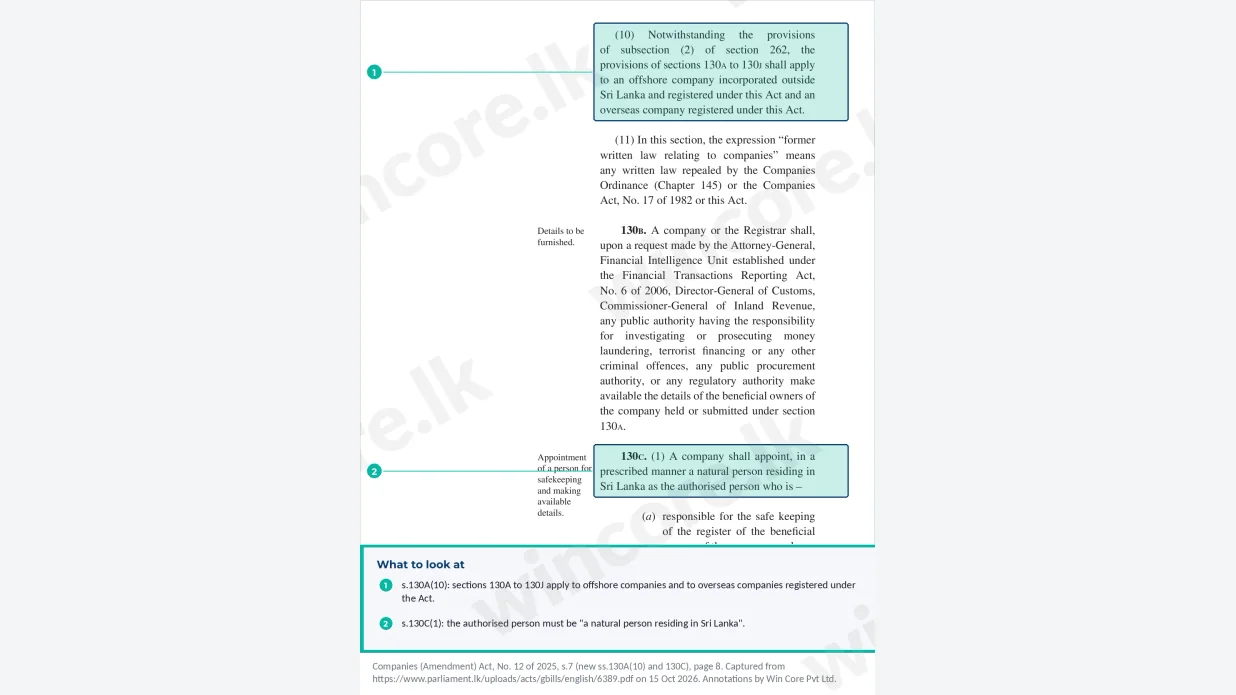
New s.130C(1): "A company shall appoint, in a prescribed manner a natural person residing in Sri Lanka as the authorised person who is (a) responsible for the safe keeping of the register of the beneficial owners of the company; and (b) authorised by the company to make the details of the beneficial owners ... available" [2]. Details go to the Registrar at incorporation and on any change (s.130C(2)); existing companies had three months from the date of operation of the 2025 Act (s.130C(3)) [2]. The section does not say the authorised person must be a director, so on our reading a resident director can also be the authorised person, or the seats can be split.
The Registrar's notice for new incorporations, effective 30 March 2026, says that after incorporation and payment, companies must submit beneficial ownership and authorised person details on Forms BO1 and BO5, and "Failure to comply with this requirement will result in the incorporation being resubmitted" [3]. Our guide to the 10 percent beneficial ownership test covers the forms. For the filings at incorporation, see the BO1 and BO5 forms.
Keep the company-law residence requirement distinct from an individual's tax residence and citizenship.
The secretary must be a Sri Lankan citizen with a Certificate of Practice
"Every company shall have a secretary" (s.221(1)) [1]. Section 222 leaves the qualifications to regulations. The Companies (Secretaries) Regulations, No. 1 of 2023 (Gazette Extraordinary No. 2323/41 of 17 March 2023) apply to a company with stated capital of Rs 500,000 or more, or annual turnover of Rs 1 million or more (reg. 2). An individual secretary must be over eighteen, "a citizen of Sri Lanka", hold a Certificate of Practice issued by the Registrar, and be an Attorney-at-Law or a member of one of five listed professional bodies (reg. 3(1)) [5]. A company can act as secretary only if it is incorporated in Sri Lanka, its articles say it is engaged in secretarial practice, citizens of Sri Lanka hold the majority of its shares and one director holds a Certificate of Practice (reg. 3(2)) [5].
The test is citizenship plus a practising certificate. The regulations contain no "ordinarily resident" wording; that belonged to the 1987 regulations, which reg. 15 rescinded [5]. A trading company usually passes the Rs 500,000 or Rs 1 million line from the start, so in practice a foreign-owned company has a Sri Lankan professional in this seat. Our company secretarial services fill it through a qualified secretary of record.
Overseas and offshore companies have their own local person
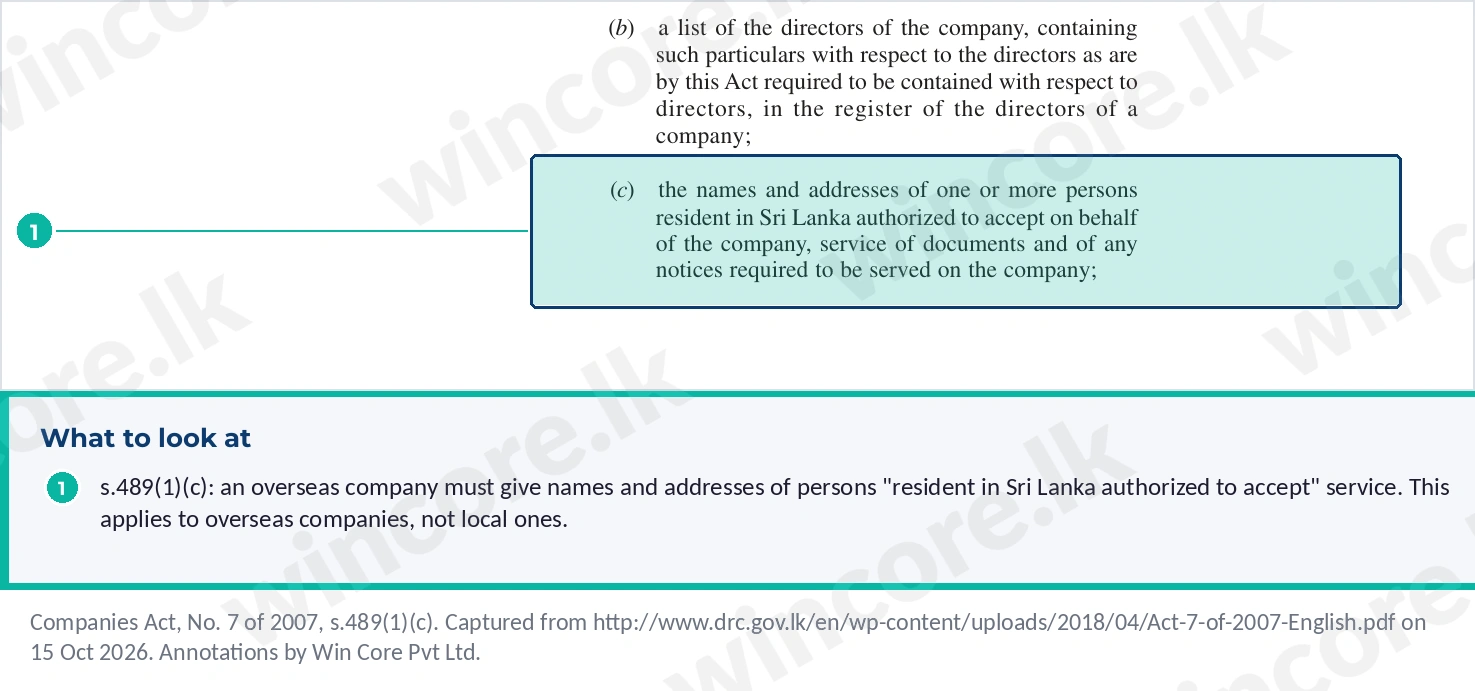
Overseas companies. A company incorporated abroad that establishes a place of business here must deliver, within one month, "the names and addresses of one or more persons resident in Sri Lanka authorized to accept on behalf of the company, service of documents and of any notices" (s.489(1)(c)) [1]. That is a person for service, not a director.
Offshore companies. An application under s.261 must include "the names and addresses of one or more persons who are resident in and are citizens of Sri Lanka, who is or are authorised to represent the company" (s.261(2)(c)) [1]. It is the only provision we found in the Act that adds citizenship for a representative.
If you are choosing between a subsidiary and a branch, our foreign branch registration page sets out what the branch route needs.
Claim by claim
| Claim you may hear | What the text says | Verdict |
|---|---|---|
| "The Companies Act requires a resident director" | ss.201, 202 contain no residence test [1] | Not in the Act |
| "So you never need a resident director" | In our filing experience the Registrar does not accept an ordinary incorporation without one | Wrong in practice |
| "A foreigner can be a director" | s.202(2) does not disqualify foreigners, subject to the articles [1] | Correct |
| "No local person is needed at all" | s.130C authorised person; s.221 secretary; reg. 3 citizen secretary [2] [5] | Wrong |
| "The secretary must be ordinarily resident" | 2023 Regulations reg. 3: citizen with a Certificate of Practice [5] | Outdated (1987 rule) |
| "The authorised person must be a director" | s.130C(1): "a natural person residing in Sri Lanka" [2] | Not in the Act |
Penalties sit with the statutory seats, not the director practice
| Default | Section | Consequence |
|---|---|---|
| Shareholder, secretary or authorised person failing to comply with s.130A(2), s.130A(3) or s.130C | s.130G(3) | Fine up to Rs 1 million, imprisonment up to ten years, or both [2] |
| Company failing s.130A(1), (3), (4), (7) or (8), or giving false or withheld BO details | s.130G(1), directors and officers deemed liable under s.130G(2) unless they prove lack of knowledge or due diligence | Same maximum [2] |
| BO1 and BO5 not submitted after incorporation | Registrar's notice | Incorporation "resubmitted" [3] |
| An act by a secretary without a valid Certificate of Practice | 2023 Regulations reg. 14 | The act "shall be invalid" [5] |
There is no penalty for lacking a resident director, because there is no statutory rule. The consequence is practical: the filing does not go through. Section 130G(1) does not list s.130C, so how a company's own failure to appoint an authorised person is punished is not clear from the text; we keep it open.
Hypothetical example
A hypothetical Japanese engineer, living in Osaka, sets up a private engineering design company in Colombo with Rs 2 million of stated capital. She holds all the shares and is a director. Her Colombo office manager, a Sri Lankan citizen living in Kandy, is appointed as a second director and signs his Form 18 in Sri Lanka. He is also named the s.130C authorised person on Form BO5. The company appoints a secretarial firm that meets reg. 3(2) and files its Form 19. With stated capital above Rs 500,000, the 2023 Regulations apply from the start. She keeps 100 percent of the shares.
What this means for you
Treat the resident director as a planning item even though the Act does not require one: choose the person before the filing, and tell them what a directorship involves. The two seats the law does require, the resident authorised person and the citizen secretary, can be filled by professionals and trusted staff rather than partners. Our registration team prepares the incorporation pack, and our guide on how to register a company in Sri Lanka walks through every form. If you are filing from overseas, read registering a company in Sri Lanka from abroad first. Before you file, run your name through our company name check.
Checklist: documents needed
- The company's draft articles, checked for any director qualification (s.202(2)(g))
- Name, address and identity document of each director, including the resident director
- Each director's Form 18, the resident director's signed in Sri Lanka
- The secretary's Form 19 and Certificate of Practice details
- The authorised person's details for Form BO5, and the BO1 beneficial owner details
- For an overseas company: names and addresses of the persons resident in Sri Lanka for service (s.489(1)(c))
FAQ
Do I need a resident director to register a company in Sri Lanka?
Not under the Companies Act, but yes in practice. Sections 201 and 202 set no residence test, and the 2025 amendment did not add one. In our filing experience, though, the Registrar does not accept an ordinary private company incorporation unless at least one director is resident in Sri Lanka, so plan for one before you file.
Can a foreigner be the only director of a Sri Lankan company?
The Act allows it, but the Registrar's practice does not. Section 202 does not disqualify foreigners, subject to the company's articles. In our experience the Registrar still expects one resident director, so a foreign sole director usually means adding a resident second director rather than relying on the statute alone.
Who must live in Sri Lanka by law?
The beneficial ownership authorised person must be "a natural person residing in Sri Lanka" under s.130C(1). Overseas companies must name residents for service under s.489(1)(c), and offshore companies must name resident citizens under s.261(2)(c). The secretary must be a Sri Lankan citizen with a Certificate of Practice once the 2023 Regulations apply.
Can the resident director also be the authorised person?
Yes, on our reading. Section 130C requires a natural person residing in Sri Lanka and does not say the person must or must not be a director. One resident can hold both seats, or the company can split them between a director and a trusted employee. Either way the person carries personal duties for the beneficial ownership register.
Does WinCore provide a nominee resident director?
No. As a matter of our own practice we do not supply nominee directors or shareholders, and we do not act as a client's authorised person. We prepare and file Forms 18, 19, BO1 and BO5 and provide a qualified secretary of record. The resident director and authorised person are people the client nominates.
Open points
- Source of the resident director practice. No published Registrar notice found on drc.gov.lk on 22 October 2026. Whether it rests on counter practice, eROC checks or another instrument is not known to us.
- Company penalty under s.130C. Section 130G(1) does not list it; s.130G(3) addresses shareholders, secretaries and authorised persons.
- Amending Gazette No. 2354/12 (17 October 2023) to the 2023 Secretaries Regulations is reported in secondary sources; we have not read its text.
- Sector rules. Licensing laws for banks, insurers and other regulated businesses can set their own board rules. Not covered.
The short version
The Companies Act does not require a resident director; the Registrar, in our filing experience, does. The law itself requires a Sri Lanka resident authorised person and, above Rs 500,000 of stated capital or Rs 1 million of turnover, a Sri Lankan citizen secretary with a Certificate of Practice. Plan for all three seats before you file.
Talk to us. If you are setting up from abroad and want the resident seats settled before the filing, our contact page.
WinCore Pvt Ltd
This article is general information on the law and published procedures as at 22 October 2026 and is not advice on your specific setup.
References
- Parliament of Sri Lanka. Companies Act, No. 7 of 2007, ss.201 to 203, 221, 222, 261 and 489. http://www.drc.gov.lk/en/wp-content/uploads/2018/04/Act-7-of-2007-English.pdf . Primary. Accessed 15 October 2026 (full text not re-fetched on 22 October 2026).
- Parliament of Sri Lanka. Companies (Amendment) Act, No. 12 of 2025, ss.130C and 130G as inserted, and list of amended sections. https://www.parliament.lk/uploads/acts/gbills/english/6389.pdf . Primary. Accessed 22 October 2026.
- Department of the Registrar of Companies. Important Notice: Mandatory Beneficial Ownership Submission for New Company Incorporations (effective 30 March 2026). https://drc.gov.lk/en/?p=4678 . Primary (administrative). Accessed 15 October 2026.
- Department of the Registrar of Companies. Guidelines and Necessary Documents. https://drc.gov.lk/en/?page_id=2741 . Primary (administrative). Accessed 15 October 2026.
- Minister of Industries. Companies (Secretaries) Regulations, No. 1 of 2023, Gazette Extraordinary No. 2323/41 (17 March 2023), regs. 2, 3, 14 and 15. Government Printer's copy hosted by the Institute of Chartered Corporate Secretaries of Sri Lanka: https://iccslk.org/en/wp-content/uploads/2024/07/ROC-Gazette-17-March-2023.pdf . Primary (Gazette text; documents.gov.lk copy not located on 22 October 2026). Accessed 22 October 2026.
Put these insights to work
WinCore specialists can review your current workflow, document gaps, and build a practical 90-day action plan.
Book a free consultationContinue reading
Explore more WinCore analysis to keep your finance, tax, and compliance roadmap moving.
Registering a private limited company in Sri Lanka in 2026: structure, name approval, the eROC filing with BO 1 and BO 5, the TIN and the first year.
Incorporation runs online through eROC. The bank account is the step that may need a visit, because due diligence rules verify copies against originals.
Why a local nominee cannot hide a foreign owner under the 2025 rules, what foreign-owned companies file, and our own no-nominee practice.