
Register a company in Sri Lanka from abroad: do you need to travel?
Incorporation runs online through eROC. The bank account is the step that may need a visit, because due diligence rules verify copies against originals.
On this page
Last verified against the primary sources on 21 October 2026.
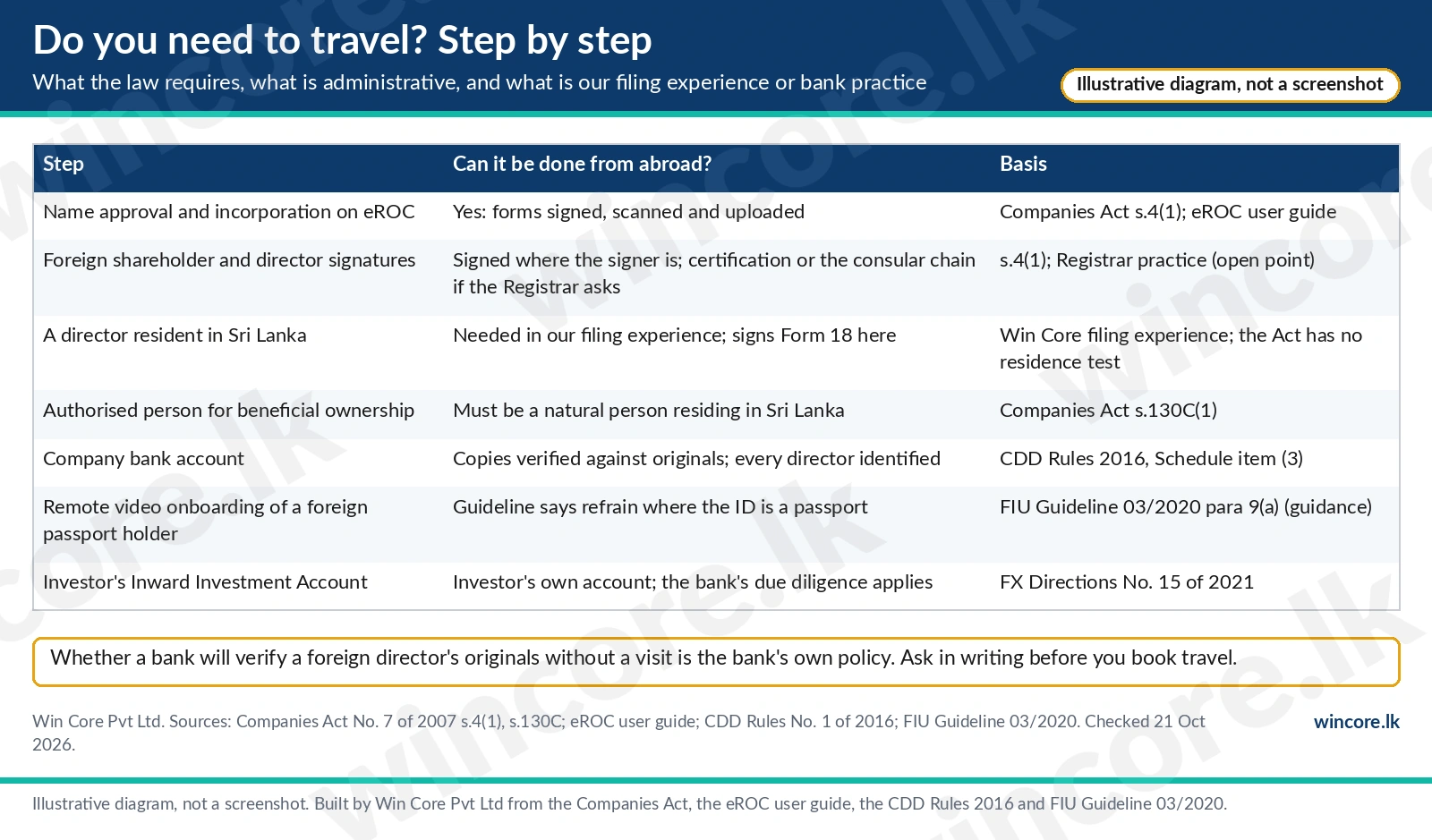
You can usually register a company in Sri Lanka from abroad without travelling, but the bank account is a different matter. Section 4(1) of the Companies Act, No. 7 of 2007 asks for an application "signed by each of the initial shareholders", not for attendance, and the Registrar's eROC system takes the signed forms as uploads [1] [2]. The bank side is governed by the Financial Institutions (Customer Due Diligence) Rules, No. 1 of 2016, which require each copy of a company's documents to be "verified against the original", and the Financial Intelligence Unit's remote onboarding guideline of 30 December 2020 says banks should refrain where the customer identifies with a passport [4] [5].
So a foreign founder should plan for two different answers. Incorporation can normally be done from home. The company's bank account, and the investor's own account that funds it, are where a visit tends to be asked for.
Take a hypothetical founder in Norway forming a Sri Lankan subsidiary for a boat-building business, working with a Colombo company secretary. She can sign the incorporation forms in Oslo. Can she also open the company's account without boarding a plane? It depends on the bank, and the published rules lean against a purely remote route for a passport holder.
To register a company in Sri Lanka from abroad, the law asks for signatures
Section 4(1) says any person or persons "may apply to incorporate a company ... by making an application for the same to the Registrar in the prescribed form signed by each of the initial shareholders", together with the name declaration and the articles where they differ from the model [1]. We found nothing in section 4 that requires a shareholder or director to appear in person.
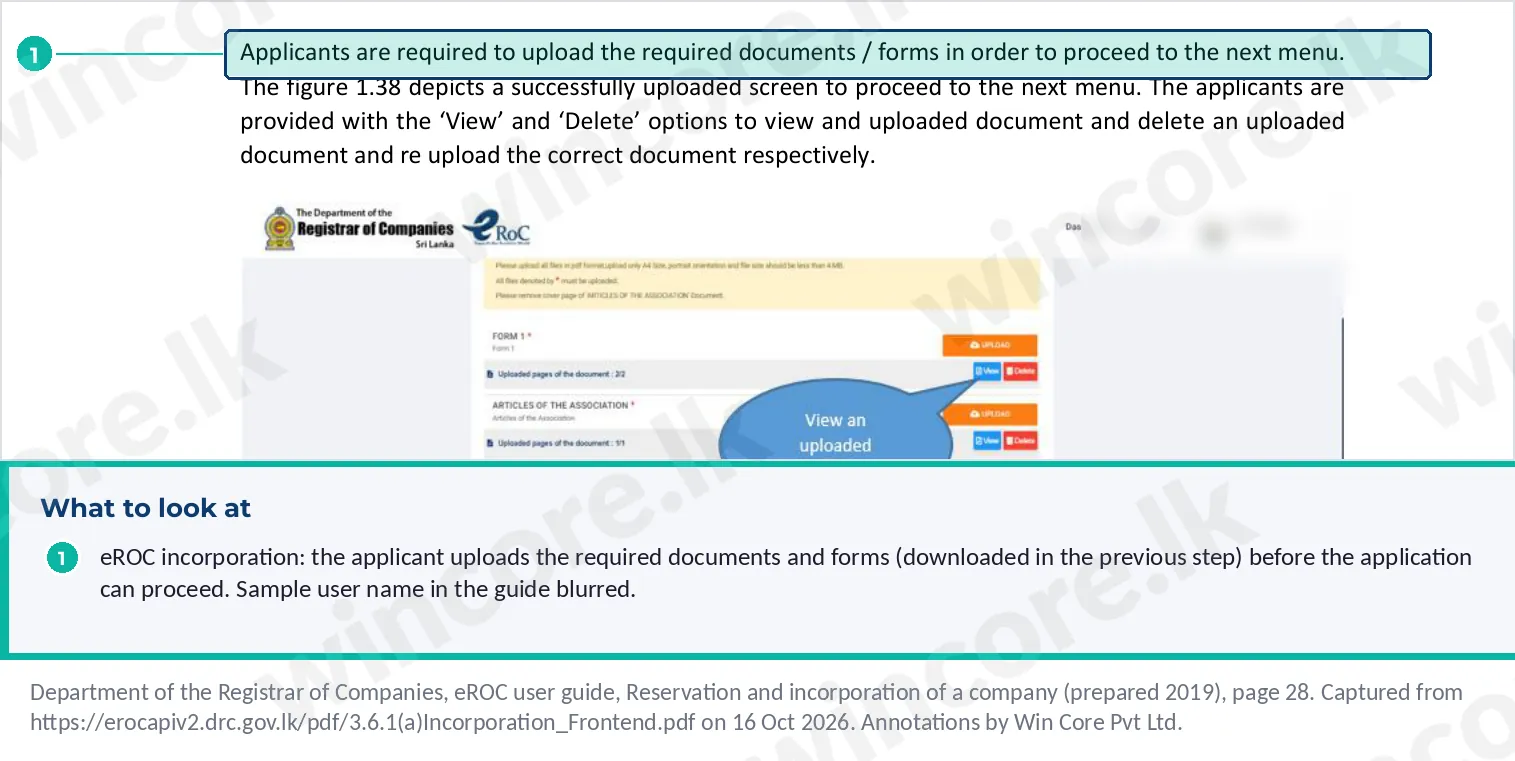
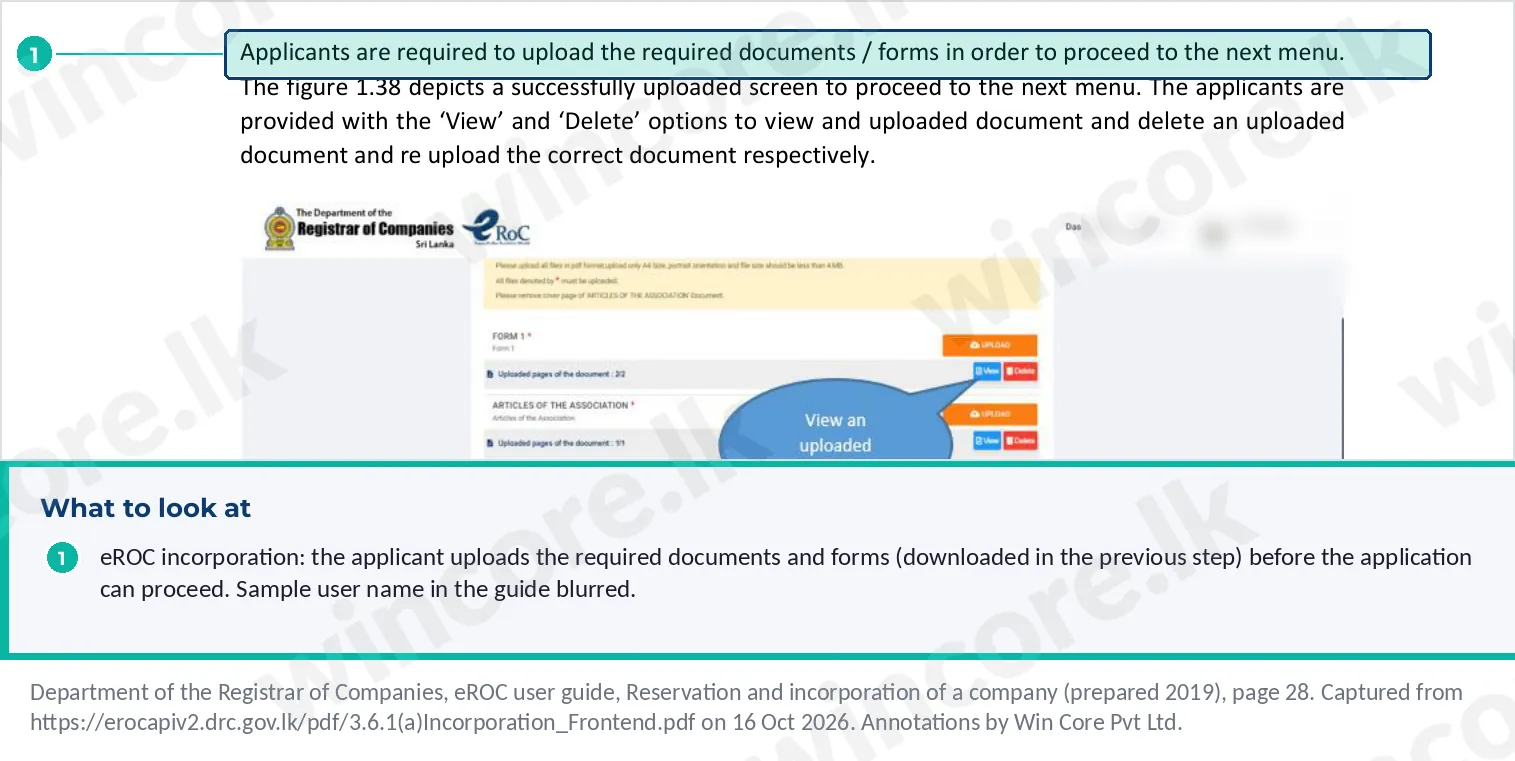
The process runs on eROC, the online system of the Department of the Registrar of Companies (DRC). The DRC's user guide for reservation and incorporation shows the applicant downloading the forms and then uploading them: "Applicants are required to upload the required documents / forms in order to proceed to the next menu", and "The upload should be a PDF file" [2]. The guide was prepared in 2019 and the system has changed since, so treat its screens as indicative. Our guide to registering a company in Sri Lanka lists the forms, and the company name check is the place to start before name approval. For the screens in order, see how to reserve a company name on eROC.
Two caveats. First, whether the Registrar asks for signatures made abroad to be notarised or legalised is administrative practice that we could not find in a published DRC notice, so we treat it as open. If the Registrar does ask, the route is the consular chain set out in our article on apostille in Sri Lanka and legalising foreign documents, because Sri Lanka is not a party to the Apostille Convention as at 21 October 2026. Second, in our filing experience the forms can be signed abroad, scanned and uploaded, and the foreign director's identity documents are certified in the home country.
Three seats need someone in Sri Lanka, even if the founder never travels
A remote incorporation still needs people who are here.
- A resident director. The Companies Act sets no residence test for directors. In our filing experience, though, the Registrar does not accept an incorporation without at least one director resident in Sri Lanka, and that director signs Form 18 here. This is our experience of what the Registrar accepts, not a section of the Act.
- A company secretary. Every company must have a secretary (s.221), and for almost every trading company the secretary must hold the qualifications prescribed for companies above the size threshold [1]. Our company secretarial solutions cover this role.
- The authorised person. Since 30 March 2026, section 130C(1) requires the company to appoint "a natural person residing in Sri Lanka" as the authorised person for its beneficial ownership register, notified on Form BO 5 at incorporation [3].
WinCore does not supply nominee directors and does not sit as the authorised person. That is our practice, not a legal rule, and our piece on the nominee shareholder in Sri Lanka explains why. The owners choose these people; we prepare and file the forms.
The company bank account: the Rules verify copies against originals
The Financial Institutions (Customer Due Diligence) Rules, No. 1 of 2016 were made by the Financial Intelligence Unit (FIU) under the Financial Transactions Reporting Act, No. 6 of 2006 and published in Gazette Extraordinary No. 1951/13 of 27 January 2016 [4].
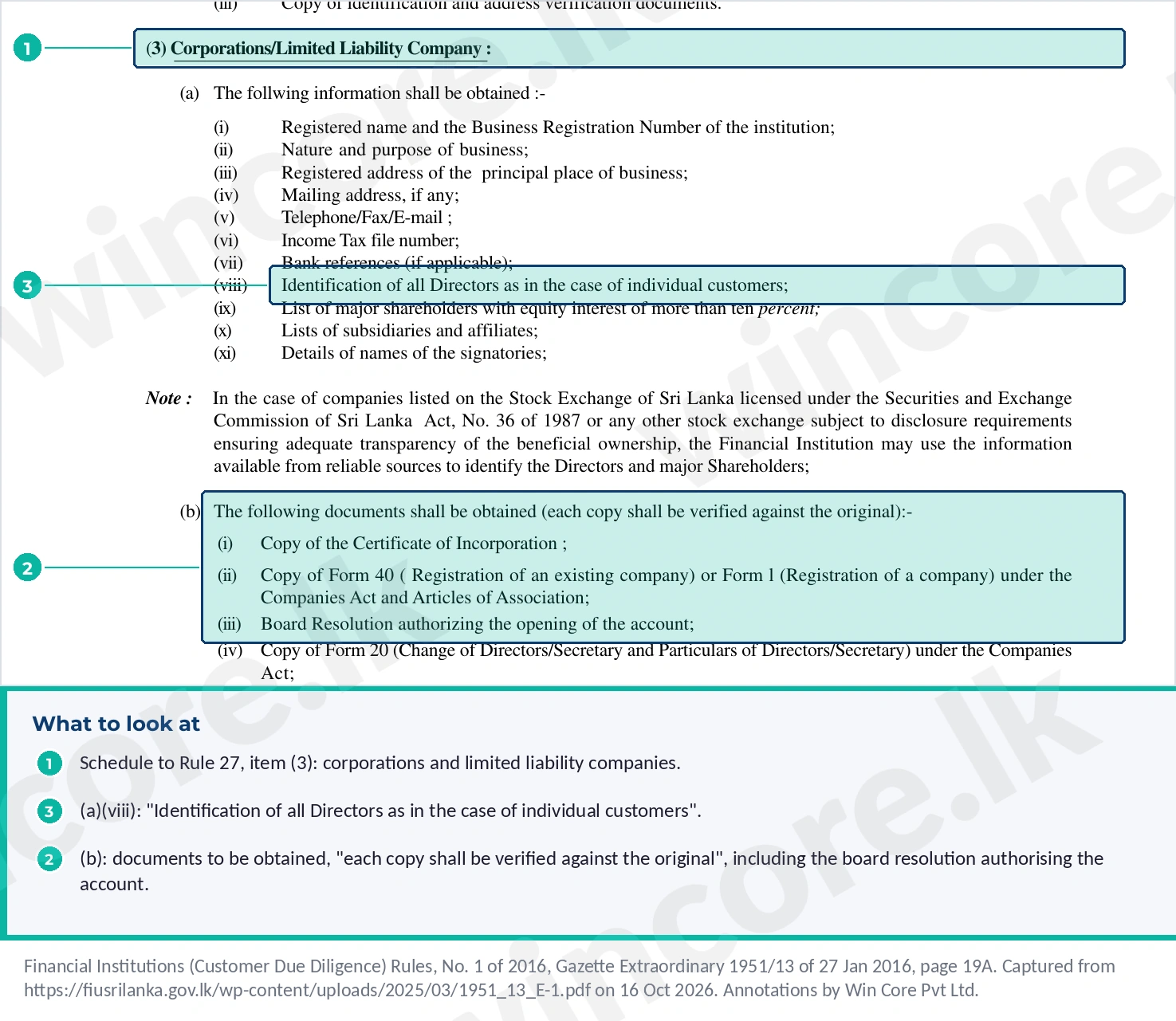
Rule 27(1) requires every financial institution to identify its customers before entering into a business relationship and to obtain and verify the information in the Schedule [4]. For a company, Schedule item (3) lists the information, including "(viii) Identification of all Directors as in the case of individual customers" and "(xi) Details of names of the signatories" [4]. It then lists the documents under these words: "The following documents shall be obtained (each copy shall be verified against the original)", starting with the certificate of incorporation, Form 1 and the articles, and the "Board Resolution authorizing the opening of the account" [4].
Three more rules shape the experience:
- Rule 28. Where the customer is not a natural person, the institution must determine the natural persons who ultimately own or control it [4]. Expect the same layered ownership questions as for the beneficial ownership 10 percent test.
- Rule 29. People acting for the customer must be identified and their authority checked through documentary evidence, including specimen signatures [4].
- Rule 8(iii). Risk profiling must consider delivery channels, "(ex: cash-based, face-to-face or nonface-to-face, cross-border)" [4]. A remote, foreign-owned customer is a risk factor to weigh. On our reading it is not, by itself, a ground for refusal.
Before sending the bank a document pack, distinguish certified company copies from notarised documents.
Remote video onboarding is guidance, and it is built for NIC holders
The FIU did publish a remote route: Guideline No. 03/2020, Revised Guidelines for Non Face-to-Face Customer Identification and Verification Using Electronic Interface Provided by the Department for Registration of Persons, dated 30 December 2020 [5]. It is guidance issued under section 15(1)(j) of the Financial Transactions Reporting Act, not a rule in its own right. Paragraph 2 limits it to "individual customers (natural persons)" verified through the Department for Registration of Persons interface, and paragraph 7 notes that the only image that interface currently returns is one "associated with a National Identity Card (NIC)" [5]. It does cover customers "not physically present in Sri Lanka", but those are NIC holders, such as Sri Lankans living abroad.
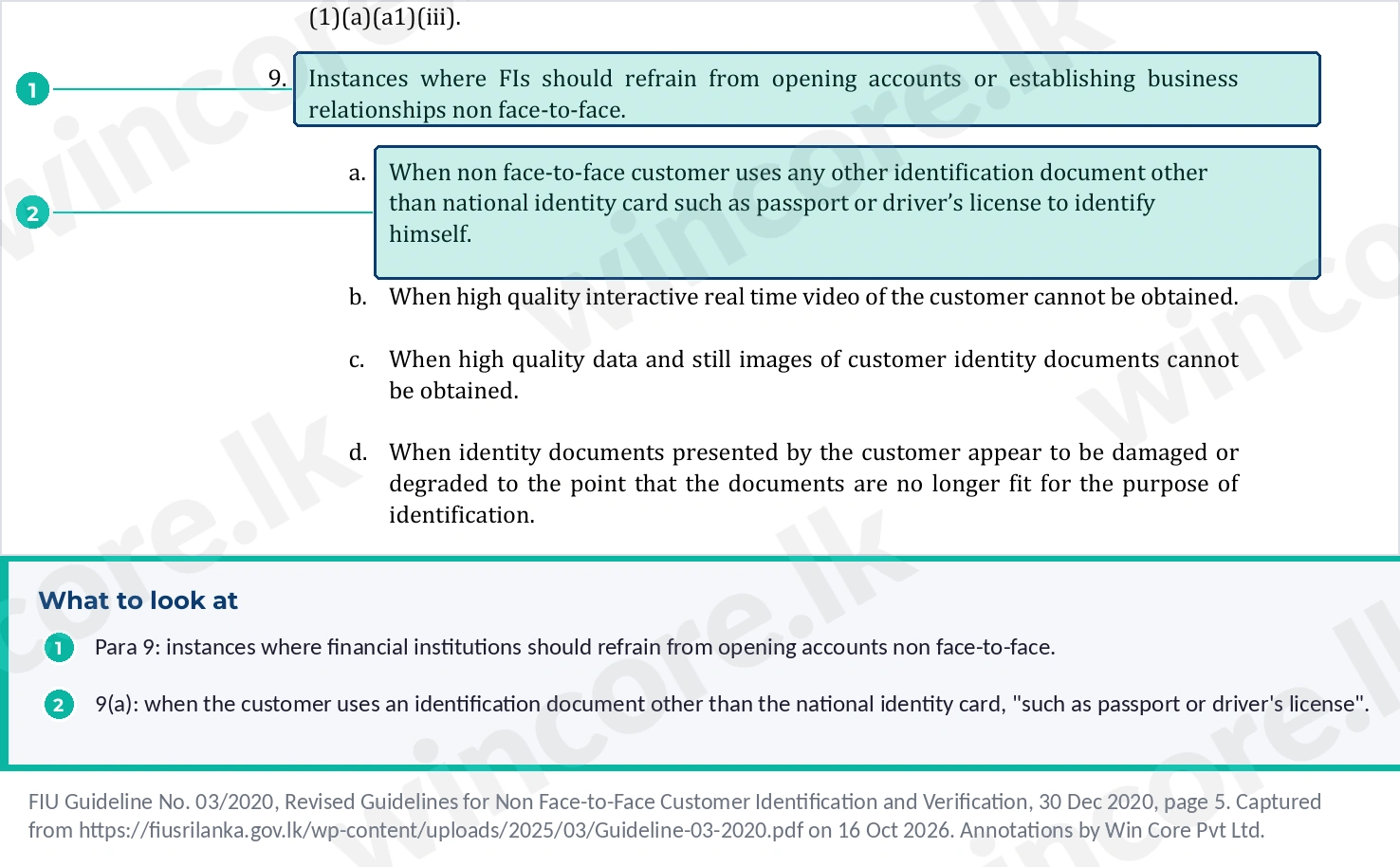
Paragraph 9 then lists cases where institutions "should refrain from opening accounts or establishing business relationships non face-to-face", and the first is: "When non face-to-face customer uses any other identification document other than national identity card such as passport or driver's license to identify himself" [5]. A foreign director identifies with a passport.
Does that mean a foreign director must fly in? Not necessarily, and the documents do not go that far:
- The guideline covers its own electronic route. It does not say a passport holder can never be onboarded without a visit. The CDD Rules require copies "verified against the original"; they do not say where or by whom that verification happens.
- In 2022 the FIU told institutions that the Department of Immigration and Emigration had agreed to authenticate customer identification details for due diligence purposes, under a memorandum with each institution (Circular 04/2022) [6]. The circular does not say it changes paragraph 9(a), so we treat its effect on foreign passports as open.
- How a bank verifies a director's originals when the director is abroad (at a Colombo branch, through an overseas branch or correspondent, or after legalisation) is that bank's policy. That is practice, not law.
So, for the account: plan for one signatory to appear before the bank, and ask the bank in writing whether it offers anything else and which documents it needs legalised.
The investor's own account comes first, and the same due diligence applies
The company's account is not the first account in a foreign investment. The money normally comes in through an Inward Investment Account (IIA), which under FX Directions No. 15 of 2021 is opened in the investor's own name. The Direction lists eligible persons, including "A non- national, resident in or outside Sri Lanka" and "A company incorporated outside Sri Lanka" [7]. Being resident abroad is expressly allowed. Nothing in that list removes the bank's due diligence, so the same CDD Rules apply when the IIA is opened [4] [7].
Two accounts therefore need onboarding: the investor's IIA and the company's operating account. If a director is going to appear in person once, arrange both on the same visit. Our comparison of a subsidiary vs branch in Sri Lanka shows how the funding route differs for a branch, and our article on the Inward Investment Account follows in this series.
Checklist: documents needed
- Signed incorporation forms (Form 1, articles, Form 18 for each director, Form 19 for the secretary) as PDF scans
- Passport copies of foreign shareholders and directors, certified in the home country
- Name and consent of the resident director, the secretary and the section 130C authorised person
- Ownership chart to individuals, for BO 1 and for the bank under rule 28
- Board resolution authorising the account and naming the signatories
- Certificate of incorporation, Form 1 and articles, with originals available for the bank to verify
- The bank's written list of what it needs legalised, and whether a visit is required
What this means for you
- Reserve the name and file incorporation on eROC through your company secretary; the forms are signed and uploaded as PDF.
- Ask the Registrar's office, through your secretary, whether foreign signatures need notarising or the consular chain, before anyone signs.
- Line up the three local seats: a resident director, the company secretary and the section 130C authorised person.
- Write to two or three banks asking whether they can verify a foreign director's originals without a visit, and what they need legalised.
- Prepare the board resolution, ownership chart and passport copies listed in Schedule item (3) of the CDD Rules.
- If someone travels, open the IIA and the company account on the same visit.
Our company registration services take the incorporation through eROC and line up the bank's document list before anyone books a flight.
FAQ
Can I register a company in Sri Lanka from abroad without visiting?
Usually yes. Section 4(1) of the Companies Act requires an application signed by each initial shareholder, not attendance, and eROC takes the signed forms as PDF uploads. Whether the Registrar wants signatures made abroad to be notarised or legalised is a point to confirm through your company secretary before anyone signs [1] [2].
Is there a law that says a director must visit the bank?
We found none. The CDD Rules require each document copy to be "verified against the original" and every director to be identified, but they do not say where or by whom the originals are checked. How the bank does that is its own policy, so ask it in writing before booking travel [4].
Can a Sri Lankan bank do my KYC by video call?
Probably not if you identify with a foreign passport. The FIU's remote onboarding guideline is built on the national identity card interface, and paragraph 9(a) says banks should refrain from non face-to-face onboarding where the customer uses a passport. It is guidance, not a statute, so ask the bank whether it uses another method [5].
Who has to be resident in Sri Lanka?
The beneficial ownership authorised person must be "a natural person residing in Sri Lanka" under section 130C(1). The Act has no residence test for directors, but in our filing experience the Registrar does not accept an incorporation without at least one resident director. The company also needs a qualified secretary [3].
Can my overseas parent company open the Inward Investment Account from abroad?
The Direction allows it: FX Directions No. 15 of 2021 list "A company incorporated outside Sri Lanka" and non-nationals resident outside Sri Lanka as eligible investors. The bank's customer due diligence still applies to the account, so the same questions about originals and signatories arise [4] [7].
Talk to us. If you want your incorporation filed on eROC and the bank's document list settled before anyone books a flight, our contact page.
WinCore Pvt Ltd
This article is general information on the law and published procedures as at 21 October 2026 and is not advice on your specific setup.
References
- Parliament of Sri Lanka. Companies Act, No. 7 of 2007, ss.4(1) and 221. http://www.drc.gov.lk/en/wp-content/uploads/2018/04/Act-7-of-2007-English.pdf . Primary. Accessed 16 October 2026.
- Department of the Registrar of Companies. eROC user guide: reservation and incorporation of a company (2019), pages 20 and 28. https://erocapiv2.drc.gov.lk/pdf/3.6.1(a)Incorporation_Frontend.pdf . Primary (administrative). Accessed 16 October 2026.
- Parliament of Sri Lanka. Companies (Amendment) Act, No. 12 of 2025, s.7 (new s.130C(1)). https://www.parliament.lk/uploads/acts/gbills/english/6389.pdf . Primary. Accessed 21 October 2026.
- Financial Intelligence Unit. Financial Institutions (Customer Due Diligence) Rules, No. 1 of 2016, Gazette Extraordinary No. 1951/13 (27 January 2016), rules 8, 27, 28, 29 and Schedule item (3). https://fiusrilanka.gov.lk/wp-content/uploads/2025/03/1951_13_E-1.pdf . Primary. Accessed 21 October 2026.
- Financial Intelligence Unit. Guideline No. 03/2020, Revised Guidelines for Non Face-to-Face Customer Identification and Verification Using Electronic Interface Provided by the Department for Registration of Persons (30 December 2020), paras 1, 2, 7 and 9. https://fiusrilanka.gov.lk/wp-content/uploads/2025/03/Guideline-03-2020.pdf . Primary (guidance). Accessed 21 October 2026.
- Financial Intelligence Unit. Circular 04/2022, Authenticating customer identification details through the Department of Immigration and Emigration (21 November 2022). https://fiusrilanka.gov.lk/wp-content/uploads/2025/03/Circular-04-2022.pdf . Primary (administrative). Accessed 16 October 2026.
- Department of Foreign Exchange, Central Bank of Sri Lanka. Directions No. 15 of 2021, Inward Investment Accounts, para 2. https://www.dfe.lk/web/images/rdevelopment/07a1296365a99f7b6f6757aecc1f070b-15-of-2021.pdf . Primary. Accessed 16 October 2026.
Put these insights to work
WinCore specialists can review your current workflow, document gaps, and build a practical 90-day action plan.
Book a free consultationContinue reading
Explore more WinCore analysis to keep your finance, tax, and compliance roadmap moving.
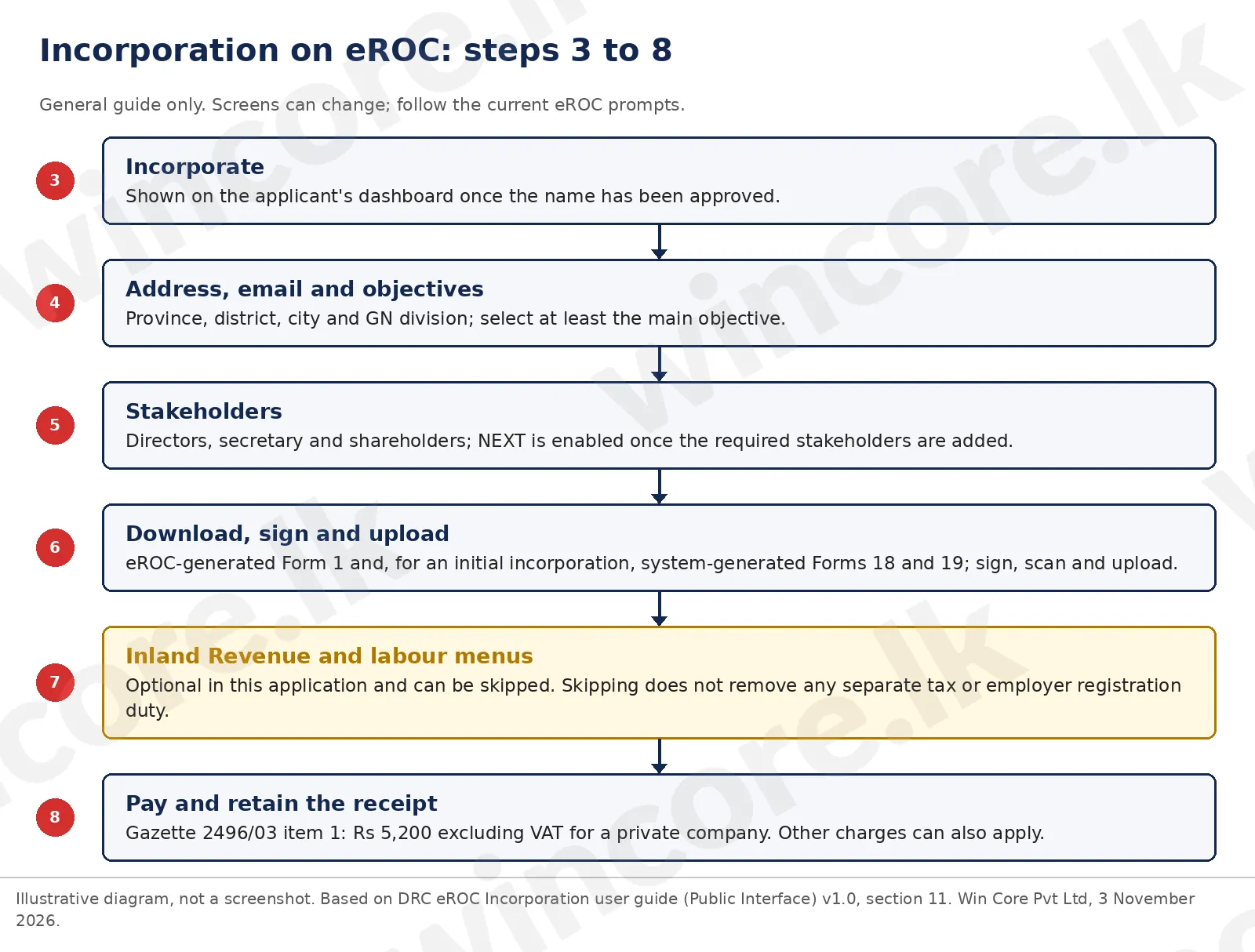
Registering a private limited company in Sri Lanka in 2026: structure, name approval, the eROC filing with BO 1 and BO 5, the TIN and the first year.
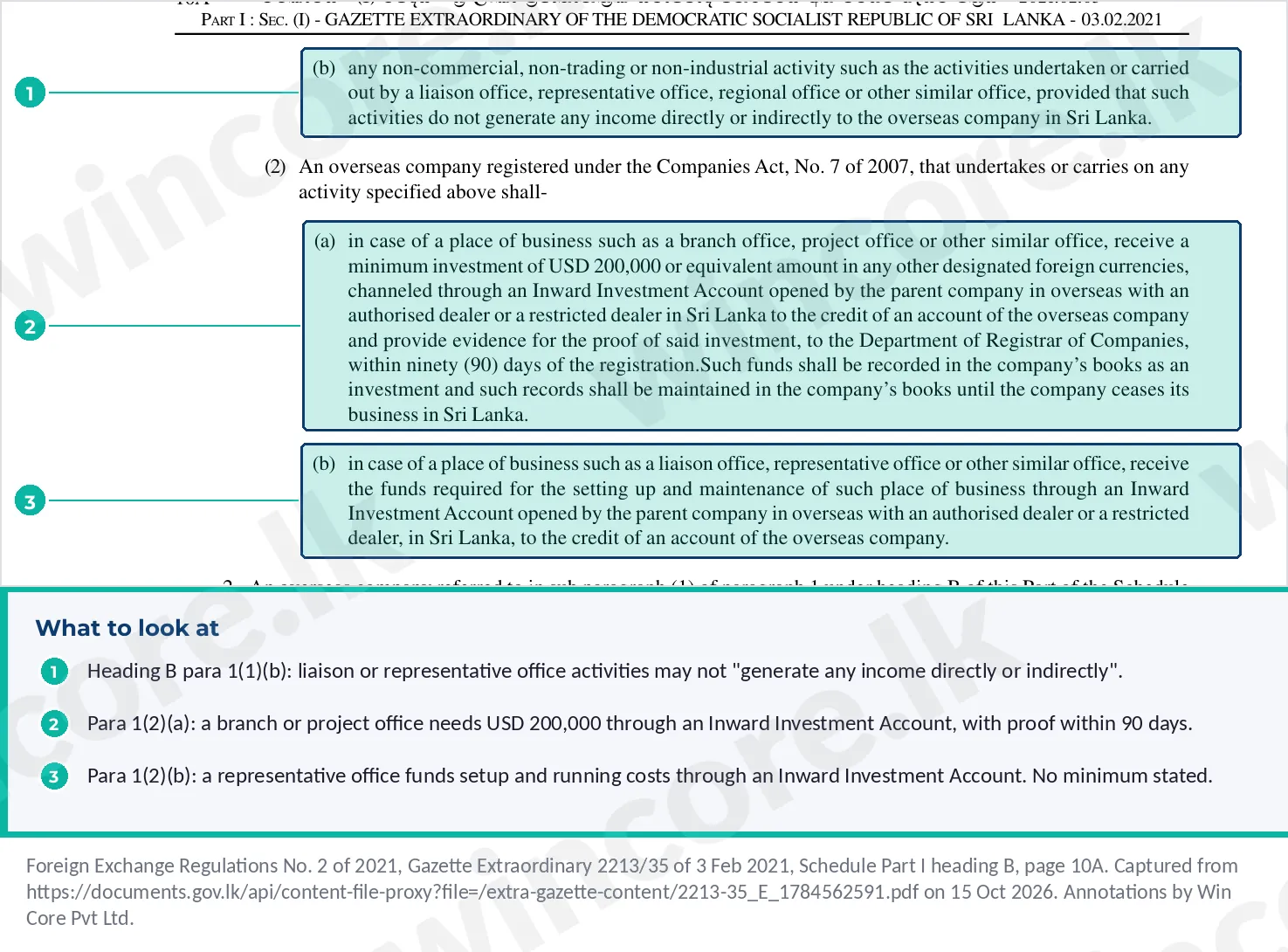
Four ways a foreign company can enter Sri Lanka, set side by side: what each may do, the money each needs, how each is taxed, and what is still open.
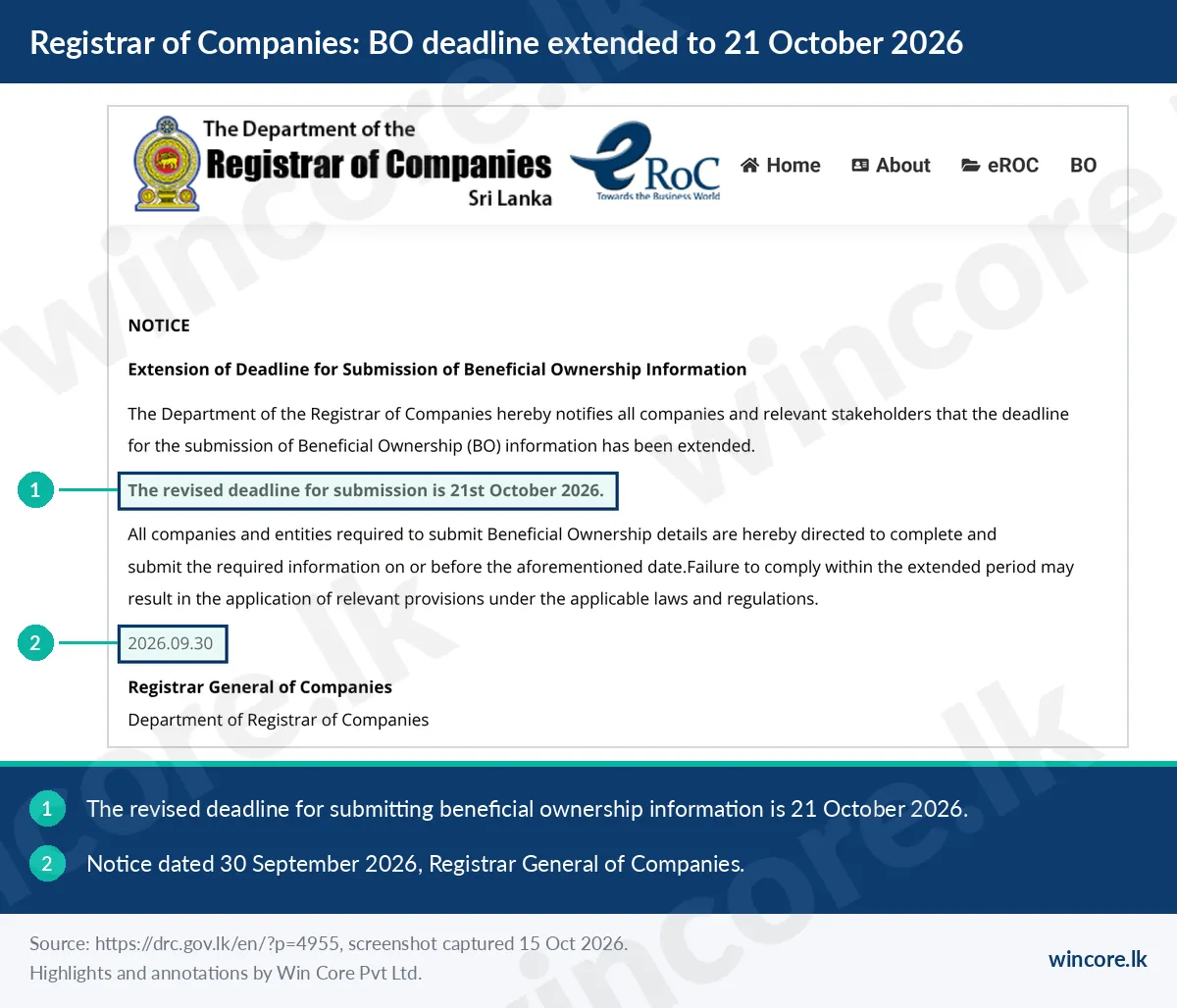
Who counts as a beneficial owner at 10 percent, the forms in the October 2026 regulations, and what existing companies face after the 21 October deadline.