
Certified copies of company documents in Sri Lanka: what banks need
The bank checks copies against originals; the IRD and the Foreign Ministry ask for Registrar-certified ones. Which you need, what it costs and who signs.
On this page
Certified copies of company documents in Sri Lanka come in two kinds, and a bank account rarely needs the expensive one. The Financial Institutions (Customer Due Diligence) Rules, No. 1 of 2016 require the bank to obtain copies of the certificate of incorporation, Form 1, the articles, the board resolution and Form 20, "each copy" to be "verified against the original". They do not require the Registrar to certify them. A Registrar-certified copy under s.480(2) of the Companies Act costs Rs 1,300 per document before VAT, Rs 1,534 with VAT at 18 percent, under Gazette 2496/03 in force from 6 July 2026. The Inland Revenue Department and the Ministry of Foreign Affairs do ask for Registrar-certified copies [1] [2] [3].
When a company opens a bank account, adds a signatory or updates its records, the bank often asks for "certified copies" without saying who must certify them. This article separates what the law requires of the bank, what the Registrar provides, and what is practice. Our article on registering a company from abroad and opening its bank account covers whether directors need to attend in person.
The CDD Rules make the bank verify copies against originals
Banks are financial institutions under the Financial Institutions (Customer Due Diligence) Rules, No. 1 of 2016, made by the Financial Intelligence Unit under the Financial Transactions Reporting Act [1]. Rule 27(1) requires every financial institution to identify its customers before entering into a business relationship and to "obtain the information specified in the Schedule hereto, verify such information, as applicable". Rule 48 applies the Schedule to customers that are legal persons [1].
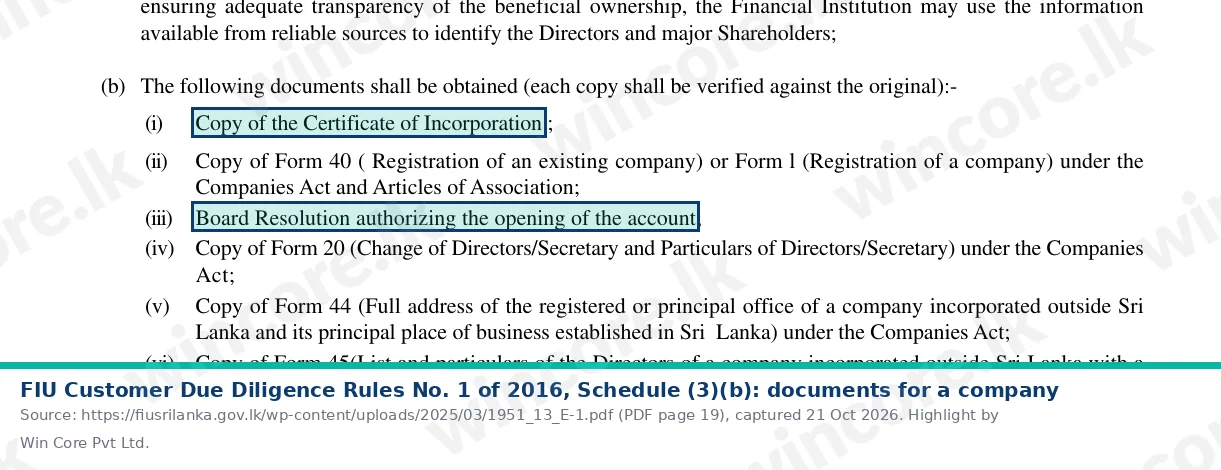
For a company, paragraph (3)(b) of the Schedule says: "The following documents shall be obtained (each copy shall be verified against the original)". The list includes:
- "Copy of the Certificate of Incorporation"
- "Copy of Form 40 ( Registration of an existing company) or Form l (Registration of a company) under the Companies Act and Articles of Association"
- "Board Resolution authorizing the opening of the account"
- "Copy of Form 20 (Change of Directors/Secretary and Particulars of Directors/Secretary) under the Companies Act"
- "Latest audited accounts if available" [1]
Rule 49 adds the identity of "all Directors and Shareholders with equity interest of more than ten per cent" and the "authorization given for any person to represent the legal person ... either by means of Board Resolution or otherwise" [1].
Two points on our reading of that text:
- The Schedule requires the bank to verify each copy "against the original". It does not say the copy must be certified by the Registrar.
- The Schedule's "Certification requirement", that documents "shall be certified, attested or authenticated", sits in item (6)(b), for the stocks and securities sector, and covers documents "to be submitted to Central Depository System" [1]. It is not, on its face, a rule for ordinary bank accounts.
So whether a bank accepts a copy checked against your original, a copy certified by your company secretary, or only a Registrar-certified copy is bank policy (practice). We have read the 2016 Rules; we have not confirmed whether the FIU has replaced or amended them since. That is an open point.
The Registrar certifies copies under section 480 for Rs 1,300 each
Section 480(2) of the Companies Act No. 7 of 2007 says: "Any person may on the payment of the prescribed fee, require the Registrar to provide and certify" a certificate of incorporation, "a copy of or extract from any other document which forms part of the Register", and registered particulars held electronically [2].
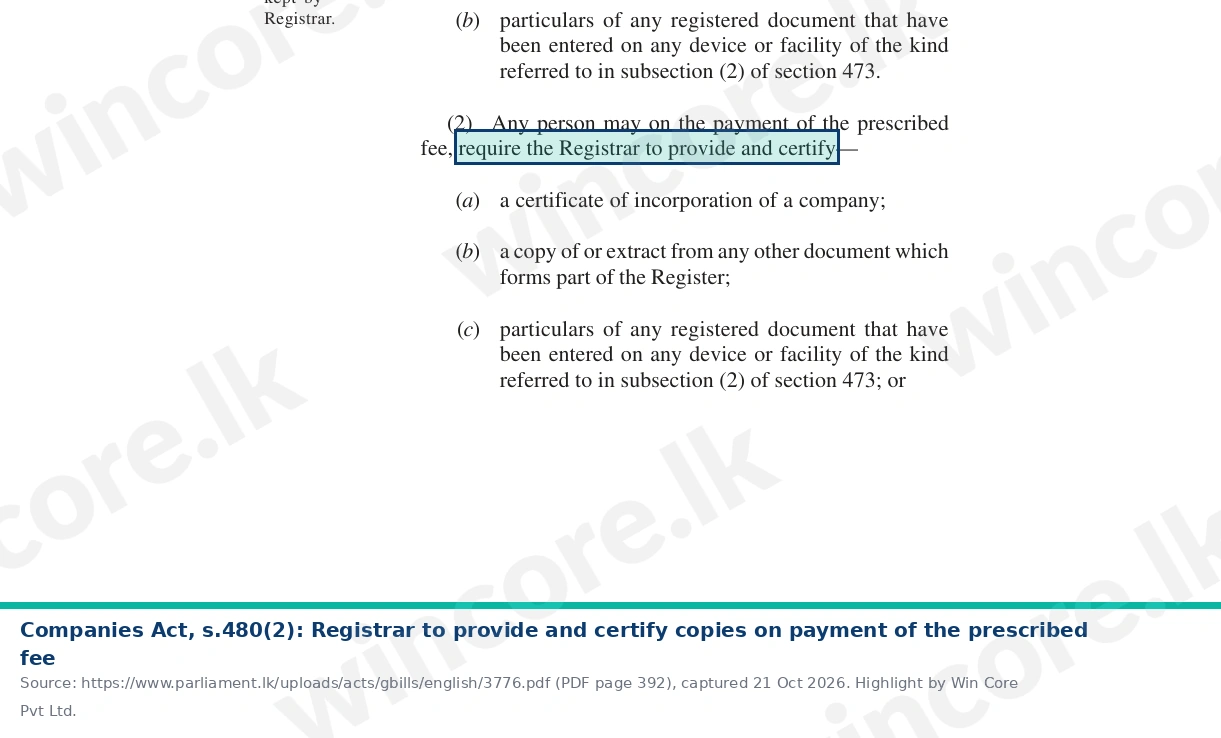
Section 480(5) gives these copies weight in court: a copy "certified to be a true copy or extract by the Registrar, shall in all legal proceedings be admissible in evidence as of equal validity with the original document" [2]. The Companies (Amendment) Act No. 12 of 2025 did not amend s.480 [4].
The Act defines "certified" as "certified in such manner as may be prescribed, or if no manner of certification is prescribed in relation to any document or class of documents, in such manner as the Registrar may require" [2].
Section 480(3) excludes some documents, for example financial statements delivered by a private company, "unless the person applying to inspect the document or requiring a copy or extract of it, is a shareholder or creditor of that company" [2].
The fee
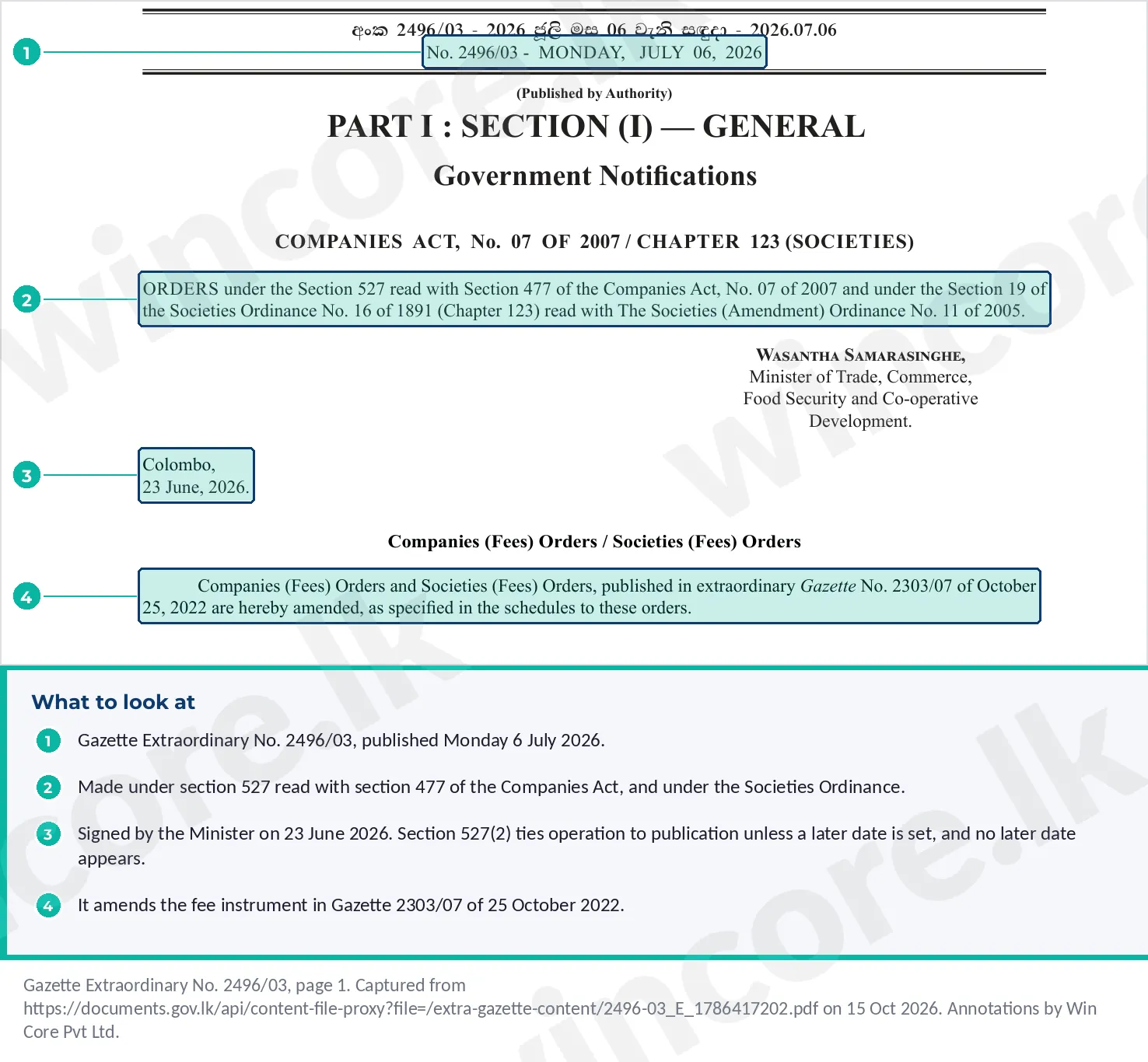
The Companies (Fees) Order in Gazette 2496/03 of 6 July 2026 sets the fee for item 10, "For certification of any document or extract thereof filed with the registrar general of companies", at Rs 1,300, and item 9, "For inspection of a file kept by the registrar general of companies", at Rs 1,300. The schedule states fees "(excluding VAT)" [3]. With VAT at the 18 percent standard rate, each is Rs 1,534.
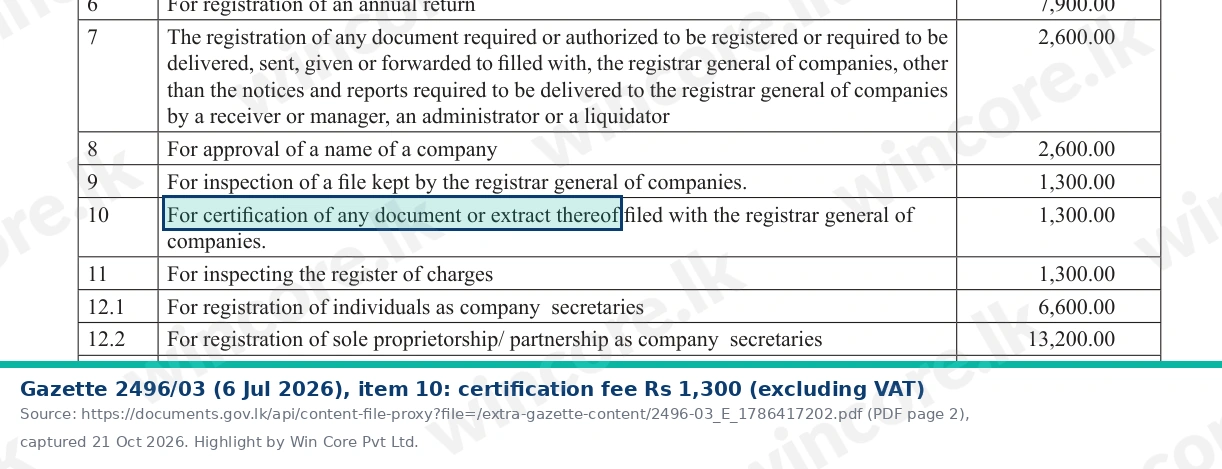
Our article on the Companies (Fees) Orders 2026 covers when the Order took effect.
On our reading, item 10 is charged per document certified. The Order does not say whether a long document attracts one fee or more. That is open.
A hypothetical cost, with our arithmetic
This is hypothetical. A bank asks for Registrar-certified copies of the certificate of incorporation, the articles and the latest Form 20.
Our arithmetic: 3 documents x Rs 1,300 = Rs 3,900 before VAT, or Rs 4,602 with VAT at 18 percent. If you also inspect the file first, add Rs 1,300 under item 9, for Rs 5,200 before VAT, or Rs 6,136 with it.
The DRC issues certified copies of forms online and verification lasts three months
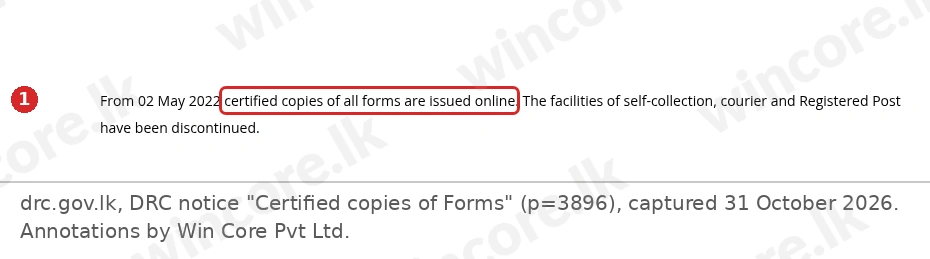
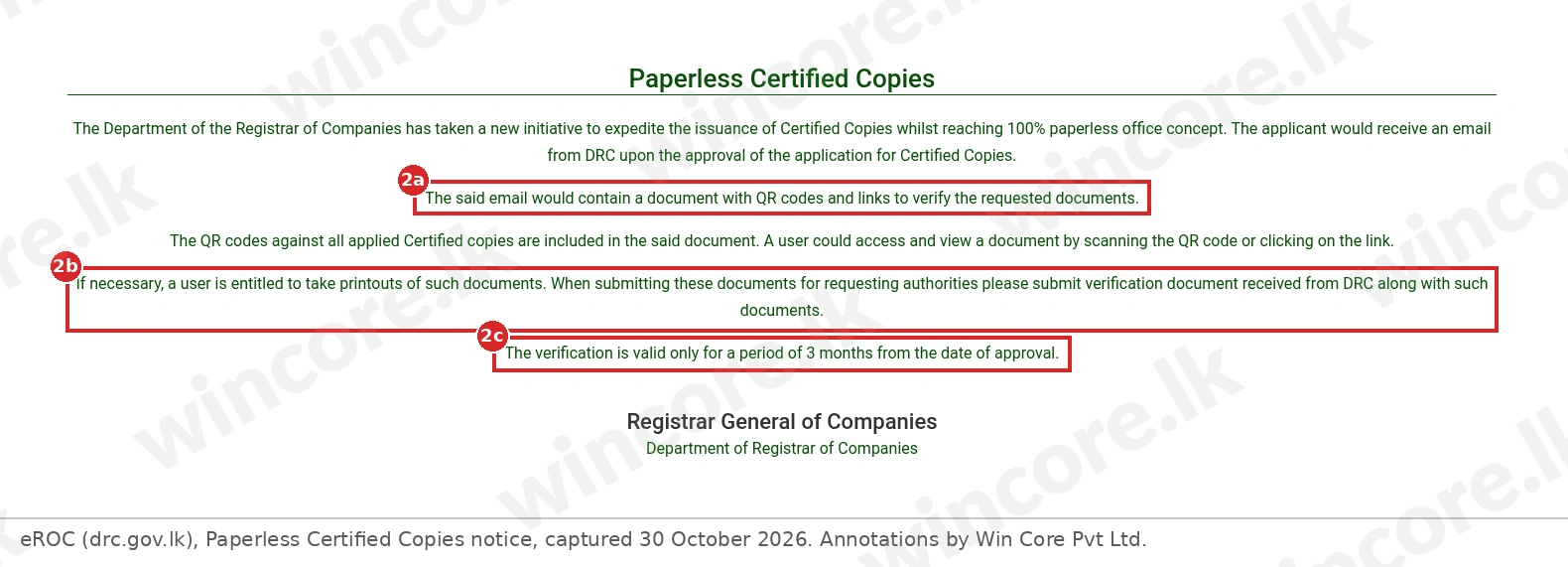
The DRC's 1 May 2022 notice says that, from 2 May 2022, certified copies of forms are issued online and self-collection, courier and registered post have been discontinued [7]. Its paperless notice says the applicant receives a verification document containing QR codes and links after approval. The verification is valid for three months from the approval date [8]. An earlier DRC notice, effective 1 January 2022, says DRC certified copies are valid for three months from their date of issue. The two notices start from different events and how they relate is an open point, so check both dates [10]. To check a copy is genuine, see how to verify a Registrar certified copy.
- Expect online issue for certified copies of forms. The DRC notice identifies online issue and says the former collection and delivery facilities were discontinued.
- Keep the verification document with the copies. The DRC asks applicants to submit it with documents sent to requesting authorities. The three months apply to the online verification, not necessarily the legal validity of the copy. Check what the recipient requires if verification has expired [8].
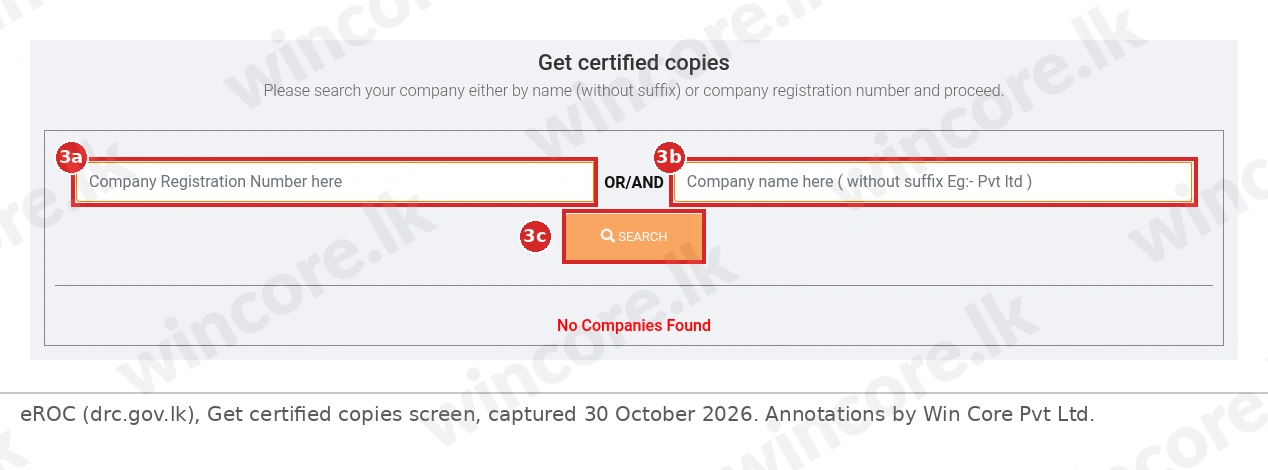
- Search for the company. The captured Get certified copies screen offers a registration number field (3a), a company name field without the suffix (3b), and Search (3c).
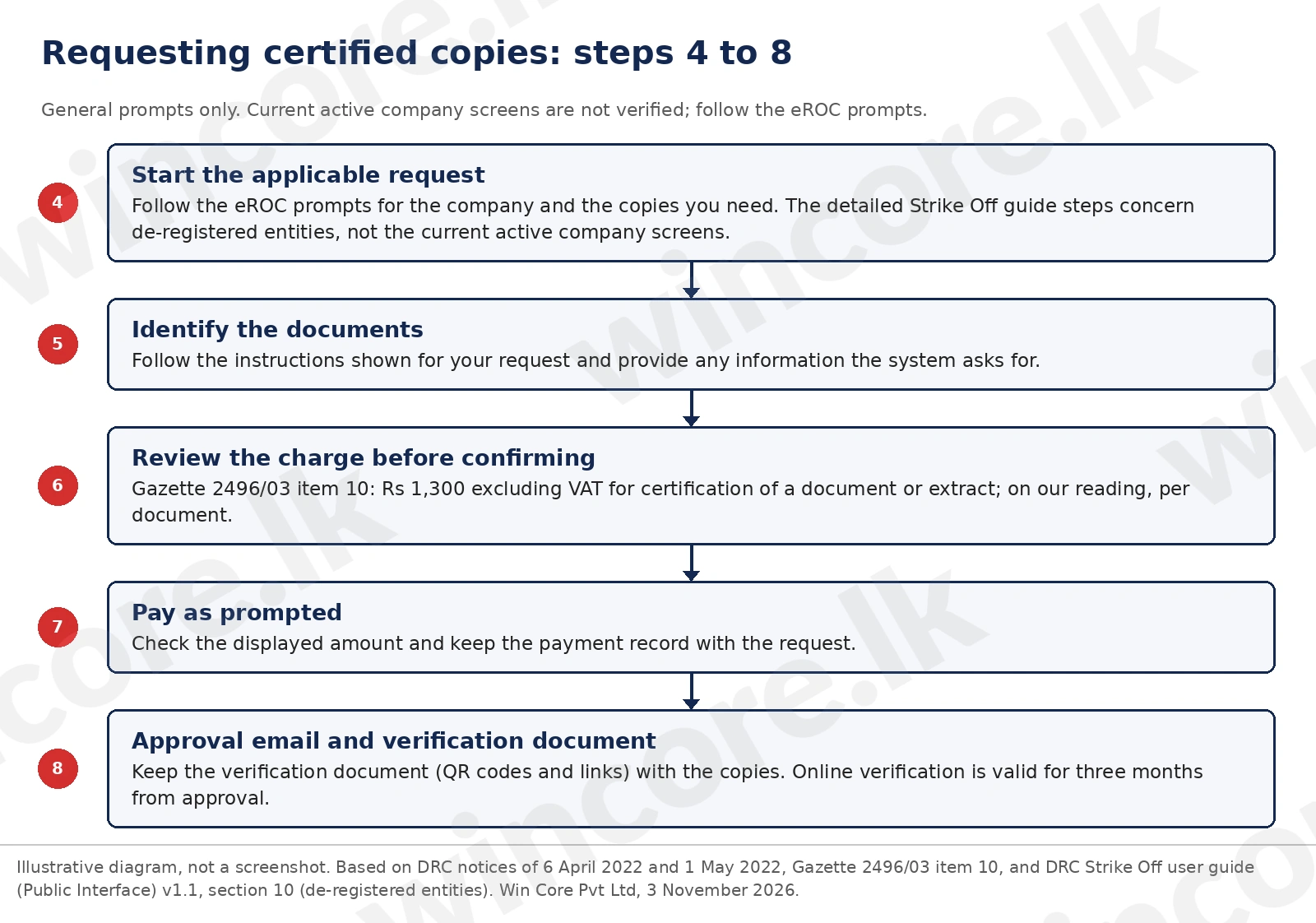
- Start the applicable request. Follow the eROC prompts for the company and copies you need. The DRC's older Strike Off guide describes a request and approval process for de-registered entities; its detailed steps should not be assumed to be the current process for an active company [9].
- Identify the documents and review the requirements. Follow the instructions shown for your request and provide any information the system asks for.
- Review the charge before confirming. Gazette 2496/03 item 10 lists Rs 1,300 excluding VAT for certification of a document or extract filed with the Registrar. On our reading it is per document, but whether a long document attracts more than one fee remains open [3].
- Pay as prompted and retain the receipt. Check the displayed payment amount and keep the payment record with your request.
- Watch for the approval email. Keep the verification document with the certified copies and provide it to the recipient. The DRC notice says the email arrives on approval [8].
The IRD and the Foreign Ministry ask for Registrar-certified copies
Banks are not the only ones asking. Two government lists, both administrative guidance rather than statute, do name the Registrar.
- TIN registration. The IRD's Taxpayer Guidelines for Registration and Update list, for a registered company, Form 01, 05 or 40 "certified by the Registrar of Companies", all Form 20s certified by the Registrar, Form 13 certified if applicable, the certificate of incorporation, the articles and directors' identity documents. To update a company's address, the IRD asks for a "Deed / Lease Agreement and Form 13 certified by Registrar of Companies" [5]. Our guide to registering a company covers the TIN due within 30 days of incorporation.
- Documents for use abroad. The Ministry of Foreign Affairs' consular page asks, for a company registration certificate, for originals "with a certified true copy taken recently from Registrar of Companies", and for a Form 20 certified by the Registrar to show the signatory's authority. Articles and board resolutions are either recorded with the Registrar and a certified true copy produced, or signed before the company secretary or legal officer with a Supreme Court certification [6].
If a TIN registration or an overseas attestation is also coming, consider whether the same Registrar copies meet each recipient's requirements and whether the DRC verification will still be available when each recipient checks them.
Copies your company certifies are practice, not law
Banks commonly accept a copy certified as a true copy by a director or the company secretary, with name, designation, signature, date and company stamp (practice). For a board resolution, the usual form is an extract certified by the secretary or a director.
The Act does not prescribe a form for this kind of certificate. On our reading, its legal value rests on the signer's honesty and authority, not on s.480. Points to check before signing:
- The original exists and is current. Form 20 must reflect the current directors; a change must reach the Registrar within twenty working days (s.223(3)).
- The resolution was validly passed. For a company with one director, see our article on a sole director company whose articles need a quorum of two. To change the articles themselves, see how to change the articles of association.
- Your records are where they should be. Section 116 requires the company to keep its records at the registered office or at a place notified to the Registrar within ten working days; our article on an outgoing company secretary who will not sign covers missing records.
A person entitled to inspect a company document under s.119 or s.120 can also require a copy from the company: under s.122(1), within five working days of a written request and payment of "a reasonable copying and administration fee as may be determined by the company". Failure is an offence under s.122(2), with fines on conviction up to Rs 100,000 for the company and Rs 50,000 for each officer in default [2].
After a change of director, the bank will want new copies
Rule 49(a) asks the bank to verify the "identity of all Directors and Shareholders with equity interest of more than ten per cent with the requirement imposed on the legal person to inform of any change in such Directors and Shareholders" [1]. On our reading, that places a duty on the bank to impose the requirement, usually through its account terms, rather than a statutory duty directly on the company. Either way, the practical result is the same: after a change of director or of a major shareholder, the bank will expect new documents.
A typical sequence (practice):
- Pass the resolution and file Form 20 with the Registrar within twenty working days (s.223(3)).
- Update the register of directors and the share register.
- Send the bank a certified copy of the filed Form 20, a certified extract of any resolution changing signatories, and identity documents for any new director.
Beneficial ownership filings under the 2025 amendment are separate; see our article on beneficial ownership and the 10 percent test.
What a company certification usually says (practice)
There is no statutory wording. A common form, written on the copy itself, is: "Certified a true copy of the original", followed by the signer's name, designation (director or company secretary), signature, date and the company stamp. Some banks also ask for the signer's identity number. If several pages are certified, initial each page. Do not certify a copy of a document you have not compared with the original yourself.
Certified copies of company documents in Sri Lanka: match the copy to who asks
| Situation | Usually enough (practice) | Law |
|---|---|---|
| Opening an account in person with originals | Copies checked against originals | CDD Rules Schedule (3)(b) |
| Bank asks for certified copies, no detail | Ask who must certify | Bank policy |
| Document for court or a dispute | Registrar-certified copy | s.480(5) |
| TIN registration for a company | Registrar-certified Form 1 and Forms 20 | IRD registration guidelines (administrative) |
| Document for use overseas | Registrar-certified true copy, then MFA attestation | MFA consular page (administrative) |
| Board resolution | Extract certified by secretary or director | Articles; CDD Rule 49(c) |
What this means for you
- The CDD Rules require the bank to verify each copy against the original; they do not, on our reading, require Registrar certification for an ordinary account.
- Ask the bank in writing who must certify, before paying the Registrar.
- If a TIN registration or an overseas attestation is also due, check each recipient's requirements and the DRC verification period before reusing a copy.
- Registrar-certified copies cost Rs 1,300 per document under item 10, Rs 1,534 with VAT.
- Certify only documents that are current and validly made.
- Keep a signed set of originals ready: certificate, articles, Form 20, board resolution.
Keeping the registers, Forms 20 and certified extracts current is part of our statutory secretarial services; for a new company, our registration services prepare the incorporation set the bank will ask for.
Checklist: documents needed
- Certificate of incorporation (original, plus copy)
- Form 1 and the articles of association
- Latest Form 20 and the register of directors
- Board resolution on the account and signatories, as a certified extract
- Identity documents of directors and of shareholders holding more than ten percent
- Latest audited accounts, if any
- The bank's written list stating who must certify, and whether Registrar copies are needed
FAQ
How long can a Registrar certified copy be verified online?
The DRC's paperless notice says online verification is valid for three months from the date of approval. It asks applicants to submit the verification document, containing QR codes and links, with the requested copies. An earlier DRC notice, effective 1 January 2022, says certified copies are valid for three months from the date of issue. How the two periods relate is open, so check both dates [8] [10].
Does a bank have to accept a copy certified by our company secretary?
No rule we have read makes it accept one. The CDD Rules require the bank to verify each copy "against the original" and leave the method to the bank. Some banks accept a copy certified by a director or the secretary, others ask for Registrar-certified copies. Ask for the bank's list in writing before you order anything.
How much does a certified copy from the Registrar of Companies cost?
Rs 1,300 per document before VAT under item 10 of Gazette 2496/03, in force from 6 July 2026, which is Rs 1,534 with VAT at 18 percent. Inspecting the file first is a separate Rs 1,300 under item 9. The Order does not say whether a long document attracts more than one fee, so check the eROC payment screen.
Can anyone get a certified copy of our certificate of incorporation?
Yes. Under s.480(2) of the Companies Act any person may, on payment of the prescribed fee, require the Registrar to provide and certify a certificate of incorporation or a copy of another document on the Register. Financial statements a private company delivers are limited to its shareholders and creditors under s.480(3)(b).
Is a Registrar-certified copy better than a company-certified one?
In court, yes. Section 480(5) makes a Registrar-certified copy admissible "as of equal validity with the original document". A copy certified by a director or the secretary has no such statutory status, so its value rests on the signer's authority and care. For a bank account, the bank's own list decides which one is enough.
Open points
- Whether the 2016 CDD Rules have been replaced or amended; not checked after 16 October 2026.
- Whether item 10 is charged per document or per page or set.
- How recent a Registrar copy must be for MFA attestation; the page says "recently" without a period. This is separate from the DRC's three-month online verification period.
- The current request screens for a live company beyond the search screen; the supplied detailed guide concerns de-registered entities.
Last verified: 22 October 2026 for the CDD, IRD and MFA material. The eROC update was checked against the supplied DRC captures, guide extract and fee order on 3 November 2026.
The short version.
- Banks must verify company documents against originals under the CDD Rules.
- The Rules do not, on our reading, require Registrar-certified copies for ordinary accounts; banks may ask for them anyway.
- The Registrar certifies copies under s.480(2) for Rs 1,300 each before VAT (item 10, Gazette 2496/03).
- Registrar-certified copies are admissible as equal to the original in legal proceedings (s.480(5)).
- Ask the bank exactly what it needs before you pay.
Talk to us. If a bank, the IRD or an embassy has sent you a document list and you want the right copies ordered once, our contact page.
WinCore Pvt Ltd
References
- Financial Intelligence Unit. Financial Institutions (Customer Due Diligence) Rules, No. 1 of 2016, Gazette Extraordinary No. 1951/13 (27 January 2016), rules 27, 48 and 49 and Schedule items (3) and (6). https://fiusrilanka.gov.lk/wp-content/uploads/2025/03/1951_13_E-1.pdf . Primary. Accessed 22 October 2026.
- Parliament of Sri Lanka. Companies Act, No. 7 of 2007, ss.116, 122, 223, 480 and 529. https://www.parliament.lk/uploads/acts/gbills/english/3776.pdf . Primary. Accessed 22 October 2026.
- Gazette Extraordinary No. 2496/03 (6 July 2026), Companies (Fees) Orders, items 9 and 10. https://documents.gov.lk/api/content-file-proxy?file=/extra-gazette-content/2496-03_E_1786417202.pdf . Primary. Accessed 22 October 2026.
- Parliament of Sri Lanka. Companies (Amendment) Act, No. 12 of 2025, sections and Schedule. https://www.parliament.lk/uploads/acts/gbills/english/6389.pdf . Primary. Accessed 22 October 2026.
- Inland Revenue Department. Taxpayer Guidelines for Registration and Update (2026). https://www.ird.gov.lk/en/Downloads/SiteAssets/TPR_Guidelines_2026_E.pdf . Administrative. Accessed 22 October 2026.
- Ministry of Foreign Affairs. Documents related to Business / Companies (consular attestation). http://www.mfa.gov.lk/en/documents-related-to-business-companies . Administrative. Accessed 22 October 2026.
- Department of the Registrar of Companies. Certified copies of Forms, 1 May 2022, effective 2 May 2022. https://drc.gov.lk/en/?p=3896 . Administrative guidance. DRC search page and supplied capture checked 3 November 2026.
- Department of the Registrar of Companies. Paperless Certified Copies, eROC notice. https://eroc.drc.gov.lk . Administrative guidance. Notice captured 30 October 2026 and checked 3 November 2026.
- Department of the Registrar of Companies. User Guide eROC System: Strike Off (Public Interface), version 1.1, section 10. https://erocapiv2.drc.gov.lk/pdf/Strikeoff-Public-Interface-V1.1.pdf . Administrative guidance. Supplied text extract read 3 November 2026.
- Department of the Registrar of Companies. Special notice: Certified Copies, effective 1 January 2022, in the DRC notice archive. https://drc.gov.lk/en/?m=2021 . Administrative guidance. Archive read 3 November 2026.
Put these insights to work
WinCore specialists can review your current workflow, document gaps, and build a practical 90-day action plan.
Book a free consultationContinue reading
Explore more WinCore analysis to keep your finance, tax, and compliance roadmap moving.
Incorporation runs online through eROC. The bank account is the step that may need a visit, because due diligence rules verify copies against originals.
The instrument behind this year's Registrar of Companies fee rise: what it amends, when it took effect, the Parliament step still open and the odd item 13.
Registering a private limited company in Sri Lanka in 2026: structure, name approval, the eROC filing with BO 1 and BO 5, the TIN and the first year.