
Change articles of association Sri Lanka: the steps and filing
Change a company's articles by special resolution or written resolution, then file the full text with the Registrar within ten working days.

On this page
Last verified against the primary sources on 26 October 2026.
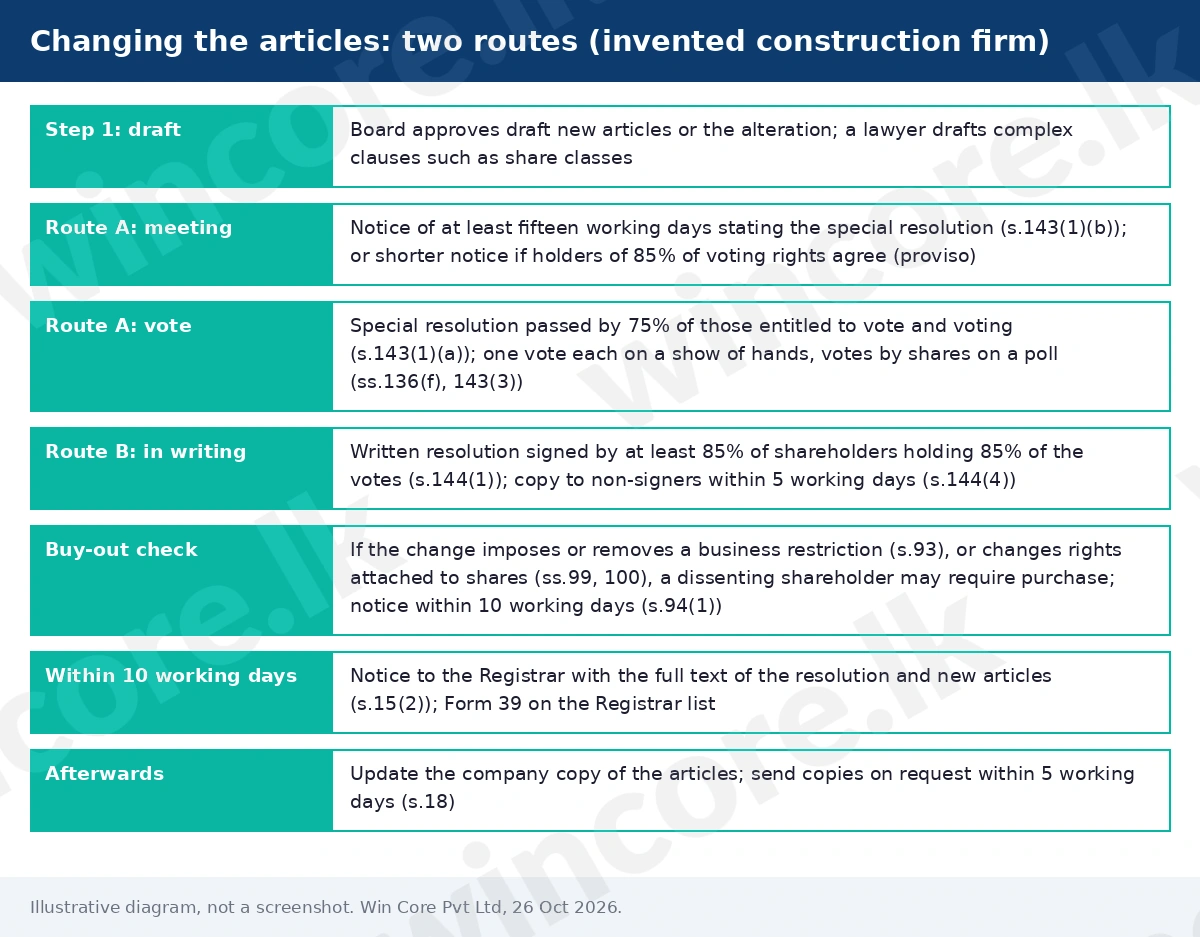
Change articles of association Sri Lanka, in brief. Under section 15 of the Companies Act No. 7 of 2007, a company may adopt new articles or alter its articles "at any time by special resolution". That means a 75 percent majority of the shareholders entitled to vote and voting at a meeting called on at least fifteen working days' notice (counted by votes on a poll), or a written resolution signed by at least 85 percent of the shareholders entitled to vote, who together hold at least 85 percent of the votes. The company then gives the Registrar notice within ten working days, with the full text of the change.
Take a hypothetical construction firm with three resident shareholders. It runs on the model articles and wants to add a right of first refusal on share transfers and change the meeting quorum. This guide covers what articles do, common reasons to change them, the two routes, shareholder rights to object, the filing, certified copies afterwards, what articles cannot override, and a checklist.
This is general information, not legal advice. Have a lawyer draft complex clauses such as share classes or transfer mechanisms.
The model articles apply unless a company's own articles say otherwise
Section 13 says the articles "may provide" for "the objects of the company", "the rights and obligations of shareholders of the company" and "the management and administration of the company" [1]. Section 16 says the articles "shall bind the company and its shareholders as if there were a contract between the company and its shareholders".
Section 14: the articles in the First Schedule ("model articles") "shall apply in respect of any company other than a company limited by guarantee, except to the extent that the company adopts articles which exclude, modify or are inconsistent with the model articles" [1]. So a company that filed no articles of its own at incorporation runs on the model articles. A company that filed its own articles has those, with the model articles filling any gaps they do not exclude.
A private company's articles must include provisions that "prohibit the company from offering shares or other securities issued by the company to the public" and "limit the number of its shareholders to fifty", not counting certain employees (section 27) [1]. If an alteration drops those provisions, "the company shall cease to be a private company" (section 28(1)(a)).
Companies change their articles for pre-emption, transfer limits, quorum and share classes
- Pre-emption. Section 53 gives existing shareholders first offer on new shares "Subject to the company's articles" [1]. Articles can widen, narrow or exclude it.
- Transfer restrictions. Section 49(5): a share "is transferable in the manner provided for by its articles and such articles may limit or restrict the extent to which a share is transferable" [1]. The construction firm's right of first refusal goes here.
- Quorum and meetings. Quorum, chairing and voting procedure can be set in the articles, within the minimum notice rules in section 135 [1].
- Sole director. Articles may need to provide for decisions when there is one director. See our sole director guide.
- Share classes. Section 49(3) allows different classes, for example redeemable or preference shares. Rights must be consistent with the articles (section 51(3)).
- Name. A name change has its own steps; see change company name.
Change articles of association Sri Lanka: pass a special resolution
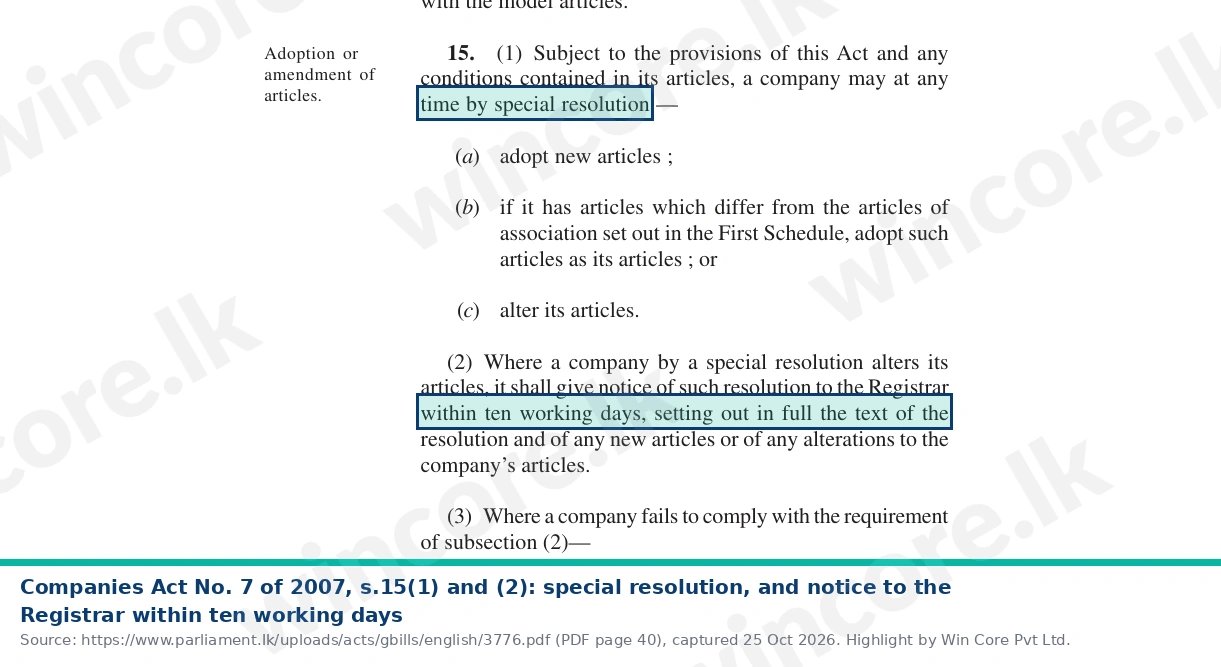
Section 15(1): "Subject to the provisions of this Act and any conditions contained in its articles, a company may at any time by special resolution (a) adopt new articles; (b) if it has articles which differ from the articles of association set out in the First Schedule, adopt such articles as its articles; or (c) alter its articles" [1].
Section 92(1) repeats the rule "Notwithstanding anything to the contrary contained in the articles": the power to "alter the company's articles" must be exercised by special resolution. Such a resolution "may be rescinded only by another special resolution" (section 92(2)) [1].
The threshold (section 143(1)). A special resolution is passed "(a) by a majority of seventy-five per centum of those shareholders entitled to vote and voting on the question; (b) at a general meeting of which not less than fifteen working days' notice, specifying the intention to propose the resolution as a special resolution has been duly given" [1]. The proviso allows shorter notice where shareholders "representing not less than eighty-five per centum of the total voting rights at that meeting" agree.
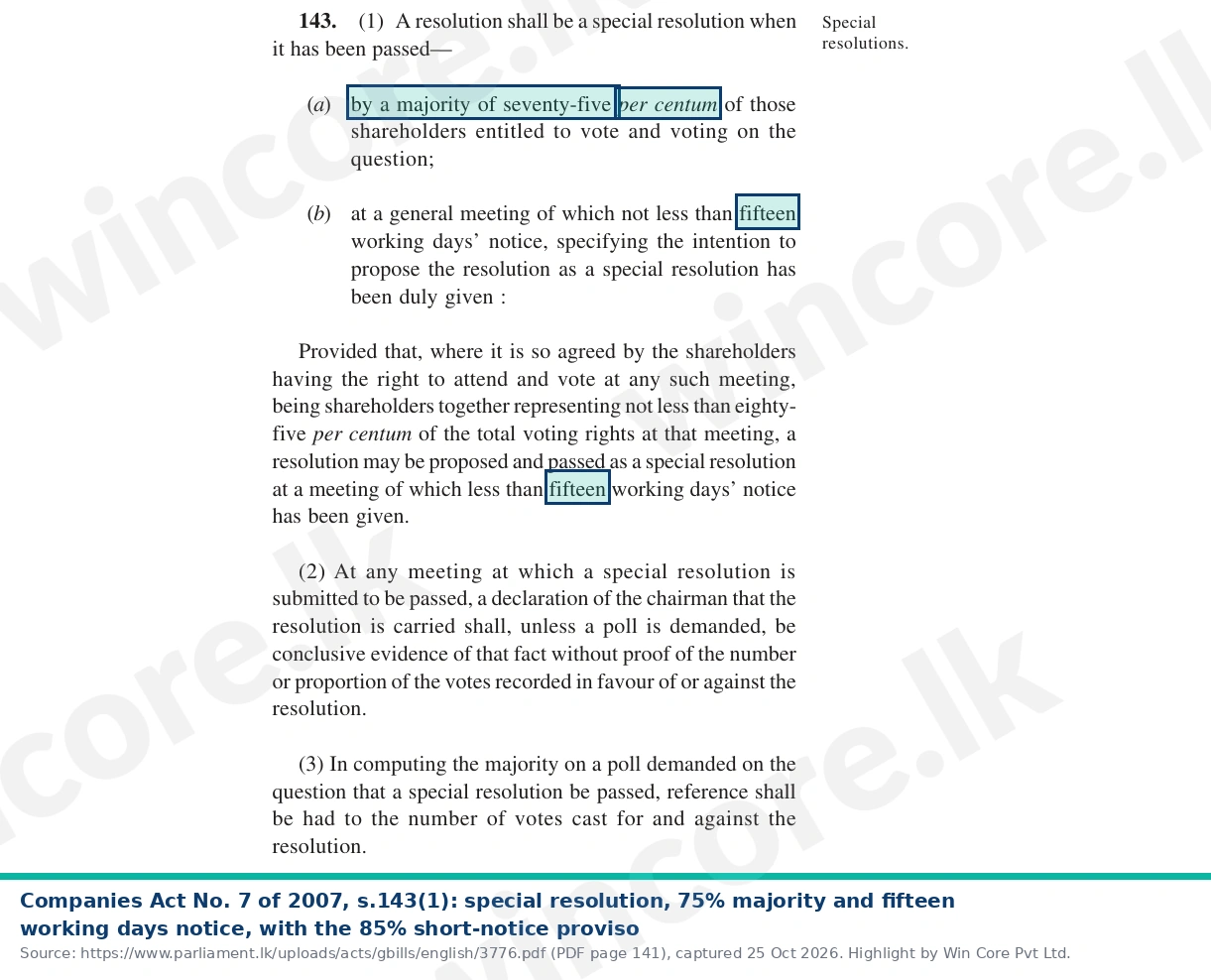
The model articles (First Schedule para 6(1)) set fifteen working days for a special resolution only "if the company is not a private company", and ten working days "in any other case". Section 143(1)(b) itself says fifteen, for every company. Articles may only provide for matters "not inconsistent with the provisions of this Act" (section 13), and section 135(1)(b), which allows five working days for a private company's other meetings, leaves out "a meeting for the passing of a special resolution". So, on our reading, a private company gives fifteen working days for a special resolution even under the model articles, or uses the 85 percent short-notice proviso, or a written resolution. At an AGM, fifteen working days applies anyway (section 135(1)(a)).
For the construction firm, the shareholders hold 50, 30 and 20 percent, and the third votes against. On a show of hands each shareholder has one vote (section 136(f)), so two of three is 67 percent and the resolution fails. Either larger holder can demand a poll (model articles para 10(4)(b): at least 10 percent of the voting rights). On a poll the votes cast count (section 143(3)), and 80 percent passes the resolution.
A written resolution under section 144 needs 85 percent, which can mean everyone
Section 144(1): "Subject to the provisions contained in the company's articles, a resolution in writing signed by not less than eighty-five per centum of the shareholders who would be entitled to vote on that resolution at a meeting of shareholders, who together hold not less than eighty-five per centum of the votes entitled to be cast on that resolution, shall be as valid as if it had been passed at a meeting" [1].
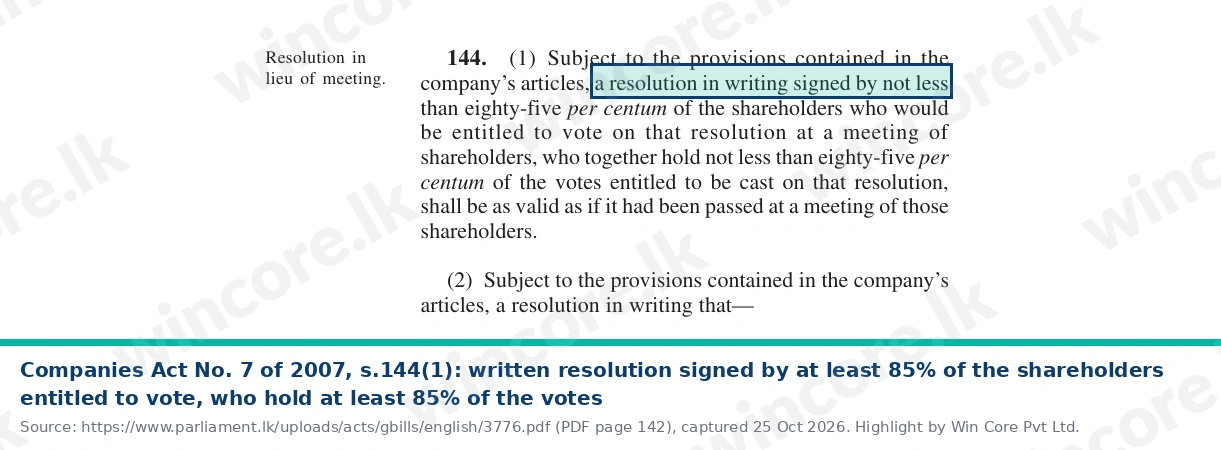
A written resolution "may be signed ... without any prior notice being given to shareholders" (section 144(5)). Within five working days, "the company shall send a copy of the resolution to every shareholder who did not sign" (section 144(4)) [1].
For three shareholders, 85 percent of the shareholders means all three must sign: two of three is 67 percent. So in the example the written route is in practice a unanimous written resolution. If one shareholder will not sign, use a meeting.
A note on section 31. Section 31 lets a private company act with the written agreement of all shareholders, and the Second Schedule lists sections that then do not apply. Section 92(1)(b) is listed; section 92(1)(a), on altering the articles, is not [1]. On our reading, section 31 does not replace the special resolution for a change of articles, though a resolution signed by every shareholder meets section 144 anyway.
Dissenting shareholders can require a buy-out in some cases
Buy-out rights (sections 93 and 94). Where an alteration "imposes or removes a restriction on the business or activities in which the company may engage", a shareholder who voted all their shares against it, or did not sign a section 144 resolution, may "require the company to purchase those shares" (section 93) [1]. Notice must be given "within ten working days of the passing of the resolution", or for a written resolution within ten working days after notice of it (section 94(1)).
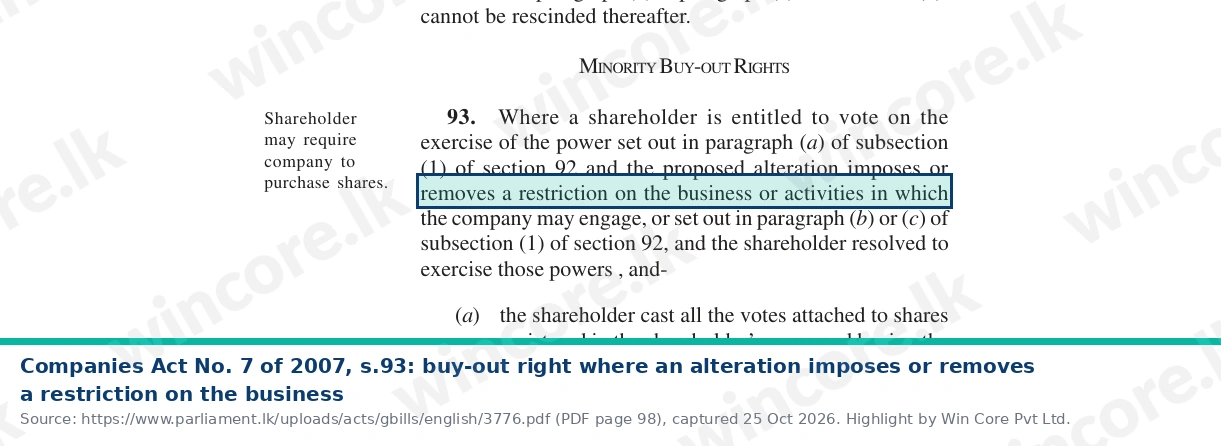
A transfer restriction or quorum change is not a restriction on the business, so on our reading section 93 does not apply to the construction firm's changes. Adding or removing objects would be different.
Interest groups (sections 99 and 100). "A company shall not take any action that would affect the rights attached to shares, unless that action has been approved by a special resolution of each interest group" (section 99(1)). Those rights include voting and distribution rights, pre-emptive rights under section 53, and the articles' own procedure for changing the articles (section 99(2)) [1]. A shareholder in the group who voted against may also require a buy-out (section 100). An "interest group" is the shareholders whose affected rights are identical and affected in the same way (section 529), so it can exist even where the company has only one class of shares. On our reading, a new right of first refusal on transfers changes a limitation attached to the shares (section 99(2)(a)), so the construction firm should treat it as approved by a special resolution of that group too and allow for the section 100 buy-out right. Where every shareholder agrees in writing, section 31 and the Second Schedule switch off section 99.
File the full text with the Registrar within ten working days
Section 15(2): "Where a company by a special resolution alters its articles, it shall give notice of such resolution to the Registrar within ten working days, setting out in full the text of the resolution and of any new articles or of any alterations to the company's articles" [1]. The Registrar's forms list includes "FORM 39 : Notice of a Special Resolution" [3].
A failure makes the company, and every officer in default, liable to a fine not exceeding fifty thousand rupees (section 15(3)) [1]. The Companies (Fees) Order in Gazette 2496/03, in force since 6 July 2026, has no item named for a special resolution. On our reading, the Form 39 notice falls under item 7, the registration of "any document required or authorized to be registered or required to be delivered" to the Registrar: Rs 2,600 before VAT, or Rs 3,068 with VAT at 18 percent. Check the eROC payment screen before paying [4].
Act No. 12 of 2025 does not change the substance of sections 13 to 18, 92 or 143 to 144; its Schedule only corrects spelling in section 92(1)(b) and (e) [2]. Our Act No. 12 of 2025 guide covers what it did change.
Keep the articles current and answer copy requests within five working days
Update the company's master copy of the articles and keep the resolution with the shareholder minutes. A shareholder may request a copy of the articles, and the company must comply "within five working days" (section 18(1)). It may charge "a fee of not more than five hundred rupees", or decline if a copy was given in the previous six months (section 18(2)) [1]. Articles other than the model articles are open to public inspection (section 120(1)(b)). Banks often ask for certified copies; see our certified copies guide.
What the articles cannot change
- The Act itself. Section 15(1) is "Subject to the provisions of this Act". Section 92(1) applies "Notwithstanding anything to the contrary contained in the articles" [1].
- Minimum meeting notice. An article is "void in so far as it provides for the calling of a meeting" on shorter notice than section 135(1) allows [1].
- Bearer shares. A company "shall not issue a share warrant to bearer or bearer share irrespective of whether its articles of association purport to authorise it to do so" (section 51(1A), inserted by Act No. 12 of 2025) [2].
- Private company status. Drop the section 27 provisions and the company stops being private (section 28).
- Objects as a shield. A restriction in the articles does not affect the company's capacity or invalidate a contract made in breach of it (section 17(2)) [1].
What this means for you
Treat a change of articles as a special resolution plus a ten-working-day filing. Pick the route by headcount: with few shareholders, a written resolution signed by everyone is often the cleanest. Check buy-out and class-rights rules before the vote, and have a lawyer draft anything beyond simple wording.
Checklist: documents needed
- Read the current articles, or confirm the company runs on the model articles (section 14).
- Draft the alteration; a lawyer drafts complex clauses.
- Check for a business restriction (section 93) or any change to rights attached to shares, including transfer limits (section 99).
- Choose the route: meeting on fifteen working days' notice (section 143), or written resolution signed by 85 percent of the shareholders entitled to vote, holding 85 percent of the votes (section 144).
- Pass the special resolution; minute it.
- Copy to non-signers within five working days (section 144(4)), if written.
- Notice to the Registrar within ten working days with the full text (section 15(2)).
- Update the master copy; answer copy requests within five working days (section 18).
FAQ
How do I change the articles of association in Sri Lanka?
Pass a special resolution under section 15(1), either at a meeting on fifteen working days' notice by a 75 percent majority of those voting, counted by votes on a poll (section 143), or by written resolution signed by at least 85 percent of shareholders holding 85 percent of the votes (section 144). Then give the Registrar notice within ten working days with the full text (section 15(2)).
Does a written resolution to change the articles have to be unanimous?
Not always. Section 144(1) needs signatures from at least 85 percent of the shareholders entitled to vote, holding at least 85 percent of the votes. In a company with few shareholders, that often means everyone. Shareholders who did not sign must receive a copy within five working days (section 144(4)).
What is the deadline to file a change of articles?
Ten working days after the special resolution, under section 15(2). The notice sets out the full text of the resolution and of the new or altered articles. The Registrar's forms list shows Form 39, Notice of a Special Resolution. Failure can bring a fine of up to fifty thousand rupees for the company and each officer in default.
Can a shareholder who votes against force the company to buy their shares?
Only in some cases. Section 93 gives a buy-out right where the alteration imposes or removes a restriction on the company's business or activities, and section 100 where an interest group's rights are affected. The shareholder must give written notice within ten working days (section 94). On our reading, a quorum change triggers neither, but a new transfer restriction can engage section 100.
The short version
Articles change by special resolution (sections 15 and 92): 75 percent of those voting at a meeting on fifteen working days' notice, counted by votes on a poll (section 143), or a written resolution signed by 85 percent of the shareholders holding 85 percent of the votes (section 144). Check buy-out and class-rights rules (sections 93, 99, 100). File the full text with the Registrar within ten working days (section 15(2)). The articles cannot override the Act.
Talk to us. If you are changing the articles and want the resolution and the Registrar notice checked, see our company secretarial services or book a consultation at our contact page.
WinCore Pvt Ltd
This article is general information as at 26 October 2026 and is not legal advice on your specific position.
References
- Parliament of Sri Lanka. Companies Act, No. 7 of 2007, ss.13 to 18, 27, 28, 31, 49, 51, 53, 92 to 94, 99, 100, 120, 135, 136, 143, 144, 529; First Schedule paras 6 and 10; Second Schedule. https://www.parliament.lk/uploads/acts/gbills/english/3776.pdf . Primary. Accessed 25 October 2026.
- Parliament of Sri Lanka. Companies (Amendment) Act, No. 12 of 2025, s.4 (new s.51(1A)). https://www.parliament.lk/uploads/acts/gbills/english/6389.pdf . Primary. Accessed 25 October 2026.
- Department of the Registrar of Companies. Download Forms. https://drc.gov.lk/en/?page_id=1998 . Primary. Accessed 25 October 2026.
- Minister of Trade, Commerce, Food Security and Co-operative Development. Companies (Fees) Orders, Gazette Extraordinary 2496/03 of 6 July 2026, Schedule item 7. https://documents.gov.lk/api/content-file-proxy?file=/extra-gazette-content/2496-03_E_1786417202.pdf . Primary. Accessed 26 October 2026.
Put these insights to work
WinCore specialists can review your current workflow, document gaps, and build a practical 90-day action plan.
Book a free consultationContinue reading
Explore more WinCore analysis to keep your finance, tax, and compliance roadmap moving.
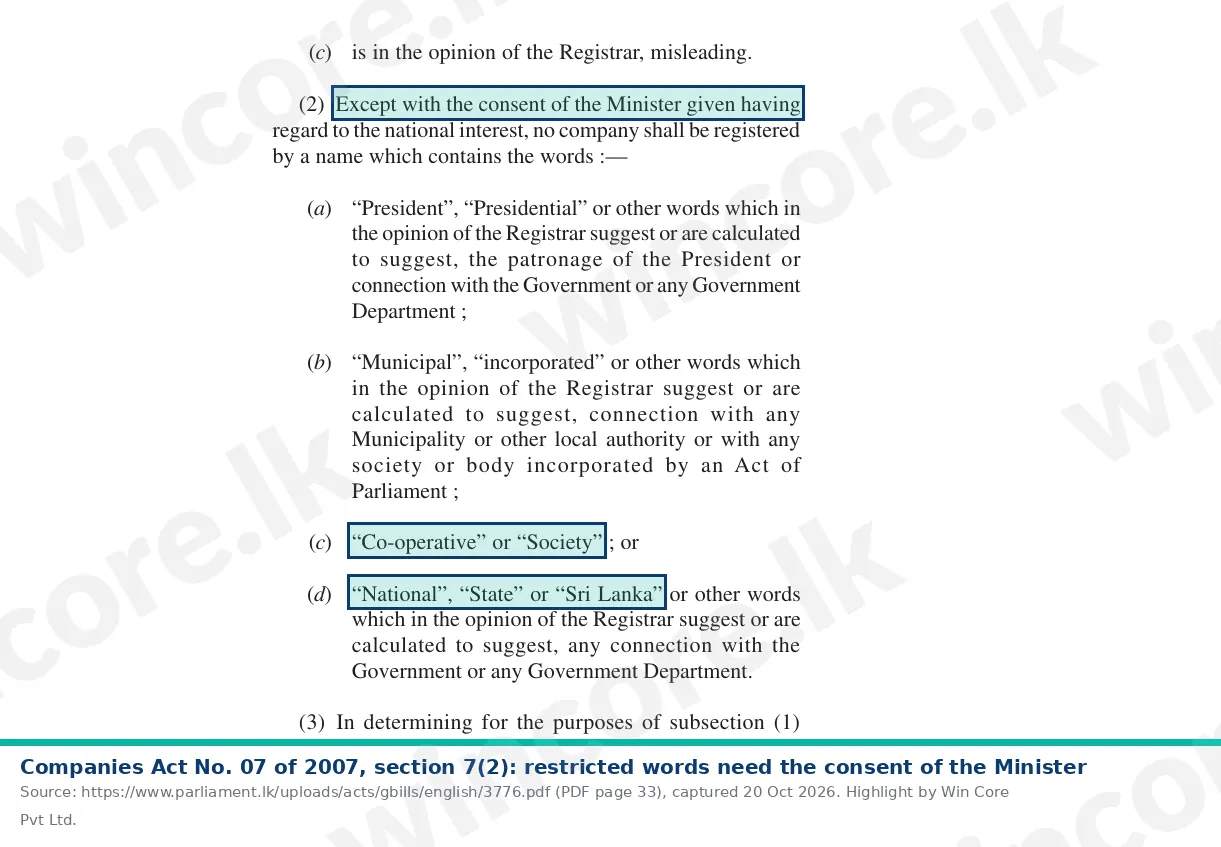
Rebranding a company? The order the Act sets, the words that need the Minister's consent, the three-month objection window and the fines for each step.

Changing a company's year-end in Sri Lanka: the section 20(2) application to the IRD, what does not move, the AGM consequence and the controls to rebuild.
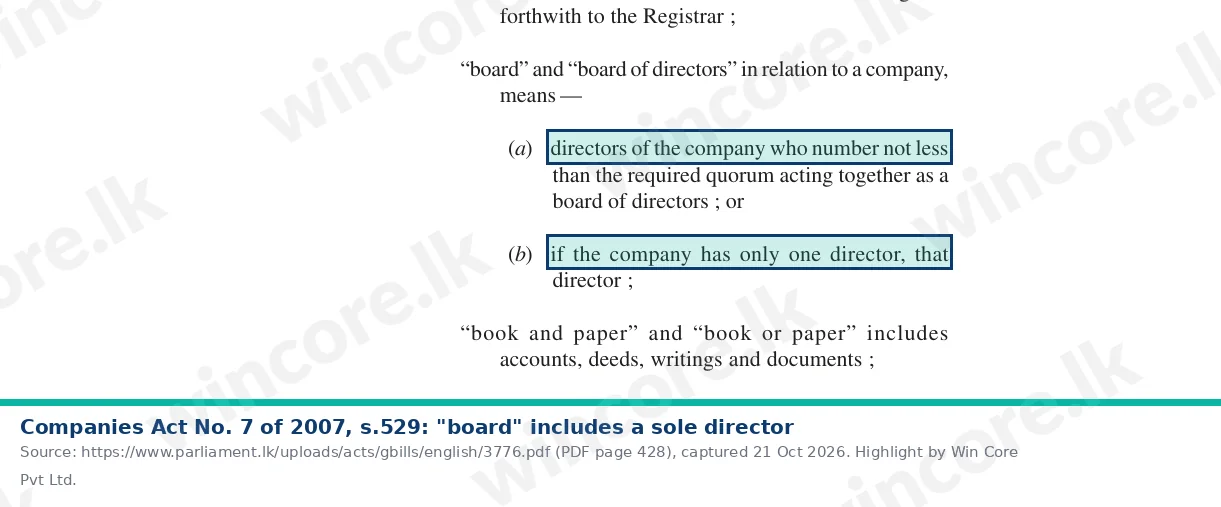
One director is lawful for a private company. Articles that need two for a board quorum are the problem. Read yours, then alter them or appoint a second.