
Sole director company Sri Lanka: when articles need a quorum of two
One director is lawful for a private company. Articles that need two for a board quorum are the problem. Read yours, then alter them or appoint a second.
On this page
A sole director company in Sri Lanka is lawful: section 201 of the Companies Act No. 7 of 2007 requires at least one director, and two only for a public company. Section 529 defines "board" as that one director. The gap is in the articles. Section 215 lets them govern board proceedings, so articles that fix a board quorum of two can stop a sole director holding a valid meeting. The fixes are a special resolution altering the articles, notified to the Registrar within ten working days (s.15), or a second director. None of these sections was changed by the 2025 amendment, in force since 30 March 2026 [1] [2]. To change the articles themselves, see how to change the articles of association.
Many companies reach one director after a co-founder leaves or a director is removed; our separate article on removing a director covers that route. This article sets out which articles you are likely to have, where the law is not clear, and the two practical ways out.
A sole director company in Sri Lanka is lawful under section 201
Section 201 of the Companies Act No. 7 of 2007 reads: "A company shall have at least one director, except a public company which should have at least two directors." [1]
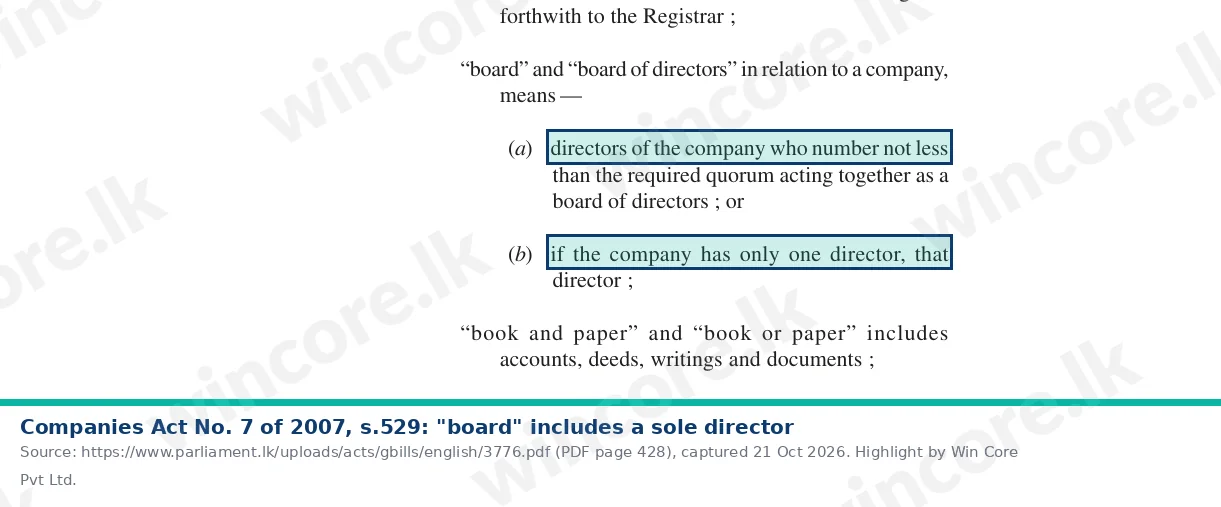
So one director is lawful for a private company. The Act also plans for it. Its definition of "board" in s.529 is:
"board" and "board of directors" in relation to a company, means ... (a) directors of the company who number not less than the required quorum acting together as a board of directors ; or (b) if the company has only one director, that director ; [1]
On our reading, paragraph (b) means that where the Act gives a power to "the board", a sole director can exercise it alone.
None of these provisions was changed by the Companies (Amendment) Act No. 12 of 2025. We checked its sections and its Schedule of corrections: they amend s.529 only in the definition of "distribution", and do not touch ss.14, 15, 143, 201, 208, 215, 223 or 486. In the model articles the Schedule corrects only articles 17(3), 17(4) and 31(1), not the board quorum and resolution articles discussed here [2]. Our article on the Companies (Amendment) Act No. 12 of 2025 lists what did change, including the new special notice for removing a director under s.206.
Before changing the board, distinguish an ordinary resignation from the procedure for removing a director.
Your articles, not the Act, set the board quorum
Section 215 is one sentence: "The articles of a company shall govern the proceedings of the board of a company." [1] The Act does not itself set a board quorum. So the answer depends on which articles your company has.
Model articles. Under s.14, the model articles in the First Schedule "shall apply in respect of any company other than a company limited by guarantee, except to the extent that the company adopts articles which exclude, modify or are inconsistent with the model articles" [1]. Model article 27(1) says: "A quorum for a meeting of the board is a majority of the directors." Model article 26 then allows a board meeting to be held "by a number of the directors who constitute a quorum being assembled together", or by audio or audio-visual link where the directors "constituting a quorum can simultaneously hear each other" [1].
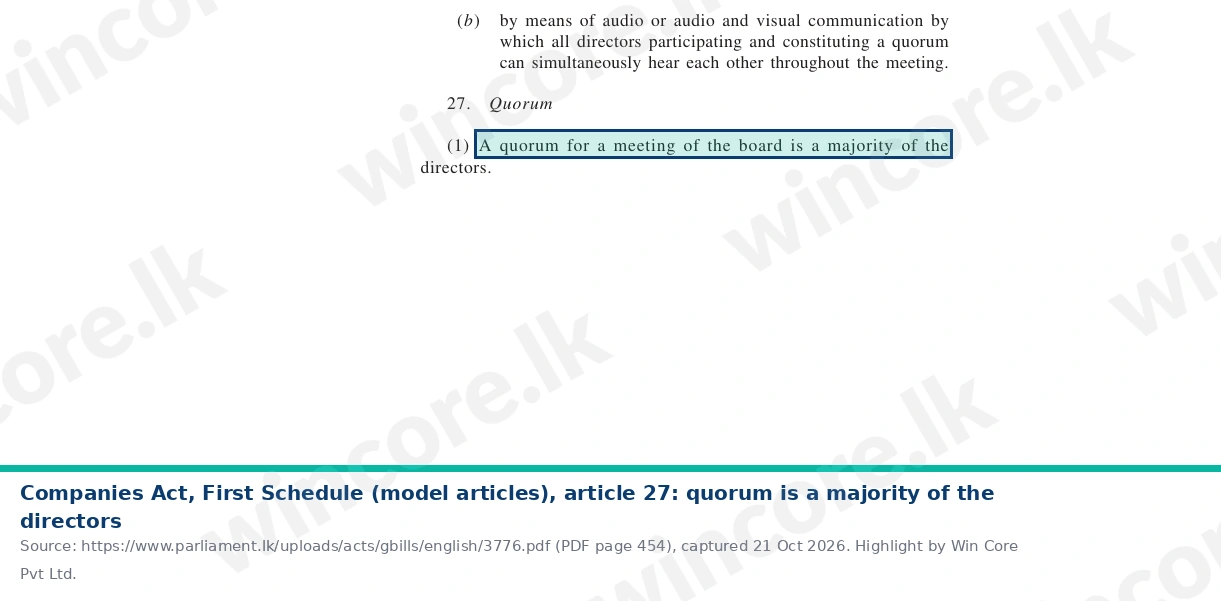
On our reading, a majority of one director is one, so a sole director under the model articles is a quorum.
Model article 30(1) also allows "A resolution in writing signed or assented to by all directors entitled to receive notice of a board meeting" to be "as valid and effective as if it had been passed at a meeting of the board duly convened and held" [1]. For a sole director, a signed written resolution is the usual working method (practice).
Bespoke articles. Many companies adopted their own articles at incorporation. Some fix the quorum at two. If yours do, model article 27 does not help: s.14 says the model articles give way to articles that are inconsistent with them.
Companies registered before 2007. Under s.486(1), "The model articles shall not apply to an existing company unless it resolves that they shall apply", under s.15. Under s.486(3), an existing company's articles continue, and where they adopted Table A of the Companies Act No. 17 of 1982, "those rules shall be deemed to be incorporated in such articles of the company" [1]. We have not read the 1982 Table A text for this article, so we do not state its quorum rule. Check the articles on your file.
Articles that require two leave an open question
Suppose your articles say the quorum for a board meeting is two, and you have one director. Two provisions pull in different directions.
- Section 215 gives the articles control over board proceedings, and a quorum rule is a rule of proceedings.
- Section 529(b) says that where there is only one director, "board" means that director.
On our reading, s.529(b) lets a sole director exercise powers the Act gives to "the board", but it does not obviously rewrite an article that says no meeting is quorate without two. The definitions in s.529(1) apply "unless the context otherwise requires" [1], and on our reading an article that expressly requires two may be such a context. We have not found a judgment that decides this point under the 2007 Act. It is open.
Two things make the risk practical rather than theoretical:
- Anyone relying on a board decision, such as an auditor or a counterparty, may read the articles and ask how the resolution was passed (practice).
- If a resolution is challenged, the company would have to argue that the article does not apply. That is an argument, not a certainty.
So we suggest you do not rely on s.529(b) alone where your articles require two.
Fix 1: alter the articles by special resolution
Section 15(1) allows a company, "Subject to the provisions of this Act and any conditions contained in its articles", "at any time by special resolution" to adopt new articles, adopt the model articles, or "alter its articles" [1]. Check first whether your articles add conditions of their own.
A special resolution under s.143(1) is one passed "by a majority of seventy-five per centum of those shareholders entitled to vote and voting on the question" at a general meeting with "not less than fifteen working days' notice". The proviso allows shorter notice where shareholders "together representing not less than eighty-five per centum of the total voting rights at that meeting" agree [1]. Written shareholder resolutions are another route where the Act and your articles allow them; our separate article on removing a director covers them.
Section 15(2) then requires the company to "give notice of such resolution to the Registrar within ten working days, setting out in full the text of the resolution and of any new articles or of any alterations" [1].
Penalty for this default. Failing to give that notice is an offence under s.15(3): a fine not exceeding Rs 50,000 for the company and Rs 50,000 for every officer in default [1].
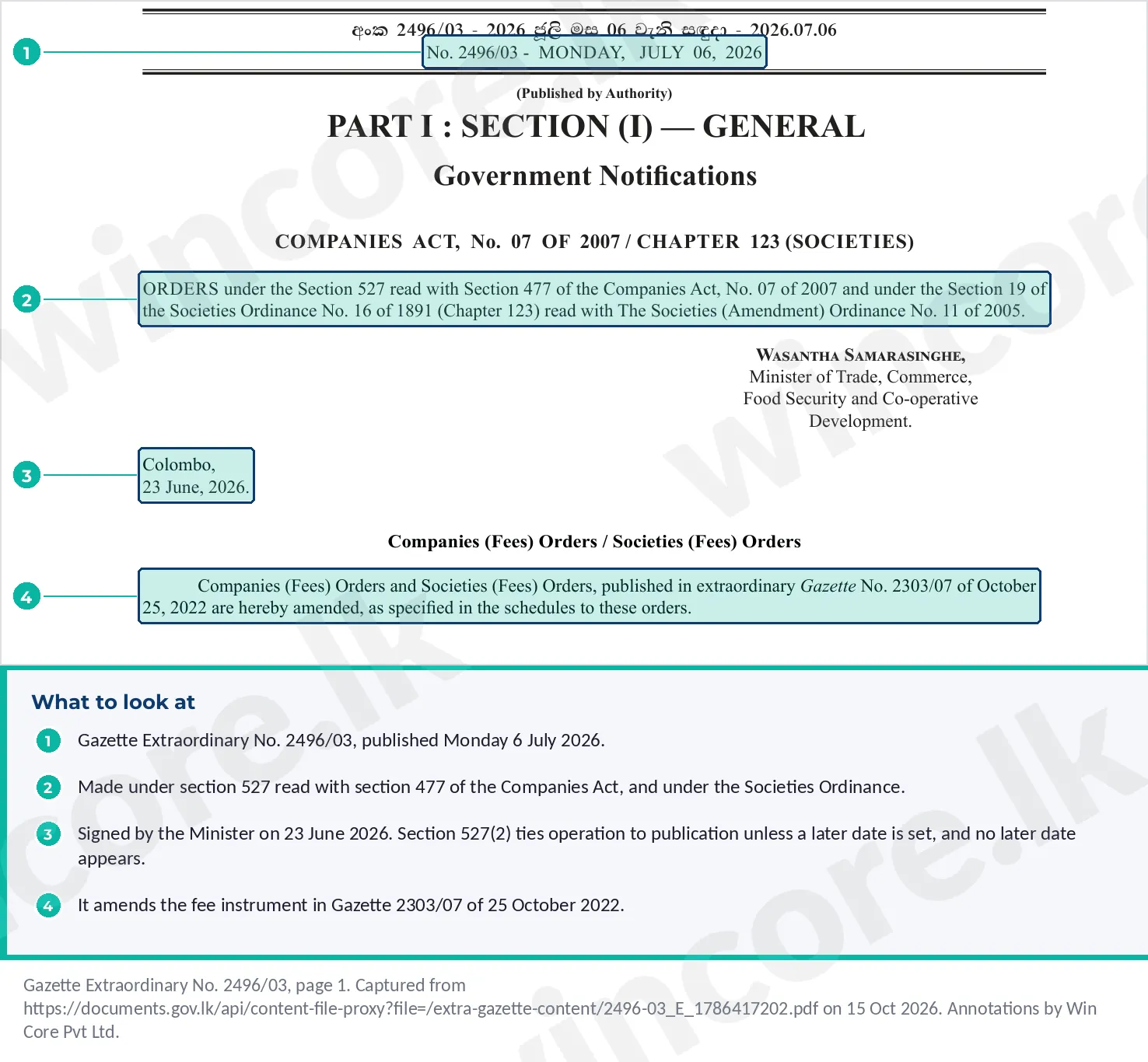
Registrar fee. Item 7 of the Companies (Fees) Order in Gazette 2496/03 charges Rs 2,600, stated "excluding VAT", for registering a document "required or authorized to be registered or required to be delivered" to the Registrar [3]. With VAT at 18 percent that is Rs 3,068. On our reading, notice of an altered article falls within item 7; no item names it. Our article on the Companies (Fees) Orders 2026 covers the Order.
Typical wording changes (practice, not legal drafting advice):
- Quorum is "a majority of the directors", matching model article 27, or
- Quorum is two, except that where the company has only one director, that director forms a quorum.
A hypothetical timeline, with our arithmetic
This is hypothetical. A company with bespoke articles requiring two directors for a quorum has one director after a resignation. It chooses Fix 1.
- Day 0: notice of a general meeting with the special resolution goes out.
- 15 working days later: meeting; special resolution passed.
- Within 10 working days: notice and text of the altered article to the Registrar, Rs 2,600 plus VAT (Rs 3,068).
Our arithmetic: about 25 working days, or roughly five calendar weeks, if no shorter-notice agreement is used. If shareholders holding at least 85 percent of the voting rights agree to short notice under the s.143 proviso, or a written resolution is used where allowed, the meeting step can be shorter.
Fix 2: appoint a second director
Under model article 20(2), "A director may be appointed or removed by ordinary resolution passed at a meeting called for the purpose or by a written resolution" [1]. Bespoke articles may let the board appoint. Once there are two directors, a quorum of two can be met.
The appointment must be notified to the Registrar within twenty working days of the change, with the new director's consent and certificate annexed (s.223(3)). Our guide on how to change your company secretary walks through the same Form 20 process. For the consent and filing steps, see how to appoint a director with Form 18 and Form 20.
Fix 2 is quicker if you have a suitable person. Fix 1 is the durable answer if you intend to stay with one director.
A sole director cannot simply resign
Section 208(1): "Where a company has only one director, that director may not resign office until that director has called a meeting of shareholders to receive notice of the resignation, and to appoint one or more new directors." Under s.208(2), "Notwithstanding its terms", the sole director's notice of resignation "shall not take effect until the date of the meeting of shareholders" [1].
What this means for you
- One director is lawful for a private company (s.201).
- Read your articles. The model articles set a quorum of a majority, which a sole director meets on our reading.
- If your articles need two, do not rely on the s.529 definition alone; that point is open.
- Either alter the articles by special resolution and notify the Registrar within ten working days, or appoint a second director.
- Use signed written resolutions for board decisions where the articles allow them.
If you would rather have the articles reviewed and the resolution, notice and Registrar filing handled together, that is part of our company secretarial services. Our annual filing checklist keeps the year's other Registrar deadlines in view.
Checklist: documents needed
- Current articles of association (and the 1982 Table A text if adopted)
- Register of directors
- Notice of general meeting, or written resolution, with the special resolution
- Text of the altered articles
- Notice to the Registrar within ten working days, with the fee
- Or: the second director's consent and certificate, and Form 20 within twenty working days
FAQ
Can a private company in Sri Lanka have only one director?
Yes. Section 201 of the Companies Act says a company "shall have at least one director", and only a public company needs at least two. The Act also expects it: s.529 defines "board" as that director where the company has only one. Your articles, not the Act, decide how that director holds board meetings.
Can a sole director sign a board resolution alone?
Under the model articles, yes on our reading. Article 27(1) sets the quorum as a majority of the directors, which one director meets, and article 30(1) makes a written resolution signed by all directors as valid as one passed at a meeting. Where bespoke articles require two, the position is open, so fix the articles first.
Do the model articles apply to my company?
Only to the extent your company has not adopted articles that "exclude, modify or are inconsistent with" them (s.14). A company registered before the 2007 Act keeps its own articles, including any Table A rules of the 1982 Act they adopted, unless it resolves under s.15 that the model articles apply (s.486). Read the articles on your file.
Can a sole director resign immediately?
No. Section 208 says a sole director may not resign until he or she has called a meeting of shareholders to receive notice of the resignation and to appoint one or more new directors. Whatever the letter says, the resignation takes effect only on the date of that meeting. Plan the successor before the resignation is sent.
Open points
- Whether s.529(b) overrides an article requiring a quorum of two; no judgment found.
- The quorum rule in Table A of the 1982 Act, for pre-2007 companies; not read for this article.
- Whether item 7 of the Fees Order is the correct item for notice of altered articles; no item names it.
Last verified: 22 October 2026. We re-read ss.15, 143, 201, 208, 215, 223(3), 486 and the s.529 definitions on the parliament.lk text, model articles 20, 26 and 30, the Companies (Amendment) Act No. 12 of 2025 and the Gazette 2496/03 schedule.
The short version.
- A private company can have one director (s.201), and the Act defines "board" to include a sole director (s.529).
- The articles govern board proceedings (s.215); model article 27 sets the quorum as a majority.
- Articles requiring two directors create a gap that the Act does not clearly close.
- Fix it by altering the articles (special resolution, notice within ten working days) or by appointing a second director.
- A sole director cannot resign until a shareholders' meeting is held (s.208).
Talk to us. If your company is down to one director and the articles say two, we can read the articles, draft the change and file the notice, our contact page.
WinCore Pvt Ltd
References
- Parliament of Sri Lanka. Companies Act, No. 7 of 2007, ss.14, 15, 143, 201, 208, 215, 223, 486 and 529, and First Schedule articles 20, 26, 27 and 30. https://www.parliament.lk/uploads/acts/gbills/english/3776.pdf . Primary. Accessed 22 October 2026.
- Parliament of Sri Lanka. Companies (Amendment) Act, No. 12 of 2025, ss.1 to 22 and Schedule. https://www.parliament.lk/uploads/acts/gbills/english/6389.pdf . Primary. Accessed 22 October 2026.
- Gazette Extraordinary No. 2496/03 (6 July 2026), Companies (Fees) Orders, item 7. https://documents.gov.lk/api/content-file-proxy?file=/extra-gazette-content/2496-03_E_1786417202.pdf . Primary. Accessed 22 October 2026.
Put these insights to work
WinCore specialists can review your current workflow, document gaps, and build a practical 90-day action plan.
Book a free consultationContinue reading
Explore more WinCore analysis to keep your finance, tax, and compliance roadmap moving.
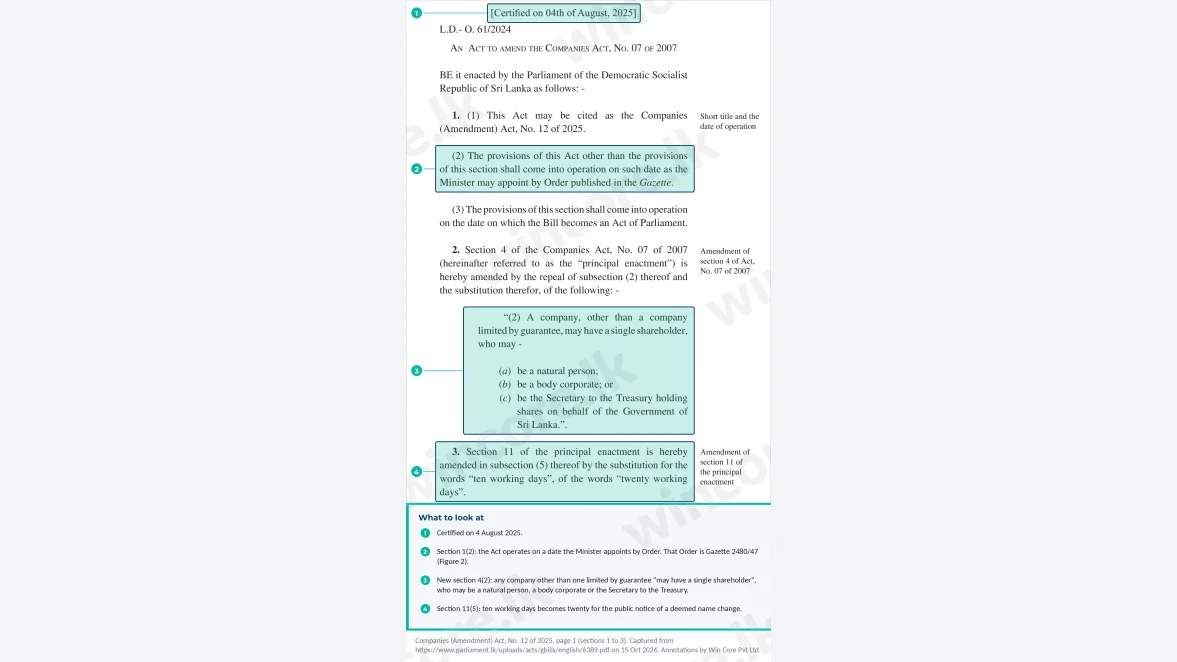
Beyond beneficial ownership, the 2025 amending Act ended bearer shares, moved allotments to working days and added a Rs 1 million general penalty.
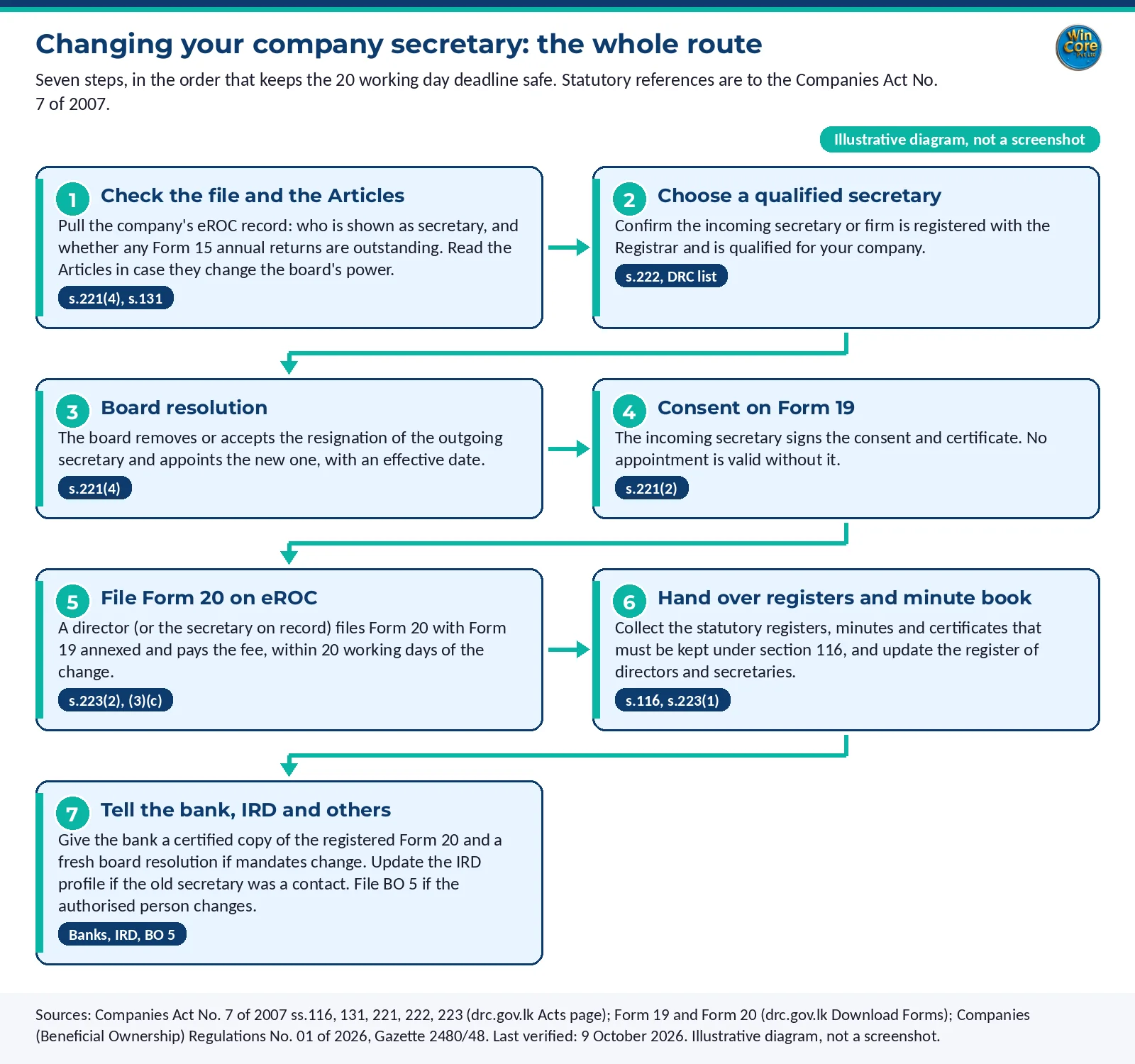
Changing a company secretary step by step: the board resolution, Form 19 consent, Form 20 within 20 working days, the fee and the handover.
The instrument behind this year's Registrar of Companies fee rise: what it amends, when it took effect, the Parliament step still open and the odd item 13.