
Appoint director Sri Lanka: Form 18 consent and Form 20 filing
Appoint a director in Sri Lanka: the Form 18 consent, who may appoint, the twenty-working-day Form 20 deadline, the registers and the IRD record.

On this page
Last verified against the primary sources on 26 October 2026.
Appoint director Sri Lanka, in brief. To appoint a director, a company needs four things in the right order:
- a person who is not disqualified;
- a decision by whoever the articles say appoints directors;
- the person's signed consent and certificate;
- a Form 20 notice to the Registrar within twenty working days.
After that come the company's own registers, the beneficial ownership record if the new director is also an owner, and the IRD record. This guide quotes each step from the Companies Act No. 7 of 2007, checked against the Companies (Amendment) Act No. 12 of 2025, and ends with a checklist and a plain-words board resolution. It covers resident directors only.
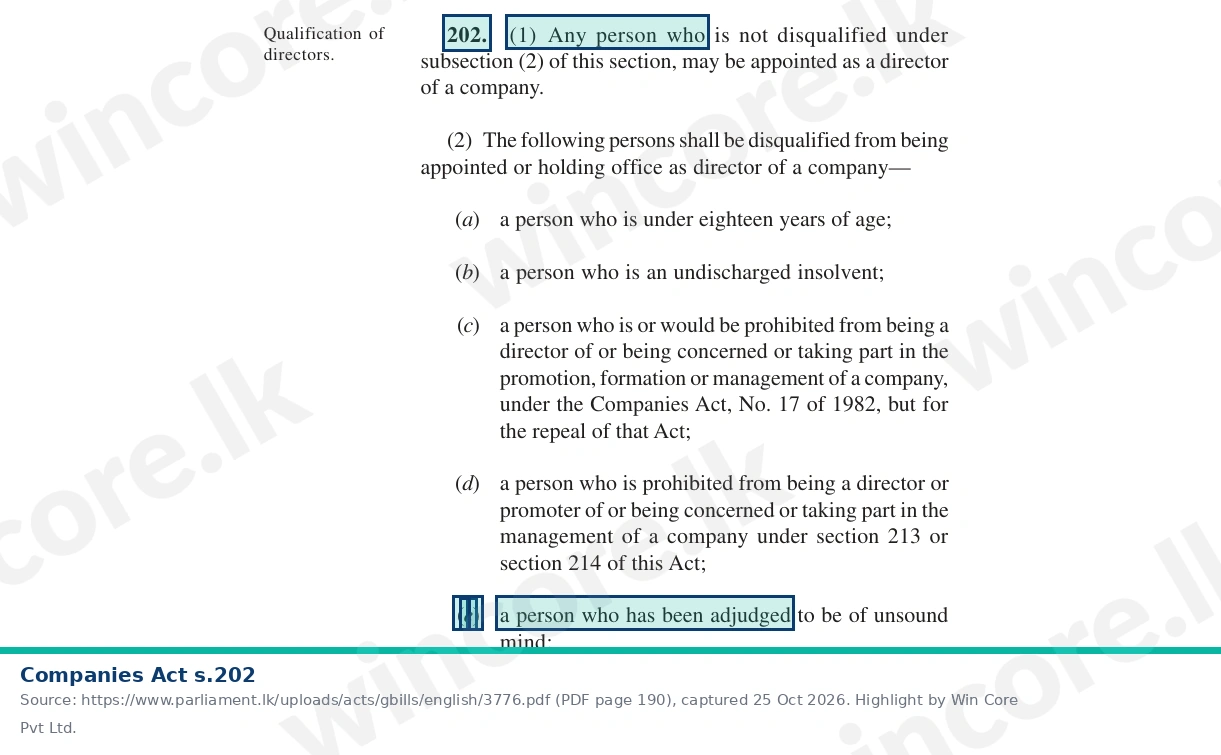
Anyone over eighteen who is not disqualified under section 202 may be a director
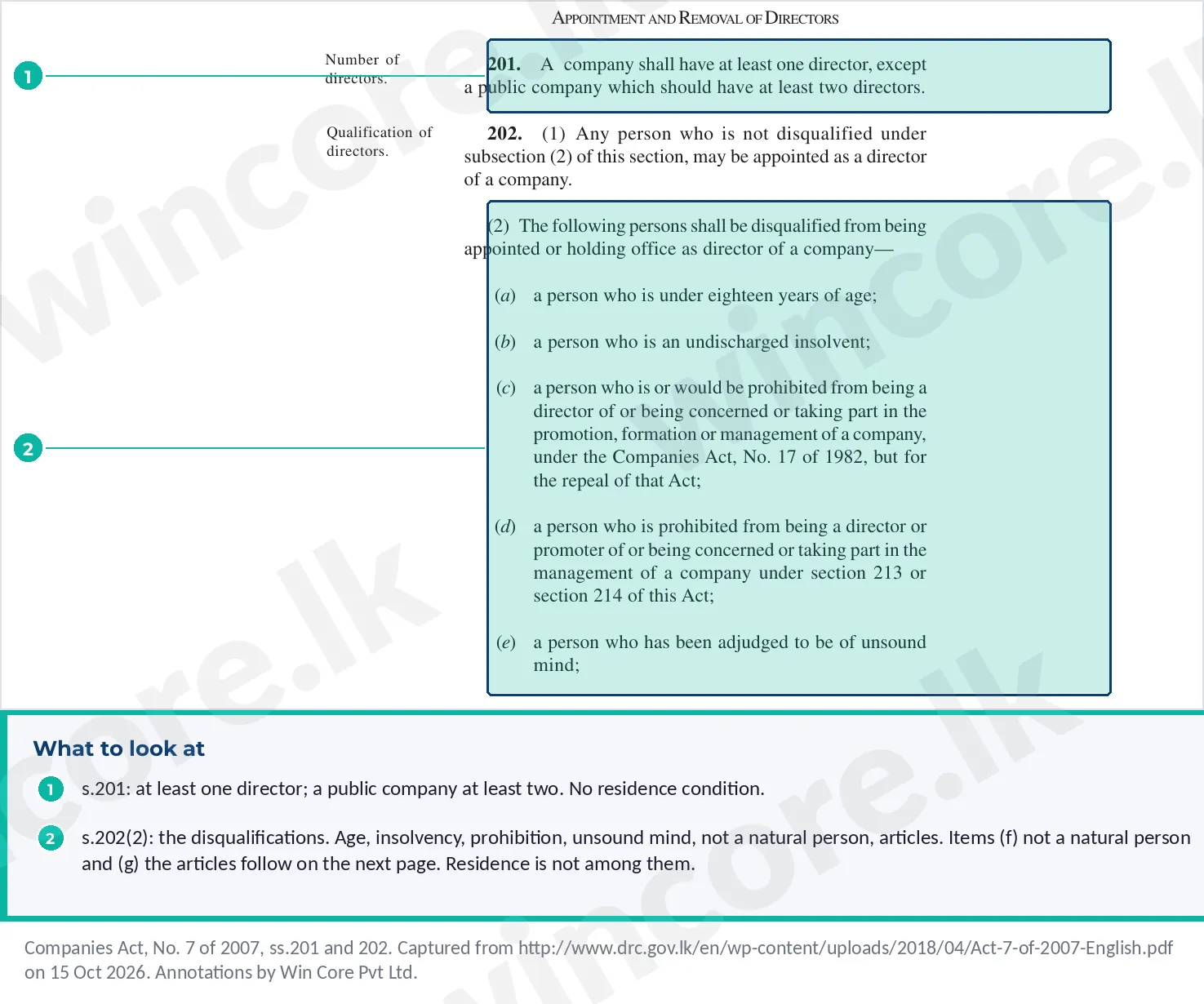
Section 202(1) states the rule: "Any person who is not disqualified under subsection (2) of this section, may be appointed as a director of a company." Section 202(2) lists who is disqualified [1]:
- (a) "a person who is under eighteen years of age";
- (b) "a person who is an undischarged insolvent";
- (c) a person who would be prohibited under the repealed Companies Act No. 17 of 1982;
- (d) "a person who is prohibited from being a director ... under section 213 or section 214 of this Act";
- (e) "a person who has been adjudged to be of unsound mind";
- (f) "a person that is not a natural person";
- (g) a person "who does not comply with any qualifications for directors contained in the articles of that company".
Section 202(3) adds a warning: a disqualified person who acts as a director is still treated as one for the duties the Act imposes.
Upper age. Section 210(1) provides that no person "shall be capable of being appointed a director of a public company or of a private company which is a subsidiary of a public company, if he has attained the age of seventy years". So for an ordinary private company that is not a subsidiary of a public company, there is no statutory upper age.
Where section 210 does apply, section 211(1) allows a general meeting to resolve that the limit does not apply. Act No. 12 of 2025 changed how long that resolution lasts: from "valid only for one year from his appointment" to "valid till the next annual general meeting subject to paragraph (b) of subsection (1) of section 133 of the Act" [2].
Number. Section 201 requires "at least one director, except a public company which should have at least two directors". See our guide on resident directors.
Shareholders appoint directors by ordinary resolution unless the articles say otherwise
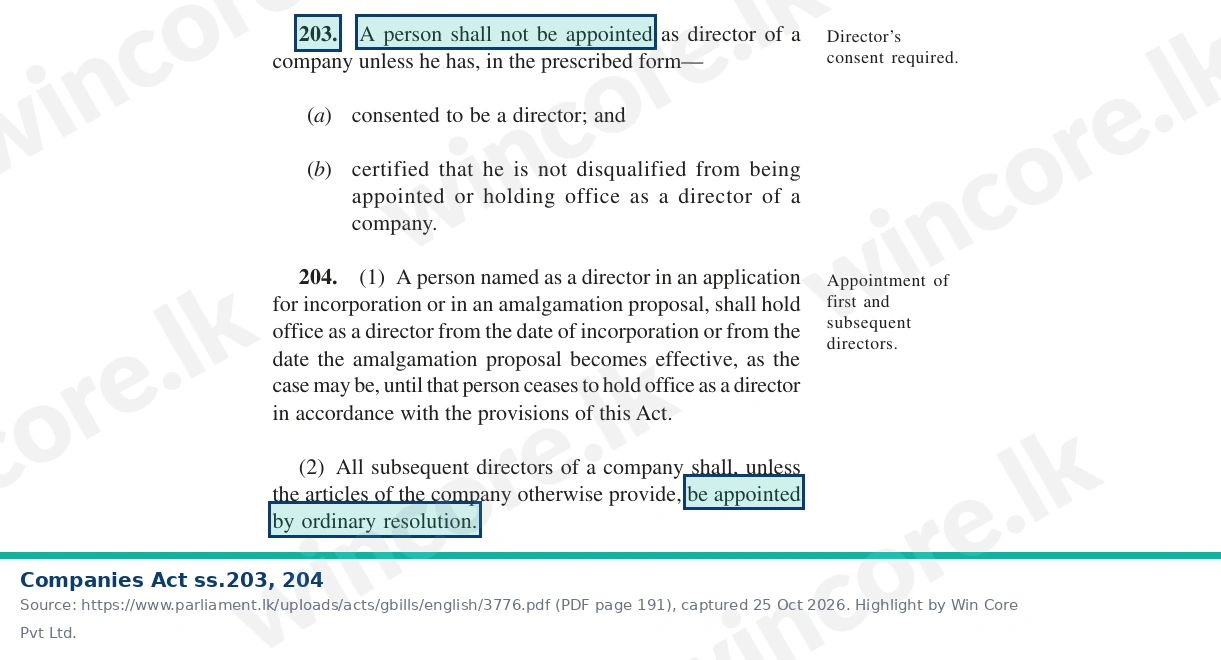
Section 204(2) sets the default: "All subsequent directors of a company shall, unless the articles of the company otherwise provide, be appointed by ordinary resolution" [1].
An ordinary resolution is a shareholders' decision. If your company uses the model articles in the First Schedule, article 20(2) keeps the decision with the shareholders: "A director may be appointed or removed by ordinary resolution passed at a meeting called for the purpose or by a written resolution" [1]. Some companies' own articles let the board fill a casual vacancy or appoint an additional director up to a maximum. Check your articles before deciding who signs.
Subject to the articles, section 205 requires directors of a company that is not a private company to be voted on individually, unless the meeting first agrees otherwise without a vote against.
No one can be appointed a director without a signed Form 18 consent and certificate
Section 203 makes consent a precondition: "A person shall not be appointed as director of a company unless he has, in the prescribed form" [1]:
- "(a) consented to be a director; and"
- "(b) certified that he is not disqualified from being appointed or holding office as a director of a company."
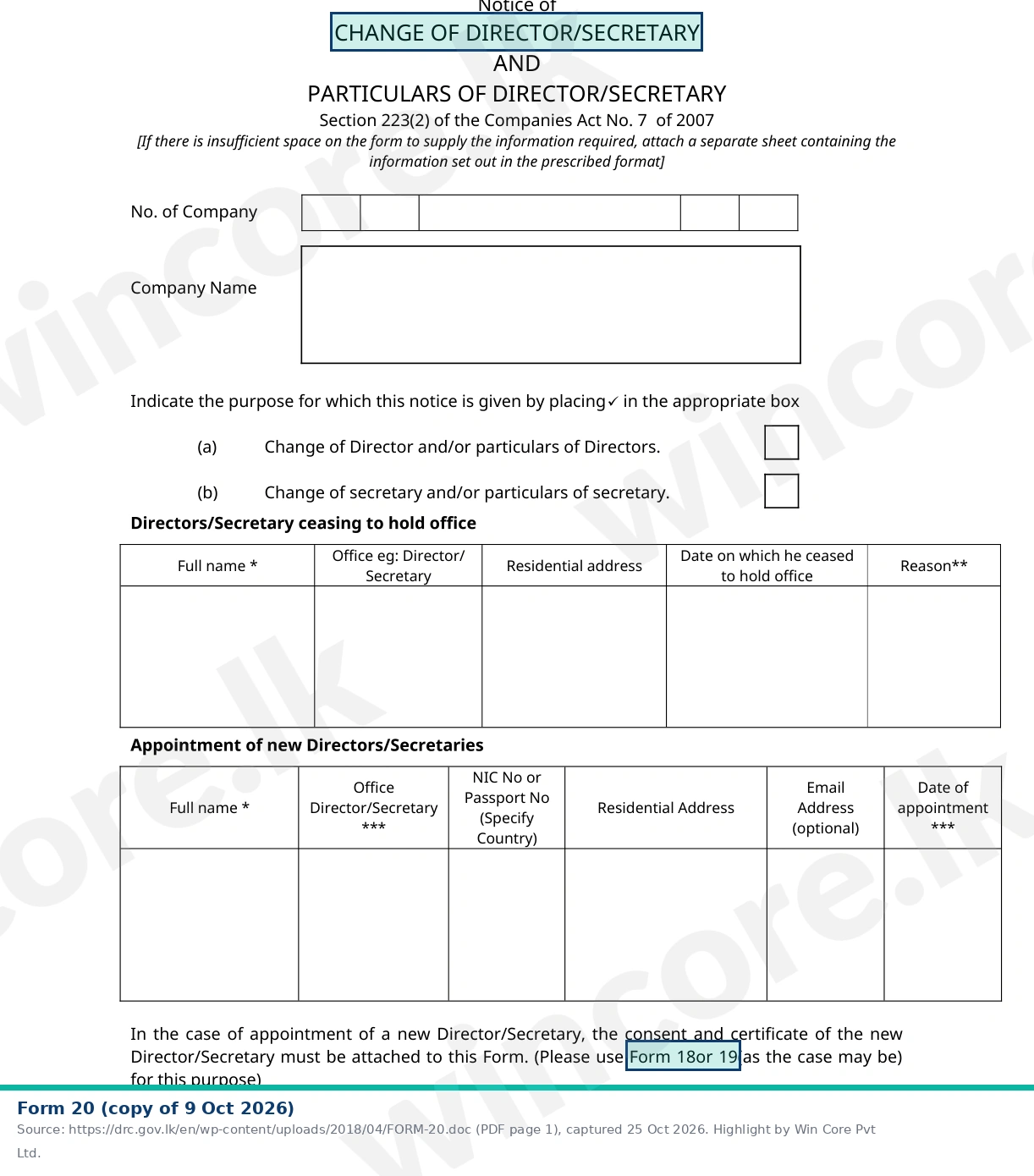
The prescribed form is Form 18. Form 20 itself tells you to attach it: "the consent and certificate of the new Director/Secretary must be attached to this Form. (Please use Form 18or 19(as the case may be) for this purpose)" [3]. When a director's particulars change, see how to update them on Form 20.
Form 20 must reach the Registrar within twenty working days of the appointment
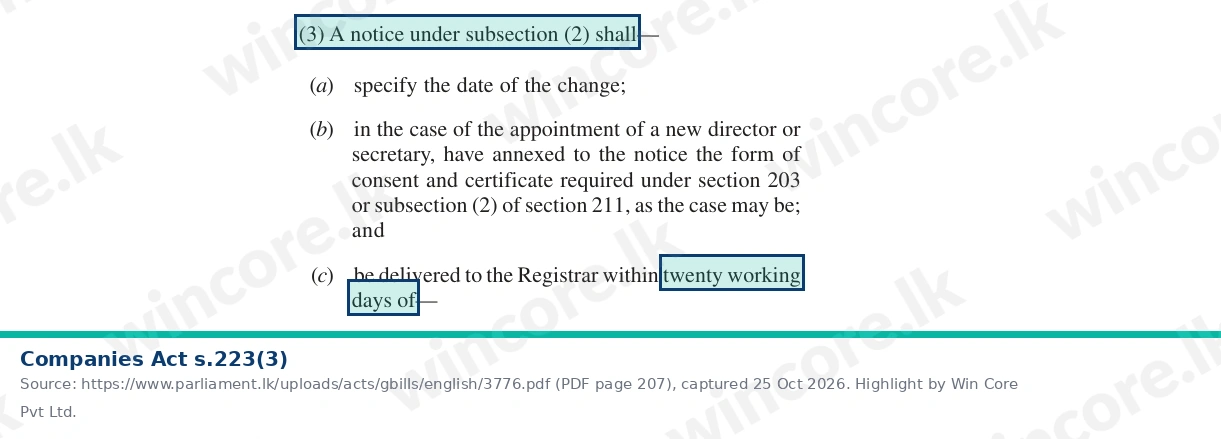
Section 223(2) requires the company to deliver notice "in the prescribed form" of "a change in the directors or the secretary of the company" to the Registrar. Section 223(3) sets the contents and the deadline. The notice shall [1]:
- "(a) specify the date of the change";
- "(b) in the case of the appointment of a new director or secretary, have annexed to the notice the form of consent and certificate required under section 203 or subsection (2) of section 211, as the case may be";
- "(c) be delivered to the Registrar within twenty working days of (i) the change occurring, in the case of the appointment or resignation of a director or secretary".
The prescribed form is Form 20, "Notice of CHANGE OF DIRECTOR/SECRETARY AND PARTICULARS OF DIRECTOR/SECRETARY, Section 223(2)". For each appointment it asks for:
- full name;
- office;
- NIC or passport number (with the issuing country);
- residential address;
- email (optional);
- date of appointment [3].
Penalty. Under section 223(4), a company that fails to comply is liable on conviction "to a fine not exceeding one hundred thousand rupees", and every officer in default "to a fine not exceeding fifty thousand rupees".
Fee. The Companies (Fees) Orders as amended by Gazette 2496/03 list item 7 at Rs 2,600.00 (excluding VAT), covering "The registration of any document required or authorized to be registered or required to be delivered ... the registrar general of companies" [4]. We read Form 20 as falling under that item. Check the amount charged when you file.
Appoint director Sri Lanka: update the registers and check beneficial ownership
Register of directors. Section 223(1) requires every company to keep, at its registered office or another place notified to the Registrar, "a register of its directors and secretaries". For an individual, it must contain "the present name and surname, any former name or surname, usual residential address and business occupation" [1]. Add the new director on the date of appointment.
Beneficial ownership, if the director is also an owner. If the new director holds or acquires shares, or otherwise becomes a beneficial owner, the rules from Act No. 12 of 2025 apply [2]:
- Shareholder to company: under section 130A(2), every shareholder must give the company the beneficial ownership details "within ten working days of the subscription of any shares or transfer of shares".
- Company to Registrar: under section 130A(1), the company gives notice of its beneficial owners "within twenty working days of the issue of any shares or transfer of shares", on Form BO 2 for an issue (regulation 2(2), Gazette 2509/67) [6]. Section 130A(7) also requires it to notify the Registrar "within fourteen working days upon the receipt of details that a person holds, acquires, or effects a subsequent change of beneficial ownership". On our reading, file by whichever date comes first.
- Director's own duty: under section 130A(3), "Every director or secretary of the company shall disclose the details ... relating to beneficial owners of the company to the Registrar when such director or secretary becomes aware of such details".
Appointment alone does not make someone a beneficial owner. Check against the definition, and see our 10% beneficial ownership guide.
Bring the IRD record and e-service access into line after the appointment
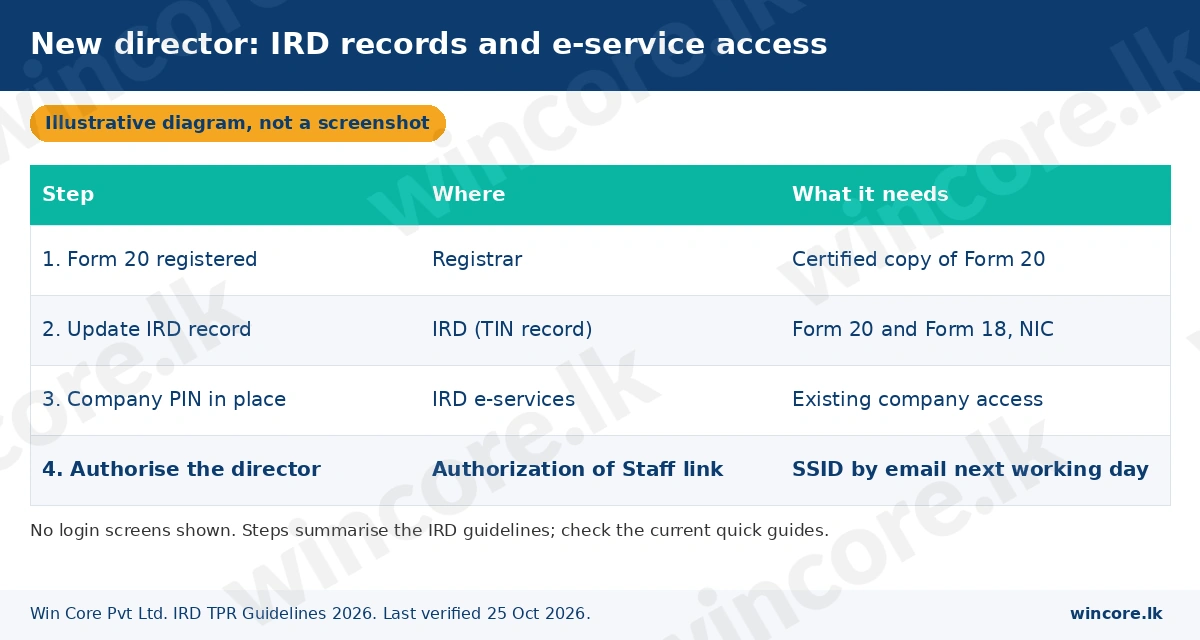
The IRD's Taxpayer Registration Guidelines for 2026, under "Updating Taxpayer Registration Details", list for a registered company "Form 01 / Form 20 certified by Registrar of Companies" and the directors' NIC or passport. For a company's first TIN they list [5]:
- "All Form 20s certified by Registrar of Companies";
- "NIC (Sri Lankans) or Valid Passport (Foreign Nationals) of all directors";
- "Form 18 certified by Registrar of Companies, if Form 20 is obtained to recognize director's signature".
So once Form 20 is registered, obtain a certified copy for the IRD file.
For online access, the guidelines say "Obtaining a PIN is essential to access IRD e-services" and that "SSIDs need to be requested only via the e-Service Portal's Authorization of Staff/Tax Agent link in order to allow their staff to log in". Staff "can be authorized for each tax type, as preparers and approvers". The "SSID will be generated and sent to your registered e-mail address on the following working day."
The new director's own TIN and the authorisation letter are covered in our guide on director TINs and the first login.
The example: an engineering company adds a director
This is an invented example. A private engineering company has two directors and three shareholders. Its articles follow the default rule in section 204(2), so shareholders appoint directors by ordinary resolution. The shareholders want to appoint the operations manager, a 46-year-old Sri Lankan resident, who will also buy 15% of the shares.
- Check. She confirms none of the section 202(2) disqualifications apply. She is over eighteen, solvent, and not prohibited under sections 213 or 214.
- Consent. She signs Form 18 before any vote.
- Appoint. The shareholders then pass an ordinary resolution. That day is the date of the change.
- File. The secretary files Form 20 with Form 18 annexed within twenty working days of that date. The fee is Rs 2,600 before VAT under item 7, as we read it.
- Registers. The register of directors is updated on the date of the appointment.
- Beneficial ownership. When her shares are issued, she gives her details to the company within ten working days (section 130A(2)). The company files Form BO 2 within twenty working days of the issue (section 130A(1), regulation 2(2)) and, on our reading, no later than fourteen working days after receiving her details (section 130A(7)), whichever comes first.
- IRD. The company obtains a certified Form 20 for the IRD record and authorises her in e-services for the tax types she will approve.
Count only working days: section 529 excludes Saturdays, Sundays and public holidays, and the Central Bank publishes each year's holiday list [7]. File early if a holiday falls in the period.
A sample resolution in plain words
Use your articles' wording and have it checked. This is an outline only.
Resolution of the shareholders (or board, if the articles allow) of [Company name] (PV [number]) 1. [Full name], NIC [number], of [address], is appointed a director of the company with effect from [date]. 2. The company has received [her/his] signed consent and certificate in Form 18, confirming [she/he] is not disqualified under section 202. 3. The secretary is directed to enter the appointment in the register of directors and to deliver Form 20, with Form 18 annexed, to the Registrar within twenty working days. 4. [If applicable] The secretary is directed to update the register of beneficial owners and file Form BO 2 with the Registrar within the periods in section 130A(1) and (7). Signed: [names], Date: [date]
What this means for you
- Check the section 202(2) disqualifications and your articles before anyone signs.
- Get the Form 18 consent first. Section 203 bars an appointment without it.
- Follow the articles on who appoints. The default is an ordinary resolution of shareholders.
- File Form 20 with Form 18 within twenty working days of the appointment.
- Update the register of directors and, if needed, the beneficial ownership record.
- Bring the IRD record and e-service access into line.
Checklist: documents needed
- Copy of the articles (who appoints, any director qualifications)
- Signed Form 18 consent and certificate
- Ordinary resolution or board resolution, dated
- Form 20 with Form 18 annexed, filed within twenty working days
- Updated register of directors
- Beneficial ownership details, if the director is also an owner
- Certified copy of Form 20 and director's NIC for the IRD
FAQ
How long do we have to file Form 20 after appointing a director?
Section 223(3)(c) of the Companies Act requires the notice to be delivered to the Registrar within twenty working days of the change occurring. Form 20 must specify the date of the change and have the new director's Form 18 consent and certificate annexed. Missing the deadline exposes the company to a fine of up to Rs 100,000.
Who can appoint a new director, the board or the shareholders?
Section 204(2) says subsequent directors are appointed by ordinary resolution of shareholders, unless the articles provide otherwise. The model articles do not give the board that power (article 20(2)); some companies' own articles let the board fill a casual vacancy or appoint additional directors. Read your articles first, and record the decision in the right body's minutes or written resolution before filing Form 20.
Is there a minimum or maximum age for directors?
The minimum is eighteen under section 202(2)(a). The age limit of seventy in section 210 applies only to public companies and private companies that are subsidiaries of public companies. Even there, a general meeting resolution under section 211 can disapply it, now valid until the next AGM after Act No. 12 of 2025.
Does a new director have to file beneficial ownership details?
Only if the director is or becomes a beneficial owner, for example by buying shares. Then the shareholder gives details to the company within ten working days, and the company files Form BO 2 within twenty working days of the issue, or within fourteen working days of receiving the details if that is earlier. Separately, section 130A(3) requires every director to disclose beneficial owner details they become aware of.
The short version
Check the disqualifications, get Form 18 signed, appoint as the articles require, and file Form 20 with Form 18 within twenty working days. Then update the register, the beneficial ownership record if relevant, and the IRD. To remove a director later, see our director removal guide.
Talk to us. If you are appointing a director and want the consent, Form 20 and registers checked, see our statutory secretarial services or book a consultation at our contact page.
WinCore Pvt Ltd
This article is general information on the law as at 26 October 2026 and is not advice on your specific position.
Cover image: Image by muhammad.abdullah on Freepik.
References
- Parliament of Sri Lanka. Companies Act, No. 07 of 2007, ss.201 to 205, 210, 211, 223 and 529 ("working day"); First Schedule (model articles) art 20(2). https://www.parliament.lk/uploads/acts/gbills/english/3776.pdf . Primary. Accessed 25 October 2026.
- Parliament of Sri Lanka. Companies (Amendment) Act, No. 12 of 2025, s.7 (new s.130A) and s.9 (s.211). https://www.parliament.lk/uploads/acts/gbills/english/6389.pdf . Primary. Accessed 25 October 2026.
- Department of the Registrar of Companies. Form 20, Notice of change of director/secretary. https://drc.gov.lk/en/wp-content/uploads/2018/04/FORM-20.doc . Primary. Copy downloaded 9 October 2026; downloaded again and checked 26 October 2026.
- Companies (Fees) Orders, amended by Gazette Extraordinary No. 2496/03 of 6 July 2026, Schedule item 7. https://documents.gov.lk/api/content-file-proxy?file=/extra-gazette-content/2496-03_E_1786417202.pdf . Primary. Accessed 25 October 2026.
- Inland Revenue Department. Taxpayer Registration Guidelines 2026. https://ird.gov.lk/en/Downloads/SiteAssets/TPR_Guidelines_2026_E.pdf . Primary (administrative guidance). Accessed 26 October 2026.
- Companies (Beneficial Ownership) Regulations, No. 1(I) of 2026, Gazette Extraordinary 2509/67 of 9 October 2026, reg 2(2). https://drive.google.com/file/d/1v3jBw9yrmEX3U1g-dvD_q_jtAq5lL5hH/view (linked from https://drc.gov.lk/en/?p=5001). Primary. Accessed 26 October 2026.
- Central Bank of Sri Lanka. Bank Holidays for 2026. https://www.cbsl.gov.lk/en/about/about-the-bank/bank-holidays-2026 . Primary (official list). Accessed 26 October 2026.
Put these insights to work
WinCore specialists can review your current workflow, document gaps, and build a practical 90-day action plan.
Book a free consultationContinue reading
Explore more WinCore analysis to keep your finance, tax, and compliance roadmap moving.
The Act is silent on where directors live. Registrar practice is not. What the law requires locally, and what a foreign founder should plan for.

Shareholders, not the board, remove a director. Since March 2026 that means special notice, a reply window for the director and Form 20 afterwards.
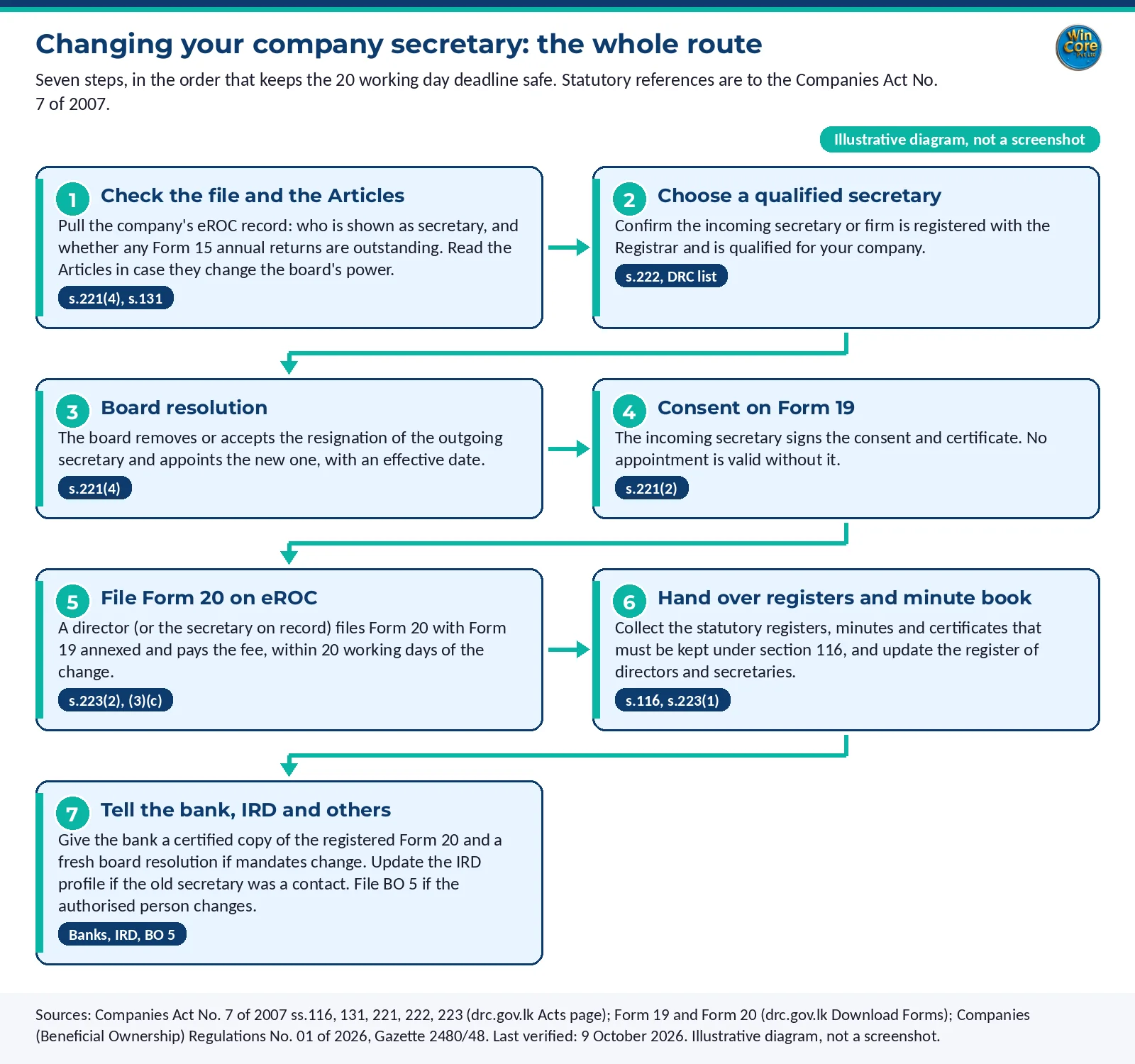
Changing a company secretary step by step: the board resolution, Form 19 consent, Form 20 within 20 working days, the fee and the handover.