
Remove a director in Sri Lanka: section 206 after the 2026 change
Shareholders, not the board, remove a director. Since March 2026 that means special notice, a reply window for the director and Form 20 afterwards.
On this page
To remove a director in Sri Lanka, the shareholders pass an ordinary resolution at a meeting called for that purpose, subject to the company's articles (Companies Act No. 7 of 2007, s.206(1)). Since 30 March 2026, when the Companies (Amendment) Act No. 12 of 2025 came into operation, the new s.206(2) to (4) add three steps: a special notice, which under s.145 must reach the company at least 28 days before the meeting; a copy of that notice to the director, who may be heard at the meeting; and fourteen working days for the director to send a written reply to shareholders. Afterwards the company tells the Registrar on Form 20 within twenty working days (s.223) [1] [2] [3].
This guide takes the steps clause by clause. It is not advice on a particular dispute, which usually also involves contracts that need their own review.
Shareholders remove a director in Sri Lanka by ordinary resolution under section 206(1)
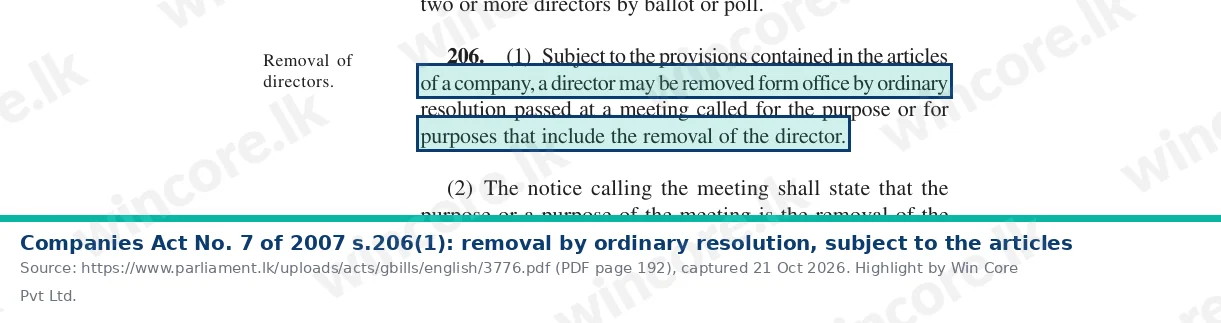
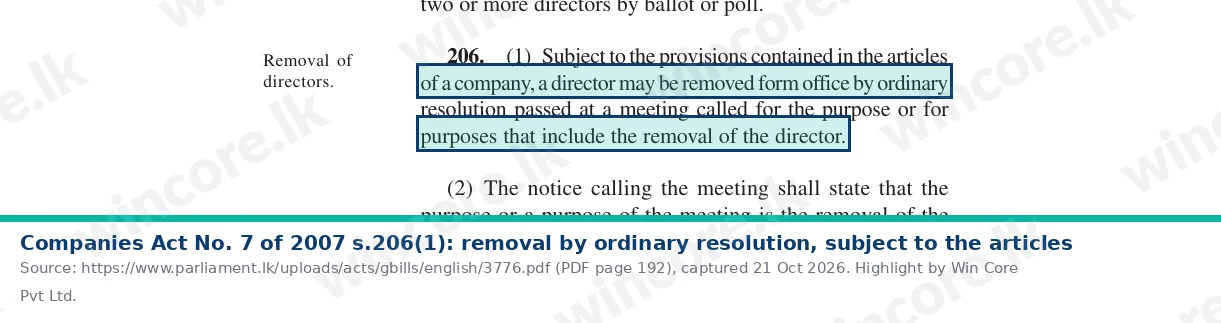
Section 206(1) was not changed in 2025. It reads: "Subject to the provisions contained in the articles of a company, a director may be removed form office by ordinary resolution passed at a meeting called for the purpose or for purposes that include the removal of the director." [1] ("Form" is a misprint in the Act; the 2025 Schedule of corrections does not list it.)
An "ordinary resolution" is "a resolution that is approved by a simple majority of the votes of those shareholders entitled to vote and voting on the question" (s.529(1)) [1]. On our reading, shareholders who abstain are not counted either way.
Three things follow from the wording.
- Articles first. The power is "Subject to the provisions contained in the articles". Articles can add conditions, such as a higher majority, a class consent, or a right for one shareholder to appoint and remove its own nominee. The model articles in the First Schedule repeat the basic rule: a director "may be appointed or removed by ordinary resolution passed at a meeting called for the purpose or by a written resolution in accordance with paragraph (4) of article 17" (article 20(2)) [1].
- Shareholders, not the board. The resolution is a shareholders' resolution. Section 207(1) vacates the office where the director "(b) is removed from office in accordance with the provisions of this Act or the articles of the company" or "(f) otherwise vacates office in accordance with the articles of the company" [1]. On our reading, the other directors can push a director out only where the articles give them that mechanism; the Act itself gives the board no removal power.
- Keep at least one director. Section 201 requires every company to "have at least one director, except a public company which should have at least two directors" [1]. If the removal would leave the company with none, appoint the replacement at the same meeting. A company left with one director should read our article on running a sole director company.
Since 30 March 2026 removal needs special notice and a copy to the director
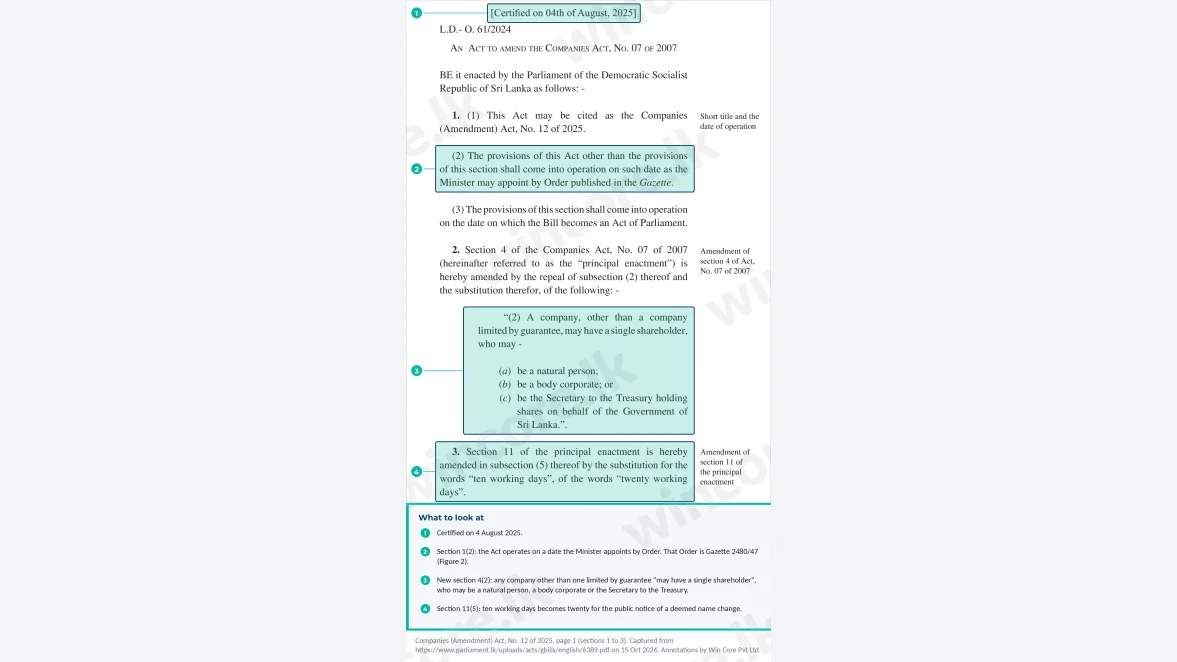
Section 8 of the Companies (Amendment) Act No. 12 of 2025, headed "Amendment of section 206 of the principal enactment", sets out new subsections (2), (3) and (4); subsection (1) stays as it was [2]. The Act, other than section 1, came into operation on 30 March 2026 under Gazette Extraordinary No. 2480/47 [3]. Our article on what else the Companies (Amendment) Act No. 12 of 2025 changed covers the rest of the Act.
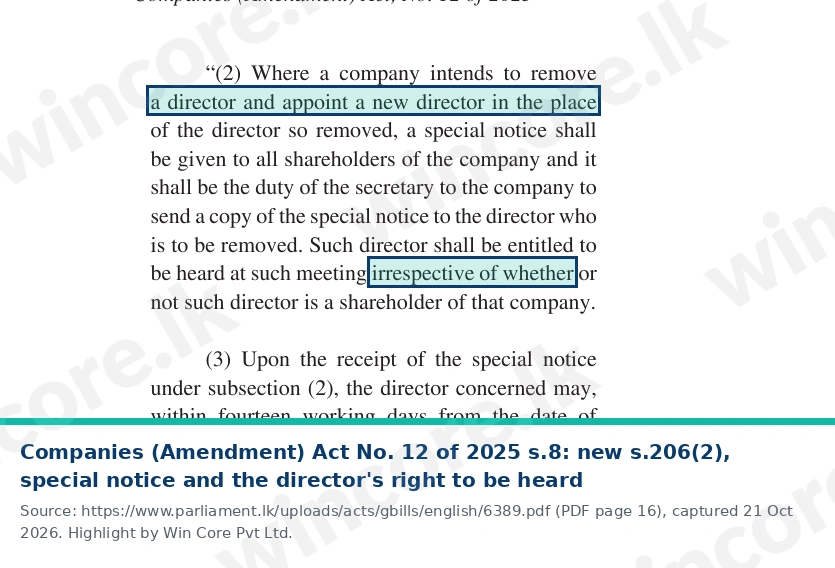
New s.206(2) reads: "Where a company intends to remove a director and appoint a new director in the place of the director so removed, a special notice shall be given to all shareholders of the company and it shall be the duty of the secretary to the company to send a copy of the special notice to the director who is to be removed. Such director shall be entitled to be heard at such meeting irrespective of whether or not such director is a shareholder of that company." [2] For the consent and filing steps, see how to appoint a director with Form 18 and Form 20.
Special notice means 28 days to the company under section 145
Section 145 applies "Where by any provision hereafter contained in this Act, special notice is required of a resolution". The resolution "shall not be effective unless notice of the intention to move it has been given to the company not less than twenty-eight days before the date of the meeting at which it is to be moved" [1].
The company then gives shareholders notice of the resolution "at the same time and in the same manner as it gives notice of the meeting". Only "if that is not practicable" does it use a newspaper advertisement or another manner allowed by the articles, "not less than fifteen working days before the date of the meeting" [1]. The fifteen working days belong to that fallback route. In the ordinary case the shareholders learn of the resolution with the notice of meeting, and for a private company on the model articles that notice goes out "not less than ten working days before the meeting" (First Schedule, article 6(1)(b)) [1].
The proviso: where, after the notice of intention reaches the company, "a meeting is called for a date twenty-eight days or less from the date of the notice", the notice "shall be deemed to have been properly given" [1]. On our reading, that stops a board defeating a special notice by calling the meeting early.
The open question: removal without a replacement
New s.206(2) begins "Where a company intends to remove a director and appoint a new director in the place of the director so removed". Read literally, special notice is triggered by removal combined with a replacement. Whether it also applies where shareholders only remove, and appoint no one, is not clear from the text. We found no Registrar guidance or judgment on it.
Our practice recommendation, not a legal requirement: give special notice in every removal. It costs a few weeks and removes any argument that the resolution was not "effective" under s.145.
The director has fourteen working days to answer in writing
Under new s.206(3), "Upon the receipt of the special notice under subsection (2), the director concerned may, within fourteen working days from the date of receipt of the special notice make a representation to the company in writing requiring the company to notify each shareholder of the company" [2].
Under new s.206(4), "The secretary to the company shall forthwith send a copy of the representation to every shareholder of the company." Where it was not sent "due to negligence of the company or due to the fact that the representation was received after the expiry of a period specified therein", the secretary "shall read out the representation at the meeting, if such director so requires" [2].
The proviso protects the company against abuse. Where the company "is able to satisfy the court that the provisions of this section are being abused by the director concerned in order to secure unnecessary publicity of a defamatory nature", it "may seek an order of the court for costs to be paid by such director, and to refrain from sending such representation to the shareholders or reading such representation at the meeting" [2].
What changed from the 2007 wording
The 2007 text required the notice of meeting to "state that the purpose or a purpose of the meeting is the removal of the director", gave the director "a period of fourteen days of such notice" for representations, and had a similar court proviso [1]. The 2025 version adds special notice, puts the duty to send the director a copy on the secretary, gives an express right to be heard "irrespective of whether or not such director is a shareholder", and counts the fourteen days in working days from receipt [2].
If the person blocking the process is the company secretary rather than the director, the board can change the secretary; see our article on an outgoing company secretary who will not sign.
If the board will not call the meeting, shareholders with 10 percent can
A director facing removal may control the board. Section 134(1) applies "Notwithstanding anything in its articles": on the requisition of shareholders holding shares carrying "not less than ten per centum of the votes which may be cast on an issue", the directors must convene an extraordinary general meeting "not later than fifteen working days after the date of the deposit of the requisition" and hold it "not later than thirty working days after" that date [1].
The requisition must state the issue, be signed by the requisitionists and be deposited at the registered office (s.134(2)). If the directors do not convene the meeting within fifteen working days, requisitionists representing more than half of the requisitionists' voting rights may convene it themselves, but it cannot be held more than three months after the deposit (s.134(3)), and the company repays their reasonable expenses (s.134(5)) [1].
On our reading, a requisitioning shareholder can deposit the s.145 notice of intention at the same time, so both clocks start together. Thirty working days is at least six calendar weeks, which leaves room for the 28 days.
A written resolution is possible but sits uneasily with the right to be heard
Section 144(1) allows, "Subject to the provisions contained in the company's articles", a written resolution signed by not less than 85 percent of the shareholders entitled to vote who together hold "not less than eighty-five per centum of the votes entitled to be cast on that resolution". It "shall be as valid as if it had been passed at a meeting of those shareholders" [1]. It may be signed "without any prior notice being given to shareholders" (s.144(5)), and a copy must go to every shareholder who did not sign within five working days (s.144(4)), on pain of fines of up to Rs 100,000 for the company and Rs 50,000 for each officer in default (s.144(6)) [1].
Model article 20(2) expressly allows removal by written resolution. New s.206(2), though, gives the director a right "to be heard at such meeting", and a written resolution has no meeting. The text does not say how the two fit. On our reading, the written route is safest only where the director agrees to it; where the director objects, hold a meeting.
Form 20 goes to the Registrar within twenty working days of the change
Section 223(2) requires the company to ensure that notice "in the prescribed form" of "a change in the directors or the secretary of the company" is delivered to the Registrar. The notice must "specify the date of the change" (s.223(3)(a)), annex the consent and certificate of any new director (s.223(3)(b)), and be delivered "within twenty working days of" either "(i) the change occurring, in the case of the appointment or resignation of a director or secretary" or "(ii) the company first becoming aware of the change, in the case of the death of a director or secretary or a change in the particulars" [1]. In Registrar practice the form is Form 20, as our guide to changing your company secretary explains. The filing fee is in the Companies Fees Order, Gazette 2496/03.
Removal is not named in (i) or (ii). On our reading, a removal is still "a change in the directors" under s.223(2), and the safe course is to file within twenty working days of the resolution taking effect.
The penalty sits in s.223(4) itself: where a company fails to comply with the section, the company is liable "to a fine not exceeding one hundred thousand rupees" and "every officer of the company who is in default" to "a fine not exceeding fifty thousand rupees" [1]. Update the register of directors and secretaries kept under s.223(1) at the same time.
If the removed director was also the company's authorised person for beneficial ownership, the company must appoint "a natural person residing in Sri Lanka" in that role and disclose "any subsequent changes to such authorised person in a form as may be prescribed" (s.130C(1) and (2)) [2]. The forms are covered in our article on the beneficial ownership regulations. If the director was the only one resident in Sri Lanka, read our article on the resident director practice before the meeting.
A removal takes at least 28 days, on our arithmetic
A private company with standard model articles and three shareholders wants to remove one director and appoint a new one. No public holidays fall in the period.
- Day 0 (a Monday): a shareholder deposits notice of intention to move the resolution at the registered office (s.145). The secretary sends the director a copy the same day (s.206(2)).
- About day 14 (Monday of the third week): the notice of meeting, with notice of the resolution, goes out at least ten working days before a meeting on day 28 (model article 6(1)(b)).
- Day 18 (Friday of the third week): the fourteenth working day after receipt, if the director received the copy on day 0. The last day for a written representation (s.206(3)). The secretary circulates it "forthwith" (s.206(4)).
- Day 28 or later: the meeting. The director may speak. The resolution passes on a simple majority of votes cast (s.529(1)).
- Within twenty working days after the meeting: Form 20 to the Registrar (s.223(3)(c), our reading).
Count Sri Lankan public and bank holidays when you fix the real dates; each one moves a working day deadline.
Removal does not end employment, shareholding or guarantees
- Employment. An executive director may also be an employee. On our reading, removing the directorship does not, on its own, end the employment contract; that needs its own process under the contract and employment law.
- Shares. A removed director who is a shareholder keeps the shares. On our reading, nothing in s.206 stops that director voting those shares on the removal resolution itself, unless the articles say otherwise.
- Bank mandates and guarantees. Signing authorities and personal guarantees need separate action with each bank or lender.
- Shareholders' agreements. A contractual nomination right may require a shareholder's consent or give that shareholder a replacement. On our reading, acting against the agreement is a contract question, separate from whether the resolution complies with the Act, so check it before the notice goes out.
What this means for you
If you are a shareholder who wants a director out, the Act gives you the power, but the 2026 procedure is longer and stricter than the one most templates still describe. Read the articles and any shareholders' agreement first. Give special notice at least 28 days before the meeting, whether or not you are appointing a replacement, and make sure the secretary sends the director a copy. Let the director reply in writing and speak at the meeting. Pass the resolution at a meeting rather than in writing if the director objects. Then file Form 20 within twenty working days, update the registers, and deal with bank mandates, beneficial ownership forms and any employment contract. Our corporate secretarial services team prepares the notices, minutes and filings, and our annual filing checklist helps keep the next annual return consistent with the new board.
Checklist: documents needed
- Current articles of association and any shareholders' agreement
- Shareholder's notice of intention to move the resolution (and requisition, if the board will not call the meeting)
- Special notice to shareholders and proof of the copy sent to the director
- Director's written representation, if any, and proof of circulation
- Notice of meeting, attendance record and signed minutes
- Form 20 with the date of the change, and the new director's consent and certificate
- Updated register of directors and secretaries
- Beneficial ownership authorised person form, if that person changes
- Bank mandate and signatory changes
FAQ
Can the board remove a director in Sri Lanka?
Not under section 206, which gives the power to shareholders by ordinary resolution at a meeting called for the purpose. The board can act only where the company's articles create their own vacation event, which s.207(1)(f) allows. Check the articles for clauses on absence from board meetings or nominee rights before assuming the board has any power to remove.
Does the director have to be a shareholder to speak at the meeting?
No. New section 206(2), in force since 30 March 2026, entitles the director to be heard at the meeting "irrespective of whether or not such director is a shareholder". The director may also send a written representation within fourteen working days of receiving the special notice, which the secretary must send to every shareholder forthwith.
Is special notice needed if no replacement director is appointed?
The text is not clear, because new section 206(2) speaks of a company that intends to remove a director "and appoint a new director" in that director's place. We found no guidance or judgment on a removal with no replacement. Our practice is to give special notice in every removal, which avoids an argument that the resolution was not effective.
How long does it take to remove a director?
At least 28 days from the notice of intention to the meeting, because section 145 requires the special notice that long before. The director's fourteen working days usually end inside that period. Add up to twenty working days after the meeting for Form 20. If the board refuses to call the meeting, the section 134 requisition clock can run alongside.
What is the fine for not filing Form 20 on time?
Section 223(4) sets a fine of up to Rs 100,000 for the company and up to Rs 50,000 for every officer in default, on conviction. The notice of change must reach the Registrar within twenty working days. The Act names appointment and resignation, not removal, so we file within twenty working days of the resolution to stay safe.
Open points
- Whether new s.206(2) special notice applies to a removal without a replacement.
- How a written resolution under s.144 and model article 20(2) sits with the director's right to be heard "at such meeting".
- The twenty working day trigger for a removal, which s.223(3)(c) does not name.
- We read no judgment on the 2025 wording.
Last verified
22 October 2026 (Asia/Colombo), against the sources listed below.
Talk to us. If you need to remove a director, or you are the director facing removal and want the procedure checked, we can read the articles, prepare the notices and file the change, our contact page.
WinCore Pvt Ltd
References
- Parliament of Sri Lanka. Companies Act, No. 7 of 2007, ss.134, 144, 145, 201, 206 (2007 text), 207, 223 and 529, and First Schedule articles 6, 17 and 20. https://www.parliament.lk/uploads/acts/gbills/english/3776.pdf . Primary. Accessed 22 October 2026.
- Parliament of Sri Lanka. Companies (Amendment) Act, No. 12 of 2025, ss.7 (new s.130C), 8 (new s.206(2) to (4)), 21 and Schedule. https://www.parliament.lk/uploads/acts/gbills/english/6389.pdf . Primary. Accessed 22 October 2026.
- Government of Sri Lanka. Gazette Extraordinary No. 2480/47 (21 March 2026), appointing 30 March 2026 as the date of operation of Act No. 12 of 2025. https://documents.gov.lk/api/content-file-proxy?file=/extra-gazette-content/2480-47_E_1784568049.pdf . Primary. Accessed 21 October 2026 (as read for our Companies (Amendment) Act article; not re-read on 22 October 2026).
Put these insights to work
WinCore specialists can review your current workflow, document gaps, and build a practical 90-day action plan.
Book a free consultationContinue reading
Explore more WinCore analysis to keep your finance, tax, and compliance roadmap moving.
Beyond beneficial ownership, the 2025 amending Act ended bearer shares, moved allotments to working days and added a Rs 1 million general penalty.
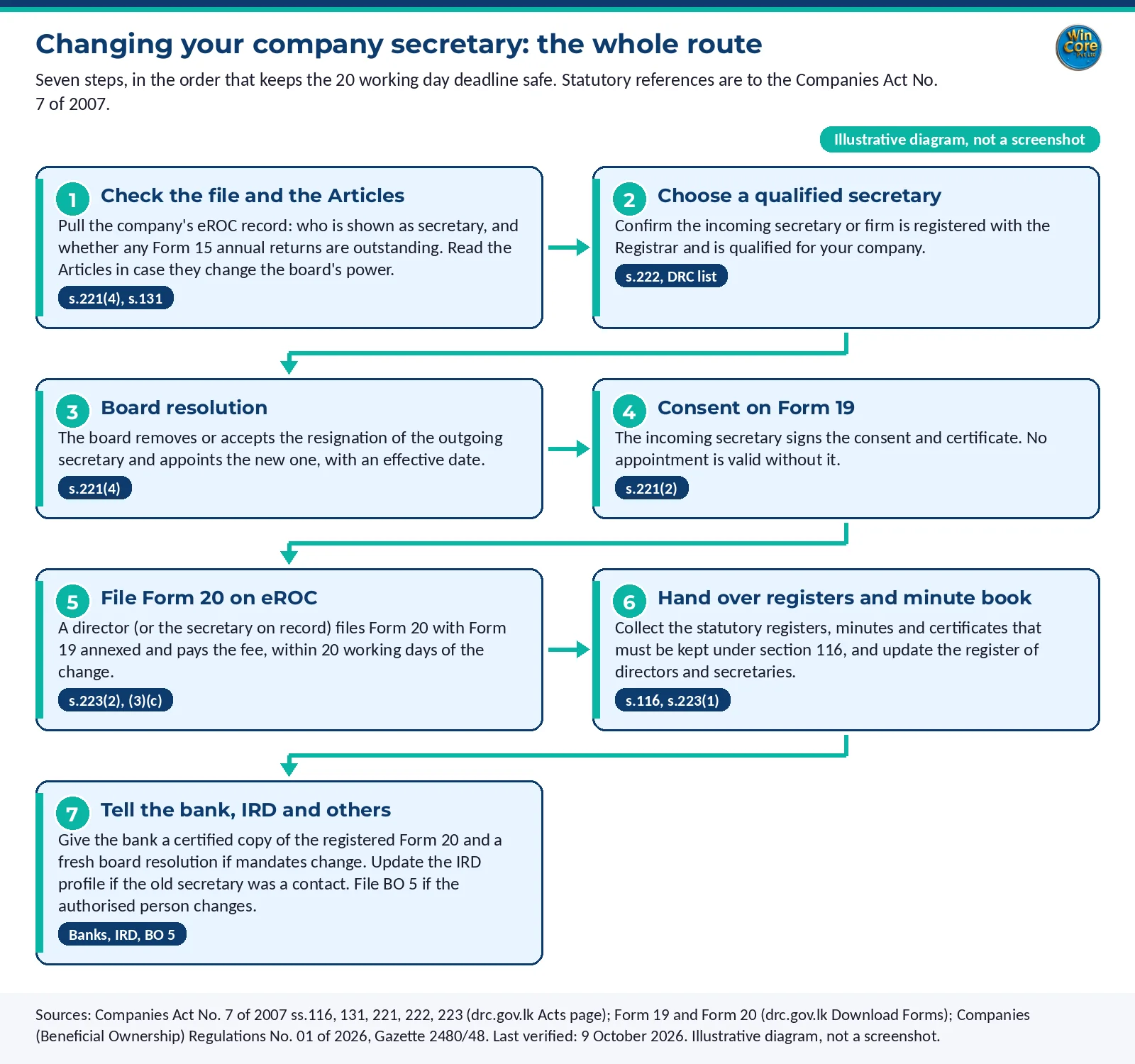
Changing a company secretary step by step: the board resolution, Form 19 consent, Form 20 within 20 working days, the fee and the handover.
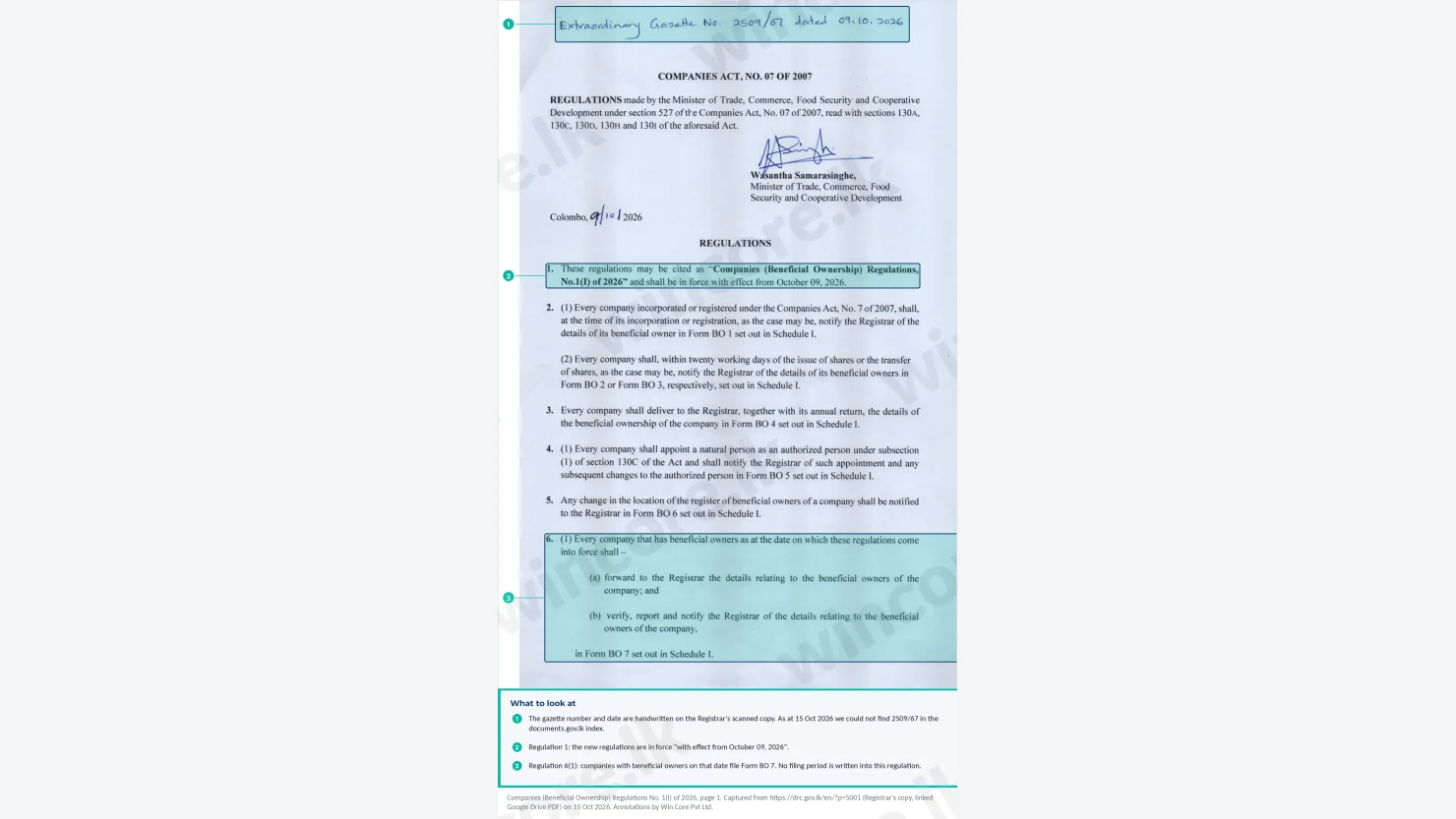
The October 2026 BO regulations replaced the March set, and from 22 October a late form costs Rs 1,000 a week. What a late BO 7 filing now costs.