
Outgoing company secretary will not sign: what the board can do
A silent former secretary cannot block the change. The board resolves, a director files, and the company rebuilds its registers from evidence.
On this page
Last verified against the primary sources on 22 October 2026.
When the outgoing company secretary will not sign, the change can still go ahead. Under section 221(4) of the Companies Act, No. 7 of 2007, the board appoints and removes the secretary unless the articles say otherwise; the duty to notify the Registrar on Form 20 within twenty working days is the company's (s.223(2) and (3)); and the Registrar's eROC guide lets a director file it. What the old secretary may still hold is the records, and the Act requires those to be kept by the company at its registered office (s.116). This piece covers both halves: changing the secretary without a signature, and rebuilding the registers.
For a routine change where everyone cooperates, our guide on how to change your company secretary sets out the seven steps.
The board can change the secretary without the outgoing secretary's signature
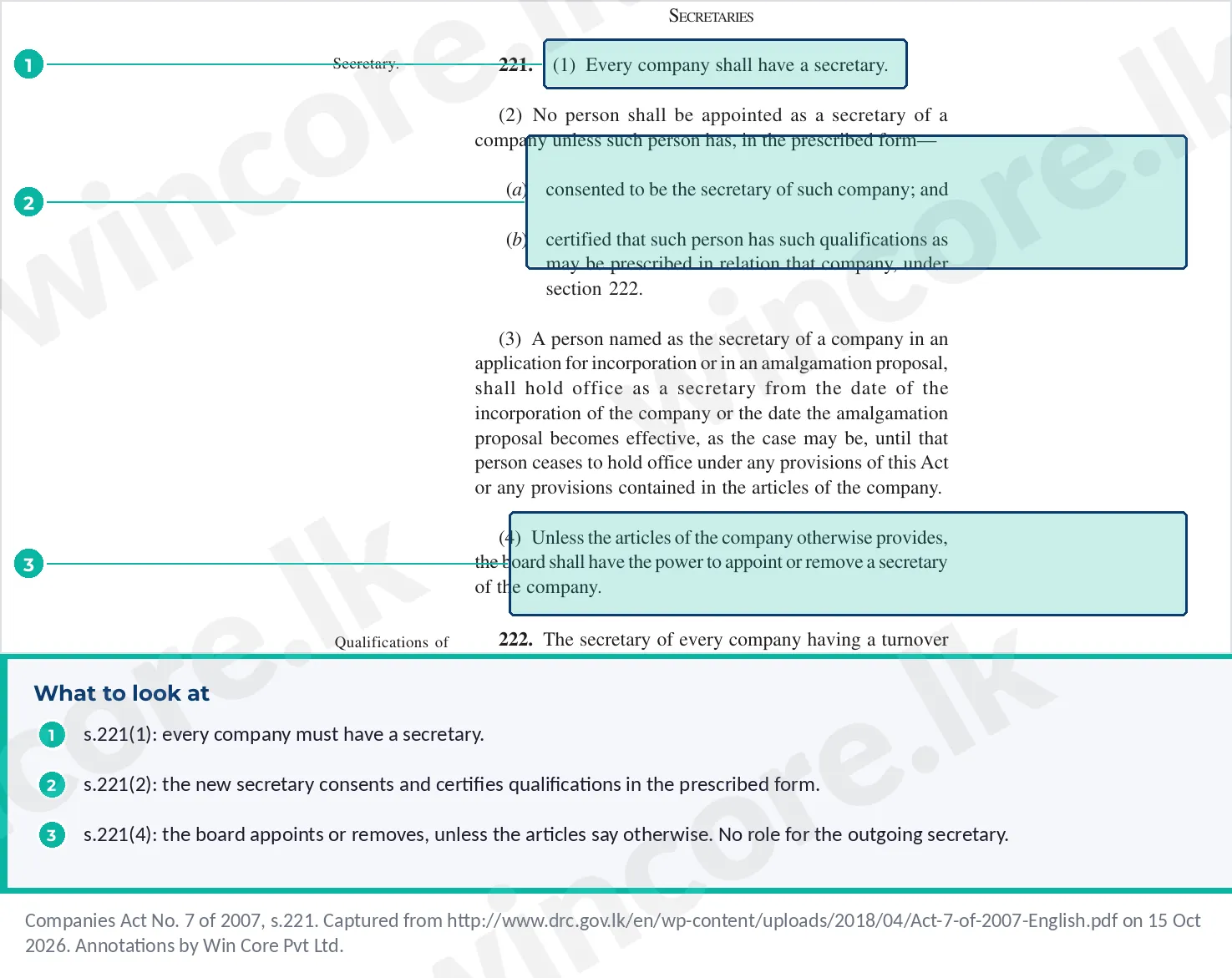
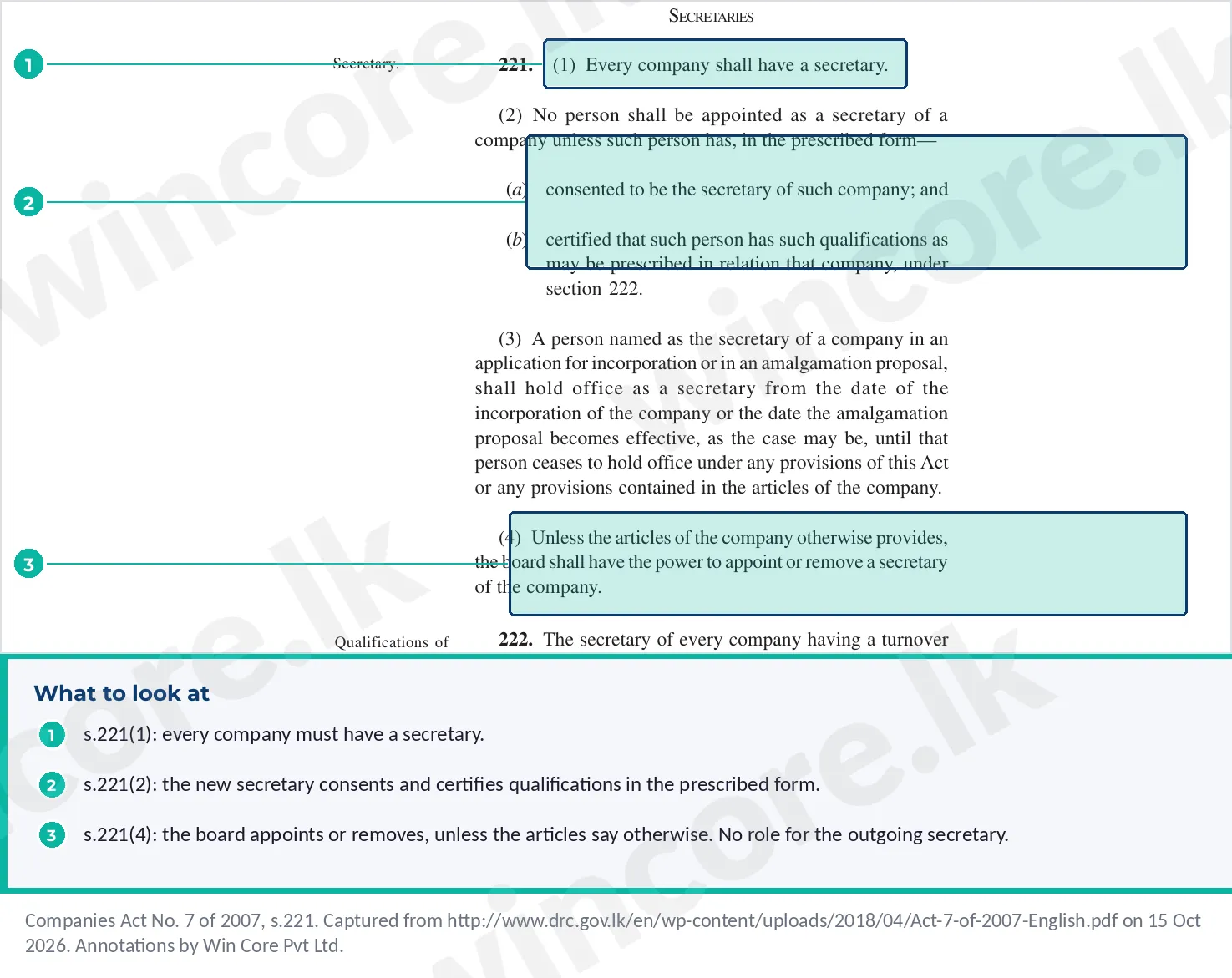
"Unless the articles of the company otherwise provides, the board shall have the power to appoint or remove a secretary of the company" (s.221(4)) [1]. Read the articles first. If they are silent, a board resolution is enough. The outgoing secretary has no part in it.
The new secretary must have consented and certified their qualifications "in the prescribed form" (s.221(2)) [1], which the Registrar's forms list as Form 19. For most companies the qualifications are in the Companies (Secretaries) Regulations, No. 1 of 2023: above Rs 500,000 of stated capital or Rs 1 million of turnover, an individual secretary must be a Sri Lankan citizen holding a Certificate of Practice and be an Attorney-at-Law or a member of a listed professional body (regs. 2 and 3) [5]. Check this before you appoint, because an act "required by law to be performed by a secretary" by someone without a valid Certificate of Practice "shall be invalid" (reg. 14) [5].
There is no statutory form for a secretary's resignation. For directors, s.207(2) says a director "may resign by signing a written notice of resignation and delivering it to the registered office" [1]; we found no equivalent for secretaries. Whether and when a secretary resigned depends on the engagement terms and the articles. Where that is disputed or the secretary simply goes silent, removal by the board under s.221(4) avoids the question.
When the outgoing secretary will not sign, a resolution records it
The resolution does the work a resignation letter would have done. On our practice it should record, with a stated date:
- that the board removes the outgoing secretary under s.221(4) (or the articles' equivalent);
- that the outgoing secretary has been asked, in writing and on dated occasions, to sign or hand over, and has not responded or is unable to do so;
- the appointment of the new secretary from a stated date, with the Form 19 consent;
- which director will sign and file Form 20; and
- a demand for the company's records and seal, if one is used, with a deadline.
Put the resolution on the company's own letterhead, signed by a director. It is the company's own decision about its own officers, so it should read as coming from the company, not from the incoming secretary. That is practice, not a legal requirement: the Act does not prescribe a letterhead.
A director can file Form 20 within twenty working days
"The company shall ensure that notice in the prescribed form of ... a change in the directors or the secretary of the company ... is delivered to the Registrar for registration" (s.223(2)) [1]. The notice must specify the date of the change, annex the new appointee's consent, and be delivered "within twenty working days of ... the change occurring, in the case of the appointment or resignation of a director or secretary" (s.223(3)) [1]. Nothing in s.223 requires the outgoing secretary to sign. (Section 223(3)(b) refers to the consent under "subsection (2) of section 211"; on our reading it means s.221(2), where the secretary's consent sits.)
The eROC user guide says Form 20 changes "can only be performed by a director, secretary or alternative director" [3]. On annual returns it adds: "If the secretary is NOT the updated secretary in the system, a Director must appoint the new secretary by logging in to the system and file a Form 20 and only then the new Secretary will be able to file F15 for the Company" [3]. For the sign-up itself, see eROC user registration.
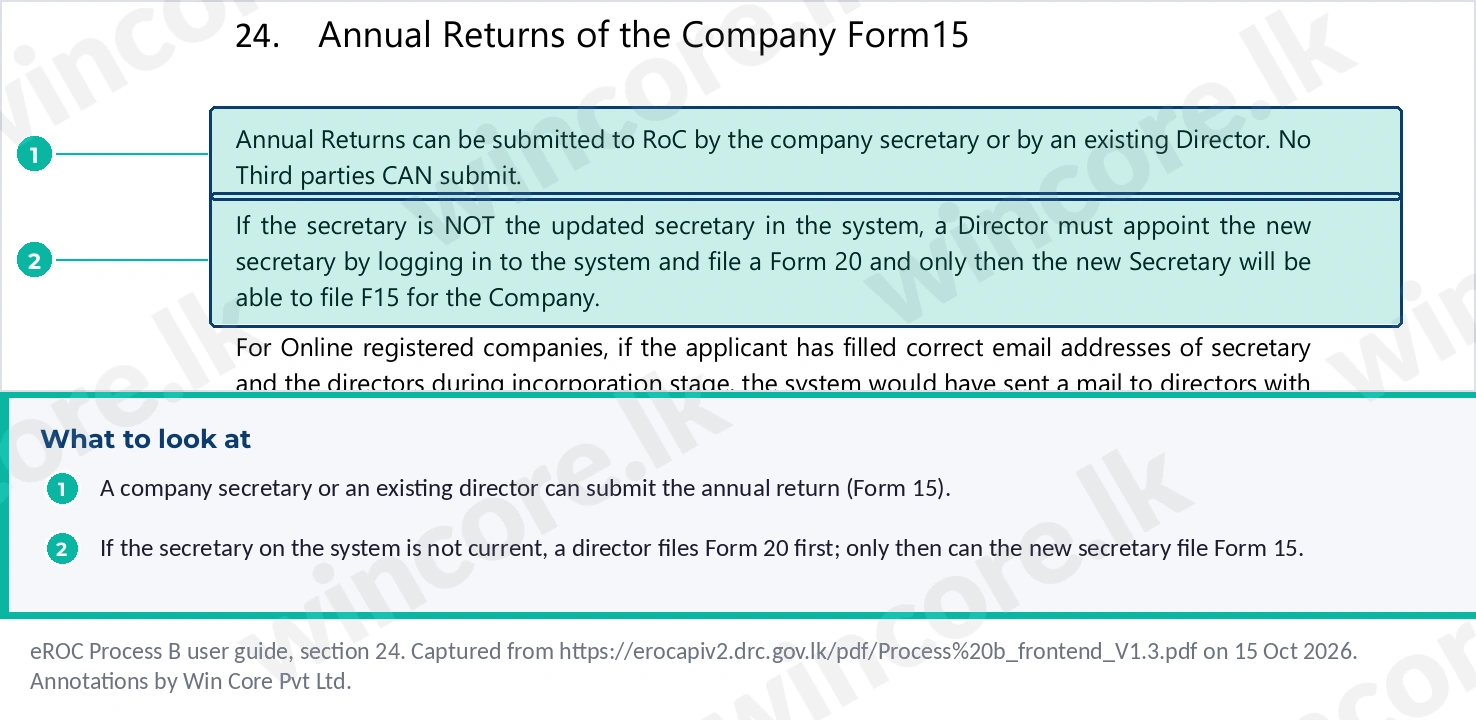
The Act requires the copy of the annual return to be "signed both by a director and the secretary of the company" (s.131(2)) [1]. So put the new secretary on record before the next return is due. Our annual return filing page and our guide to Form 15 annual return filing cover that return. The Form 20 registration fee is Rs 2,600 before VAT (item 7 of Gazette 2496/03), Rs 3,068 with VAT at 18 percent [4]; our guide to ROC government fees explains how fees are counted.
If the outgoing secretary was also the company's beneficial ownership authorised person, the company must notify the new authorised person on Form BO 5, as our beneficial ownership guide explains.
The records belong to the company, not the secretary
Section 116(1) lists the records a company "shall keep ... at its registered office", including the articles, minutes and resolutions of shareholders and of directors for the last ten years, the register of directors and secretaries, the share register and accounting records [1]. Records may be kept elsewhere in Sri Lanka only if notice reaches the Registrar "within ten working days of their first being kept elsewhere or moved" (s.116(4)) [1]. On our reading, records sitting in a former secretary's office with no notice filed put the company itself in breach.
Every director "is entitled on giving reasonable notice, to inspect the written records of the company without a charge" (s.118(1)) [1]. That right runs against the company. The Act gives no express procedure to compel a former secretary to return records; recovery is a question for a lawyer, not a filing step.
Rebuild the registers from the Registrar's file and your own documents
Rebuilding means reconstructing each record from evidence the company can still reach.
| Register or record | What the Act requires | Where to rebuild from |
|---|---|---|
| Register of directors and secretaries | Names, former names, usual residential address, business occupation (s.223(1)) | Form 20s and incorporation documents on the Registrar's file |
| Share register | Holders, holdings and dates of issue, repurchase and transfer for the last ten years (s.123(1)) | s.51(4) share issue notices; annual return shareholder lists (Fifth Schedule); signed transfer forms |
| Minutes and resolutions | Last ten years (s.116(1)) | Directors' and shareholders' own copies; bank mandates; resolutions filed with the Registrar |
| Beneficial ownership register | Details in s.130A(1), kept under s.130A(4) | Shareholder declarations under s.130A(2) |
| Accounting records | Current period and last ten completed periods (s.116(1)) | Bank statements, auditors, tax filings |
The Registrar charges Rs 1,300 before VAT to inspect a file (item 9) and Rs 1,300 before VAT to certify a document or extract (item 10) [4].
Records must be protected against falsification (s.117(2)) [1]. Our practice is to date every rebuilt register on the day it is rebuilt, note the sources used, and minute the board's adoption of it. We never backdate entries to look original; that is practice, but backdating would also sit badly with s.117(2).
Where the share register cannot be squared, for example a transfer with no evidence, s.128 lets "the person aggrieved or the company or any shareholder" apply to court for rectification, and the company delivers a copy of the order to the Registrar within ten working days (s.128(4)) [1].
Hypothetical example
A hypothetical engineering company in Kurunegala has three directors and five shareholders. Its secretarial firm stops replying after a fee dispute and keeps the minute book. On Monday 2 November 2026 the board removes the firm under s.221(4), records the unanswered requests, and appoints a new secretary, who signs Form 19 the same day. A director files Form 20 on Friday 13 November 2026, nine working days later and well inside twenty. The new secretary inspects the Registrar's file, orders certified copies of the last three annual returns, and rebuilds the share register from them and the share issue notices. One transfer has a signed form but never appeared in a return. The board records it with the evidence; if a shareholder disputed it, the route would be s.128.
Penalties fall on the company and its officers
| Failure | Company | Officer in default | Section |
|---|---|---|---|
| Records not kept at registered office, or no notice of another place | Up to Rs 200,000 | Up to Rs 100,000 | s.116(5) |
| Share register not maintained | Up to Rs 200,000 | Up to Rs 100,000 | s.123(2) |
| Form 20 notice late or missing | Up to Rs 100,000 | Up to Rs 50,000 | s.223(4) |
| Rectification order not delivered | Up to Rs 100,000 | Up to Rs 50,000 | s.128(5) |
All are maximum fines on conviction [1]. Read the subjects of ss.116, 123 and 223: "a company shall keep", "Every company ... shall maintain", "The company shall ensure". The secretary carries out the filings; the company answers for them. That is why the company can, and should, act without the old secretary.
What this means for you
You do not need the outgoing secretary's cooperation to change secretary. You need a clear board resolution, a qualified new secretary, a director with eROC access, and your own evidence. Start rebuilding the registers at once, because the next annual return depends on them. Our corporate secretarial services take over as secretary of record and rebuild the registers, and our annual filing checklist shows what falls due next.
Checklist: documents needed
- Current articles, checked for any rule on appointing or removing the secretary
- Copies of the written requests to the outgoing secretary, with dates
- Board resolution on the company's own letterhead, signed by a director
- New secretary's Form 19 and Certificate of Practice details
- Form 20, signed and filed by a director within twenty working days
- Certified copies from the Registrar's file (annual returns, Form 20s, share issue notices)
- Directors' and shareholders' own copies of minutes and resolutions
- Rebuilt registers, dated, with a note of sources and the board minute adopting them
FAQ
Can a director file Form 20 if the old secretary will not sign?
Yes. The eROC user guide says Form 20 changes can be performed by a director, secretary or alternative director, and s.223 puts the duty to notify on the company, not on the outgoing secretary. The board resolves to remove and appoint, the new secretary signs Form 19, and a director files Form 20 within twenty working days. When a director's particulars change, see how to update them on Form 20.
How long do we have to file Form 20?
Twenty working days from the change, under s.223(3)(c)(i) of the Companies Act. Count from the date stated in the board resolution, leaving out weekends and public holidays. A late or missing notice can cost the company up to Rs 100,000 and each officer in default up to Rs 50,000 under s.223(4).
What if the articles require a shareholder decision to remove the secretary?
Then follow the articles. Section 221(4) gives the board the power to appoint or remove the secretary only "unless the articles of the company otherwise provides". If the articles reserve the decision to shareholders, pass the shareholder resolution first, then file Form 20 within twenty working days of the change it makes.
Can we file the annual return before the new secretary is on record?
Not safely. The eROC guide lets a director submit Form 15, but s.131(2) requires the copy of the return to be signed by a director and the secretary. The guide also says a new secretary can file Form 15 only after a director has filed Form 20. Put the new secretary on record first.
Can the old secretary keep our minute book?
No. Section 116 requires the company to keep its minutes, registers and other records at its registered office, or elsewhere in Sri Lanka with notice to the Registrar. The Act gives no express procedure to force a former secretary to return them, so demand them in writing and take legal advice if they are withheld.
Open points
- No provision found on how a secretary resigns, or on compelling a former secretary to return records.
- The s.223(3)(b) reference to s.211: read as s.221(2); no Registrar notice confirms it.
- Whether the Registrar accepts a Form 20 recording a removal the former secretary disputes: no notice located.
- Whether the Registrar charges Form 20 "per one person" when one notice records both a removal and an appointment.
The short version
The board appoints and removes the secretary, the company files Form 20 within twenty working days, and a director can file it. The records belong at the registered office. If the old secretary keeps them, rebuild from the Registrar's file and your own documents, dated openly and adopted by the board.
Talk to us. If your secretary has gone silent and a filing is coming due, our contact page.
WinCore Pvt Ltd
This article is general information on the law and published procedures as at 22 October 2026 and is not advice on your specific situation.
References
- Parliament of Sri Lanka. Companies Act, No. 7 of 2007, ss.51(4), 116 to 118, 123, 128, 131, 207, 221 to 223 and Fifth Schedule. http://www.drc.gov.lk/en/wp-content/uploads/2018/04/Act-7-of-2007-English.pdf . Primary. Accessed 15 October 2026 (full text not re-fetched on 22 October 2026; ss.116, 123, 221 to 223 confirmed unamended by Act No. 12 of 2025 on 22 October 2026).
- Parliament of Sri Lanka. Companies (Amendment) Act, No. 12 of 2025, s.130A. https://www.parliament.lk/uploads/acts/gbills/english/6389.pdf . Primary. Accessed 22 October 2026.
- Department of the Registrar of Companies. eROC Process B public interface user guide, v1.3, sections 17 and 24. https://erocapiv2.drc.gov.lk/pdf/Process%20b_frontend_V1.3.pdf . Primary (administrative). Accessed 15 October 2026.
- Government of Sri Lanka. Gazette Extraordinary No. 2496/03 (6 July 2026), Companies fees, items 7, 9 and 10. https://drc.gov.lk/en/wp-content/uploads/2026/07/2496-03_E.pdf . Primary. Accessed 15 October 2026.
- Minister of Industries. Companies (Secretaries) Regulations, No. 1 of 2023, Gazette Extraordinary No. 2323/41 (17 March 2023), regs. 2, 3 and 14. Government Printer's copy hosted by the Institute of Chartered Corporate Secretaries of Sri Lanka: https://iccslk.org/en/wp-content/uploads/2024/07/ROC-Gazette-17-March-2023.pdf . Primary (Gazette text). Accessed 22 October 2026.
Put these insights to work
WinCore specialists can review your current workflow, document gaps, and build a practical 90-day action plan.
Book a free consultationContinue reading
Explore more WinCore analysis to keep your finance, tax, and compliance roadmap moving.
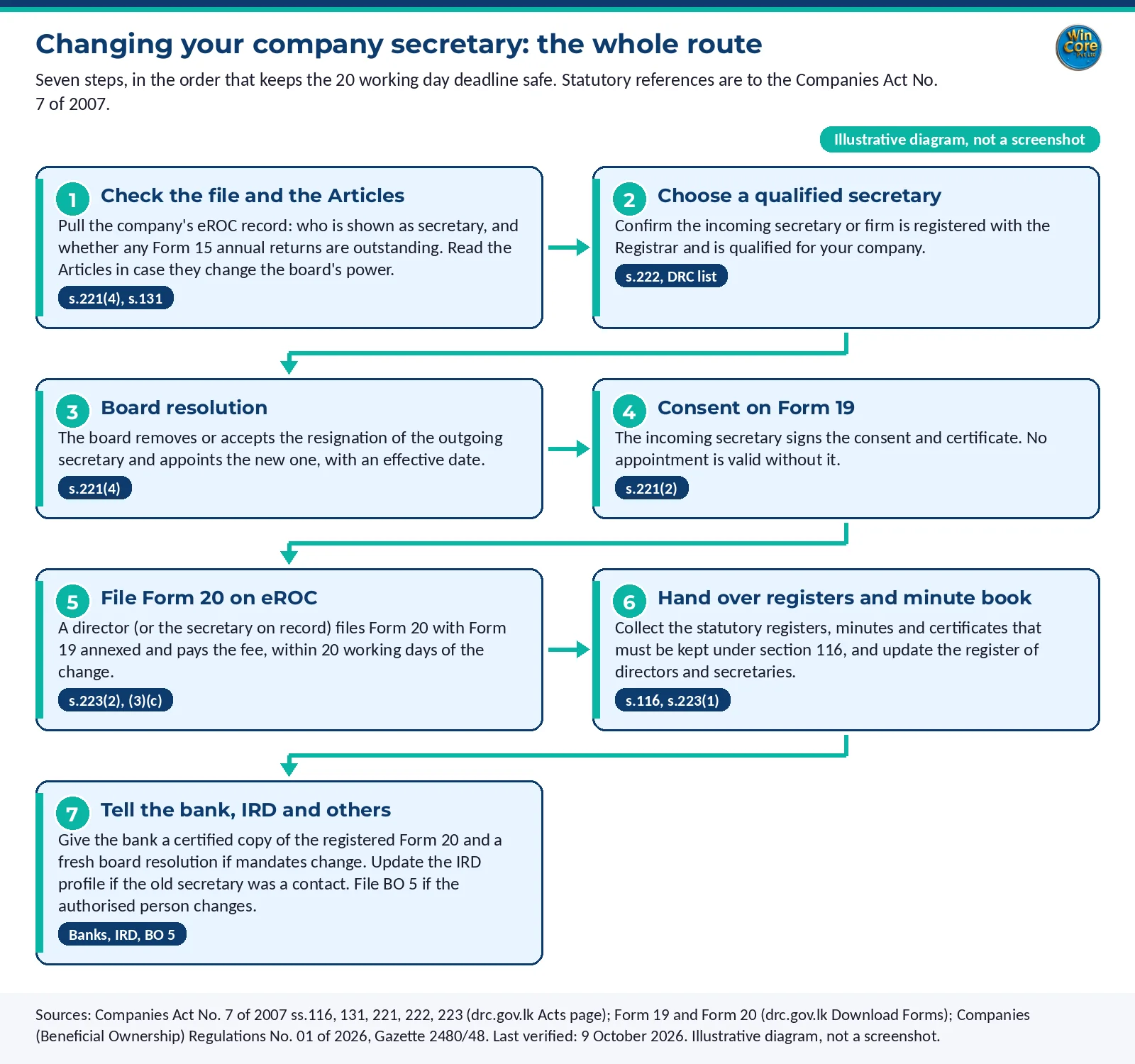
Changing a company secretary step by step: the board resolution, Form 19 consent, Form 20 within 20 working days, the fee and the handover.
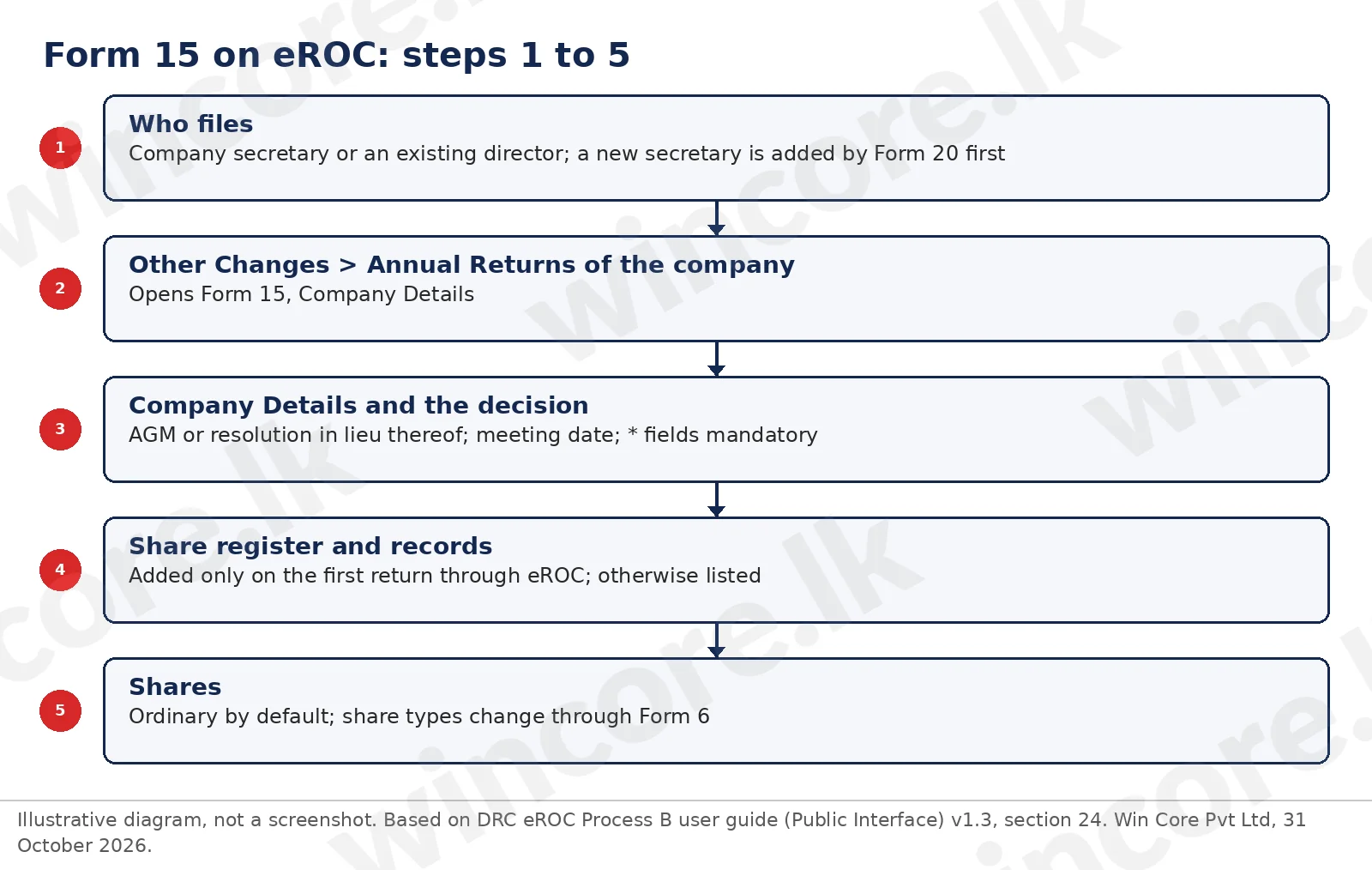
Treat Form 15 as a live governance filing: the 30-working-day clock from the AGM, the BO 4 that goes with it, the fee, and the controls that keep it on time.
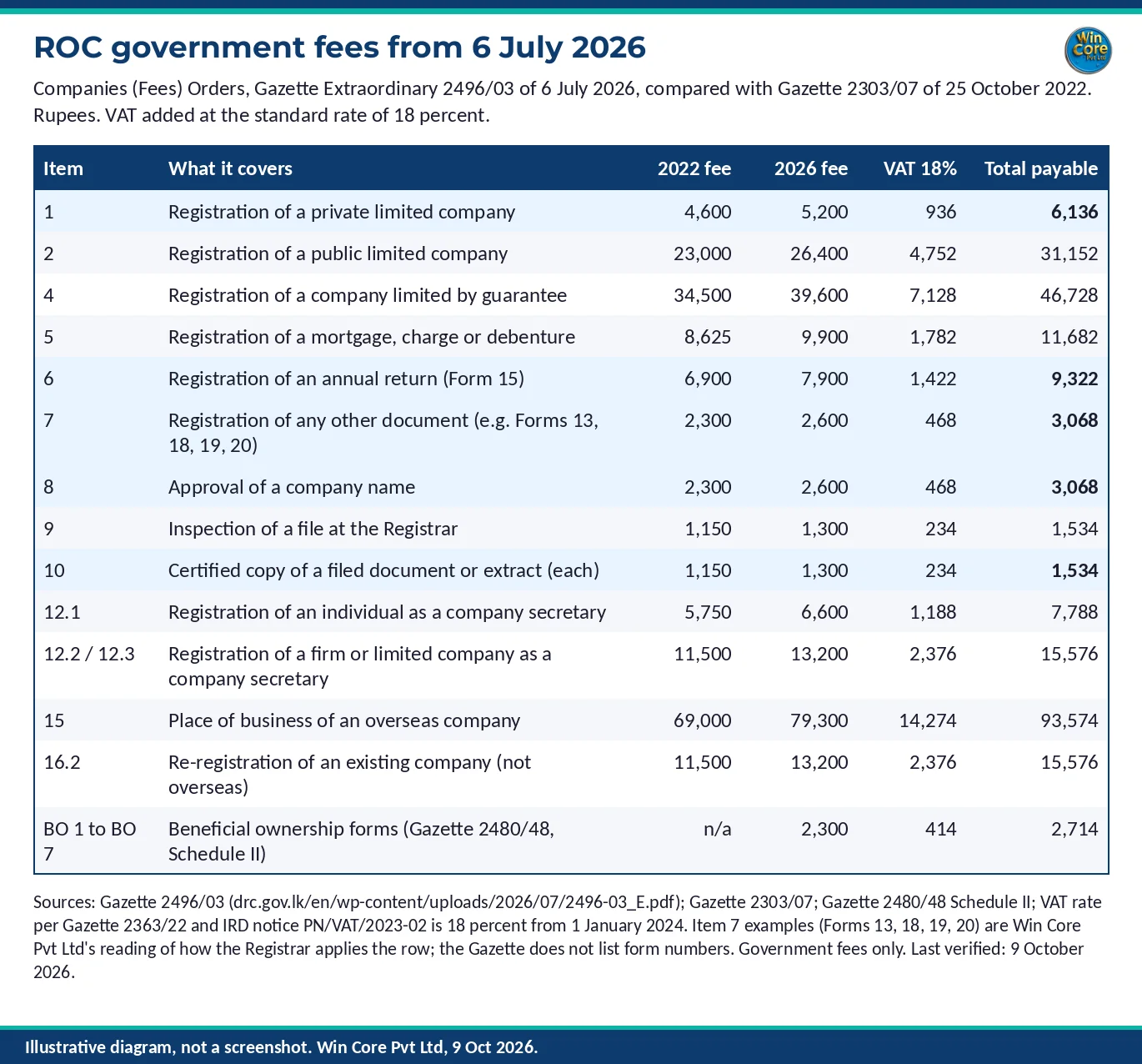
Every Registrar of Companies fee from 6 July 2026 with VAT added, and worked costs for an incorporation, a late Form 15 and a secretary change.