
How to change your company secretary in Sri Lanka
Changing a company secretary step by step: the board resolution, Form 19 consent, Form 20 within 20 working days, the fee and the handover.
On this page
By WinCore Pvt Ltd. Last verified: 9 October 2026.
Changing a company secretary has two halves, and they run on different clocks. The legal half is changing the name on the lock: the board appoints someone new, that person consents, and the Registrar of Companies is told on Form 20 within twenty working days. The practical half is collecting the keys: the registers, the minute book, the certificates, and telling the bank and the tax office who now holds them. Companies tend to start with the keys, because that is where the frustration is. The law starts with the lock.
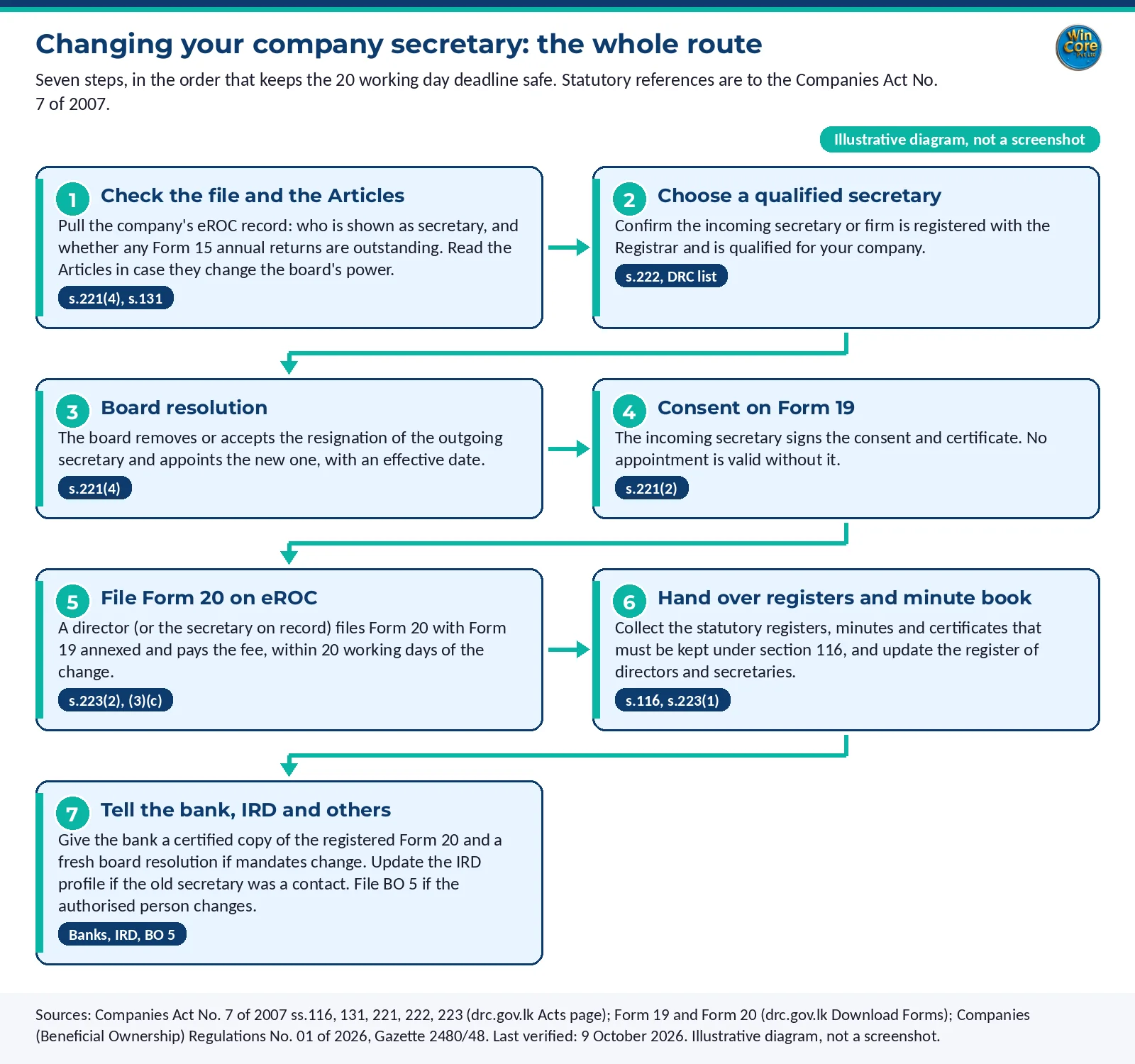
This guide walks through the seven steps in order, with the section of the Companies Act No. 7 of 2007 behind each one, the official forms, the government fee from the 2026 fees Gazette, and what usually goes wrong.
What the law requires, in four sentences
Every company must have a secretary (section 221(1)). Unless the Articles say otherwise, the board has the power to appoint or remove the secretary (section 221(4)). Nobody can be appointed unless they have, in the prescribed form, consented and certified that they hold the prescribed qualifications (section 221(2)). The company must deliver notice of the change to the Registrar in the prescribed form, with the new secretary's consent annexed, "within twenty working days" of the change (section 223(2) and (3)).
Section 223(4) makes failure an offence: on conviction, a fine of up to Rs 100,000 for the company and up to Rs 50,000 for every officer in default. The Companies (Amendment) Act No. 12 of 2025 did not change sections 221 to 223.
Instrument: Companies Act No. 7 of 2007, ss.221 to 223, official PDF on drc.gov.lk. Last verified: 9 October 2026.
Step 1: check the company's file and its Articles
What to do. Before anyone resigns, look at what the Registrar holds. Who is shown as secretary on eROC? Are any Form 15 annual returns outstanding? Do the Articles change the board's power to appoint or remove the secretary?
Where. The company's eROC record (a director's login), certified copies if you need them on paper, and the Articles held at the registered office.
What you need. The company number and a director's eROC login.
What goes wrong. Outstanding annual returns. The DRC's own eROC manual says that if the secretary on the system is not the current secretary, "a Director must appoint the new secretary by logging in to the system and file a Form 20 and only then the new Secretary will be able to file F15 for the Company." A backlog of Form 15s therefore has to be cleared by whoever is on record, or after the Form 20 is in. Late returns attract a compounding charge under section 514 of the Act; our ROC fees guide explains how that charge works, and our company secretarial service can clear a backlog.
How long. An hour, if a director can log in.
Step 2: choose a qualified, registered secretary
What to do. Confirm that the incoming secretary, whether an individual or a firm, holds the qualification your company needs and is registered with the Registrar.
Where. Section 222 of the Act says the secretary of a company with a turnover or stated capital above a prescribed amount must have prescribed qualifications. The DRC publishes yearly lists of registered company secretaries and secretary firms under the Companies (Secretaries) Regulations, No. 1 of 2023 (Gazette 2323/41), which rescinded the 1987 Regulations (regulation 15). The latest list, covering registrations in 2025, was published on 3 July 2026.
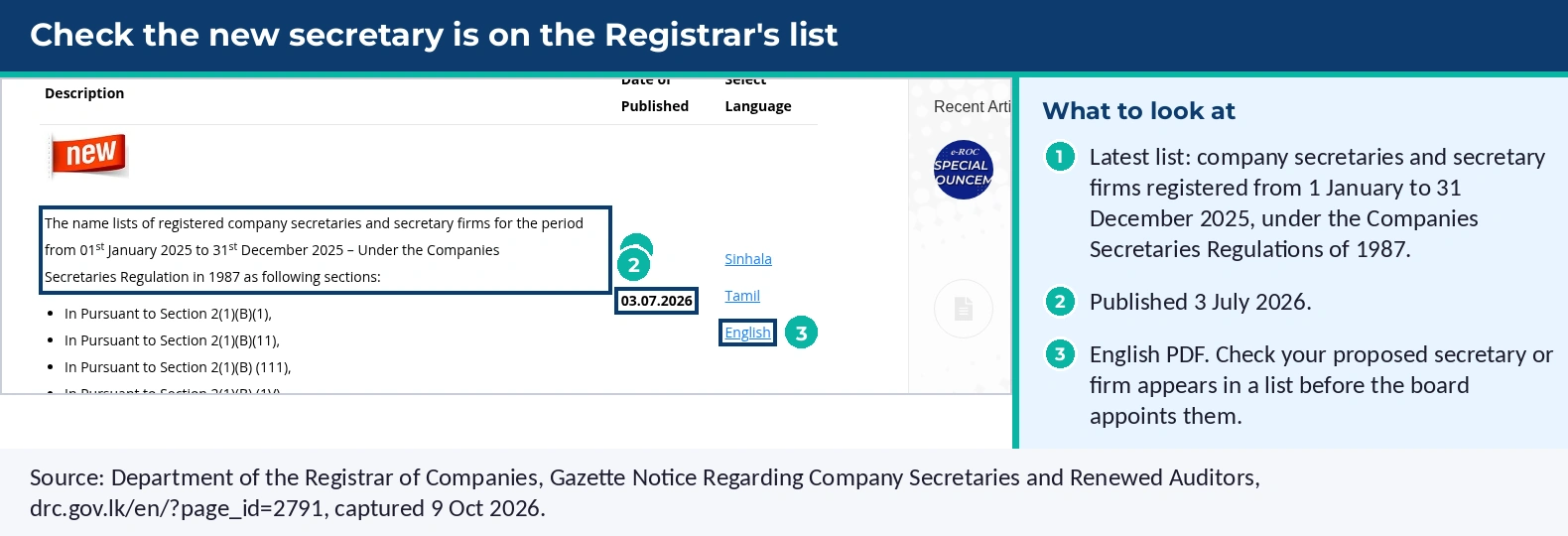
What you need. The secretary's full name, NIC or passport number, address and, if registered, the registration number.
What goes wrong. Appointing an unqualified person because they are convenient, or a firm that has not registered. Where the company has stated capital of Rs 500,000 or more or turnover of Rs 1 million or more (regulation 2), the secretary must hold a Certificate of Practice issued by the Registrar (regulation 5(1)).
The secretary's own fees. The secretary pays these, not the company, and two Gazettes set them for two different things. The Schedule to the 2023 Regulations, made under section 222 of the Act, prices the Certificate of Practice: Rs 10,000, non-refundable, to apply (regulation 5(2)); Rs 2,500 for an individual or Rs 5,000 for others to renew it (regulation 9(1)); and the same amounts to notify a change in the secretary's details (regulation 10(2)). Item 12 of the Companies (Fees) Orders, made under section 477 and last amended by Gazette 2496/03 of 6 July 2026, is the Registrar's fee for registering as a company secretary: Rs 6,600 for an individual and Rs 13,200 for a sole proprietorship, partnership or limited company, plus VAT. The 2026 Order amends only the 2022 Fees Orders; it does not mention the 2023 Schedule, so it does not replace it and both stand. Neither instrument says whether eROC collects both at a first application, so the payment screen gives the final figure. The Registrar's notice re-posted on 30 December 2025 says there is no impediment to acting as a secretary registered through eROC "until further notice", so a yearly renewal does not appear to be called for at present. None of these is payable by a company that is changing its secretary: its government cost is the Form 20 fee in Step 5. To link a company to your login, see how to connect a company to an eROC account.
How long. A day to check.
If the secretary also supplies the address, settle the registered-office arrangements before ending the old engagement.
Step 3: pass the board resolution
What to do. The board resolves to accept the outgoing secretary's resignation (or to remove them, if the Articles allow) and to appoint the new secretary from a stated date. Record it in the minutes.
Where. A board meeting or a written resolution signed by the directors, depending on the Articles.
What you need. The resignation letter if there is one, the incoming secretary's details, and the effective date.
What goes wrong. Leaving the effective date blank. The twenty working days under section 223(3)(c) run from "the change occurring", so the date in the resolution sets the deadline. Banks will usually want a certified copy of this resolution too.
How long. A day.
Step 4: get the new secretary's consent on Form 19
What to do. The incoming secretary signs Form 19, the Consent and Certificate of Secretary under section 221(2), stating the date of appointment and, if applicable, their registration number.
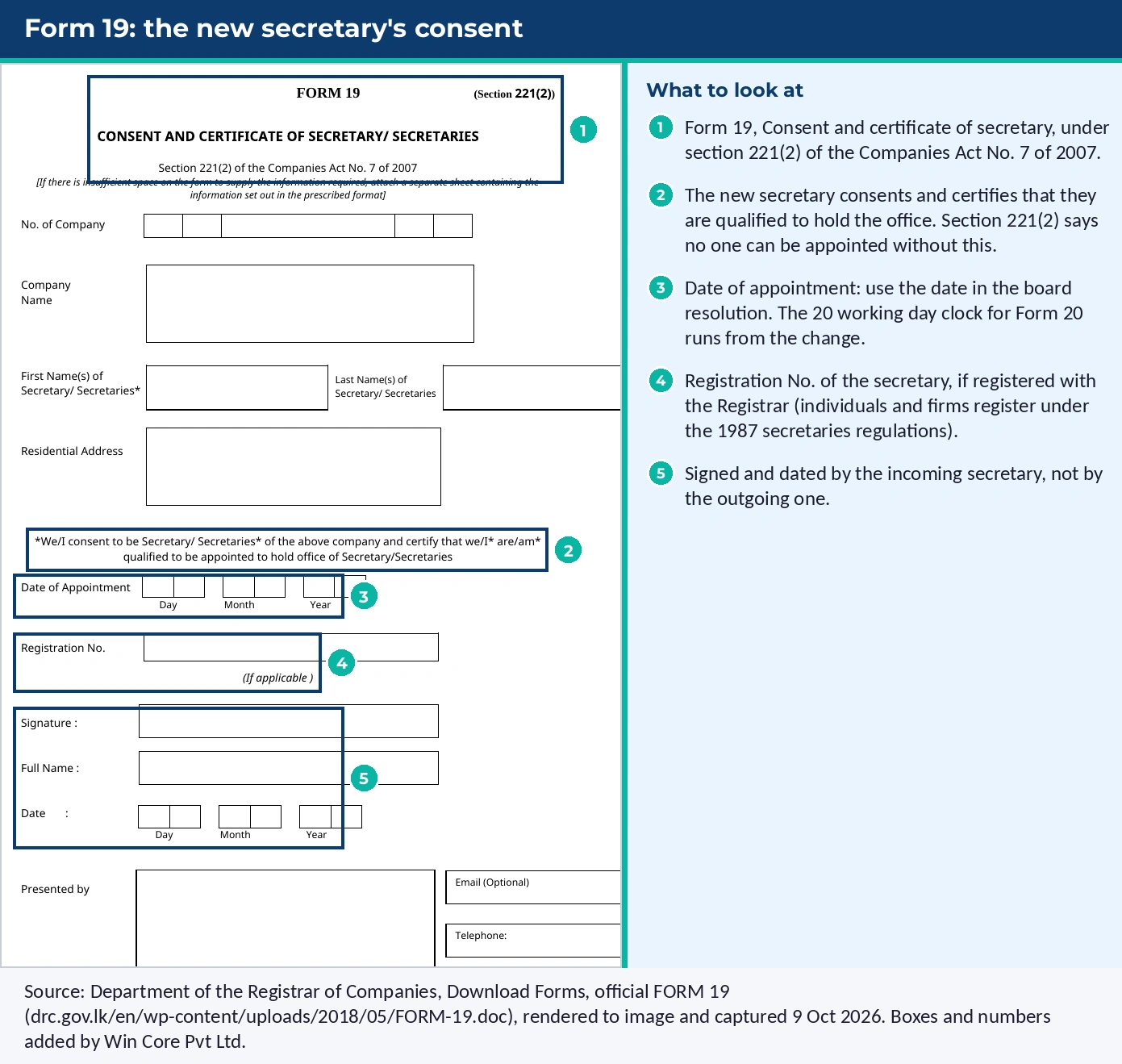
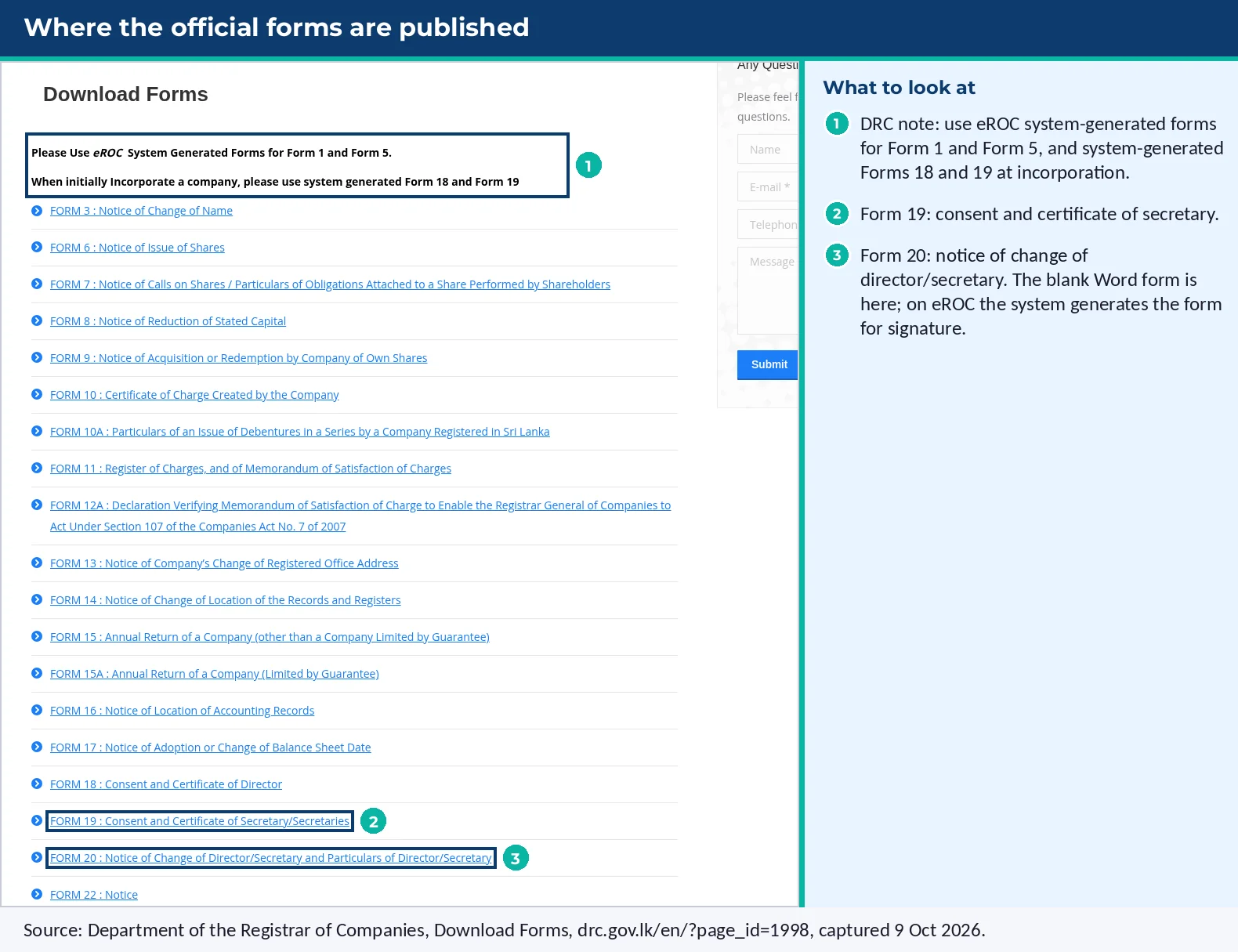
Where. The blank form is on the DRC Download Forms page; on eROC the system generates the forms for signature.
What you need. The board resolution's effective date and the new secretary's registration number, if they are registered.
What goes wrong. The outgoing secretary signing it, or a date that does not match the resolution.
How long. Same day, once the secretary has agreed terms.
Step 5: file Form 20 on eROC within twenty working days
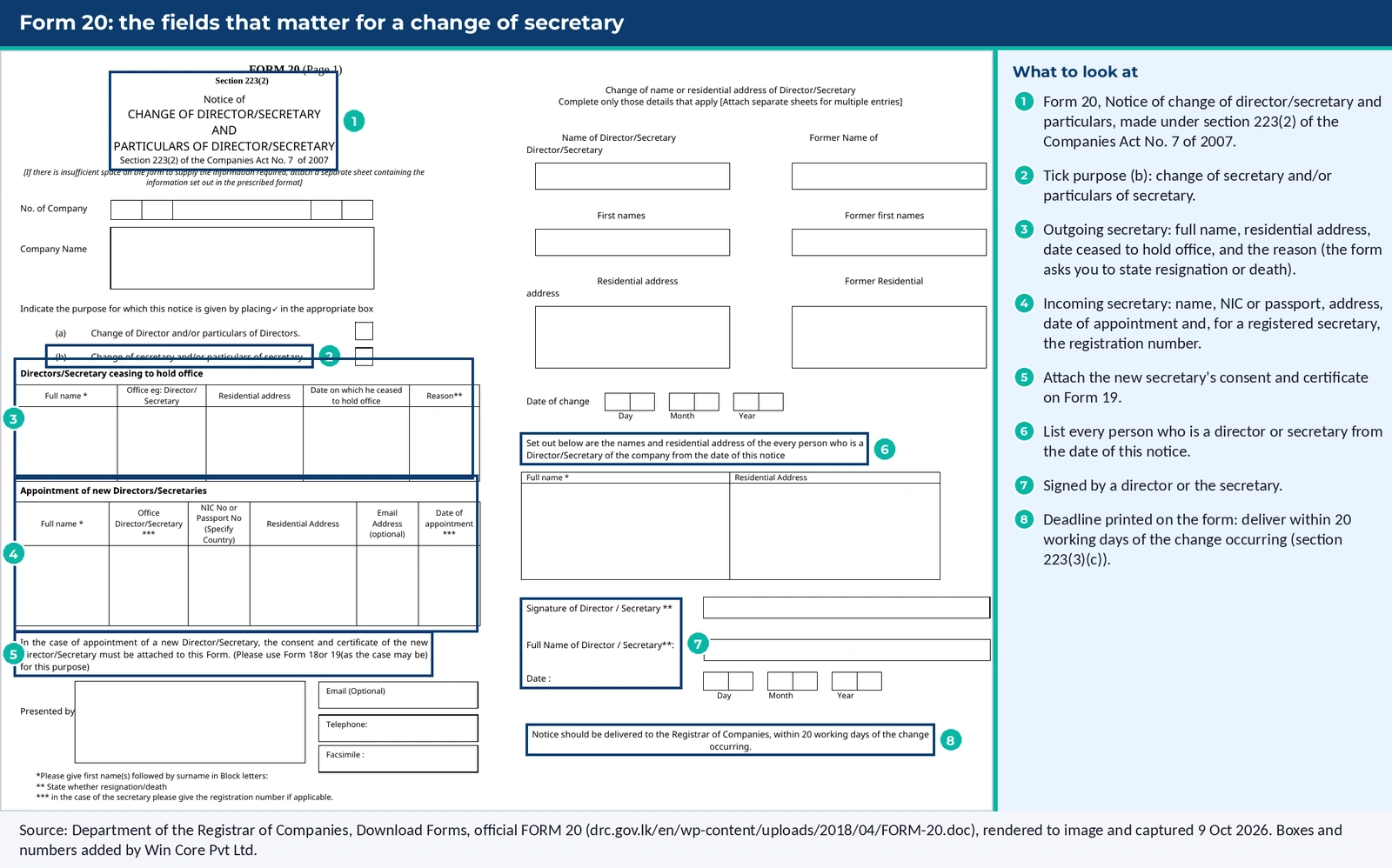
What to do. File Form 20, the "Notice of Change of Director/Secretary and Particulars of Director/Secretary", ticking purpose (b), change of secretary. Record the outgoing secretary in "ceasing to hold office" and the new one in "appointment", attach Form 19, sign and pay.
Where. eroc.drc.gov.lk. The filing happens behind a login, so the steps are shown below as a diagram drawn from the DRC's public user guide for company changes, not as screenshots.
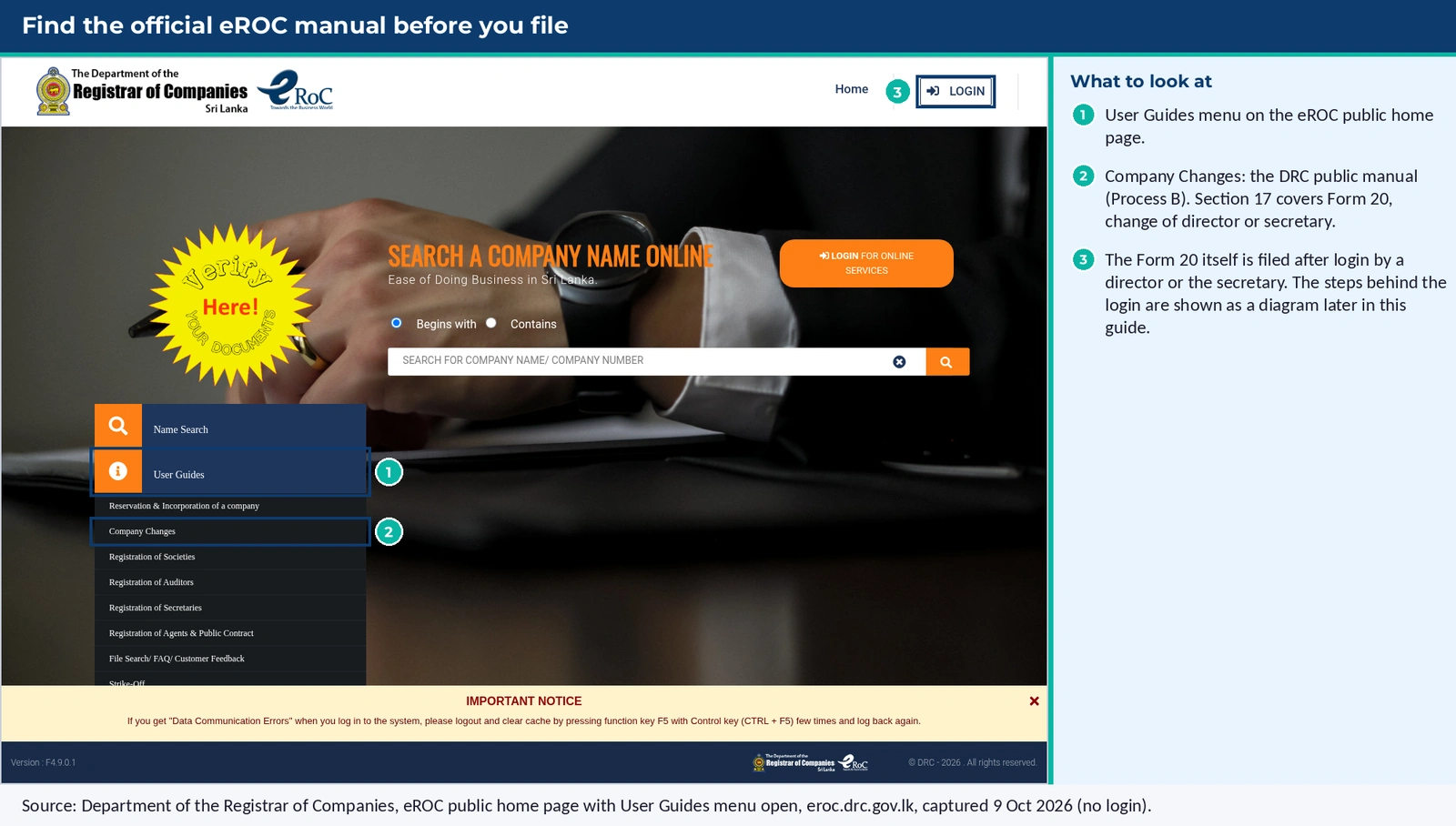
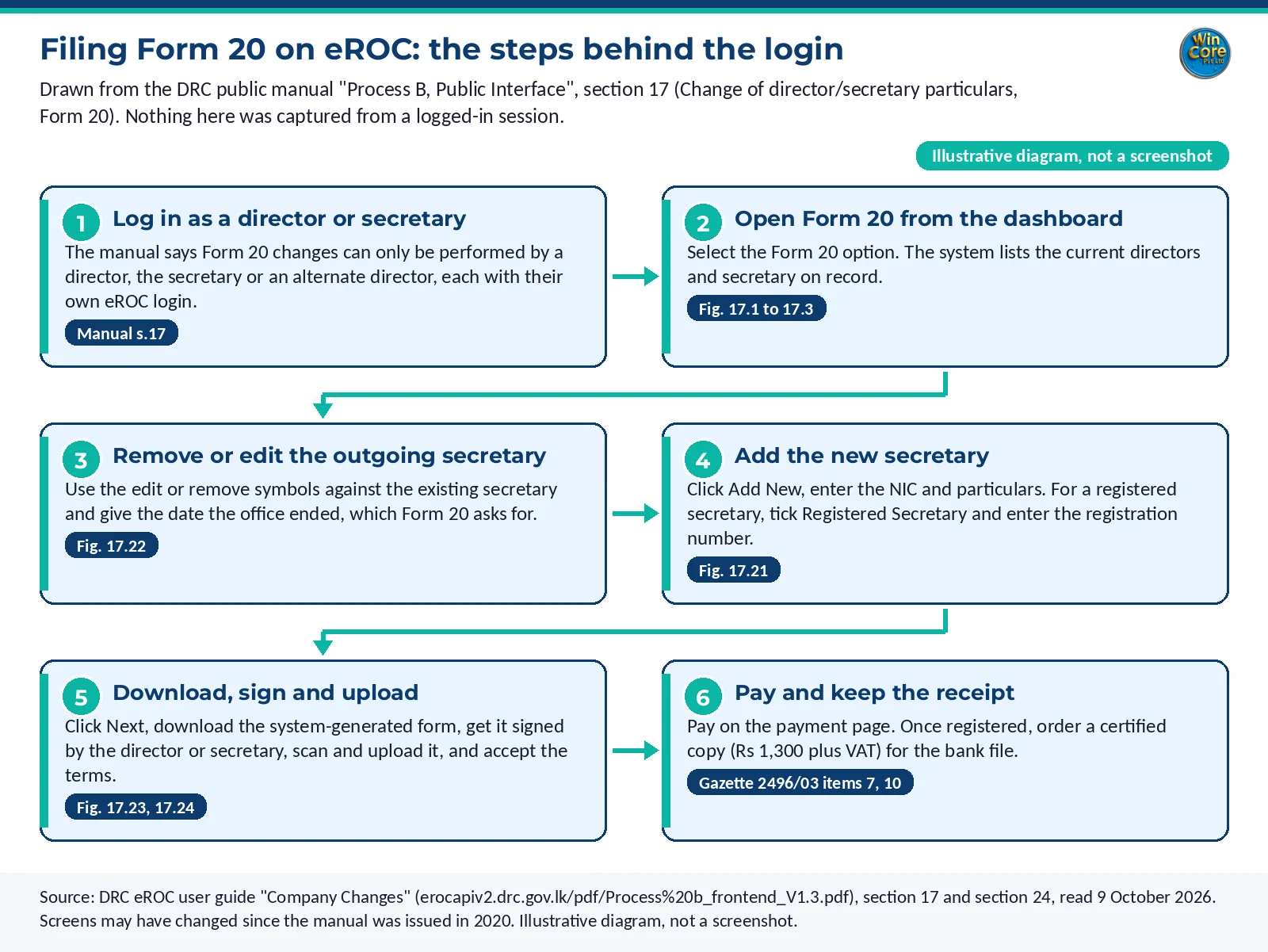
The manual says Form 20 changes "can only be performed by a director, secretary or alternative director", each with their own eROC login. For a registered secretary, tick "Registered Secretary" and enter the registration number.
The fee. Form 20 falls under item 7 of the Companies (Fees) Orders in Gazette 2496/03 of 6 July 2026, the registration of any document: Rs 2,600 plus VAT at 18 percent, which is Rs 3,068. The DRC guidance page describes the Form 20 charge as "per one person", so if eROC counts the outgoing and incoming secretary separately, expect Rs 6,136. The payment screen gives the final figure. Our ROC fees guide has the full 2026 schedule.
Instrument: Gazette Extraordinary 2496/03 of 6 July 2026, item 7, official PDF. Last verified: 9 October 2026.
What you need. A director's or the current secretary's eROC login, the new secretary's particulars, the signed Form 19 and a payment card.
What goes wrong. Missing the twenty working days because everyone was waiting for the handover. The handover does not have to come first.
How long. Filing takes under an hour. The Registrar's processing time varies, and we do not quote it.
Step 6: hand over the statutory registers and minute book
What to do. Collect from the outgoing secretary everything the company must keep under section 116(1), and update the register of directors and secretaries (section 223(1)).
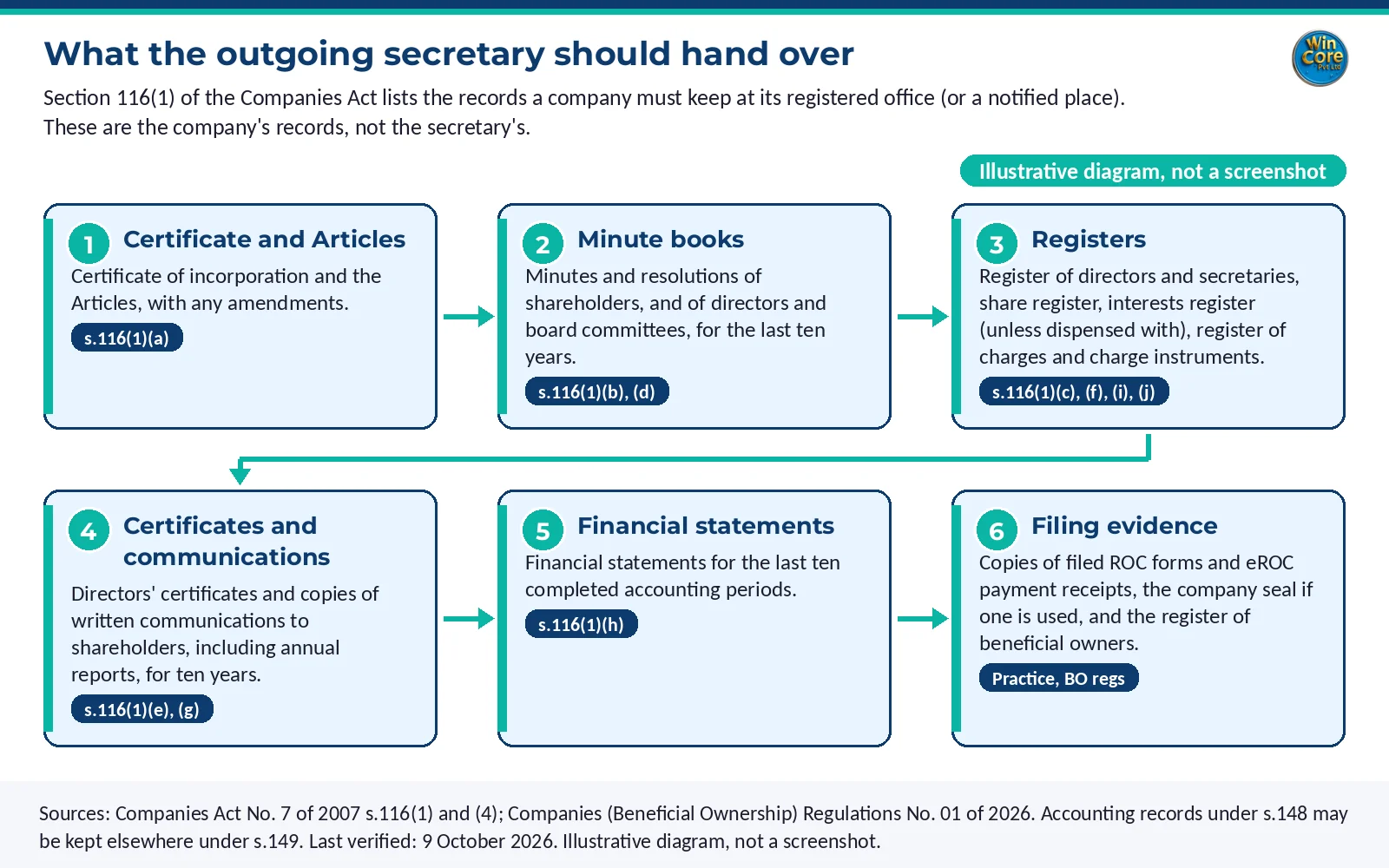
Section 116(1) lists, among others: the certificate of incorporation and Articles; minutes and resolutions of shareholders and of directors for the last ten years; the interests register (unless a private company has dispensed with it); directors' certificates; the register of directors and secretaries; copies of written communications to shareholders; financial statements for the last ten completed accounting periods; the register of charges; and the share register. If the records will be kept somewhere other than the registered office, section 116(4) requires notice to the Registrar within ten working days.
Where. At the registered office, or wherever the outgoing secretary kept them.
What you need. A written handover list, signed by both secretaries, of every record and where it is kept.
What goes wrong. A secretary who will not hand anything over. This happens more than it should, and it does not stop the change: the board can still pass the resolution and a director can sign and file Form 20. The registers can be rebuilt from the Registrar's file and the company's own records. We cover that situation, including the board resolution declaring the outgoing secretary unavailable, in our guide for when the outgoing company secretary will not sign. For how a secretary registers, see company secretary registration on eROC.
How long. A week if the outgoing secretary cooperates; longer if the registers have to be reconstructed from certified copies.
Instrument: Companies Act No. 7 of 2007, s.116 and s.223(1), official PDF. Last verified: 9 October 2026.
Step 7: tell the bank, the IRD and anyone else who relies on the old name
A brief detour, because this step is where most of the follow-up calls come from. A company secretary has no power over the bank account and holds no shares, yet banks, auditors and government offices treat the secretary as the company's point of record. Change the person and every one of those relationships needs a document. Back to the keys.
Banks. Give the bank a certified copy of the registered Form 20 (item 10 of Gazette 2496/03: Rs 1,300 plus VAT, Rs 1,534, per document) and a certified copy of the board resolution. If the board changes signatories or mandates at the same meeting, the bank will want that resolution as well.
Inland Revenue. The IRD's 2026 taxpayer registration guidelines list "Form 01 / Form 20 certified by Registrar of Companies" among the supporting documents for updating a company's registration details, which is done through IRD e-services. Update the company's profile if the outgoing secretary was the registered contact, email or mobile number, or a person the IRD dealt with for the company.
Beneficial ownership. If the outgoing secretary was also the company's authorised person under section 130C of the Companies Act (who must be "a natural person residing in Sri Lanka"), the company must notify the change on Form BO 5 under regulation 4 of the Companies (Beneficial Ownership) Regulations No. 1(I) of 2026, in force from 9 October 2026. The fee is Rs 2,300 plus applicable taxes (Schedule II, Gazette 2509/67). Our guide to beneficial ownership filings for existing companies walks through the BO 5 screen.
Others. The auditor, the company's letterhead and website if they name the secretary, and any licensing body that holds the company's officer details.
What goes wrong. Giving the bank an uncertified printout. A document from an eROC file search "can't be used as a certified copy", according to the DRC's file search guide.
How long. A day to send the documents. Neither the banks nor the IRD publish an update timeline, so ask when you submit.
Instruments: IRD Taxpayer Guidelines for Registration and Update (2026), TPR_Guidelines_2026_E.pdf; Companies (Beneficial Ownership) Regulations No. 1(I) of 2026, Gazette 2509/67 of 9 October 2026 (as posted by the Registrar); Companies (Amendment) Act No. 12 of 2025, s.130C, official PDF. Last verified: 9 October 2026.
Documents you need
Checklist: changing your company secretary
- Company number and a director's eROC login
- The Articles of association (to confirm the board's power under s.221(4))
- Outgoing secretary's resignation letter, or the board's removal decision
- Board resolution appointing the new secretary, with the effective date
- Form 19, consent and certificate, signed by the new secretary
- New secretary's full name, NIC or passport number, residential address, email and registration number (if registered)
- Form 20, generated on eROC, signed by a director or the secretary
- Payment card for the Form 20 fee (Rs 3,068 including VAT per Form 20 line)
- Form BO 5, if the authorised person is changing
- Handover list of the section 116 records
- Certified copies of the registered Form 20 for the bank and the IRD
What usually goes wrong
So what actually trips companies up? Rarely the form. It is almost always sequencing: waiting for the outgoing secretary's cooperation before filing anything, then discovering the twenty working days have gone, or that a Form 15 cannot be filed because the system still shows the old secretary. File the change first. Collect the records second. The order matters more than the speed.
We will admit that none of this is complicated. It is a resolution, two forms and some phone calls. It becomes complicated only when the steps are done in the order that feels natural rather than the order the Act sets.
Frequently asked questions
Can we change our company secretary without the old secretary's signature?
Yes. The board appoints and removes the secretary under section 221(4), unless the Articles say otherwise, and Form 20 can be signed and filed by a director. The outgoing secretary's cooperation helps with the handover of records but is not needed for the filing. Our guide for when the outgoing company secretary will not sign covers that case.
What is the deadline to file Form 20 for a new secretary?
Twenty working days from the change occurring, under section 223(3)(c) of the Companies Act No. 7 of 2007. The same deadline is printed on Form 20.
How much does the ROC charge to change a secretary?
Rs 2,600 plus VAT (Rs 3,068) under item 7 of Gazette 2496/03. The eROC payment screen gives the final figure, which may be higher if each person on the form is charged separately. Add Rs 1,534 for each certified copy and Rs 2,714 for a BO 5 if the authorised person also changes.
Who can file the Form 20 on eROC?
According to the DRC's eROC manual, a director, the secretary or an "alternative director", using their own eROC login.
Do we have to tell the bank and the IRD?
The Act does not require it, but the bank will need a certified copy of the registered Form 20 and the board resolution to update its records, and the IRD's guidelines list a certified Form 20 among the documents for updating company details.
Related reading
- Company secretarial services
- ROC government fees from 6 July 2026
- Beneficial ownership: the 10 percent test, the new October 2026 regulations and what to file
- Company registration services
Sources
- Companies Act No. 7 of 2007, ss.116, 131, 221, 222, 223, 514: https://drc.gov.lk/en/wp-content/uploads/2018/04/Act-7-of-2007-English.pdf. Verified 9 October 2026.
- Companies (Amendment) Act No. 12 of 2025 (s.130C; no change to ss.221 to 223): https://drc.gov.lk/en/wp-content/uploads/2026/04/COMPANIES-AMENDMENT-ACT-No.-12-OF-2025-6389.pdf. Verified 9 October 2026.
- DRC Form 20 and Form 19: https://drc.gov.lk/en/wp-content/uploads/2018/04/FORM-20.doc and https://drc.gov.lk/en/wp-content/uploads/2018/05/FORM-19.doc, from https://drc.gov.lk/en/?page_id=1998. Verified 9 October 2026.
- Companies (Fees) Orders, Gazette Extraordinary 2496/03 of 6 July 2026, items 7, 10 and 12: https://drc.gov.lk/en/wp-content/uploads/2026/07/2496-03_E.pdf. Verified 9 October 2026; item 12 re-read 22 October 2026.
- Companies (Beneficial Ownership) Regulations No. 1(I) of 2026, Gazette 2509/67, reg 4 and Schedule II: https://drc.gov.lk/en/?p=5001. Verified 15 October 2026 (they replaced Gazette 2480/48 from 8 October 2026).
- DRC eROC user guide, Company Changes (Process B), sections 17 and 24: https://erocapiv2.drc.gov.lk/pdf/Process%20b_frontend_V1.3.pdf. Verified 9 October 2026.
- DRC registered company secretaries lists: https://drc.gov.lk/en/?page_id=2791. Verified 9 October 2026.
- Companies (Secretaries) Regulations, No. 1 of 2023, Gazette Extraordinary 2323/41 of 17 March 2023, regulations 2, 3, 5, 9, 10, 13 and 15 and the Schedule: https://iccslk.org/en/wp-content/uploads/2024/07/ROC-Gazette-17-March-2023.pdf. Verified 22 October 2026.
- DRC notice, "No impediment to acting as a company secretary until further notice" (re-posted 30 December 2025): https://drc.gov.lk/en/?p=4574. Verified 22 October 2026.
- IRD Taxpayer Guidelines for Registration and Update (2026): https://ird.gov.lk/en/Downloads/SiteAssets/TPR_Guidelines_2026_E.pdf. Verified 9 October 2026.
Change the name on the lock first; then go and collect the keys.
Switching secretaries? If you would like us to review your company's file, the Form 20 and the handover before you start, book a consultation at our contact page.
WinCore Pvt Ltd
Put these insights to work
WinCore specialists can review your current workflow, document gaps, and build a practical 90-day action plan.
Book a free consultationContinue reading
Explore more WinCore analysis to keep your finance, tax, and compliance roadmap moving.
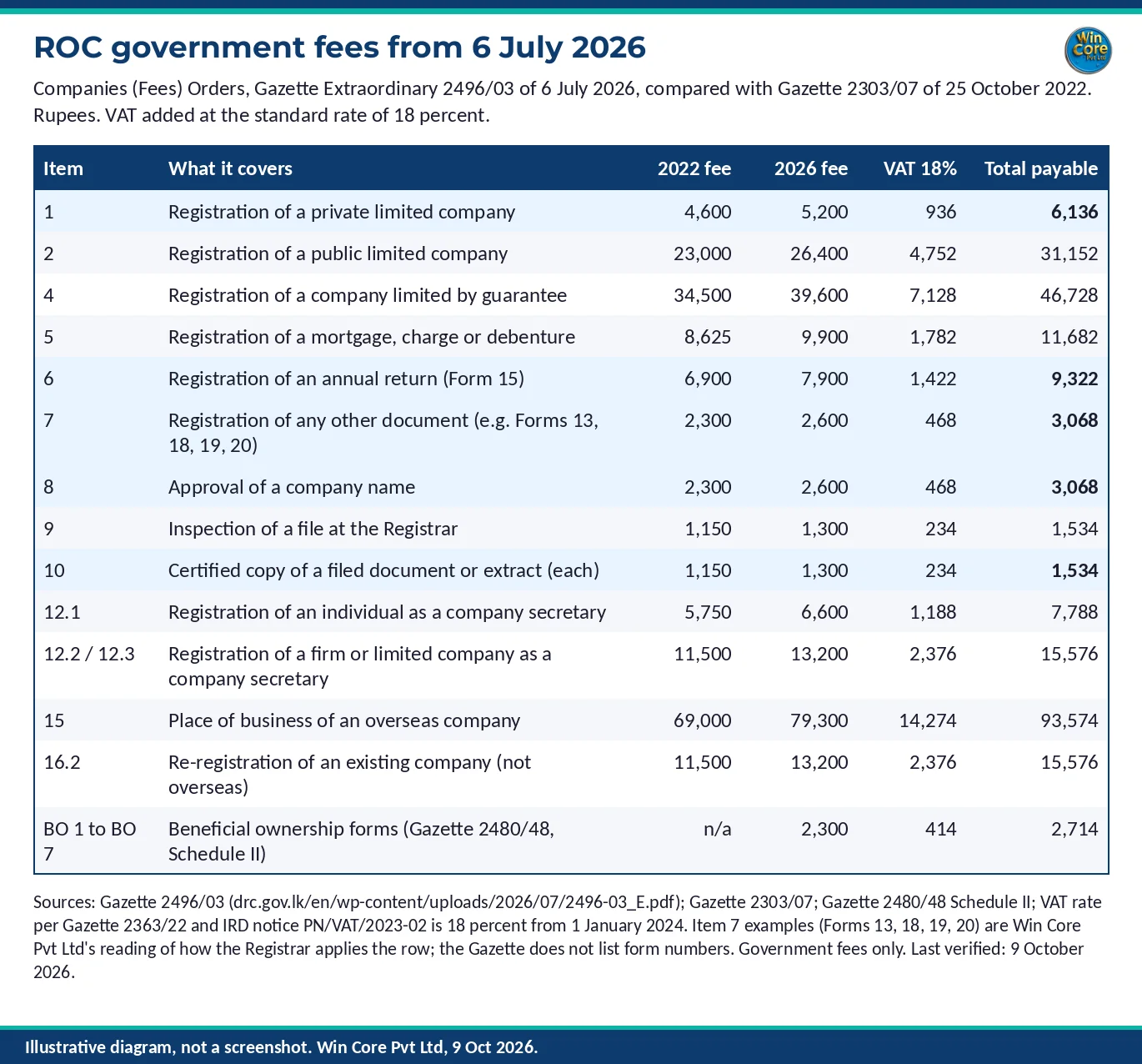
Every Registrar of Companies fee from 6 July 2026 with VAT added, and worked costs for an incorporation, a late Form 15 and a secretary change.
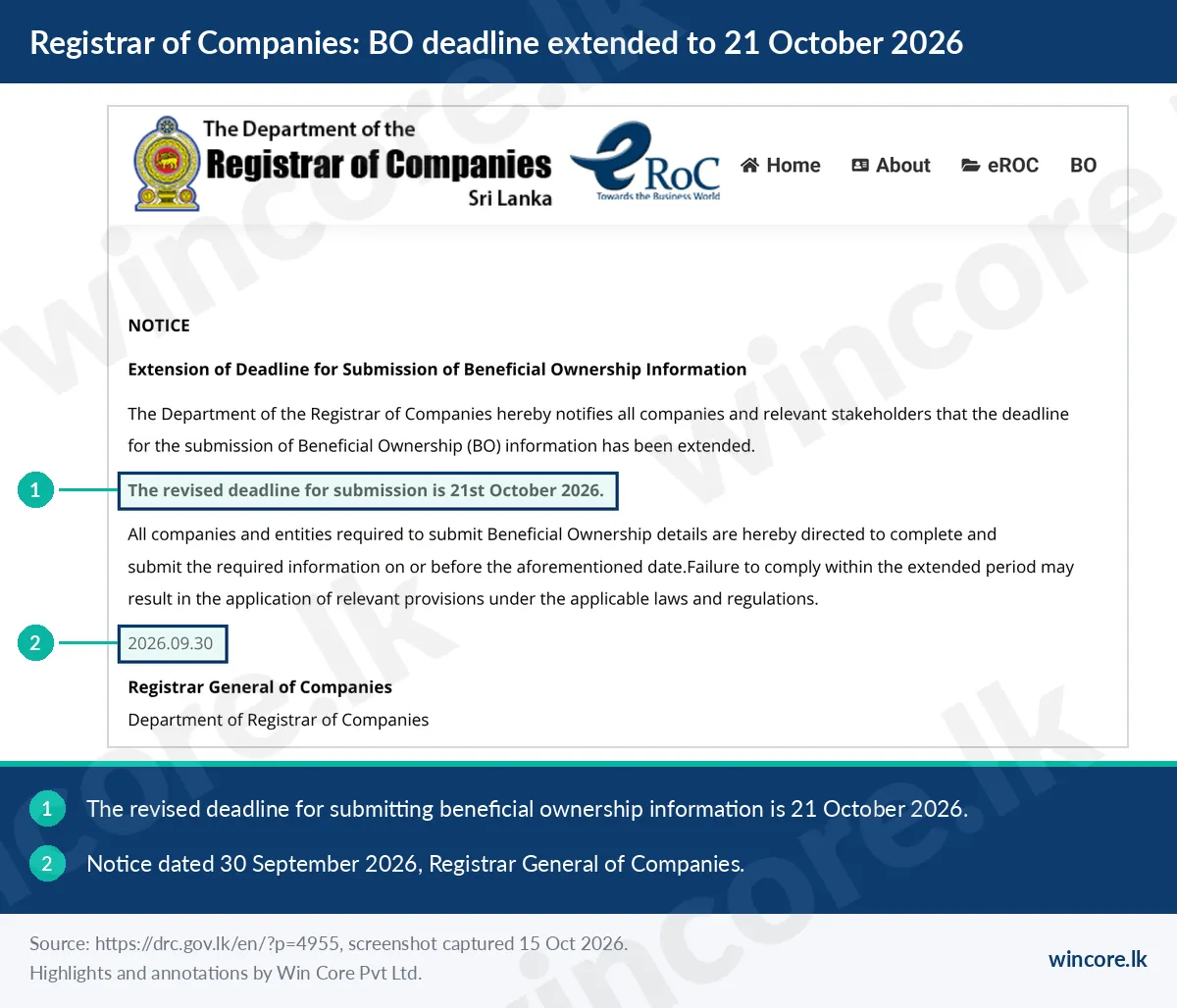
Who counts as a beneficial owner at 10 percent, the forms in the October 2026 regulations, and what existing companies face after the 21 October deadline.
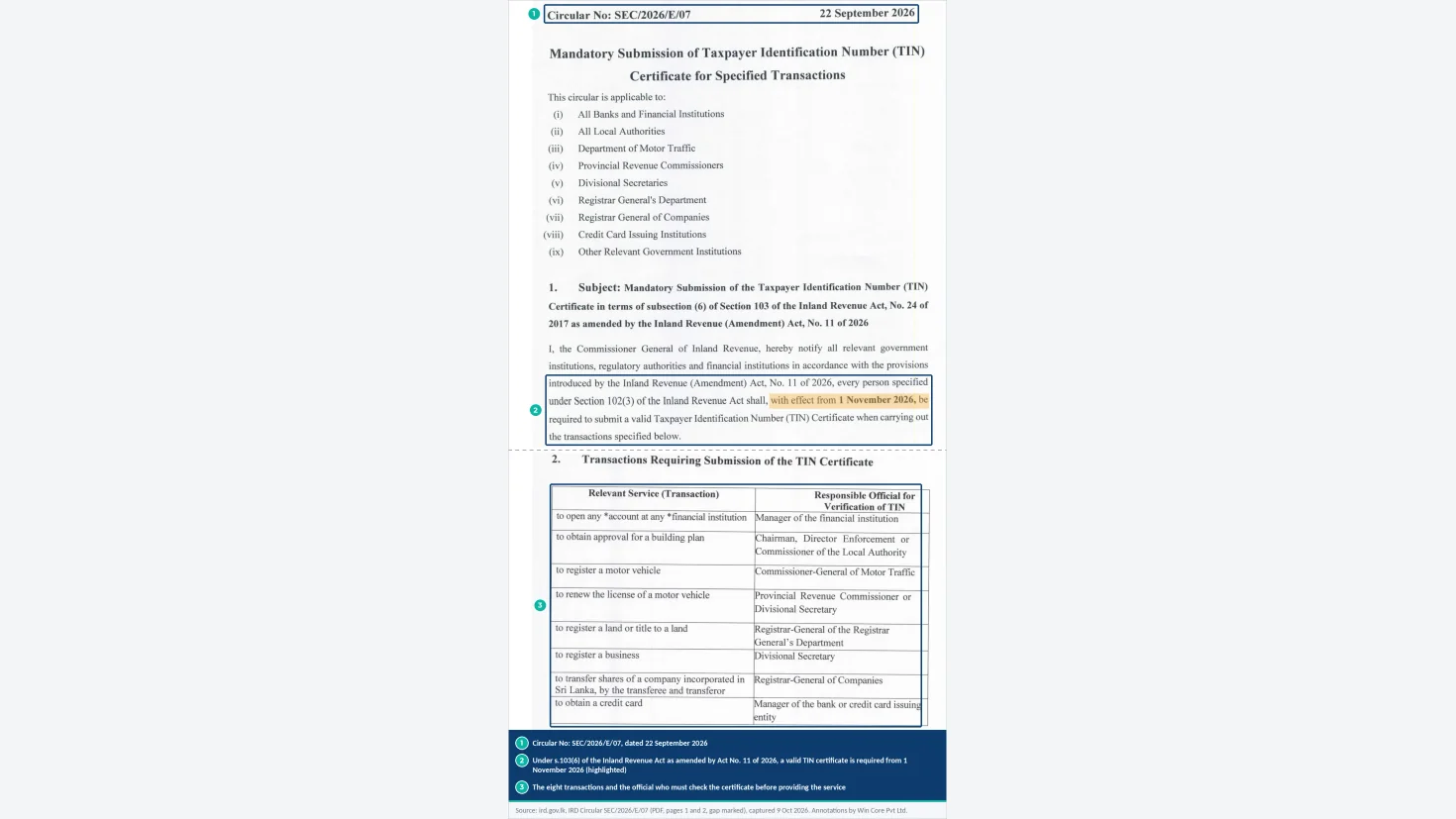
From 1 November 2026 individuals need a TIN certificate for eight transactions. Who needs one, how to get it, and TINs for companies and staff.