
Registered office Sri Lanka: a rented house or an address service
A rented house can be your company's registered office. What the address then carries, what to ask an address service, and how a move takes effect.
On this page
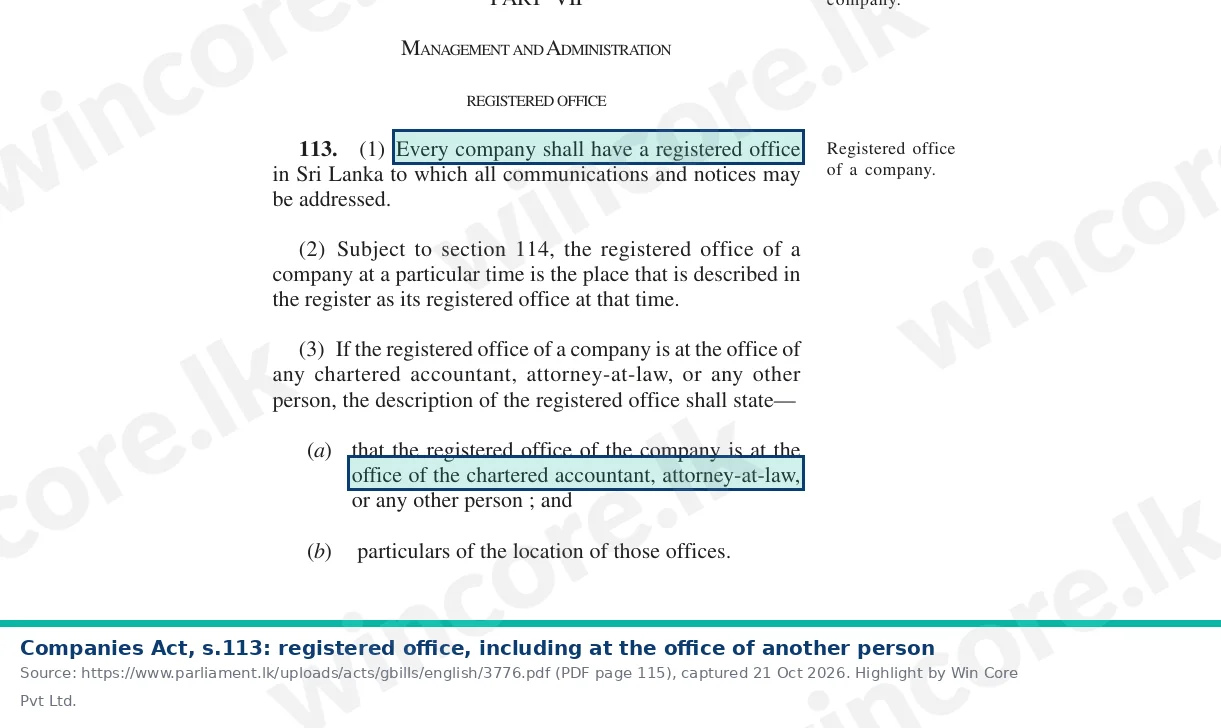
Every company needs a registered office in Sri Lanka "to which all communications and notices may be addressed" (Companies Act No. 7 of 2007, s.113(1)), and nothing in ss.113 to 116 requires it to be commercial premises or owned by the company. On our reading, a rented house can be the registered office. A change takes effect five working days after the Registrar receives notice (s.114(2)). The tax side is stricter: for VAT registration the Inland Revenue Department asks for a deed or lease with the owner's no objection letter or utility bills in the business name, and to update a company's address, a lease and a Registrar-certified Form 13 [1] [4].
Many small companies start with the founder's home, often a rented house, as the registered office. Others use another firm's address. This article sets out what the Act requires, what follows from the address you choose, what to ask an address service, and how to change the address.
The registered office in Sri Lanka is where notices must reach the company
Section 113(1) of the Companies Act No. 7 of 2007: "Every company shall have a registered office in Sri Lanka to which all communications and notices may be addressed." [1]
Under s.113(2), the registered office "at a particular time is the place that is described in the register as its registered office at that time" [1].
Section 113(3) deals with an office at someone else's premises: "If the registered office of a company is at the office of any chartered accountant, attorney-at-law, or any other person, the description of the registered office shall state" that it is at that person's office, and "particulars of the location of those offices" [1].
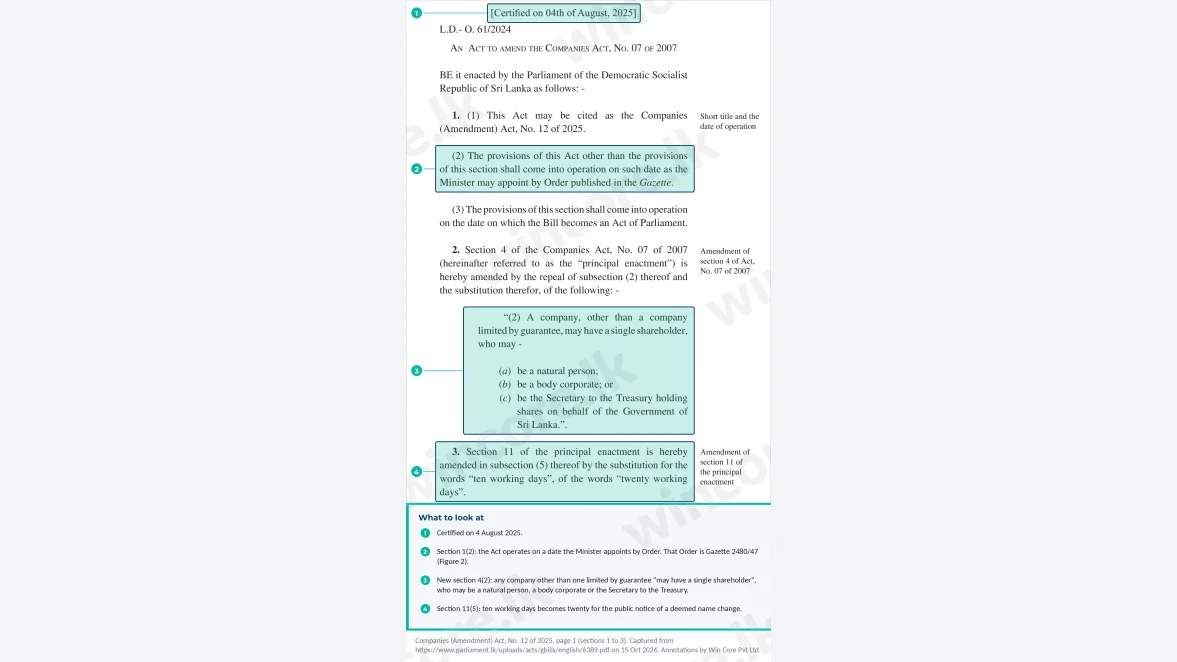
None of ss.12, 113 to 116, 121 or 523 was changed by the Companies (Amendment) Act No. 12 of 2025, apart from a spelling correction to s.116(2) in its Schedule [2]. See our article on the Companies (Amendment) Act No. 12 of 2025.
A rented house can be a registered office, but the lease and the IRD may object
We found nothing in the Act that requires the registered office to be commercial premises, owned by the company, or a particular kind of building. On our reading, a rented house in Sri Lanka can be a registered office, so long as it is a place where communications and notices can be addressed and received.
What the Act does not settle is everything outside company law:
- The lease. Many residential leases restrict business use or registration of a business at the address. Read yours, and get the landlord's written consent (practice).
- Local authority rules. Whether running a business from a residential address needs any local authority licence depends on the activity and the area. We have not checked these rules; that is open. For council permits, see how a trade licence works.
- Tax registrations. The IRD's Taxpayer Guidelines for Registration and Update ask, for permanent VAT registration on turnover, for "Proof of business address, such as a deed, lease agreement, or rent agreement, together with a No Objection Letter from the property owner, or utility bills (water or electricity) issued in the business name showing the business address". For importers and exporters the wording is "and utility bills", so both. The same guidelines say "No supporting documents are required for tax types other than VAT", and to update a company's address they ask for a "Deed / Lease Agreement and Form 13 certified by Registrar of Companies" [4]. A house leased in the director's own name, with bills in the landlord's name, may not satisfy the VAT list; our guide to importer VAT registration explains how that proof differs from the registered office.
The address carries legal consequences, not just post
Choosing the registered office is more than a postal choice. On our reading of the Act, the address carries these consequences.
Documents served there count as served. Section 523(a) allows a document to be served on a company "by leaving it at or sending it by post to the registered office of the company" [1]. That includes legal papers.
A creditor's demand can be left there. Under s.271(a), a company is deemed unable to pay its debts if a creditor owed more than Rs 50,000 "has served on the company by leaving it at the registered office of the company, a demand" and the company "has for three weeks from the date of so leaving, neglected to pay" [1]. If nobody checks the post, three weeks can pass unnoticed.
The Registrar writes there. Registrar notices, including those before a company is struck off, go to the registered office; our article on striking off a company under section 394 covers that process.
The records are kept there. Section 116(1) lists the documents a company must keep "at its registered office", unless under s.116(3) and (4) it gives the Registrar notice of another place "within ten working days of their first being kept elsewhere or moved" [1].
Penalty for this default. Under s.116(5), failing to keep the records or to give that notice is an offence: a fine not exceeding Rs 200,000 for the company and Rs 100,000 for every officer in default [1].
Shareholders may inspect there. Under s.121(1), documents open to inspection "shall be available for inspection at the place at which the company's records are kept, between the hours of 9.00 a.m. and 4.00 p.m. on each working day during the inspection period" [1]. In a family home, that matters.
The name must be shown there. Section 12(2): "Every company shall ensure that its name and its company number are clearly displayed at its registered office." Under s.12(3), the fine is up to Rs 50,000 for the company and Rs 50,000 for each officer in default [1].
An address service is a contract, so get its terms in writing
An address service is a commercial arrangement under which a company uses a firm's office as its registered office. The Act does not regulate the service as such. It only requires the description in s.113(3) where the office is "at the office of any chartered accountant, attorney-at-law, or any other person" [1].
What is included varies by provider (practice). Ask, in writing, about each of these:
- Mail handling: how fast post is opened, scanned and sent on, and whether registered post and court papers are treated as urgent.
- Records custody: whether the provider keeps your statutory registers and minute books at that address, as s.116 requires unless you notify another place.
- Inspection: who will handle a shareholder's request to inspect between 9.00 a.m. and 4.00 p.m.
- Name display: whether your name and number will be displayed as s.12(2) requires.
- Ending the service: notice period, and what happens to post and records after it ends.
Address services are often sold alongside secretarial work; our article on choosing a company secretary and checking a retainer explains how to compare quotes. Whoever provides the address, the company stays responsible for the s.116 records and the s.12(2) display.
If one provider supplies both the address and filings, put the secretary engagement and handover terms in writing as well.
A change of registered office takes effect five working days after notice
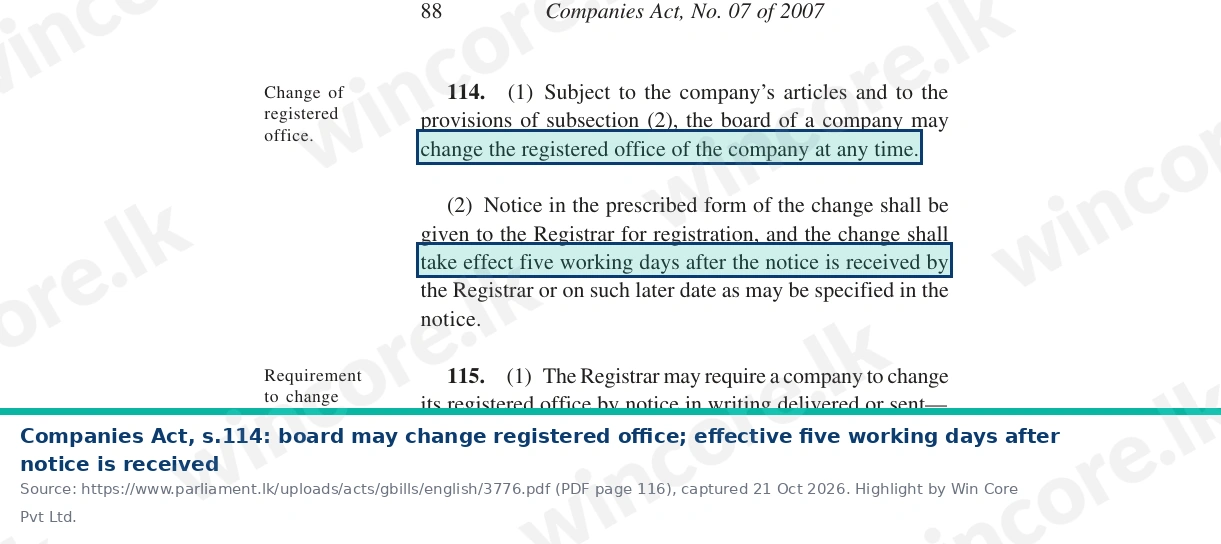
Section 114(1): "Subject to the company's articles and to the provisions of subsection (2), the board of a company may change the registered office of the company at any time." Under s.114(2), "Notice in the prescribed form of the change shall be given to the Registrar for registration, and the change shall take effect five working days after the notice is received by the Registrar or on such later date as may be specified in the notice." [1] To move the office, see how to change the registered office address with Form 13.
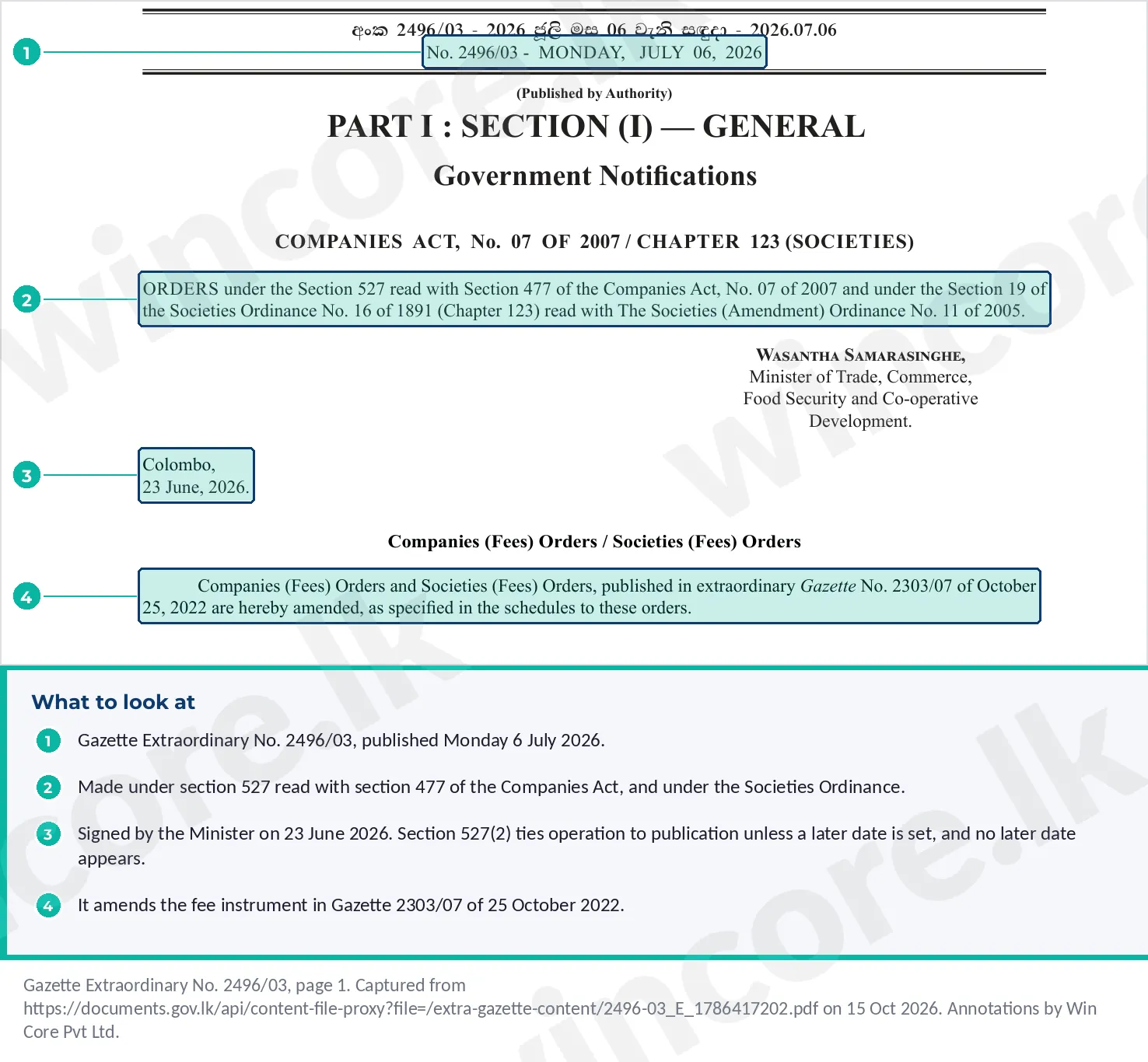
The IRD's guidelines call this notice Form 13 [4]. Section 114 sets no deadline and no penalty of its own: until the notice is received, the old address simply stays the registered office. The fee, on our reading, is item 7 of the Companies (Fees) Order in Gazette 2496/03, Rs 2,600 excluding VAT (Rs 3,068 with VAT at 18 percent), for "The registration of any document required or authorized to be registered" [3]; no item names a change of office. See our article on the Companies (Fees) Orders 2026. Keeping these notices on time is part of our company secretarial services.
For a company with one director, "the board" is that director; see our article on a sole director company.
When the Registrar requires a change
Section 115 lets the Registrar require a change by written notice, with a date "not being a date that is earlier than twenty working days after the date of receipt of the notice", reasons, and a statement of "the right to appeal against such requirement to court under section 472" [1]. If the company appeals and the appeal is dismissed, it must change the office within five working days after the court's decision (s.115(3)(b)). Penalty: under s.115(4), failing to comply is an offence, with a fine up to Rs 50,000 for the company and Rs 50,000 for each officer in default [1]. The Act does not list reasons; on our reading, an address where notices are not received would be a likely one.
A hypothetical move, with our arithmetic
This is hypothetical. A company's registered office is a rented house. The lease ends on a Friday. The company signs up for an address service, and the director files notice of the new address on a Monday, eleven days before the lease ends.
Our arithmetic: if the Registrar receives the notice that Monday, the change takes effect five working days later, on the following Monday, assuming no public holidays. That is four days before the lease ends. Filing on the last Monday of the lease would leave the change taking effect after the company had left. The old address stays the registered office until the change takes effect, so keep collecting post there until the change takes effect, and for some time after (practice). If records move too, give notice of the new place within ten working days (s.116(4)).
What this means for you
- A rented house can be a registered office under the Act, on our reading; check your lease and local rules.
- Whoever is at the address receives legal papers, creditor demands and Registrar letters on your behalf.
- Keep the statutory records there, or notify another place within ten working days.
- If you use an address service, get its mail handling, records and exit terms in writing.
- A change takes effect five working days after the Registrar receives notice.
- For VAT registration, have a lease or deed plus the owner's no objection letter or utility bills in the company's name.
If you are forming the company now, our registration services settle the registered office in the incorporation documents; our guide to registering a company covers the rest of the filing.
Checklist: documents needed
- Lease or deed, and the owner's written consent or no objection letter for the address
- Utility bills in the company's name, if VAT registration is coming
- Board resolution approving any change of registered office
- Notice of change of registered office in the prescribed form (Form 13), with the fee
- Address service agreement, if any, with mail, records and exit terms
- Notice to the Registrar of any other place where records are kept, within ten working days
- Name and company number displayed at the address
FAQ
Can I register my company at my home address in Sri Lanka?
On our reading of the Act, yes. Section 113 asks only for a registered office in Sri Lanka "to which all communications and notices may be addressed", and sets no rule on the type of building. Check that your lease allows it, get the owner's consent, and remember that legal papers and inspection requests will arrive at your home.
Must the register say the office is someone else's?
Yes, where the registered office is at the office of a chartered accountant, attorney-at-law or any other person. Section 113(3) requires the description to state that it is at that person's office and to give the location of those offices. An address service therefore has to be described as the provider's office, not as your own premises.
Is a PO box acceptable as a registered office?
On our reading, unlikely. Section 113(2) speaks of "the place" described in the register, and documents may be served by leaving them at the registered office (s.523(a)), which a box number cannot receive. The Act does not deal with PO boxes in terms, and we have not seen the Registrar's practice, so treat it as untested.
What does the IRD need to register a rented address for VAT?
A deed, lease or rent agreement as proof of business address, with a no objection letter from the owner or utility bills in the business name, under the IRD's 2026 registration guidelines. Importers and exporters need the letter and the bills. Other tax types need no supporting documents. Ask the owner for the letter before you apply.
Open points
- Local authority rules on businesses at residential addresses; not checked.
- Whether item 7 is the correct fee item for notice of change of registered office; no item names it.
- Whether a PO box or a virtual address without staff satisfies s.113.
- Whether the IRD accepts a lease in a director's own name for a company's VAT registration; the guidelines say "issued in the business name" for utility bills only.
- The reasons the Registrar uses in practice under s.115.
Last verified: 22 October 2026. We re-read Companies Act ss.12, 113, 114, 115, 116, 121 and 271(a) on the parliament.lk text, the Companies (Amendment) Act No. 12 of 2025, the Gazette 2496/03 schedule and the IRD registration guidelines.
The short version.
- Every company needs a registered office in Sri Lanka where communications and notices can be addressed (s.113).
- A rented house can serve, on our reading; check the lease and local rules.
- Service of documents, creditor demands, records and inspections all attach to the address.
- An address service must be described as another person's office (s.113(3)); its terms are a matter of contract.
- A change takes effect five working days after the Registrar receives notice (s.114(2)).
Talk to us. If you are choosing a registered office or moving one, and want the notice, the records and the IRD address update lined up, our contact page.
WinCore Pvt Ltd
References
- Parliament of Sri Lanka. Companies Act, No. 7 of 2007, ss.12, 113, 114, 115, 116, 121, 271 and 523. https://www.parliament.lk/uploads/acts/gbills/english/3776.pdf . Primary. Accessed 22 October 2026.
- Parliament of Sri Lanka. Companies (Amendment) Act, No. 12 of 2025, sections and Schedule item 24. https://www.parliament.lk/uploads/acts/gbills/english/6389.pdf . Primary. Accessed 22 October 2026.
- Gazette Extraordinary No. 2496/03 (6 July 2026), Companies (Fees) Orders, item 7. https://documents.gov.lk/api/content-file-proxy?file=/extra-gazette-content/2496-03_E_1786417202.pdf . Primary. Accessed 22 October 2026.
- Inland Revenue Department. Taxpayer Guidelines for Registration and Update (2026), Registration of Tax Types and Updating Taxpayer Registration Details. https://www.ird.gov.lk/en/Downloads/SiteAssets/TPR_Guidelines_2026_E.pdf . Administrative. Accessed 22 October 2026.
Put these insights to work
WinCore specialists can review your current workflow, document gaps, and build a practical 90-day action plan.
Book a free consultationContinue reading
Explore more WinCore analysis to keep your finance, tax, and compliance roadmap moving.
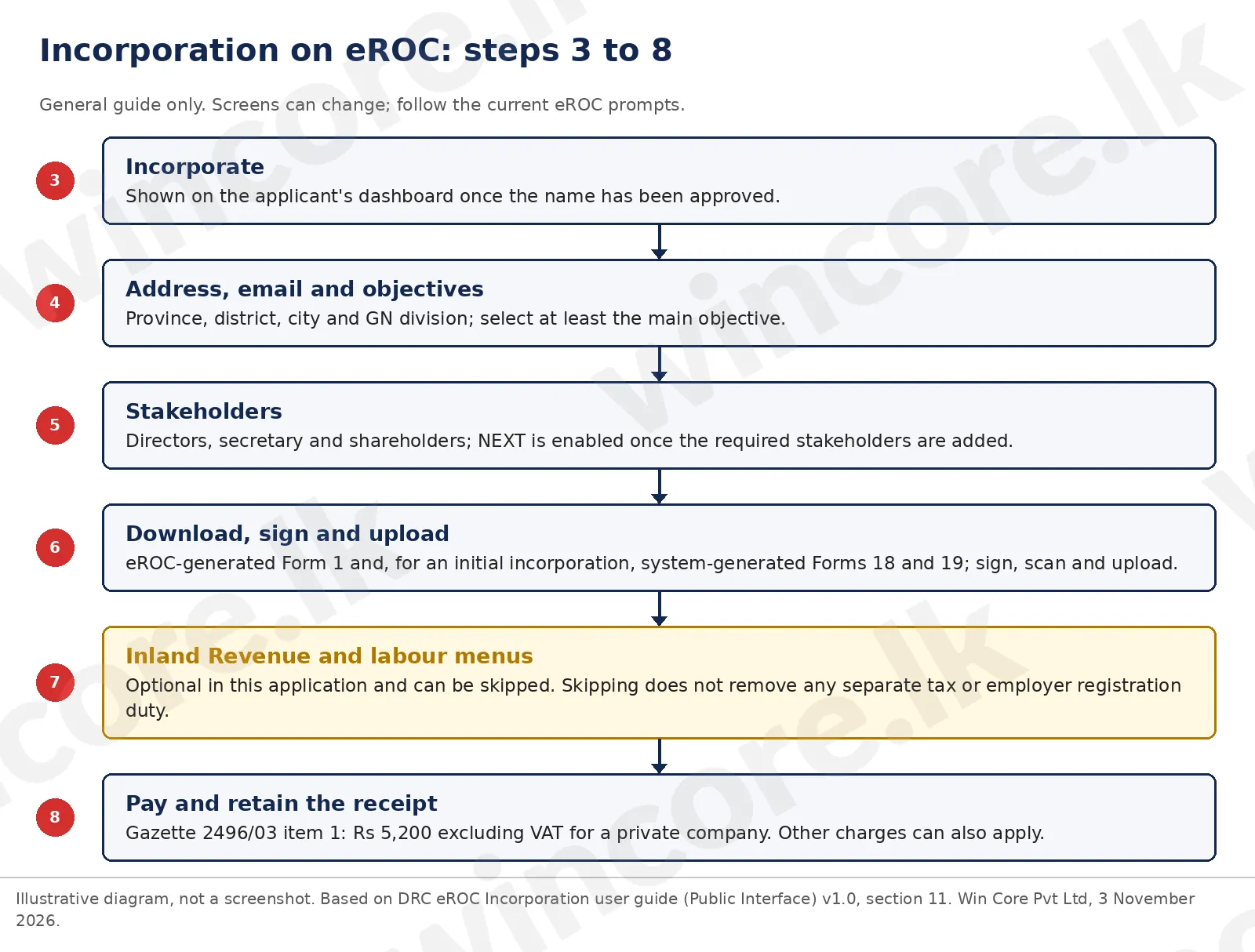
Registering a private limited company in Sri Lanka in 2026: structure, name approval, the eROC filing with BO 1 and BO 5, the TIN and the first year.
Beyond beneficial ownership, the 2025 amending Act ended bearer shares, moved allotments to working days and added a Rs 1 million general penalty.
The instrument behind this year's Registrar of Companies fee rise: what it amends, when it took effect, the Parliament step still open and the odd item 13.