
Importer VAT registration in Sri Lanka for a foreign-owned company
A foreign-owned company that imports to sell meets three Acts before its first container clears. What each one asks, clause by clause.
On this page
Last verified against the primary sources on 21 October 2026.
Importer VAT registration in Sri Lanka has no turnover test. Since the VAT (Amendment) Act, No. 4 of 2025, certified on 11 April 2025, every person who imports goods for commercial purposes must register under s.10(1)(ix) of the VAT Act and apply within fifteen days of becoming liable. VAT on each shipment is paid to Customs at the port, and excess import VAT on goods resold without processing is carried forward, not refunded. Each shipment needs a bill of entry under s.47 of the Customs Ordinance, and the company needs a registered office in Sri Lanka under s.113 of the Companies Act, No. 7 of 2007.
None of the sections in this piece turns on who owns the company. What differs for a foreign owner is practical: signatories are often abroad and the office is often a secretary's address.
Take a hypothetical company owned by a cycling brand in the Netherlands. It will import bicycles and sell them to riders from a showroom in Kandy. Its first order is on the water.
Whether foreign ownership is allowed for the activity at all is a separate question, covered in our guide to 100 percent foreign ownership and the three restricted lists.
Importer VAT registration in Sri Lanka has no turnover test
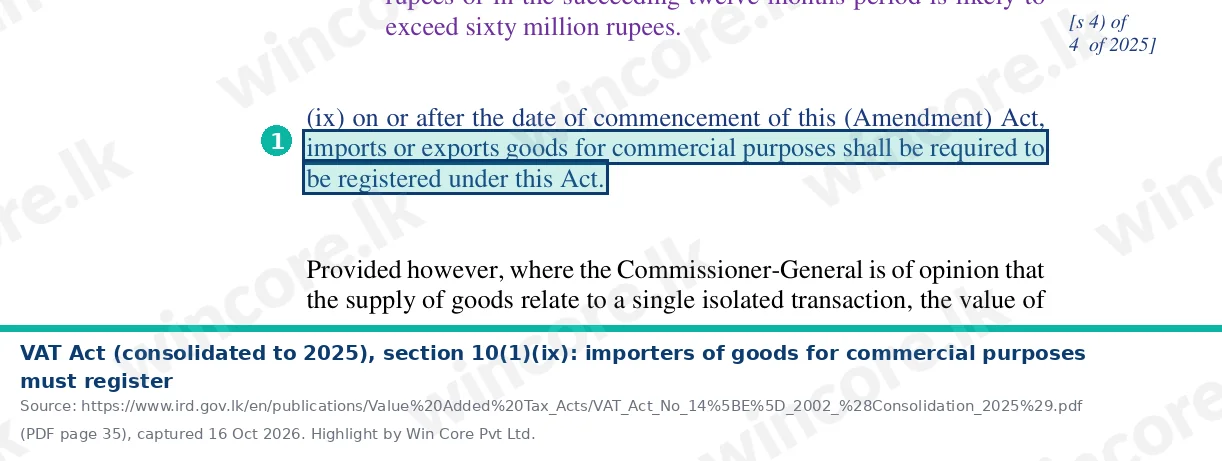
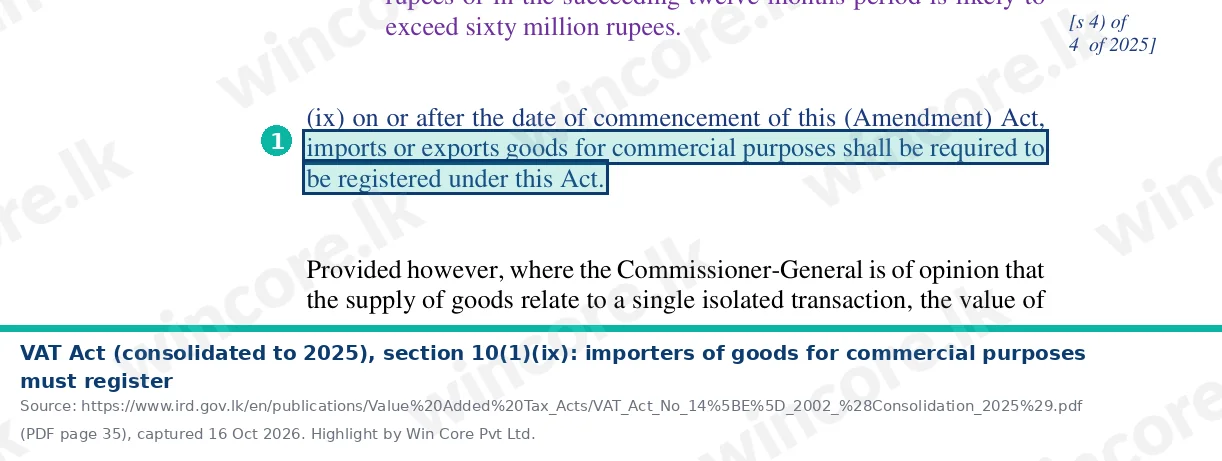
Section 10(1) of the Value Added Tax Act, No. 14 of 2002 lists who "shall be required to be registered". Most of its paragraphs are turnover tests. Paragraph (ix) is not. It covers every person who "on or after the date of commencement of this (Amendment) Act, imports or exports goods for commercial purposes" [1].
The Inland Revenue Department's notice on the amending Act [2] puts it plainly: "All persons importing or exporting goods for commercial purposes will be required to register under the VAT Act, regardless of turnover thresholds or exemptions" [3].
Three things follow for the bicycle importer.
- There is no threshold to wait for. The Rs 15 million a quarter and Rs 60 million a year tests in s.10(1)(viii) are for other businesses. Our guide to VAT registration thresholds explains those tests.
- The clock is fifteen days. Section 10(2) requires an application "not later than fifteen days from the date on which is so liable to be registered" [1]. When an importer first becomes liable is not defined. On our reading it is the point when commercial importing begins or is clearly about to begin, so we would apply before the first shipment lands.
- Commercial purposes is the test. On our reading, a one-off import of samples or of the company's own equipment is not obviously "for commercial purposes"; the IRD treats those under Temporary VAT, below. Resale stock plainly is.
Failing to apply as s.10 requires is an offence under s.67(a). Under s.67 as amended by the VAT (Amendment) Act, No. 14 of 2026, the penalty on conviction before a Magistrate is a fine "not exceeding one million rupees" for any period on or after 1 October 2025, or Rs 25,000 for earlier periods, or imprisonment up to six months, or both [4]. Whether the higher cap reaches conduct before 30 June 2026 is open; see our note on the VAT Amendment Act No. 14 of 2026.
The IRD asks for a real order and a real business address
The IRD's Taxpayer Registration Guidelines for 2026 start with the TIN. They say a TIN "is essential for paying taxes / importing/exporting or obtaining any services from the Inland Revenue Department" [5]. VAT is then a separate registration on top of the TIN.
For permanent VAT registration of importers and exporters, the guidelines list a request letter "clearly stating the reason for registration and the nature of the business", a "Commercial invoice and Bill of Lading (BL) for importers", the business registration certificate, and "Proof of business address, such as a deed, lease agreement, or rent agreement, together with a No Objection Letter from the property owner and utility bills (water, electricity) issued in the business name showing the business address" [5].
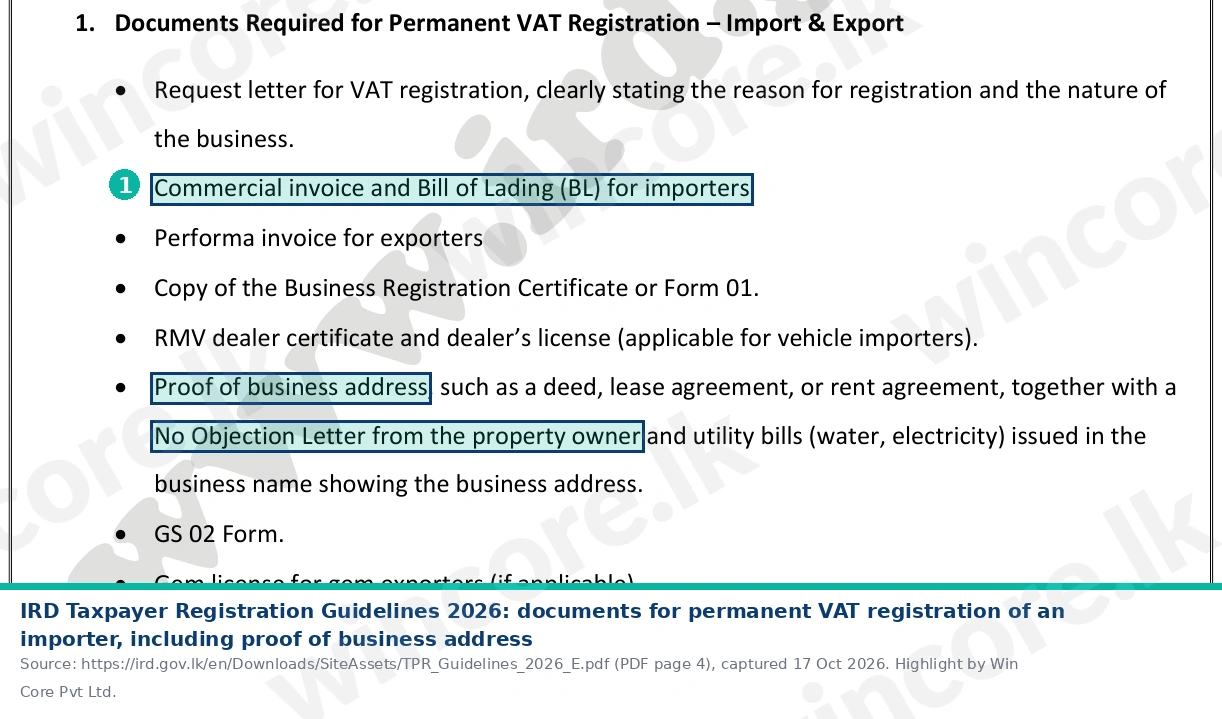
On our reading, the commercial invoice and bill of lading mean the IRD expects to see a real order, so have the first shipment's documents ready when you apply. The address proof is about a business address with utility bills in the company's name. That is a different thing from the registered office, covered below.
The same guidelines describe Temporary VAT for those "who have not obtained a permanent Value Added Tax registration" and need to "undertake import, export and re-export activities via Sri Lanka Customs" [5]. The importer documents listed for it are for a "Non-Commercial Purpose", such as "personal use, sample, or capital goods" [5]. How Temporary VAT sits next to the s.10(1)(ix) duty for a regular commercial importer is not explained in the guidelines. We treat it as open.
VAT on the goods is paid to Customs at the port
Section 2(1)(b) charges VAT "on the importation of goods into Sri Lanka, by any person" [1]. Registration does not change that. Section 2(3) says the tax on importation "shall be charged, levied and collected as if it is a customs duty and as if all goods imported into Sri Lanka are dutiable and liable to customs duty" [1]. The provisos to s.2(3) list goods on which no tax is charged, such as goods entering a customs bonded area or a free port, and certain fabric for garment manufacture [1]. Bicycles for resale are not in those provisos. Separately, s.8 exempts the importation of goods listed in the First Schedule, so check that Schedule for your product [1].
So the importer pays VAT to Customs with the duty, and recovers it later as input tax. The document that supports the claim is the Customs one. Section 20(3) says "the customs goods declaration or any other document authenticated by the Director General of Customs shall be treated as a tax invoice under this Act" [1]. Section 22(6)(iii) denies input tax where the supply is not supported by "a customs goods declaration or other authenticated document issued by the Director-General of Customs" received within twelve months of "the date of importation of goods" [1]. Under s.22(6)(iv)(b), the declaration must also be claimed in a return for a period ending within twenty four months of its date, or the input tax cannot be deducted [1].
Import VAT on resale stock is carried forward, not refunded
In its first months it pays import VAT at the port on every shipment, but its sales lag behind. Input tax exceeds output tax, and the owner expects a refund.
Section 22(5) has a proviso aimed at exactly this business: "in case of a registered person who imports goods for re-sale without processing, the excess input tax representing the tax paid under subsection (3) of section 2 shall not be refunded", and that input tax "shall be carried forward", except where the supplies are made to registered persons referred to in items (i) to (vi) of s.2(2)(e) [1]. Section 2(2)(e) is the old SVAT deferral, which now applies only "for any period prior to October 1, 2025" [1], so on our reading the exception has little room for later periods.
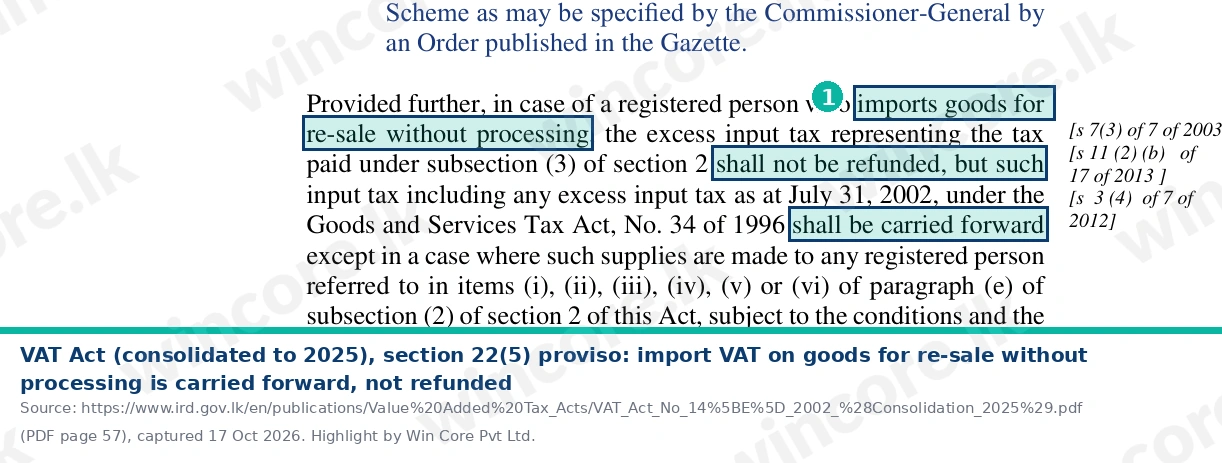
For the bicycle importer, which sells the bicycles as they arrive, the excess import VAT sits on the balance sheet as a VAT receivable until later output tax absorbs it. Whether a light step such as assembly counts as "processing" is not defined in the text we read. We state that as open.
Every shipment needs a supported bill of entry
The Customs Ordinance works shipment by shipment. Section 47 says the person entering goods inwards, "whether such goods be free of duty" or not, "shall deliver to the Director-General a bill of entry of such goods" [6]. The bill must state, among other things, "the name of the person in whose name the goods are to be entered, and the quantity, value, and description of the goods", and its particulars "shall be supported by such documents" as the Director-General specifies by Gazette notification [6].
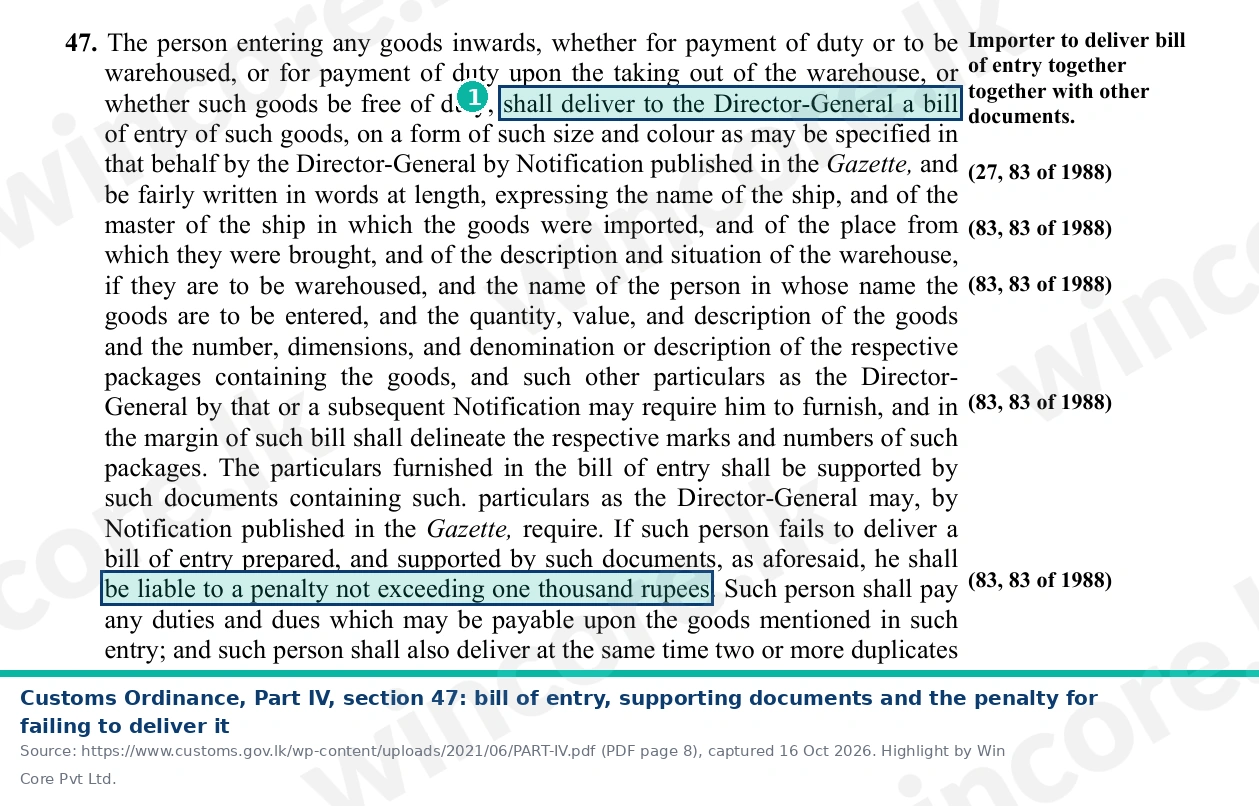
The penalty in s.47 itself is small: a person who fails to deliver a supported bill of entry "shall be liable to a penalty not exceeding one thousand rupees" [6]. The margin note attributes that wording to Act No. 83 of 1988; we have not traced any later change to the amount. The larger exposures are elsewhere in the same Part. If goods "shall not agree with the particulars in the bill of entry the same shall be forfeited" (s.47) [6]. Under s.52, where the declared value is not in accordance with Schedule E, the goods are forfeited, and if they cannot be recovered the declarant forfeits "treble the value of such goods" or a penalty of two thousand rupees, at the Director-General's election [6].
For a foreign-owned importer, the point is control. Where goods are entered in the company's name, s.51 has the value "duly affirmed by declaration by the importer or his agent" [6], so the figures are the company's responsibility, whoever prepares the entry. The supplier's invoice, the packing list and the bill of entry should describe the same goods at the same value. Our import duty calculator gives a first estimate of the duty on a shipment.
The registered office must be in Sri Lanka, and may be a secretary's office
Section 113(1) of the Companies Act, No. 7 of 2007: "Every company shall have a registered office in Sri Lanka to which all communications and notices may be addressed" [7]. Under s.113(3), if it is at the office of "any chartered accountant, attorney-at-law, or any other person", the register must say so and give the location [7].
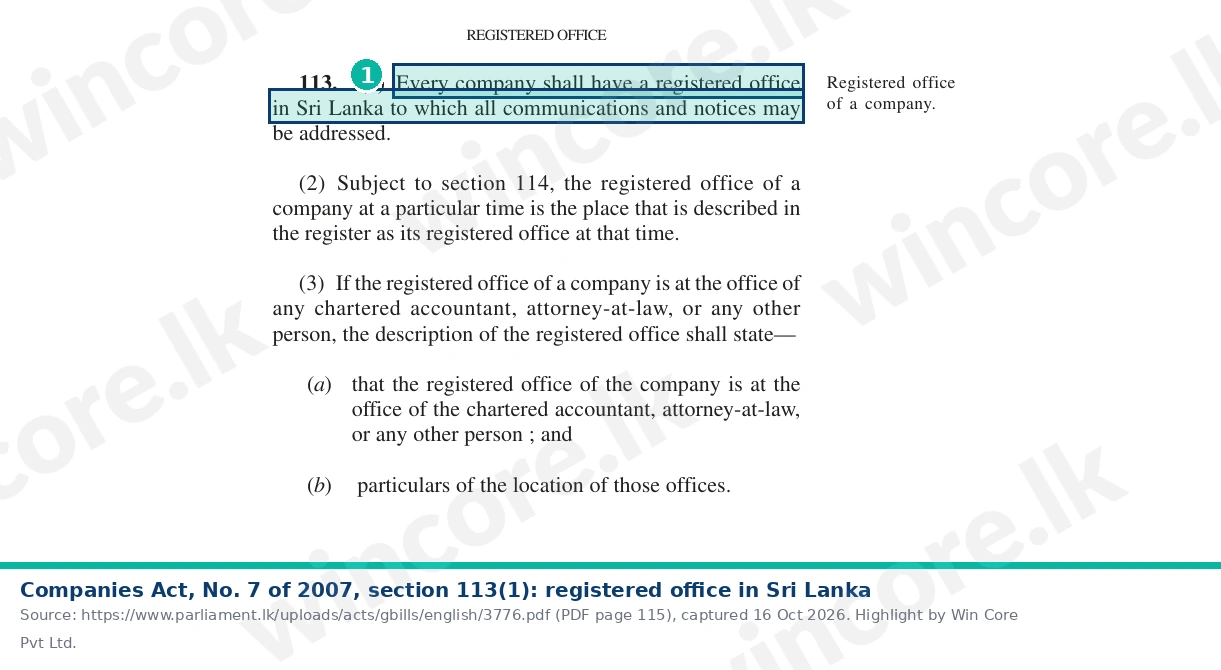
So a foreign-owned company may use its secretary's office as its registered office, and our company secretarial services keep the register entries and Registrar notices that go with it. Three things then need watching.
- The records. Section 116(1) lists the records kept at the registered office. Under s.116(3) they may be kept elsewhere in Sri Lanka (the share register and accounting records under ss.124 and 149), and s.116(4) requires notice to the Registrar within ten working days of records first being kept elsewhere or moved [7].
- The VAT address is a separate proof. The IRD's list above asks for a lease or deed, a No Objection Letter and utility bills "in the business name" [5]. A secretary's address on the company register does not supply those. An importer that holds stock will usually need a warehouse or office anyway, and that lease can serve as the proof.
- Moving is a board decision with notice. Under s.114, subject to the articles, the board may change the registered office, notice "in the prescribed form" goes to the Registrar, and the change takes effect "five working days after the notice is received by the Registrar" or a later date in the notice [7].
Each default carries its own penalty section
| Default | Section | Consequence |
|---|---|---|
| Not applying for VAT registration as s.10 requires | VAT Act s.67(a), as amended | For periods from 1 October 2025, fine up to Rs 1 million, up to six months, or both; backdating open [4] |
| Not furnishing customs declarations or tax invoices as s.21 requires | VAT Act s.67(p), new | Same s.67 penalty [4] |
| Bill of entry not delivered with supporting documents | Customs Ordinance s.47 | Penalty up to Rs 1,000 [6] |
| Goods do not match the bill of entry | Customs Ordinance s.47 | Goods forfeited, with goods packed with them [6] |
| Declared value not in line with Schedule E | Customs Ordinance s.52 | Goods forfeited; if not recoverable, treble value or Rs 2,000 at the Director-General's election [6] |
| Records kept elsewhere without notice | Companies Act s.116(5) | Company fine up to Rs 200,000 on conviction; each officer in default up to Rs 100,000 [7] |
| Not changing the registered office when the Registrar requires | Companies Act s.115(4) | Company and each officer in default, fine up to Rs 50,000 each [7] |
Section 113(1) itself states no penalty. Since 30 March 2026, the Companies (Amendment) Act, No. 12 of 2025 adds a general penalty in s.513A for any breach "for which no punishment is expressly provided", a fine up to Rs 1 million, up to six months, or both [8]. On our reading that would reach a company with no registered office in Sri Lanka. Our note on the Companies (Amendment) Act No. 12 of 2025 covers s.513A.
What this means for you
Plan the VAT registration as part of the first shipment. Have the lease, the No Objection Letter and a utility bill in the company's name ready, because a secretary's registered office does not supply them. Budget for import VAT that is carried forward rather than refunded while sales build up. Make sure whoever clears your goods describes and values them as your supplier's invoice does. Our tax services team handles importer VAT registration and the VAT returns that follow.
Checklist: documents needed
- Request letter for VAT registration stating the reason and the nature of the business
- GS 02 form, as listed in the IRD guidelines
- Commercial invoice and bill of lading for the first shipment
- Certificate of incorporation (business registration certificate)
- Lease, rent agreement or deed for the business address, with the owner's No Objection Letter
- Water or electricity bill in the company's name at that address
- Supplier invoice and packing list that match each bill of entry
- Customs goods declarations, filed with the VAT records
- Registered office entry, and a Registrar notice if records are kept elsewhere
FAQ
Does a small importer need VAT registration in Sri Lanka?
Yes, if it imports goods for commercial purposes. Section 10(1)(ix) of the VAT Act has no turnover test, and the IRD's notice on the 2025 amending Act says importers register "regardless of turnover thresholds or exemptions". The Rs 15 million a quarter and Rs 60 million a year tests are for other businesses [1] [3].
Is VAT charged at the port before the importer registers?
Yes. Section 2(1)(b) charges VAT on the importation of goods "by any person", and s.2(3) has it collected as if it were customs duty. Registration does not decide whether the tax is paid at the port. It decides whether the importer can claim that tax back as input tax against the VAT on its own sales [1].
Can an importer get a refund of excess import VAT?
Not on goods imported for re-sale without processing. The s.22(5) proviso says the excess input tax representing VAT paid at import "shall not be refunded" and is carried forward against later output tax. Its exception points to the old SVAT paragraph, s.2(2)(e), which now covers only periods before 1 October 2025, so plan cash flow on carry forward [1].
Can the registered office be the company secretary's office?
Yes. Section 113(3) of the Companies Act allows the registered office to be at the office of a chartered accountant, attorney-at-law or any other person, if the register says so and gives the location. For VAT the IRD will still ask for a lease or deed, a No Objection Letter and utility bills in the company's name [5] [7].
Does the foreign owner need to be in Sri Lanka for these registrations?
No section cited here requires the owner to be present. The VAT Act, the Customs Ordinance and s.113 of the Companies Act all work through the company, its signatories and its agents. At incorporation, though, the Registrar in practice expects at least one director resident in Sri Lanka, even though the Companies Act itself sets no residency test.
Open points
- When an importer becomes liable. Section 10(2) runs from the date a person is "so liable to be registered"; the Act does not say whether that is the first order, the first shipment or earlier.
- Temporary VAT. How the IRD's Temporary VAT route sits with s.10(1)(ix) for a regular commercial importer is not stated in the guidelines.
- "Without processing". The s.22(5) proviso does not define processing. Whether assembly, kitting or relabelling counts is open.
- The s.22(5) exception. It refers to persons in items (i) to (vi) of s.2(2)(e), the SVAT paragraph now limited to periods before 1 October 2025. How the exception, and the Risk Based Refund Scheme, apply to an importer's later periods is not settled at source.
- Customs amounts. The Rs 1,000 and Rs 2,000 figures carry margin notes to Act No. 83 of 1988. We have not traced any later amendment to them.
- Licences. Product licences and import controls for particular goods are outside this piece.
Talk to us. If your company will import goods to sell and you want the VAT registration, the registered office and the first year's VAT returns set up in one sequence, contact us at our contact page.
WinCore Pvt Ltd
References
- Inland Revenue Department. Value Added Tax Act, No. 14 of 2002, consolidated to 2025, ss.2(1)(b), 2(3), 8, 10(1)(viii) and (ix), 10(2), 20(3), 22(5) proviso, 22(6)(iii) and (iv)(b). https://www.ird.gov.lk/en/publications/Value%20Added%20Tax_Acts/VAT_Act_No_14%5BE%5D_2002_%28Consolidation_2025%29.pdf . Primary. Accessed 17 October 2026; s.22(6) re-read 22 October 2026.
- Parliament of Sri Lanka. Value Added Tax (Amendment) Act, No. 4 of 2025 (certified 11 April 2025), ss.4 and 5. https://www.ird.gov.lk/en/publications/Value%20Added%20Tax_Acts/VAT_Act_No_04-2025_E.pdf . Primary. Accessed 17 October 2026.
- Inland Revenue Department. Notice to the Taxpayers: Amendments to the Value Added Tax Act, PN/VAT/2025-01 (Revised) (17 April 2025), item 4. https://www.ird.gov.lk/en/Lists/Latest%20News%20%20Notices/Attachments/677/PN_VAT_2025-01_11042025_E.pdf . Primary. Accessed 17 October 2026.
- Parliament of Sri Lanka. Value Added Tax (Amendment) Act, No. 14 of 2026 (certified 30 June 2026), s.13 (amending s.67). https://www.ird.gov.lk/en/publications/Value%20Added%20Tax_Acts/VAT_Act_No_14-2026_E.PDF . Primary. Accessed 21 October 2026.
- Inland Revenue Department. Taxpayer Registration Guidelines (2026), pp.2, 4 and 8. https://ird.gov.lk/en/Downloads/SiteAssets/TPR_Guidelines_2026_E.pdf . Primary. Accessed 21 October 2026.
- Sri Lanka Customs. Customs Ordinance, Part IV, Regulations Inwards, ss.47, 51 and 52. https://www.customs.gov.lk/wp-content/uploads/2021/06/PART-IV.pdf . Primary (as published by Sri Lanka Customs). Accessed 21 October 2026.
- Parliament of Sri Lanka. Companies Act, No. 7 of 2007, ss.113, 114, 115(4), 116. https://www.parliament.lk/uploads/acts/gbills/english/3776.pdf . Primary. Accessed 17 October 2026. Sections 114 to 116 read again on 21 October 2026 at https://srilaws.com/legislation/companies-act-no-7-of-2007/section-116 and the pages for sections 114 and 115 (Secondary reproduction of the official English text).
- Parliament of Sri Lanka. Companies (Amendment) Act, No. 12 of 2025, s.513A (inserted); commencement 30 March 2026 by Gazette 2480/47. https://www.parliament.lk/uploads/acts/gbills/english/6389.pdf . Primary. Accessed 17 October 2026.
Put these insights to work
WinCore specialists can review your current workflow, document gaps, and build a practical 90-day action plan.
Book a free consultationContinue reading
Explore more WinCore analysis to keep your finance, tax, and compliance roadmap moving.
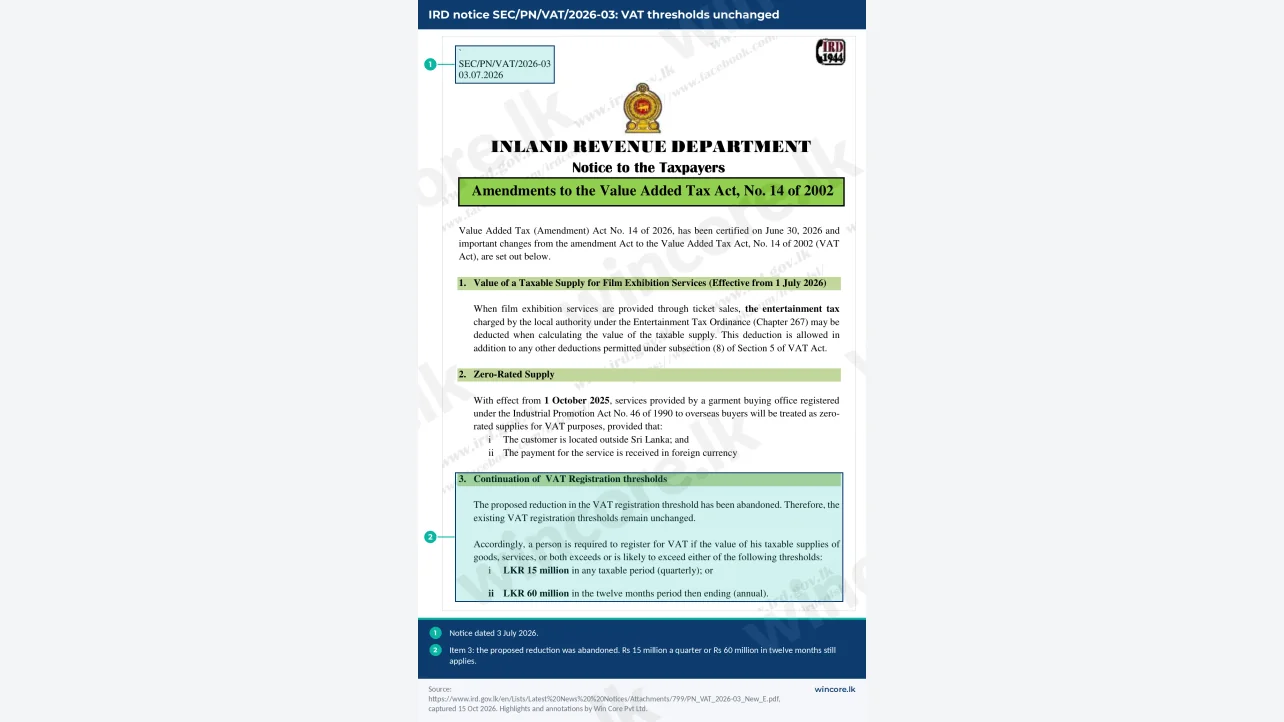
The VAT registration tests are Rs 15 million a quarter or Rs 60 million over 12 months. How the tests run, the 15 day rule and who must register.
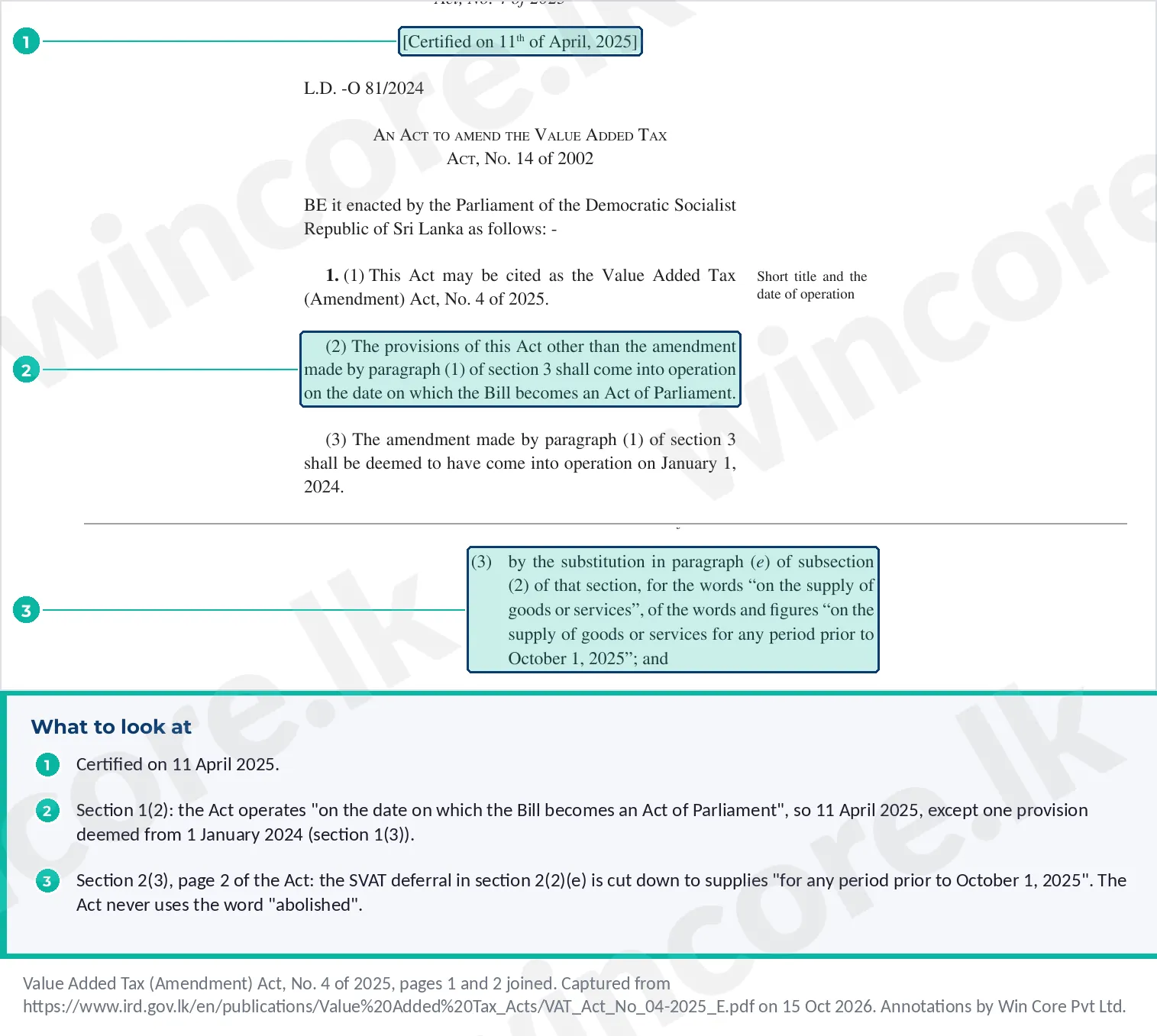
SVAT stopped for supplies from 1 October 2025. How the 2025 Act did it, when exporters now get refunds, and which wind-up dates count.
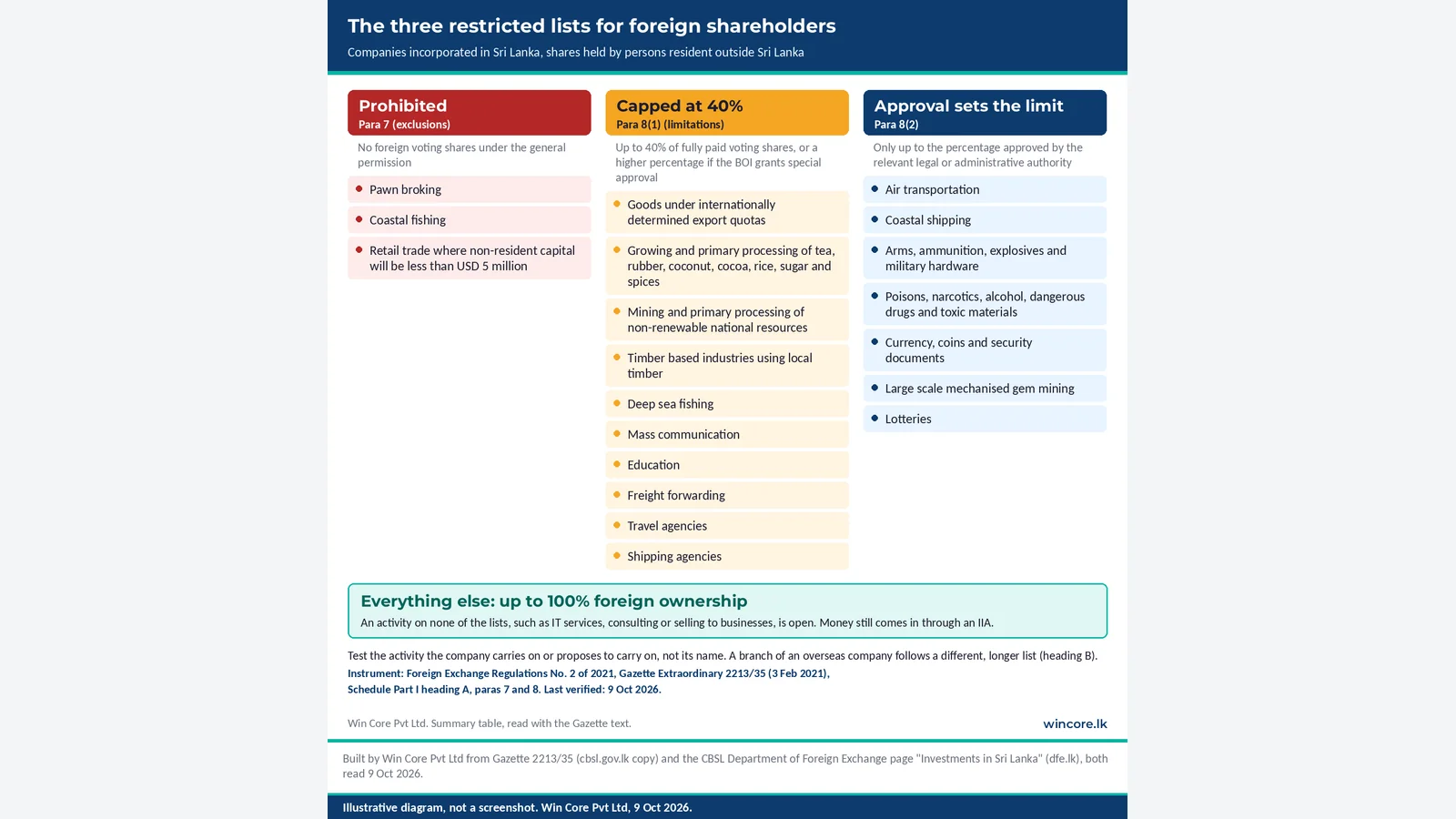
Most Sri Lankan companies can be 100 percent foreign owned. The three restricted lists in Gazette 2213/35, the retail test and the BOI route.