
Strike off company Sri Lanka: section 394 for dormant companies
Closing a company that never traded: the Registrar's letters, the director's affidavit, the three month Gazette notice, and who can bring the company back.
On this page
Last verified against the primary sources on 3 November 2026.
To strike off a company in Sri Lanka without winding it up, the Registrar of Companies uses section 394 of the Companies Act, No. 7 of 2007: on an answer that the company is not carrying on business, or on silence after two letters, the Registrar may publish a Gazette notice, and three months later may strike the name off. On our reading of s.394(5), the company is dissolved when the strike-off notice is published, although that subsection refers to the notice under subsection (4), as explained below. Directors', managers' and shareholders' liability, if any, continues; property vests in the State subject to the statutory exceptions (s.395); and a court may order restoration on an eligible application made before the five year period expires (s.394(6)). Section 394 itself contains no fine.
A company can end in two ways. It can be wound up, with a liquidator who collects assets, pays creditors and reports. Or it can be struck off, an administrative removal from the register with no liquidator. Striking off is faster and simpler, which is why owners of dormant companies ask for it. It is also narrower, and it leaves more behind than most people expect.
Think of it as switching off a light, not demolishing the house. The company stops existing on the register. Anything still inside it, property, liabilities, claims, does not disappear.
Take a hypothetical private company formed in 2021 to bid for a single construction tender, which it lost. It never traded, holds nothing and owes nothing. Can the directors have it struck off, and what if someone later needs it back?
Section 394 is written from the Registrar's side
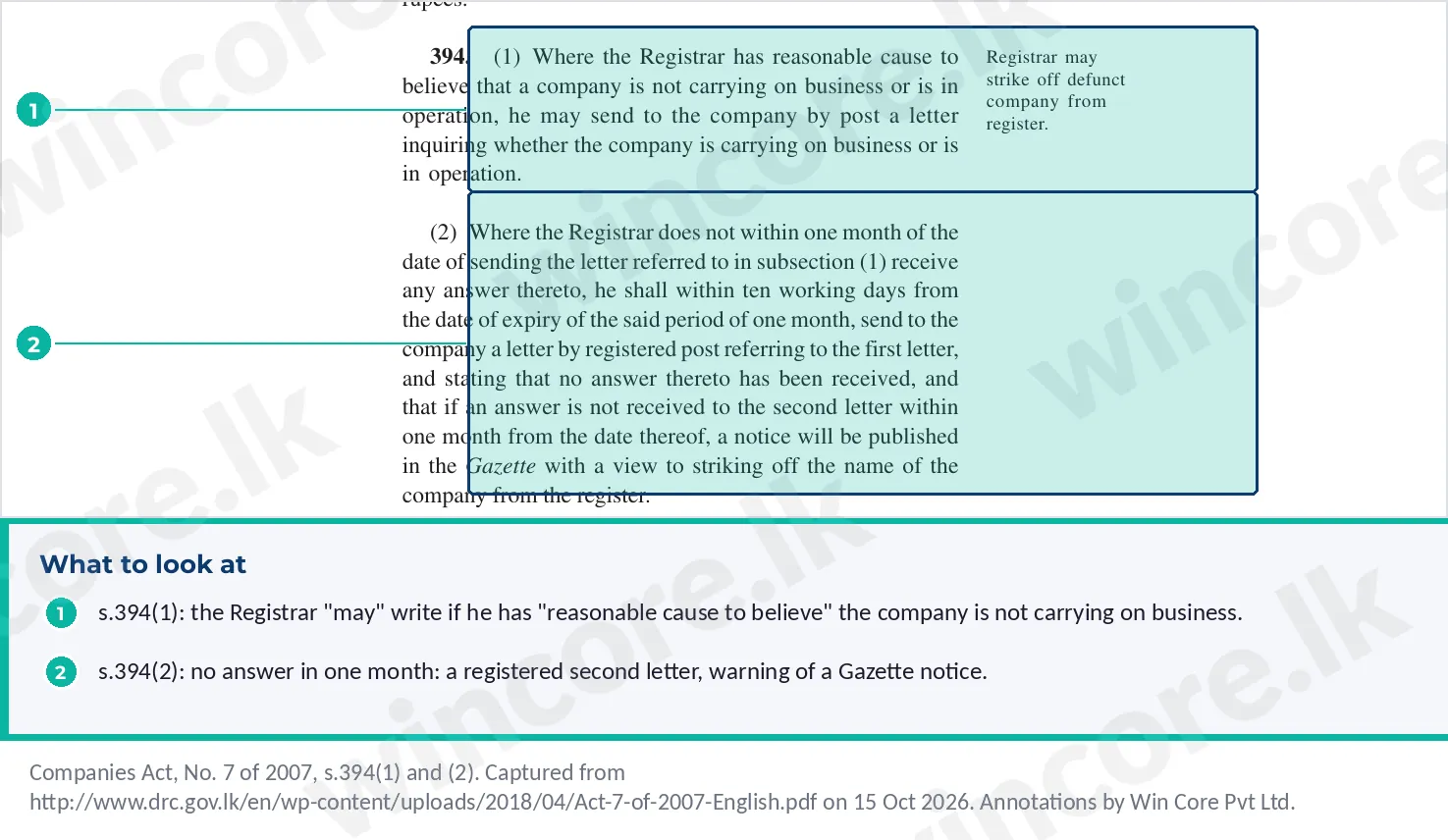
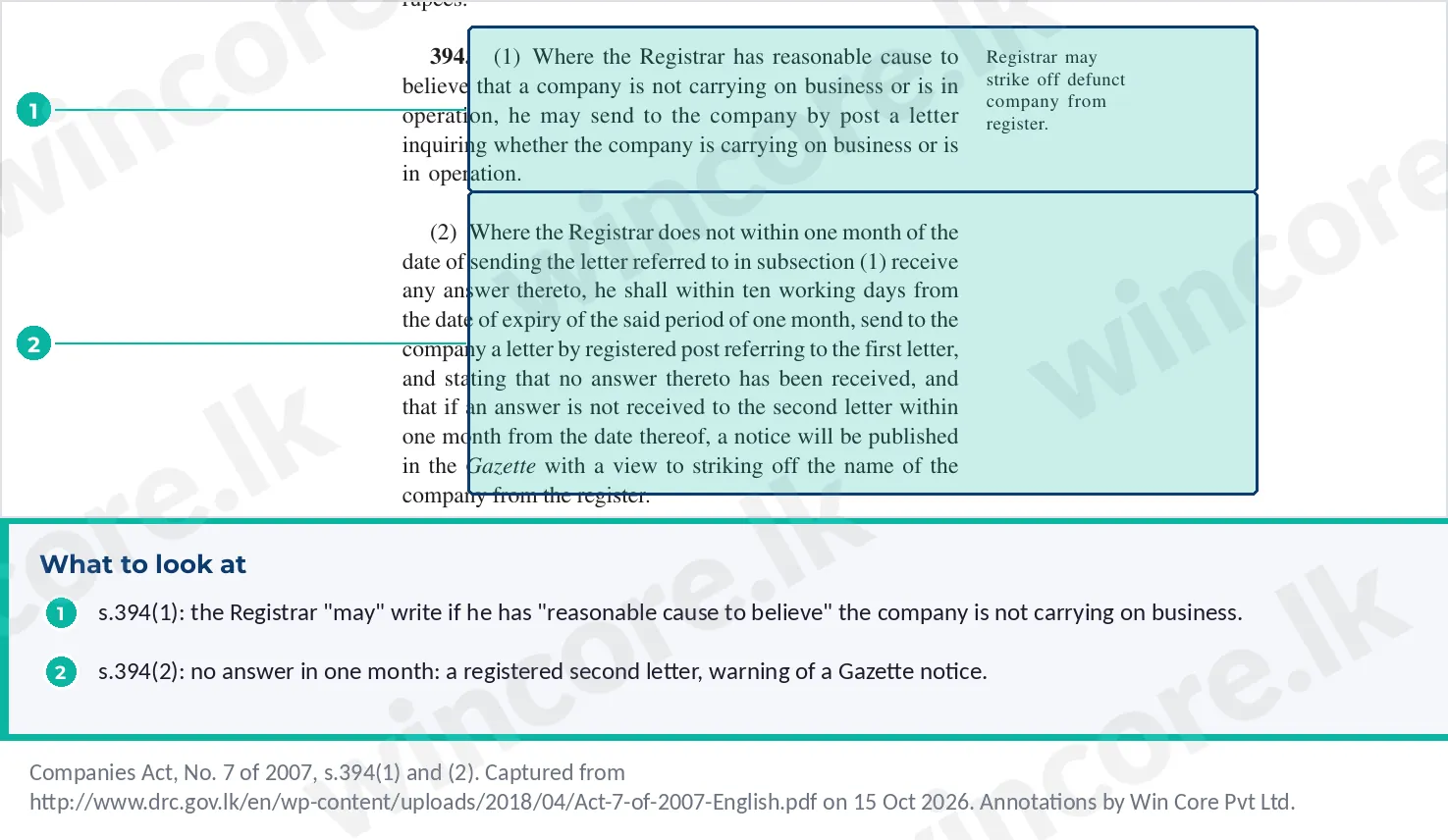
The section is headed "Registrar may strike off defunct company from register" [1]. The Companies (Amendment) Act, No. 12 of 2025 did not amend it on our search of the Act's text; it changed a different strike-off rule in s.487 [3]. The Registrar's route has four steps.
- First letter. "Where the Registrar has reasonable cause to believe that a company is not carrying on business or is in operation, he may send to the company by post a letter inquiring whether the company is carrying on business or is in operation" (s.394(1)) [1].
- Second letter. If no answer comes "within one month", the Registrar "shall within ten working days" send a registered letter warning that, without an answer within one month, "a notice will be published in the Gazette with a view to striking off the name of the company from the register" (s.394(2)) [1].
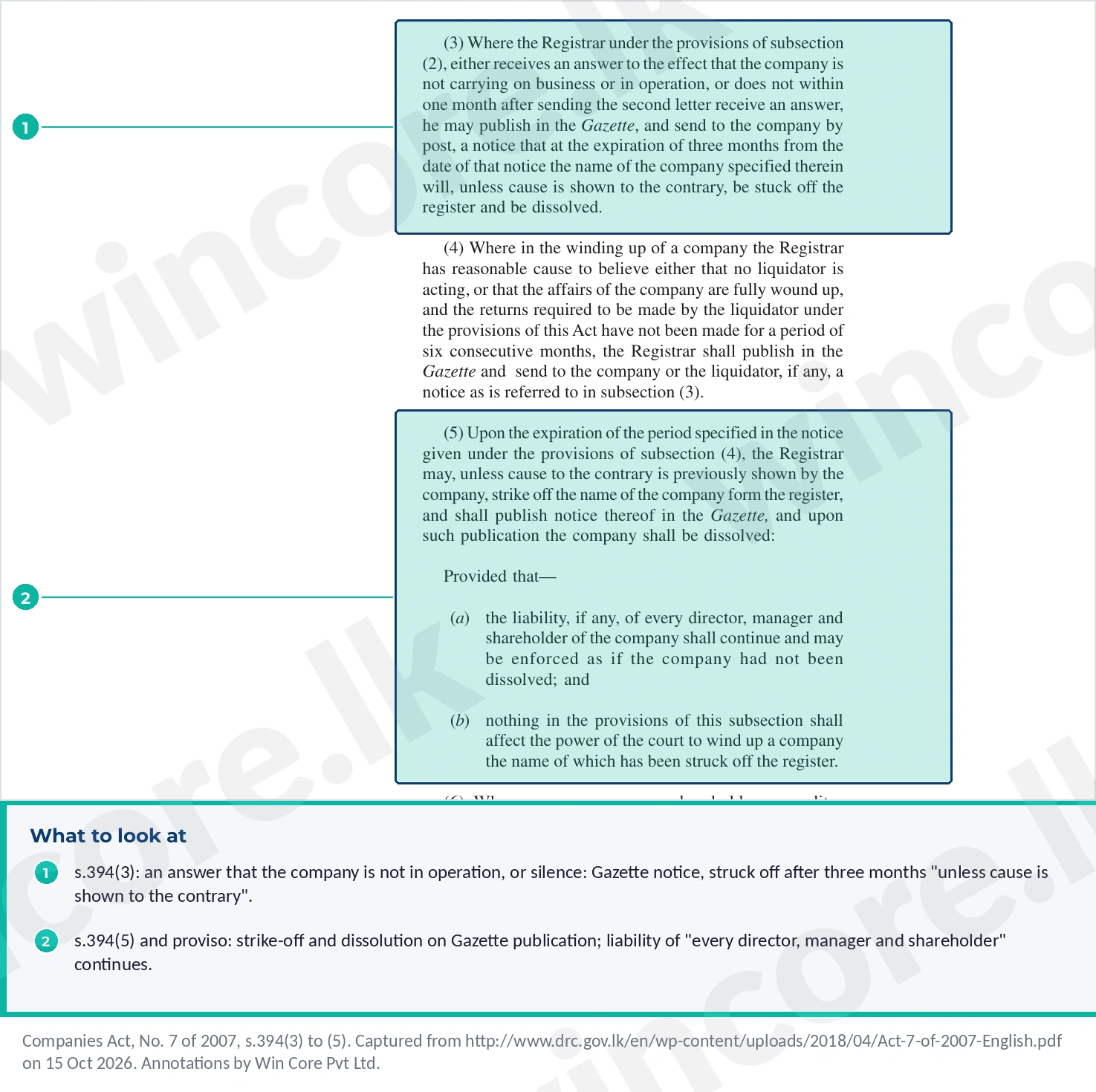
- Gazette notice. If the Registrar "either receives an answer to the effect that the company is not carrying on business or in operation, or does not within one month after sending the second letter receive an answer", he "may publish in the Gazette, and send to the company by post" a notice that after "three months from the date of that notice the name of the company ... will, unless cause is shown to the contrary, be stuck off the register and be dissolved" (s.394(3)) [1]. The Act prints "stuck off".
- Strike-off and dissolution. On expiry, the Registrar "may, unless cause to the contrary is previously shown by the company, strike off the name", "shall publish notice thereof in the Gazette, and upon such publication the company shall be dissolved" (s.394(5)) [1].
Letters and notices go to the registered office, or where none is registered, to an officer at the latest address in the company's filings (s.394(7)) [1]. A company that wants to stay on the register needs a registered office that someone actually reads.
Affidavits support a voluntary request to strike off a company in Sri Lanka
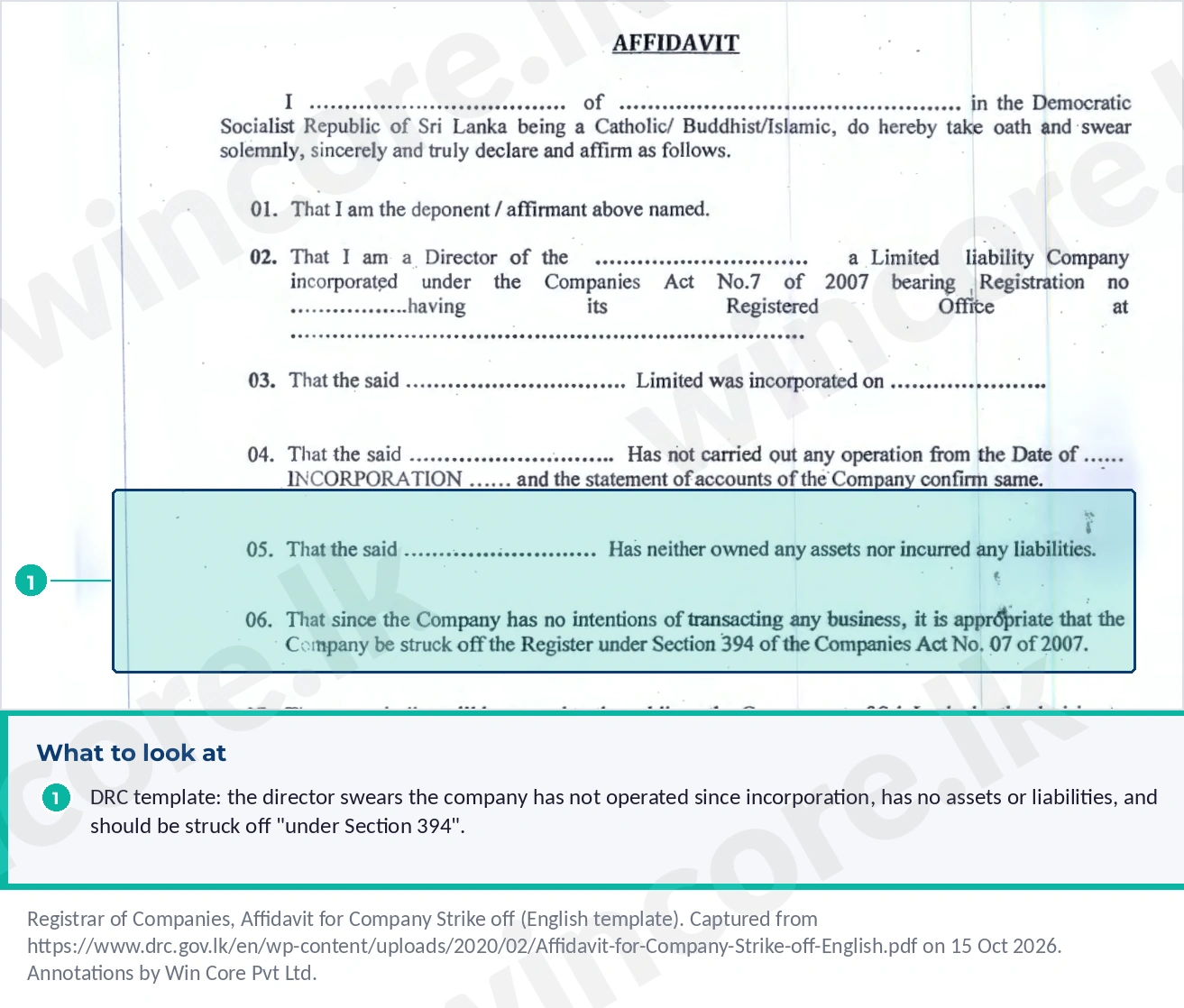
Section 394 sets out the Registrar's powers. On our reading, the voluntary affidavit route can supply the answer described in s.394(3), after which the Registrar may act [1]. The Registrar publishes an English director affidavit template for company strike off [2].
In the template, a director swears that the company "Has not carried out any operation from the Date of ... INCORPORATION ... and the statement of accounts of the Company confirm same", that it "Has neither owned any assets nor incurred any liabilities", and that "since the Company has no intentions of transacting any business, it is appropriate that the Company be struck off the Register under Section 394" [2].
| Point | Voluntary (affidavit) | Registrar-initiated |
|---|---|---|
| Who starts it | A director or secretary can submit the local eROC request; the guide calls for separate affidavits from each director and non-director shareholder [4] | The Registrar, on "reasonable cause to believe" (s.394(1)) [1] |
| Letters | On our reading, the affidavit is the answer under s.394(3); whether the Registrar also sends letters for a voluntary request is not verified | First letter, then registered second letter (s.394(1), (2)) |
| Gazette notice | s.394(3), three months | s.394(3), three months |
| Dissolution | On our reading, on Gazette publication under s.394(5), subject to the drafting point below | Same |
| Fits whom | The template describes a company that never operated, owned assets or incurred liabilities [2] | Any company the Registrar believes is not operating |
Can a company that traded for years, then went quiet, use the affidavit? The template's wording does not fit it, because paragraph 04 swears no operation since incorporation. A director cannot truthfully sign that. Winding up is the conventional route for such a company. How the Registrar handles a company that has stopped trading is an open point below.
Requesting strike off and submitting a restoration order on eROC
The DRC Strike Off guide describes a local company request by a director or secretary through the company's Strike Off option, and a correspondence route. The separate court order route is used after a court has made an order; it is not a step every strike off applicant must take [4]. For the three routes compared, see how to close a company.
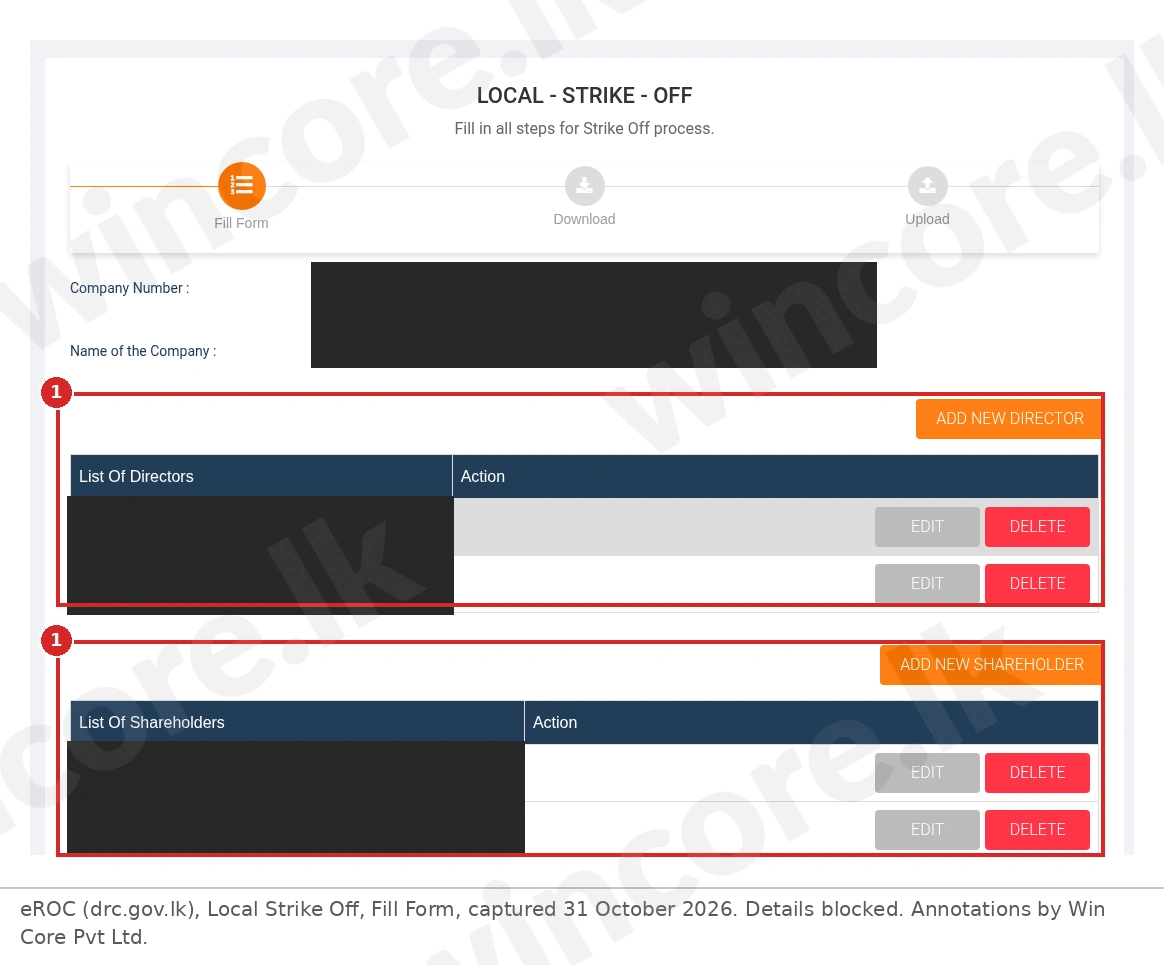
- Open Strike Off and review the lists. Select Strike Off on the company. The guide describes the current director and shareholder lists and controls to add, edit or delete entries. Check them against the company's records [4].
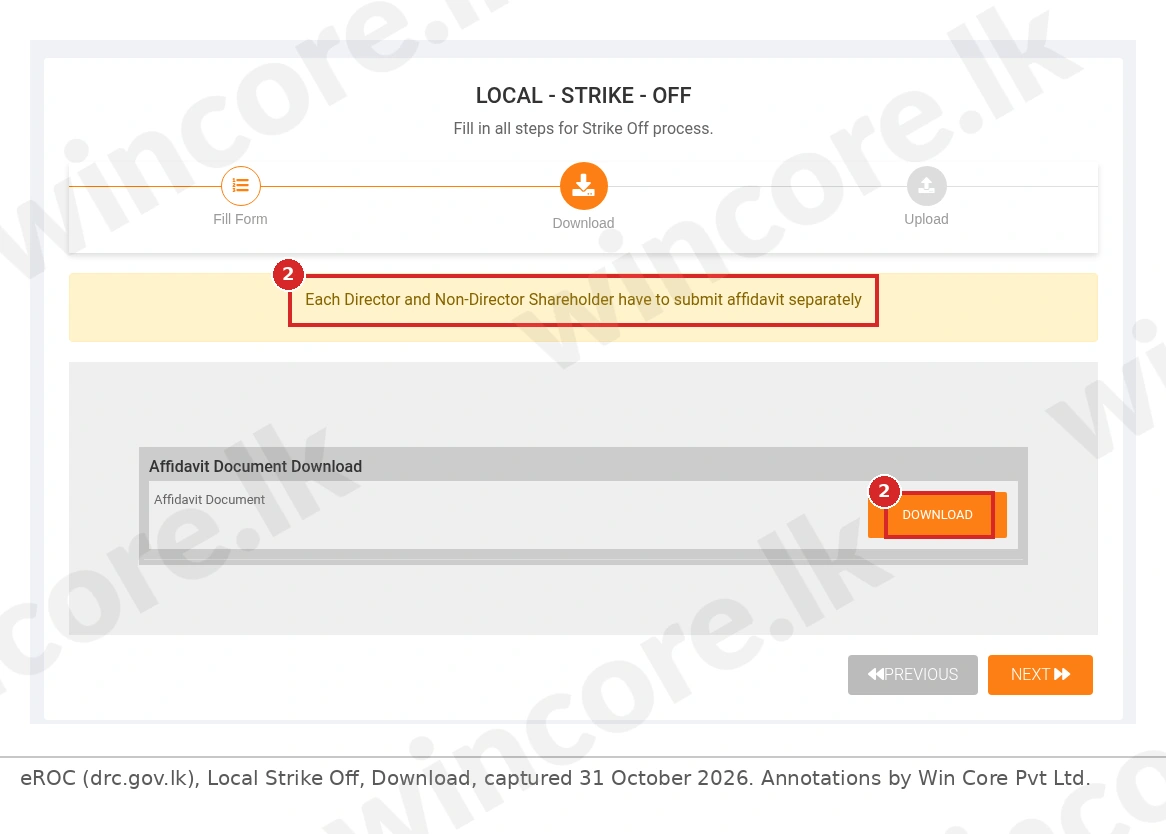
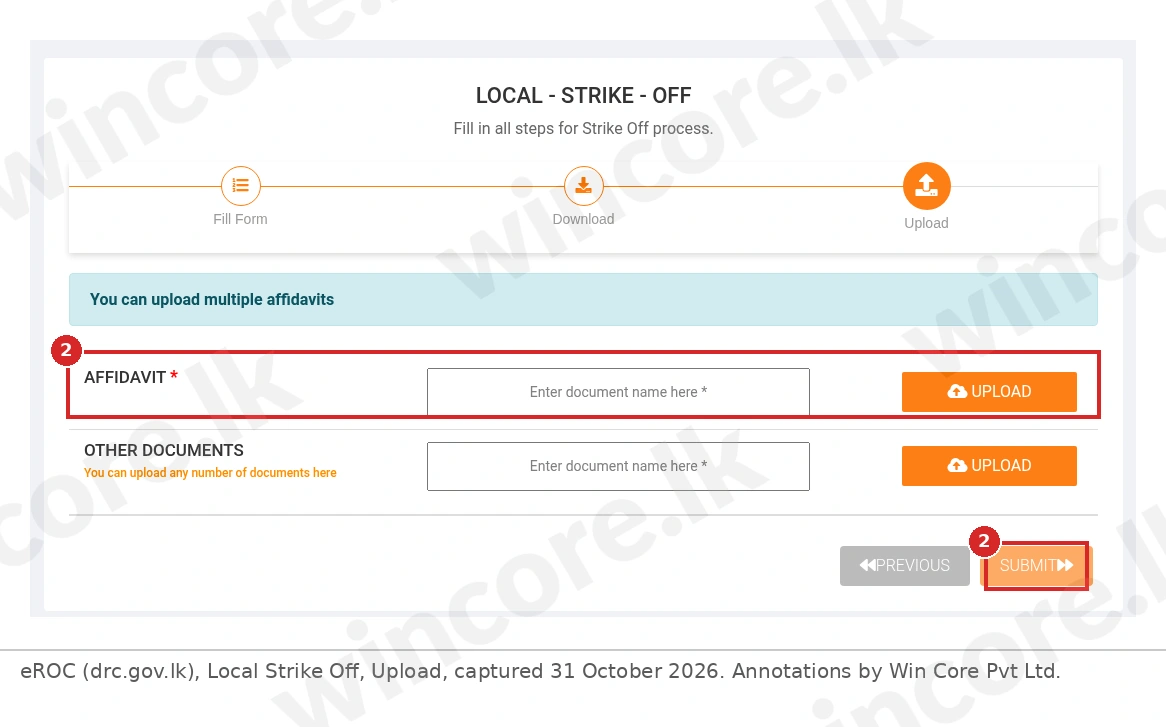
- Download and upload the affidavits. The guide's download banner says each director and each shareholder who is not a director must submit an affidavit separately. Download and complete the appropriate documents, upload them and any other documents, and submit. The guide says the dashboard shows the application status and is updated on approval [4]. Submission or a portal status is not itself the Gazette publication that dissolves a company.
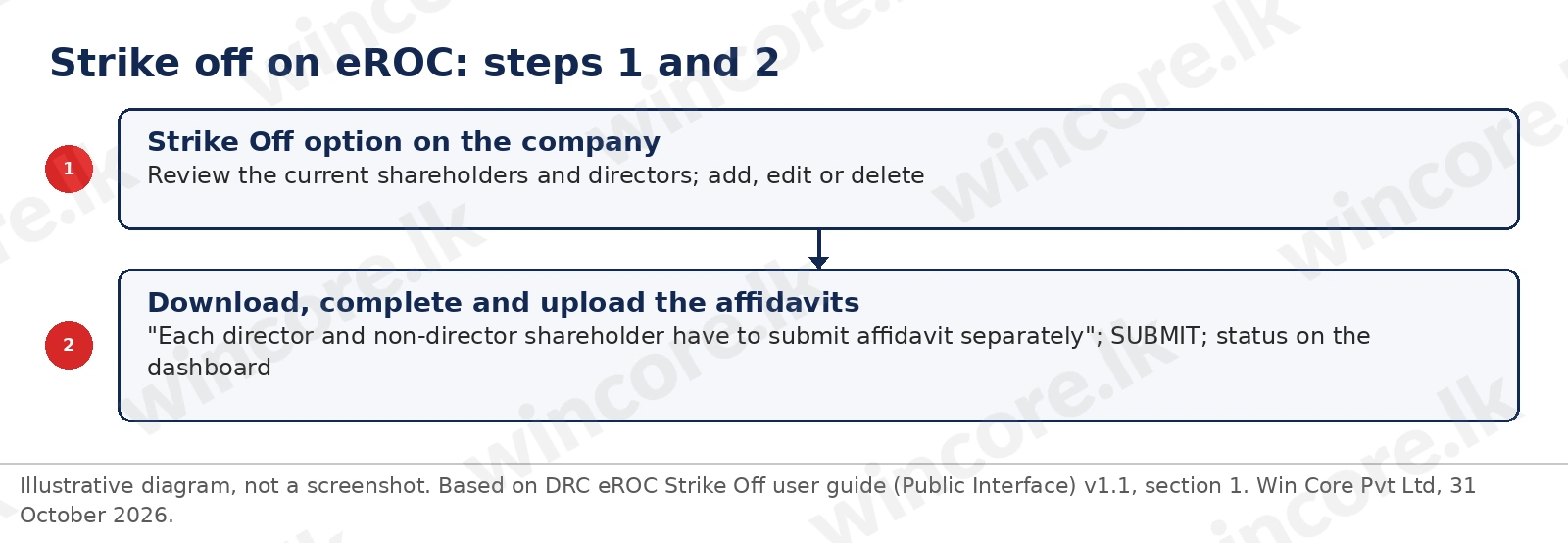
The supplied captures show the Fill Form, Download and Upload tabs as they appeared on 31 October 2026.
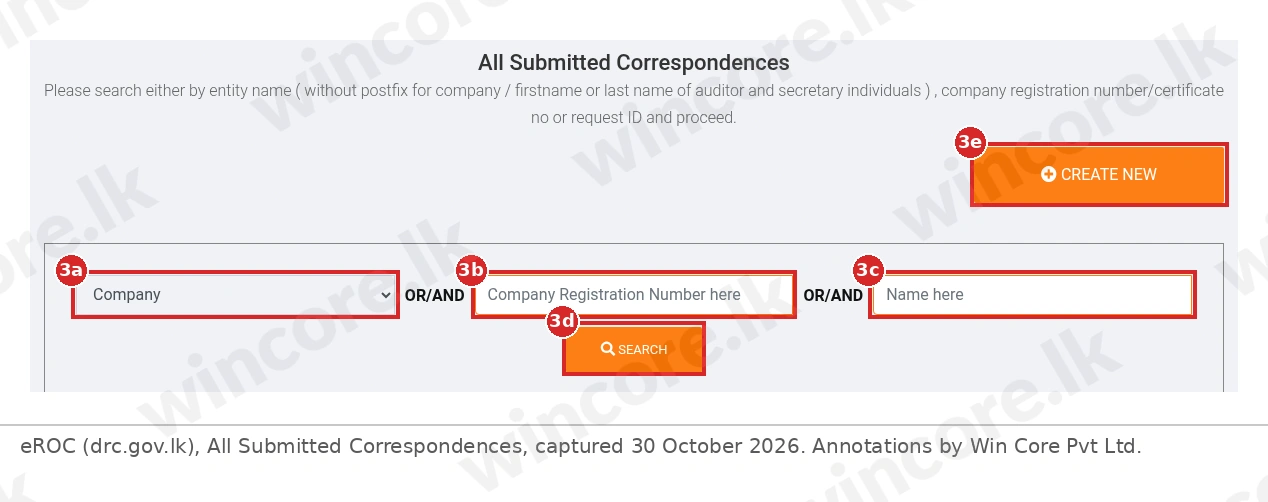
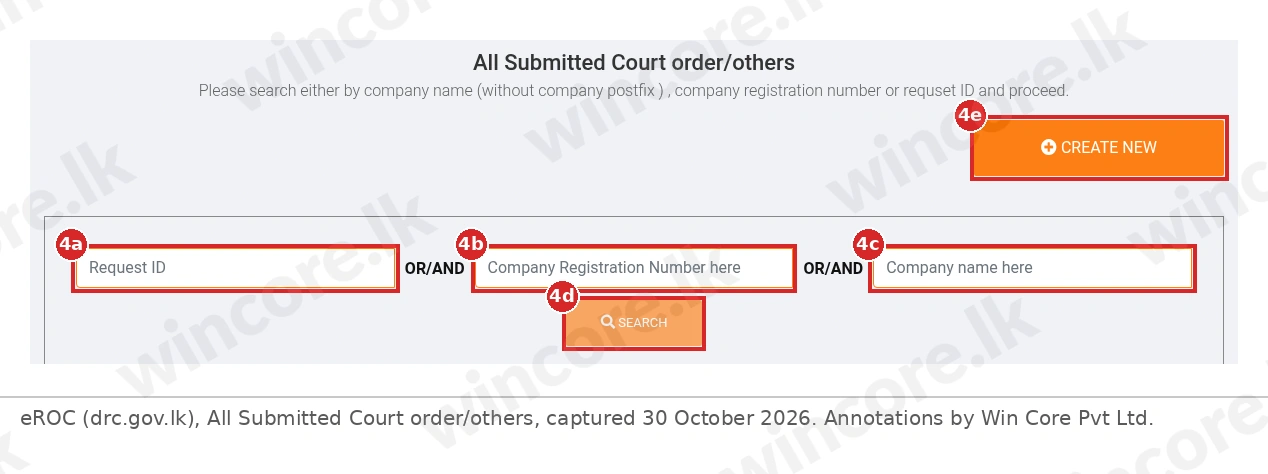
Correspondence is an alternative route. The All Submitted Correspondences screen filters existing submissions by entity type, registration number or name. To start a new one, choose Create New, find the entity, select Submit New, choose the purpose, enter the subject and message, upload any documents with captions and complete the submission. The guide includes company strike off in this module [4].
A court order is needed for the restoration route. Under section 394(6), an eligible applicant first applies to court within the stated period; the court may make a restoration order if the statutory test is met. The DRC guide then describes submitting the court order through Court order/others for companies, choosing the purpose re-instating. Its guide says the application status appears after DRC approval. The Act deems the company to have continued in existence upon delivery of a certified copy of the order to the Registrar for registration [1] [4]. For filing a court order with the Registrar, see the eROC court order steps.
Dissolution ends the company, not the liability
| Effect | Section | What the text says |
|---|---|---|
| Personal liability continues | s.394(5) proviso (a) | "the liability, if any, of every director, manager and shareholder of the company shall continue and may be enforced as if the company had not been dissolved" [1] |
| Court can still wind it up | s.394(5) proviso (b) | "nothing in the provisions of this subsection shall affect the power of the court to wind up a company the name of which has been struck off the register" [1] |
| Property goes to the State | s.395 | All property "vested in or held on trust for the company immediately before the date of its dissolution (including leasehold property but not including property held by the company on trust for any other person)" vests in the State, subject to court orders under ss.393 and 394 [1] |
| Restoration possible for five years | s.394(6) | Court may restore on an application made "before the expiration of five years from the publication in the Gazette of the notice referred to in subsection (5)" [1] |
We read all seven subsections of s.394 on 3 November 2026 and found no fine or offence in it. The consequences are the effects above, not penalties. Section 393(2) does carry a fine of up to Rs 50,000 on conviction, but only for failing to deliver a certified copy of an order declaring a dissolution void to the Registrar within seven days, or such further time as the court allows [1]; it is not a fine for being struck off. For a filing default constituting an offence, the Registrar may accept a composition sum under section 514 instead of instituting or continuing proceedings.
Why does the State take the property? A dissolved company cannot own anything, and leaving its assets ownerless would invite anyone to take them. Vesting in the State keeps them in one place until a court restores the company or orders otherwise. For the tender company with nothing in it, s.395 takes nothing, which is exactly why the affidavit asks the director to swear to it.
Restoration has three different windows, and only one fits section 394
Section 394(6), five years. Where "a company or any shareholder or creditor thereof is aggrieved by the company having been struck off", the court, on an application by the company, shareholder or creditor "before the expiration of five years from the publication in the Gazette of the notice referred to in subsection (5)", may order restoration if "satisfied, that the company was at the time of the striking off carrying on business or in operation, or otherwise that it is just" [1]. Upon a certified copy of the order being delivered to the Registrar for registration, the company is deemed to have continued in existence as if its name had not been struck off; the court may give directions to put everyone back in the same position. Directors are not listed as applicants in their own right.
Section 393, two years, a different case. The court may, "at any time within two years from the date of the dissolution", declare a dissolution void on application "by the liquidator of the company, or by any other person who appears to the court to be interested" [1]. Its wording speaks of a liquidator. Whether it also reaches a s.394 strike-off is open.
Section 487, ten years, not s.394. Act No. 12 of 2025 s.17 added a proviso for companies struck off under s.487(3), the re-registration rule for companies formed under the old law. Such a company may apply to court before ten years expire from the amendment Act's operation, making the Attorney-General a party and showing cause why it could not comply with re-registration. The court may permit re-registration and, upon registration, order the return of property vested in the State, subject to rights acquired from the State in good faith; the proviso also limits State liability where property was destroyed or damaged or its physical possession was not taken by the State [3]. That Act came into operation on 30 March 2026, as our explainer on the Companies (Amendment) Act No. 12 of 2025 records. This window does not apply to a s.394 strike-off.
Back to the tender company. It is struck off in 2026. In 2028 a supplier surfaces with an unpaid invoice from the bid stage. The supplier, as a creditor, can apply under s.394(6) before five years have expired from publication of the strike-off notice, and the director's sworn statement that the company had no liabilities would then be scrutinised.
Before you file, check the facts against the affidavit
- Test each sworn statement. The published director template refers to no operation since incorporation and to the company never having owned assets or incurred liabilities [2]. Do not sign a statement that is untrue; consider whether winding up or another route fits the facts.
- Check the company's property and liabilities. Closing an account now does not make a statement that the company never owned assets or incurred liabilities true. On dissolution, s.395 vests the company's property in the State, subject to its exceptions and court orders.
- Settle tax registrations separately. Striking off is a Companies Act process. How the Inland Revenue Department closes a company's TIN and tax types is outside s.394, and our income tax services team handles that side.
- Prepare the separate affidavits. The eROC guide asks for one from each director and each non-director shareholder [4]. The Registrar also publishes a director affidavit template [2]. Watch the Gazette for any notice under s.394(3).
- Answer any Registrar letter if you want to keep the company. Silence after the second letter allows the Gazette notice.
Checklist: documents needed
- Certificate of incorporation and the registration number
- The company's statement of accounts showing no operation since incorporation
- Evidence that the company holds no assets and owes nothing
- Separate affidavits for each director and each non-director shareholder, as directed by the eROC guide
- Any covering letter required by the current filing instructions
- Proof that deposits, leases and any account have been closed
- A copy of the s.394(3) Gazette notice and, later, the s.394(5) strike-off notice
Practice point, not a legal requirement in s.394: bring the company's statutory filings up to date before you apply, because an unfiled annual return or an out-of-date secretary on the register slows any Registrar process. Our guide to Form 15 annual return filing covers the return, and how to change your company secretary covers Form 20.
What this means for you
The published director affidavit describes a company that has never operated, owned assets or incurred liabilities. Do not swear a statement that is untrue. How the Registrar handles a company that formerly traded remains an open point. Remember too that "may" runs through the section: the Registrar may write, may publish and may strike off, and the Registrar must send the second letter in the case described in subsection (2), and publish the strike-off notice after striking off under subsection (5). Subsection (4) also uses a mandatory notice for the separate winding-up case. Our corporate secretarial services team can check the facts, prepare the affidavit pack and track the Gazette notices.
Open points we have not settled
- Drafting gap in s.394(5). It refers to "the notice given under the provisions of subsection (4)", the winding-up case, not the s.394(3) notice for dormant companies [1]. On our reading (5) covers both, but the text does not say so.
- Companies that stopped trading. The template covers only companies that never operated. We have not verified whether the Registrar accepts a different affidavit for companies that formerly traded.
- Section 393 and strike-off. Whether the two year rule reaches a s.394 dissolution.
- Prerequisites, fees and processing time. Whether the Registrar requires outstanding returns first, what fee applies and how long it takes: not verified.
- Template date. The sample jurat on the template is dated 2019; the Registrar could replace it without notice.
FAQ
Can I strike off my own company in Sri Lanka?
A director or secretary can request local strike off through eROC. The DRC guide calls for separate affidavits from each director and non-director shareholder. On our reading, the affidavit route supplies the answer described in section 394(3); the published director template describes a company that never operated, owned assets or incurred liabilities [2] [4].
How long does a strike-off take?
On our reading, allow at least three months from the section 394(3) Gazette notice and, if the Registrar strikes the name off, until publication of the strike-off notice. Section 394(5) refers expressly to the subsection (4) notice, which leaves the drafting point described above open. We have not verified the Registrar's processing time before the first notice, so allow for it.
What happens to money left in a struck-off company?
It vests in the State under section 395, along with all other property the company held, including leasehold property. Property the company held on trust for someone else is excluded. Section 395 is subject to court orders under sections 393 and 394. Check the company's property and the affidavit wording before applying.
Can a struck-off company be restored?
Yes, by court order under section 394(6). The company, a shareholder or a creditor may apply before five years have expired from publication of the Gazette notice of the strike-off. The court must be satisfied the company was in operation when struck off, or that restoration is otherwise just. Once a certified copy of the order is delivered to the Registrar for registration, the company is deemed to have continued in existence as if not struck off.
Does striking off end the directors' liability?
No. Proviso (a) to section 394(5) says the liability of every director, manager and shareholder "shall continue and may be enforced as if the company had not been dissolved". Proviso (b) adds that a court can still wind the company up. Striking off removes the name, not the obligations behind it.
Who can request a strike off on eROC?
The DRC guide says a director or secretary can request local company strike off through the company page, and it also describes the Correspondence route. It calls for a separate affidavit from each director and each non-director shareholder. The dashboard displays the application's status; submission is not the same as dissolution [4].
Talk to us. If you have a company that never traded and want to close it properly, book a consultation at our contact page.
WinCore Pvt Ltd
This article is general information on the law as at 3 November 2026 and is not advice on your specific position.
References
- Parliament of Sri Lanka. Companies Act, No. 7 of 2007, ss.393, 394(1) to (7) and 395. http://www.drc.gov.lk/en/wp-content/uploads/2018/04/Act-7-of-2007-English.pdf . Primary. Supplied PDF checked 3 November 2026.
- Department of the Registrar of Companies. Affidavit for Company Strike off (English template). https://www.drc.gov.lk/en/wp-content/uploads/2020/02/Affidavit-for-Company-Strike-off-English.pdf . Primary. Template read 3 November 2026.
- Parliament of Sri Lanka. Companies (Amendment) Act, No. 12 of 2025, s.17 (amending s.487(5)). https://www.parliament.lk/uploads/acts/gbills/english/6389.pdf . Primary. Supplied PDF checked 3 November 2026.
- Department of the Registrar of Companies. User Guide eROC System: Strike Off (Public Interface), version 1.1, sections 1, 7, 8 and 9. https://erocapiv2.drc.gov.lk/pdf/Strikeoff-Public-Interface-V1.1.pdf . Primary. Read 3 November 2026.
Put these insights to work
WinCore specialists can review your current workflow, document gaps, and build a practical 90-day action plan.
Book a free consultationContinue reading
Explore more WinCore analysis to keep your finance, tax, and compliance roadmap moving.
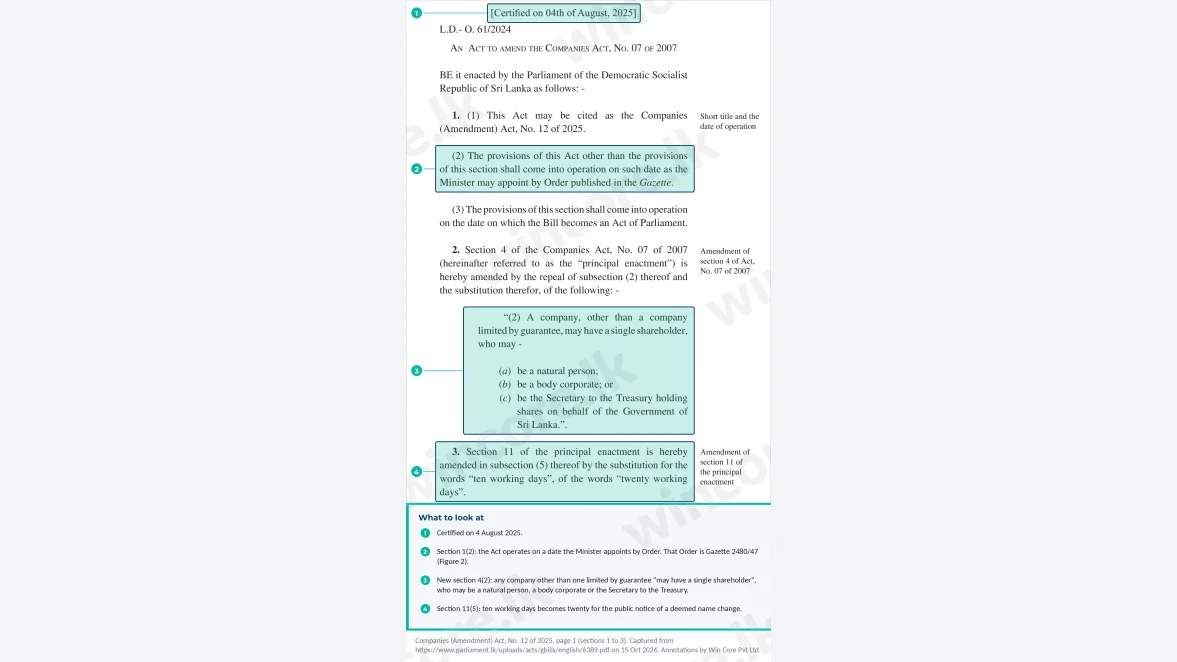
Beyond beneficial ownership, the 2025 amending Act ended bearer shares, moved allotments to working days and added a Rs 1 million general penalty.
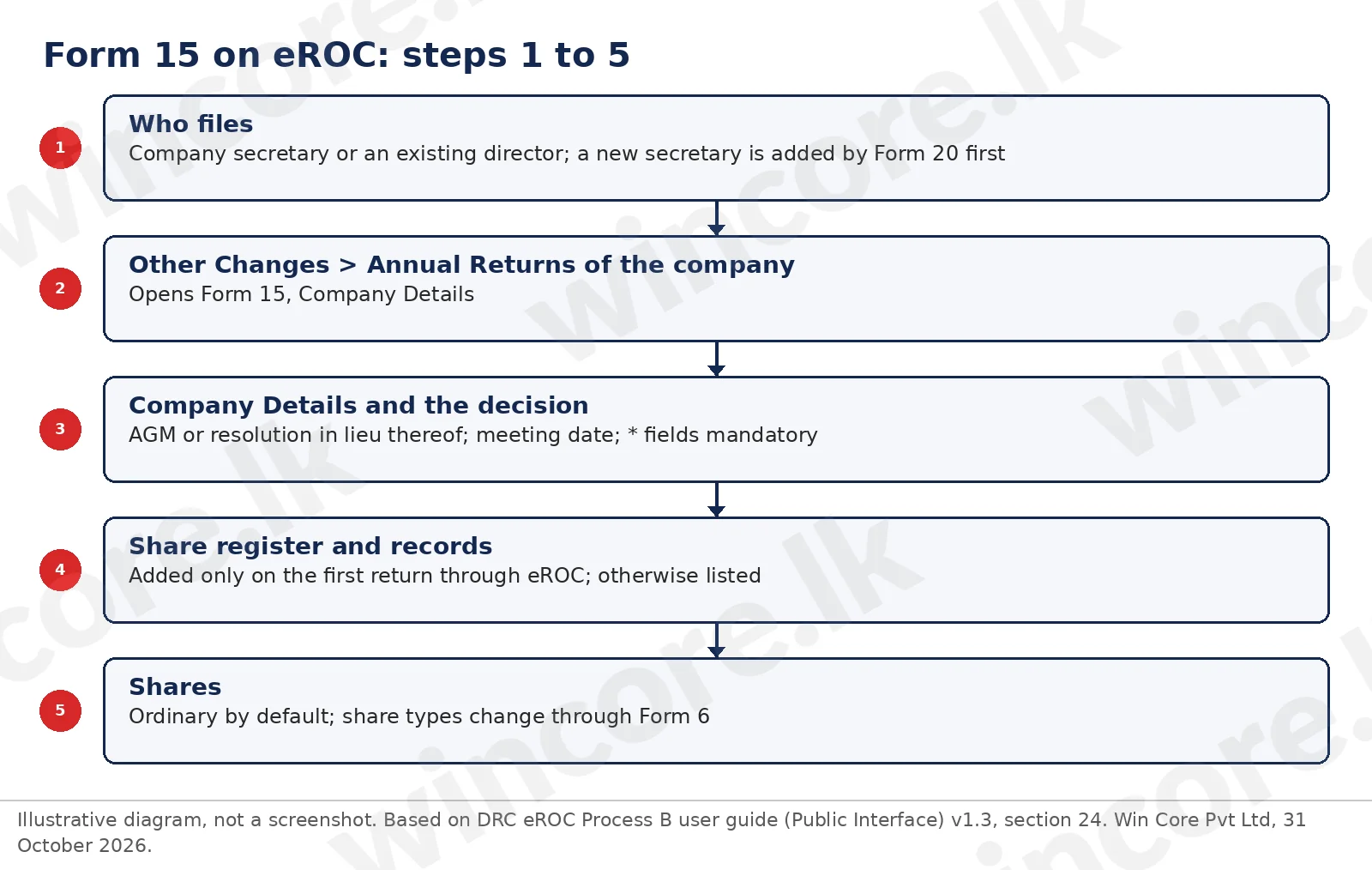
Treat Form 15 as a live governance filing: the 30-working-day clock from the AGM, the BO 4 that goes with it, the fee, and the controls that keep it on time.
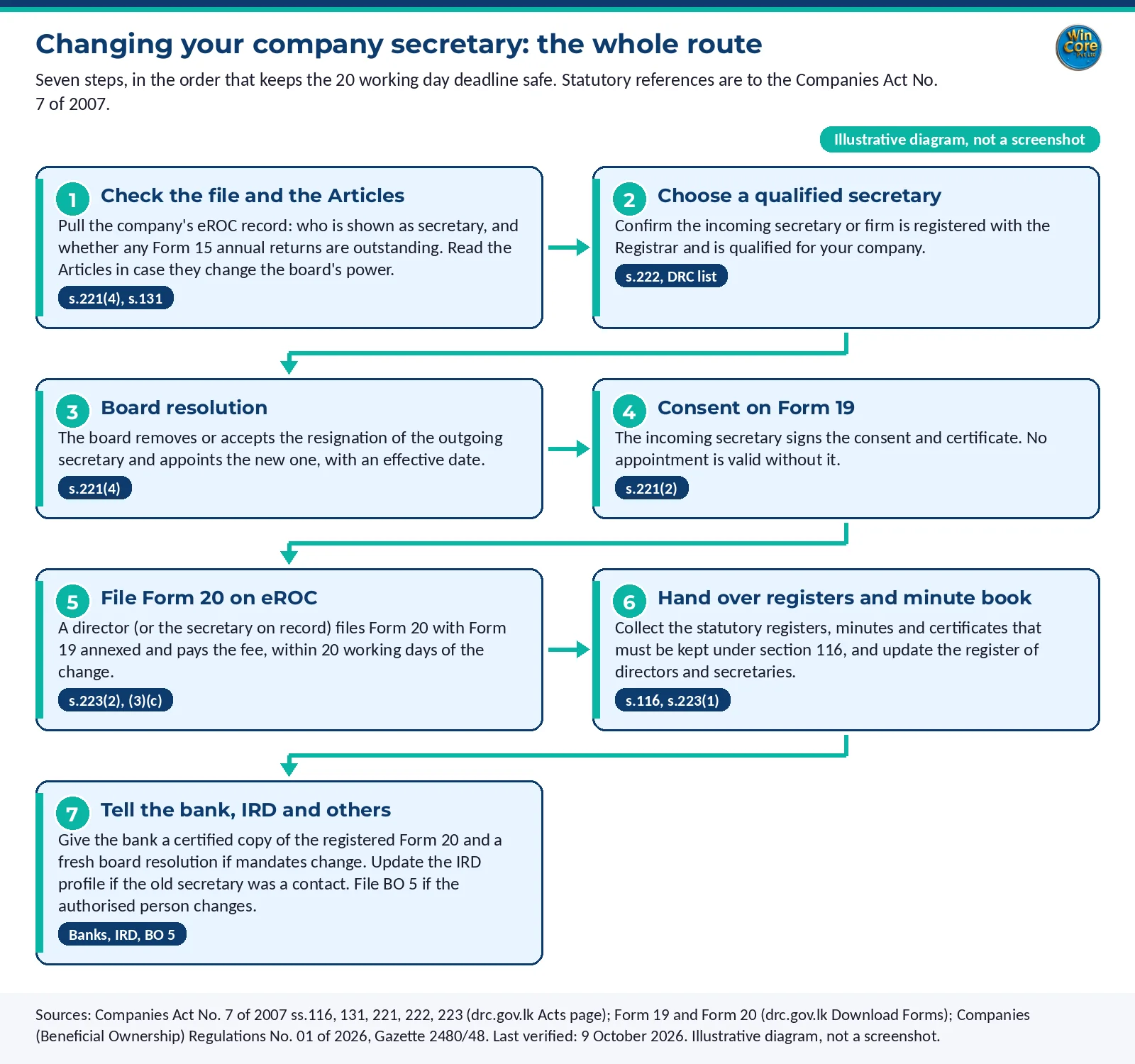
Changing a company secretary step by step: the board resolution, Form 19 consent, Form 20 within 20 working days, the fee and the handover.