
Statutory registers Sri Lanka: what a company must keep
Which registers a Sri Lankan company must keep, where they may be kept, who can inspect them, how long to keep them and the ten-working-day notices.
On this page
Last verified against the primary sources on 26 October 2026.
Statutory registers Sri Lanka, in brief. The Companies Act No. 7 of 2007 requires every company to keep a set of records at its registered office: the share register, the register of directors and secretaries, an interests register (unless a private company has dispensed with it), minutes of board and shareholder meetings, directors' certificates, the register of charges, financial statements and accounting records. Since Act No. 12 of 2025, section 130A(4) adds a register of beneficial owners, also kept at the registered office; it is not one of the section 116 records. Most must be kept for ten years. Some are open to shareholders, and some to anyone who gives written notice.
Take a hypothetical hardware wholesaler with two directors, three shareholders and a bank overdraft secured by a charge over its stock. This guide follows it through each register.
Statutory registers Sri Lanka: section 116 lists what every company must keep
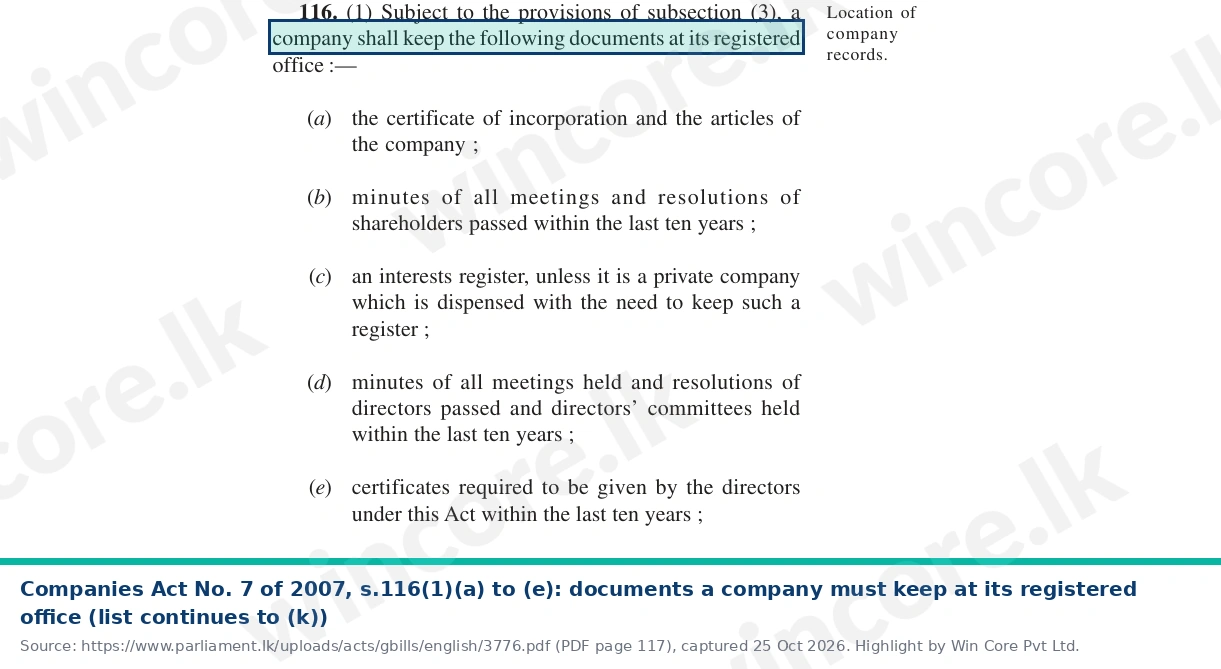
Section 116(1): "a company shall keep the following documents at its registered office" [1]:
- (a) "the certificate of incorporation and the articles of the company";
- (b) "minutes of all meetings and resolutions of shareholders passed within the last ten years";
- (c) "an interests register, unless it is a private company which is dispensed with the need to keep such a register";
- (d) minutes of directors' meetings, resolutions and committees "within the last ten years";
- (e) "certificates required to be given by the directors under this Act within the last ten years";
- (f) "the register of directors and secretaries required to be kept under section 223";
- (g) copies of written communications to all shareholders, including annual reports, for ten years;
- (h) financial statements "for the last ten completed accounting periods";
- (i) instruments creating charges and "the register of charges required to be kept under sections 109 and 110";
- (j) "the share register required to be kept under section 123"; and
- (k) accounting records under section 148 "for the current accounting period and for the last ten completed accounting periods".
Section 116(2) lets the Registrar shorten the ten-year periods "where he considers it necessary and appropriate". A failure under section 116(1) or (4) exposes the company to a fine of up to two hundred thousand rupees and each officer in default to up to one hundred thousand rupees (section 116(5)) [1].
Each register has its own section, and the beneficial owners register is new
Share register (section 123). It records "the name and the latest known address of each person who is or has within the last ten years been a shareholder", the number of shares of each class held, and the date of any issue, repurchase, redemption or transfer in the last ten years [1]. For the wholesaler, three entries, one per shareholder, plus any transfers.
Register of directors and secretaries (section 223). For an individual it records "the present name and surname, any former name or surname, usual residential address and business occupation" [1]. A change goes to the Registrar within twenty working days (section 223(3)(c)).
Interests register. Section 192(1) requires a director who is "interested in a transaction or proposed transaction with the company" to "cause to be entered in the interests register" the nature and extent of the interest [1]. Section 30(1) lets a private company "by unanimous resolution of its shareholders dispense with the keeping of an interests register". That resolution "shall cease to have effect, if any shareholder gives notice in writing" (section 30(2)).
Minutes (section 147). "Every company shall cause minutes of all proceedings of general meetings and meetings of its directors to be entered in books kept for that purpose" (section 147(1)). Signed minutes are evidence of the proceedings (section 147(2)). Every director and former director may receive certified copies of board minutes for their period in office (section 147(4)) [1]. Our guide to certified copies covers that request.
Register of charges (sections 109 and 110). The company keeps copies of instruments creating charges and its own register of charges. The wholesaler's overdraft charge over stock is recorded there.
Accounting records (section 148). They must "correctly record and explain the company's transactions" and include daily entries of money received and spent, a record of assets and liabilities, and, for a business dealing in goods, a record of goods bought and sold and of stock at year end (section 148(2)) [1]. For a hardware wholesaler, the stock records matter most.
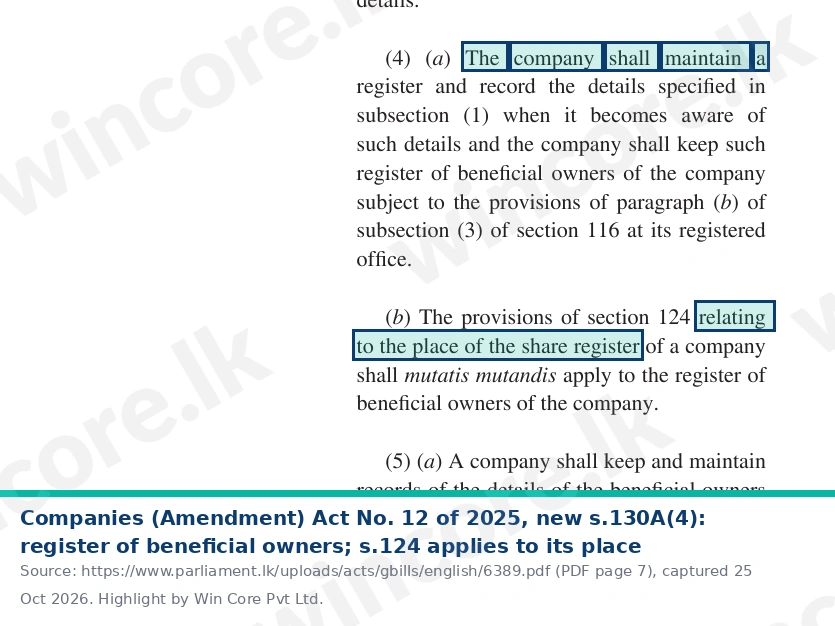
Register of beneficial owners (section 130A). Act No. 12 of 2025 inserted section 130A. Under section 130A(4)(a), "The company shall maintain a register and record the details specified in subsection (1) when it becomes aware of such details", kept at the registered office. Section 130A(5)(a) requires the records to be kept "for a period of at least ten years after the date on which the record was made" [2]. Shareholders must give the company their details "within ten working days of the subscription of any shares or transfer of shares" (section 130A(2)). See beneficial ownership at 10 percent.
The company must also appoint "a natural person residing in Sri Lanka as the authorised person" responsible "for the safe keeping of the register of the beneficial owners" (section 130C(1)) [2]. Regulation 4(1) of the Beneficial Ownership Regulations in Gazette 2509/67 requires the appointment and later changes to be notified "in Form BO 5" [3].
A move away from the registered office needs notice to the Registrar, usually within ten working days
The default is the registered office. Three different rules allow other places:
- Most records (section 116(3)(a), (4)). Records in paragraphs (a) to (i) "may be kept at a place in Sri Lanka other than in the registered office". If records are kept elsewhere or moved, "within ten working days of their first being kept elsewhere or moved", notice of the place goes to the Registrar [1]. The Registrar's forms list includes "FORM 14 : Notice of Change of Location of the Records and Registers" [5].
- Share register (section 124). "The principal register shall be kept in Sri Lanka" (section 124(2)). If it is not at the registered office, notice of its place goes to the Registrar "within ten working days after it ceases to be kept there or after the place at which it is kept is altered" (section 124(4)) [1].
- Accounting records (section 149). "A company shall keep its accounting records in Sri Lanka", unless the Registrar permits otherwise (section 149(1)) [1]. Section 149 itself requires notice of the place only where the records are kept outside Sri Lanka (section 149(2)(b)). The forms list includes "FORM 16 : Notice of Location of Accounting Records" [5].
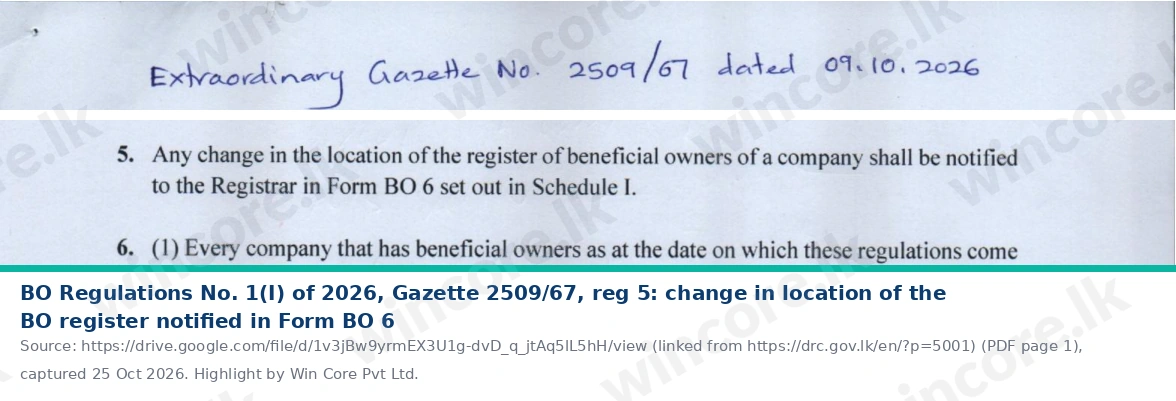
The BO register and Form BO 6. Section 130A(4)(b): "The provisions of section 124 relating to the place of the share register of a company shall mutatis mutandis apply to the register of beneficial owners" [2]. On our reading, that applies the ten-working-day notice in section 124(4) where the register of beneficial owners is kept away from the registered office; the wording does not plainly settle a move in which the register stays at the registered office. Regulation 5 sets the form: "Any change in the location of the register of beneficial owners of a company shall be notified to the Registrar in Form BO 6 set out in Schedule I" [3]. Regulation 5 sets no period of its own. Regulation 10, as replaced from 22 October 2026 by Regulations No. 1(II) of 2026 (Gazette 2511/47), charges a penalty of Rs 1,000 a week where a form is not submitted within the period prescribed for it, with a part week counted as a full week; whether the section 124 period counts as that period for Form BO 6 is not settled [4]. If the BO register moves, see the BO6 form.
If the wholesaler moves its registers from its own office to its company secretary's office, it files Form 14 for the records under section 116(4), the share register notice under section 124(4), and Form BO 6 for the BO register, each within ten working days of the move (for Form BO 6, on our reading of section 130A(4)(b)).
Inspection rights differ for directors, shareholders and the public
| Who | What they may inspect | Section |
|---|---|---|
| Directors | The company's written records, on reasonable notice, without charge | 118(1) |
| Shareholders, or a person they authorise in writing | Minutes and resolutions of shareholders; written communications to shareholders for ten years; directors' certificates; interests register | 119(1) |
| Any person | Certificate of incorporation; articles (if not the model articles); share register; register of directors and secretaries; registered office particulars; charges and register of charges | 120(1) |
| Listed authorities on request | Beneficial ownership details | 130B |
| Any member of the public, from the Registrar | Limited BO details (names, nationalities, countries of residence, business addresses, nature and extent) | 130D |
A court may limit a director's inspection if it "would not be in the company's interests" or is "for a purpose that is not properly connected with the director's duties" (section 118(2)) [1]. The BO register is not in the lists in sections 119 or 120. Section 130B requires the company or the Registrar to make BO details available on request to bodies including the Attorney-General, the Financial Intelligence Unit, Customs, the Commissioner-General of Inland Revenue and regulatory authorities. Separately, section 130D requires the Registrar to make limited BO details "promptly accessible to the public": full names, nationalities, countries of residence, business addresses, and the nature and extent of the ownership. Further details need a Right to Information application [2].
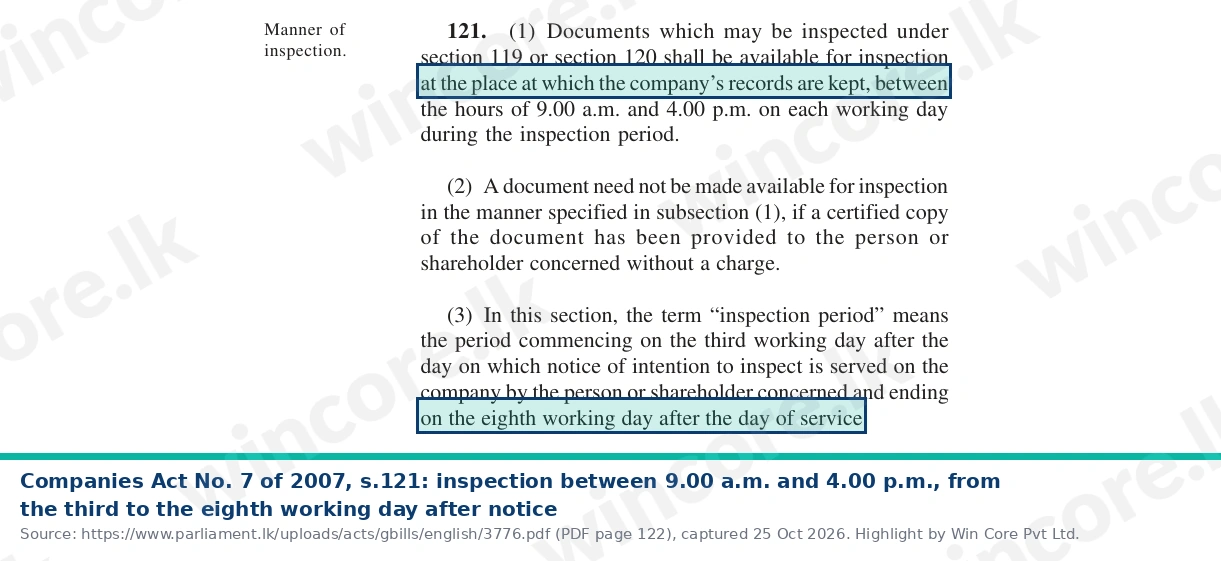
How inspection works (section 121). Documents are available "between the hours of 9.00 a.m. and 4.00 p.m. on each working day during the inspection period". That period runs from "the third working day after the day on which notice of intention to inspect is served" to "the eighth working day after the day of service" (section 121(1), (3)). A free certified copy can be given instead (section 121(2)) [1].
Copies (section 122). A person may ask for a copy or extract, to be sent "within five working days" after a written request and payment of "a reasonable copying and administration fee as may be determined by the company" [1].
Keep company records for ten years, and longer if another law says so
- Shareholder and board minutes, resolutions, directors' certificates and shareholder communications: ten years (section 116(1)(b), (d), (e), (g)).
- Financial statements and accounting records: the current period and ten completed accounting periods (section 116(1)(h), (k)).
- Share register: shareholders and dealings within the last ten years (section 123(1)).
- Beneficial ownership records: at least ten years after each record is made (section 130A(5)(a)).
Other laws, such as tax laws, may set their own periods. Keep the longer one.
Electronic registers are allowed if they can be printed and are protected from falsification
Section 117(1): records "shall be kept in written form or in a form or in a manner that allows the documents and information that comprise the records to be easily accessible and convertible into written form". Section 117(2) requires "adequate measures" to "prevent the records being falsified and detect any falsification of them" [1]. So, on our reading, an electronic register is allowed if it can be printed and has controls, such as backups and an edit trail, that prevent and detect falsification. A failure under section 117(2) carries a fine of up to Rs 200,000 for the company and up to Rs 100,000 for each officer in default (section 117(3)).
The duty to keep registers stays with the company when a secretary holds them
Many companies let the company secretary keep the books. The duty under section 116 stays with the company, and the fines in section 116(5) fall on the company and officers in default [1]. Before a secretary changes, list every register and minute book, agree a handover date, and confirm whether the place of the records will change. If it does, the ten-working-day notices above apply. Our guide on an outgoing secretary who will not sign covers the practical side.
Nine registers and records, each with its section and who may inspect it
| Register or record | Section | What it records | Who may inspect |
|---|---|---|---|
| Share register | 123, 124 | Shareholders, addresses, shares by class, dates of issue and transfer (10 years) | Any person (s.120) |
| Directors and secretaries | 223 | Names, former names, residential address, occupation | Any person (s.120) |
| Interests register | 116(1)(c), 192, 30 | Directors' interests in transactions | Shareholders (s.119) |
| Shareholder minutes and resolutions | 116(1)(b), 147 | Proceedings of general meetings, resolutions | Shareholders (s.119) |
| Board minutes and resolutions | 116(1)(d), 147 | Board and committee proceedings | Directors (s.118); certified copies to directors (s.147(4)) |
| Directors' certificates | 116(1)(e) | Certificates required by the Act | Shareholders (s.119) |
| Register of charges | 109, 110 | Charges over company property | Any person (s.120) |
| Accounting records | 148, 149 | Daily money in and out, assets, liabilities, stock | Directors (s.118) |
| Register of beneficial owners | 130A, 130C | BO details and nature of ownership | Authorities on request (s.130B); limited details public through the Registrar (s.130D) |
What this means for you
Keep one checklist of the registers in section 116, plus the BO register. Hold them at the registered office or notify the Registrar within ten working days of where they are, with Form BO 6 for the BO register. Answer inspection notices within the third to eighth working day window. Keep ten years, and make sure electronic records can be printed and cannot be quietly changed. The annual return also carries the BO details (section 130A(8)); see our Form 15 annual return guide.
Checklist: documents needed
- List each register in section 116, and the register of beneficial owners, with the place each is kept
- Share register and register of directors and secretaries, current to the last change (sections 123 and 223)
- Interests register, or a unanimous shareholder resolution dispensing with it (sections 30 and 192)
- Shareholder and board minutes, resolutions and directors' certificates for the last ten years (sections 116 and 147)
- Register of charges and the instruments creating charges (sections 109 and 110)
- Accounting records kept in Sri Lanka, with stock records for a goods business (sections 148 and 149)
- Notice to the Registrar within ten working days of any move of the section 116 records or the share register (sections 116(4) and 124(4)), and Form BO 6 for a move of the BO register (regulation 5)
- Inspection notices answered in the third to eighth working day window (section 121)
- Electronic records that can be printed and are protected against falsification (section 117)
- Handover list agreed with the outgoing secretary before the handover date
FAQ
What statutory registers must a private company keep in Sri Lanka?
Section 116(1) lists the share register, the register of directors and secretaries, an interests register unless dispensed with, minutes and resolutions of shareholders and directors, directors' certificates, the register of charges, financial statements and accounting records. Section 130A, added by Act No. 12 of 2025, adds a register of beneficial owners kept at the registered office.
Can a company keep its registers away from the registered office?
Yes. Most records may be kept elsewhere in Sri Lanka, with notice to the Registrar within ten working days (section 116(3), (4)). The principal share register must stay in Sri Lanka, with its own ten-working-day notice (section 124). Accounting records stay in Sri Lanka unless the Registrar permits otherwise (section 149). A move of the BO register is notified in Form BO 6.
Who can inspect the share register?
Any person who serves written notice of intention to inspect (section 120(1)(c)). Inspection is between 9.00 a.m. and 4.00 p.m. on working days, from the third to the eighth working day after the notice is served (section 121). The company can instead provide a free certified copy. Copies on request must be sent within five working days, for a reasonable fee.
Is the beneficial ownership register open to the public?
Partly. The company's own register is not listed in sections 119 or 120, so it is not open for inspection at the company. But section 130D requires the Registrar to make limited details public: names, nationalities, countries of residence, business addresses, and the nature and extent of ownership. Listed authorities get full details on request (section 130B); others may apply under the Right to Information Act.
Can statutory registers be kept electronically?
Yes. Section 117(1) allows records in any form that can be readily accessed and converted into written form. Section 117(2) requires adequate measures to prevent falsification and detect it. In practice, that means controlled access, backups and an edit history. A failure under section 117(2) can bring a fine of up to Rs 200,000 for the company and Rs 100,000 for each officer in default (section 117(3)).
Talk to us. If you are moving your registers or changing company secretary, see our company secretarial services or book a consultation at our contact page.
WinCore Pvt Ltd
This article is general information as at 26 October 2026 and is not legal advice on your specific position.
Cover image: Image by rawpixel.com on Freepik.
References
- Parliament of Sri Lanka. Companies Act, No. 7 of 2007, ss.30, 109, 110, 116 to 124, 147 to 149, 192, 223. https://www.parliament.lk/uploads/acts/gbills/english/3776.pdf . Primary. Accessed 25 October 2026.
- Parliament of Sri Lanka. Companies (Amendment) Act, No. 12 of 2025, s.7 (new ss.130A to 130D). https://www.parliament.lk/uploads/acts/gbills/english/6389.pdf . Primary. Accessed 25 October 2026.
- Companies (Beneficial Ownership) Regulations, No. 1(I) of 2026, Gazette Extraordinary 2509/67 of 9 October 2026, regs 4(1), 5. https://drive.google.com/file/d/1v3jBw9yrmEX3U1g-dvD_q_jtAq5lL5hH/view (linked from https://drc.gov.lk/en/?p=5001). Primary. Accessed 25 October 2026.
- Companies (Beneficial Ownership) Regulations, No. 1(II) of 2026, Gazette Extraordinary 2511/47 of 21 October 2026, in operation 22 October 2026, reg 3 (new reg 10). https://drive.google.com/file/d/1zQMPo8yAMzOb6PH4rzVxxEcoLN_S6Kc2/view (linked from https://drc.gov.lk/en/?p=5007). Primary. Accessed 26 October 2026.
- Department of the Registrar of Companies. Download Forms. https://drc.gov.lk/en/?page_id=1998 . Primary. Accessed 25 October 2026.
Put these insights to work
WinCore specialists can review your current workflow, document gaps, and build a practical 90-day action plan.
Book a free consultationContinue reading
Explore more WinCore analysis to keep your finance, tax, and compliance roadmap moving.
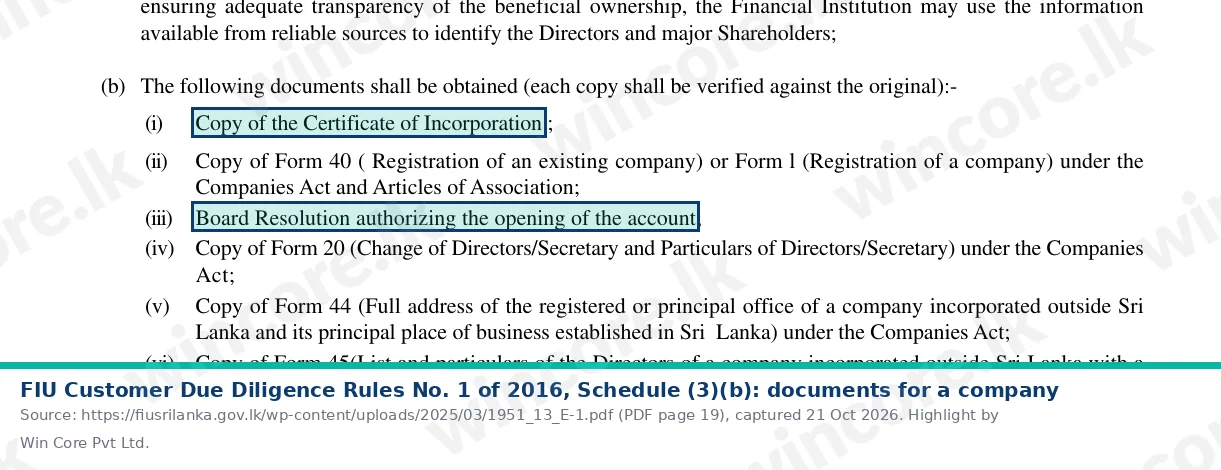
The bank checks copies against originals; the IRD and the Foreign Ministry ask for Registrar-certified ones. Which you need, what it costs and who signs.
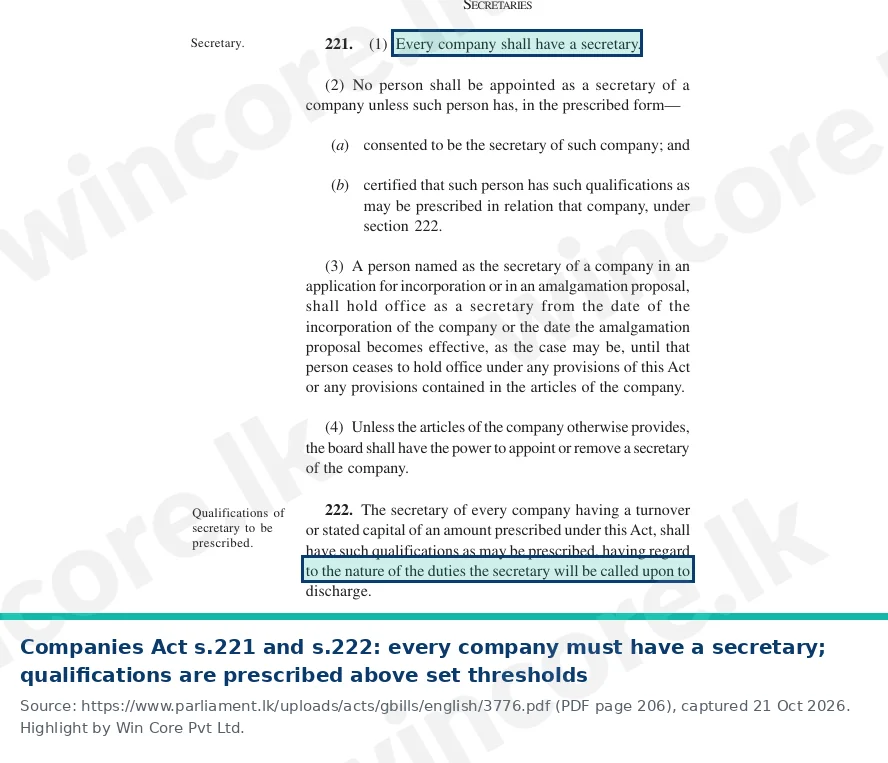
A secretarial quote is only cheap if it covers your year. What the law requires of the secretary, how to compare offers and how to check the firm.
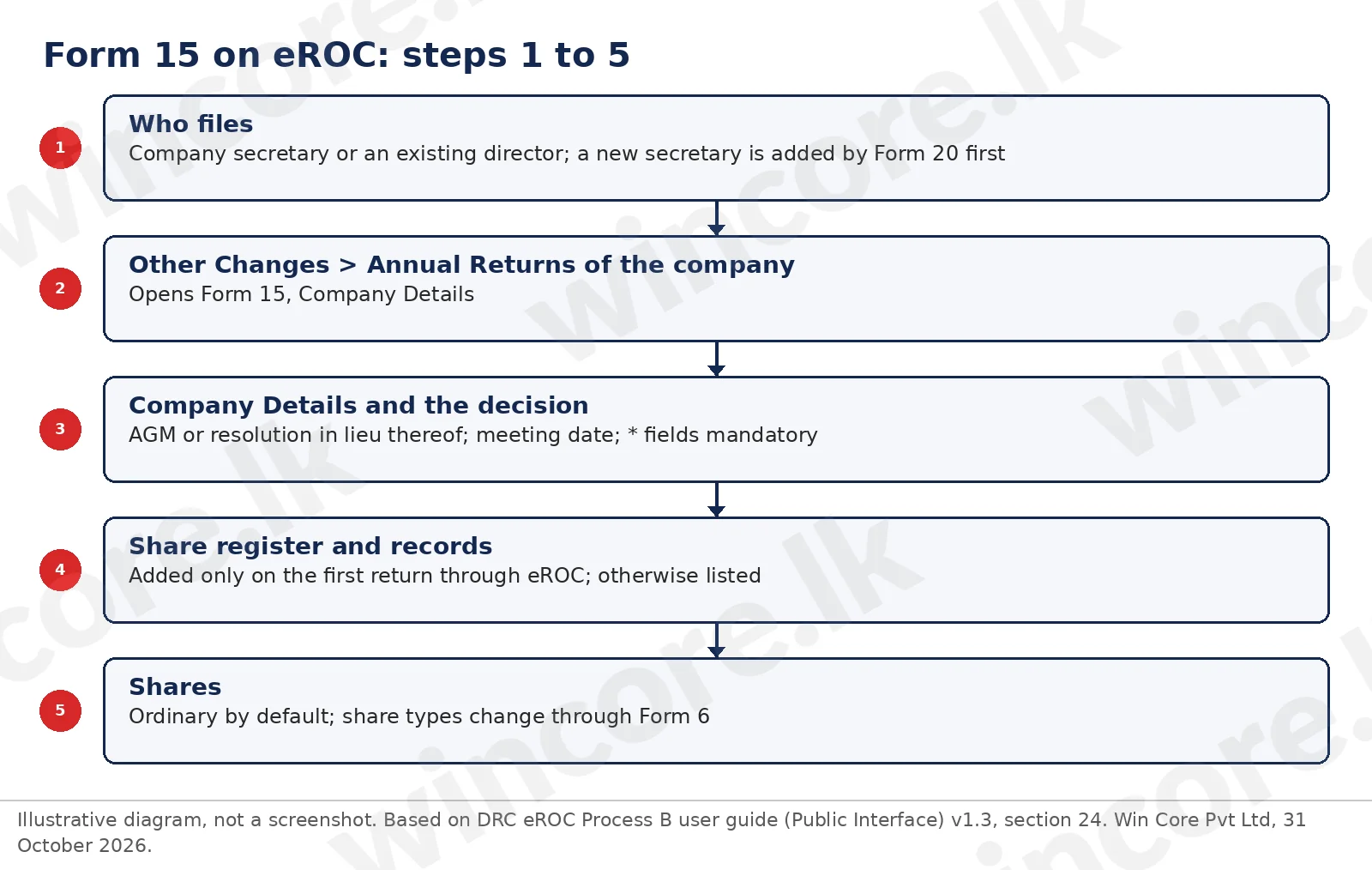
Treat Form 15 as a live governance filing: the 30-working-day clock from the AGM, the BO 4 that goes with it, the fee, and the controls that keep it on time.