
Apostille Sri Lanka: why foreign documents still need legalisation
An apostille from your home country does not yet work in Colombo. The four-step consular chain, the MFA's rules, and what the Companies Act asks for.
On this page
Last verified against the primary sources on 21 October 2026.
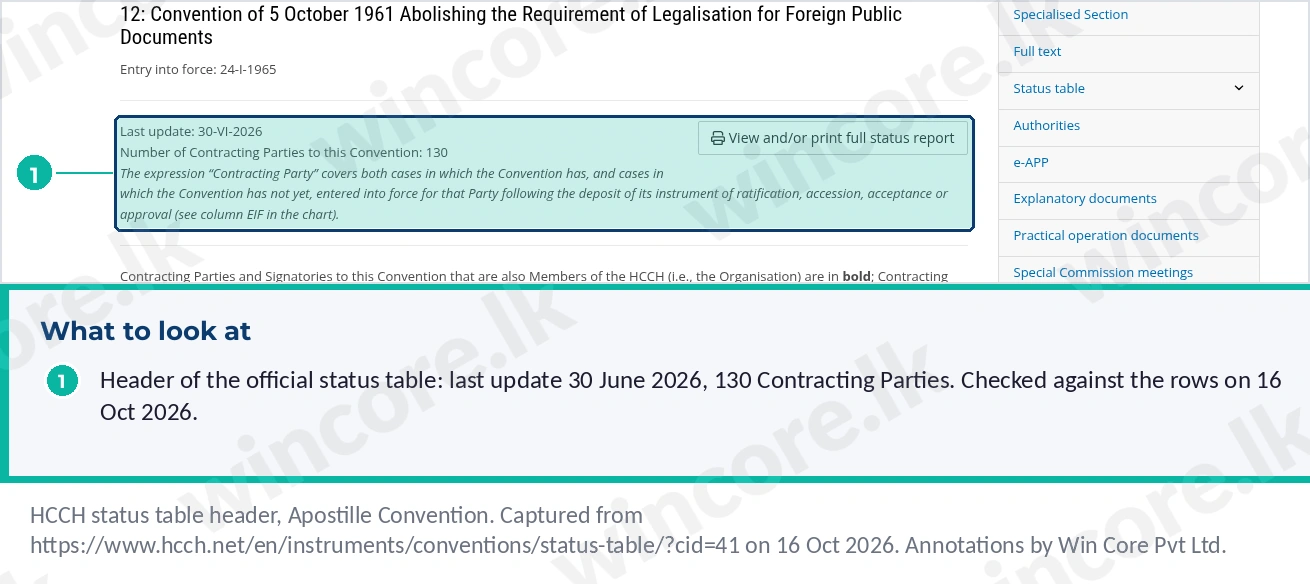
An apostille does not yet work for documents used in Sri Lanka. As at 21 October 2026, Sri Lanka is not a Contracting Party to the Hague Apostille Convention of 5 October 1961: the official status table, last updated on 30 June 2026, lists 130 Contracting Parties and has no row for Sri Lanka [2]. So a foreign company document still reaches Colombo by consular legalisation: a notary, the home country's foreign ministry, the Sri Lanka mission in that country, and, where the end user asks, the Ministry of Foreign Affairs in Colombo, whose guidelines accept a foreign document "ONLY IF" a mission has attested it first [4].
This matters to anyone setting up in Sri Lanka from abroad. A foreign parent that forms a subsidiary, registers a branch or opens a bank account will be asked for copies of its constitution, its certificate of incorporation, board resolutions and powers of attorney. Those papers are signed and certified in another country, and someone in Colombo has to be satisfied that the signatures and seals are real.
Take a hypothetical engineering company in Germany forming a Sri Lankan subsidiary. Its managing director signs a board resolution and a power of attorney in Munich. Germany is a Contracting Party, so an apostille is available there. Will it be accepted in Colombo? As at the date of this article, not as an apostille. The reason is a missing row in a table.
The Apostille Convention binds only the country where the document is used
The Convention replaces the consular chain with one certificate. Article 2 says "Each Contracting State shall exempt from legalisation documents to which the present Convention applies and which have to be produced in its territory" [1]. Article 3 says the apostille is "The only formality that may be required" to certify the signature, the capacity of the signer and the seal [1].
The key words are "Contracting State" and "produced in its territory". The duty to accept an apostille sits with the country where the document is used. An apostille issued in Germany works in another Contracting State. It does not bind Sri Lanka unless Sri Lanka is a Contracting State.
Apostille in Sri Lanka: not on the HCCH table as at 21 October 2026
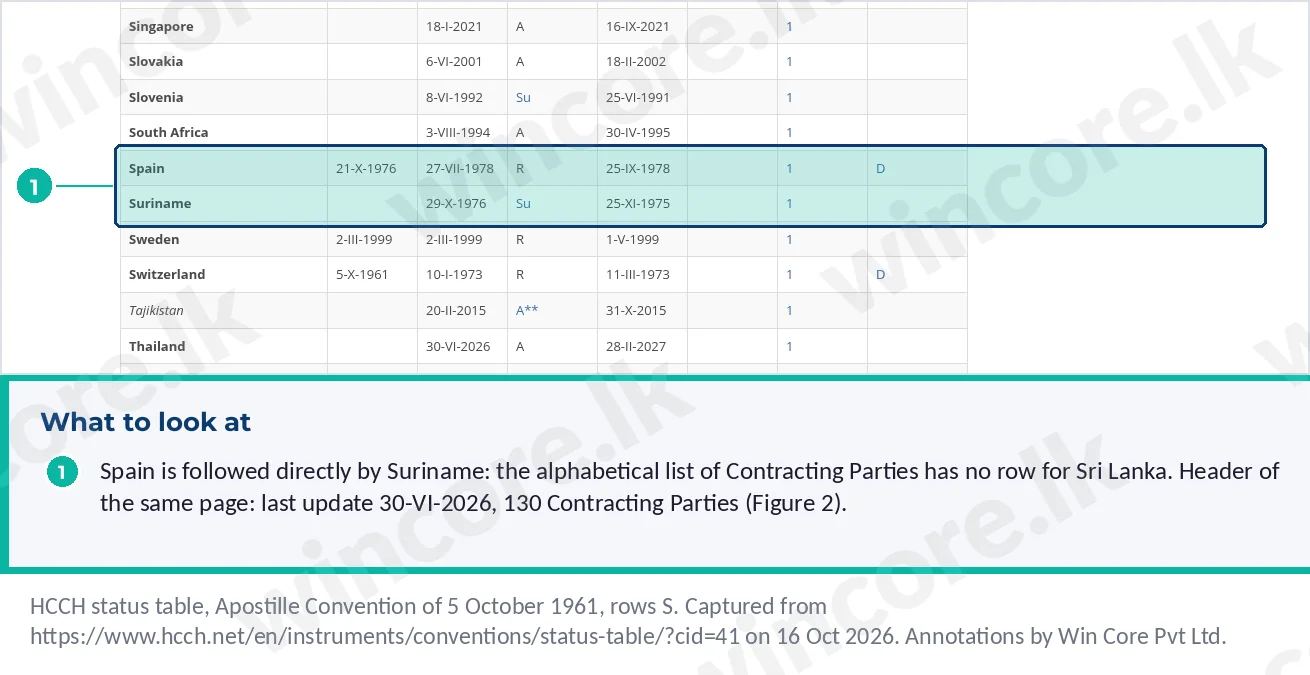
The official record is the status table kept by the Hague Conference on Private International Law (HCCH). We read it on 16 October 2026 and again on 21 October 2026. On both days the page showed "Last update: 30-VI-2026" and "Number of Contracting Parties to this Convention: 130" [2]. In the alphabetical list, Spain is followed directly by Suriname. There is no row for Sri Lanka [2].
Two things confuse searches. First, Sri Lanka is a Member of the HCCH as an organisation: the HCCH recorded that Sri Lanka accepted its Statute on 27 September 2001 [3]. Membership of the organisation is not the same as being a party to each of its conventions. Second, at least one Sri Lankan website we found while researching this piece says Sri Lanka's accession to the Apostille Convention took effect on 31 January 2025. The HCCH table does not list Sri Lanka, so we do not rely on that statement. The depositary record decides, not a secondary page.
Accession would take about eight months to work
A country can accede at any time, but under Article 12 the accession "shall have effect only as regards the relations between the acceding State and those Contracting States which have not raised an objection to its accession in the six months after the receipt of the notification", and the Convention enters into force between them "on the sixtieth day after the expiry of the period of six months" [1]. The table shows the pattern: Viet Nam deposited on 31 December 2025 with entry into force on 11 September 2026, and Thailand deposited on 30 June 2026 with entry into force on 28 February 2027 [2]. If Sri Lanka accedes, expect a gap of about eight months, and note that an apostille from a State that objects would still not work. Check the table on the day you send documents.
The consular chain runs notary, foreign ministry, Sri Lanka mission, then the MFA
Without the apostille, Sri Lanka uses consular legalisation, run in Colombo by the Consular Affairs Division of the Ministry of Foreign Affairs (MFA). The MFA's guidelines for attestation set the gate in item 14: "Any document issued by a foreign authority of agency will accept for attestation ONLY IF such document is attested by the Sri Lanka Diplomatic Mission of that particular country or by the Diplomatic Mission representing that country in Sri Lanka" [4].
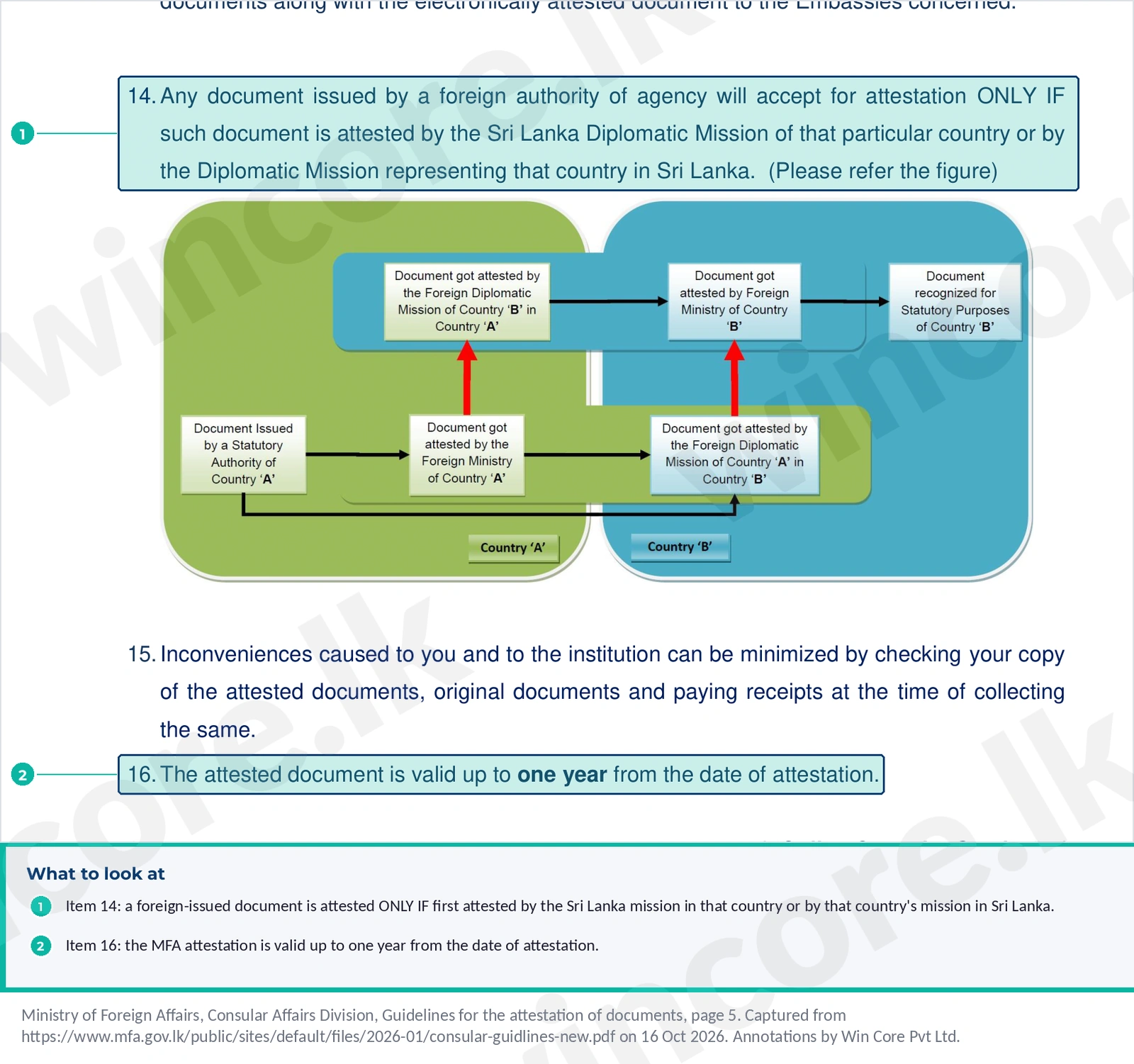
The figure under item 14 shows the route: a document issued by an authority in Country A, attested by Country A's foreign ministry, then by Country B's mission in Country A, then by Country B's foreign ministry, and only then "recognized for Statutory Purposes of Country B" [4]. Sri Lanka's missions publish the same order. The Embassy in Bangkok says a foreign-issued document will be accepted "ONLY IF such document is attested by the Foreign Ministry of the document issued country", and that a power of attorney signed by a foreign citizen must first be "certified by an authorized authority (Notary) of the country of his /her residence" [5]. The Embassy in Vienna uses the same foreign ministry wording [6].
Put together, the usual chain for a company document is:
- Notary or issuing registry in the home country certifies the copy or witnesses the signature.
- Home foreign ministry authenticates the notary or official.
- Sri Lanka's embassy or high commission in that country attests the foreign ministry seal (or, under item 14, the home country's own mission in Colombo).
- MFA Consular Affairs Division in Colombo attests the mission seal, where the end user asks for it.
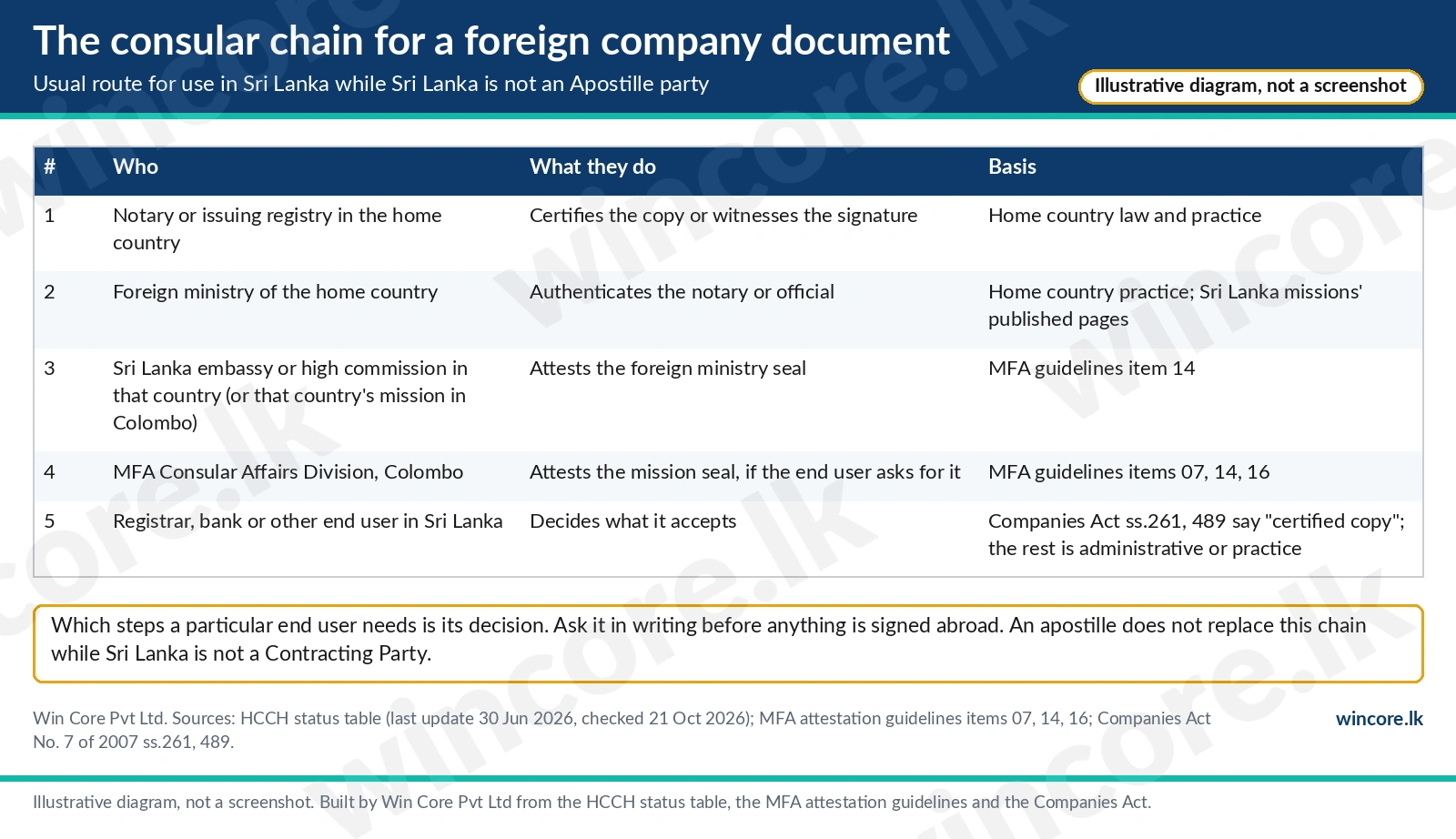
Steps 1 and 2 follow the home country's own rules, which vary. Step 3 is set by Sri Lanka's missions. Step 4 is the MFA's administrative procedure.
Fees, validity and photocopies at the MFA
Item 07 of the guidelines says that, "As per the Extra Ordinary Gazette Notification no. 2306/35 published on 16.11.2022", the charge for each document from 1 January 2023 is "Rs. 1200/= for a Sri Lankan citizen" and "Rs. 3000/= for a foreign national" [4]. We read the fee in the MFA's guidelines; we did not open Gazette 2306/35 itself, so treat the gazette as cited by the MFA rather than checked by us. Mission fees abroad are separate.
Item 08 says "Any photocopied document will NOT be accepted for attestation" [4]. Item 16 says "The attested document is valid up to one year from the date of attestation" [4]. Item 06 requires a prior appointment, and item 13 describes the Electronic Document Attestation System, through which embassies download attested documents [4]. These are administrative rules of the MFA, not provisions of an Act.
The Companies Act asks for a certified copy, not a named chain
It helps to separate three layers, because they are often blended into one "requirement".
The statute. The Companies Act, No. 7 of 2007 asks for "a certified copy of the charter, statute or memorandum and articles of association" when a foreign company registers as an off-shore company (s.261(2)(a)), and "a certified copy of the charter, statues or memorandum and articles" when an overseas company registers a place of business (s.489(1)(a)) [7]. Where the instrument is not in an official language or English, both add "a translation of the instrument in such language as may be specified by the Registrar" [7]. The Act says "certified copy". It does not itself spell out notary, foreign ministry and embassy steps.
The administrative layer. How a foreign certification is verified is set by the MFA guidelines and by what the Registrar of Companies accepts. We did not find a published Registrar notice listing the legalisation steps for foreign documents on drc.gov.lk on 21 October 2026, so this stays an open point: confirm with the Registrar's office, or through your company secretary, before the documents leave the home country.
Practice. Banks set their own customer due diligence procedures, and many ask for legalised copies of a foreign parent's documents. That is bank practice, not a statute we can cite. Ask the bank for its list in writing.
Translations sit outside the chain unless you plan them in
A legalisation chain certifies signatures and seals, not content. If a German certificate of incorporation is legalised and then translated in Colombo, the translation is a new document with no chain of its own. The MFA attests a translation only if it was made by "a Sworn Translator registered at the Ministry of Justice" (item 11.2), and where no sworn translator is registered for the language, the translation must be certified by an embassy of a country that uses that language (item 11.5) [4]. The Companies Act leaves the language of a filing translation to the Registrar [7].
So decide early who will translate, and whether the translation must sit inside the chain. Getting a translation made in the home country before the notary step often avoids a second round. That is practice, not law, and the right answer depends on the end user.
Checklist: documents needed
- Each end user's written list of documents (Registrar, bank, Board of Investment, landlord)
- Certified copies of the parent's constitution and certificate of incorporation
- Board resolution and any power of attorney, signed before a notary
- Home foreign ministry authentication of the notary
- Sri Lanka mission attestation in the home country
- Translations by an accepted translator, where a document is not in English
- MFA appointment and attestation in Colombo, if the end user asks for it
What this means for you
- Check the HCCH status table on the day you start. If Sri Lanka has acceded, read the entry into force date before relying on an apostille.
- Ask each end user for its list in writing, before you sign anything abroad.
- Present originals. The MFA does not attest photocopies (item 08), so each step should certify the document itself, not a copy of a certified copy.
- Run the chain in order: notary, home foreign ministry, Sri Lanka mission, then the MFA in Colombo if asked.
- Diary the one year validity of an MFA attestation (item 16) and time the chain close to the filing.
- Settle translations first so the translated version sits inside the chain where the end user wants it.
Our foreign branch registration team and our company secretarial services cover the filings that follow, and our guide to registering a company in Sri Lanka sets out the eROC steps. For the choice of vehicle, see our comparison of a subsidiary vs branch in Sri Lanka; for ownership limits, see whether a foreigner can own 100 percent of a Sri Lankan company. Our articles on the resident director rule and on the Inward Investment Account follow in this series.
FAQ
Will an apostille from my country work in Sri Lanka?
Not as at 21 October 2026. Sri Lanka does not appear in the HCCH status table for the Apostille Convention, last updated 30 June 2026, and the Convention only binds the Contracting State where a document is used. Until Sri Lanka accedes and the accession takes effect, foreign documents need consular legalisation through the Sri Lanka mission [1] [2].
Is Sri Lanka a member of the Hague Conference?
Yes, Sri Lanka has been a Member of the HCCH organisation since 2001, but that is a separate question. Membership of the organisation does not make a country party to each Hague convention. The Apostille Convention is its own treaty, and its status table, the depositary record, has no row for Sri Lanka [2] [3].
Can my country's embassy in Colombo do the mission step instead?
Item 14 of the MFA guidelines allows it. A foreign-issued document is accepted for attestation if it has been attested by the Sri Lanka mission in the issuing country "or by the Diplomatic Mission representing that country in Sri Lanka". Confirm that the embassy in Colombo offers the service, and that your end user accepts that route [4].
How much does the MFA charge to attest a document for a foreign national?
Rs 3,000 per document, according to item 07 of the MFA guidelines, which cites Gazette 2306/35 and an effective date of 1 January 2023. A Sri Lankan citizen pays Rs 1,200. Mission fees in the home country are separate, and we did not open the gazette itself to check the figure [4].
Does the Companies Act require the full consular chain?
No, the Act itself asks for a "certified copy" of the foreign company's constitution, with a translation where needed, under sections 261(2)(a) and 489(1)(a). The verification steps come from the MFA's guidelines and from what the Registrar or the bank accepts, so ask the end user before the documents are signed [7].
Talk to us. If you want us to list the documents your Sri Lankan company, branch or bank account will need and the order in which to legalise them, our contact page.
WinCore Pvt Ltd
This article is general information on the law and published procedures as at 21 October 2026 and is not advice on your specific documents.
References
- Hague Conference on Private International Law. Convention of 5 October 1961 Abolishing the Requirement of Legalisation for Foreign Public Documents, full text, arts 2, 3 and 12. https://www.hcch.net/en/instruments/conventions/full-text/?cid=41 . Primary. Accessed 21 October 2026.
- Hague Conference on Private International Law. Status table, Convention No. 12 (Apostille), last update 30 June 2026. https://www.hcch.net/en/instruments/conventions/status-table/?cid=41 . Primary (depositary record). Accessed 21 October 2026.
- Hague Conference on Private International Law. Hague Conference has now 55 Member States (27 September 2001). https://www.hcch.net/en/news-archive/details/?varevent=23 . Primary. Accessed 16 October 2026.
- Ministry of Foreign Affairs, Consular Affairs Division. Guidelines for the attestation of documents (file dated January 2026), items 06, 07, 08, 11, 13, 14 and 16. https://www.mfa.gov.lk/public/sites/default/files/2026-01/consular-guidlines-new.pdf . Primary (administrative). Accessed 21 October 2026.
- Embassy of Sri Lanka, Bangkok. Attestation, authentication, legalization of documents. https://bangkok.embassy.gov.lk/attestation-authentication-legalization-of-documents/ . Primary (administrative). Accessed 16 October 2026.
- Embassy of Sri Lanka, Vienna. Legalization of documents. https://srilankaembassy.at/citizen-services/legalization-of-documents/ . Primary (administrative). Accessed 16 October 2026.
- Parliament of Sri Lanka. Companies Act, No. 7 of 2007, ss.261(2)(a) and 489(1)(a). http://www.drc.gov.lk/en/wp-content/uploads/2018/04/Act-7-of-2007-English.pdf . Primary. Accessed 16 October 2026.
Put these insights to work
WinCore specialists can review your current workflow, document gaps, and build a practical 90-day action plan.
Book a free consultationContinue reading
Explore more WinCore analysis to keep your finance, tax, and compliance roadmap moving.
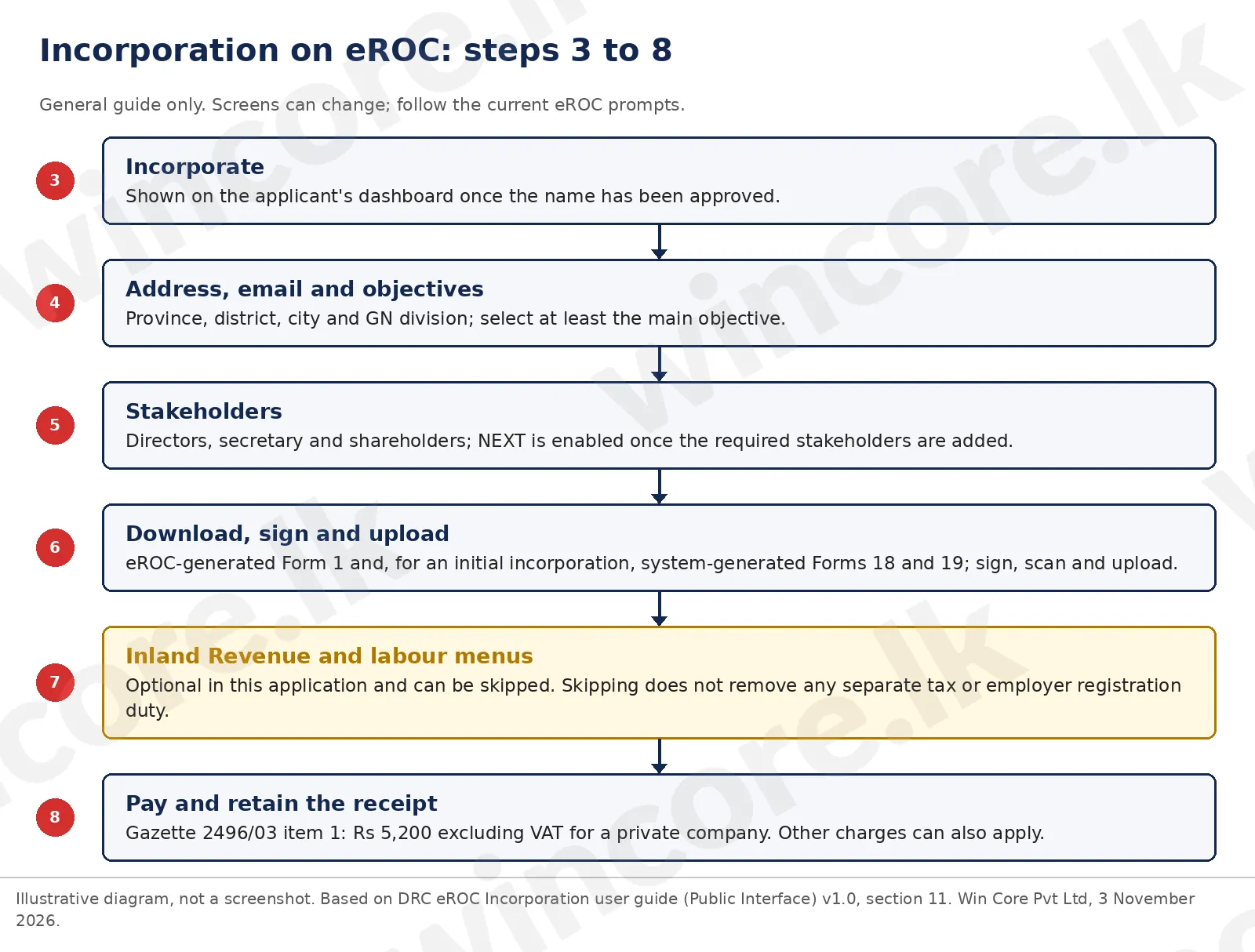
Registering a private limited company in Sri Lanka in 2026: structure, name approval, the eROC filing with BO 1 and BO 5, the TIN and the first year.
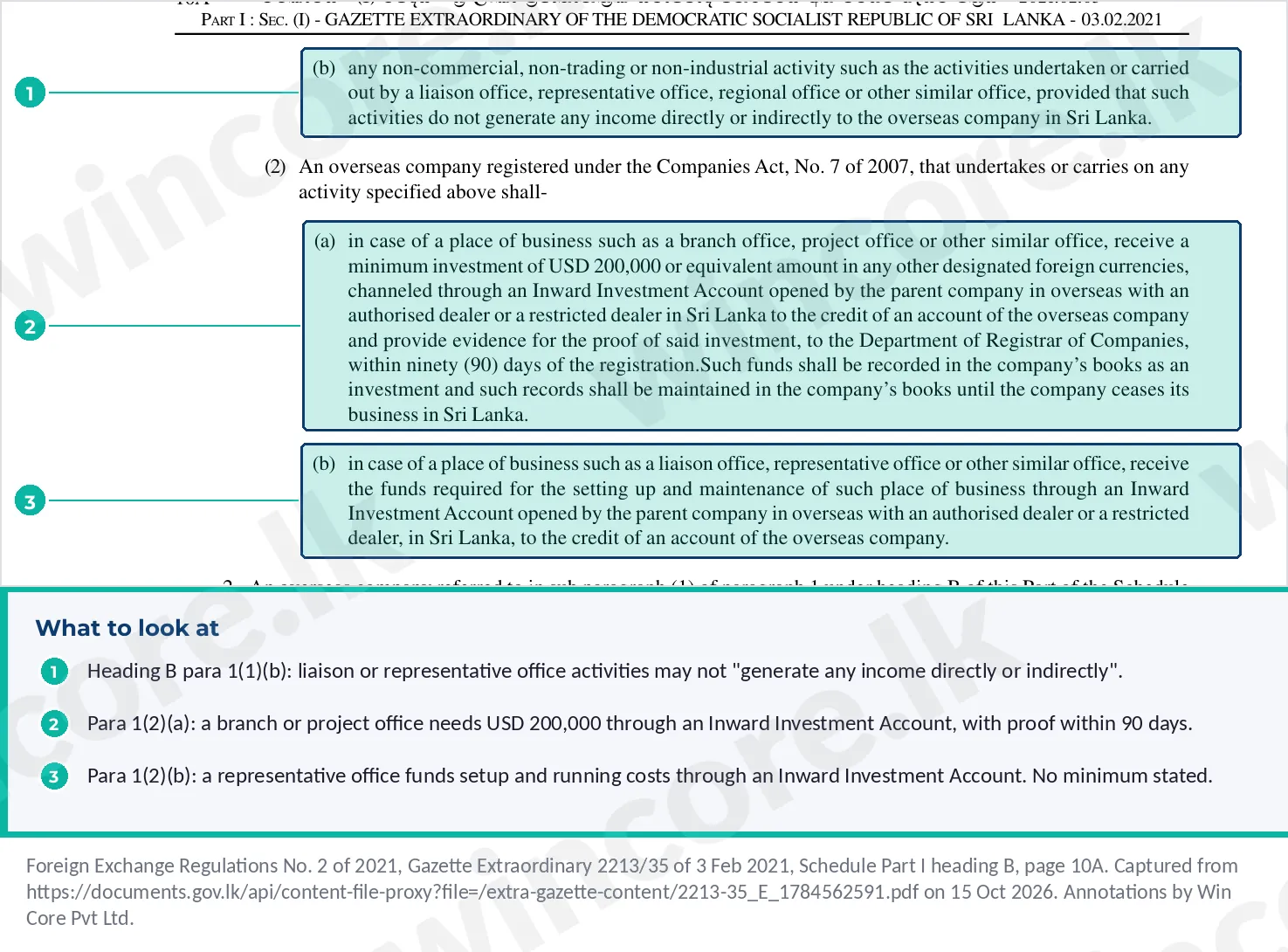
Four ways a foreign company can enter Sri Lanka, set side by side: what each may do, the money each needs, how each is taxed, and what is still open.
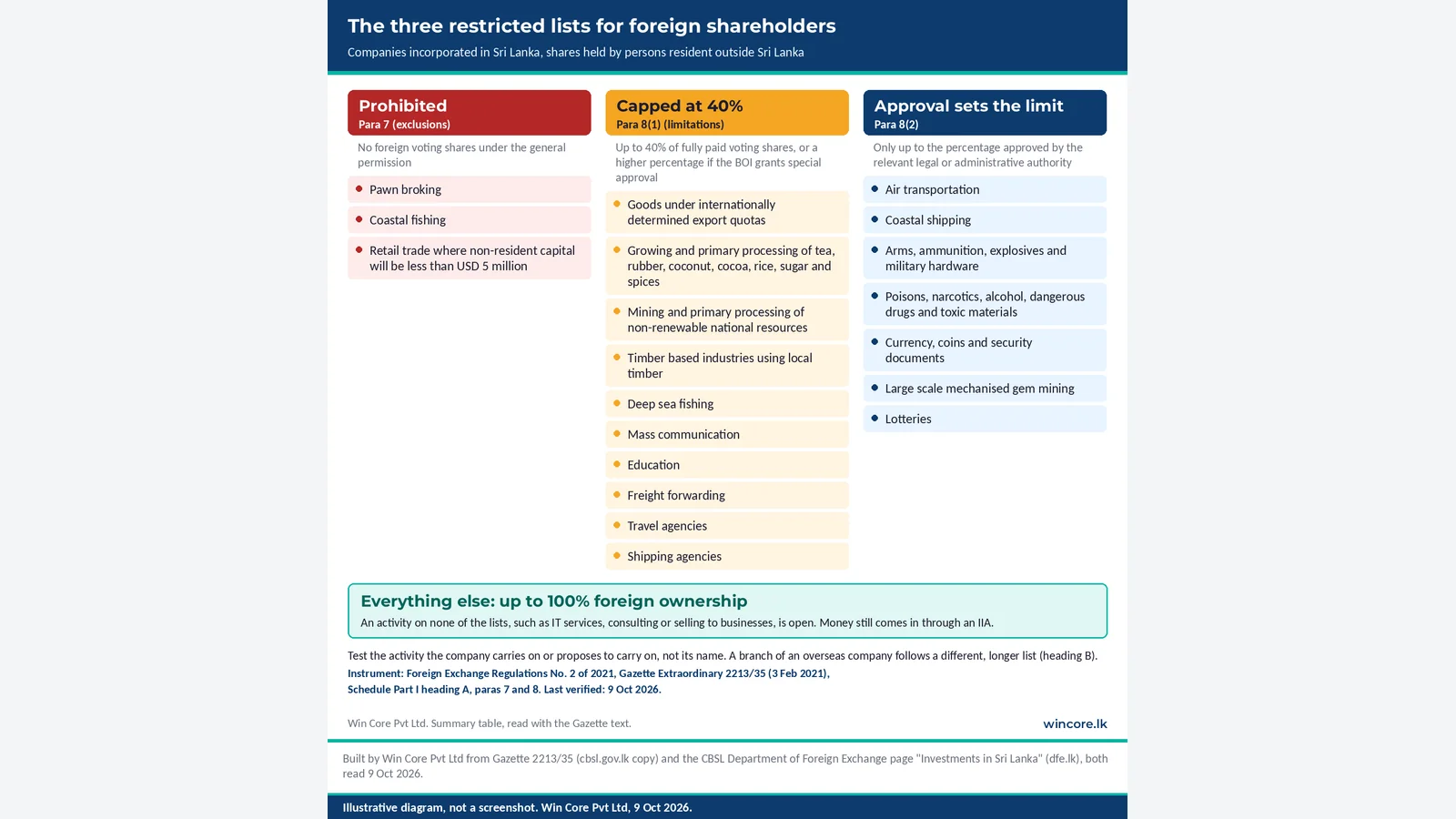
Most Sri Lankan companies can be 100 percent foreign owned. The three restricted lists in Gazette 2213/35, the retail test and the BOI route.