
Issue of shares Sri Lanka Form 6: resolution, notice, BO 2
Issue new shares under the Companies Act: the board resolution, pre-emption, the twenty-working-day Form 6 and BO 2 deadlines, and stamp duty.
On this page
Last verified against the primary sources on 26 October 2026.
Issue of shares Sri Lanka Form 6, in brief. Under the Companies Act No. 7 of 2007, the board issues new shares, subject to the articles and the existing shareholders' pre-emptive rights. Before issuing, the board resolves on the consideration and states that it is fair and reasonable. The company then allots within twenty working days of receiving the money, enters the new holder on the share register, and gives the Registrar a Form 6 notice within twenty working days of the issue. A Form BO 2 follows within the same period.
Companies issue shares for three common reasons: to top up capital, to bring in a new shareholder, or to convert a loan into equity. The steps are the same in each case. Only the consideration changes.
Take a hypothetical engineering company. It has one resident shareholder, the founder, holding 8,700 shares, and stated capital of Rs 1,750,000. A second resident engineer will subscribe Rs 2,500,000 for 2,500 new shares. This guide follows that issue from the board meeting to the year-end accounts.
The board decides an issue of shares, subject to the articles and pre-emption
Section 51(1): "Subject to the provisions of sections 52 and 53 and the company's articles, the board of a company may issue such shares to such persons as it considers appropriate" [1]. On our reading, the Act does not require a shareholder resolution for an ordinary issue. Your articles may, so read them first.
If the new shares carry rights other than the standard ones in section 49(2) (one vote, an equal share in dividends and in surplus assets), the board must approve "terms of issue" under section 51(2). Those terms must be consistent with the articles and "are deemed to form part of the articles" (section 51(3)) [1]. Redeemable preference shares are the usual example.
Since the Companies (Amendment) Act No. 12 of 2025, a company "shall not issue a share warrant to bearer or bearer share irrespective of whether its articles of association purport to authorise it to do so" (new section 51(1A)) [2]. The amending Act came into operation on 30 March 2026 (Gazette 2480/47) [3].
Pre-emptive rights. Section 53(1) says that, "Subject to the company's articles", shares that rank equally with or above existing shares for voting or distributions "shall be offered to the holders of existing shares" in a way that would keep their relative rights. The offer must stay open "for a reasonable period of time" (section 53(2)) [1]. In the example, the founder is offered the 2,500 shares first and declines in writing. That letter goes in the minute book.
Before issuing, the board must set the price and resolve that it is fair
Section 52(1): "Before issuing any shares, the board shall (a) decide the consideration for which the shares will be issued; and (b) resolve that in its opinion that consideration is fair and reasonable to the company and to all existing shareholders" [1].
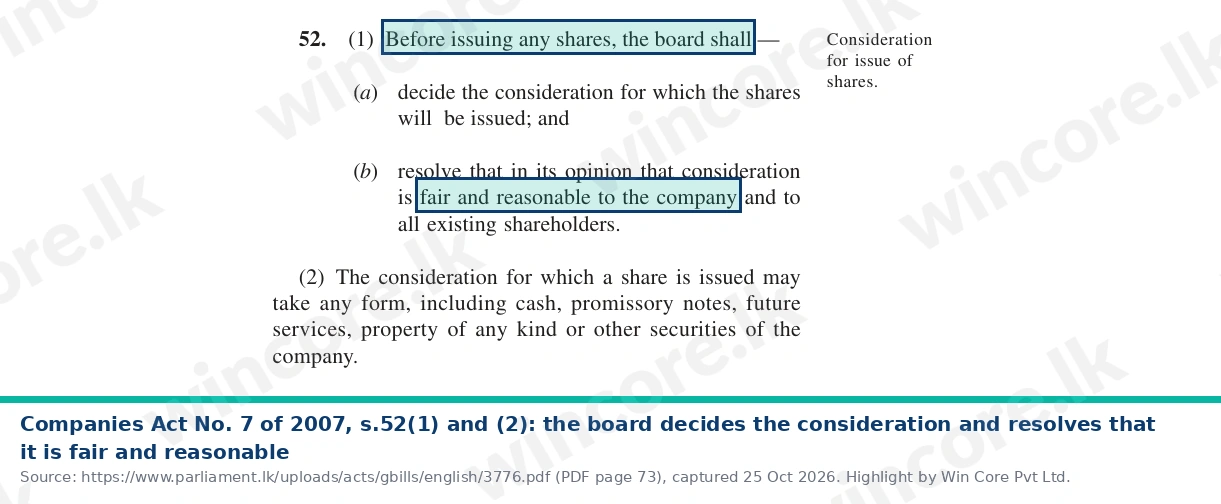
A practical resolution for the example records:
- the number and class of shares: 2,500 ordinary shares;
- the person to whom they are issued;
- the consideration: Rs 2,500,000 in cash, which is Rs 1,000 per share;
- why the terms are fair and reasonable, for example that the price matches net assets per share in the latest accounts, or a valuation the board relied on;
- that the section 53 offer was made and declined, or that the articles exclude it;
- the authority to allot on receipt of the money, update the register and file Form 6 and Form BO 2.
There is no par value to state. Section 49(4) says "No share in a company shall have a nominal or par value" [1]. The price per share is whatever the board decides is fair.
Consideration can be something other than cash, including a converted loan
Section 52(2): consideration "may take any form, including cash, promissory notes, future services, property of any kind or other securities of the company" [1]. For non-cash consideration, section 58(2) requires that "the board shall determine the cash value of such consideration" for stated capital [1].
So if the incoming engineer contributed a used machine instead of cash, the board would minute the machine's cash value and the basis for it (a quotation, an invoice, a valuer's report). On our reading, sections 52 and 58 do not require an independent valuation. A documented basis protects the directors if the fairness statement is later questioned.
Converting a loan works the same way. If the founder had lent the company Rs 750,000, the board could issue shares in return for the release of that debt. On our reading that is consideration in "any form" under section 52(2). The loan comes off the balance sheet and stated capital goes up by the agreed value.
Allot within twenty working days; shares are issued when the register is updated
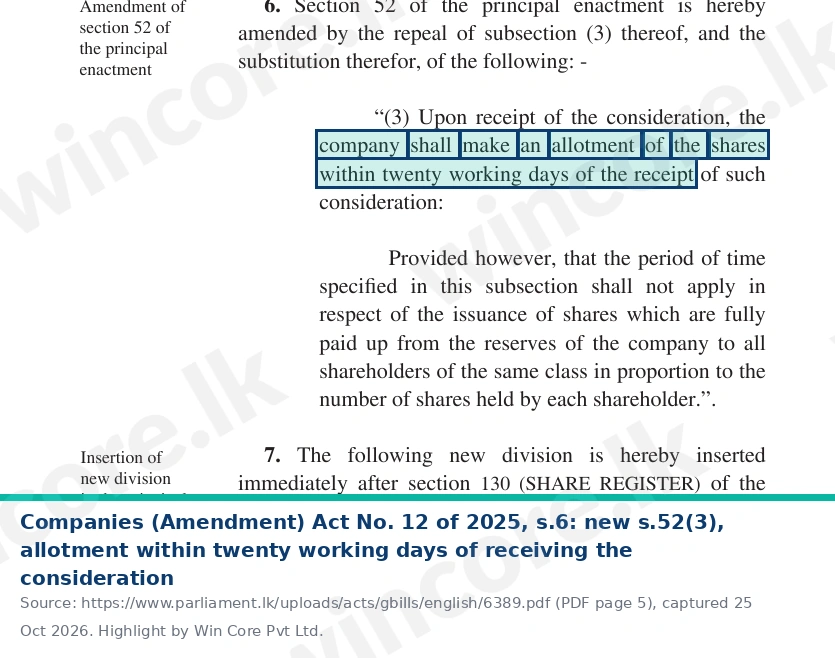
Act No. 12 of 2025 replaced section 52(3). The company "shall make an allotment of the shares within twenty working days of the receipt of such consideration" [2]. A proviso excludes fully paid bonus shares issued from reserves to all shareholders of a class in proportion to their holdings.
Section 54(1) fixes the moment of issue: "A share is deemed to be issued when the name of the holder is entered on the share register, and such entry shall be made prior to compliance with subsection (4) of section 51" [1]. So update the register first, then file.
The share register must record each shareholder's name and latest known address, the number of shares of each class, and the date of any issue, for the last ten years (section 123(1)). A failure exposes the company to a fine of up to two hundred thousand rupees and each officer in default to up to one hundred thousand rupees (section 123(2)) [1].
Share certificates. The model articles in the First Schedule apply unless your own articles exclude or modify them (section 14). Paragraph 4(6) says that where the company issues shares, it "must within two moths complete and have ready for delivery a share certificate" [1]. "Moths" is the Act's own typo; Act No. 12 of 2025 corrects the same typo in section 324(1) (Schedule item 59), but its Schedule does not touch paragraph 4(6). Read it as two months, and check your articles.
Issue of shares Sri Lanka Form 6: due within twenty working days under section 51(4)
Section 51(4) requires that "Within twenty working days of the issue of any shares under this section, the company shall (a) give notice to the Registrar in the prescribed form" of the number of shares issued, the consideration or its value as determined under section 58(2), and "the amount of the company's stated capital following the issue of the shares", and "(b) deliver to the Registrar a copy of any terms of issue" [1].
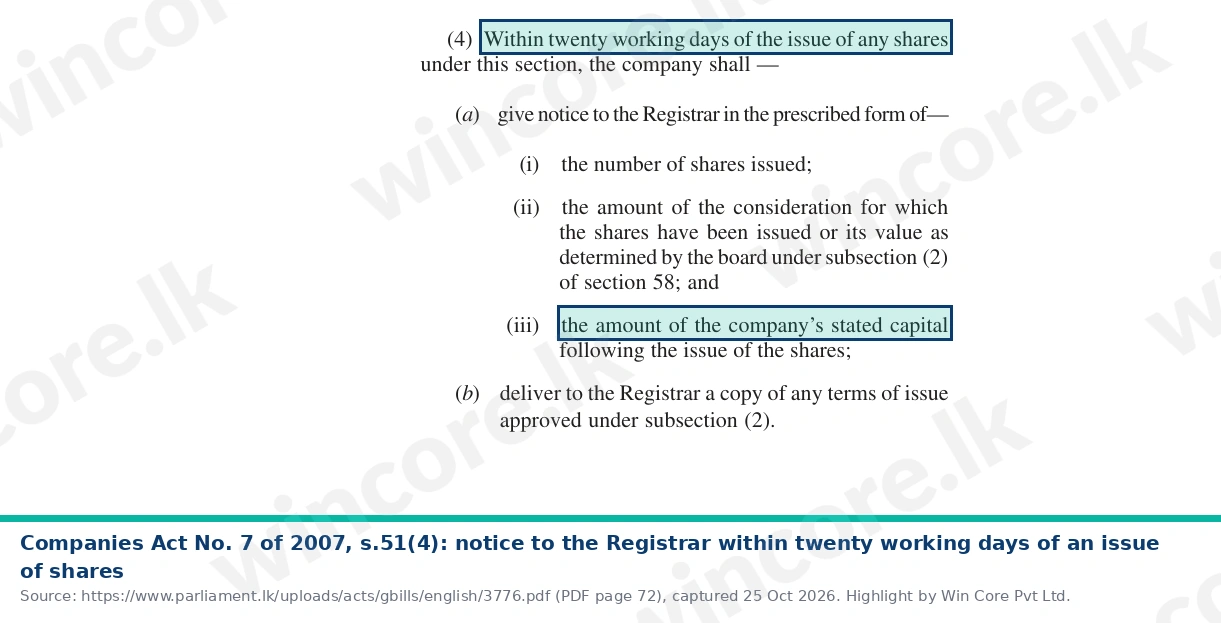
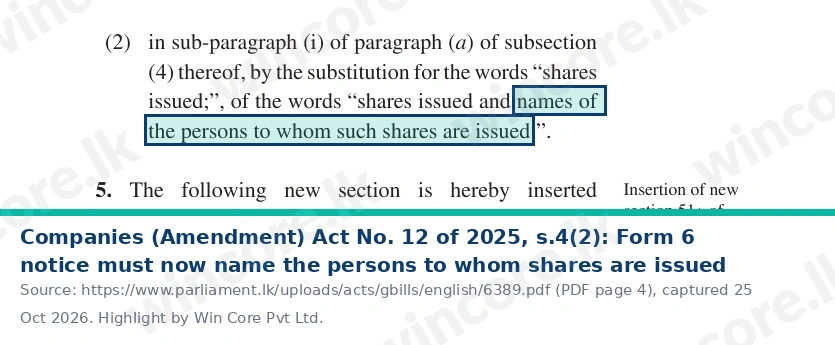
Act No. 12 of 2025 changed item (i) to "shares issued and names of the persons to whom such shares are issued" [2]. The notice now names the new shareholder.
The prescribed form is Form 6. The Registrar's download page lists "FORM 6 : Notice of Issue of Shares", and the Registrar's beneficial ownership guide says to "file the Issue of Shares (Form 06) through the eROC system" [6]. Miss the deadline and section 51(5) makes the company, and every officer in default, liable to a fine not exceeding fifty thousand rupees [1].
For each eROC screen and field, see our Form 6 eROC filing guide.
For the example, Form 6 shows 2,500 shares issued to the new shareholder, consideration Rs 2,500,000, and stated capital after the issue of Rs 4,250,000.
Form BO 2 within twenty working days (Gazette 2509/67)
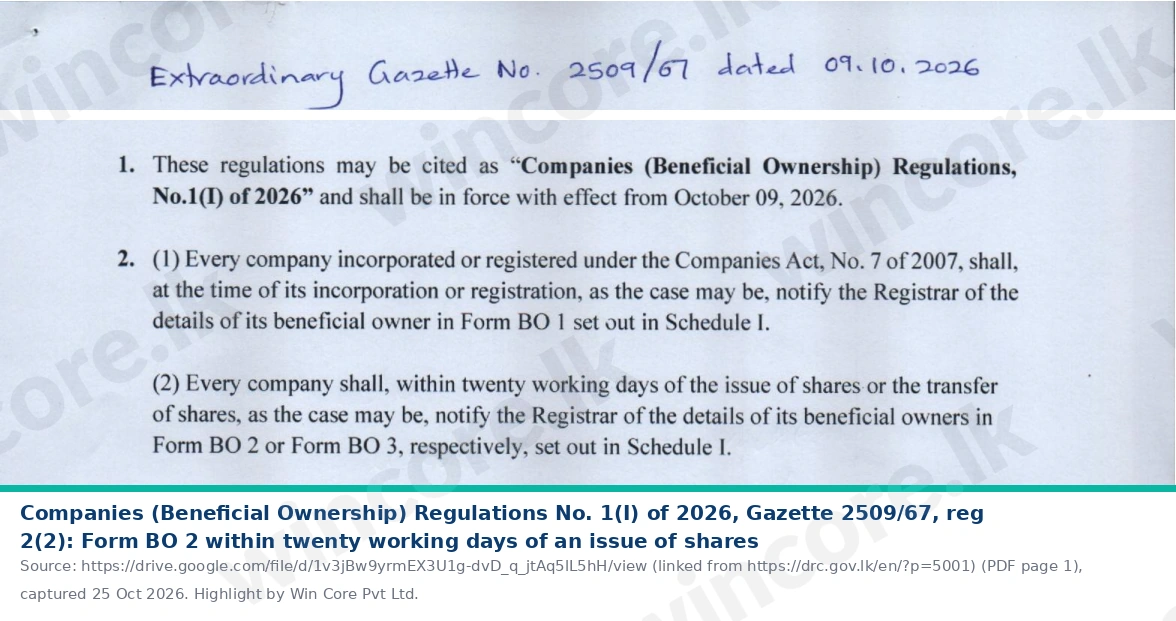
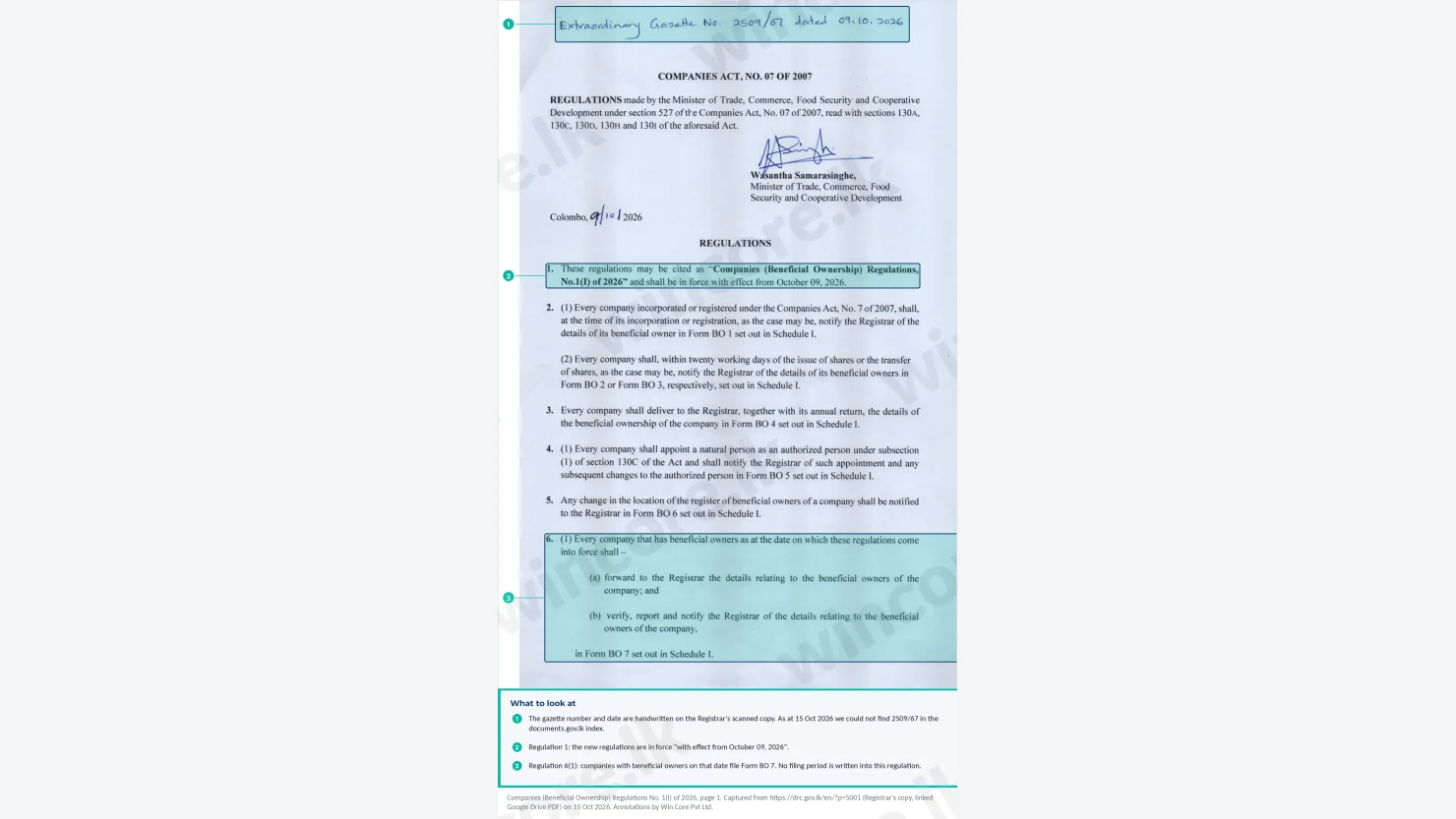
The Companies (Beneficial Ownership) Regulations No. 1(I) of 2026, published in Extraordinary Gazette 2509/67 of 9 October 2026, require that "Every company shall, within twenty working days of the issue of shares or the transfer of shares, as the case may be, notify the Registrar of the details of its beneficial owners in Form BO 2 or Form BO 3, respectively" (regulation 2(2)) [4]. Section 130A(1) of the Act, inserted by Act No. 12 of 2025, sets the same twenty working days, and under section 130A(2) the new shareholder must give the company the beneficial ownership details "within ten working days of the subscription of any shares" [2]. If a BO form is late, regulation 10, as replaced by Regulations No. 1(II) of 2026 (Gazette 2511/47) from 22 October 2026, charges "a penalty payment of one thousand rupees (Rs. 1,000/-) per week", and any part of a week counts as a full week [5].
The Registrar's guide shows the order: the BO system shows "Issue of Shares Pending" only after Form 06 is filed on eROC [6]. In the example, the new engineer holds 2,500 of 11,200 shares, which is about 22 percent. A "beneficial owner" is a natural person who "ultimately owns or controls ten per cent or more of a company" (section 130J, inserted by Act No. 12 of 2025) [2]. Both people meet that test, so BO 2 lists both. See beneficial ownership at 10 percent and the 2509/67 regulations.
A share certificate on an issue carries no stamp duty, on our reading
The Stamp Duty (Special Provisions) Act No. 12 of 2006 lists in section 4(f) "a share certificate on new or additional issue or on transfer or assignment" as a specified instrument [7]. The current exemption schedule, however, includes item 35, added by Gazette 1947/46 of 1 January 2016: "Any share certificate issued consequent to the issue, transfer or assignment of any number of shares of any company" [8].
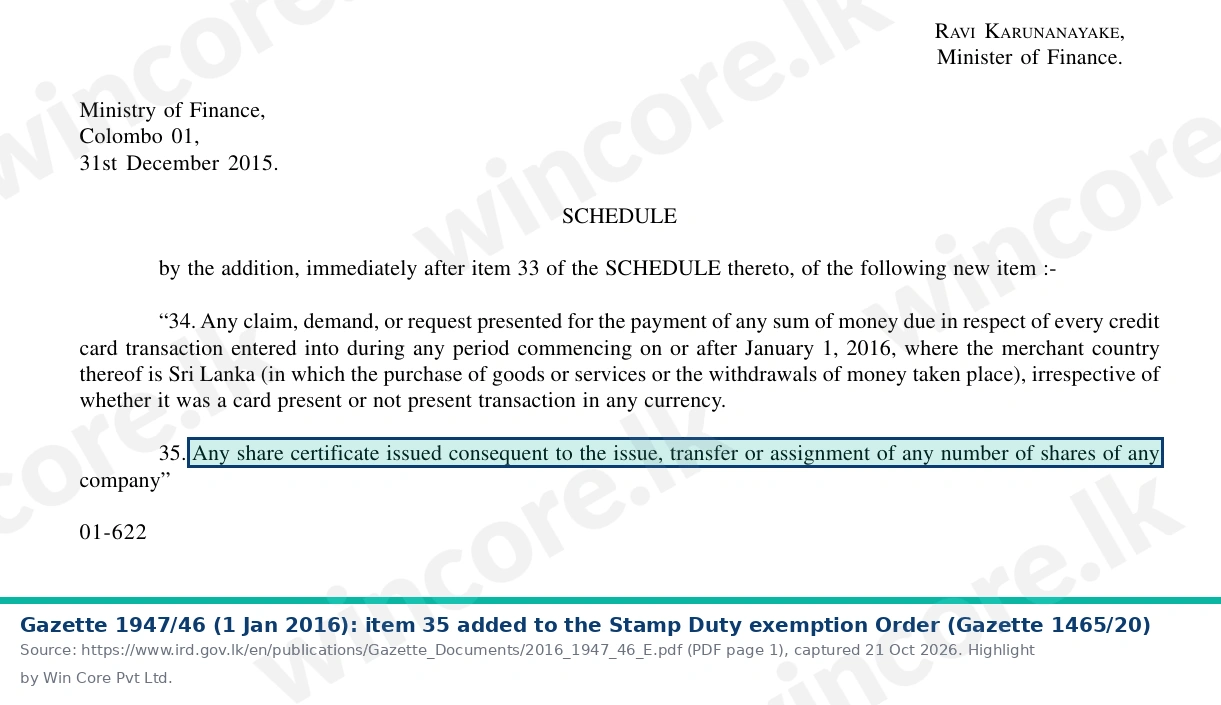
The Inland Revenue stamp duty page, checked on 25 October 2026, still lists 1947/46 among its gazettes. The later exemption Orders we read (Gazettes 2007/24, 2149/18, 2312/73 and 2477/22) replace items 12, 15 and 16 and add items 36 to 38; none removes item 35. On our reading, the certificate for a new issue carries no stamp duty. Our Stamp Duty Act guide has the full schedule.
Stated capital rises by the consideration and sits in equity
Section 58(1) defines stated capital as "the total of all amounts received by the company or due and payable to the company (a) in respect of the issue of shares; and (b) in respect of calls on shares" [1].
Under SLFRS for SMEs, an entity recognises shares as equity when it issues them and the other party must provide cash (paragraph 22.7). It measures them "at the fair value of the cash or other resources received or receivable, net of transaction costs" (22.8), and treats transaction costs "as a deduction from equity" (22.9) [9].
| Stated capital | Rs |
|---|---|
| Opening (8,700 shares) | 1,750,000 |
| Issued to new shareholder (2,500 shares) | 2,500,000 |
| Closing (11,200 shares) | 4,250,000 |
Stated capital also feeds the solvency test for dividends: assets must exceed liabilities and stated capital (section 57(1)(b)) [1].
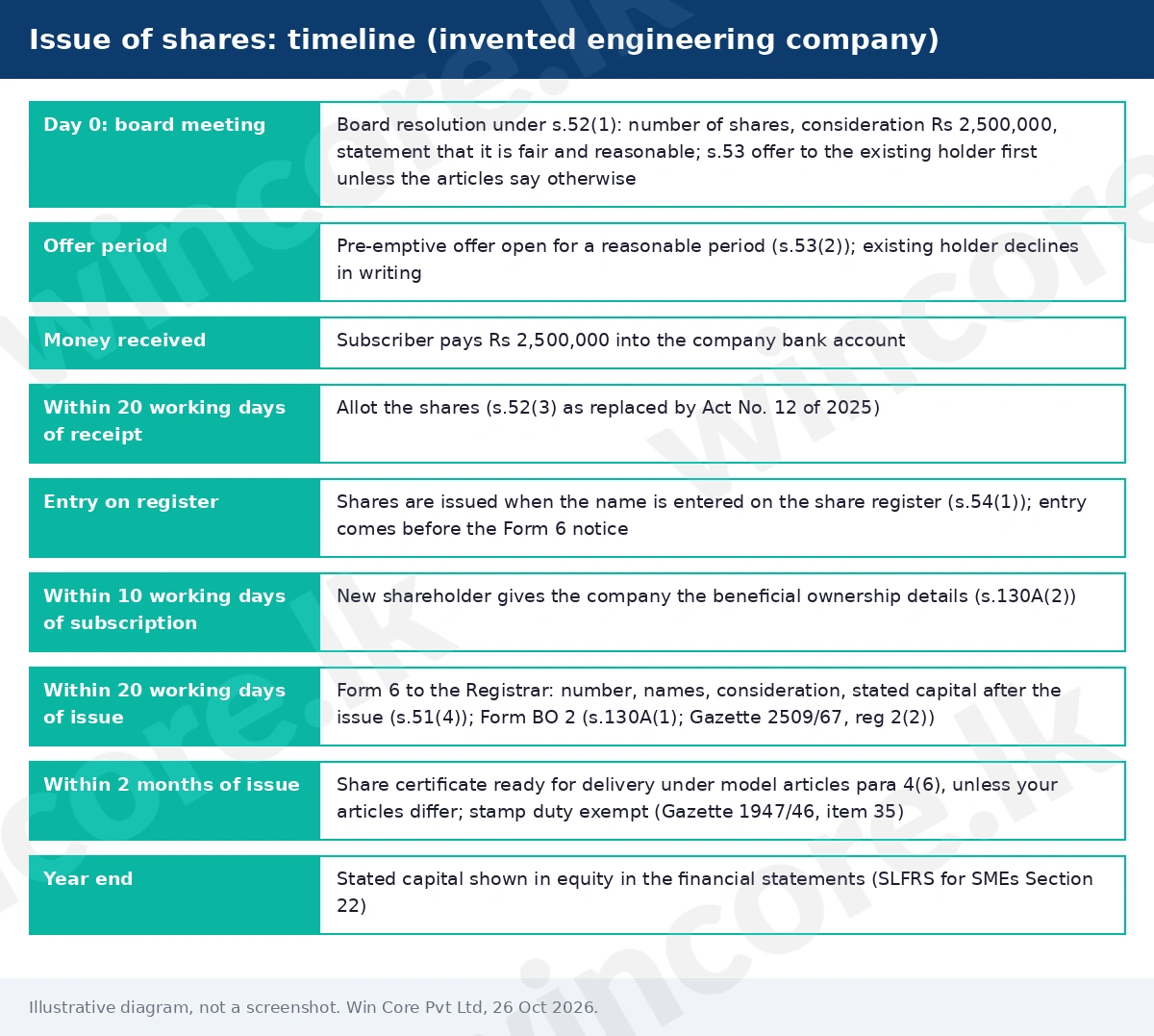
The whole issue on one timeline
What this means for you
Treat an issue as a board decision with a paper trail. Read the articles, offer the shares to existing holders, minute the consideration and why it is fair, allot within twenty working days of receiving the money, update the register, then file Form 6 and Form BO 2 within twenty working days of the issue. For a later sale of existing shares instead, see our share transfer guide.
Checklist: documents needed
- Articles read: any shareholder approval, pre-emption exclusion or limit on classes.
- Section 53 offer to existing holders, with written acceptance or decline.
- Board resolution under section 52(1): number, class, person, consideration, fairness statement.
- Board value for non-cash consideration under section 58(2), with its basis.
- Terms of issue approved under section 51(2) if the shares carry non-standard rights.
- Consideration received; allotment within twenty working days (section 52(3)).
- Name entered on the share register (sections 54(1), 123).
- Form 6 within twenty working days of issue, with terms of issue if any (section 51(4)).
- Form BO 2 within twenty working days of the issue (section 130A(1); Gazette 2509/67, reg 2(2)), after the new holder's details (section 130A(2)).
- Share certificate within two months, unless your articles differ (model articles para 4(6)).
- Ledger: stated capital credited; costs deducted from equity.
FAQ
Do shareholders have to approve an issue of shares?
Not under the Act for an ordinary issue. Section 51(1) gives the power to the board, subject to sections 52 and 53 and the articles. Some articles add a shareholder approval step, so check yours. Existing holders also have pre-emptive rights under section 53 unless the articles exclude them.
What is the deadline for Form 6?
Twenty working days from the issue of the shares, under section 51(4). The shares are issued when the holder's name is entered on the share register (section 54(1)). The notice gives the number of shares, the names of the persons, the consideration and the stated capital after the issue. Late filing risks a fine of up to fifty thousand rupees.
Is Form BO 2 needed for every issue of shares?
Regulation 2(2) of the Beneficial Ownership Regulations in Gazette 2509/67 requires Form BO 2 within twenty working days of an issue of shares. It does not limit this to issues that change the owners. The Registrar's guide says Form 06 is filed first on eROC. If BO 2 is late, a penalty payment of Rs 1,000 a week applies from 22 October 2026 (Gazette 2511/47).
Can shares be issued for something other than cash?
Yes. Section 52(2) allows any form of consideration, including promissory notes, future services, property or other securities of the company. The board must decide the consideration, state that it is fair and reasonable, and determine its cash value under section 58(2). Converting a director's loan into shares is a common example.
Is there stamp duty on a share certificate?
On our reading, no. Section 4(f) of the Stamp Duty (Special Provisions) Act lists share certificates, but item 35 of the exemption Order, added by Gazette 1947/46, exempts any share certificate issued on an issue, transfer or assignment of shares. Later orders we read up to Gazette 2477/22 do not remove it.
The short version
The board issues shares under section 51, after offering them to existing holders (section 53) and resolving on fair consideration (section 52). Allot within twenty working days of receiving the money, enter the register, then file Form 6 (section 51(4)) and Form BO 2 (Gazette 2509/67), each within twenty working days of the issue. The certificate is stamp duty exempt, and stated capital goes up by the consideration.
Talk to us. If you are planning a share issue and want the paperwork checked, see our corporate secretarial services or book a consultation at our contact page.
WinCore Pvt Ltd
This article is general information as at 26 October 2026 and is not legal advice on your specific position.
Cover image: Image by Freepik.
References
- Parliament of Sri Lanka. Companies Act, No. 7 of 2007, ss.14, 49, 51, 52, 53, 54, 57, 58, 123; First Schedule paras 3, 4. https://www.parliament.lk/uploads/acts/gbills/english/3776.pdf . Primary. Accessed 25 October 2026.
- Parliament of Sri Lanka. Companies (Amendment) Act, No. 12 of 2025, ss.4, 6, 7 (new ss.130A and 130J). https://www.parliament.lk/uploads/acts/gbills/english/6389.pdf . Primary. Accessed 25 October 2026.
- Gazette Extraordinary 2480/47, Order appointing the date of operation of Act No. 12 of 2025. https://documents.gov.lk/api/content-file-proxy?file=/extra-gazette-content/2480-47_E_1784568049.pdf . Primary. Accessed 15 October 2026.
- Companies (Beneficial Ownership) Regulations, No. 1(I) of 2026, Gazette Extraordinary 2509/67 of 9 October 2026, reg 2(2). https://drive.google.com/file/d/1v3jBw9yrmEX3U1g-dvD_q_jtAq5lL5hH/view (linked from https://drc.gov.lk/en/?p=5001). Primary. Accessed 25 October 2026.
- Companies (Beneficial Ownership) Regulations, No. 1(II) of 2026, Gazette Extraordinary 2511/47 of 21 October 2026, in force 22 October 2026. reg 3 (new reg 10). https://drive.google.com/file/d/1zQMPo8yAMzOb6PH4rzVxxEcoLN_S6Kc2/view (linked from https://drc.gov.lk/en/?p=5007). Primary. Accessed 26 October 2026.
- Department of the Registrar of Companies. Download Forms, https://drc.gov.lk/en/?page_id=1998 ; and (BO 02) Beneficial ownership submission after issuing new shares, https://drc.gov.lk/en/?page_id=4778 . Primary. Accessed 25 October 2026.
- Parliament of Sri Lanka. Stamp Duty (Special Provisions) Act, No. 12 of 2006, s.4(f), IRD consolidation. https://www.ird.gov.lk/en/Type%20of%20Taxes/Stamp%20Duty_Acts/SDActNo.12%5BE%5D2006ConsolFinal.pdf . Primary. Accessed 15 October 2026.
- Gazette Extraordinary 1947/46 of 1 January 2016, item 35. https://www.ird.gov.lk/en/publications/Gazette_Documents/2016_1947_46_E.pdf . Primary. Accessed 25 October 2026.
- CA Sri Lanka. SLFRS for SMEs (2015), paras 22.7 to 22.9. https://www.slaasc.lk/files/_SLFRS%20FOR%20SMEs%20-%202015.pdf . Primary. Accessed 25 October 2026.
Put these insights to work
WinCore specialists can review your current workflow, document gaps, and build a practical 90-day action plan.
Book a free consultationContinue reading
Explore more WinCore analysis to keep your finance, tax, and compliance roadmap moving.
The October 2026 BO regulations replaced the March set, and from 22 October a late form costs Rs 1,000 a week. What a late BO 7 filing now costs.
The steps to move shares between two people in a private company, from the instrument and the board to TIN certificates, BO 3 and the seller's gains tax.
Which papers attract stamp duty in Sri Lanka, why most vehicle leases are not exempt, and how the 2025 Order doubled the rate on leases.