
Share transfer Sri Lanka: how to transfer shares in a private company
The steps to move shares between two people in a private company, from the instrument and the board to TIN certificates, BO 3 and the seller's gains tax.
On this page
Last verified against the primary sources on 23 October 2026.
A share transfer in Sri Lanka needs a proper instrument of transfer before the company may register it (Companies Act No. 7 of 2007, s.73), and a company that refuses must send the buyer a notice within two months (s.76). From 1 November 2026 each individual transferor and transferee must show a TIN certificate (IRD Circular SEC/2026/E/07). The company files Form BO 3 within twenty working days, and an individual seller pays capital gains tax at 15 percent on a sale made on or after 3 June 2026 (Inland Revenue (Amendment) Act No. 11 of 2026, s.36(1)) [1] [6] [7] [9].
This page is the procedure for a private company where the seller and the buyer are both resident individuals. It does not cover non-resident shareholders, listed shares or transfers on death. If you are still deciding whether to buy a company at all, start with our article on whether to buy an existing company in Sri Lanka or register a new one.
A hypothetical, used throughout. A family-owned surveying company has 10,000 issued shares. One founder, a resident individual, sells 2,000 of her shares to the general manager, also a resident individual, for Rs 6,000,000, which both accept as market value. She subscribed for those shares in 2019 for Rs 2,000,000. The instrument of transfer is signed on 12 November 2026.
A share transfer in Sri Lanka starts with the articles and a proper instrument
Section 49(5) of the Companies Act: "A share in a company is transferable in the manner provided for by its articles and such articles may limit or restrict the extent to which a share is transferable" [1]. Private company articles often add pre-emption rights or a board power to decline a transfer. That is common drafting, not a rule of the Act, so read your own articles before the price is agreed.
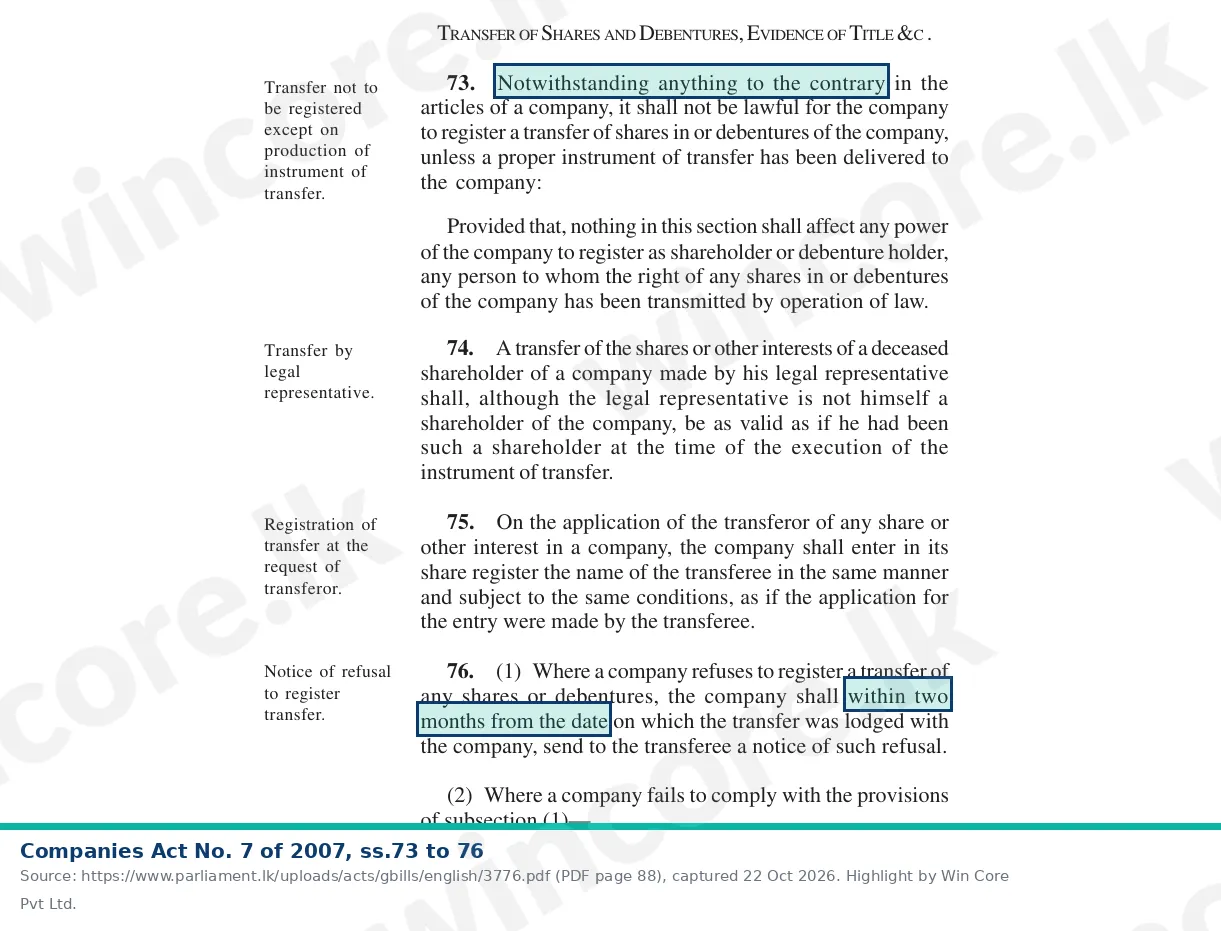
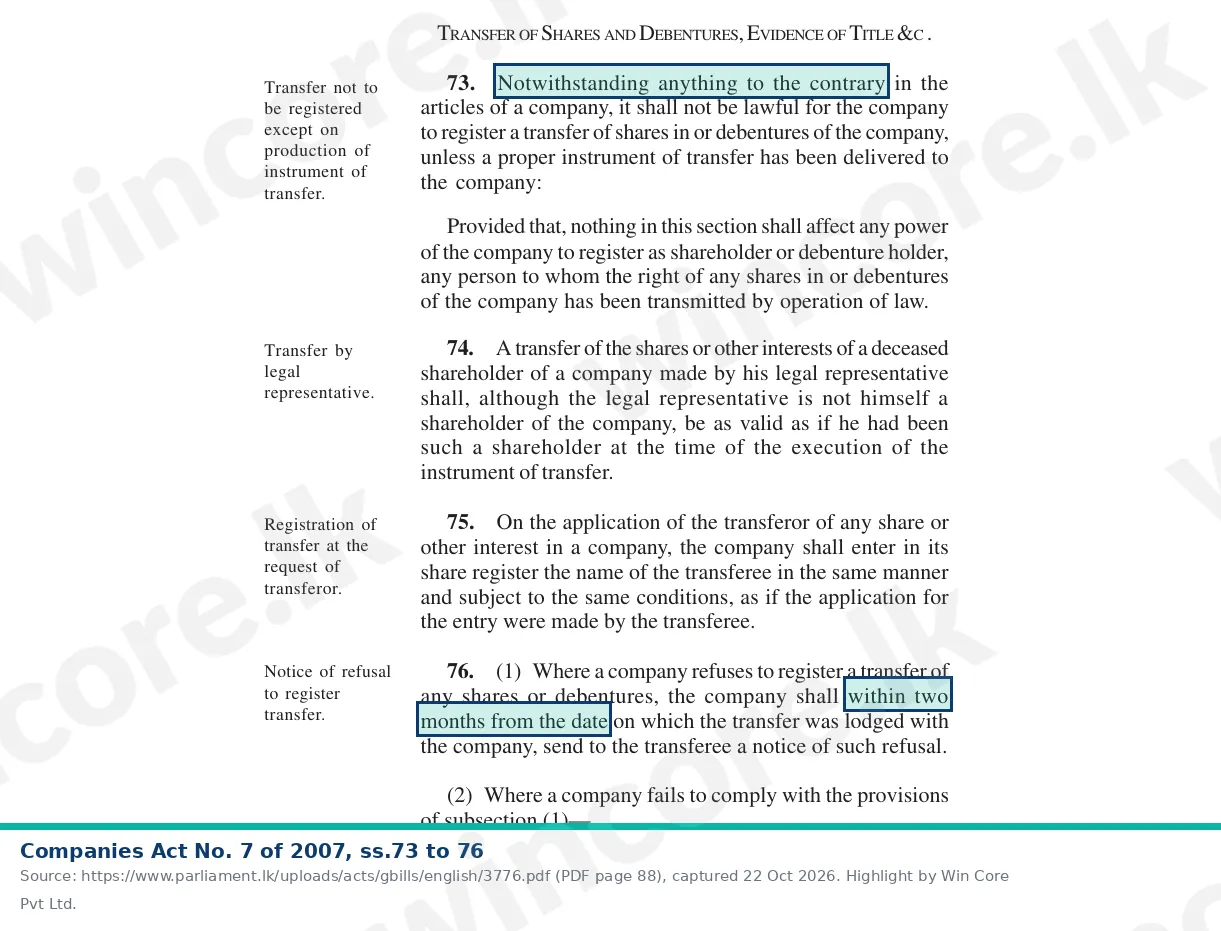
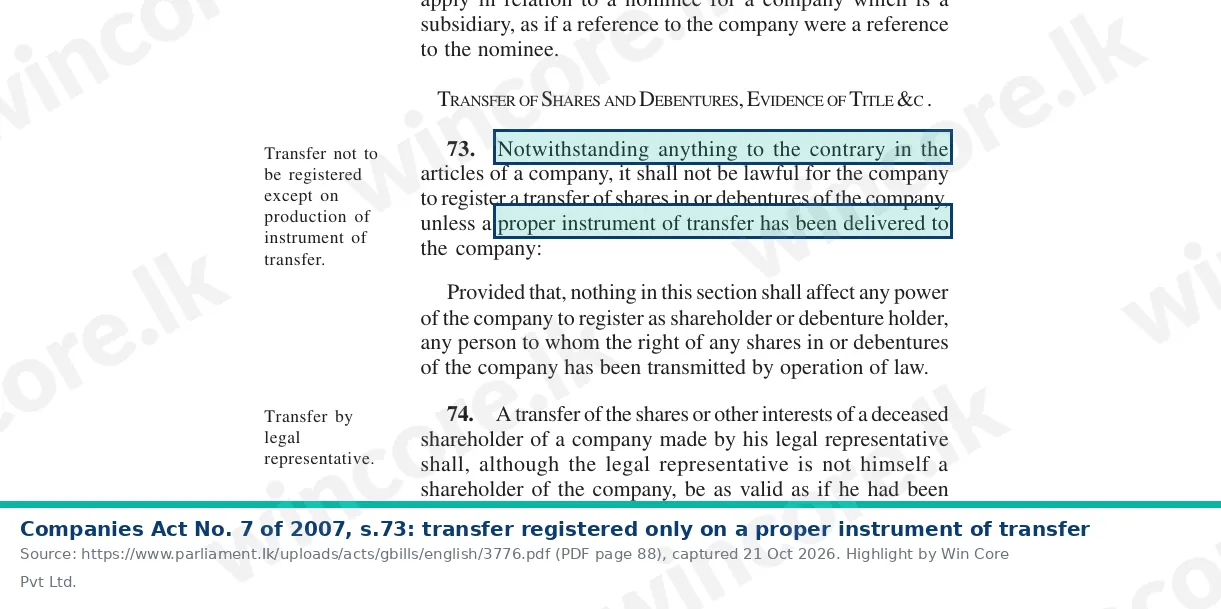
Section 73 sets the one condition the articles cannot override: "Notwithstanding anything to the contrary in the articles of a company, it shall not be lawful for the company to register a transfer of shares in or debentures of the company, unless a proper instrument of transfer has been delivered to the company" [1]. The proviso keeps the company's power to register a person to whom shares have been "transmitted by operation of law", for example on death. Under s.75 the seller may also apply, and the company "shall enter in its share register the name of the transferee in the same manner and subject to the same conditions, as if the application for the entry were made by the transferee" [1].
The board registers the transfer or sends a refusal within two months
Under s.76(1), where a company refuses to register a transfer, it "shall within two months from the date on which the transfer was lodged with the company, send to the transferee a notice of such refusal". If it does not, the company and every officer in default are each liable on conviction to a fine not exceeding Rs 50,000 (s.76(2)) [1].
Once the board approves, the share register must show the change. Section 123(1)(c)(iii) requires the register to record the date of any "transfer of shares by or to" each shareholder within the last ten years, "and in relation to the transfer, the name of the person to or from whom the shares were transferred" [1]. Failure is an offence: a fine of up to Rs 200,000 for the company and up to Rs 100,000 for each officer in default (s.123(2)) [1] [2]. The new holding then appears in the company's next Form 15 annual return; our annual filing checklist lists what goes with it.
In the example, the board confirms that the pre-emption offer in the articles went to the other shareholders and was declined, resolves to register the transfer, writes it into the share register and issues the new share certificates. Our corporate secretarial services prepare the board resolution, the register entries and the filings that follow.
The share certificate has been exempt from stamp duty since 2016
Our article on the Stamp Duty Act No. 12 of 2006 covers the Act generally. For a share transfer, four texts matter:
- Section 4(f) lists as a specified instrument "a share certificate on new or additional issue or on transfer or assignment"; s.6(b) makes duty payable, unless the parties agree otherwise, "in the case of a transfer or assignment of any share, by the transferee or assignee of such share" [3]. The instrument of transfer is not itself in the s.4 list, although s.4(k) lets the Minister add instruments by Order.
- The rate Order in Gazette 1465/19 of 5 October 2006 (item 6) charged duty on "Any share certificate issued consequent to the issue, transfer or assignment of any number of shares of any company", per Rs 1,000 of the aggregate value [3].
- Gazette 1947/46 of 1 January 2016 added item 35 to the exemption Order (Gazette 1465/20): "Any share certificate issued consequent to the issue, transfer or assignment of any number of shares of any company" [4].
- Section 8(1) still carries a proviso that "share transfers executed in Sri Lanka shall be stamped within one month from the execution of the same" [3].
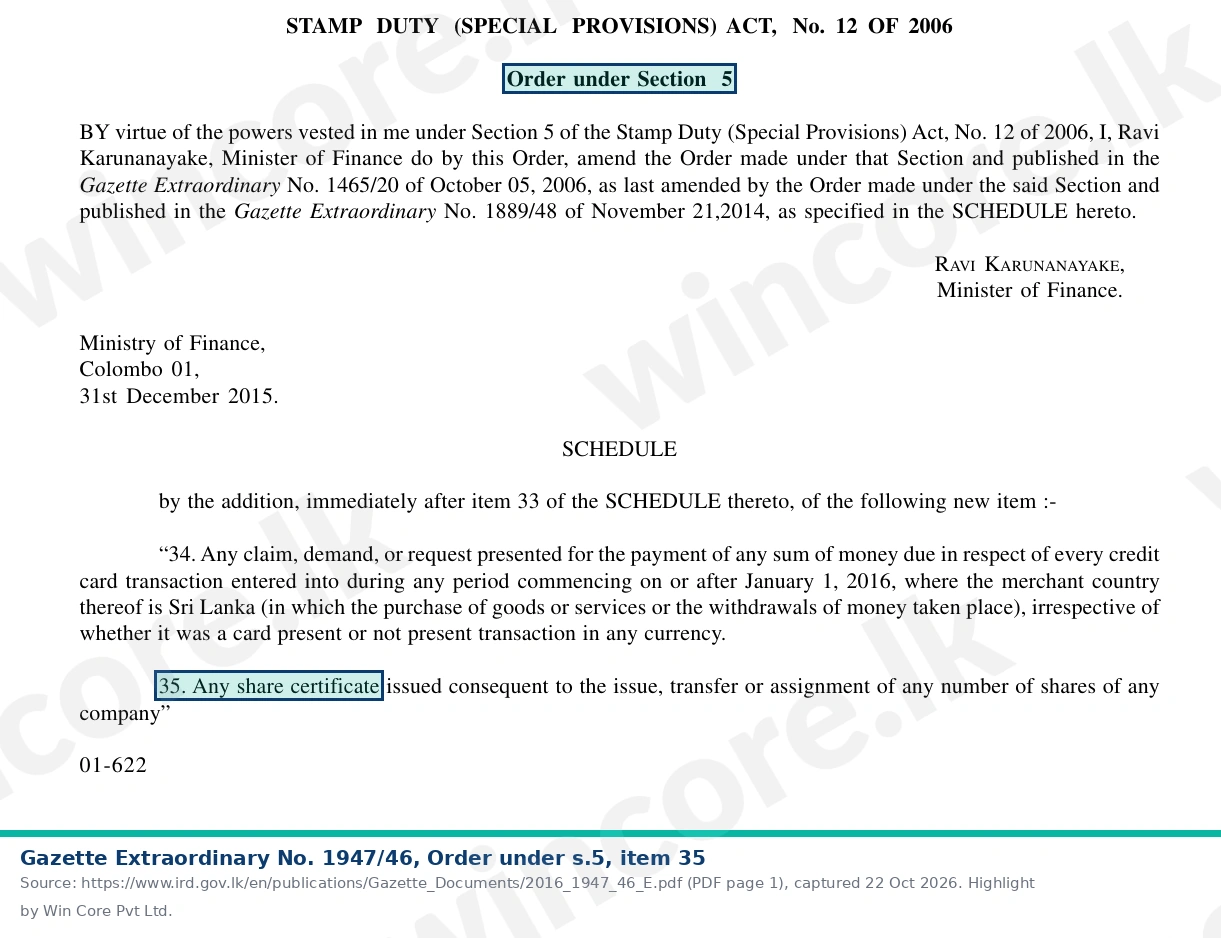
On our reading, item 35 uses the same words as the charging item, so a share certificate issued on a transfer has been exempt since 2016. The later exemption Orders we checked for our Stamp Duty Act article (Gazettes 2149/18, 2312/73 and 2477/22) add items 36 to 38 and do not touch item 35. Two points stay open: how the s.8(1) proviso on share transfers works after the exemption, and whether any other law charges duty on the instrument of transfer itself. We have not found one.
One document bears on the first point. The IRD's website still carries a "Transfer of Shares" form with a "Stamp Duty File No." and an office box for the "Value of a share (on net assets basis)", signed by a Deputy Commissioner [5]. Its checklist asks for accounts for 2012/2013 and 2013/2014, so on our reading it predates item 35. In the example, on our reading no duty is due on the general manager's certificate; for a large transfer, ask the IRD whether it still expects the form.
From 1 November 2026, the seller and the buyer each need a TIN certificate
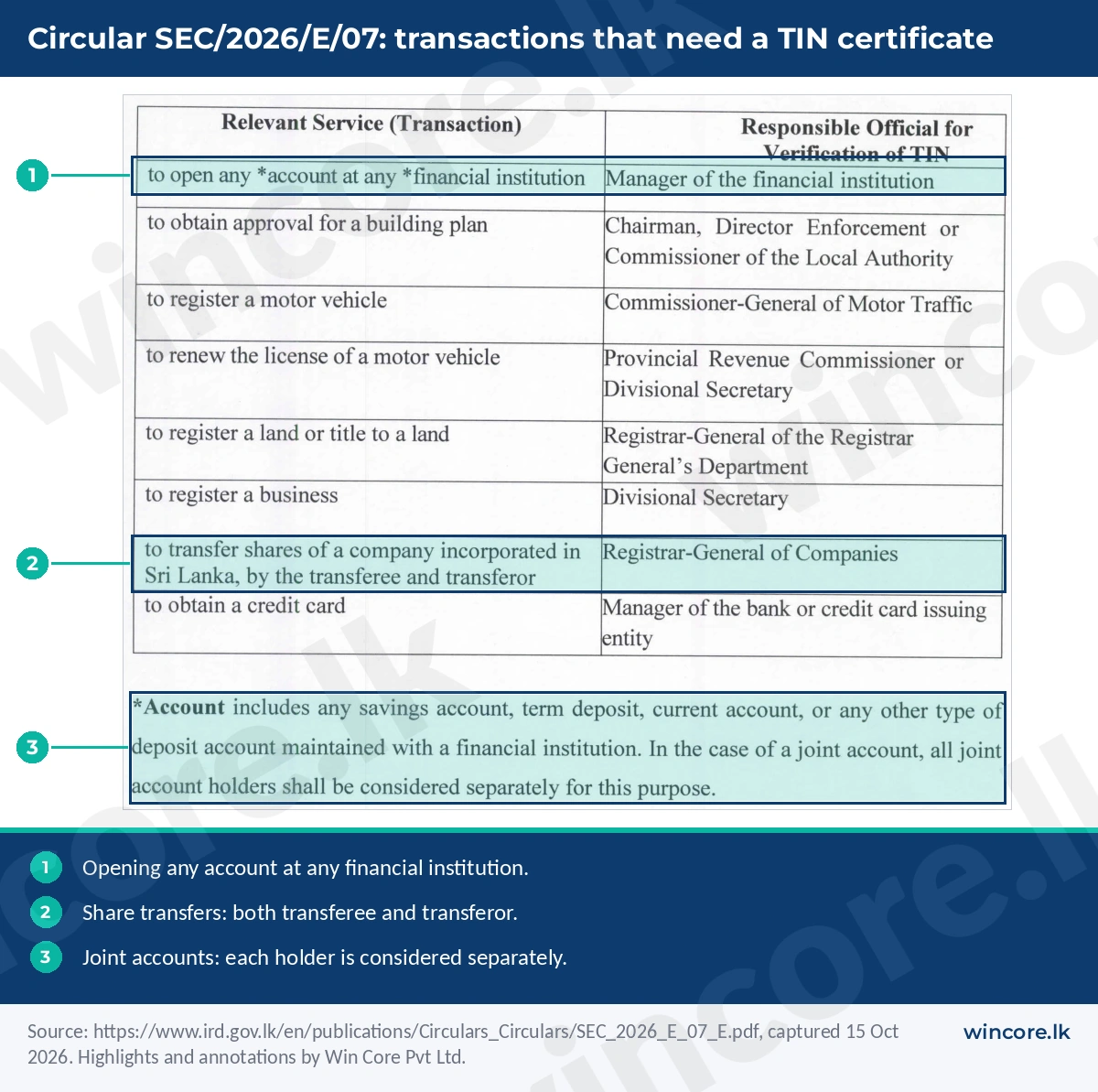
Section 103(6)(b) of the Inland Revenue Act, inserted by s.24 of Act No. 11 of 2026, lists "to transfer shares of a company incorporated in Sri Lanka, by the transferee and transferor" among the purposes for which a TIN certificate must be submitted, with the "Registrar-General of Companies" as the official responsible [6]. The Act says "With effect from April 1, 2026"; Circular SEC/2026/E/07 of 22 September 2026 applies the check "with effect from 1 November 2026" [6] [7]. Our article on the TIN certificate circular SEC/2026/E/07 explains the two dates.
The circular exempts individuals under eighteen, non-resident individuals, individuals whose registration was refused, persons entitled to diplomatic privileges, and "Any Entity other than an individual (Company, Partnership, ...)". A photocopy or soft copy of the certificate, or a printout of the IRD e-services TIN verification with the NIC number, is accepted [7].
In the example, the transfer is signed on 12 November 2026, so the founder and the general manager each need a certificate. If either has never registered, our income tax compliance services include TIN registration for individuals. The circular does not say at what point the Registrar-General checks the certificates for a share transfer; we keep that open.
The buyer has ten working days and the company twenty to report beneficial owners
The Companies (Amendment) Act No. 12 of 2025 put two clocks on every transfer. Section 130A(2): "Every shareholder shall, within ten working days of the subscription of any shares or transfer of shares give the details specified in subsection (1) to the company." Under s.130A(1) the company must, "within twenty working days of the issue of any shares or transfer of shares, give notice to the Registrar in the prescribed form" of its beneficial owners [8].
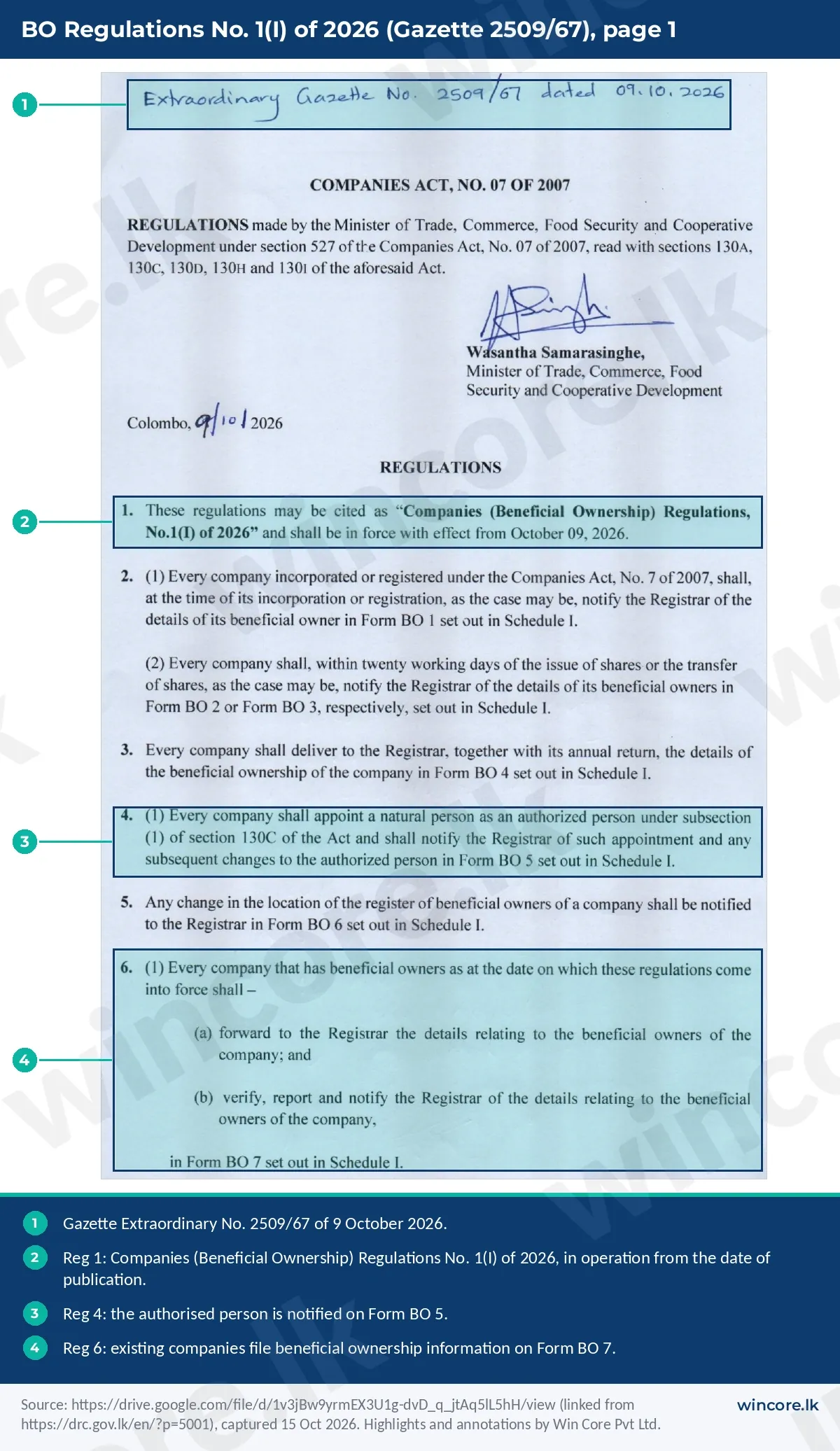
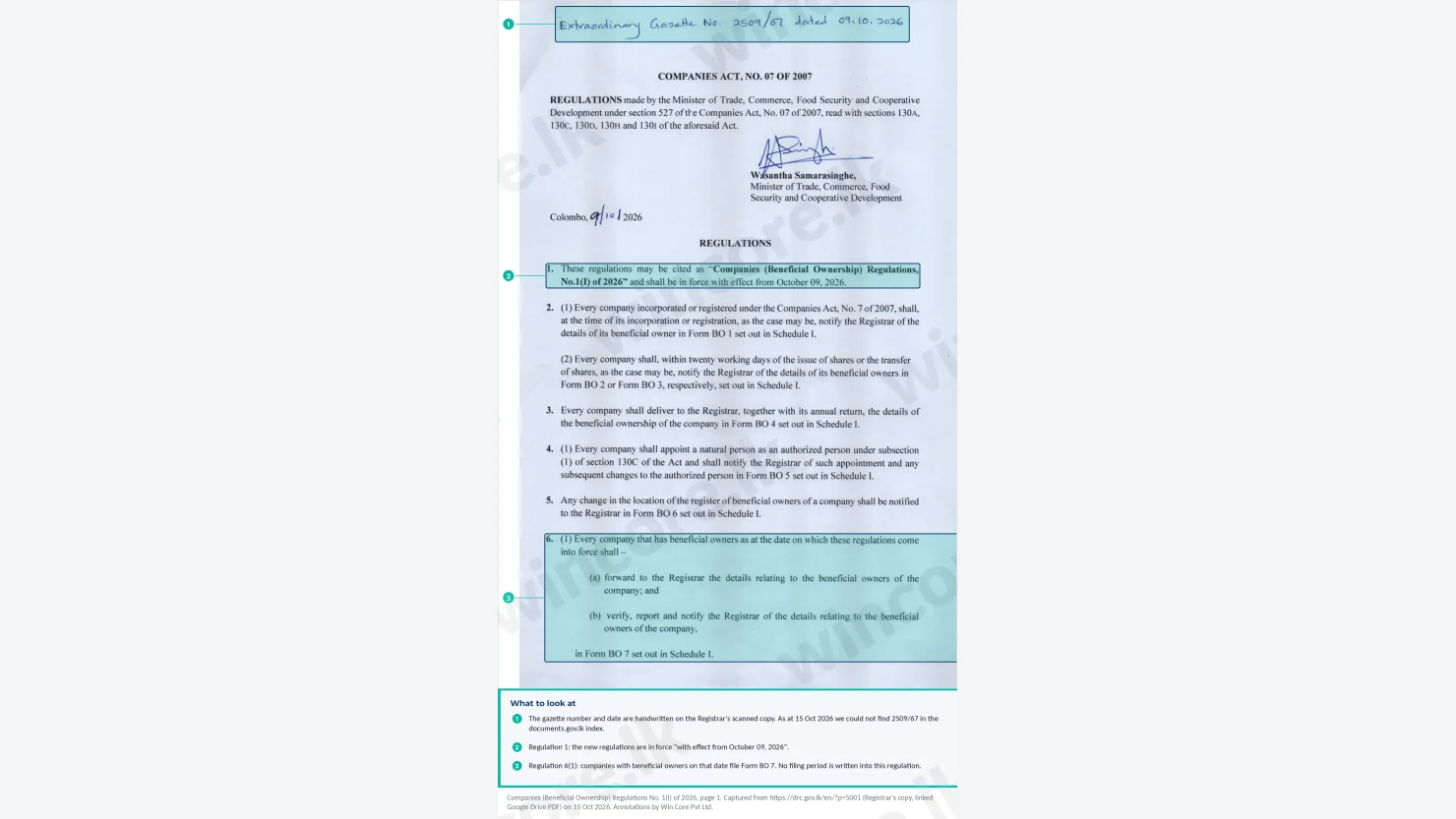
Regulation 2(2) of the Companies (Beneficial Ownership) Regulations No. 1(I) of 2026 (Gazette 2509/67, in force from 9 October 2026) names the form: within twenty working days "of the issue of shares or the transfer of shares, as the case may be", the company notifies the Registrar "in Form BO 2 or Form BO 3, respectively" [9]. On our reading, "respectively" makes BO 3 the transfer form, and it is due on the transfer itself, not only when someone crosses a threshold. A beneficial owner is a natural person who "ultimately owns or controls ten per cent or more" of the company, or who exercises effective control (s.130J) [8].
Late filing. From 22 October 2026, regulation 10 as replaced by Regulations No. 1(II) of 2026 (Gazette 2511/47) charges "one thousand rupees (Rs. 1,000/-) per week" for a prescribed form not submitted in time, and any part of a week counts as a full week [10]. Separately, a company that fails to comply with s.130A(1), and a shareholder who fails to comply with s.130A(2), commit an offence under s.130G(1) and s.130G(3), with a fine of up to Rs 1 million, imprisonment of up to ten years, or both [8].
In the example, the general manager moves to 20 percent and becomes a beneficial owner. He gives his details to the company within ten working days, and the company files BO 3 within twenty. Our arithmetic: a BO 3 filed two weeks and one day late counts as three weeks, so Rs 3,000 under regulation 10. Our article on the beneficial ownership regulations in Gazettes 2509/67 and 2511/47 covers the forms and fees.
An individual seller pays 15 percent capital gains tax within a month after the month of sale
When the gain arises. Under s.39(a) of the Inland Revenue Act No. 24 of 2017, an owner realises an asset "when that person parts with ownership of the asset, including when the asset is sold, exchanged, transferred" [11]. Shares held as an investment are an "investment asset", which s.195 defines as "a capital asset held as part of an investment" [11].
The gain. The cost of the shares includes "expenditure incurred by the person in acquiring the asset" and "incidental expenditure incurred by the person in acquiring and realising the asset" (s.37(1)(a) and (c)) [11].
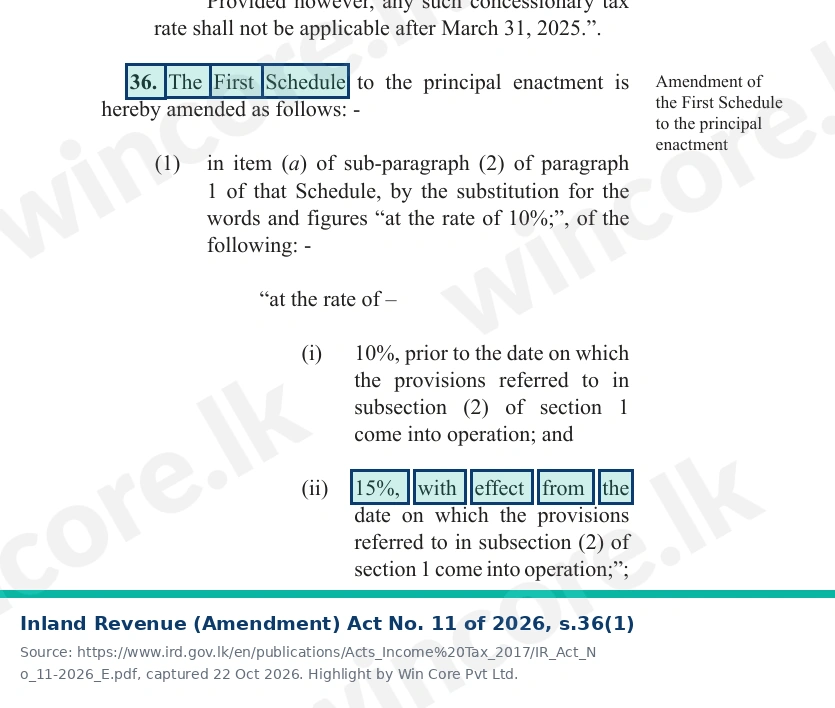
The rate and its date. First Schedule paragraph 1(2)(a) taxed an individual's gains from investment assets "at the rate of 10%". Section 36(1) of Act No. 11 of 2026 replaced those words with "10%, prior to the date on which the provisions referred to in subsection (2) of section 1 come into operation" and "15%, with effect from the date on which the provisions referred to in subsection (2) of section 1 come into operation" [6]. Section 1(2) brings those provisions into operation "on the date on which the Bill becomes an Act of Parliament", and the Act was certified on 3 June 2026. Section 36 appears in the s.1(3) table only for a different item, paragraph 4(2B)(b), so on our reading the 15 percent rate applies to gains realised on or after 3 June 2026. The IRD's online consolidation, which carries amendments only to 31 March 2025, still prints 10 percent.
Return and payment. Section 93(3) requires a capital gains tax return "within thirty days after the end of the relevant calendar month in which the realisation occurred", and s.82(2)(c)(i) makes the tax payable on that date [11].
Exemptions that do not help here. Third Schedule paragraph (f) exempts a resident individual's gain that "does not exceed Rs. 50,000" where total gains in the year "do not exceed Rs. 600,000", and paragraph (h) exempts gains on "shares quoted in any official list published by any stock exchange licensed by the Securities and Exchange Commission of Sri Lanka" [11]. Act No. 11 of 2026 amends neither [6].
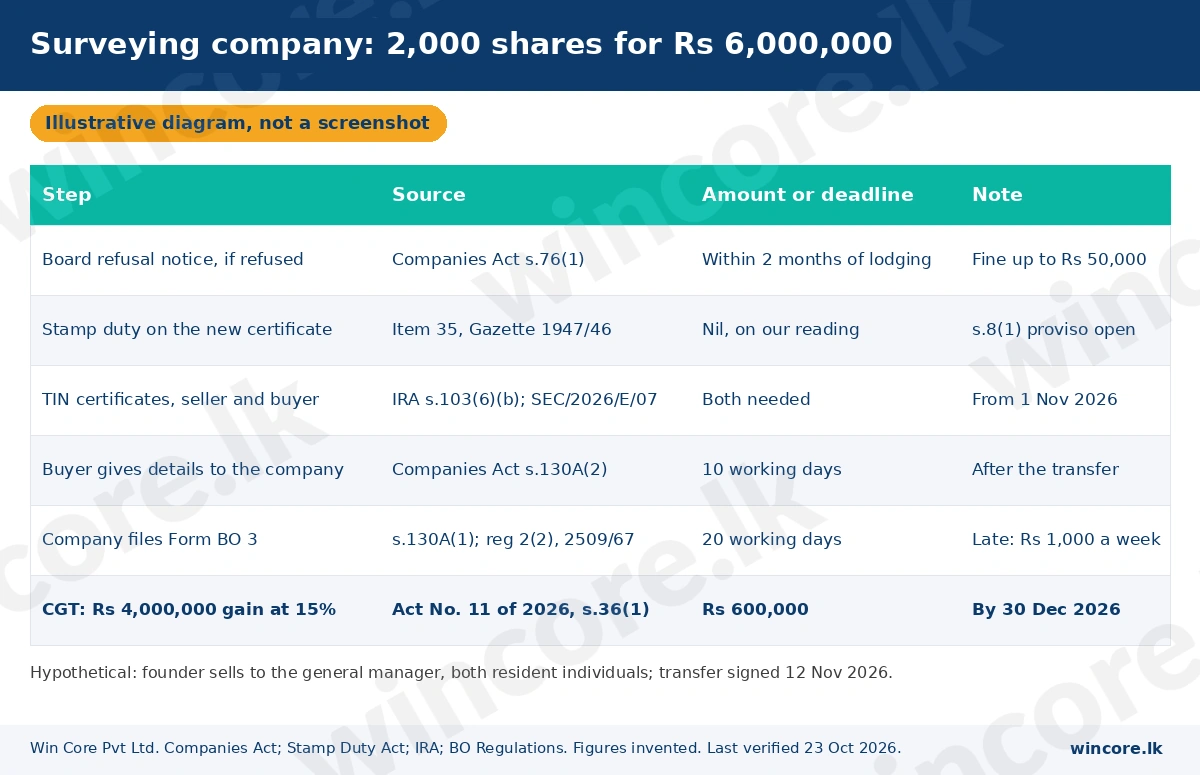
The example, with our arithmetic. Gain: Rs 6,000,000 less Rs 2,000,000 is Rs 4,000,000, before any incidental costs of the sale. Tax at 15 percent: Rs 600,000. The sale is in November 2026, so the founder files and pays by 30 December 2026. The buyer pays no capital gains tax on buying. Our capital gains tax guide covers other assets and late payment. A company selling shares is taxed at a different rate and is outside this page.
What this means for you
- Read the articles first: pre-emption and board refusal rights shape the deal.
- Deliver a proper instrument of transfer (s.73). If the board refuses, the notice is due within two months of lodging (s.76).
- Write the transfer into the share register (s.123).
- From 1 November 2026, collect TIN certificates from every individual seller and buyer.
- Diarise ten working days for the buyer's details and twenty for the company's Form BO 3; a late form costs Rs 1,000 a week.
- On our reading, the share certificate is exempt from stamp duty, with two points still open.
- An individual seller budgets 15 percent of the gain, filed and paid within thirty days after the month of sale.
Checklist: documents needed
- Articles of association, current version, checked for pre-emption and refusal rights
- Signed instrument of transfer
- Board resolution approving registration
- TIN certificate, or IRD verification printout with NIC, for each individual seller and buyer
- Updated share register and new share certificates
- Beneficial owner details from the buyer, within ten working days
- Form BO 3 filed within twenty working days
- The seller's cost records and the capital gains tax return
FAQ
Is stamp duty payable on a share transfer in Sri Lanka?
On our reading, not on the share certificate, because item 35 of the exemption Order in Gazette 1947/46 has exempted it since 1 January 2016. Two points remain open: how the s.8(1) proviso on stamping share transfers within one month works after the exemption, and whether any other law charges the instrument of transfer. For a large transfer, ask the IRD first.
Can the board refuse to register a share transfer?
Yes, if the articles give it that power, because s.49(5) makes shares transferable in the manner the articles provide. A company that refuses must send the transferee a notice of refusal within two months of the transfer being lodged (s.76(1)). If it does not, the company and every officer in default can each be fined up to Rs 50,000 on conviction.
Which form goes to the Registrar after a share transfer?
Form BO 3, within twenty working days of the transfer, under s.130A(1) of the Companies Act and regulation 2(2) of the beneficial ownership regulations in Gazette 2509/67. The buyer must first give the company his or her details within ten working days. From 22 October 2026 a late form costs Rs 1,000 a week, with any part week counted as a full week.
What capital gains tax rate applies when an individual sells private company shares?
Fifteen percent of the gain on a sale made on or after 3 June 2026, under s.36(1) of the Inland Revenue (Amendment) Act No. 11 of 2026; the rate was 10 percent before. The listed shares exemption does not cover private company shares. The capital gains tax return is filed, and the tax paid, within thirty days after the end of the month of sale.
Do both buyer and seller need a TIN certificate?
Yes, where both are individuals. From 1 November 2026, Circular SEC/2026/E/07 requires a TIN certificate "by the transferee and transferor" for a share transfer, checked by the Registrar-General of Companies. Companies and other entities, non-resident individuals and those under eighteen are exempt. An IRD e-services verification printout with the NIC number is accepted in place of the certificate.
Open points
- How the s.8(1) proviso on stamping share transfers within one month works after item 35, and whether the IRD still expects its "Transfer of Shares" form.
- Whether any other law charges duty on the instrument of transfer itself.
- At what point the Registrar-General of Companies checks TIN certificates for a share transfer.
- Whether the twenty working days for Form BO 3 run from the signing of the instrument or from registration of the transfer; counting from signing is the safer reading.
Last verified: 23 October 2026. We re-read Companies Act ss.49(5), 73, 75, 76 and 123 on the parliament.lk text (s.123(2)(a) from a secondary copy, as the text layer drops it); ss.130A, 130G and 130J of Act No. 12 of 2025; the Registrar's post on Gazette 2511/47; Stamp Duty Act ss.4, 6 and 8 and Gazette 1947/46; ss.1, 24 and 36 of Act No. 11 of 2026; Circular SEC/2026/E/07; and Inland Revenue Act ss.37, 39, 82, 93 and 195 with the First and Third Schedules.
The short version. Check the articles, deliver a proper instrument, register the transfer or refuse within two months, collect both TIN certificates, file BO 3 within twenty working days, and have the seller pay 15 percent on the gain within thirty days after the month ends. Stamp duty on the certificate is nil on our reading, with two points open.
Talk to us. If you are planning a share transfer and want the board papers, the register, Form BO 3 and the seller's capital gains tax return handled together, our contact page.
WinCore Pvt Ltd
References
- Parliament of Sri Lanka. Companies Act, No. 7 of 2007, ss.49(5), 73, 75, 76 and 123. https://www.parliament.lk/uploads/acts/gbills/english/3776.pdf . Primary. Accessed 23 October 2026.
- LankaLAW. Companies Act, No. 7 of 2007, text of s.123(2)(a), used because the parliament.lk text layer drops that paragraph. https://lankalaw.net/wp-content/uploads/2025/02/2007Y0V0C7A.html . Secondary. Accessed 23 October 2026.
- Inland Revenue Department. Stamp Duty (Special Provisions) Act, No. 12 of 2006 (consolidation with Act No. 10 of 2008, "for the purpose of convenient reference only"), ss.4, 6 and 8, with Gazettes 1465/19 and 1465/20. https://www.ird.gov.lk/en/Type%20of%20Taxes/Stamp%20Duty_Acts/SDActNo.12%5BE%5D2006ConsolFinal.pdf . Primary (IRD consolidation). Accessed 23 October 2026.
- Gazette Extraordinary No. 1947/46 (1 January 2016), Order under s.5, item 35. https://www.ird.gov.lk/en/publications/Gazette_Documents/2016_1947_46_E.pdf . Primary. Accessed 23 October 2026.
- Inland Revenue Department, Taxpayer Service Unit. Transfer of Shares (form, undated). https://www.ird.gov.lk/en/publications/Unit%20Profiles_Tax%20Payer%20Service%20Unit/Form_Shares_Transfer.pdf . Primary (IRD form). Accessed 23 October 2026.
- Parliament of Sri Lanka. Inland Revenue (Amendment) Act, No. 11 of 2026 (certified 3 June 2026), ss.1, 24 (new s.103(6)), 36 and 38. https://www.ird.gov.lk/en/publications/Acts_Income%20Tax_2017/IR_Act_No_11-2026_E.pdf . Primary. Accessed 23 October 2026.
- Inland Revenue Department. Circular SEC/2026/E/07, Mandatory Submission of Taxpayer Identification Number (TIN) Certificate for Specified Transactions (22 September 2026), paras 1 to 4 and the exemptions. https://www.ird.gov.lk/en/publications/Circulars_Circulars/SEC_2026_E_07_E.pdf . Primary. Accessed 23 October 2026.
- Parliament of Sri Lanka. Companies (Amendment) Act, No. 12 of 2025 (certified 4 August 2025), ss.130A, 130G and 130J. https://www.parliament.lk/uploads/acts/gbills/english/6389.pdf . Primary. Accessed 23 October 2026.
- Companies (Beneficial Ownership) Regulations, No. 1(I) of 2026, Gazette Extraordinary No. 2509/67 (9 October 2026, number handwritten on the Registrar's copy), regs 1 and 2(2). https://drive.google.com/file/d/1v3jBw9yrmEX3U1g-dvD_q_jtAq5lL5hH/view (linked from https://drc.gov.lk/en/?p=5001). Primary (Registrar's copy). Accessed 15 October 2026.
- Companies (Beneficial Ownership) Regulations, No. 1(II) of 2026, Gazette Extraordinary No. 2511/47 (21 October 2026), reg 3 (new regulation 10). https://drive.google.com/file/d/1zQMPo8yAMzOb6PH4rzVxxEcoLN_S6Kc2/view (linked from https://drc.gov.lk/en/?p=5007). Primary (Registrar's copy). Accessed 23 October 2026.
- Inland Revenue Department. Inland Revenue Act, No. 24 of 2017 (consolidation incorporating amendments up to 31 March 2025), ss.37, 39, 82, 93 and 195, First Schedule para 1(2), Third Schedule paras (f) and (h). https://www.ird.gov.lk/en/publications/Acts_Income%20Tax_2017/IRA_Cons_Act_-_2025_Changes.pdf . Primary (IRD consolidation). Accessed 23 October 2026.
Put these insights to work
WinCore specialists can review your current workflow, document gaps, and build a practical 90-day action plan.
Book a free consultationContinue reading
Explore more WinCore analysis to keep your finance, tax, and compliance roadmap moving.
Buying a company's shares brings its whole history with it. What the transfer needs, what happens to tax losses, and when a new company is simpler.

Sri Lanka taxes gains on investment assets at a flat rate, separate from your other income: 15% for individuals from 3 June 2026 (10% before). Here is what is exempt and how to file the capital gains tax return.
The October 2026 BO regulations replaced the March set, and from 22 October a late form costs Rs 1,000 a week. What a late BO 7 filing now costs.