
Share capital requirement Sri Lanka: what a new company needs
No minimum share capital applies to a resident private company. How much to put in as stated capital, how much to lend, and the half-of-capital test.

On this page
Last verified against the primary sources on 26 October 2026.
Share capital requirement Sri Lanka, in brief. The Companies Act No. 7 of 2007 sets no general minimum share capital for a private company owned by resident founders. Shares have no par value, and there is no authorised capital to declare. What the company has instead is "stated capital": the total the shareholders have paid, or owe, for their shares. The founders choose the amount. The useful question is how much to put in as capital and how much, if any, to lend.
This guide covers what the 2007 Act changed, how stated capital is recorded, how to decide the amount, the records to keep when the money goes in, and how to add capital later. A worked example with rupee figures follows for a hypothetical logistics firm with two resident founders.
The 2007 Act removed par value and authorised capital
The 2007 Act repealed the Companies Act No. 17 of 1982 (section 533(1)) [1]. Two features of the older share structure are absent from the new Act.
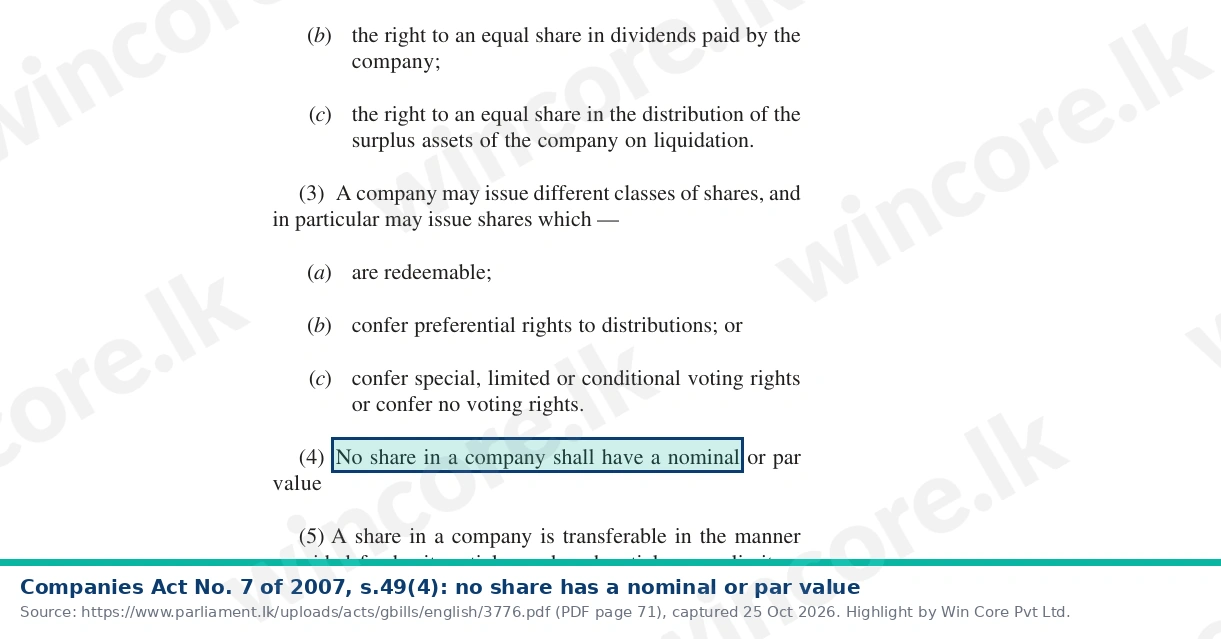
No par value. Section 49(4): "No share in a company shall have a nominal or par value" [1]. A share is not a Rs 10 share. It is one share, issued for whatever consideration the board decides is fair (section 52(1)).
No authorised capital. Section 13 lists what articles may provide for: "the objects of the company", "the rights and obligations of shareholders" and "the management and administration of the company" [1]. We searched the full text of the Act and of the Companies (Amendment) Act No. 12 of 2025 and found no requirement for an authorised share capital. The board can issue more shares later, subject to the articles and pre-emptive rights (sections 51(1) and 53) [1].
Stated capital is what shareholders have paid or owe for their shares
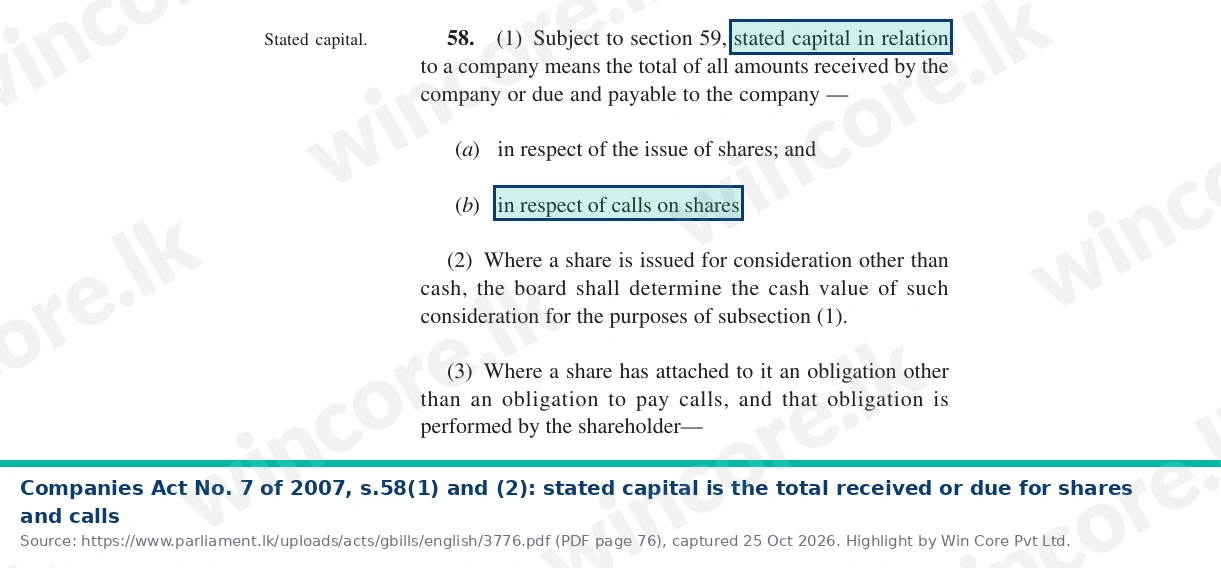
Section 58(1): "stated capital in relation to a company means the total of all amounts received by the company or due and payable to the company (a) in respect of the issue of shares; and (b) in respect of calls on shares" [1]. For a non-cash contribution, "the board shall determine the cash value of such consideration" (section 58(2)). For the notice to the Registrar, see calls on shares and Form 7.
It is recorded in four places:
- The incorporation application. Section 50(1) says the company "shall issue to each shareholder named in the application for incorporation, the shares to which that person is entitled" immediately after incorporation [1].
- The share register. Section 123(1) requires the name and address of each shareholder, the number of shares of each class and the date of each issue [1].
- Registrar notices. For each later issue, Form 6 states "the amount of the company's stated capital following the issue of the shares" (section 51(4)(a)(iii)) [1].
- The accounts. Under SLFRS for SMEs, shares are equity, measured at "the fair value of the cash or other resources received or receivable, net of transaction costs" (paragraph 22.8). Transaction costs are "a deduction from equity" (22.9) [3].
At incorporation, the Beneficial Ownership Regulations in Gazette 2509/67 also require the company to notify the Registrar of its beneficial owners "in Form BO 1" (regulation 2(1)) [2].
Share capital requirement Sri Lanka: no rupee minimum for a private company
We checked rather than assumed. The only "minimum" money rule we found in the Act is the "minimum subscription" for shares offered under a prospectus (section 45 and the definition in section 529) [1]. That applies to offers to the public, not to two founders taking shares in a private company. Act No. 12 of 2025 does not add a capital minimum; its new section 4(2) restates that a company, other than one limited by guarantee, may have a single shareholder, which the 2007 text already allowed [4].
So, under the Companies Act, the share capital requirement for a resident-owned private company is that shares are issued for some consideration the board considers fair. There is no rupee floor in the Act, and we found none on the Registrar's incorporation guidelines page when we checked it on 26 October 2026 [7]. Some regulated activities may carry their own capital rules under other laws; check the licensing law for your sector before you fix the figure.
Size stated capital from the first year's cash needs
Start from what the company must pay before it earns. For the invented logistics firm, the founders list their first-year cash needs:
| Item | Rs |
|---|---|
| Deposit on a used delivery truck | 1,500,000 |
| Rent advance for the yard and office | 600,000 |
| Three months of salaries before steady sales | 1,200,000 |
| Fuel and working capital | 700,000 |
| Total | 4,000,000 |
Registration costs are covered in our company registration cost guide, and the steps in how to register a company.
Then weigh three practical points:
- Bank account. The company needs its own account for the capital to go into. Banks set their own opening requirements, so ask the bank what it needs before incorporation.
- Company secretary. The Companies (Secretaries) Regulations, No. 1 of 2023 apply to the secretary of a company "having a stated capital of rupees five hundred thousand or more, or an annual turnover of rupees one million or more" (regulation 2). The secretary must then meet regulation 3, which starts with being over eighteen and a citizen of Sri Lanka [6].
- Credibility. Suppliers, landlords and lenders may read the balance sheet. A company whose equity turns negative in its first year looks weaker, whatever the founders have lent it.
- Getting money back. Capital is hard to take out. Reducing stated capital needs a special resolution, and "Public notice of a proposed reduction of a company's stated capital shall be given not less than sixty days before the resolution" (section 59(1), (2)) [1]. On our reading, paying that money out to the founders is also a "distribution" (section 529, as amended by Act No. 12 of 2025), so it needs board authorisation under section 56(2) and, unless the articles say otherwise, an ordinary resolution of shareholders (section 56(1)(b)). The board must be satisfied that the company will meet the solvency test immediately afterwards, and obtain a certificate of solvency from the auditors [1] [4]. An agreement with a creditor under section 59(3) can also block a reduction. A director's loan is repaid under its own terms.
A director's loan stays repayable; stated capital does not
Two sections turn this into numbers.
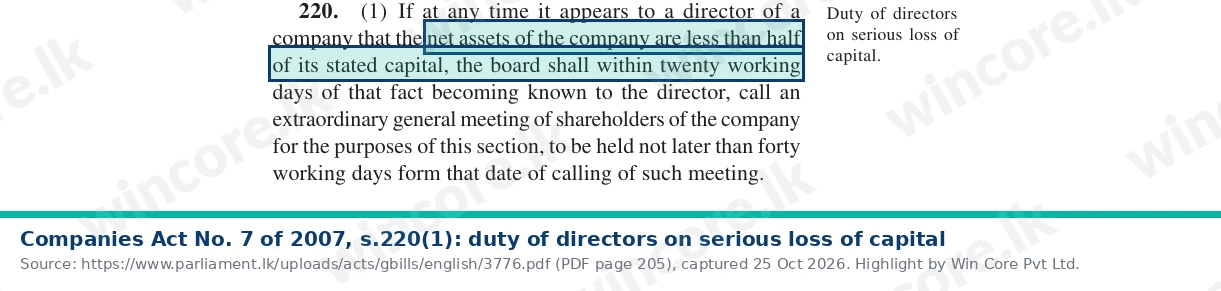
Section 220(1): "If at any time it appears to a director of a company that the net assets of the company are less than half of its stated capital, the board shall within twenty working days of that fact becoming known to the director, call an extraordinary general meeting". The meeting must be held within forty working days of being called, with a board report on the losses. A director who knowingly and wilfully allows a failure faces a fine of up to two hundred thousand rupees (section 220(4)) [1].
Section 57(1): the solvency test, needed before a dividend, requires that the company can pay its debts as they fall due and that its assets exceed "(i) the value of its liabilities; and (ii) the company's stated capital" [1].
A loan from a director is a liability, not stated capital. Write it down: amount, interest (if any), repayment and whether it can be converted into shares later. Our article on director-paid company expenses covers how those balances arise. Tax treatment of interest is outside this article; ask your tax adviser.
Worked example: Rs 4,000,000 two ways
The logistics firm's two founders put in Rs 4,000,000 between them. In year one the company makes a loss of Rs 1,200,000, as many new companies do.
| Option A | Option B | |
|---|---|---|
| Stated capital (Rs) | 1,000,000 | 4,000,000 |
| Director loans (Rs) | 3,000,000 | 0 |
| Year 1 loss (Rs) | (1,200,000) | (1,200,000) |
| Equity at year end (Rs) | (200,000) | 2,800,000 |
| Half of stated capital (Rs) | 500,000 | 2,000,000 |
| Section 220 meeting needed? | Yes | No |
| Money back to founders | Repay loans | Reduction under s.59, then a distribution under s.56 |
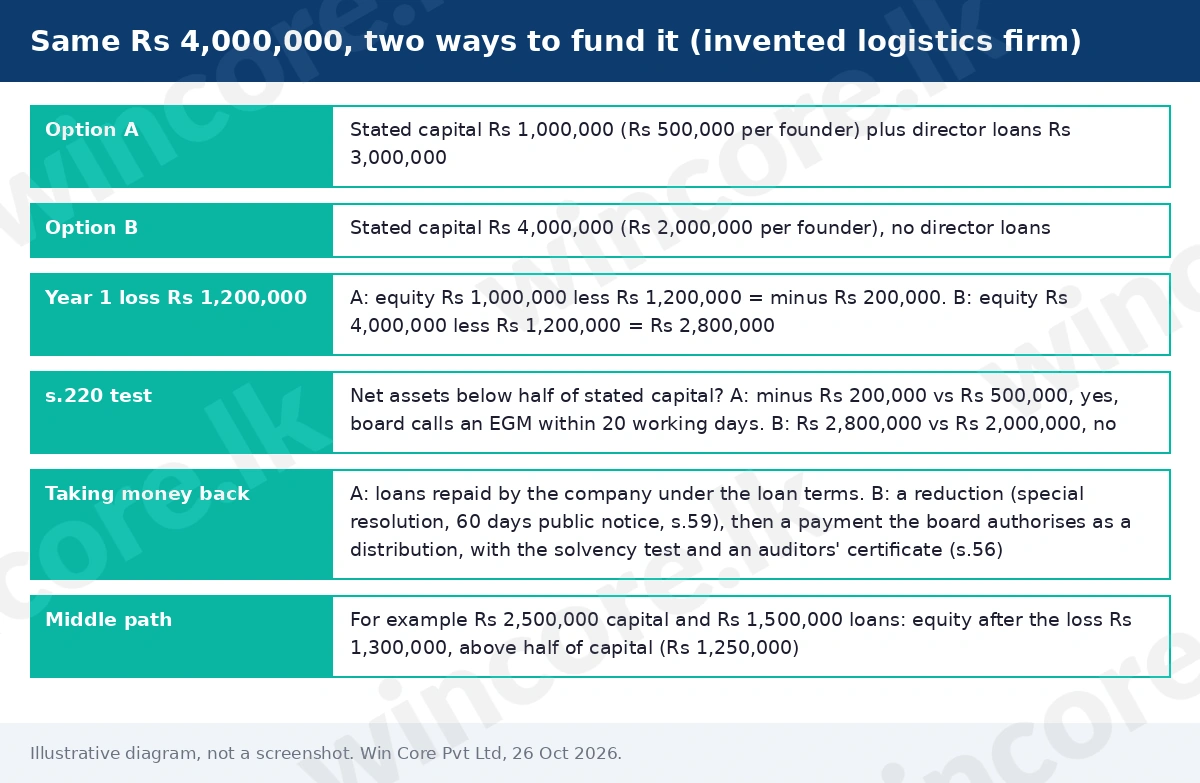
Option A keeps money easy to repay, but the balance sheet shows negative equity and the board must call a section 220 meeting. Option B looks stronger but locks the money in. A middle path, say Rs 2,500,000 of capital and Rs 1,500,000 of loans, leaves equity of Rs 1,300,000 after the same loss. That is above half of stated capital (Rs 1,250,000), but only just.
No figure is right for every company. Model your first-year loss and pick a capital figure that keeps net assets above half of it.
Pay the capital into the company account and keep the records
Open the company bank account in the company's name and have each founder pay the subscription from their own account, with a reference naming the shares. Record the issue in a board minute, update the share register and prepare the certificates, credit stated capital in the ledger, and keep any director loan in a separate liability account on written terms. The checklist below lists every record, with its section.
Our startup accounting guide sets up the books around these entries.
The board can add stated capital later by issuing more shares
When the company needs more, the board issues new shares. It must decide the consideration and resolve it is "fair and reasonable to the company and to all existing shareholders" (section 52(1)), offer the shares to existing holders unless the articles say otherwise (section 53), and allot "within twenty working days of the receipt of such consideration" (section 52(3), as substituted by Act No. 12 of 2025) [1] [4]. Form 6 goes to the Registrar within twenty working days of the issue (section 51(4)), and Form BO 2 within twenty working days under regulation 2(2) of Gazette 2509/67 [2]. If BO 2 is late, regulation 10, as replaced by Regulations No. 1(II) of 2026 (Gazette 2511/47) from 22 October 2026, charges "a penalty payment of one thousand rupees (Rs. 1,000/-) per week", and any part of a week counts as a full week [5].
A director's loan can also be converted into shares, with the release of the debt as consideration. Our secretarial services page covers capital changes after incorporation.
What this means for you
Choose a figure that covers early losses, so that net assets stay above half of stated capital (section 220), and fund the rest by written director loans if you want the money back later. A director's loan is repaid under its own terms. Reducing stated capital needs a special resolution and at least sixty days' public notice (section 59(1), (2)), and paying it out is a distribution under section 56.
Checklist: documents needed
- Company bank account opened in the company's name.
- Each founder pays the subscription from their own account, with a reference naming the shares.
- Board minute recording the shares issued, consideration and receipt.
- Share register updated (section 123) and share certificates prepared. The model articles require a certificate "within two moths" (First Schedule para 4(6), as printed), unless your articles differ [1].
- Ledger: stated capital credited; director loans in a separate liability account.
- Written loan terms for any director loan.
- Form BO 1 and Form BO 5 (authorised person under section 130C) at incorporation (Gazette 2509/67, regs 2(1) and 4(1)).
FAQ
Is there a minimum share capital for a private company in Sri Lanka?
Not under the Companies Act No. 7 of 2007. The only minimum we found is the minimum subscription for shares offered under a prospectus (section 45), which does not apply to founders taking shares in a private company. Some licensed sectors may have capital rules in their own laws, so check those before you fix the amount.
What is the difference between stated capital and authorised capital?
Stated capital is the total received or due for shares and calls (section 58(1)). Authorised capital was a ceiling on the shares a company could issue under the older law, where the memorandum stated it (Companies Act No. 17 of 1982, s.4(4)(a)). The 2007 Act has no authorised capital and no par value (section 49(4)). The board can issue more shares later, subject to the articles.
Should founders put money in as capital or as a loan?
It depends on how quickly you may want the money back and how the balance sheet must look. A loan is repaid under its terms. Capital stays in unless reduced by special resolution with sixty days' public notice (section 59) and paid out as a distribution (section 56). Too little capital can trigger a section 220 meeting if early losses push net assets below half of it.
What happens if net assets fall below half of stated capital?
Section 220 requires the board to call an extraordinary general meeting within twenty working days of a director becoming aware of it. The meeting is held within forty working days of being called, with a board report on the losses, their causes and the steps being taken. Knowing and wilful failure can bring a fine of up to two hundred thousand rupees.
The short version
There is no general share capital requirement for a resident-owned private company in Sri Lanka. Shares have no par value and there is no authorised capital (sections 49(4), 13). Stated capital is what the shareholders pay for their shares (section 58). Choose a figure that covers early losses so that net assets stay above half of it (section 220), and fund the rest by written director loans if you want the money back later.
Talk to us. If you are choosing a capital figure for a new company, see our company registration services or book a consultation at our contact page.
WinCore Pvt Ltd
This article is general information as at 26 October 2026 and is not legal advice on your specific position.
Cover image: Image by muhammad.abdullah on Freepik.
References
- Parliament of Sri Lanka. Companies Act, No. 7 of 2007, ss.13, 45, 49, 50, 51, 52, 53, 56, 57, 58, 59, 123, 220, 529, 533; First Schedule para 4(6). https://www.parliament.lk/uploads/acts/gbills/english/3776.pdf . Primary. Accessed 25 October 2026.
- Companies (Beneficial Ownership) Regulations, No. 1(I) of 2026, Gazette Extraordinary 2509/67 of 9 October 2026, reg 2(1), (2). https://drive.google.com/file/d/1v3jBw9yrmEX3U1g-dvD_q_jtAq5lL5hH/view (linked from https://drc.gov.lk/en/?p=5001). Primary. Accessed 25 October 2026.
- CA Sri Lanka. SLFRS for SMEs (2015), paras 22.7 to 22.9. https://www.slaasc.lk/files/_SLFRS%20FOR%20SMEs%20-%202015.pdf . Primary. Accessed 25 October 2026.
- Parliament of Sri Lanka. Companies (Amendment) Act, No. 12 of 2025, ss.2, 6, 20. https://www.parliament.lk/uploads/acts/gbills/english/6389.pdf . Primary. Accessed 25 October 2026.
- Companies (Beneficial Ownership) Regulations, No. 1(II) of 2026, Gazette Extraordinary 2511/47 of 21 October 2026, in force 22 October 2026. reg 3 (new reg 10). https://drive.google.com/file/d/1zQMPo8yAMzOb6PH4rzVxxEcoLN_S6Kc2/view (linked from https://drc.gov.lk/en/?p=5007). Primary. Accessed 26 October 2026.
- Companies (Secretaries) Regulations, No. 1 of 2023, Gazette Extraordinary 2323/41 of 17 March 2023, regs 2, 3(1). Scanned gazette copy at https://iccslk.org/en/wp-content/uploads/2024/07/ROC-Gazette-17-March-2023.pdf (hosted by the Institute of Chartered Corporate Secretaries of Sri Lanka; the documents.gov.lk original was not fetched). Primary text, secondary host. Accessed 26 October 2026.
- Department of the Registrar of Companies. Guidelines & Necessary Documents. https://drc.gov.lk/en/?page_id=2741 . Primary. Checked 26 October 2026; no minimum capital stated.
Put these insights to work
WinCore specialists can review your current workflow, document gaps, and build a practical 90-day action plan.
Book a free consultationContinue reading
Explore more WinCore analysis to keep your finance, tax, and compliance roadmap moving.
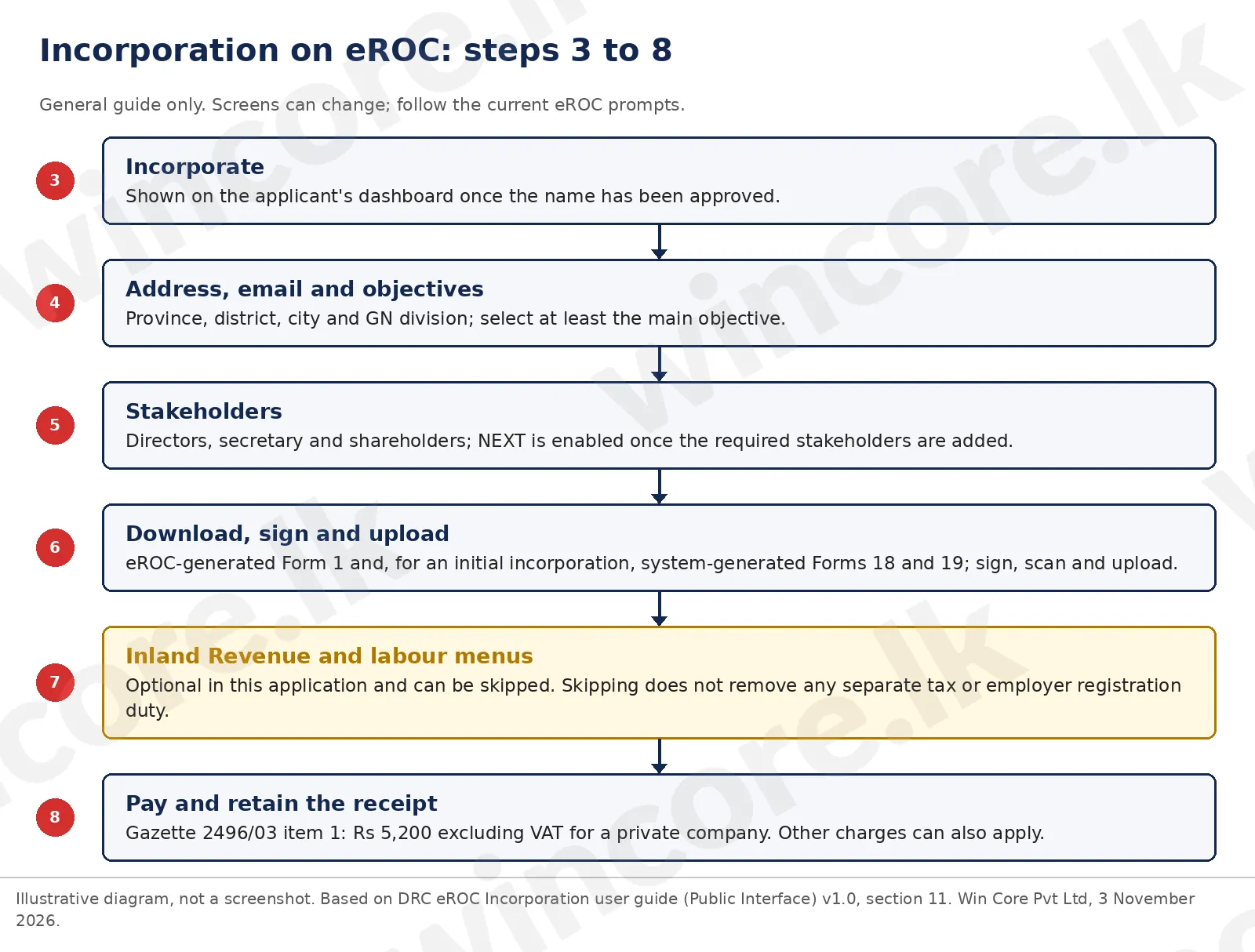
Registering a private limited company in Sri Lanka in 2026: structure, name approval, the eROC filing with BO 1 and BO 5, the TIN and the first year.
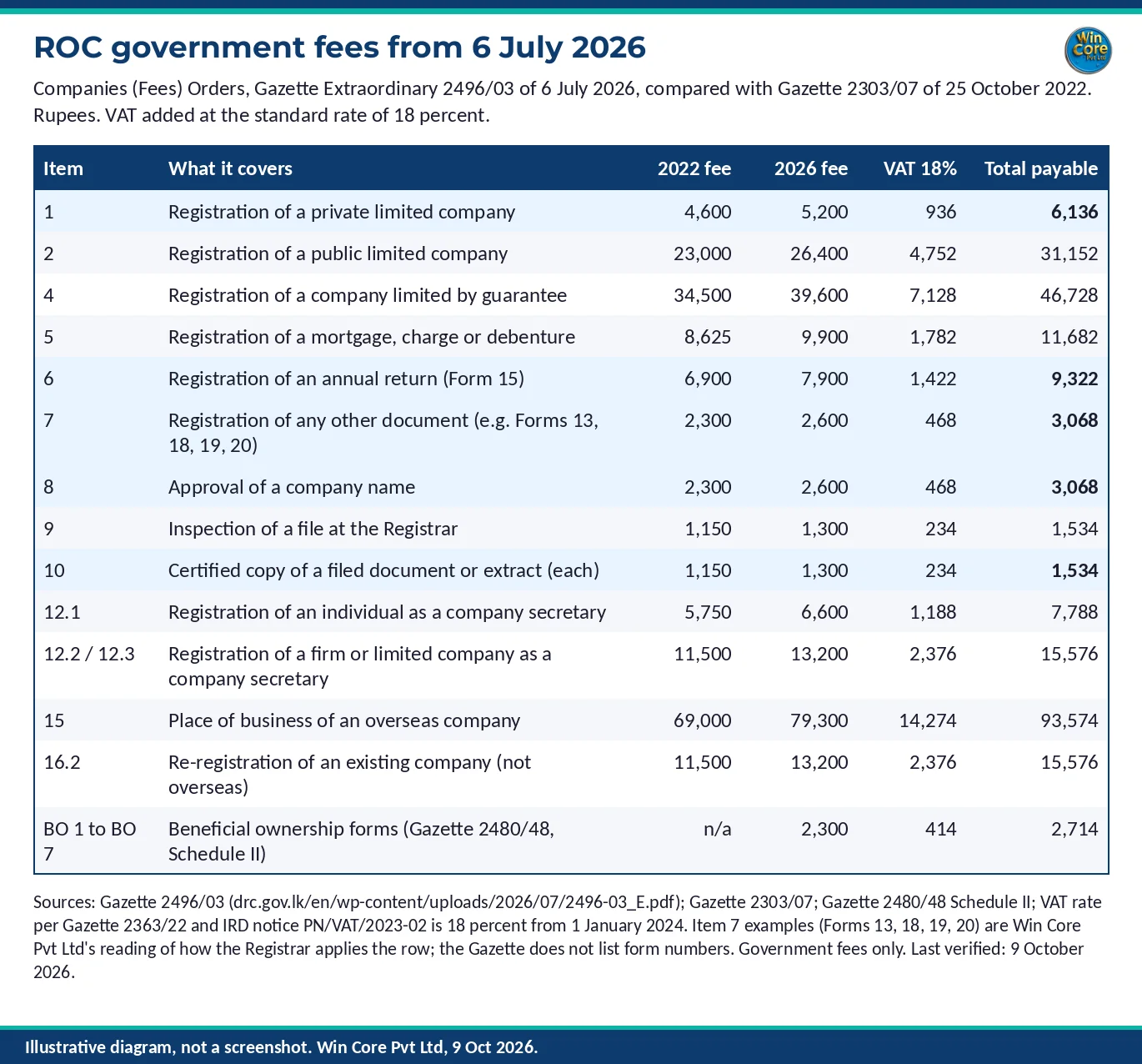
Every Registrar of Companies fee from 6 July 2026 with VAT added, and worked costs for an incorporation, a late Form 15 and a secretary change.

New companies in Sri Lanka face eight or more compliance registrations in year one. Here is how to set up your books, register for taxes, and stay clean.