
E-commerce tax in Sri Lanka: VAT, income tax, and compliance obligations for online businesses
Selling online in Sri Lanka triggers the same tax obligations as any other business. Here is how VAT, income tax, SSCL and import taxes apply to e-commerce businesses.

On this page
Last verified against the primary sources on 15 October 2026.
Take a hypothetical online store selling stationery and gifts. Monthly revenue has grown to Rs 6 million, so Rs 18 million a quarter, above the quarterly VAT threshold of Rs 15 million [1]. The business is not registered for VAT and has never filed a VAT return. If it does not apply, the Commissioner-General can register it from a date he determines, which can be in the past, so VAT falls due on sales it has already made without charging it, together with penalties under the VAT Act [1].
E-commerce businesses in Sri Lanka are subject to the same tax laws as any other business. There is no special "digital business" exemption and no simplified regime for online sellers. The same thresholds and reliefs apply as for any business: individuals get the personal relief before income tax (see below), and VAT and SSCL registration depend on the same turnover lines as for any other seller. If you sell products or services online, whether through your own website, a marketplace like Daraz, or social media, you are running a business and these obligations apply. For what a business website costs to build, see website development cost.
This guide covers the tax obligations for common e-commerce models: direct online retail, dropshipping, digital product sales and marketplace selling.
Business registration comes first
Before thinking about tax, every e-commerce business needs a legal structure:
- Sole proprietorship: the simplest option for individual sellers. See our sole proprietorship registration page. For how the owner is taxed, see sole proprietor income tax.
- Private limited company (Pvt Ltd): incorporated with the Registrar of Companies under the Companies Act [2]. Better for businesses with several founders, outside investment or a higher risk profile. See our company registration page.
- Partnership: suitable for two or more co-founders. See our partnership registration page.
Then register for a TIN through Taxpayer Registration on the IRD e-Services portal [3]. A company must do so within 30 days of incorporation [4].
Income tax on e-commerce revenue
E-commerce income is assessable under the Inland Revenue Act No. 24 of 2017 like any other business income [5].
For sole proprietors and individuals
E-commerce profits are part of your assessable income, taxed at progressive rates from 6 percent to 36 percent after the Rs 1,800,000 annual personal relief, in force from 1 April 2025 [6].
For companies (Pvt Ltd)
E-commerce profits are taxed at the standard corporate income tax rate of 30 percent [5].
What counts as taxable profit
Revenue minus allowable expenses. Common business expenses for e-commerce include:
- Cost of goods sold (purchase price, raw materials)
- Platform fees (store subscriptions, marketplace commissions, payment gateway fees)
- Shipping and logistics costs
- Packaging materials
- Digital marketing spend
- Website hosting and domain costs
- The business share of home office costs
- Salaries paid to employees and fees paid to freelancers
Keep receipts and invoices for every expense you deduct. A deduction you cannot support with documents is hard to defend if the IRD asks.
VAT for online sellers
Registration threshold
You must register for VAT if your taxable supplies exceed, or are likely to exceed, Rs 15 million in any quarter or Rs 60 million in the twelve months then ending [1]. The proposed 2026 cut was abandoned [7]. If you import or export goods for commercial purposes, you must register whatever your turnover [1]. Our guide to VAT registration thresholds sets out the tests and the 15 days to apply.
Do not confuse this with SSCL. From 1 July 2026, SSCL registration applies once turnover exceeds, or is likely to exceed, Rs 9 million in a quarter or Rs 36 million over four quarters [8], so a growing online store may need to register for SSCL before VAT. See our SSCL registration guide. For why SSCL on a supplier invoice cannot be claimed, see SSCL and input VAT.
VAT rate
The standard VAT rate is 18 percent [1].
What this means in practice
If you are VAT-registered, you must:
- Charge VAT on all taxable supplies, either added to your selling price or included in it
- Issue a tax invoice within 28 days when a VAT-registered customer asks for one, in the format prescribed from 1 October 2026 by Gazette 2481/22 as amended; other customers get an ordinary invoice showing the tax-inclusive total [1] [9]. Our tax invoice guide lists the fields.
- File VAT returns electronically by the last day of the month after each taxable period ends [1]
- Pay the net VAT (output VAT minus input VAT on business purchases) by the dates in the IRD tax calendar; the tax calendar tool lists them
Common e-commerce VAT scenarios
| Scenario | VAT treatment |
|---|---|
| Selling physical goods online within Sri Lanka | Standard 18% VAT applies |
| Selling digital products (e-books, courses) to Sri Lankan buyers | Standard 18% VAT applies |
| Exporting physical goods (international orders) | Zero-rated, with input VAT still claimable, but only if payment is received in foreign currency through a licensed bank in Sri Lanka within six months of the end of the taxable period |
| Dropshipping from a foreign supplier to a Sri Lankan buyer | Whoever clears the goods is the importer; import VAT and customs charges apply |
| Marketplace commission income (you run a marketplace) | 18% VAT on commission fees |
The export condition matters for stores paid out through foreign payment gateways: if the money does not arrive through a licensed bank in Sri Lanka in foreign currency within the time limit, the sale is not zero-rated [1].
If online sales are settled in digital assets, keep the cryptocurrency tax analysis and transaction records distinct from the ordinary sales ledger.
Customs and import taxes on imported goods
If your e-commerce model involves importing goods, whether for resale or dropshipping, import taxes apply when the goods enter Sri Lanka.
Key import taxes
- Customs Import Duty: varies by HS code
- Ports and Airports Development Levy and CESS: vary by HS code; check the current tariff for each product
- SSCL: for imports, liable turnover is the VAT value of the import at 100 percent, so the levy is 2.5 percent of that value [10]
- Import VAT: 18 percent on the value of the import as the VAT Act defines it [1]
Use our Import Duty Calculator and CIF Calculator to estimate your landed cost, and confirm the duty lines for your HS code against the current Customs tariff before you price.
Dropshipping-specific considerations
In a dropshipping model, the foreign supplier ships directly to your Sri Lankan customer, but the goods still enter Sri Lanka and someone must clear them and pay the import charges. If the consignment is in your business name, you are the importer, and as a commercial importer you must register for VAT whatever your turnover [1].
APIT and EPF/ETF for employees
If your e-commerce business has employees (warehouse staff, customer service, content creators), you must:
- Withhold APIT from employee salaries and pay it to the IRD within 15 days after the end of each month [5]
- Register for EPF and pay EPF and ETF contributions monthly; ETF contributions must reach the ETF Board on or before the last working day of the following month [11]. Our EPF and ETF guide covers the rates and dates.
Use our Salary Calculator and EPF Calculator to work through the amounts.
Withholding tax (WHT) obligations
If your e-commerce business pays:
- Freelancers (social media specialists, photographers, web developers and other listed independent service providers): deduct WHT at 5 percent of the full payment when payments to that resident individual in a calendar month add up to more than Rs 100,000 [12] [13]. Our guide to 5 percent WHT on service fees covers the monthly test.
- Foreign platforms and service providers (store subscriptions, payment processors, ad platforms): WHT at 14 percent applies to service fees paid to a non-resident only where the fee has a source in Sri Lanka [5]. On our reading, a subscription to a platform run from abroad will usually not have a Sri Lankan source, but check each contract. Separately, from 1 July 2026 a non-resident platform may have to charge Sri Lankan VAT on its services, but not to a customer that is VAT-registered in Sri Lanka [7]. If you are registered, give the platform your registration details.
Use our WHT Calculator for specific rates.
E-commerce tax compliance checklist
- Register the business (sole proprietorship, partnership or Pvt Ltd)
- Obtain a TIN through IRD e-Services, within 30 days of incorporation for a company
- Confirm income tax registration (automatic for a company once it has a TIN) [3]
- Monitor quarterly turnover against the VAT threshold (Rs 15 million a quarter or Rs 60 million in twelve months) and the SSCL threshold (Rs 9 million a quarter from 1 July 2026)
- Register for VAT when the threshold is reached, or at once if you import or export goods commercially
- Issue tax invoices in the Gazette format to registered customers who ask
- File VAT returns by the last day of the month after each period and pay on the calendar dates
- Register as an employer for APIT, EPF and ETF if hiring
- File the annual income tax return electronically
- Keep invoices, receipts, bank statements and platform reports for the period the law requires
- Register for WHT if making payments subject to withholding
- Check the customs duty lines before importing goods
Platform-specific tax reports
Most e-commerce platforms provide transaction reports that help with tax compliance, for example the finance and tax reports in Shopify and WooCommerce, the transaction report in Daraz Seller Centre and the monthly statements in Etsy. Download these reports monthly and reconcile them against your bank statements.
Talk to us. If you run an online store and want your VAT, SSCL and import position checked, our tax team can work through it with you; reach us through our contact page.
This guide is general information on the law as at 15 October 2026 and is not advice on your specific situation.
References
- Inland Revenue Department. Value Added Tax Act, No. 14 of 2002, consolidated version up to 2025, ss.2, 6, 7(1)(a), 10(1)(viii) and (ix), 14(1), 20 and 21. https://www.ird.gov.lk/en/publications/Value%20Added%20Tax_Acts/VAT_Act_No_14%5BE%5D_2002_%28Consolidation_2025%29.pdf . Primary. Accessed 15 October 2026.
- Parliament of Sri Lanka. Companies Act, No. 7 of 2007. https://drc.gov.lk/en/wp-content/uploads/2018/04/Act-7-of-2007-English.pdf . Primary. Accessed 15 October 2026.
- Inland Revenue Department. Taxpayer Guidelines for Registration and Update (2026). https://www.ird.gov.lk/en/Downloads/SiteAssets/TPR_Guidelines_2026_E.pdf . Primary. Accessed 15 October 2026.
- Parliament of Sri Lanka. Inland Revenue (Amendment) Act, No. 11 of 2026, certified 3 June 2026, s.23 (new s.102(1A)). https://www.ird.gov.lk/en/publications/Acts_Income%20Tax_2017/IR_Act_No_11-2026_E.pdf . Primary. Accessed 15 October 2026.
- Inland Revenue Department. Inland Revenue Act, No. 24 of 2017, consolidated, First Schedule; ss.85(1B) and 86(1). https://www.ird.gov.lk/en/publications/Acts_Income%20Tax_2017/IRA_Cons_Act_-_2025_Changes.pdf . Primary. Accessed 15 October 2026.
- Parliament of Sri Lanka. Inland Revenue (Amendment) Act, No. 2 of 2025, certified 20 March 2025, Fifth Schedule personal relief and individual rates. https://www.ird.gov.lk/en/publications/Acts_Income%20Tax_2017/IR_Act_No_02-2025_E.pdf . Primary. Accessed 15 October 2026.
- Inland Revenue Department. Notice to the Taxpayers: Amendments to the Value Added Tax Act, SEC/PN/VAT/2026-03 (3 July 2026), items 3 and 4. https://www.ird.gov.lk/en/Lists/Latest%20News%20%20Notices/Attachments/799/PN_VAT_2026-03_New_E.pdf . Primary. Accessed 15 October 2026.
- Parliament of Sri Lanka. Social Security Contribution Levy (Amendment) Act, No. 10 of 2026, certified 9 April 2026, s.2. https://www.ird.gov.lk/en/publications/Acts_SSCL/SSCL_Act_No_10-2026_E.pdf . Primary. Accessed 15 October 2026.
- Commissioner-General of Inland Revenue. Gazette Extraordinary No. 2481/22 (27 March 2026), format of the tax invoice, effective 1 October 2026 under Gazette No. 2500/106. https://www.ird.gov.lk/en/publications/Gazette_Documents/2026_2481-22_E.pdf . Primary. Accessed 15 October 2026.
- Inland Revenue Department. Social Security Contribution Levy Act, No. 25 of 2022, consolidated up to 2026, s.3(2)(a) and Second Schedule. https://www.ird.gov.lk/si/publications/Acts_SSCL/SSCL_Cons_Act_-_2026_Changes.pdf . Primary. Accessed 15 October 2026.
- Employees' Trust Fund Board. Payment of Contributions, web page. https://etfb.lk/payment-of-contributions/ . Primary. Accessed 15 October 2026.
- Parliament of Sri Lanka. Inland Revenue (Amendment) Act, No. 45 of 2022, inserting s.85(1C), as widened by Act No. 11 of 2026 s.13. https://www.ird.gov.lk/en/publications/Acts_Income%20Tax_2017/IR_Act_No._45_2022_E.pdf . Primary. Accessed 15 October 2026.
- Inland Revenue Department. Circular SEC/2026/E/04, Withholding Tax / Advance Income Tax (8 June 2026), rate table. https://www.ird.gov.lk/en/publications/Circulars_Circulars/SEC_2026_E_04_E.PDF . Primary. Accessed 15 October 2026.
Put these insights to work
WinCore specialists can review your current workflow, document gaps, and build a practical 90-day action plan.
Book a free consultationContinue reading
Explore more WinCore analysis to keep your finance, tax, and compliance roadmap moving.
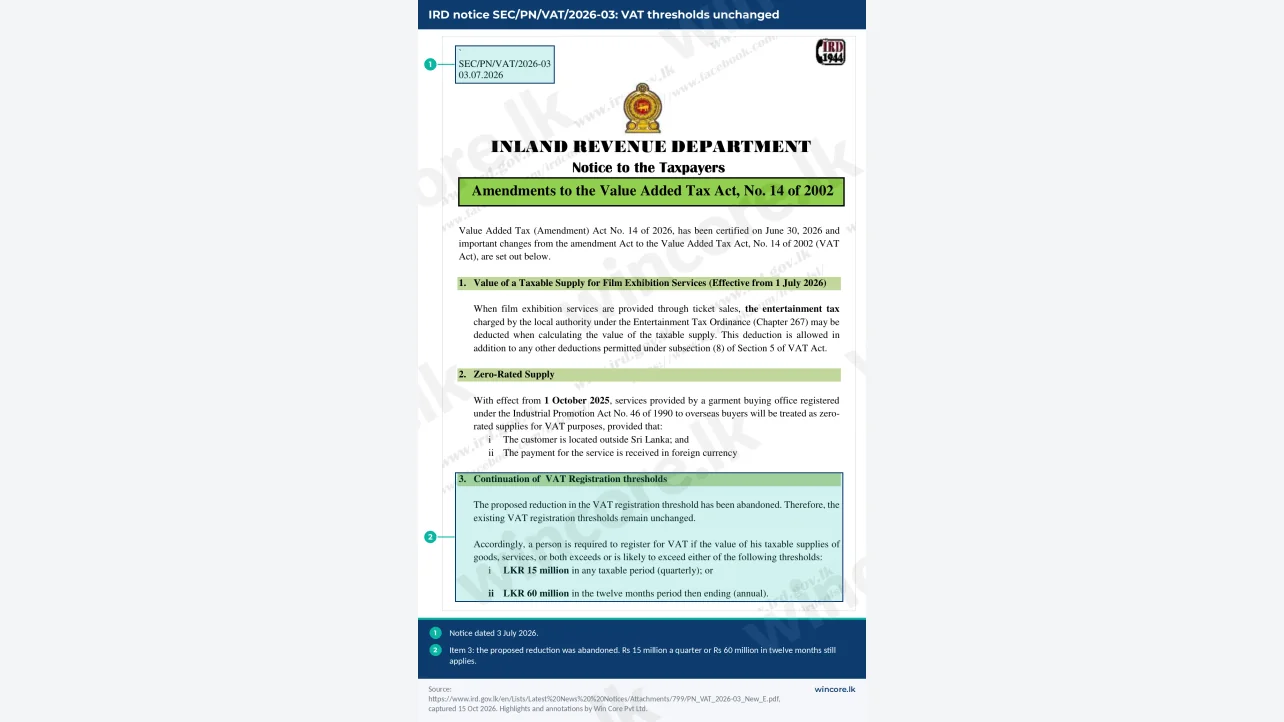
The VAT registration tests are Rs 15 million a quarter or Rs 60 million over 12 months. How the tests run, the 15 day rule and who must register.
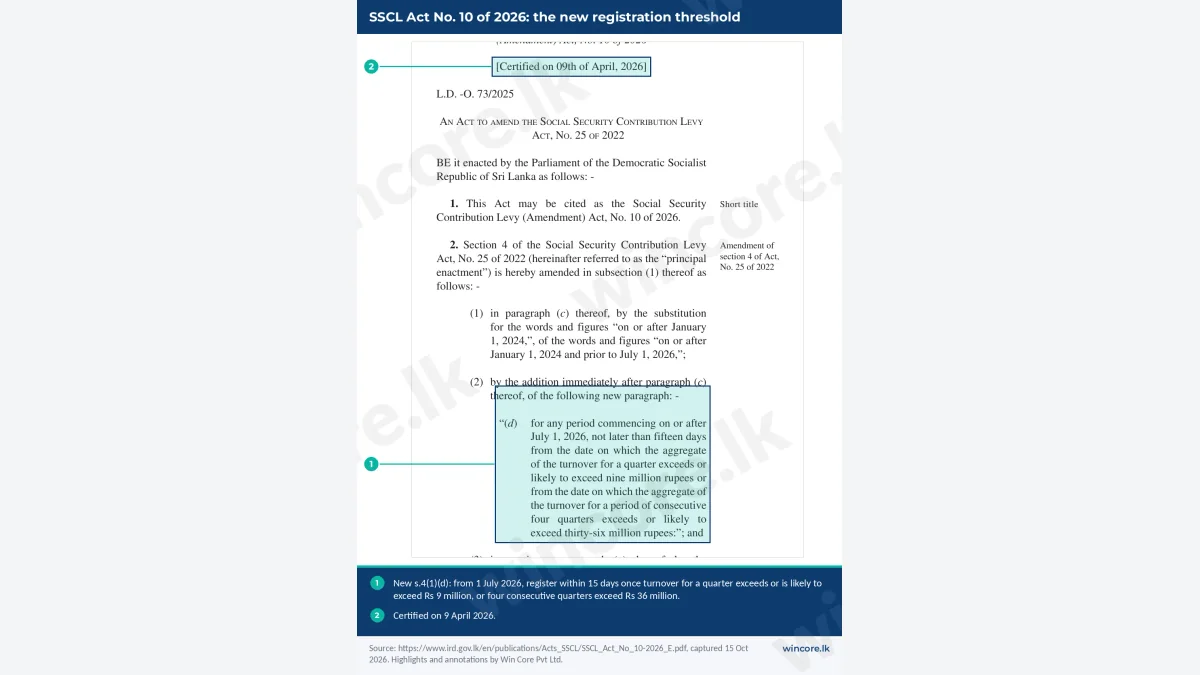
SSCL registration now starts at Rs 9 million a quarter or Rs 36 million a year from 1 July 2026. How to test, register and pay monthly.
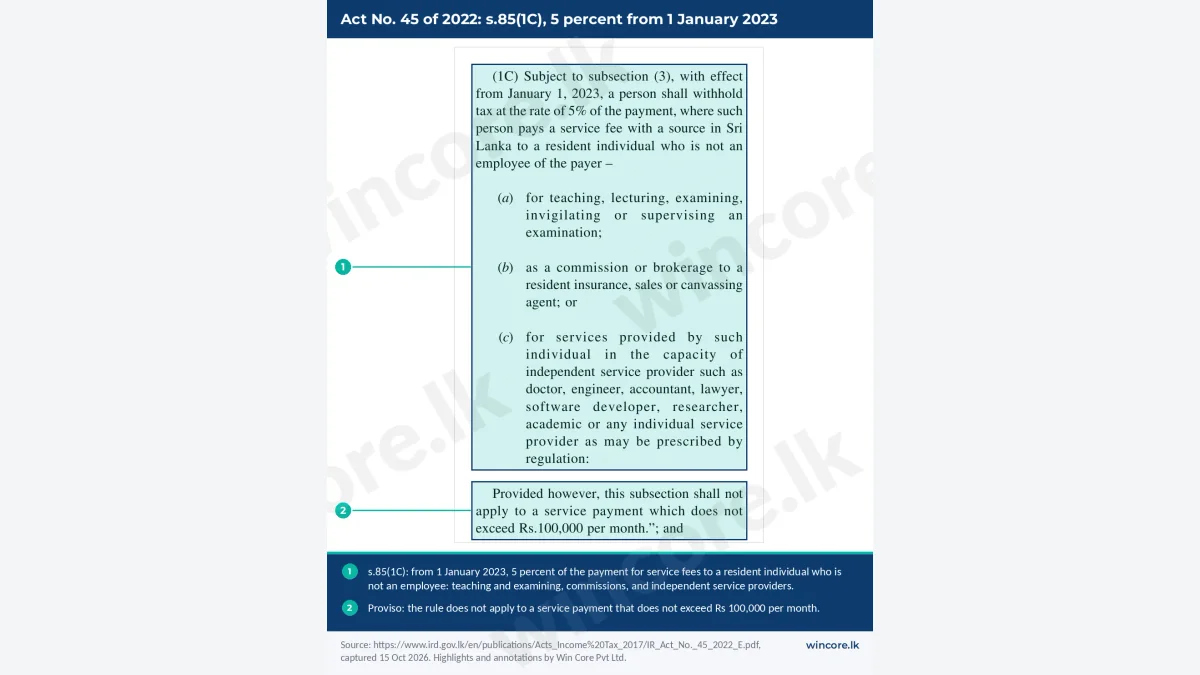
When a payer must withhold 5 percent on service fees, the services added in June 2026, payment within 15 days and the certificate rules.