
Switching payroll provider in Sri Lanka: past liability, parallel run
A new payroll provider does not clean the past. Who owes old EPF, ETF and APIT, what to collect at handover, and how to test the first month.
On this page
Last verified against the primary sources on 22 October 2026.
Switching payroll provider in Sri Lanka changes who does the work, not who owes the money. The EPF Act (ss.10 and 15), the ETF Act (s.16) and the Inland Revenue Act (ss.83A(1A) and 86) put contributions and APIT on the employer, and none of them has a transfer date or names a payroll provider. EPF and ETF for a month are due by the last day of the following month and APIT within fifteen days after the month ends, whoever runs the payroll. Arrears from the old provider's months stay with the employer: neither Act lets EPF or ETF arrears age out, and in EPF recovery the employer must prove it paid. Getting a provider's mistake back from the provider is a contract question.
Take an invented hardware retailer with thirty-two staff that moves its payroll to a new provider from February 2027. Who pays if the old provider got something wrong? What should the new provider receive? How do you know the first month is right? This piece answers those three questions, and separates what the law says from what is good practice.
The employer stays liable for EPF, ETF and APIT, past and present
EPF. The employer is "liable to pay to the Fund on or before the last day of the succeeding month" a contribution of "twelve per centum of such employee's total earnings" (s.10(2), which opens "Subject to" s.10(3) and s.27 on approved provident funds) [1]. Under s.15 the employer "shall deduct and pay to the Fund" the employee's 8 percent [1]. Three further rules make the past stick:
- No time bar. "The provisions of the Prescription Ordinance shall not apply to the recovery" of contributions or surcharges (s.17(3)) [1].
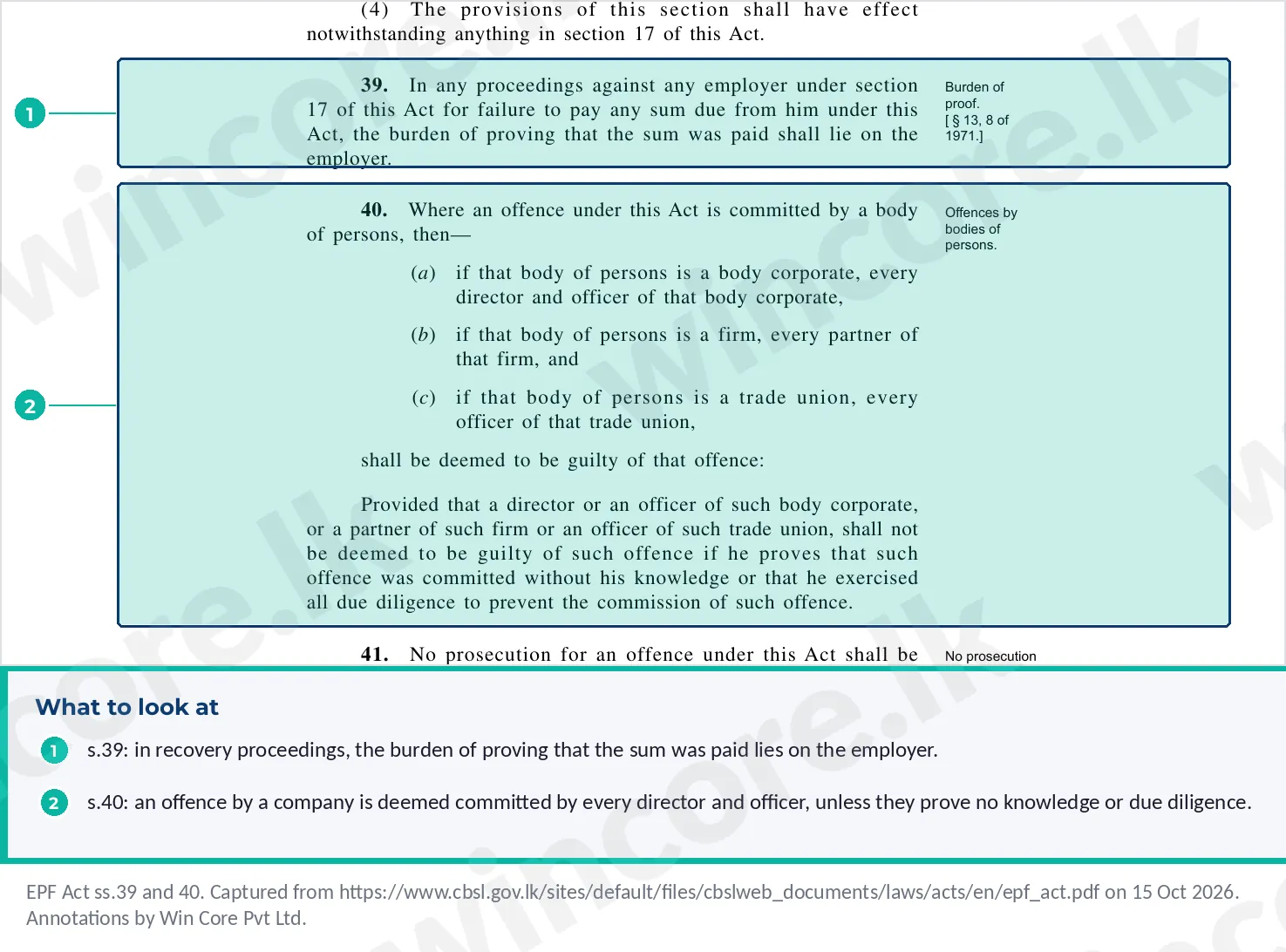
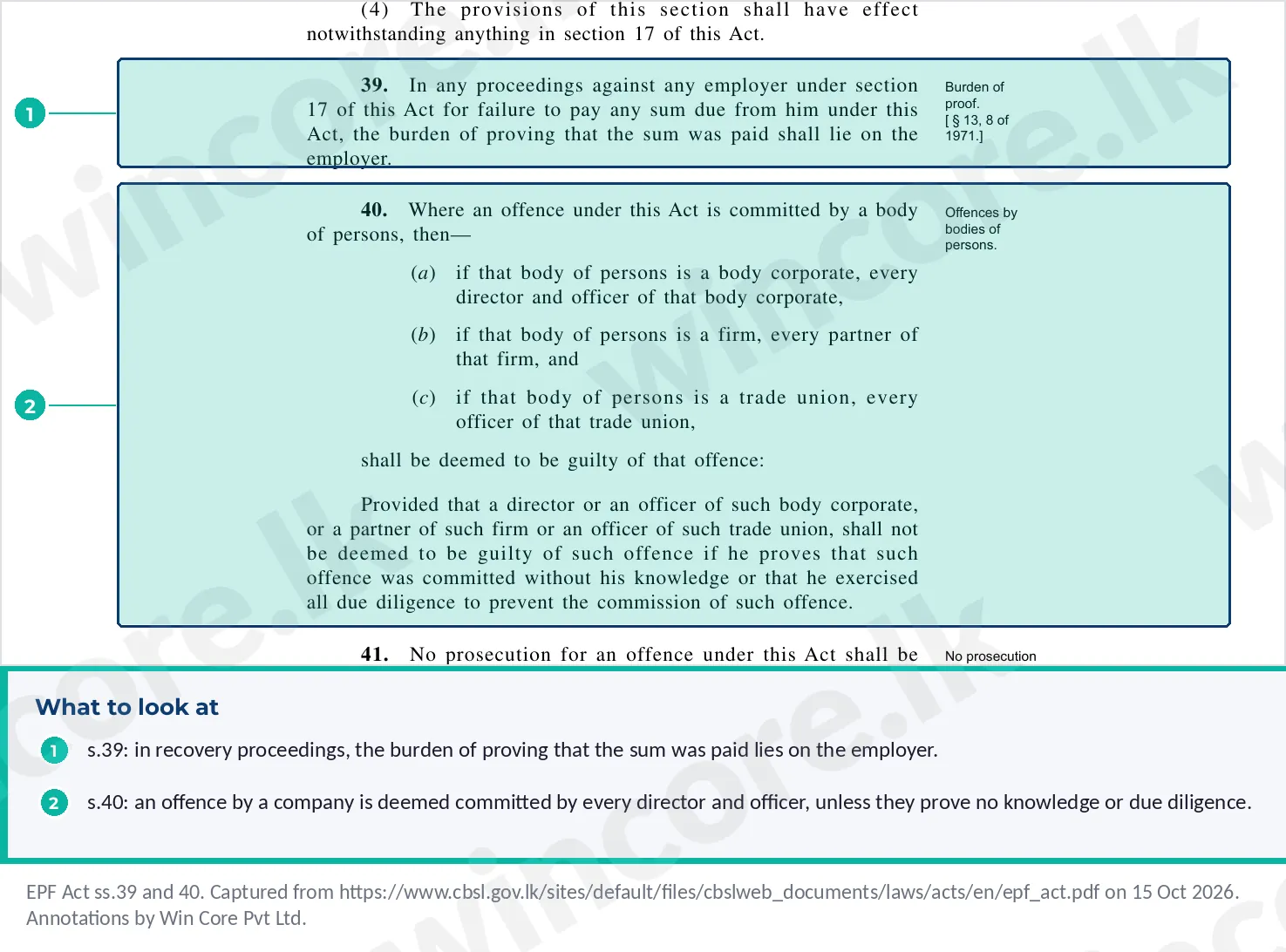
- Burden of proof. In proceedings under s.17, "the burden of proving that the sum was paid shall lie on the employer" (s.39) [1].
- Directors. An offence by a company is deemed committed by every director and officer, unless the person proves it was committed "without his knowledge" or that he "exercised all due diligence to prevent" it (s.40) [1].
ETF. The employer pays 3 percent of total earnings by the last day of the following month (s.16(1)), with the same 5 to 50 percent surcharge ladder for late payment (s.27) [2]. Section 28(6) of the ETF Act also excludes the Prescription Ordinance from recovery [2], and ETF s.40 has the same director rule and proviso as EPF s.40.
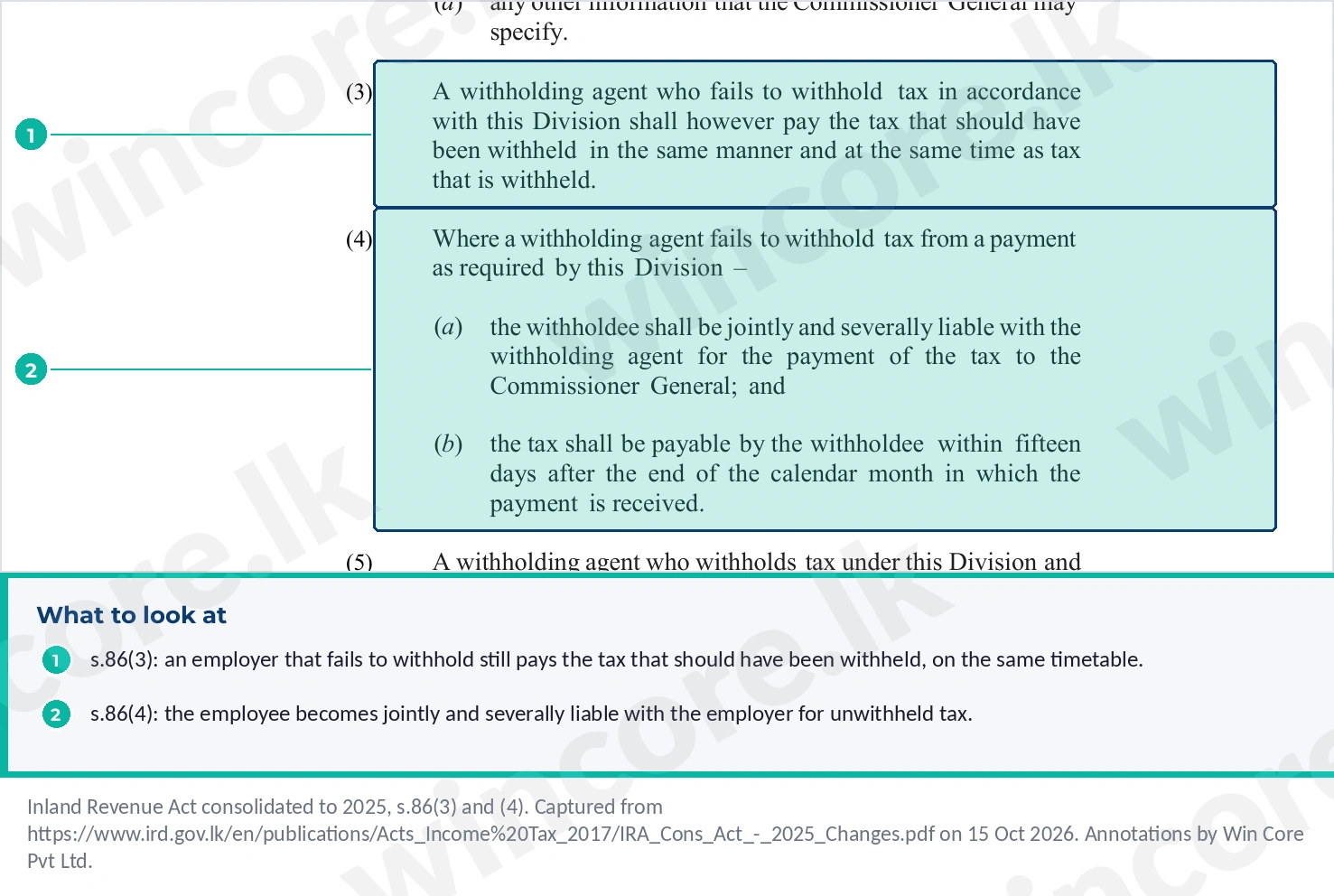
APIT. "An employer shall deduct the Advance Personal Income Tax" on employment payments "as specified by the Commissioner-General" (s.83A(1A)) [3]. Every withholding agent pays the tax withheld "within fifteen days after the end of each calendar month" (s.86(1)). If APIT was not withheld, the employer "shall however pay the tax that should have been withheld" (s.86(3)), the employee becomes "jointly and severally liable" with it (s.86(4)(a)), and an employer that pays the missing tax "shall be entitled to recover an equal amount" from the employee (s.86(6)) [3].
What it costs when the old payroll was wrong
| Failure | Consequence | Section |
|---|---|---|
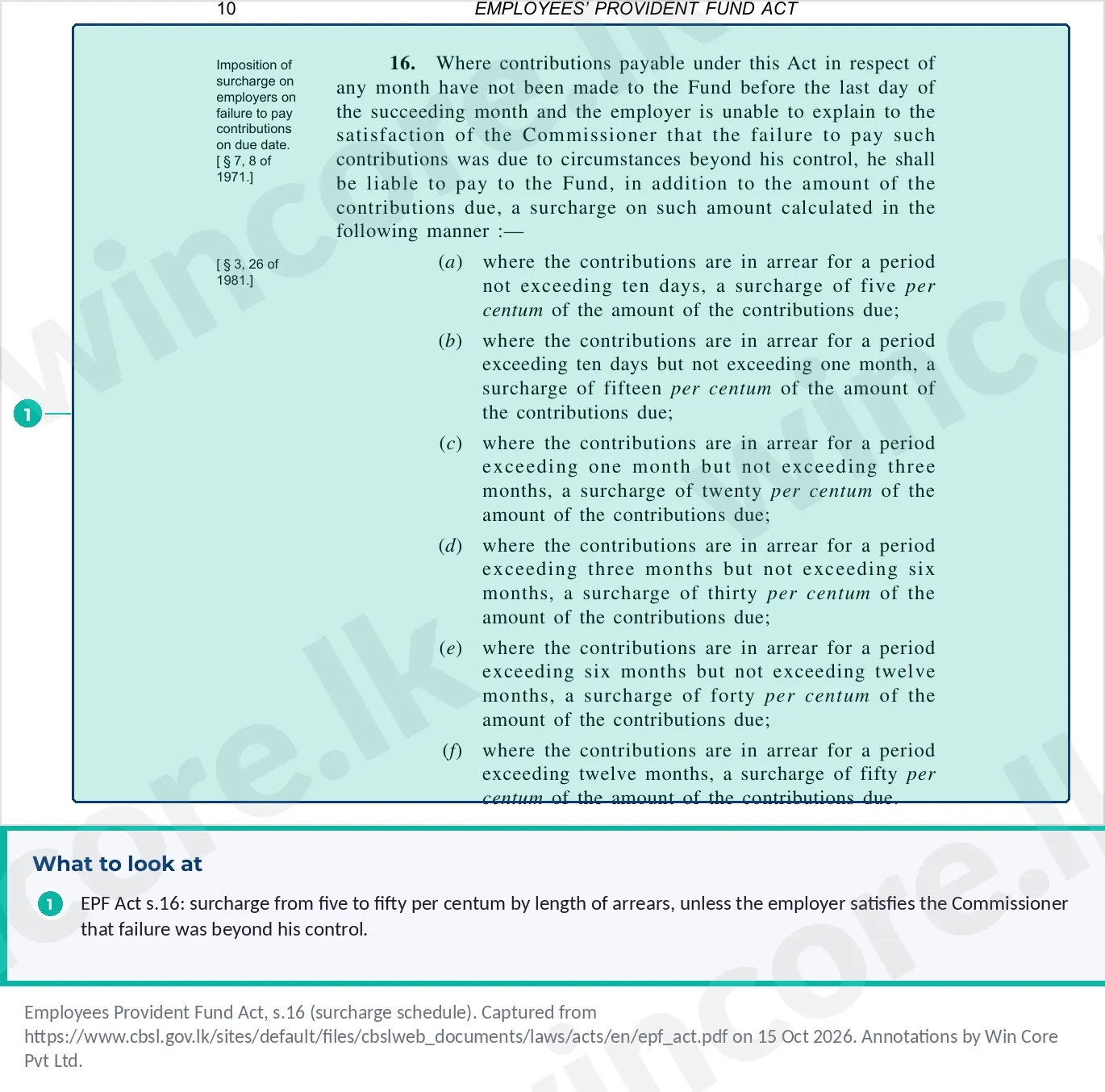
| EPF paid late | Surcharge of 5 to 50 percent of the contributions, by length of delay, unless the Commissioner accepts the delay was beyond the employer's control | EPF s.16 [1] |
| ETF paid late | Same ladder; the ETF Board decides the "beyond control" question | ETF s.27 [2] |
| APIT paid late | Interest from the due date, plus a penalty of 20 percent of the tax due but not paid if it is still unpaid fourteen days after the due date | IRA s.179(1) and s.159(1) [3] |
| APIT not withheld | Employer still pays it, and may recover it from the employee | IRA s.86(3) and s.86(6) [3] |
Our note on the EPF and ETF surcharge sections sets out each band, who decides the "beyond his control" question and the separate return surcharge. None of the employer's share or surcharge may be taken from staff pay (EPF s.20) [1].
A provider can be prosecuted, but the arrears stay with the employer
The EPF Act does reach people other than the employer, but only for offences. Section 35 says that where an offence for which the employer is liable was in fact committed by a "manager, agent, servant or other person", that person can be proceeded against "in the same manner as if he were the employer" and is liable to "the like punishment" [1]. Section 36 lets an employer who is charged bring the real offender before the court; if the employer proves it "has used due diligence to enforce the provisions of this Act" and that the other person acted "without his knowledge, consent or connivance", the employer is exempt from punishment [1].
On our reading, those two sections are about punishment. They do not move the contributions or the surcharge, which s.17 recovers from the employer and s.39 makes the employer prove paid. Whether an outside payroll provider counts as an "agent" for s.35 depends on the facts, and we found no decision on it. We found no equivalent agent section in the ETF Act.
We also searched labourdept.gov.lk, epf.lk, etfb.lk, ird.gov.lk, cbsl.gov.lk and parliament.lk on 22 October 2026 for any law that licenses payroll bureaus or moves these duties to them, and found none. That is a dated search result, not proof that none exists.
The handover file is built from what the employer must prove
The Acts do not list a handover file. They do tell you what the employer must be able to prove, and that sets the contents. EPF s.33 requires employers to keep "such records as may be determined by the Commissioner and notified in the Gazette" [1]; we have not read that notification for this piece. Our working list is practice, not a legal requirement:
| Item | Why it matters |
|---|---|
| Employee master: names, NIC or passport, TIN, EPF member numbers, start dates | EPF and APIT identify each employee |
| Monthly pay registers for at least the current and previous years | s.39 puts proof of payment on the employer |
| EPF and ETF returns and payment receipts, month by month | Surcharge runs month by month (s.16, s.27) |
| APIT schedules and payment receipts, month by month | s.86(1) monthly payment; s.179 penalty |
| Year-to-date pay and APIT for each employee | Cumulative figures carry on after the switch |
| The last APIT annual statement filed | s.86(2) annual statement |
| Open issues list: known errors, Labour Department letters, IRD notices | Past liability stays with the employer |
| Who holds which portal access (EPF employer number, IRD e-Services) | Practice: issue new credentials, never share passwords |
Ask for the file before you give notice, and put its delivery in a usable form into the service contract. Request it in writing, list each item, and record what is missing. Anything the old provider cannot produce goes on the open issues list, because s.39 leaves the employer, not the provider, to prove payment.
Switching payroll provider in Sri Lanka starts with a written cut-off month
- Fix a cut-off month and decide in writing who calculates, files and pays that month's EPF, ETF and APIT.
- Agree the first month of responsibility. A sound contract says the new provider answers for its own work from the first month it processes, and that anything earlier it finds is reported to you and dealt with separately. That is practice; the statutes leave every month with the employer either way.
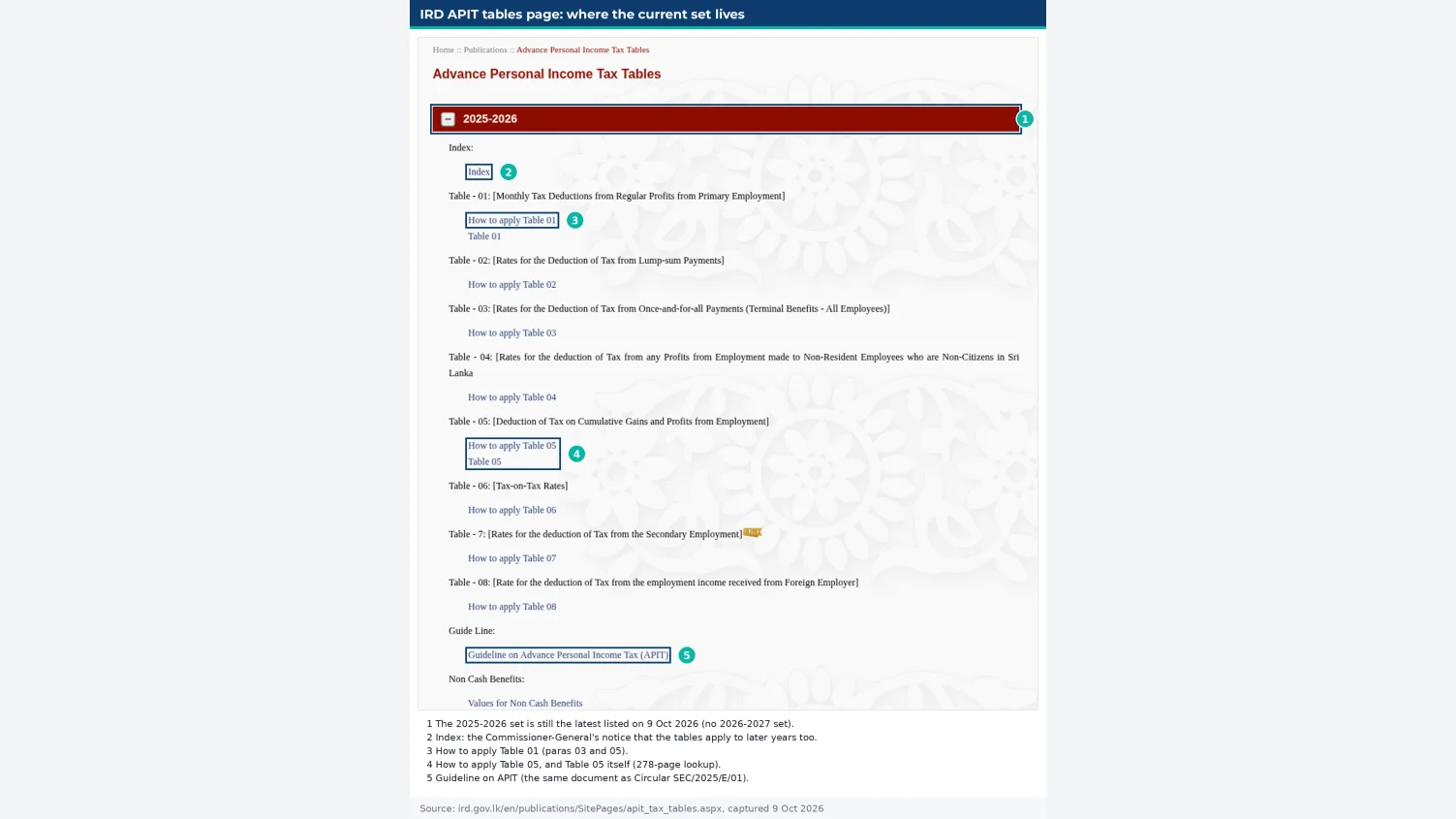
- Load year-to-date figures, not only the current month. A change of provider is not a change of employer, so staff do not "commence employment" again. On our reading, Table 05 is not triggered by the switch itself; our guide to APIT for staff who join or leave mid-year explains when it is. Our APIT lookup helps with the monthly figures.
- Review the open issues list before the first live payroll, not after.
If you are still deciding whether to change provider or bring payroll in house, our comparison of payroll software and outsourcing covers that choice. Once the new provider is running, our payroll review checklist sets out how to test its work, and our note on outsourced payroll EPF liability covers whose account the payments should leave.
A parallel run is practice, and it should be checked employee by employee
No Act requires a parallel run. It is the cheapest way to find out whether the new set-up is right before staff are paid from it. Our method:
- Run the cut-off month twice, once by the old provider or existing system and once by the new.
- Compare line by line: gross pay, EPF base, EPF and ETF amounts, APIT and net pay for each employee.
- Explain every difference as an error in the old payroll, an error in the new set-up, or a policy change, and record which.
- Pay from one run only. The other is a check.
- Sign off in writing before the new provider runs alone.
Two payrolls can agree in total and still be wrong for individual employees, because an over-deduction for one person can hide an under-deduction for another. The employer answers employee by employee, so the check must too.
The invented hardware retailer, month by month
The retailer switches on 1 February 2027. The old provider processes January; the new provider runs January in parallel.
- APIT for January: due by 15 February 2027 (s.86(1)).
- EPF and ETF for January: due by 28 February 2027 under EPF s.10(2) and ETF s.16(1). That is a Sunday, and the EPF Department and ETF Board ask for payment by the last working day, so aim for Friday 26 February.
- The parallel run shows that a salary arrears payment made in November was added to that month's salary and taxed on the monthly table. Lump sums and arrears have their own method, set out in our guide to APIT Table 02 for bonuses and lump sums. Any tax under-deducted in November is the employer's to pay under s.86(3), together with interest under s.159(1) on tax unpaid since the November due date of 15 December and, because the parallel run finds it in February, more than fourteen days after that date, the 20 percent penalty under s.179(1). Once it has paid, it may recover an equal amount from the employee under s.86(6).
The new provider did not create the November error and the old one is gone, but the Department looks to the retailer. Whether it can claim the cost back from the old provider turns on their contract.
What this means for you
Change providers if you need to, but do not expect the change to clean the past. Get the file before you give notice, carry year-to-date figures across, agree in writing from which month the new provider answers for its work, and run one month in parallel. Decide what to do about any known error before the new provider's first live month, because the surcharge and the penalty keep growing while it sits.
Our payroll management services Sri Lanka page sets out how we run a monthly payroll, and our payroll outsourcing page covers taking over from another provider or an in-house team.
Checklist: documents needed
- Employee master with NIC or passport, TIN and EPF member numbers
- Pay registers for the current and previous years
- EPF and ETF returns and payment receipts for each month
- APIT schedules, payment receipts and the last annual statement
- Year-to-date pay and APIT per employee at the cut-off month
- Open issues list, with any Labour Department or IRD letters
- Written cut-off agreement: who files and pays the switch month
- Signed parallel run comparison, employee by employee
FAQ
Is the old payroll provider liable for its mistakes?
Not under the EPF, ETF or Inland Revenue Acts, which put contributions and APIT on the employer. EPF s.35 lets an agent who commits an offence be prosecuted, but that concerns punishment, not the arrears. Any claim to recover the cost of a provider's mistake rests on the service contract between you and the provider.
How far back can EPF and ETF arrears be claimed?
There is no time limit under the Prescription Ordinance. EPF s.17(3) and ETF s.28(6) both say it does not apply to recovering contributions or surcharges, so an old shortfall does not age out. In EPF recovery proceedings the employer also carries the burden of proving that each sum was paid.
Does changing payroll provider restart APIT for staff?
No, the employer is the same, so year-to-date pay and tax carry on. On our reading Table 05 applies when an employee commences employment or retires during the year, and a change of provider is neither. Load each employee's cumulative figures into the new system before its first month.
Do we need a parallel run when we change payroll provider?
The law does not require one, but we recommend one month in parallel. Run the cut-off month in both systems, compare each employee's gross, EPF, ETF, APIT and net pay, explain every difference and pay from one run only. Totals that agree are not enough, because individual errors can offset.
Who files EPF, ETF and APIT for the month of the switch?
Whoever the employer chooses, agreed in writing before the cut-off month. The liability is the employer's either way, so name one party for each return and payment, set the dates, and file the receipts. Gaps at the switch month are a common source of late payment surcharges.
Open points
- The Commissioner's Gazette notification on EPF records under s.33 was not read.
- Whether an outside payroll provider is an "agent" for EPF s.35 is untested in the sources we read.
- Whether a particular allowance is part of "total earnings" depends on what it pays for; our note on which allowances count for EPF and ETF covers the test.
- The exact words of IRA s.179(1) were read on the page image of the IRD consolidation (PDF page 163) on 22 October 2026, because the PDF text layer drops them; the 20 percent rate is also stated in the IRD's own guidance.
- Recovery from a former provider is a contract question outside these Acts.
Last verified 22 October 2026 against the EPF Act reprint, the ETF Act and the Inland Revenue Act consolidated to 2025.
This article is general information, not advice on your specific position.
Talk to us. If you are changing payroll provider and want the handover file and the first month checked, contact us at our contact page.
WinCore Pvt Ltd
References
- Central Bank of Sri Lanka. Employees' Provident Fund Act, No. 15 of 1958 (reprint incorporating amendments to 31 December 1998, not a statutory reprint), ss.10, 15, 16, 17, 20, 33, 35, 36, 39 and 40. https://www.cbsl.gov.lk/sites/default/files/cbslweb_documents/laws/acts/en/epf_act.pdf . Primary. Accessed 22 October 2026.
- Employees' Trust Fund Board. Employees' Trust Fund Act, No. 46 of 1980 (with amendments to 1993), ss.16, 27, 28 and 40. https://etfb.lk/wp-content/uploads/2021/03/ETF-Act.pdf . Primary. Accessed 22 October 2026.
- Inland Revenue Department. Inland Revenue Act, No. 24 of 2017, consolidated with amendments to 2025, ss.83A, 86, 159 and 179. https://www.ird.gov.lk/en/publications/Acts_Income%20Tax_2017/IRA_Cons_Act_-_2025_Changes.pdf . Primary. Accessed 22 October 2026. The s.179(1) rate is as stated in IRD, Guide to the Return of Income Tax Y/A 2025/26, Section 09, https://www.ird.gov.lk/en/Downloads/IT_Individuals_Doc/Asmt_IIT_004_2025_2026_E.pdf . Primary.
Put these insights to work
WinCore specialists can review your current workflow, document gaps, and build a practical 90-day action plan.
Book a free consultationContinue reading
Explore more WinCore analysis to keep your finance, tax, and compliance roadmap moving.

Payroll software or outsourcing in Sri Lanka in 2026: what a compliant payroll must do, how to work out the true in-house cost, and a decision matrix.
The four sections behind EPF and ETF: rates, the due day, the 5 to 50 percent ladder, who judges 'beyond control', and what Act No. 2 of 2012 changed.
Staff who join or leave mid-year need APIT Table 05, not Table 01. Why it matters, with worked examples and the T-10 annual return steps.