
Outsourced payroll EPF liability in Sri Lanka: who pays, from where
Outsourcing payroll moves the work, not the duty. Who the Acts hold liable, the two payment models providers use, and what to ask before you sign.
On this page
Last verified against the primary sources on 22 October 2026.
Outsourced payroll EPF liability in Sri Lanka stays with the employer. EPF Act s.10(2) makes the employer liable for its 12 percent by the last day of the following month and s.15 for paying over the employee's 8 percent, ETF Act s.16(1) puts the 3 percent on the employer, and Inland Revenue Act s.83A(1A) puts APIT on the employer, with payment due within fifteen days after the month ends (s.86(1)). None of these clauses moves to a provider by contract. So the practical question is which payment model a provider uses: does the money for salaries, EPF, ETF and APIT pass through the provider's account, or leave your own?
Providers use one of two models. In the first, the employer transfers the funds to the provider, which pays staff, EPF, ETF and APIT from them. In the second, the provider prepares the bank salary file and the statutory payment files, and the employer's own people approve them and release the payments from the employer's account. The employer stays liable under either model. Ask any provider which model it uses before you sign, and have the answer written into the engagement letter. This piece explains what the law says, what to put in place under each model, and keeps what is law apart from what is practice.
Outsourced payroll EPF liability stays with the employer under the Acts
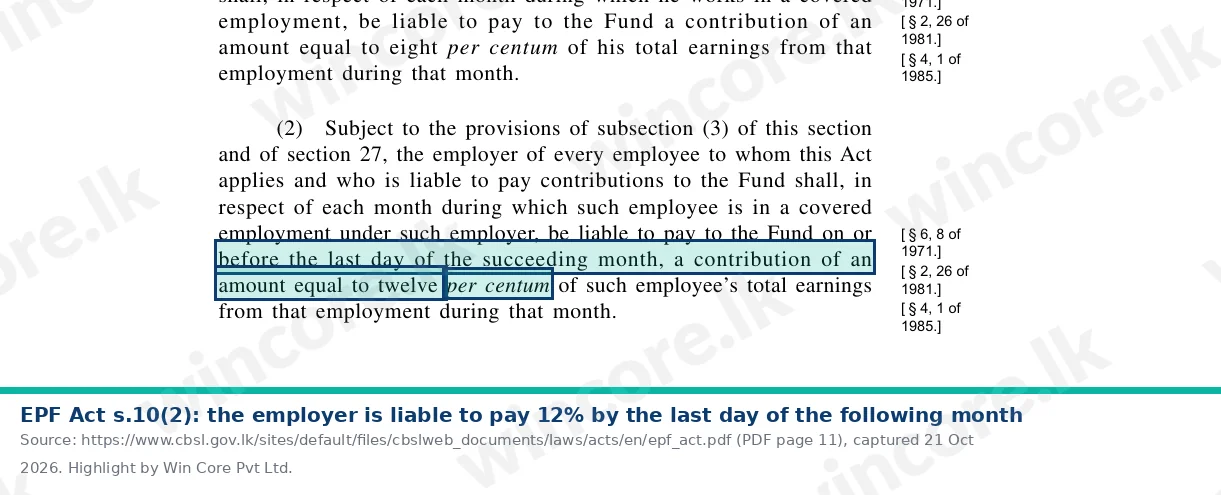
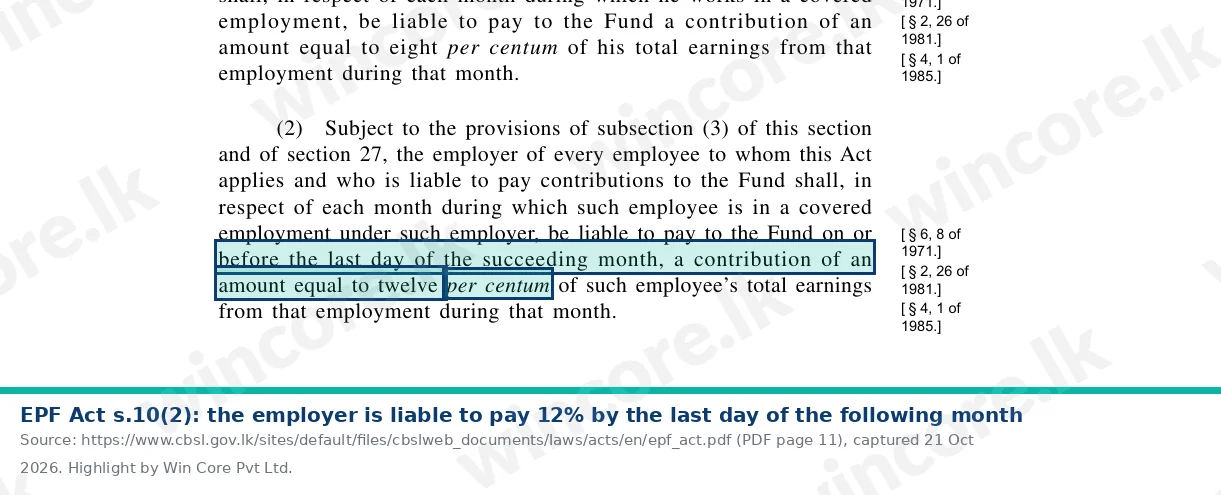
EPF. Section 10(2) opens "Subject to the provisions of subsection (3) of this section and of section 27" and makes the employer "liable to pay to the Fund on or before the last day of the succeeding month" a contribution of "twelve per centum of such employee's total earnings" [1]. Section 15 places the deduction and payment of the employee's 8 percent on the employer [1]. In recovery proceedings "the burden of proving that the sum was paid shall lie on the employer" (s.39), and the Prescription Ordinance does not apply to recovering contributions or surcharges (s.17(3)) [1].
ETF. The employer's contribution is "three per centum of the total earnings", due "on or before the last day of the succeeding month" (ETF s.16(1)) [2]. There is no employee share, and ETF s.28(6) also excludes the Prescription Ordinance from recovery [2].
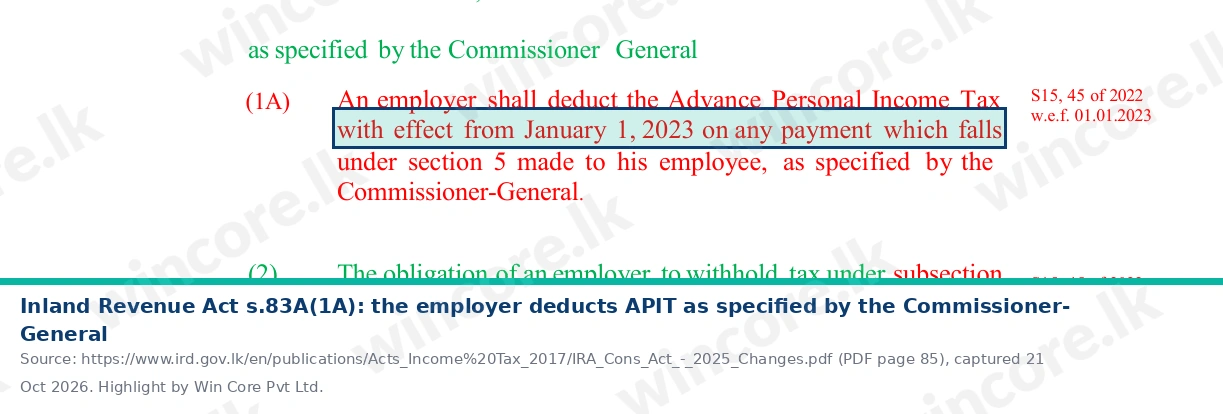
APIT. "An employer shall deduct the Advance Personal Income Tax with effect from January 1, 2023 on any payment which falls under section 5 made to his employee, as specified by the Commissioner-General" (s.83A(1A)) [3]. Withheld tax is paid within fifteen days after the end of each calendar month (s.86(1)). A withholding agent that fails to withhold "shall however pay the tax that should have been withheld" (s.86(3)), and may then recover an equal amount from the employee (s.86(6)) [3].
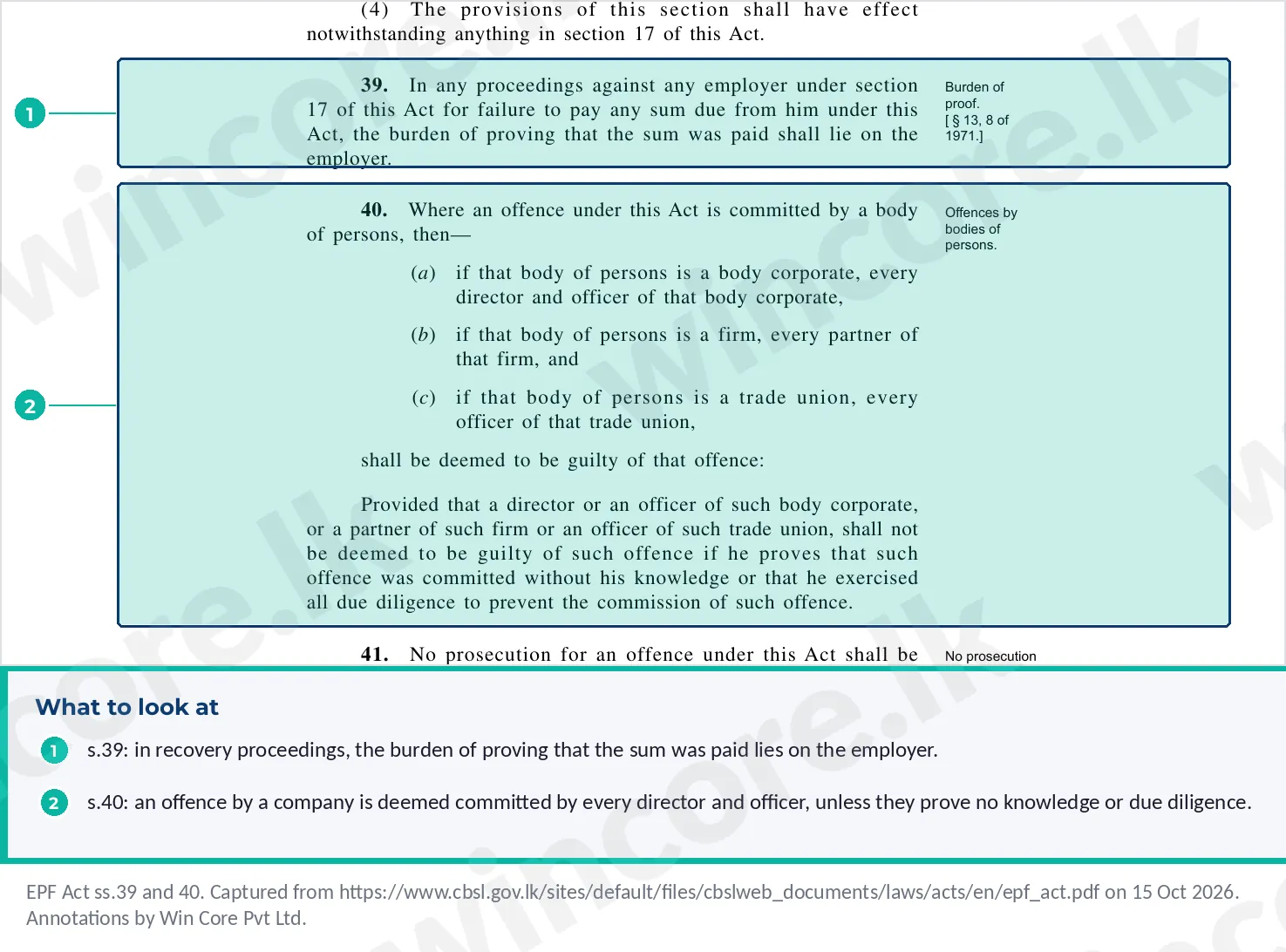
Directors. Where an offence is committed by a company, "every director and officer of that body corporate" is deemed guilty, unless he proves "that such offence was committed without his knowledge or that he exercised all due diligence to prevent the commission of such offence" (EPF s.40) [1]. ETF s.40 has the same rule [2]. On our reading, a director who can see each payment leave the company's account, or receives each receipt, is better placed to show due diligence than one who relies on the provider's word.
The provider. The EPF Act reaches a provider only for offences. Section 35 lets a "manager, agent, servant or other person" who actually committed an offence be proceeded against "as if he were the employer", and s.36 lets an employer that proves it used due diligence, and that the other person acted without its knowledge, consent or connivance, escape punishment [1]. On our reading neither section moves the contributions or surcharges, which s.17 recovers from the employer. We searched labourdept.gov.lk, epf.lk, etfb.lk, ird.gov.lk, cbsl.gov.lk and parliament.lk on 22 October 2026 for a law that licenses payroll bureaus or shifts these duties to them and found none; that is a dated search result, not proof that none exists.
Our guide to switching payroll provider applies the same rules to the months before a handover.
If the provider also handles people processes, define the wider HR-outsourcing scope and retained employer duties rather than assuming payroll covers them.
A late payment costs the employer, whoever held the money
The surcharges and penalties run against the employer:
- EPF late payment. Section 16 adds a surcharge "in addition to the amount of the contributions due", from five percent for arrears not exceeding ten days to fifty percent beyond twelve months, unless the employer explains "to the satisfaction of the Commissioner" that the failure was due to "circumstances beyond his control" [1]. Whether a provider's default would count is for the Commissioner, and we would not plan around it. ETF s.27 has the same ladder, decided by the ETF Board [2]. Our note on the EPF and ETF surcharge sections sets out each band.
- APIT late payment. Section 179(1) imposes a penalty of 20 percent of the tax due but not paid where the tax is not paid within fourteen days of the due date [3], and interest runs at 1.5 percent a month under s.159(1) from the due date.
- Staff cannot be charged. The employer may not deduct its contribution or a surcharge from wages (EPF s.20; ETF s.30) [1] [2].
A hypothetical example, with our arithmetic. An invented logistics company has a monthly payroll of Rs 5,000,000 of total earnings. Its March EPF, due by 30 April 2026, is paid in the middle of June, about six weeks late.
- EPF for March: Rs 5,000,000 x 20 percent (8 plus 12) = Rs 1,000,000.
- Arrears of more than one month but not more than three months fall in the s.16(c) band of twenty percent [1].
- Surcharge: Rs 1,000,000 x 20 percent = Rs 200,000, payable by the company on top of the Rs 1,000,000.
If Rs 300,000 of March APIT, due by 15 April, was also paid in the middle of June, more than fourteen days after its due date, s.179(1) adds Rs 60,000 plus interest. The company may have a claim under its contract against whoever caused the delay, but the Fund and the Department look to the company. Our penalty calculator helps with the tax side.
Model one: the provider prepares the files, you approve and pay
In this model the provider never holds the money. The principle, which is practice and not a legal requirement: the provider calculates and prepares the bank and statutory payment files; your people approve them; your bank account pays.
- Salaries by bulk transfer from your account. The provider prepares the salary file in your bank's bulk payment format. Someone in your business uploads it and a second person, usually a director, authorises it in your online banking. The provider has no authorisation rights on the account.
- EPF and ETF from your account. The provider prepares the contribution schedules and returns. The payment leaves your account, and the receipt is filed against the schedule. Our guide to EPF and ETF monthly payment procedures covers the forms and payment routes.
- APIT from your account. The provider prepares the APIT schedule; the payment to the Department leaves your account by the fifteenth.
- A monthly pack back to you: payroll register, payslips, bank file, EPF and ETF schedules, APIT schedule, and a list of joiners, leavers and changes.
- Portal access in the company's name. EPF, ETF and IRD logins belong to the company, with the provider given the access it needs to prepare and submit. Change passwords when an engagement ends.
The bulk file is the point of control. Before the first run, have each employee's bank details confirmed in writing, because a transfer to a wrong account number is hard to reverse.
Model two: the provider pays from funds you transfer
Some employers prefer the provider to pay staff and the authorities from funds the employer transfers, for example where no one in the business can upload and approve each month. The law does not prohibit it, on the texts we read; it simply leaves the liability with the employer. If you choose it, agree these points in writing (practice, not a statutory list):
- A funding schedule agreed in advance, stating what each transfer covers (net pay, the EPF and ETF due, and APIT if the provider is to pay it) and how bank charges are treated. Keep the provider's own fee out of the same transfer, so the money it holds is only for your staff and the authorities.
- A date by which funds must reach the provider, ahead of payday and each statutory due date, and what follows if they arrive late.
- A written go-ahead from you before anything is paid out.
- How the money is held. Money received to pay your staff is a liability of the provider to you until it is paid out, not the provider's income. Ask how it is held and recorded, and how your balance is shown to be nil after each run.
- Receipts within a set number of days of each payment, in the company's name.
- Who bears a surcharge or penalty caused by the provider's delay.
These terms reduce the risk. They do not move the statutory liability, which stays with the employer under this model as under model one, so the receipts still need checking every month.
Check the provider's calculations either way
Whichever model is used, the employer answers for the numbers. Our payroll review checklist sets out the tests, from who bears each deduction to the payment dates. Where the provider also treats some people as consultants rather than employees, our note on consultant or employee misclassification is relevant, because the EPF and APIT answers change with the classification.
What this means for you
Outsourcing payroll does not move EPF, ETF or APIT liability off the employer on the texts we read, under either payment model. Ask any provider which model it uses: does it pay staff and the authorities from funds you transfer, or does it prepare the bank and statutory payment files for your people to approve and pay from your account? If you approve and pay, the provider prepares the bulk file and schedules and your people release them. If the provider pays, put the funding total, the deadlines, the approval step, how the money is held and the receipts in the contract. Either way, file every receipt against its schedule each month and check the calculations, because the burden of proving payment is yours.
Our payroll outsourcing and payroll services pages describe our monthly cycle. The same question applies to us: ask which payment model your engagement will use before you sign.
Checklist: documents needed
- Engagement letter with scope, deadlines and who pays each item
- Bank mandate showing who uploads and who authorises bulk payments
- Signed beneficiary confirmation: bank, branch, account name and number
- Monthly payroll register, payslips and bank file from the provider
- EPF and ETF schedules and payment receipts in the company's name
- APIT schedules and payment receipts
- List of portal logins and who controls each
- Where the provider pays: funding schedule and written release approvals
FAQ
Is the employer still liable for EPF when payroll is outsourced?
Yes. EPF s.10(2) makes the employer liable for its 12 percent and s.15 for paying over the employee's 8 percent, by the last day of the following month. In recovery proceedings the employer must prove each sum was paid (s.39), and old arrears do not prescribe (s.17(3)), whoever prepared or paid the payroll.
How do I find out which payment model a provider uses?
Ask before you sign. Does the provider pay salaries, EPF, ETF and APIT from funds you transfer to it, or does it prepare the bank and statutory payment files for your people to approve and pay from your own account? Have the answer, and who approves each payment, written into the engagement letter. The employer stays liable under either model.
Is it illegal for a payroll provider to pay EPF on our behalf?
We found nothing that prohibits it. The provider can prepare and pay, but the liability and the burden of proving payment stay with the employer under EPF ss.10, 15 and 39. If the provider pays, agree the funding deadline, written release approval and receipts in the contract, and check each receipt monthly.
Can a provider's late payment be treated as beyond our control?
Possibly, but do not rely on it. EPF s.16 lifts the surcharge only where the employer explains to the Commissioner's satisfaction that the failure was due to circumstances beyond its control, and the ETF Board decides the same question for ETF. Whether a provider's default qualifies is untested in the sources we read.
Does the payroll provider become the withholding agent for APIT?
No, not on the text of the Act. Section 83A(1A) of the Inland Revenue Act places the APIT deduction on the employer, and s.86 applies to it as withholding agent. We found no clause that makes an outside payroll provider the withholding agent, so late or missed APIT remains the employer's to pay.
Open points
- We found no Sri Lankan law that licenses payroll bureaus or shifts EPF, ETF or APIT liability to them (dated search, 22 October 2026).
- Whether a provider's default can be "circumstances beyond his control" under EPF s.16 or ETF s.27 is untested in the sources we read.
- Whether an outside provider is an "agent" for EPF s.35 depends on the facts.
- The EPF records the Commissioner may require under s.33 depend on a Gazette notification we did not read.
- The exact words of IRA s.179(1) were read on the page image of the IRD consolidation (PDF page 163) on 22 October 2026, because the PDF text layer drops them; the 20 percent rate is also stated in the IRD's own guidance.
Last verified 22 October 2026 against the EPF Act reprint, the ETF Act and the Inland Revenue Act consolidated to 2025.
This article is general information, not advice on your specific position.
Talk to us. If you are setting up outsourced payroll and want the payment flow and approvals designed with you, contact us at our contact page.
WinCore Pvt Ltd
References
- Central Bank of Sri Lanka. Employees' Provident Fund Act, No. 15 of 1958 (reprint incorporating amendments to 31 December 1998, not a statutory reprint), ss.10, 15, 16, 17, 20, 33, 35, 36, 39 and 40. https://www.cbsl.gov.lk/sites/default/files/cbslweb_documents/laws/acts/en/epf_act.pdf . Primary. Accessed 22 October 2026.
- Employees' Trust Fund Board. Employees' Trust Fund Act, No. 46 of 1980 (with amendments to 1993), ss.16, 27, 28, 30 and 40. https://etfb.lk/wp-content/uploads/2021/03/ETF-Act.pdf . Primary. Accessed 22 October 2026.
- Inland Revenue Department. Inland Revenue Act, No. 24 of 2017, consolidated with amendments to 2025, ss.83A, 86, 159 and 179. https://www.ird.gov.lk/en/publications/Acts_Income%20Tax_2017/IRA_Cons_Act_-_2025_Changes.pdf . Primary. Accessed 22 October 2026. The s.179(1) rate is as stated in IRD, Guide to the Return of Income Tax Y/A 2025/26, Section 09, https://www.ird.gov.lk/en/Downloads/IT_Individuals_Doc/Asmt_IIT_004_2025_2026_E.pdf . Primary.
Put these insights to work
WinCore specialists can review your current workflow, document gaps, and build a practical 90-day action plan.
Book a free consultationContinue reading
Explore more WinCore analysis to keep your finance, tax, and compliance roadmap moving.
A new payroll provider does not clean the past. Who owes old EPF, ETF and APIT, what to collect at handover, and how to test the first month.
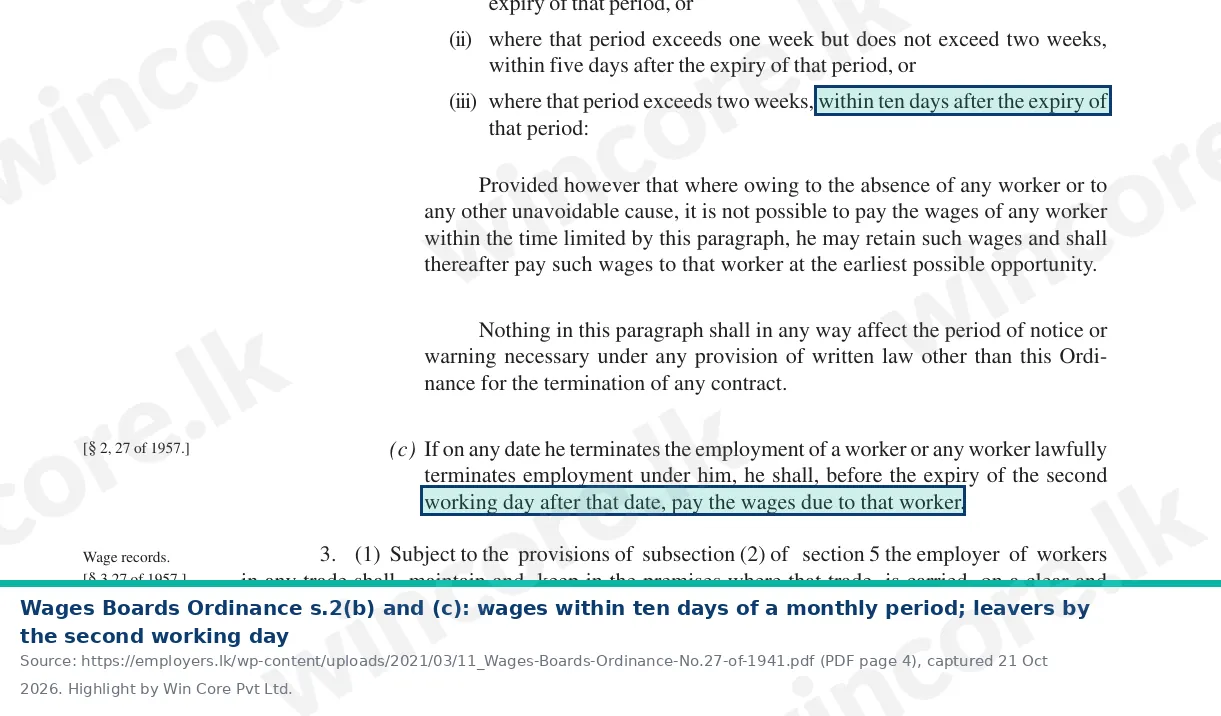
Inherited a payroll? Four questions, the clause behind each check, and six errors shown on an invented garment factory, with the cost of each.
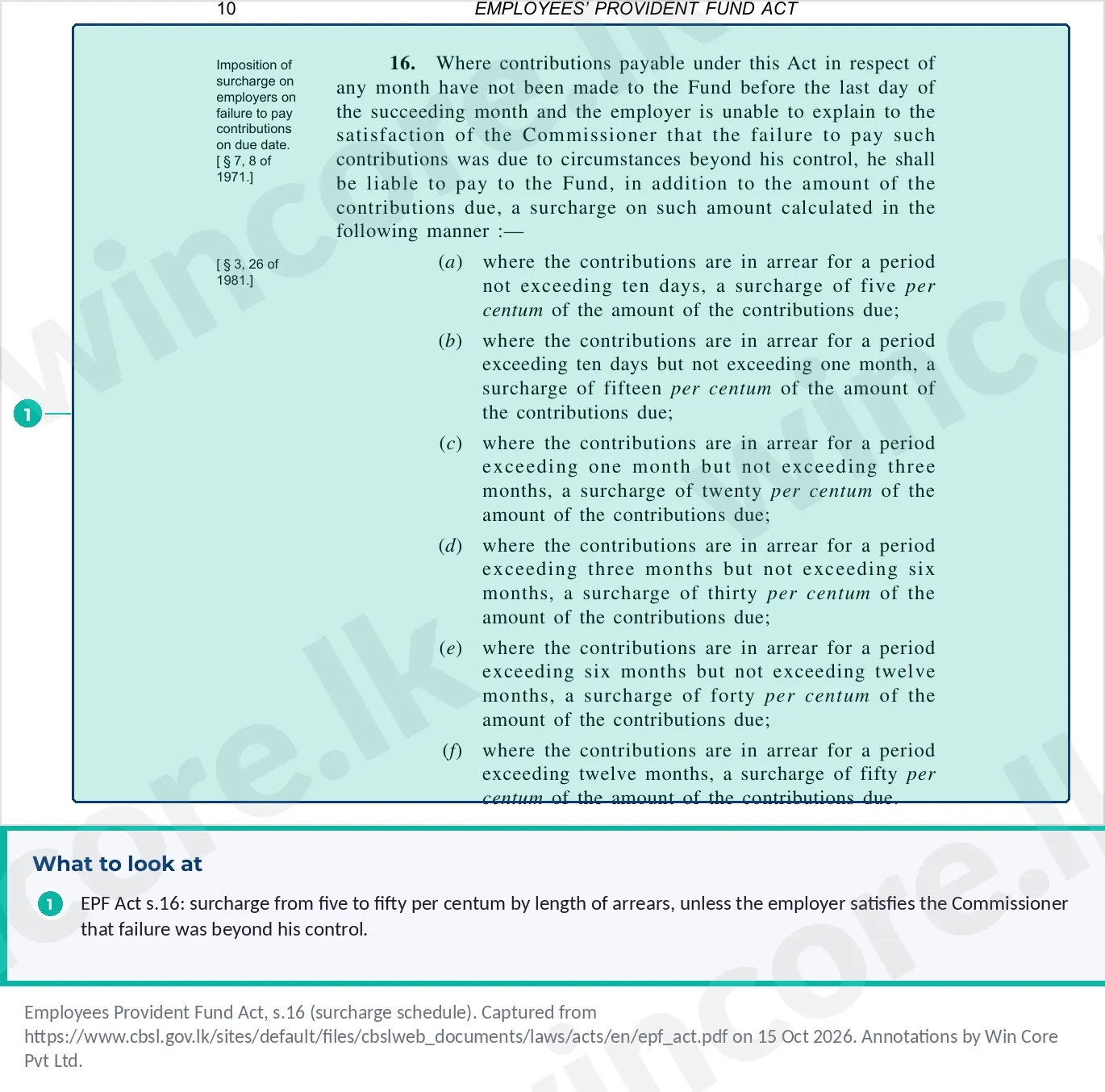
The four sections behind EPF and ETF: rates, the due day, the 5 to 50 percent ladder, who judges 'beyond control', and what Act No. 2 of 2012 changed.