
What an employer keeps when HR is outsourced in Sri Lanka
An outside HR team can recruit, draft and monitor. The Acts still name you for EPF, ETF, termination, gratuity and, from 2027, the data contract.
On this page
Last verified against the primary sources on 23 October 2026.
HR outsourcing in Sri Lanka moves the work of recruitment, contracts, policies and compliance monitoring to an outside team. It does not move the employer's legal duties. The employer still pays EPF at 12 percent and ETF at 3 percent of total earnings by the last day of the following month (EPF Act s.10(2), ETF Act s.16(1)), needs the workman's written consent or the Commissioner's prior written approval before a non-disciplinary termination where the Termination of Employment of Workmen Act applies (s.2(1)), and pays any gratuity within thirty days (Payment of Gratuity Act s.5(1)). From 1 January 2027, the Personal Data Protection Act also requires the employer to bind its HR provider by contract as a processor (s.21, brought into operation by Gazette 2498/16).
This guide sets out what an outside HR team runs, each duty that stays with you and the clause behind it, a worked example, when outsourcing pays, and the questions to settle before you sign.
An outside HR team drafts and runs; you decide and sign
Our HR outsourcing services page lists eight parts [1]:
- Recruitment: job descriptions, sourcing, screening and shortlisting. You make the final hiring decision.
- Employment contracts: appointment letters, offer letters and contracts drafted to Sri Lankan labour law.
- Onboarding: joining documents, induction scheduling and system access.
- Labour law compliance monitoring against the Termination of Employment of Workmen Act, the Shop and Office Employees Act and the EPF and ETF Acts.
- Performance management: KPIs, appraisal cycles and improvement plans.
- Disciplinary and grievance process management, including inquiries.
- HR policies and an employee handbook.
- Monthly HR reporting on headcount, turnover and attendance.
Running the payroll and making the monthly EPF, ETF and APIT payments is a separate service, described on our payroll services page.
The split that works is simple. The provider prepares; the employer decides, signs and pays. A handbook drafted by the provider becomes your policy only when you issue it. A shortlist comes from the provider; the offer letter is yours. A provider can run a disciplinary inquiry; the finding, the penalty and the letter are yours. Our employment contract template is a starting point for the appointment letter.
Each Act below places its duty on "the employer". None of these sections mentions an outside provider. On our reading, a service contract cannot change who the Acts name; it can only give you a claim against the provider.
EPF and ETF stay with the employer by name
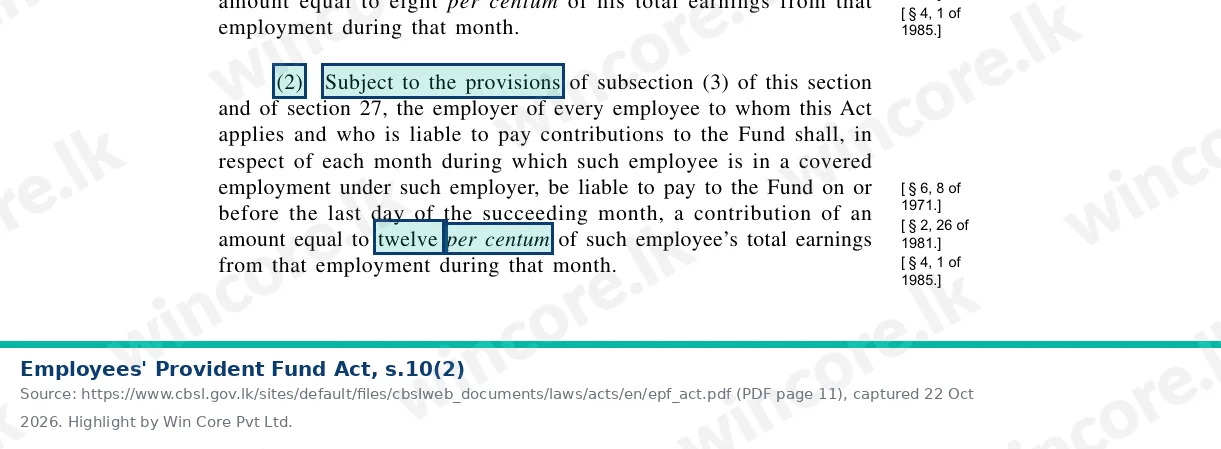
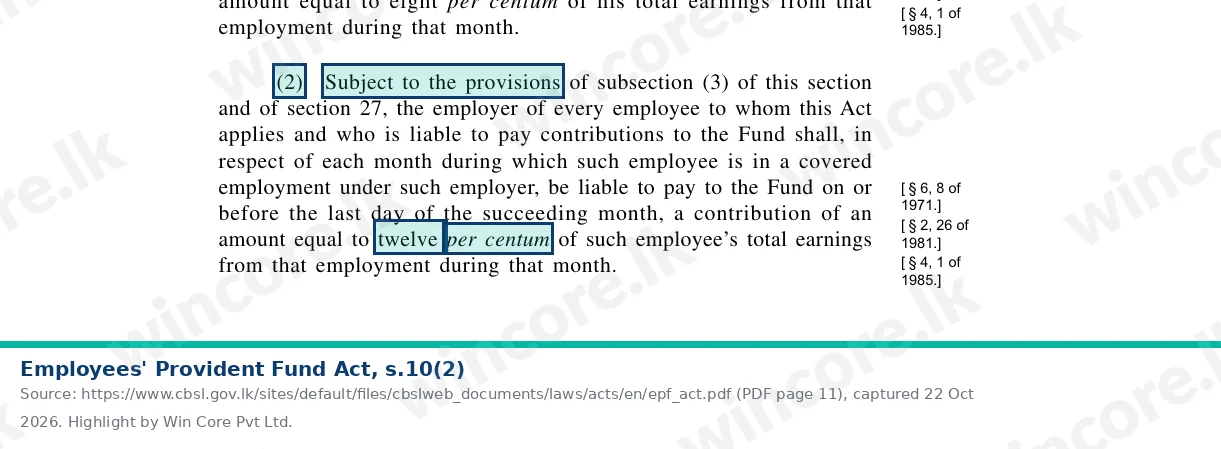
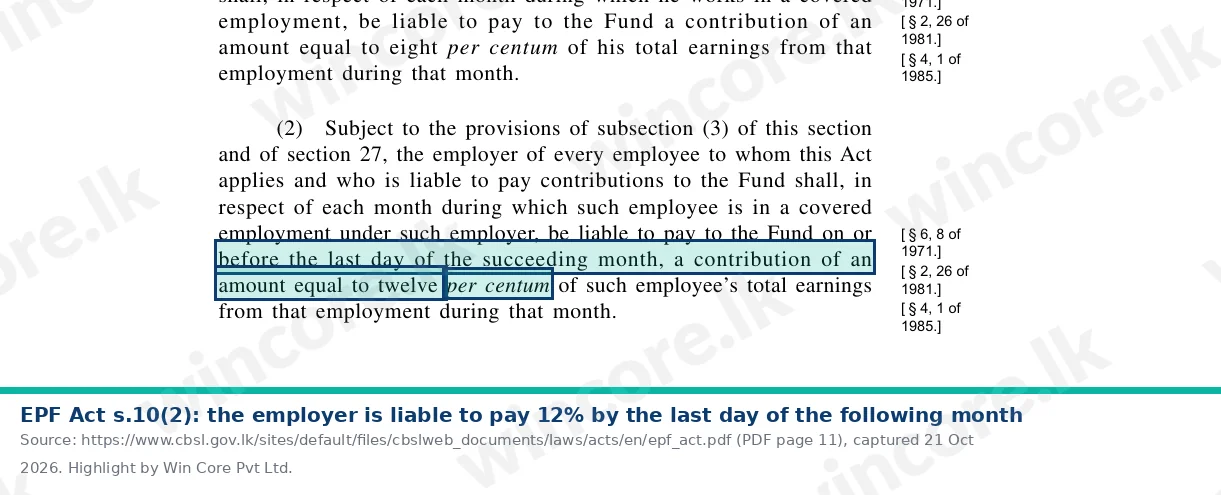
Section 10(2) of the Employees' Provident Fund Act opens "Subject to the provisions of subsection (3) of this section and of section 27" and makes "the employer of every employee to whom this Act applies" liable "to pay to the Fund on or before the last day of the succeeding month, a contribution of an amount equal to twelve per centum of such employee's total earnings" [2]. The employee's own 8 percent (s.10(1)) is also the employer's job to collect: s.15 says the employer "shall deduct and pay to the Fund the contribution for each month of such employee ... before the last day of the succeeding month from the earnings of such employee" [2].
Late payment is the employer's cost. Section 16 adds a surcharge "in addition to the amount of the contributions due", from five percent for arrears of up to ten days to fifty percent beyond twelve months, unless the employer explains "to the satisfaction of the Commissioner" that the failure was due to "circumstances beyond his control" [2]. Whether a provider's mistake would count is for the Commissioner, and we would not plan around it.
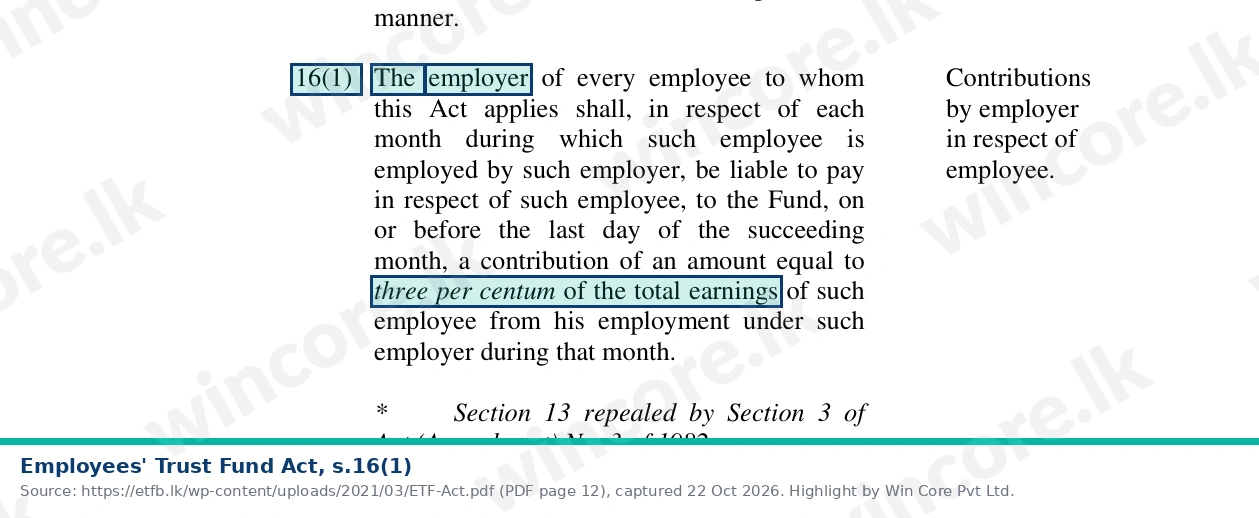
Section 16(1) of the Employees' Trust Fund Act is drafted the same way: "The employer of every employee to whom this Act applies shall ... be liable to pay in respect of such employee, to the Fund, on or before the last day of the succeeding month, a contribution of an amount equal to three per centum of the total earnings" [3]. There is no employee share.
Our guide to outsourced payroll and EPF liability covers the two payment models providers use and the offence sections that can also reach a provider's staff.
A termination needs consent or the Commissioner's approval, and you apply
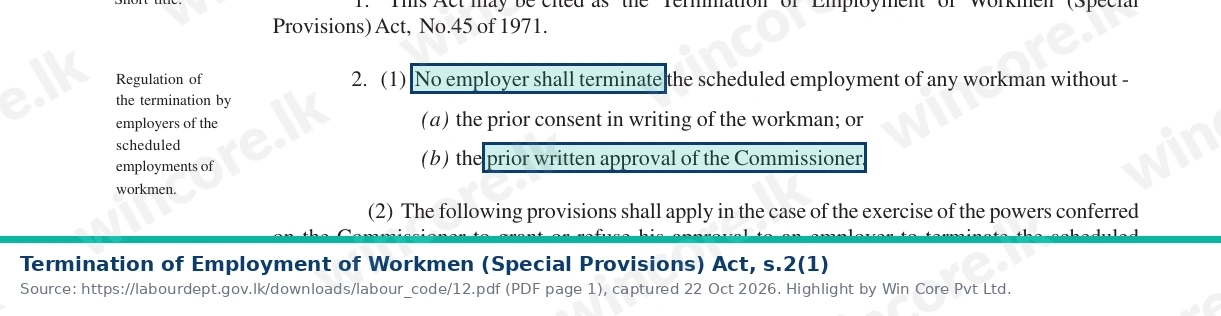
Section 2(1) of the Termination of Employment of Workmen (Special Provisions) Act, No. 45 of 1971 (TEWA) says: "No employer shall terminate the scheduled employment of any workman without (a) the prior consent in writing of the workman; or (b) the prior written approval of the Commissioner" [4].
Who is covered. "Scheduled employment" (s.19) means a trade under a Wages Board Order, every shop and office within the Shop and Office Employees Act, and every factory within the Factories Ordinance. Section 3(1)(a) takes the Act out of play for an employer "by whom less than fifteen workmen on an average have been employed during the period of six months preceding the month in which the employer seeks to terminate", and s.3(1)(b) for a workman employed for less than 180 days, counting approved absence, holidays and certain other days, where the termination falls within the first twelve months [4].
What counts. Section 2(4) covers any termination by the employer "otherwise than by reason of a punishment imposed by way of disciplinary action", including "non-employment ... whether temporarily or permanently" and closure. For a disciplinary dismissal, s.2(5) requires the employer to give the workman the reasons in writing "before the expiry of the second working day after the date of such termination" [4].
Who applies. Approval is granted or refused "on application in that behalf made by such employer", and the workman is heard (s.2(2)(a)). A termination in breach is "illegal, null and void" (s.5), and the Commissioner may order the employer to take the workman back with his wages (s.6) [4]. A provider can prepare the inquiry file, the charge letter and the draft application. The application, the decision and the signature are the employer's. Our guide to employee termination covers the inquiry steps and the compensation formula.
Gratuity, final pay and shop and office records are the employer's too
Section 5(1) of the Payment of Gratuity Act, No. 12 of 1983 applies to "Every employer who employs or has employed fifteen or more workmen on any day during the period of twelve months immediately preceding the termination". On termination for any reason, including resignation, retirement or death, a workman with "not less than five completed years" must be paid a gratuity "within a period of thirty days of such termination" [5]. For a monthly rated workman, that is half a month's wage or salary for each completed year, at the rate last drawn (s.6(2)(a)). Late payment adds a surcharge payable to the workman, from 10 percent within one month after the due date to 30 percent beyond twelve months (s.5(4)) [5]. Our gratuity calculator works the amount.
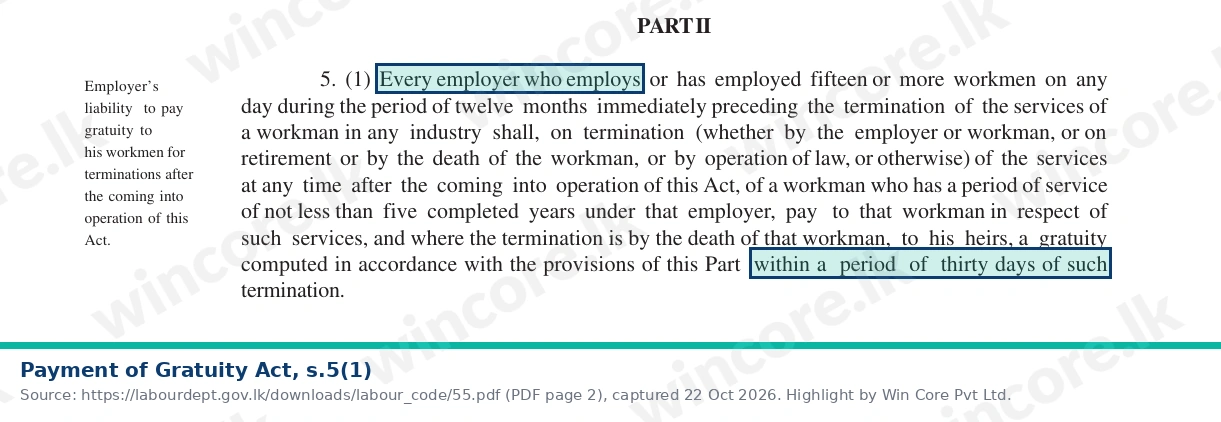
Note the two fifteen tests differ. TEWA uses an average over six months; the Gratuity Act asks whether fifteen were employed on any one day in the last twelve months.
For shop and office staff, the Shop and Office Employees Act puts these on "the employer" [6]:
- written particulars of the conditions of employment on the date of employment (s.17);
- a list of staff and a record of hours worked, overtime, holidays and leave (s.18);
- annual leave with full remuneration, which "the employer shall allow" (s.6);
- pay within the set days after each pay period, and on any termination, the remuneration due "before the expiry of the second working day after that date" (s.19(1)(b) and (c)).
Section 54A lets an offence actually committed by a "manager, agent, servant or other person" be proceeded against "either together with the employer, or before or after the conviction of the employer" [6]. On our reading that adds a person who can be prosecuted; it does not take the duty off the employer.
From 1 January 2027 your HR provider is a PDPA processor
Gazette Extraordinary 2498/16 appoints 1 January 2027 for sections 2 and 3, Part I and Part III of the Personal Data Protection Act, No. 9 of 2022 [7]. A "processor" is a person "which processes personal data on behalf of the controller", and the "controller" is the one that "determines the purposes and means of the processing" (s.56) [8]. On our reading, an HR provider holding your staff files is your processor, and you are the controller.
From that date, s.21(1) requires the employer to "use only processors who ensure the provision of appropriate technical and organizational measures" and to ensure the provider "is bound by a contract or provisions of any written law" that sets out the subject-matter, duration, nature and purpose of the processing, the type of personal data, the categories of data subjects and the obligations of the controller [8]. Section 22(1) requires the provider to act "only on the written instructions of the controller", bind its personnel to confidentiality, allow your compliance audits, and erase or return the data when the service ends. A provider that decides the purposes and means itself is deemed a controller (s.22(2)) [8]. Act No. 22 of 2025 did not amend ss.21, 22 or these two definitions [9]. Part II (rights) and Part VII (penalties) still have no date. Our note on PDPA obligations from 1 January 2027 covers the rest of Parts I and III.
Worked example: a hardware chain with 38 staff keeps every statutory duty
An invented hardware retailer runs four shops and a small head office with 38 employees, all in shop and office employment. Total monthly earnings for EPF and ETF are Rs 4,180,000. It is opening a fifth shop and wants an outside team to recruit for it, write a handbook and set up annual appraisals.
What stays with the retailer, whatever the HR contract says (our arithmetic):
- EPF. Employer's 12 percent is Rs 501,600 (s.10(2)). The employees' 8 percent, Rs 334,400, is deducted and paid over by the retailer (s.15). Total Rs 836,000, by the last day of the following month.
- ETF. 3 percent is Rs 125,400 (s.16(1)), by the same date.
- Termination. With an average well above fifteen, ending a sales assistant's employment for a non-disciplinary reason after her 180 days needs her written consent or the Commissioner's prior written approval, on the retailer's own application.
- Gratuity. A storekeeper leaves after 7 completed years on a last drawn salary of Rs 90,000 a month. Half a month for each year: Rs 45,000 x 7 = Rs 315,000, due within thirty days. Paid on day 45, it is 15 days late and carries a 10 percent surcharge of Rs 31,500.
- Final pay. Salary due and leave not taken (s.6(6)) by the end of the second working day after the termination (s.19(1)(c)).
- Data. From 1 January 2027, a processor contract with the HR provider covering the staff data it holds.
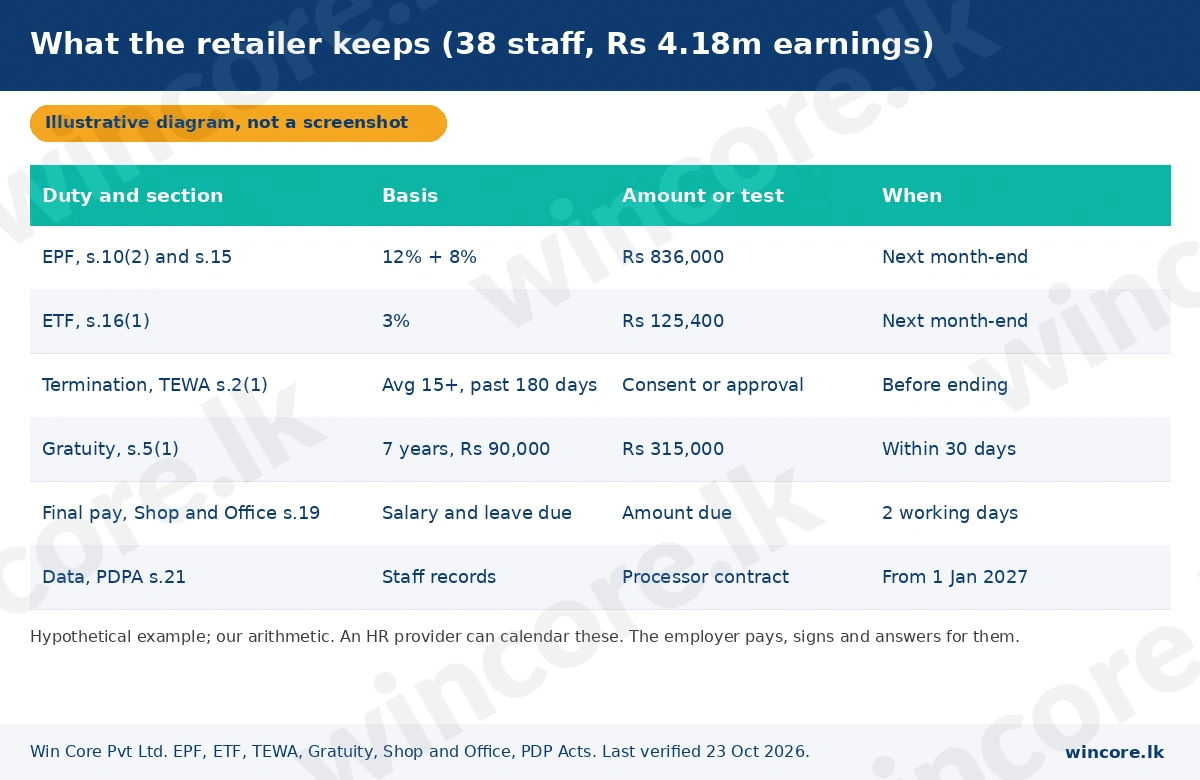
The provider can put every one of these dates in a calendar. The retailer still pays, signs and answers for them.
HR outsourcing in Sri Lanka pays best when hiring jumps or headcount nears fifteen
It tends to pay when:
- you are opening a branch, shop or site and need several hires at once, and a full-time recruiter would sit idle afterwards;
- your headcount is approaching fifteen, where TEWA and the Gratuity Act start to apply, and policies need to exist before the first termination or long-service exit;
- your handbook is missing or years old;
- appraisals are informal and disputes keep starting from them.
It pays less with a small, stable team, or when you already have an experienced HR officer and need only occasional advice. Compare the full cost of an in-house HR hire, with EPF at 12 percent and ETF at 3 percent on top of salary, against written quotes for the outsourced scope. For the wider legal map, see our labour law guide for employers.
Settle seven questions before you sign
- Which services are in the scope, and which are extra?
- Who signs letters to employees? (On our reading, it should be you.)
- How will EPF, ETF and gratuity dates be calendared, and who bears a surcharge caused by the provider's delay?
- Who prepares, and who files, an application to the Commissioner under TEWA s.2(2)?
- Who owns the handbook, templates and HR records if the contract ends?
- Does the contract meet PDPA ss.21 and 22 from 1 January 2027: written instructions, staff confidentiality, audits, and return or erasure of data?
- Who is the named contact, and what are the response times?
What this means for you
- An outside HR team can recruit, draft contracts and policies, run inquiries, set up appraisals and monitor compliance.
- EPF, ETF, termination, gratuity, final pay and shop and office records stay with you under EPF ss.10(2), 15 and 16, ETF s.16(1), TEWA s.2, Gratuity Act s.5 and Shop and Office ss.6, 17, 18 and 19.
- Check where you sit against both fifteen-workman tests.
- From 1 January 2027, paper the provider as a PDPA processor.
- Put in writing who does what, and keep sign-off on every decision that affects an employee's job or pay.
Checklist: documents needed
- Current employee list with start dates, roles and monthly earnings
- Headcount by month for the last 12 months (for both fifteen-workman tests)
- Existing appointment letters and contracts
- Current handbook or policy documents, if any
- Last 3 months of EPF and ETF payment receipts
- Leave and attendance records kept under the Shop and Office Act
- Open disciplinary or termination files
- Draft scope of services, sign-off matrix and PDPA processor terms
FAQ
Does HR outsourcing in Sri Lanka move EPF and ETF liability to the provider?
No, on the wording of the Acts. EPF s.10(2) and ETF s.16(1) make "the employer" liable to pay by the last day of the following month, and EPF s.15 makes the employer deduct and pay over the employee's 8 percent. A provider can calculate and remind. A service contract may give you a claim against the provider; it does not change the Acts.
Can an HR provider terminate an employee for us?
It can prepare the inquiry, the letters and the draft application, but the decision belongs to the employer. Under TEWA s.2(1), the employer must not terminate a covered workman without his written consent or the Commissioner's prior written approval, and s.2(2)(a) has the employer make the application. A termination in breach is null and void under s.5.
When does the gratuity rule apply to my business?
It applies once you have employed fifteen or more workmen on any day in the twelve months before a termination. Under Payment of Gratuity Act s.5(1), a workman with at least five completed years must then be paid within thirty days, whatever the reason for leaving, subject to the s.13 forfeiture for fraud or damage. Late payment adds a surcharge of 10 to 30 percent under s.5(4).
Is my HR provider covered by the PDPA?
Yes, from 1 January 2027, on our reading. Gazette 2498/16 brings Part III into operation that day. A provider that processes staff data on your behalf is a processor, and s.21 requires you to bind it by contract covering the subject-matter, duration, purpose and type of data. Section 22 makes it act only on your written instructions.
What does an outsourced HR team usually cover?
Our HR outsourcing page lists recruitment, contract drafting, onboarding, labour law compliance monitoring, performance management, disciplinary and grievance processes, policies and a handbook, and monthly HR reporting. Other providers vary. Ask for the scope in writing, and check whether payroll and the EPF and ETF payments are included or sold separately, as they are with us.
This page reflects the Acts, the Gazette and our service page as read on 22 and 23 October 2026. It is general information and not advice on your specific situation.
Talk to us. If you want recruitment, contracts and labour law compliance run for you while the decisions stay with you, see our HR outsourcing services or book a consultation at our contact page.
WinCore Pvt Ltd
References
- WinCore Pvt Ltd. HR Outsourcing Sri Lanka service page, features list. /services/hr-outsourcing. Own page, read from the site source on 23 October 2026.
- Employees' Provident Fund Act, No. 15 of 1958, ss.10(1), 10(2), 15 and 16, Central Bank of Sri Lanka reprint incorporating amendments to 31 December 1998 (not a statutory reprint). https://www.cbsl.gov.lk/sites/default/files/cbslweb_documents/laws/acts/en/epf_act.pdf . Primary. Accessed 23 October 2026.
- Employees' Trust Fund Act, No. 46 of 1980, s.16(1), Employees' Trust Fund Board copy. https://etfb.lk/wp-content/uploads/2021/03/ETF-Act.pdf . Primary. Accessed 23 October 2026.
- Termination of Employment of Workmen (Special Provisions) Act, No. 45 of 1971, as amended to Act No. 20 of 2008, ss.2(1), 2(2), 2(4), 2(5), 3(1), 5, 6 and 19, Department of Labour, Labour Code. https://labourdept.gov.lk/downloads/labour_code/12.pdf . Primary. Accessed 23 October 2026.
- Payment of Gratuity Act, No. 12 of 1983, as amended to Act No. 62 of 1992, ss.5(1), 5(4), 6(2) and 13, Department of Labour, Labour Code. https://labourdept.gov.lk/downloads/labour_code/55.pdf . Primary. Accessed 23 October 2026.
- Shop and Office Employees (Regulation of Employment and Remuneration) Act, No. 19 of 1954, ss.6, 17, 18, 19 and 54A, Department of Labour, Labour Code. https://labourdept.gov.lk/downloads/labour_code/20.pdf . Primary. Accessed 23 October 2026.
- Gazette Extraordinary No. 2498/16 of 22 July 2026, Order under section 1(3) of the Personal Data Protection Act. https://documents.gov.lk/api/content-file-proxy?file=/extra-gazette-content/2498-16_E_1785745588.pdf . Primary. Accessed 23 October 2026.
- Personal Data Protection Act, No. 9 of 2022, ss.21, 22 and 56. https://dpa.gov.lk/acts/Data%20Protection%20Act%20SL%20-%20English%20(2).pdf . Primary. Accessed 23 October 2026.
- Personal Data Protection (Amendment) Act, No. 22 of 2025, list of amended sections and s.56 amendments. https://dpa.gov.lk/acts/22-2025_E_251104_201549%20(1).pdf . Primary. Accessed 23 October 2026.
Put these insights to work
WinCore specialists can review your current workflow, document gaps, and build a practical 90-day action plan.
Book a free consultationContinue reading
Explore more WinCore analysis to keep your finance, tax, and compliance roadmap moving.
Outsourcing payroll moves the work, not the duty. Who the Acts hold liable, the two payment models providers use, and what to ask before you sign.

How to lawfully terminate employees in Sri Lanka: disciplinary inquiries, TEWA consent or approval, compensation, final pay and the six-month tribunal limit.
Employer-focused labour law guide for Sri Lanka covering contracts, hours, wages, leave, records, and inspection-ready controls.