
Payroll review checklist Sri Lanka: checking someone else's payroll
Inherited a payroll? Four questions, the clause behind each check, and six errors shown on an invented garment factory, with the cost of each.
On this page
Last verified against the primary sources on 22 October 2026.
A payroll review checklist for Sri Lanka has to test four things, because the law attaches a separate consequence to each: gross pay (Wages Boards Ordinance and Shop and Office Employees Act), the EPF, ETF and APIT base (EPF Act s.10, ETF Act s.16(1), Inland Revenue Act s.83A(1A)), payment dates (wages within ten days of a monthly wage period, EPF and ETF by the last day of the following month, APIT within fifteen days after month end) and records. A payroll can be right on the numbers and still be exposed on timing or records. Where a check is our practice rather than law, we say so.
Sooner or later most finance people are handed a payroll they did not prepare: a new employer, an outsourced provider, a departing payroll clerk, or a buyer's review before an acquisition. This piece sets out the checks, each tied to the clause that makes it matter, and then walks through an invented garment factory. The factory is invented. It does not describe any business we have worked with, and none of its figures or errors comes from a real payroll.
A payroll review checklist in Sri Lanka answers four questions
- Is every person paid the right gross? Hours, days, rates, overtime, Poya days and minimum wage.
- Are EPF, ETF and APIT on the right base, and is each borne by the right person?
- Was everything paid on time? Wages to staff, contributions to the funds, tax to the Inland Revenue Department.
- Do the records exist that would prove the first three to an inspector?
Keep the answers in separate lists. Money owed, late payment and missing records have different fixes and different penalties.
Gross pay is tested against the register and the rate
Part I of the Wages Boards Ordinance is headed "Provisions relating to all trades", and "trade" is defined widely [5]. Its s.3(1) requires a written wages record for each wage period showing the hours or days worked, the wages paid, the date of payment and the deductions [5]. For a trade that has a Wages Board, s.41 requires a register showing "the number of hours of work" and "the number of hours of overtime work" of each worker, entered "forthwith after the expiry of that wage period" and "in respect of each day of the wage period", kept "for a period of four years" [5]. Once a form of s.41 register is prescribed for a trade, s.3 stops applying to it (s.5(2)) [5].
For shops and offices, s.18(b) of the Shop and Office Employees Act requires "a record of the hours actually worked by each such person, including particulars of all overtime work" and of holidays and leave [6]. Our guide to the Shop and Office Employees Act covers who it applies to.
The practical check, which is practice: pick a sample of workers, trace hours from the register to the payroll, and trace each rate to the Wages Board decision or the contract. For the national minimum wage, check the current gazetted figure rather than one repeated here.
Two items are often missed. Work on a Full Moon Poya Day is allowed only "subject to the condition that he shall be paid not less than one and a half times his normal daily rate of wages" (s.3B) [5]. And wages may be paid only "without any deduction other than an authorized deduction" made "with the consent of the worker" (s.2(a)), within a cap of half the wages due in most trades [5].
EPF, ETF and APIT: check the base and who bears each
The EPF Act sets the employee contribution at "eight per centum of his total earnings" (s.10(1)) and the employer's at "twelve per centum of such employee's total earnings", due "on or before the last day of the succeeding month" (s.10(2)) [1]. Section 15 makes the employer deduct only the employee's share from pay. The ETF Act sets the employer's contribution at "three per centum of the total earnings", due by the same day (s.16(1)), and there is no employee share [3].
Who bears what is a check of its own. The employer must not deduct from an employee's earnings any sum it is liable to pay as a contribution or surcharge (EPF s.20; ETF s.30) [1] [3]. A payslip that shows an ETF deduction is wrong on its face.
The base is the other check. "Total earnings" is wider than basic salary, and which allowances count depends on what each pays for; our note on which allowances count for EPF and ETF sets out the six heads in the Act, and our EPF calculator works out the amounts.
For APIT, an employer "shall deduct the Advance Personal Income Tax" on employment payments "as specified by the Commissioner-General" (Inland Revenue Act s.83A(1A)) [4]. Check that each employee is on the right IRD table and that the tax reached the Department "within fifteen days after the end of each calendar month" (s.86(1)) [4].
Payment dates are a separate test from the amounts
| What | Deadline | Clause |
|---|---|---|
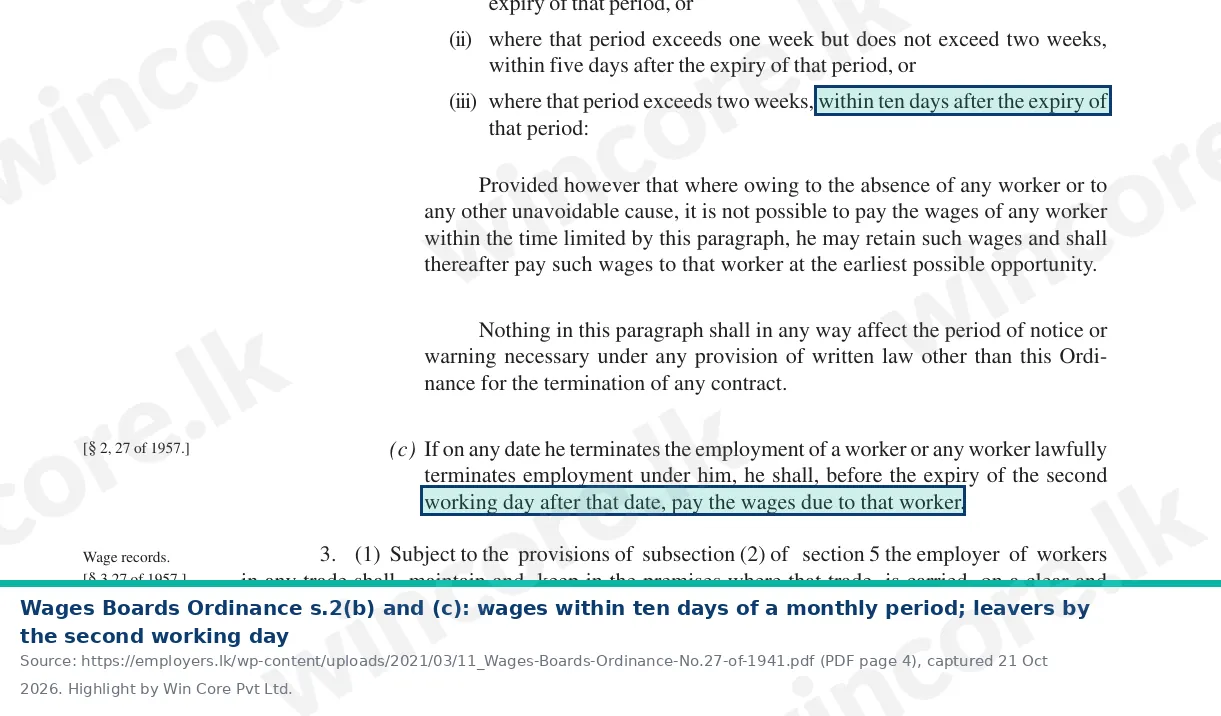
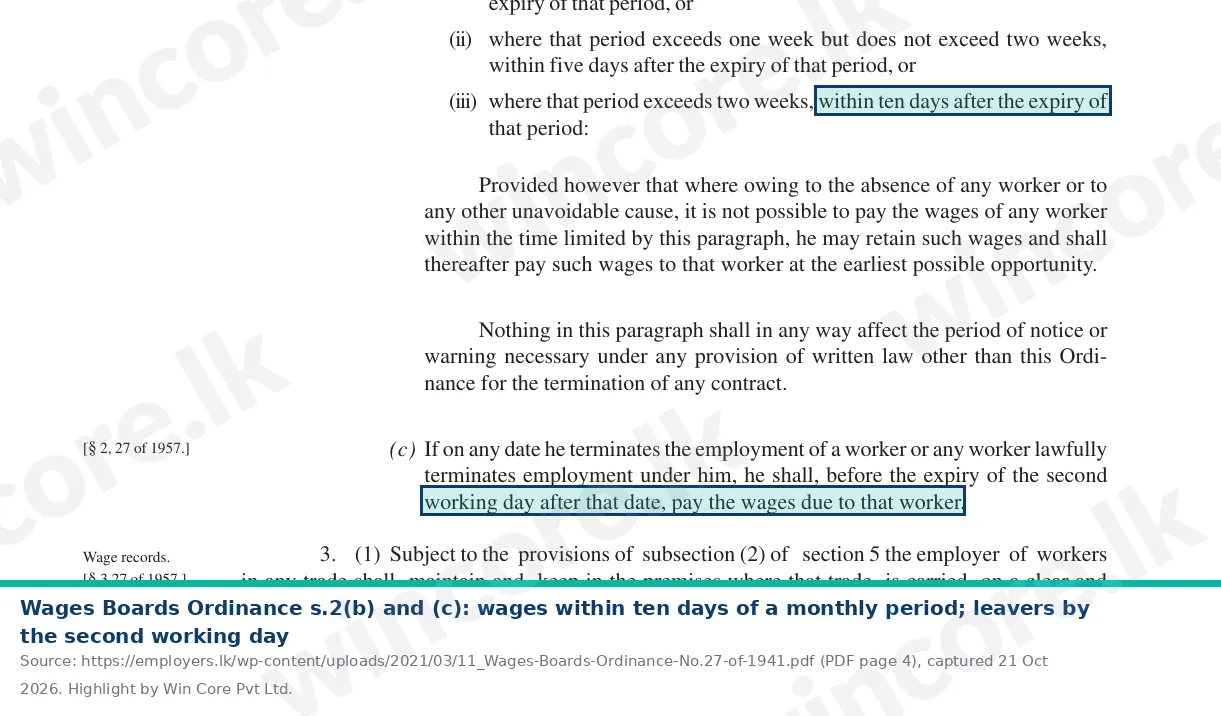
| Wages, wage period over two weeks | Within ten days after the period ends | WBO s.2(b)(iii) |
| Wages, weekly or fortnightly period | Three or five days after the period ends | WBO s.2(b)(i), (ii) |
| Wages on termination | Before the end of the second working day | WBO s.2(c) |
| EPF 8 percent and 12 percent | Last day of the succeeding month | EPF Act s.10 |
| ETF 3 percent | Last day of the succeeding month | ETF Act s.16(1) |
| APIT withheld | Within 15 days after month end | IRA s.86(1) |
The wage deadlines carry a proviso: where "owing to the absence of any worker or to any other unavoidable cause" payment in time is not possible, the employer pays "at the earliest possible opportunity" [5]. Paragraph (b) also gives way to a Wages Board decision for the trade to the extent the two conflict (s.5(1)) [5], so read the decision before calling a date late. The EPF Department and ETF Board ask for payment by the last working day of the month.
Each default has its own cost, so map the error to the clause
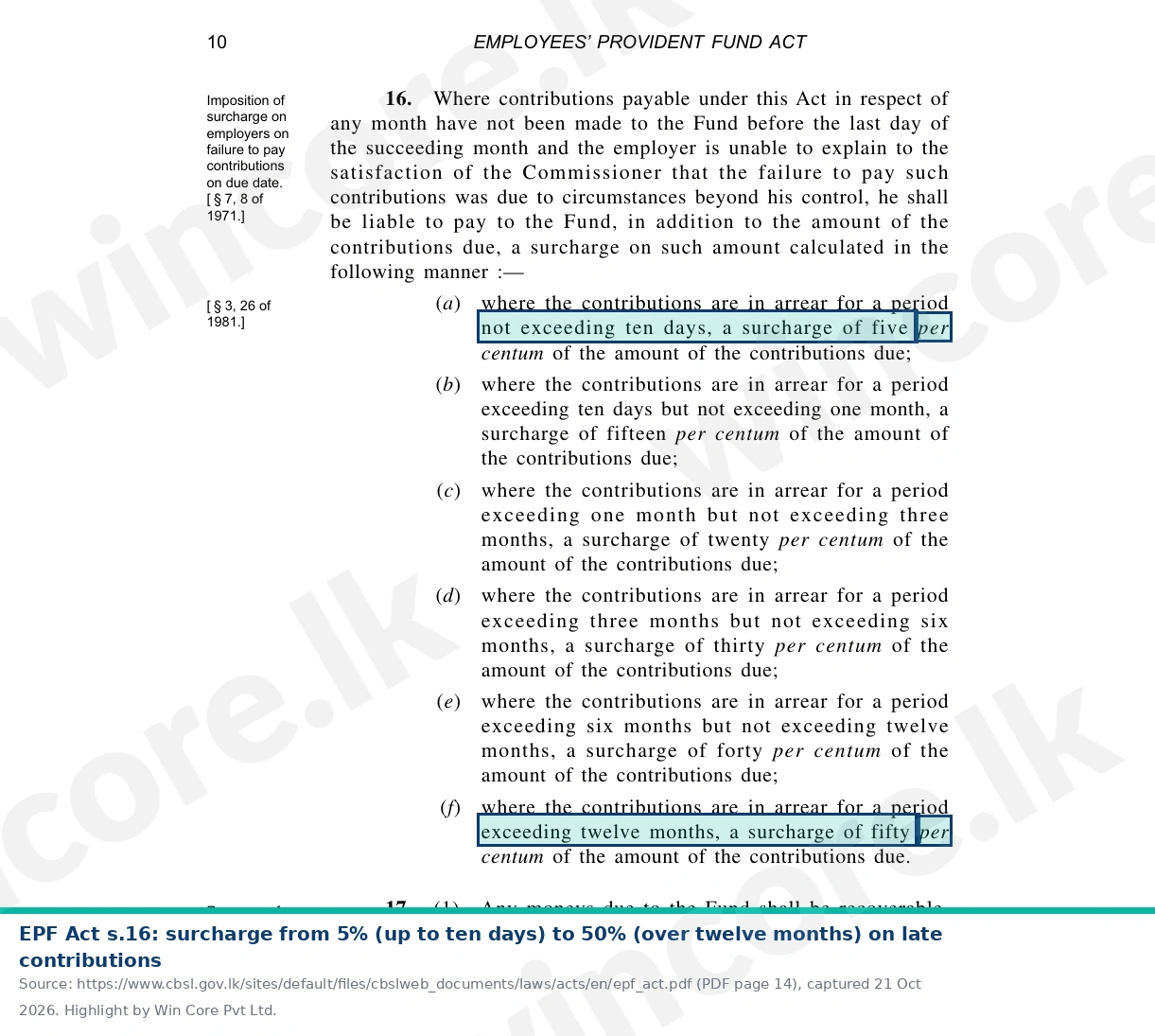
- Late EPF. Section 16 adds a surcharge "in addition to the amount of the contributions due", from five percent for arrears not exceeding ten days to fifty percent beyond twelve months, unless the employer explains "to the satisfaction of the Commissioner" that the failure "was due to circumstances beyond his control" [1]. ETF s.27 uses the same ladder, judged by the ETF Board. Our note on the EPF and ETF surcharge sections sets out each band.
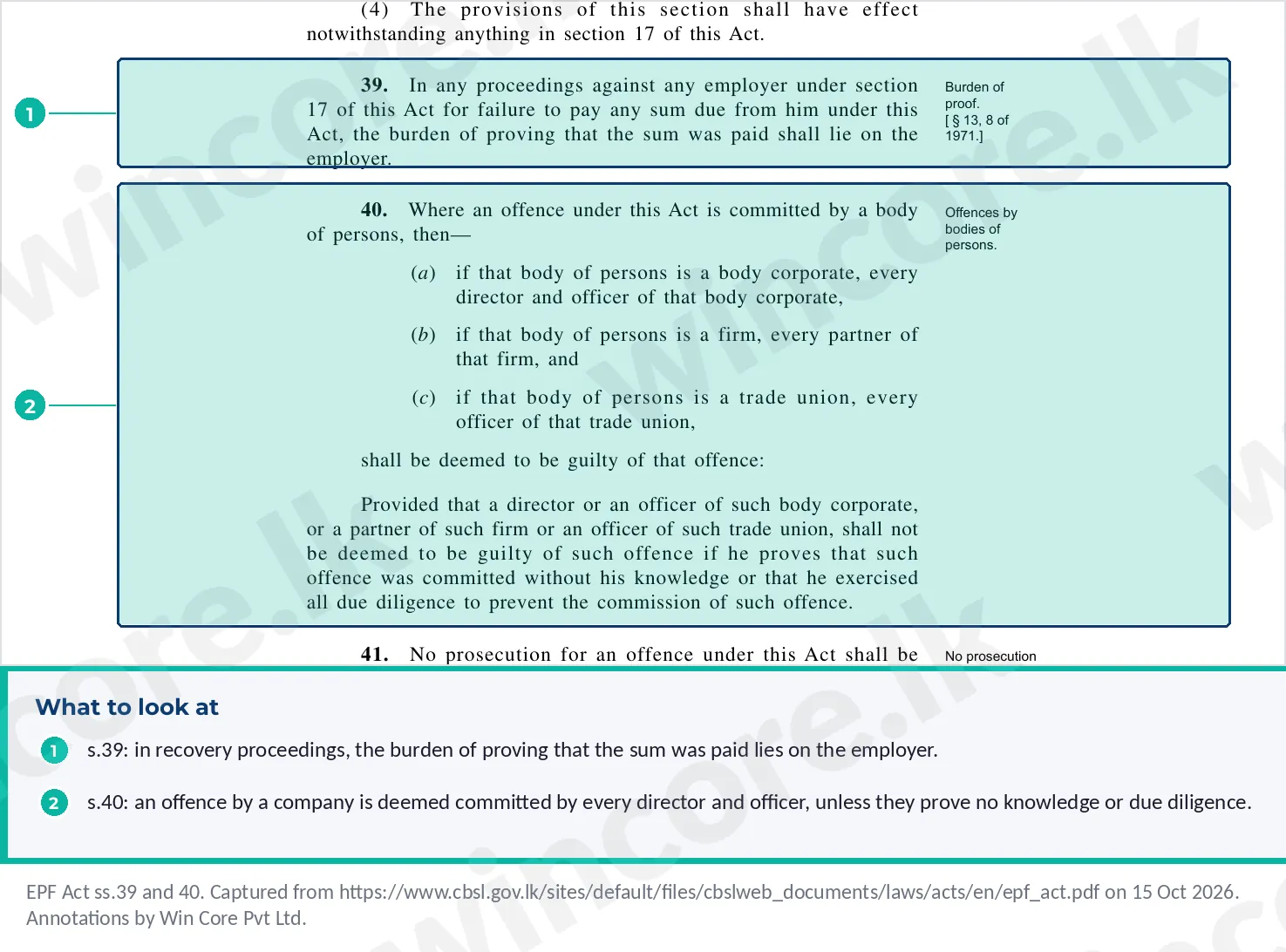
- EPF offences generally. Section 37, as amended by Act No. 2 of 2012, provides, on conviction after summary trial before a Magistrate, a fine not exceeding Rs 2,500, imprisonment up to six months, or both, plus up to Rs 75 "for each day on which the offence is continued after conviction" [1] [2].
- Late or wrong ETF return. Section 37A: "a surcharge at the rate of one per cent of the amount of the contribution to which the return relates for every completed month or part thereof", unless the employer explains the failure to the Board's satisfaction [3].
- Late APIT. Section 179(1): where tax due is not paid "within fourteen days of the due date", "a penalty equal to twenty per cent of the amount of tax due but not paid" [4], with interest at 1.5 percent a month under s.159(1) from the due date.
- Wages Boards Ordinance, Part I. Section 4(1): a first offence carries a fine of Rs 100 to Rs 250, rising for later offences to imprisonment of up to six months [5]. Under s.4(2) the court may also order the employer to pay the sums due, and s.4(2A) adds a surcharge of 20 to 50 percent of the sum where it has been in arrear for more than a month [5].
- Shop and Office records. Section 54A sets a first-offence fine of Rs 100 to Rs 250 for failing to keep the s.18 records [6].
The fines are small. The surcharges, the 20 percent tax penalty and the arrears themselves are where the money is.
An invented garment factory shows six errors a review can find
The factory below is invented for this article. It is a garment factory in a Wages Board trade with 40 production workers on a monthly wage period, each with total earnings of Rs 45,000 a month. A new finance manager checks six months of payroll prepared by a former clerk.
1. ETF deducted from workers' pay. Each payslip shows a 3 percent "ETF" deduction. ETF is the employer's alone, and ETF s.30 forbids taking it from earnings. Our arithmetic: Rs 1,350 a worker a month, Rs 54,000 a month, Rs 324,000 over six months owed back to the workers, while the contributions themselves were paid.
2. EPF paid about twelve days late most months. Contributions are 20 percent of Rs 1,800,000, so Rs 360,000 a month. Twelve days late is more than ten days but not more than a month: the 15 percent step under s.16(b). Our arithmetic: Rs 54,000 a month if the Commissioner does not accept an explanation. Nine days late would have been 5 percent, Rs 18,000.
3. APIT paid three weeks late. The production workers are below the APIT threshold, but the factory manager and two supervisors are not. Their tax was withheld correctly but paid 21 days after the s.86(1) date, outside the fourteen days in s.179(1). Section 179(1) charges 20 percent of the tax due but not paid, plus interest from the due date.
4. Uniform charges deducted without consent. Twenty-five new joiners each had Rs 2,000 taken from their first month's wages for uniforms, with no written consent on file. Section 2(a) allows only authorized deductions made with the worker's consent, so on our reading these fail it. Our arithmetic: Rs 2,000 x 25 = Rs 50,000 to be repaid.
5. Monthly wages paid on the 15th of the next month. For a monthly wage period, s.2(b)(iii) requires payment within ten days after the period ends, unless the Wages Board decision for the trade sets something else. Check the decision before recording it as a breach.
6. Two ETF returns filed a month late. Section 37A adds 1 percent of the contribution to which each return relates, for every completed month or part, unless the Board accepts the employer's explanation.
None of these needs fraud. Each is a habit that went unchallenged.
How to run the review: recompute, then compare (our practice)
- Get the population first: payroll master, EPF and ETF returns, APIT schedules and the bank transfer file. Reconcile headcount across all four before testing any one person.
- Test against source records, not the preparer's file. Take a sample of employees, work their pay from the registers, rates and IRD tables, then compare with the payroll and note the cause of each difference.
- Run a month-on-month comparison of net pay and ask for the reason behind any large change.
- Date-stamp every payment against the deadlines above.
- Report in three lists: money owed, timing, records, and note the areas found correct.
If the payroll came from an outside provider, our guide to switching payroll provider covers who answers for past months and how to run a parallel month.
What this means for you
If you have inherited a payroll, check the contribution base, who bears each deduction, the APIT tables, the payment dates and the registers before you approve the next month's run. Pay arrears promptly, because the EPF and ETF surcharge steps up with time. Keep the wages record or the s.41 register for four years, and where an allowance's treatment is unclear, write down the reasoning: it is the first thing a Labour officer will ask about.
Our payroll services team runs monthly payroll and independent payroll reviews, and our HR compliance services cover registers and records.
Checklist: documents needed
- Payroll master and six months of payroll registers
- Daily attendance and overtime register (WBO s.41) or s.18 records
- Wages record (WBO s.3) where no s.41 register is prescribed
- Applicable Wages Board decision or employment contracts
- EPF Form C and ETF returns with payment receipts and dates
- APIT monthly payment receipts and the table used per employee
- Bank salary transfer files with payment dates
- Leaver list with termination and payment dates
- Written consents for any deductions from wages
FAQ
Is a payroll review required by law in Sri Lanka?
No, the law does not require a review as such. It requires correct pay, contributions, tax and records, each with its own penalty. A review is our recommended way to check them, usually when you inherit a payroll, change provider or before an acquisition, and it should test figures against source records rather than rely on the preparer's workings.
Can an employer deduct ETF from an employee's salary?
No. ETF is a 3 percent contribution paid by the employer alone under ETF s.16(1), and ETF s.30 forbids deducting from an employee's earnings any sum the employer must pay as a contribution or surcharge. The only statutory fund deduction from pay is the employee's 8 percent EPF share under EPF s.15.
Can we pay EPF arrears without a surcharge?
Only if the Commissioner accepts that the failure to pay was due to circumstances beyond the employer's control, under EPF s.16. Otherwise the ladder applies, from 5 percent for up to ten days late to 50 percent beyond twelve months. Write the explanation down with evidence the day you know a payment will be late.
Do the Wages Boards Ordinance payment deadlines apply outside Wages Board trades?
On our reading, yes for Part I. The payment deadlines and the wages record sit in Part I, headed "Provisions relating to all trades", and "trade" is defined widely. The s.41 register applies only to trades with a Wages Board. How Part I sits with the Shop and Office Employees Act for office staff is an open point.
Who is liable for errors made by a former clerk or provider?
The employer, for the money. EPF s.10 and s.15, ETF s.16 and Inland Revenue Act s.86 put contributions and APIT on the employer. EPF s.35 lets an agent who commits an offence be prosecuted as if he were the employer, but that concerns punishment, not the arrears.
Open points
- Whether a given allowance is part of "total earnings" depends on what it pays for; not resolved here.
- Wage Board decisions are trade-specific; we have not checked any board's current rates or payment dates.
- The regulations prescribing the form of Shop and Office s.18 records were not read, and the Act was read in a private consolidation.
- How Part I of the Wages Boards Ordinance interacts with the Shop and Office Employees Act for shop and office staff was not settled.
- How the Labour Department applies the "unavoidable cause" proviso to s.2 is not documented in the sources we read.
Last verified 22 October 2026 against the sources below.
This article is general information, not advice on your specific position.
Talk to us. If you have inherited a payroll and want it checked independently before the next run, contact us at our contact page.
WinCore Pvt Ltd
References
- Central Bank of Sri Lanka. Employees' Provident Fund Act, No. 15 of 1958 (reprint incorporating amendments to 31 December 1998, not a statutory reprint), ss.10, 15, 16, 20, 35 and 37. https://www.cbsl.gov.lk/sites/default/files/cbslweb_documents/laws/acts/en/epf_act.pdf . Primary. Accessed 22 October 2026.
- Parliament of Sri Lanka. Employees' Provident Fund (Amendment) Act, No. 2 of 2012, s.7 (as reprinted in Central Bank of Sri Lanka, Annual Report 2012, Part IV). https://www.cbsl.gov.lk/sites/default/files/cbslweb_documents/publications/annual_report/2012/en/16_Part_04.pdf . Primary. Accessed 22 October 2026.
- Employees' Trust Fund Board. Employees' Trust Fund Act, No. 46 of 1980 (with amendments to 1993), ss.16, 27, 30 and 37A. https://etfb.lk/wp-content/uploads/2021/03/ETF-Act.pdf . Primary. Accessed 22 October 2026.
- Inland Revenue Department. Inland Revenue Act, No. 24 of 2017, consolidated with amendments to 2025, ss.83A, 86, 159 and 179. https://www.ird.gov.lk/en/publications/Acts_Income%20Tax_2017/IRA_Cons_Act_-_2025_Changes.pdf . Primary. Accessed 22 October 2026. The 20 percent rate is also stated in IRD, Guide to the Return of Income Tax Y/A 2025/26, Section 09, https://www.ird.gov.lk/en/Downloads/IT_Individuals_Doc/Asmt_IIT_004_2025_2026_E.pdf . Primary.
- Wages Boards Ordinance, No. 27 of 1941 (as amended), ss.2, 3, 3B, 4, 5, 41 and 64 (Employers' Federation of Ceylon reprint). https://employers.lk/wp-content/uploads/2021/03/11_Wages-Boards-Ordinance-No.27-of-1941.pdf . Secondary reprint of the primary text. Accessed 22 October 2026.
- Shop and Office Employees (Regulation of Employment and Remuneration) Act (private consolidation to 2024), ss.18 and 54A. https://lankalaw.net/wp-content/uploads/2025/03/Shop-and-Office-Employees-Consolidated-2024.pdf . Secondary. Accessed 21 October 2026.
Put these insights to work
WinCore specialists can review your current workflow, document gaps, and build a practical 90-day action plan.
Book a free consultationContinue reading
Explore more WinCore analysis to keep your finance, tax, and compliance roadmap moving.
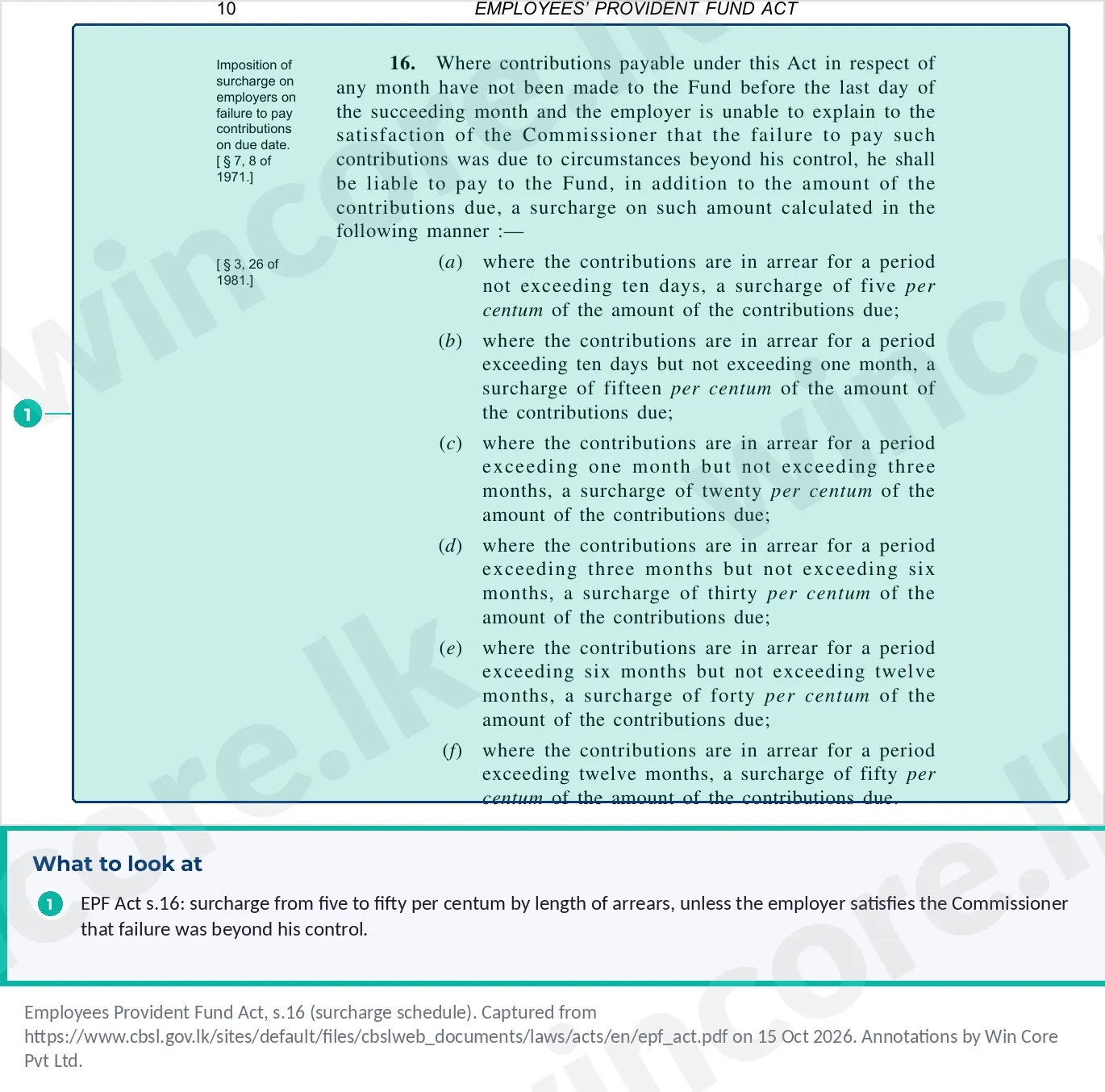
The four sections behind EPF and ETF: rates, the due day, the 5 to 50 percent ladder, who judges 'beyond control', and what Act No. 2 of 2012 changed.
A new payroll provider does not clean the past. Who owes old EPF, ETF and APIT, what to collect at handover, and how to test the first month.

Employer guide to the Shop and Office Employees framework in Sri Lanka, covering coverage tests, hours, leave, records, and inspection controls.