
Partnership and trust taxation in Sri Lanka: structure and compliance guide
Partnership and trust tax treatment can be misunderstood at setup stage. Learn classification, filing ownership, and control points for Sri Lanka.

On this page
Last verified against the primary sources on 15 October 2026.
You set up a partnership or trust to solve a business problem. Six months later, the IRD sends an assessment query. And nobody in the structure can say who was supposed to file, at what level, or where the allocation records are.
That is the exact situation this guide is designed to prevent.
If you handle partnership or trust structures in Sri Lanka, the key objective is to define tax and reporting ownership at formation. Not after the first assessment query lands on someone's desk. Because treatment can depend on legal form, resident status, and income type, confirm the current position with the Inland Revenue Department before filing.
Your legal structure decides who files, who signs, and who gets penalised
A legal structure is not only a legal decision. It decides:
- who the taxable person is for each income stream
- who files and who signs
- how profits or income are allocated
- how withholding credits and assessments are tracked
If those rules are unclear, accounting can be technically accurate while tax compliance remains exposed.
The form also changes the rate on some income. On gains from the realisation of investment assets made on or after 3 June 2026, partnerships pay 15 percent, while trusts, unit trusts and mutual funds pay 30 percent [1], the same as companies [2]. Our capital gains tax guide covers the exemptions and the 30-day return.
For foundational setup context, start with how to register a company in Sri Lanka. To set up a partnership, see how to register a partnership.
If the proposed structure will undertake voluntary relief work, check registration and reporting under the NGO Act separately from its tax treatment.
Partnership tax obligations: what to confirm before the first IRD filing
For partnerships, teams should confirm at the beginning:
- registration and tax-identity setup responsibilities
- partner-level versus entity-level reporting obligations
- profit allocation method and documentation
- treatment of partner drawings and distributions
- responsibility for instalment tracking where applicable
Do not rely on verbal partner arrangements. Tax allocation and filing ownership must be written, approved, and version-controlled.
Trust tax failures: why trustee governance gaps cost more than calculation errors
For trusts, most failures come from governance gaps rather than calculation errors.
Trustees should maintain:
- trust deed and amendment records
- beneficiary allocation logic and support
- income-type classification notes
- period-wise filing and payment evidence
- continuity controls when trustees change
Where trust income includes cross-border elements or mixed asset classes, escalate review early. Late-stage interpretation creates expensive correction cycles.
Keep current tax obligations separate from proposed changes to the Trusts Ordinance; a Bill is not itself an enacted tax rule.
Filing calendar design for partnerships and trusts
Even where final liability is determined in specific ways, the operating process should still follow one disciplined calendar for:
- periodic bookkeeping close
- quarterly instalment review where required
- withholding and payment obligations
- annual statement and return preparation
Use the tax calendar as the base schedule and assign one accountable owner for each statutory event.
Documentation and evidence standards
A practical file should include:
- constitutive documents and current amendments
- identity and tax registration records
- allocation schedules and approval trail
- bank movement support for distributions
- ledger-to-return reconciliation pack
- correspondence and notices archive
If ownership transitions are expected, design a handover checklist before they occur. Unplanned transitions are a common reason filings fall behind.
Common mistakes to avoid in partnership and trust tax workflows
- assuming all income is taxed the same way regardless of legal form
- maintaining accounting records without allocation support
- treating trustee or partner changes as purely legal, not tax events
- combining personal and structure-level cash flows without controlled records
- delaying professional review until after filing deadlines
Pair this guide with corporate income tax compliance in Sri Lanka and 5 percent WHT on service fees for the withholding side.
Frequently asked questions
Are partnerships taxed the same way as private limited companies?
Not necessarily. Treatment depends on the structure and the income type. Gains on investment assets are one example: 15 percent for a partnership and 30 percent for a company, for gains made on or after 3 June 2026 [1] [2]. Do not assume company rules apply by default.
Do trusts need separate operational records even if assets are simple?
Yes. Trustees still need controlled records to support allocations, filings, and beneficiary reporting.
Can we design structure first and tax workflow later?
That approach usually creates rework. Tax ownership and reporting controls should be designed at setup stage.
What is the first control to implement after setup?
Create a documented filing calendar with named owners and one reconciled evidence pack for every period.
Talk to us. If you are forming a partnership or trust, or taking over one whose filing ownership is unclear, our tax team and partnership registration team can go through the setup with you; book a consultation at our contact page.
WinCore Pvt Ltd
This guide is general information on the law as at 15 October 2026 and is not advice on your specific situation.
References
- Inland Revenue Department. Notice to the Taxpayers SEC/PN/IT/2026/02, Amendments to the Inland Revenue Act (8 June 2026), item 20. https://www.ird.gov.lk/en/Lists/Latest%20News%20%20Notices/Attachments/794/SEC_PN_IT_2026-02_E.pdf . Primary. Accessed 15 October 2026.
- Inland Revenue Department. Inland Revenue Act, No. 24 of 2017, consolidated text with amendments to 2025, First Schedule para 4(4). https://www.ird.gov.lk/en/publications/Acts_Income%20Tax_2017/IRA_Cons_Act_-_2025_Changes.pdf . Primary. Accessed 15 October 2026.
Put these insights to work
WinCore specialists can review your current workflow, document gaps, and build a practical 90-day action plan.
Book a free consultationContinue reading
Explore more WinCore analysis to keep your finance, tax, and compliance roadmap moving.
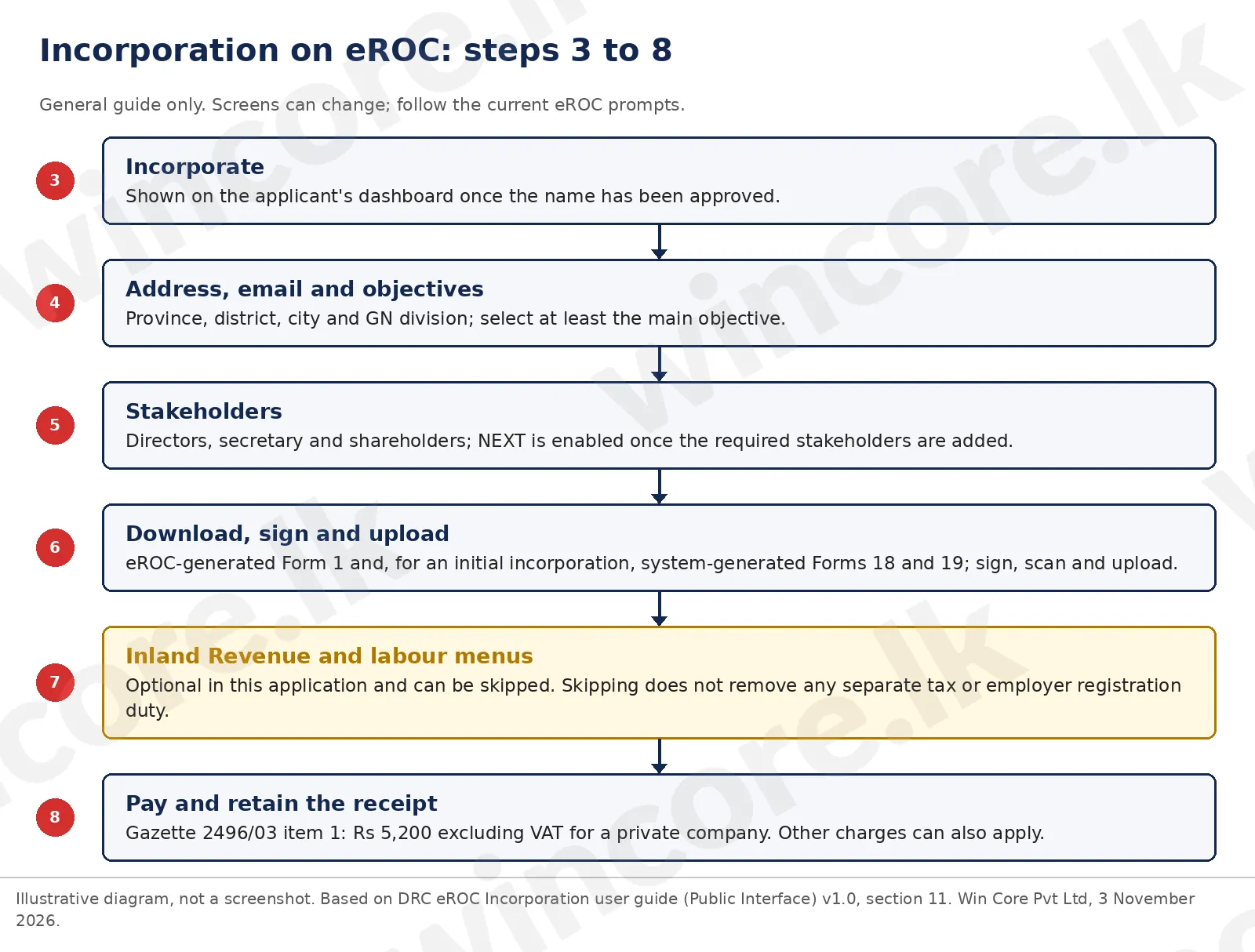
Registering a private limited company in Sri Lanka in 2026: structure, name approval, the eROC filing with BO 1 and BO 5, the TIN and the first year.
Sri Lanka corporate income tax guide: rates, taxable income, quarterly instalments, deductions, capital allowances, and key compliance penalties.
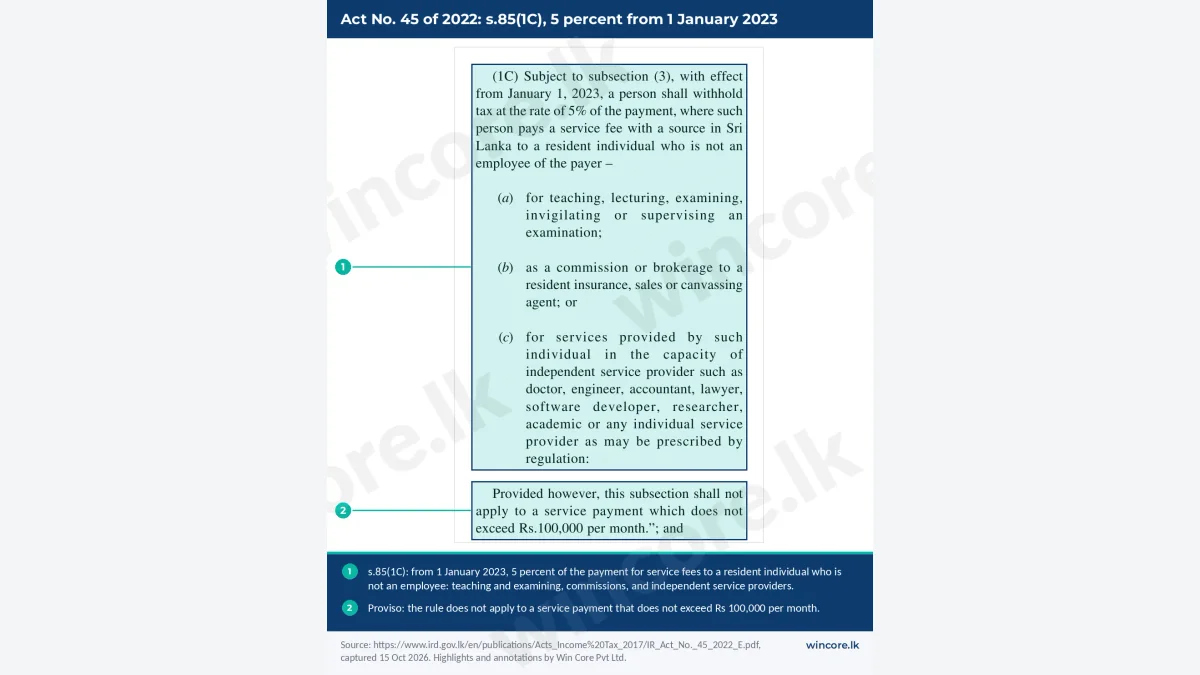
When a payer must withhold 5 percent on service fees, the services added in June 2026, payment within 15 days and the certificate rules.