
Trusts (Amendment) Bill Sri Lanka: trust registration proposed
A Bill read in Parliament on 21 October 2026 would make trustees register family and will trusts, renew every five years and keep records for six years.
On this page
Last verified against the primary sources on 4 November 2026.
Updated 4 November 2026: second reading listed for Thursday 5 November 2026 on parliament.lk; the Bill text is unchanged and none of it is law yet.
Last updated 4 November 2026, 09:45 (Sri Lanka time).
What changed
- 4 Nov 2026: parliament.lk now lists the second reading for 5 November 2026; the order of business for that day takes it up only if no petition is filed in the Supreme Court under Article 121 [9]. No amendment to the Bill text is listed.
- 30 Oct 2026: first published, from the Bill as presented at first reading on 21 Oct 2026 and its parliament.lk status as read on 26 Oct 2026.
The Trusts (Amendment) Bill Sri Lanka would make trustees register the trust instrument itself with the Registrar-General and hold a certificate of registration valid for five years. The Bill was presented in Parliament for its first reading on 21 October 2026, and parliament.lk lists its second reading for 5 November 2026 [1] [9]. As presented, it proposes one month to register a new trust, six months for an existing trust after commencement, and fines of up to Rs 3 million, up to ten years' imprisonment, or both, while keeping the six-year period for identity records that the Ordinance already sets [2] [4]. None of this is law yet.
Key facts - Instrument: Trusts (Amendment) Bill, amending the Trusts Ordinance (Chapter 87); first reading 21 October 2026; second reading listed for 5 November 2026. - Who and where: the trustee of a trust created under section 5(1) or (2) of the Ordinance registers with the Registrar-General; the information, records and penalty sections also bind an "authorised person". - Proposed deadlines: one month for a new trust; six months for an existing trust after commencement; renewal at least three months before the five-year certificate expires; changes within 14 working days. - Proposed penalties: up to Rs 3,000,000, up to ten years, or both, on conviction by a Magistrate; for breaches of sections 5A(7), 6A(2) and (3) or 19A only, the Registrar-General could instead impose a penalty of up to one third of that fine.
| Stage | Date | Source |
|---|---|---|
| Cabinet approves amending the Ordinance | 18 December 2024 (subject to confirmation) | Cabinet decision [3] |
| Bill published in the Gazette | 9 October 2026, supplement issued 14 October 2026 | Bill cover page [2] |
| First reading | 21 October 2026 | parliament.lk [1] |
| Second reading | Listed for 5 November 2026 (only if no Supreme Court petition is filed under Article 121) | parliament.lk [1] [9] |
| Speaker's certificate and commencement | Only after the Bill is passed; no separate date in the Bill | parliament.lk, Bill [1] [2] |
The Trusts (Amendment) Bill Sri Lanka would make trustees register the trust instrument
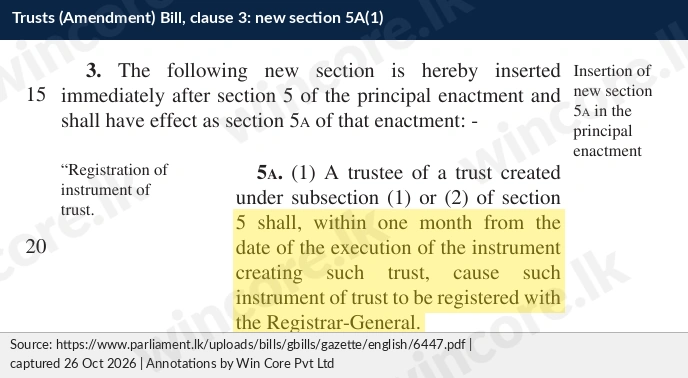
Clause 3 would insert a new section 5A. Proposed section 5A(1) says a trustee of a trust created under subsection (1) or (2) of section 5 "shall, within one month from the date of the execution of the instrument creating such trust, cause such instrument of trust to be registered with the Registrar-General" [2].
Section 5 says how a trust is validly made: a trust of land by the last will of the author or the trustee, or by a written instrument signed by the author or the trustee and notarially executed; a trust of movable property by such a will, by a signed written instrument with no notary needed, or by transferring ownership of the property to the trustee by delivery [5]. On our reading, section 5A would therefore reach the ordinary family trust deed as well as trusts in wills.
Trusts in a will would get their own clock under proposed section 5A(2):
- Land held on a will trust. Any later instrument made under the will "by which immovable property is transferred or vested" would be registered within one month of that transfer or vesting.
- Movable property held on a will trust. The probate, together with the last will, would be registered within one month of the grant of probate.
Section 5A(2) does not say who registers; on our reading it is the trustee, because amended section 6A(2) would require the trustee or authorised person to forward the information within the section 5A periods [2].
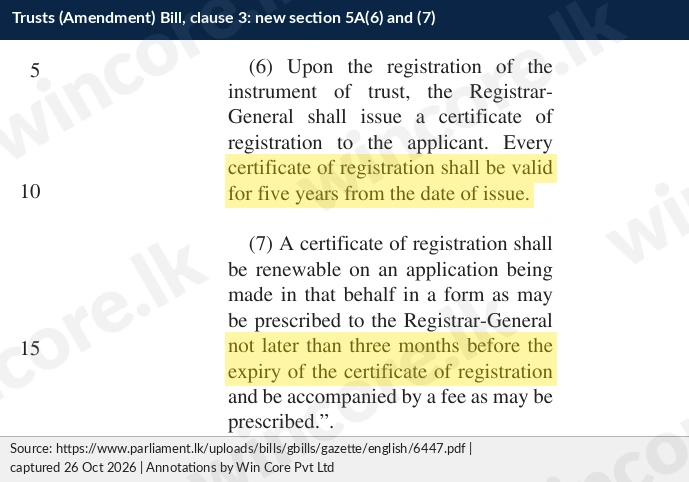
The application would go to the Registrar-General "in such form as may be prescribed", with a copy of the instrument (or the documents in section 5A(2)) and a prescribed fee (s.5A(5)). On registration the Registrar-General would issue a certificate "valid for five years from the date of issue" (s.5A(6)), renewable on an application made "not later than three months before the expiry" of the certificate (s.5A(7)) [2].
Clause 2 would also change "express trust" from a trust created "generally in the form" of a written instrument to one created "in the form" of one, and repeal the definition of "court" (today, the District Court) [2] [4].
Existing trusts would get six months, counted from commencement, not from today
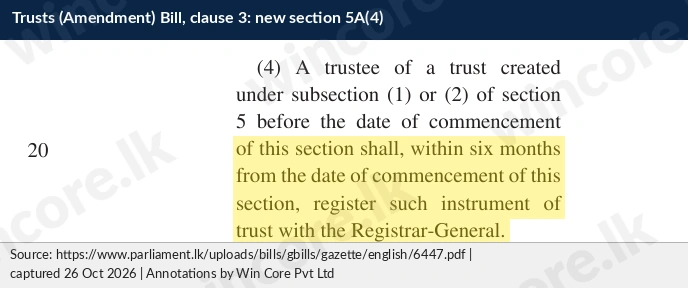
Proposed section 5A(4): a trustee of a trust created under section 5(1) or (2) "before the date of commencement of this section shall, within six months from the date of commencement of this section, register such instrument of trust with the Registrar-General" [2].
That clock has not started. The Bill would still need its second and third readings, and then the Speaker's certificate under Article 79 of the Constitution, which parliament.lk lists as the final stage. Under Article 80(1), a Bill passed by Parliament "shall become law when the certificate of the Speaker is endorsed thereon" [1] [7]. The Bill fixes no separate commencement date, so on our reading section 5A would commence on that endorsement, unless Parliament adds a date. The text can still be amended.
A passed Act would also need regulations: the forms, the fees and the further information in section 6A(3) are all left to be "prescribed". Under section 115A of the Ordinance, regulations are gazetted and placed before Parliament for approval [4].
Worked example: an existing family trust. In 2019 a retired engineer in Kandy signed a notarial trust deed placing her house, valued at Rs 38,000,000, and Rs 6,000,000 in fixed deposits on trust for her three grandchildren, with her son as trustee. Suppose, only to show the arithmetic, that section 5A commenced on 1 March 2027.
| Step | Proposed rule | Date in the example |
|---|---|---|
| Register the existing trust deed | Six months from commencement (s.5A(4)) | By 31 August 2027, to be safe |
| Certificate issued | Valid five years from issue (s.5A(6)) | Issued 20 May 2027, valid to 19 May 2032 |
| Apply to renew | Not later than three months before expiry (s.5A(7)) | By 19 February 2032 |
| A grandchild changes address | Forward within 14 working days of recording the change (s.6A(4)) | 14 working days from the day the son records it |
Worked example: a will trust. A father's will leaves Rs 15,000,000 in deposits and a plot of land in Matara on trust for his two children. If probate were granted on 12 April 2028, after commencement, the probate and will would be registered by 12 May 2028 (s.5A(2)(b)). If the deed vesting the land in the trustee were signed on 3 July 2028, it would be registered by 3 August 2028 (s.5A(2)(a)).
The Trusts Ordinance already asks trustees for information, with far lighter penalties
The Trusts (Amendment) Act, No. 6 of 2018, certified on 28 March 2018, added the reporting rules that the Trusts Ordinance (Chapter 87) contains today [4]:
- the Registrar-General keeps a register of express trusts "containing such information as may be prescribed" (s.6A(1)), and the trustee forwards the prescribed information to the Registrar-General (s.6A(2));
- the trustee keeps identity records of the trustee, co-trustees, the author, the beneficiaries and certain agents and advisers, "verified and updated every three months, to the greatest extent possible", for at least six years after each person's involvement ends (s.19A(2) and (5));
- a trustee who contravenes sections 6A, 19, 19A or 19B is liable, on conviction by a Magistrate, to a fine "not exceeding two hundred thousand rupees" or imprisonment "for a term not exceeding two years", or both (s.19C).
The Trusts (Information Relating to Express Trusts) Regulations 2019 (Gazette Extraordinary No. 2108/10) have the information sent to the Registrar of Lands with the original instrument and to the Registrar-General with its counterpart original, gave trusts that existed in 2019 six months to comply, and have changes forwarded "immediately" (reg 4) [6]. So today's law has a register and a records duty, but no certificate, no renewal and no fixed day count for a new trust. The Bill would add all three and raise the maximum fine fifteen times, from Rs 200,000 to Rs 3,000,000.
Trustees would keep identity records, and the 10 percent test reaches companies behind a trust
Clause 6 would replace section 19A. A trustee would keep records "of all such information as may be prescribed" on the identity of [2]:
- the trustee or authorised person, and any co-trustee;
- the author of the trust, meaning the person who created it;
- each beneficiary, or for a class each member so far as reasonably ascertainable, or else a clear description of the class;
- anyone "who may exercise effective control over the trust or disposition of trust property", such as a guardian;
- any agent, legal representative, manager, investment advisor, tax advisor or accountant "who may have any decision-making authority", or who acts for a decision-maker.
The trustee would verify this from reliable, independent sources and review it "at appropriate intervals" according to the risk of money laundering, terrorist financing or proliferation financing (s.19A(2)), in place of today's three-month cycle. Dealing with a bank, another financial institution or a designated non-financial business, the trustee would disclose the role, confirm whether the trust must be registered under section 5A and, if it must, prove registration, and supply the records on request (s.19A(3)). Records would be kept "at least for a period of six years" after each person's involvement ends (s.19A(8)).
Where the 10 percent comes in. Proposed section 19A(6) says that where a person on the record is a company incorporated or registered under the Companies Act, the trustee records "the natural persons who are the beneficial owners of such company". Section 19A(7) then defines a beneficial owner as a natural person who ultimately owns or controls ten per cent or more of a company, or who exercises effective control through other means [2]. That is the wording of section 130J of the Companies Act, inserted by Act No. 12 of 2025 [8], which our guide to beneficial ownership and the 10 percent test explains.
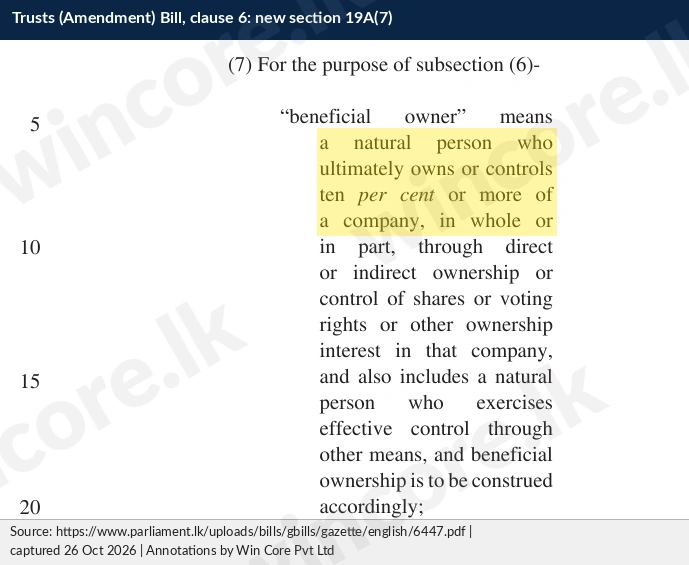
On our reading the 10 percent line does not filter the trust's own beneficiaries. Section 19A(1) lists every beneficiary with no threshold, and where another trust appears on the record, its "owners of the beneficial interest" are again all the persons in section 19A(1) [2].
Take a family trust whose beneficiaries include a private holding company owned by four cousins at 40, 30, 22 and 8 percent. The trustee would record the cousins at 40, 30 and 22 percent, and the cousin at 8 percent only if that cousin controls the company some other way, for example by appointing directors.
If a trust holds shares in a company, the company has its own beneficial ownership duties; our page on the beneficial ownership regulations 2026 covers the forms. Section 130J does not mention trusts, so how a beneficiary's share of a trust holding is measured there is a point we keep open.
Who would see the register. Amended section 6B(1) would let authorities including the Financial Intelligence Unit, Customs and the Commissioner-General of Inland Revenue ask the Registrar-General for it directly; today, any authority other than the Financial Intelligence Unit needs its written sanction. Under new section 6B(1B), the public could inspect the "full names of the author of the trust, trustee and beneficiary, and the nature and extent of the beneficial interest" [2].
Penalties would rise to Rs 3 million or ten years, with an administrative route up to one third
Proposed section 19C(1): a trustee or authorised person who contravenes sections 5A, 6A, 19, 19A and 19B "shall be guilty of an offence" and, on conviction by a Magistrate, would be liable to a fine "not exceeding three million rupees" or to imprisonment "for a period not exceeding ten years", or both [2]. Where the trustee is a company, the same maximums would apply and each director or officer would be deemed guilty unless they prove lack of knowledge or all due diligence (s.19C(2)). Where the trustee is another body corporate, a firm, a partnership or a trust, its directors, managers, secretaries, members, partners or trustees would be deemed guilty and face up to Rs 1,000,000, up to ten years, or both, subject to the same defence (s.19C(3)).
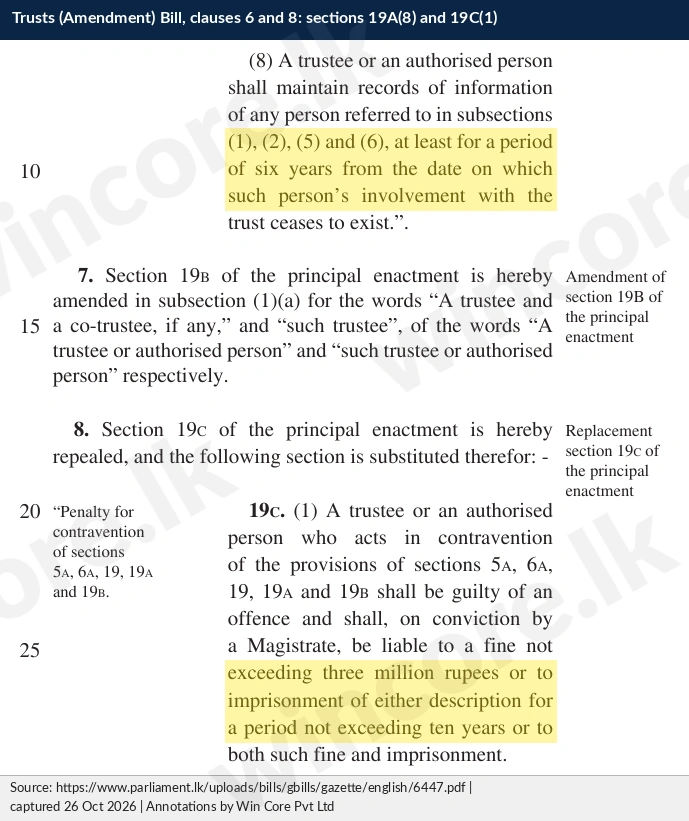
New section 19D would give the Registrar-General a second route for breaches of section 5A(7) (renewal), section 6A(2) and (3) (information) or section 19A (records). After a notice to show cause within one month, the penalty would be "not exceeding one third of the maximum fine that could be imposed under section 19c", which on our reading is up to Rs 1,000,000 for an individual trustee. Appeals would go to the Ministry Secretary within thirty days, then to the Court of Appeal on a question of law. Once a breach is admitted and the penalty paid, no prosecution would lie for it (s.19D(9)) [2].
The Bill sets maximums only, with no scale. Section 19D does not name section 5A(1) or 6A(4); on our reading a late registration reaches it through section 6A(2), while a late change report sits only in section 19C.
What this means for you
If you are a trustee, the Bill changes nothing until it is passed and certified; your duties under sections 6A and 19A and the 2019 Regulations apply meanwhile. On our reading the six months for an existing trust would run from commencement even if the forms come later. Six months is short if the deed, identity documents and beneficiary details are scattered, so gathering them now costs little.
If a trust holds shares in your company, its Companies Act beneficial ownership duties already apply. For tax, see our guide to partnership and trust taxation in Sri Lanka. We will update this page when the Bill moves.
Checklist: documents needed
- The trust deed or last will, and the probate where a will trust holds movable property
- Any deed made under the will that transferred or vested land in the trustee
- NIC or passport copies for the trustee, co-trustees, the author of the trust and each beneficiary
- Details of any guardian, adviser or other person with control or decision-making authority
- For any company on the record, its beneficial owners at 10 percent or more, or with effective control
- A list of the trust's bank accounts and investments, with the institutions' names
FAQ
Would a family trust have to register under the Trusts (Amendment) Bill?
Yes, if the Bill passes as presented. Proposed section 5A covers trusts created under section 5(1) or (2) of the Trusts Ordinance, which on our reading includes a notarial family trust deed and a trust in a will. A new trust would be registered with the Registrar-General within one month, and an existing one within six months of commencement. The Bill sets no value threshold.
When would trust registration start in Sri Lanka?
Not before the Bill is passed and the Speaker endorses its certificate. The Bill was read for the first time on 21 October 2026 and its second reading is listed for 5 November 2026. It sets no separate commencement date, so on our reading section 5A would commence on certification. Existing trusts would then have six months, but the forms and fees would still need regulations.
What is the penalty under the Trusts (Amendment) Bill?
A fine of up to Rs 3,000,000, imprisonment of up to ten years, or both, on conviction by a Magistrate under proposed section 19C. For some breaches, including a missed renewal or incomplete records, the Registrar-General could instead impose a penalty of up to one third of the maximum fine, which on our reading is up to Rs 1,000,000 for an individual trustee.
Who counts as a beneficial owner of a trust under the Bill?
On our reading, everyone listed in proposed section 19A(1) would go on the trust's record, with no 10 percent threshold: trustees, the author of the trust, every beneficiary or class, anyone with effective control, and advisers with decision-making authority. The 10 percent test in section 19A(7) would apply only when one of those persons is a company, whose natural owners at 10 percent or more would then be recorded.
Does the Trusts (Amendment) Bill change how trusts are taxed?
No. The Bill amends only the Trusts Ordinance and does not touch the Inland Revenue Act, so trust income and gains are taxed as they are today. It would, however, let the Commissioner-General of Inland Revenue ask the Registrar-General for register information under amended section 6B(1).
Talk to us. If a trust sits on your company's share register, our statutory secretarial services keep the company's statutory registers and beneficial ownership filings in order while the Bill goes through Parliament. Book a consultation at our contact page.
WinCore Pvt Ltd
General information on the Bill as presented at first reading, not legal advice on your situation.
Cover image: Image by Freepik.
References
- Parliament of Sri Lanka. Trusts (Amendment), bill details page G6447: presented and first reading 21 October 2026; second reading 5 November 2026; third reading and Speaker's endorsement undated. https://www.parliament.lk/en/business-of-parliament/bill-details/G6447 . Primary. Accessed 4 November 2026.
- Trusts (Amendment) Bill, Gazette of the Democratic Socialist Republic of Sri Lanka, Part II of 9 October 2026, Supplement (issued 14 October 2026), Statement of Legal Effect and clauses 1 to 10 (new ss.5A, 19A, 19C, 19D, 19E; amended ss.3, 6A, 6B, 19B). https://www.parliament.lk/uploads/bills/gbills/gazette/english/6447.pdf . Primary. Accessed 26 October 2026.
- Cabinet Office of Sri Lanka. Amendments to the Trusts Ordinance, Cabinet decisions of 18 December 2024 (subject to confirmation). https://www.cabinetoffice.gov.lk/cab/index.php?option=com_content&view=article&id=16&Itemid=49&lang=en&dID=12941 . Primary. Accessed 26 October 2026.
- Trusts (Amendment) Act, No. 6 of 2018 (certified 28 March 2018), ss.2 to 8, inserting ss.6A, 6B, 19A, 19B, 19C and 115A and defining "express trust". https://documents.gov.lk/ (Department of Government Printing archive; the old direct link stopped working in October 2026, search for Act No. 6 of 2018). Primary. Accessed 26 October 2026.
- Trusts Ordinance (Chapter 87), ss.3, 5 and 6, revised text. https://www.srilankalaw.lk/revised-statutes/volume-viii/1314-trusts-ordinance.html . Secondary (s.5(1) wording cross-checked against the Court of Appeal's quotation in Tilakaratne v Jayatilaka, [2003] 3 Sri L.R. 315, https://lawnet.gov.lk/?p=62893). Accessed 26 October 2026.
- Trusts (Information Relating to Express Trusts) Regulations 2019, Gazette Extraordinary No. 2108/10 (28 January 2019), regs 2 to 7. https://documents.gov.lk/ (Department of Government Printing archive; the old direct link stopped working in October 2026, search for Gazette Extraordinary No. 2108/10). Primary (scanned text). Accessed 26 October 2026.
- Constitution of the Democratic Socialist Republic of Sri Lanka, Articles 79 and 80(1), Revised Edition 2023 (as amended up to 31 October 2022). https://www.parliament.lk/files/pdf/constitution.pdf . Primary. Accessed 26 October 2026.
- Companies (Amendment) Act, No. 12 of 2025, s.130J definition of "beneficial owner". https://www.parliament.lk/uploads/acts/gbills/english/6389.pdf . Primary. Accessed 26 October 2026.
- Parliament of Sri Lanka. Forthcoming business of the House, first sitting week of November 2026 (Committee on Parliamentary Business, 23 and 30 October 2026): Thursday 5 November 2026, Trusts (Amendment) Bill, second reading, in the event no petitions are filed in the Supreme Court. https://www.parliament.lk/en/home/forthcoming-business-of-the-house/view/5494 . Primary. Accessed 4 November 2026.
Put these insights to work
WinCore specialists can review your current workflow, document gaps, and build a practical 90-day action plan.
Book a free consultationContinue reading
Explore more WinCore analysis to keep your finance, tax, and compliance roadmap moving.
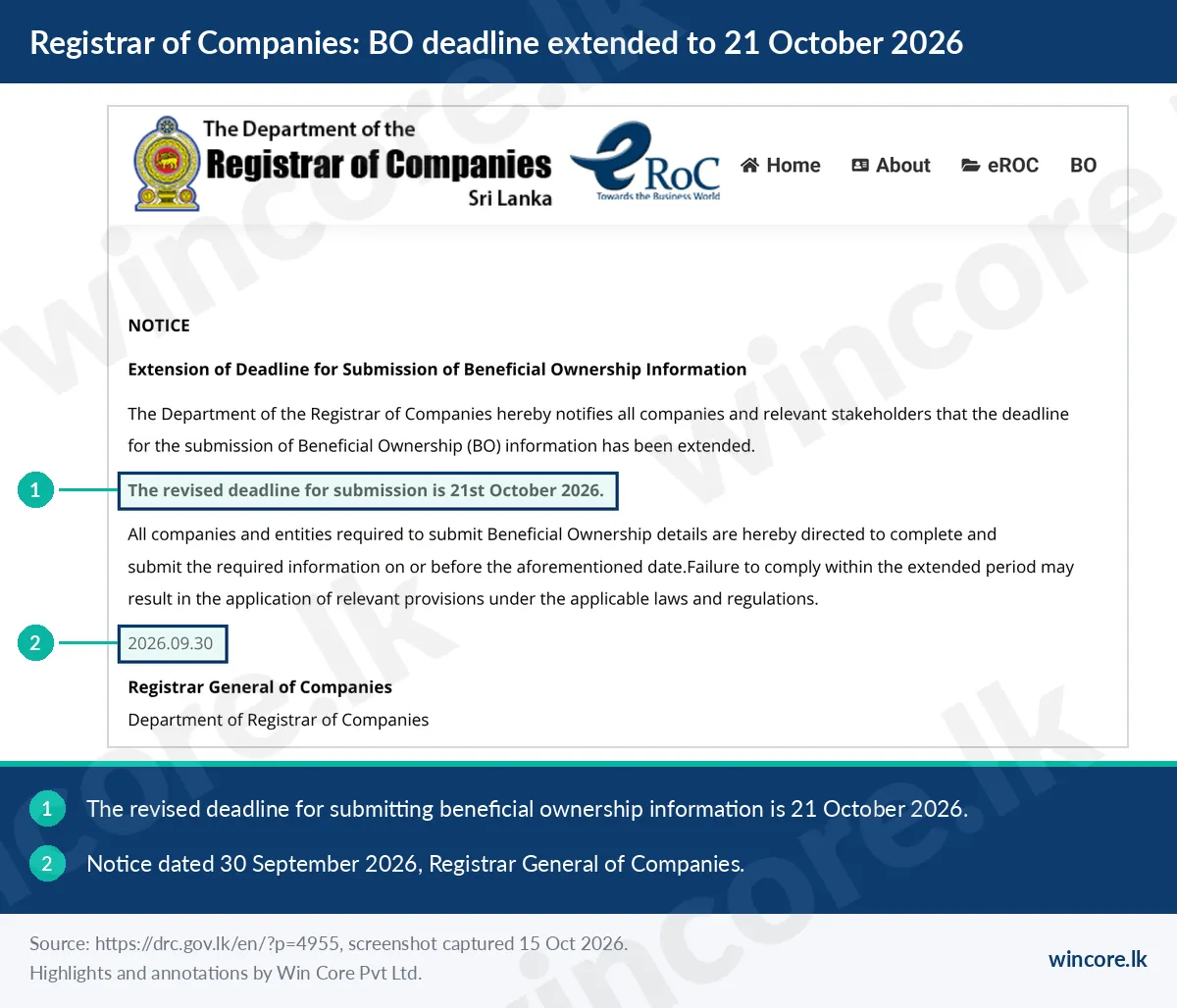
Who counts as a beneficial owner at 10 percent, the forms in the October 2026 regulations, and what existing companies face after the 21 October deadline.

Partnership and trust tax treatment can be misunderstood at setup stage. Learn classification, filing ownership, and control points for Sri Lanka.
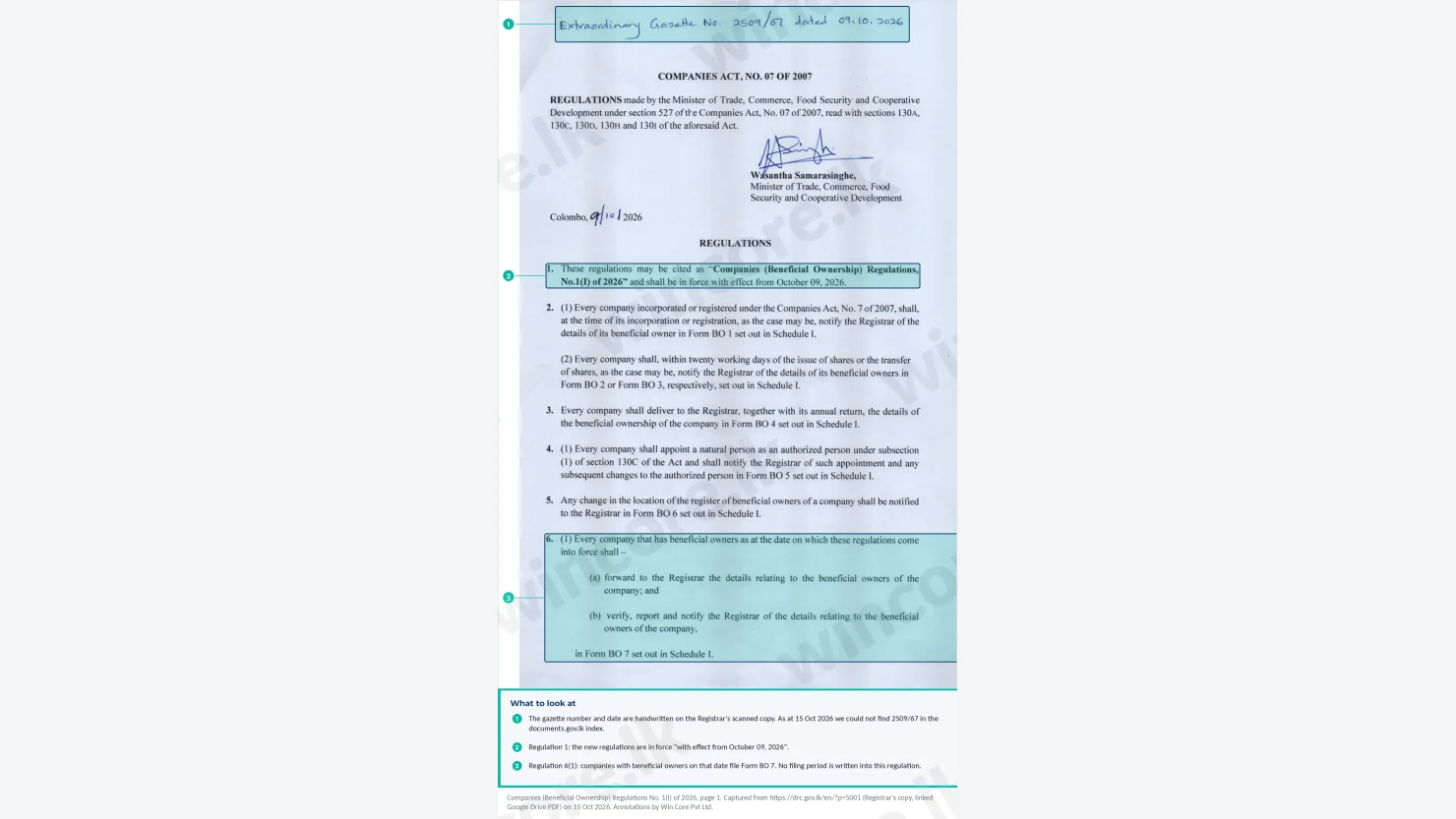
The October 2026 BO regulations replaced the March set, and from 22 October a late form costs Rs 1,000 a week. What a late BO 7 filing now costs.