
Port City employee income tax exemption: who qualifies and until when
Who keeps tax-free Port City pay, for which months, what changes in February 2029 and the evidence file employers should keep each year.
On this page
WinCore Pvt Ltd · Port City payroll and tax · Last verified 21 October 2026
The Port City employee income tax exemption now has an end date. Pay for February 2026 to January 2029 is exempt only for staff of an employer the Colombo Port City Economic Commission approved before 20 January 2026, and only if they are paid in a designated foreign currency, not rupees. Staff of an employer approved on or after 20 January 2026 are taxable from the first payslip, with APIT. That is section 35 as replaced by the Amendment Act No. 1 of 2026, certified on 20 January 2026. So three facts decide it: when your employer was approved, what currency you are paid in, and what month it is.
Until January 2026 the second fact did most of the work. The original section 35 of the Colombo Port City Economic Commission Act No. 11 of 2021 said that any employee of an authorised person, paid in a designated foreign currency, was exempt from income tax, with no end date [3]. The Colombo Port City Economic Commission (Amendment) Act No. 1 of 2026 replaced it [1].
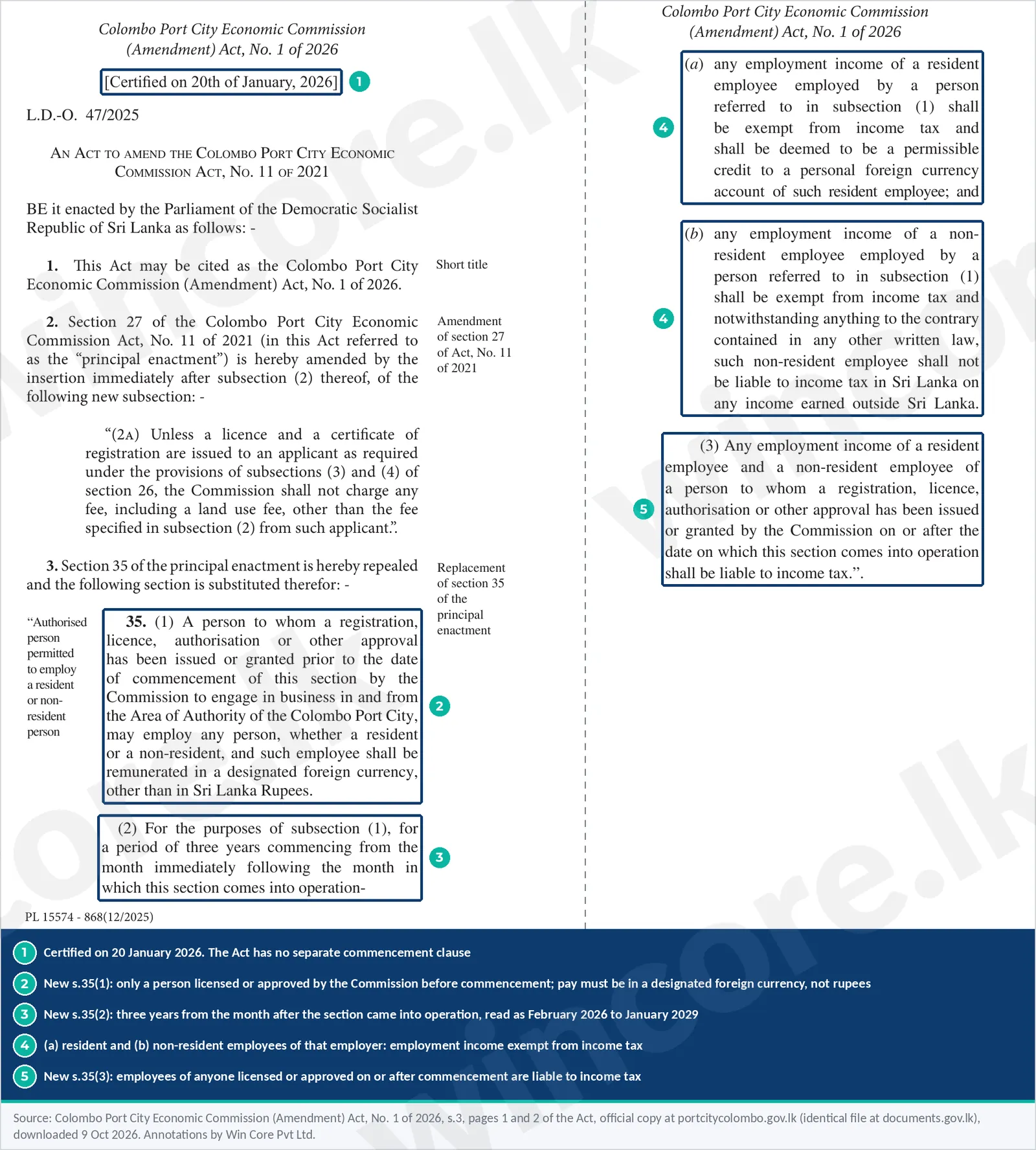
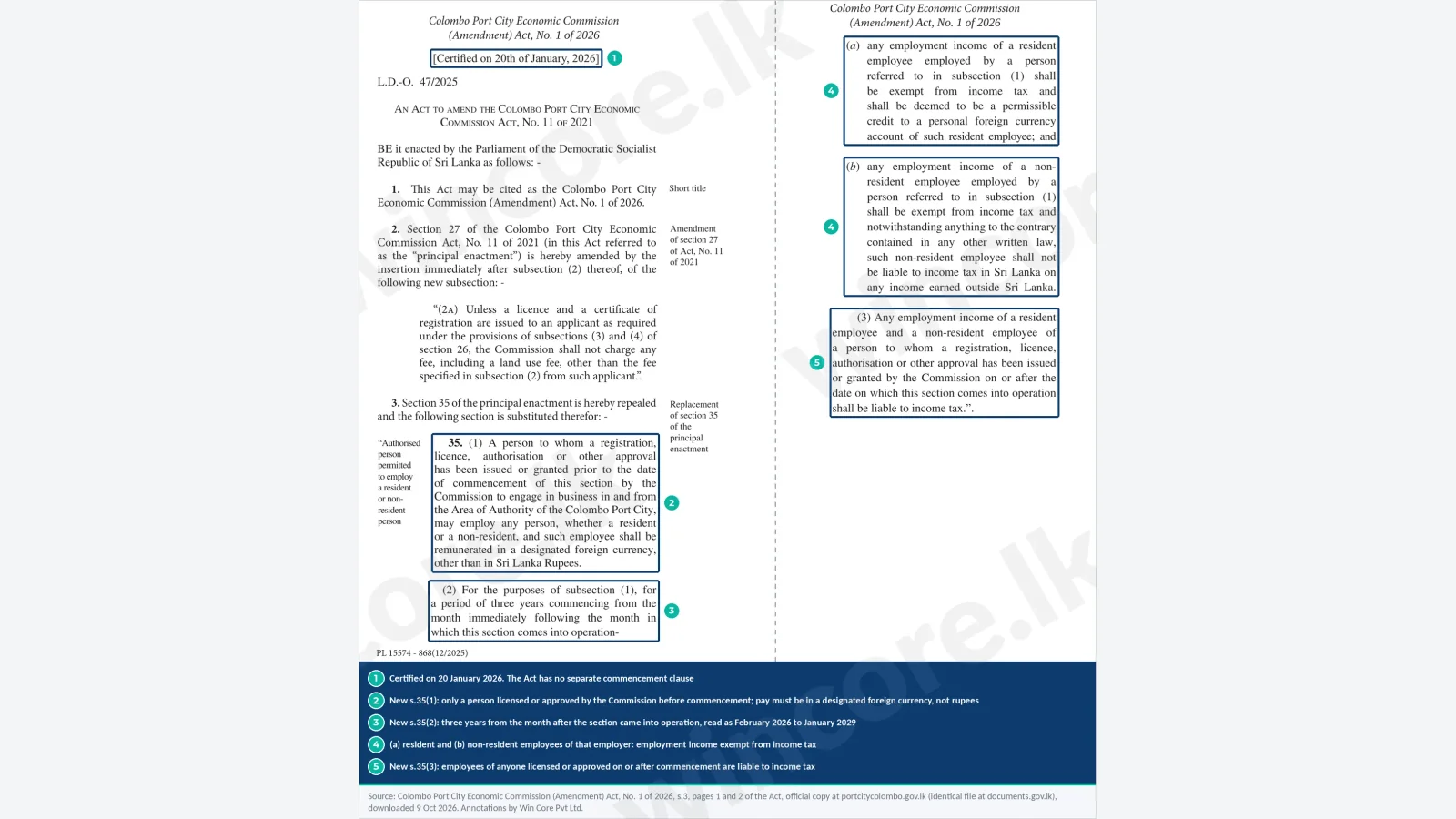
The new section 35 splits Port City staff into exempt and taxable
Section 3 of the Amendment Act repeals section 35 and puts in its place a section with three parts [1] [2].
- Subsection (1), the employer. A person "to whom a registration, licence, authorisation or other approval has been issued or granted prior to the date of commencement of this section by the Commission" may employ residents or non-residents, and "such employee shall be remunerated in a designated foreign currency, other than in Sri Lanka Rupees".
- Subsection (2), the hourglass. "For a period of three years commencing from the month immediately following the month in which this section comes into operation", a resident employee's employment income is exempt and is deemed a permissible credit to their personal foreign currency account; a non-resident employee's employment income is exempt and they are not liable to Sri Lankan income tax on income earned outside Sri Lanka.
- Subsection (3), everyone else. Employment income of staff of a person licensed or approved "on or after the date on which this section comes into operation shall be liable to income tax".
We read the English text; the Commission and Government Publications Bureau copies are identical [1] [2]. Section 18 of the Act says the Sinhala text prevails if the Sinhala and Tamil texts are inconsistent.
Keep payroll relief separate from the authorised person's audited-accounts deadline and its annual reporting evidence.
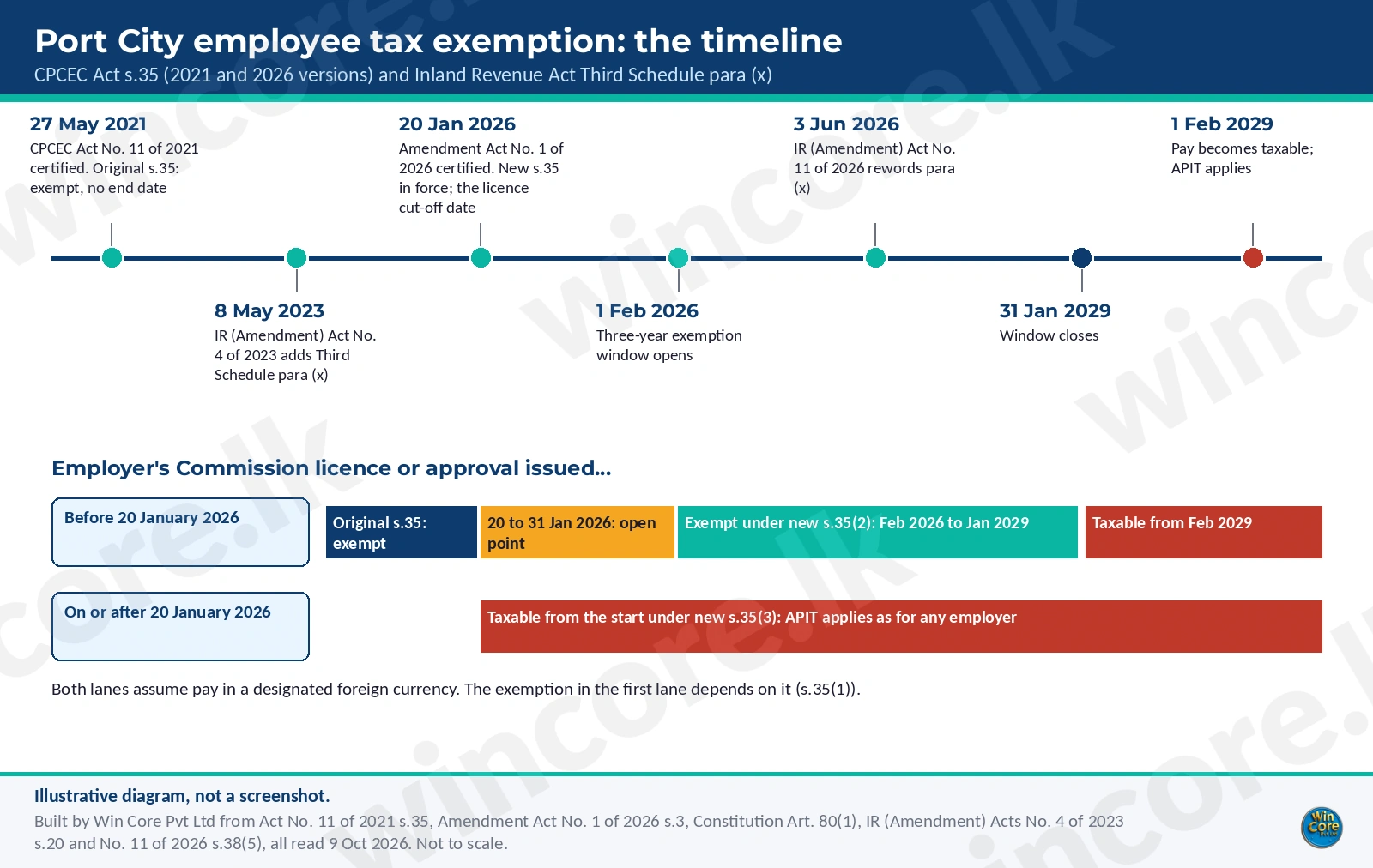
The exemption window runs from February 2026 to January 2029
Everything hangs on the phrase "comes into operation". So which date is it: the day Parliament passed the Bill, the day the Speaker certified it, or the day it was published?
The Act has no commencement clause. Its front page says it was certified on 20 January 2026, and it was published as a supplement to the Gazette of 23 January 2026 [1]. Article 80(1) of the Constitution says a Bill passed by Parliament "shall become law when the certificate of the Speaker is endorsed thereon" [4]. So the section came into operation on 20 January 2026. That gives:
- Cut-off for employers: registration, licence, authorisation or approval issued before 20 January 2026.
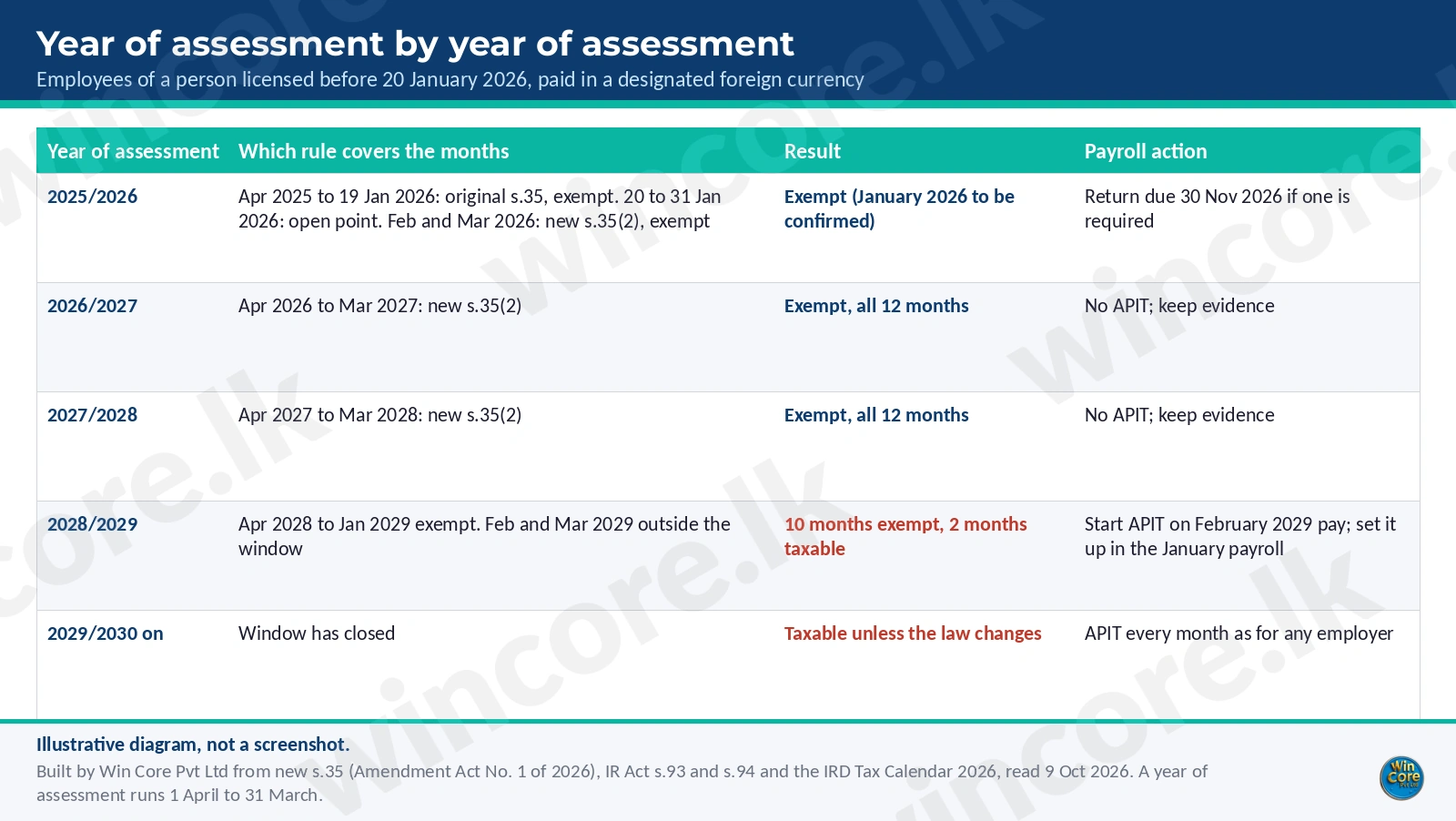
- Exemption window: three years from the month after January 2026, so 1 February 2026 to 31 January 2029.
- From 1 February 2029: salaries taxable, unless the law changes again.
That reading is ours from the primary texts, and it matches the published commentary we checked: KPMG's January 2026 note says the amendment "came into effect on January 20, 2026" [14] [15], and AW Chambers' Port City guide reaches the same 20 January cut-off and February 2026 start through the same Article 80(1) route [16]. One honest caveat: the Constitution speaks of a Bill "becoming law", while section 35 speaks of "comes into operation". With no separate commencement clause we treat them as the same day, and so does every source we found, but no court or IRD notice has said so in terms.
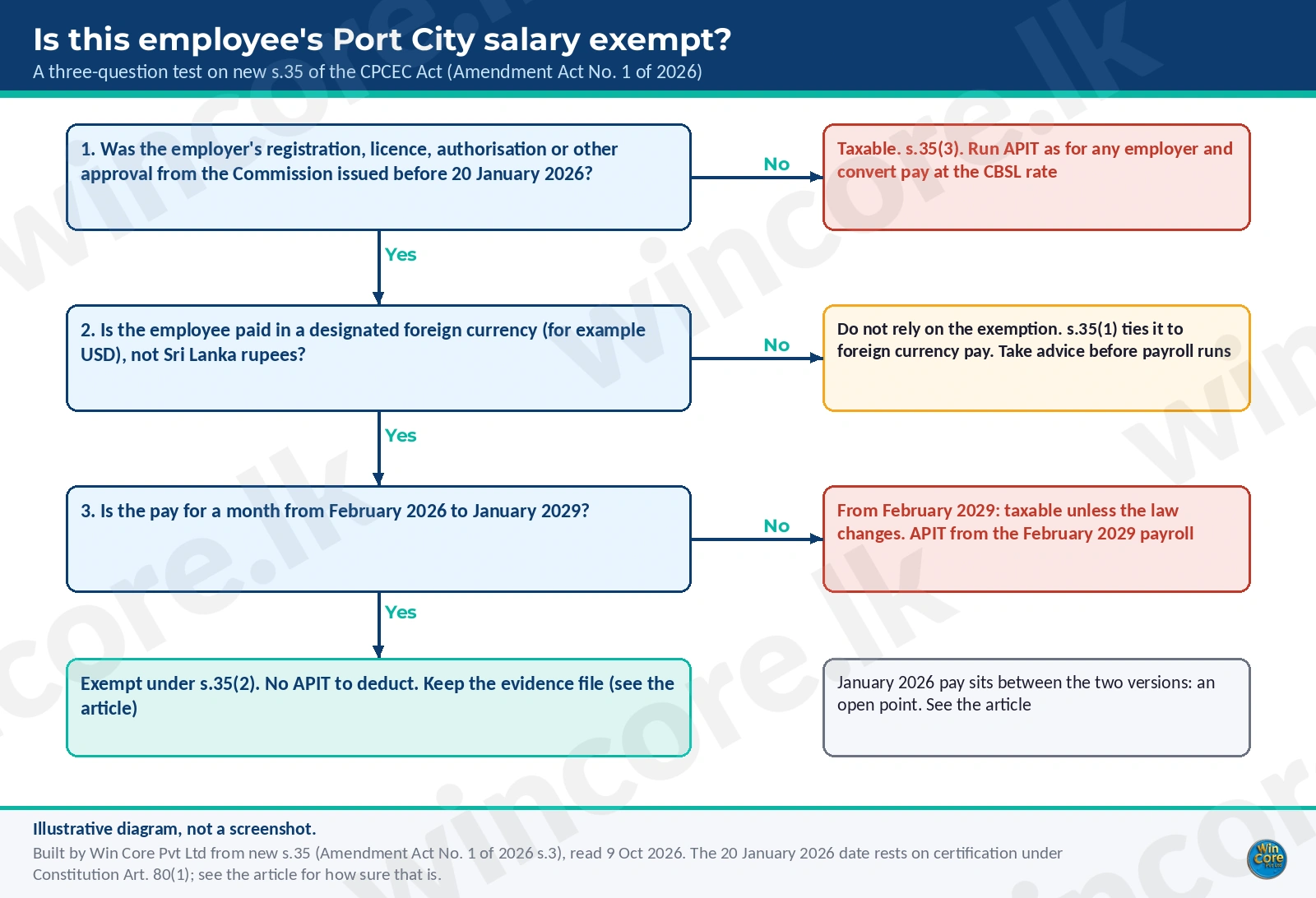
Who qualifies for the Port City employee income tax exemption
Run each employee through three questions.
- Was the employer's registration, licence, authorisation or other approval issued by the Commission before 20 January 2026? If the first approval came on or after that date, section 35(3) applies and the salary is taxable now [1].
- Is the employee paid in a designated foreign currency, not rupees? Section 35(1) says the employee "shall be remunerated in a designated foreign currency" [1]. "Designated foreign currency" means a currency designated by the Monetary Board under section 25 of the Banking Act, as defined in the principal Act [3]. US dollars are the usual case.
- Is the pay for a month from February 2026 to January 2029? If yes, it is exempt; residents and non-residents alike [1].
Two traps sit inside question 1. First, Port City licences run for twelve months and are renewed [13]. If a licence is not renewed within forty-five days of expiry, the holder ceases to be an Authorised Person from the expiry date (reg 24) [13]. Our reading is that a company that lets its licence lapse and is licensed afresh after 20 January 2026 risks being treated as "licensed on or after" commencement, which would take its staff out of the exemption. Renew on time and keep every renewal. Second, the test is the Commission's approval, not your incorporation date or the date you hired the employee. A new hire in 2027 at a pre-cut-off employer is inside the window. A Business of Strategic Importance Order does not change the test either: section 35 does not mention BSIs and turns only on the Commission approval date, on our reading.
Resident and non-resident staff get different exemptions
Section 35(2) has two limbs, and they are not the same [1].
- Resident employee, s.35(2)(a). Employment income is exempt from income tax and is deemed a permissible credit to the employee's personal foreign currency account. The second half is a foreign exchange point: the dollar salary may go into that account.
- Non-resident employee, s.35(2)(b). Employment income is exempt and, "notwithstanding anything to the contrary contained in any other written law", the employee is not liable to Sri Lankan income tax on income earned outside Sri Lanka.
So a non-resident employee at a qualifying employer gets two things: the Port City salary is exempt, and their income from outside Sri Lanka is not taxed here. A resident colleague gets the salary exemption only. Residence is decided under the Inland Revenue Act for each year of assessment, so check it every year before relying on the exemption.
The Inland Revenue Act follows section 35 through the Third Schedule
The Port City Act grants the exemption; the Inland Revenue Act No. 24 of 2017 has to recognise it, and it does so through the Third Schedule.
- Exempt amounts are excluded from employment income (s.5(3)(a)) and amounts in the Third Schedule are exempt (s.9(1)) [5].
- Paragraph (x) of the Third Schedule, added by the Inland Revenue (Amendment) Act No. 4 of 2023 (s.20), exempts "the employment income of an employee employed in terms of section 35 of that Act, up to the extent provided for in that Act for each year of assessment" [6].
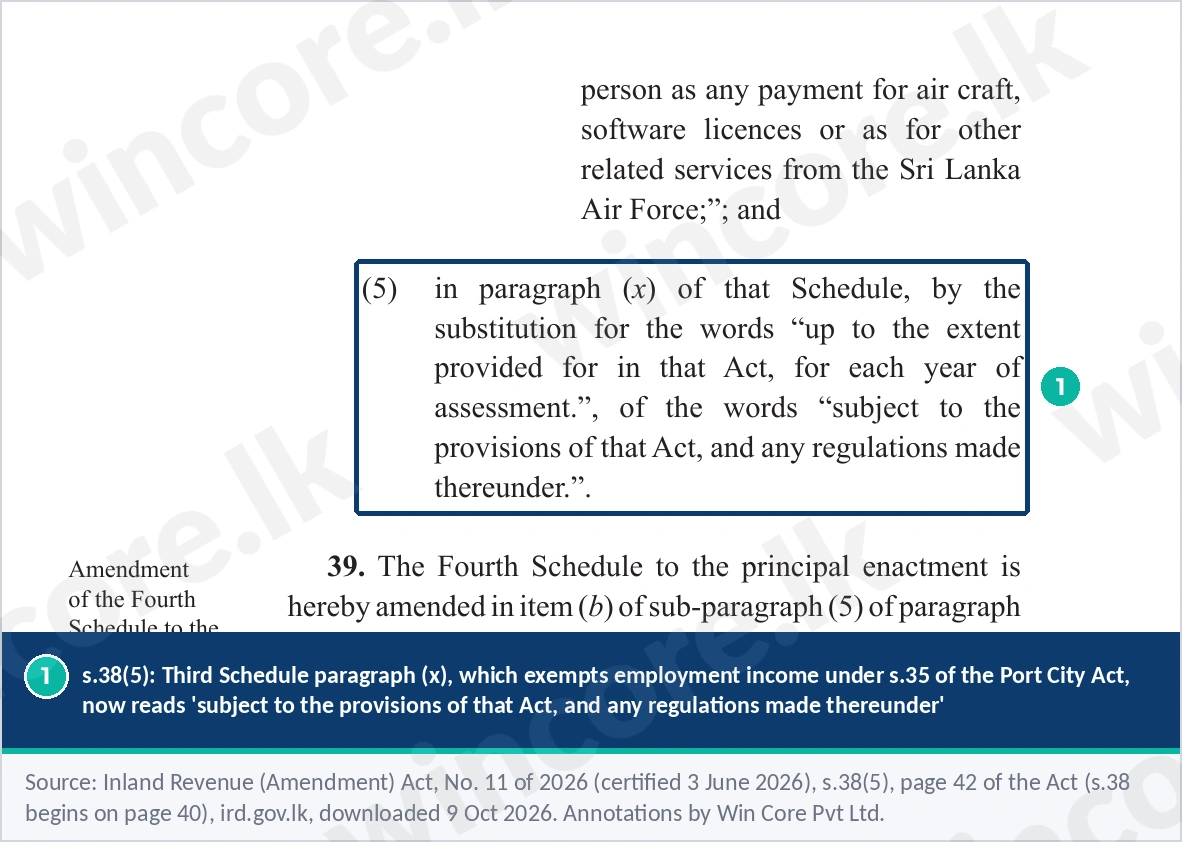
- The Inland Revenue (Amendment) Act No. 11 of 2026, certified 3 June 2026, replaced those last words with "subject to the provisions of that Act, and any regulations made thereunder" (s.38(5)) [7]. That change is not in the Act's table of special dates, so it took effect on 3 June 2026 (s.1(2)) [7].
Either wording points back to section 35, so the IR Act exemption follows the Port City Act's hourglass, not the other way round.
No APIT on exempt pay
APIT is withheld from employment income. The IRD's own APIT table notes for 2025/26 say: "Other than the exempt amounts given in the Third Schedule of the Inland Revenue Act, No. 24 of 2017 (as amended), no exemptions are available for employment income" [8]. Section 35 pay is in the Third Schedule, so for a qualifying employee in the window there is nothing to withhold.
For everyone else, APIT applies in the ordinary way:
- staff of a Port City business first licensed on or after 20 January 2026, from their first payslip;
- staff of a pre-cut-off employer from February 2029 payroll;
- any pay that falls outside the conditions, for example a salary paid in rupees.
Foreign currency pay that is taxable is translated into rupees at the Central Bank rate on the date the amount is taken into account, unless the Commissioner-General specifies otherwise (s.26(6)) [5]. Our salary calculator and APIT lookup give the APIT on a rupee figure, and our note on APIT for mid-year joiners and leavers covers the part-year arithmetic that February 2029 will bring.
The T-10 is the IRD's "Certificate of Income Tax Deductions", the withholding certificate an employer gives each employee under section 87 [10] [5]. Its job is to certify tax deducted: it records the deduction, not the reason for it, and "the employer did not deduct" is not the same statement as "the income is exempt". That is why we do not use it as proof here.
The annual APIT statement has the same gap. Section 86(2) requires a withholding agent to file an annual statement of payments "subject to withholding" within thirty days after 31 March [5]. Exempt section 35 pay is not subject to withholding. The IRD's 2025/26 guide to the annual statement has a place for exempt remuneration only for employees "whose tax have been deducted under APIT", and its list of employees without deductions is for those under the Rs 150,000 a month threshold [9]. There is no box designed for a fully exempt Port City employee. If you also run a taxable payroll and file the statement, we would ask the IRD in writing how it wants section 35 staff shown, rather than guess.
What this means for you
If you are the employer. Nothing in the Act or any IRD notice we read requires you to file anything with the IRD to claim the exemption, or to issue a particular certificate [1] [11]. What you need is a file that proves the three facts, kept for as long as your accounting records: at least ten years under reg 16(c) [13]. The monthly payroll register in the currency of pay, with rupee equivalents at the Central Bank rate, matters twice: employees need it for their records, and you will need it when APIT starts in February 2029.
Checklist: documents needed
- First Commission registration, licence or approval, dated before 20 January 2026
- Every licence renewal since, each within 45 days of expiry
- Employment contracts stating pay in a designated foreign currency
- Bank records showing salaries paid from the foreign currency account
- Monthly payroll register in the currency of pay with Central Bank rupee equivalents
- Residence status of each employee for the year of assessment
- Keep evidence of the three facts for each employee and year
If you are the employee. A resident individual who has no tax payable for the year is not required to file a return (s.94(1)(a)(i)), unless the Commissioner-General serves a notice requiring one (s.94(2)) [5]. The IRD's June 2026 notice gives a similar relief to employees whose only income is employment income fully subject to APIT, and adds that once the IRD opens a file for you, you keep filing until it is closed [11]. It does not mention exempt Port City pay, so for that we rely on section 94 itself. If you do file, because you have rent, interest or other income, show the Port City salary as exempt and keep a record of the exempt pay with your papers. Returns for 2025/26 are due by 30 November 2026 [12].
If you are about to be licensed. Plan your payroll on the basis that salaries are taxable from the first month, with APIT and EPF and ETF from day one. Our payroll team sets this up for new Port City employers, and our income tax advisory services cover the IRD side.
Four points the law does not answer yet
We would rather say these plainly than paper over them.
- 20 to 31 January 2026. The original section 35 was repealed on 20 January; the new window starts on 1 February. Pay for those twelve days sits between the two. We know of no IRD statement on it.
- "Other approval". Whether an approval in principle from the Commission before 20 January counts as an "other approval" when the licence itself came later. The wording is wide; nobody has tested it.
- Mixed pay. Whether a rupee allowance paid alongside a dollar salary is outside the exemption. New section 35(2) does not repeat the old words "so received", but subsection (1) still requires pay in a designated foreign currency. We would keep all pay in dollars.
- Reporting. How the IRD wants exempt staff shown on an annual APIT statement, if at all (see above).
FAQ
Is my Port City salary still tax free in 2026?
Yes, if your employer's Commission approval predates 20 January 2026 and you are paid in a designated foreign currency. The exemption covers pay for February 2026 to January 2029 under the new section 35(2), for residents and non-residents alike. If either condition fails, the salary is ordinary employment income and APIT applies [1].
My employer was licensed in March 2026. Is my salary exempt?
No. Section 35(3) makes the employment income of staff of a person licensed or approved on or after 20 January 2026 liable to income tax. Your employer should deduct APIT from your first payslip under the ordinary tables, and convert any foreign currency pay at the Central Bank rate [1] [5].
Will my Port City employer issue a T-10?
Not as proof of exemption. A T-10 certifies tax deducted under section 87: it records the deduction, not the reason for it. For the exempt months, ask your employer what evidence it keeps of the three facts. For any taxable months, the T-10 is the right document [10].
What happens to Port City salaries in February 2029?
On the law as it stands, salaries become taxable from February 2029 pay, and APIT starts that month. The 2028/29 year will have ten exempt months and two taxable ones. Watch for regulations, because paragraph (x) of the Third Schedule now refers to "any regulations made thereunder" [1] [7].
Do EPF and ETF apply to Port City employees?
Yes. Neither the EPF Act nor the ETF Act is among the enactments disapplied in the Port City under Schedule III, or listed for exemption in Schedule II, of the principal Act. Contributions continue whatever the income tax position. See our EPF and ETF guide for 2026 for rates and due dates [3].
Port City employers also deal with BSI Orders gazetted one by one: see Port City BSI tax relief, gazette by gazette.
Talk to us. If you employ staff in Port City and want the evidence file set up before employees' returns fall due on 30 November, book a consultation at our contact page.
WinCore Pvt Ltd
References
- Parliament of Sri Lanka. Colombo Port City Economic Commission (Amendment) Act No. 1 of 2026 (certified 20 January 2026; Gazette supplement of 23 January 2026), s.3 (new s.35) and s.18. https://www.portcitycolombo.gov.lk/resources/documents/acts/01-2026_E.pdf . Primary. Accessed 9 October 2026.
- Department of Government Printing, Government Publications Bureau. Colombo Port City Economic Commission (Amendment) Act No. 1 of 2026 (same text as [1]). https://documents.gov.lk/api/content-file-proxy?file=%2Fact-content%2F01-2026_E_1784552762.pdf . Primary. Accessed 9 October 2026.
- Parliament of Sri Lanka. Colombo Port City Economic Commission Act No. 11 of 2021, s.35 (original) and interpretation section ("designated foreign currency"). https://www.portcitycolombo.gov.lk/resources/documents/acts/11-2021_E.pdf . Primary. Accessed 9 October 2026.
- Parliament of Sri Lanka. The Constitution of the Democratic Socialist Republic of Sri Lanka, Article 80(1). https://www.parliament.lk/files/pdf/constitution.pdf . Primary. Accessed 9 October 2026.
- Inland Revenue Department. Inland Revenue Act No. 24 of 2017, consolidated text (amendments to 2025), ss.5(3)(a), 9(1), 26(6), 86(2), 87, 94(1)(a)(i), 94(2). https://www.ird.gov.lk/en/publications/Acts_Income%20Tax_2017/IRA_Cons_Act_-_2025_Changes.pdf . Primary. Accessed 9 October 2026.
- Parliament of Sri Lanka. Inland Revenue (Amendment) Act No. 4 of 2023, s.20(5) (new Third Schedule para (x)). https://www.ird.gov.lk/en/publications/Acts_Income%20Tax_2017/IR_Act_No._04_2023_E.pdf . Primary. Accessed 9 October 2026.
- Parliament of Sri Lanka. Inland Revenue (Amendment) Act No. 11 of 2026 (certified 3 June 2026), ss.1(2), 1(3) and 38(5). https://www.ird.gov.lk/en/publications/Acts_Income%20Tax_2017/IR_Act_No_11-2026_E.pdf . Primary. Accessed 9 October 2026.
- Inland Revenue Department. APIT Tax Table 01, Y/A 2025/2026, text and notes, note 07. https://www.ird.gov.lk/en/publications/APIT_Tax_Tables/2025-2026/Table%20-%201/02.%20APIT_2526_Table_01_Text.pdf . Primary. Accessed 9 October 2026.
- Inland Revenue Department. Guide to fill Annual Statement of Employer, APIT and Schedules, Y/A 2025/2026, Part I, Part II(a) and Schedule 03. https://www.ird.gov.lk/en/Downloads/Other_PAYE_Doc/Asmt_APIT_Guide_2025_2026_E.pdf . Primary. Accessed 9 October 2026.
- Inland Revenue Department. T-10, Certificate of Income Tax Deductions (form). https://www.ird.gov.lk/en/Type%20of%20Taxes/Pay%20as%20Your%20Earn_Annual%20Declaration%20of%20Employer/APIT_T10_NEW_2021.pdf . Primary. Accessed 9 October 2026.
- Inland Revenue Department. Public notice SEC/PN/IT/2026/02 on filing income tax returns for Y/A 2025/2026 (8 June 2026), item 12. https://www.ird.gov.lk/en/Lists/Latest%20News%20%20Notices/Attachments/794/SEC_PN_IT_2026-02_E.pdf . Primary. Accessed 9 October 2026.
- Inland Revenue Department. Tax Calendar 2026, 30 November 2026 entry. https://www.ird.gov.lk/en/publications/Tax%20Calendar_Documents/Tax_Calendar_2026_E.pdf . Primary. Accessed 9 October 2026.
- Minister of Finance with the Colombo Port City Economic Commission. Regulations No. 01 of 2022, Gazette Extraordinary No. 2299/46 of 28 September 2022, regs 8(b), 16(c), 21, 24. https://www.portcitycolombo.gov.lk/resources/documents/extragazettes/2299-46_E.pdf . Primary. Accessed 9 October 2026.
- KPMG (United States). TaxNewsFlash: Sri Lanka, amended tax incentives and exemptions for Colombo Port City (January 2026). https://kpmg.com/us/en/taxnewsflash/news/2026/01/tnf-sri-lanka-amended-tax-incentives-and-exemptions-colombo-port-city.html . Secondary. Accessed 9 October 2026.
- KPMG Sri Lanka. KPMG Tax News (listing of 2026 tax updates). https://kpmg.com/lk/en/insights/news-and-updates/kpmg-tax-news.html . Secondary. Accessed 9 October 2026.
- AW Chambers. Investing in Port City Colombo (law stated 29 September 2026), chapter on employment and section 35. https://www.awchambers.com/AW-Chambers-Port-City-Guide.pdf . Secondary. Accessed 9 October 2026.
Put these insights to work
WinCore specialists can review your current workflow, document gaps, and build a practical 90-day action plan.
Book a free consultationContinue reading
Explore more WinCore analysis to keep your finance, tax, and compliance roadmap moving.

APIT deduction for Sri Lankan employers: the five bands, which IRD table applies to bonuses, joiners, second jobs and terminal pay, T-10s and annual statement.
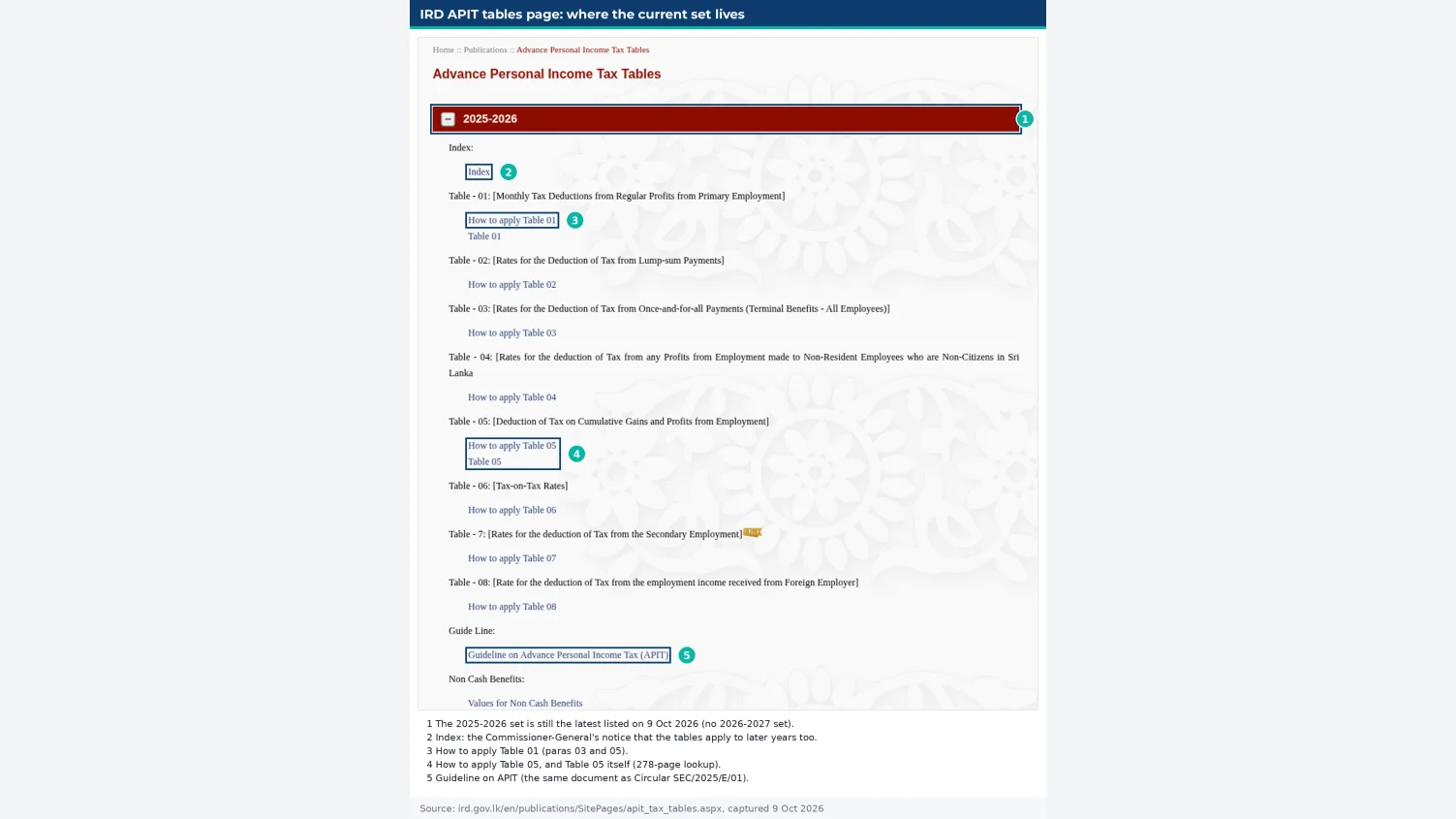
Staff who join or leave mid-year need APIT Table 05, not Table 01. Why it matters, with worked examples and the T-10 annual return steps.
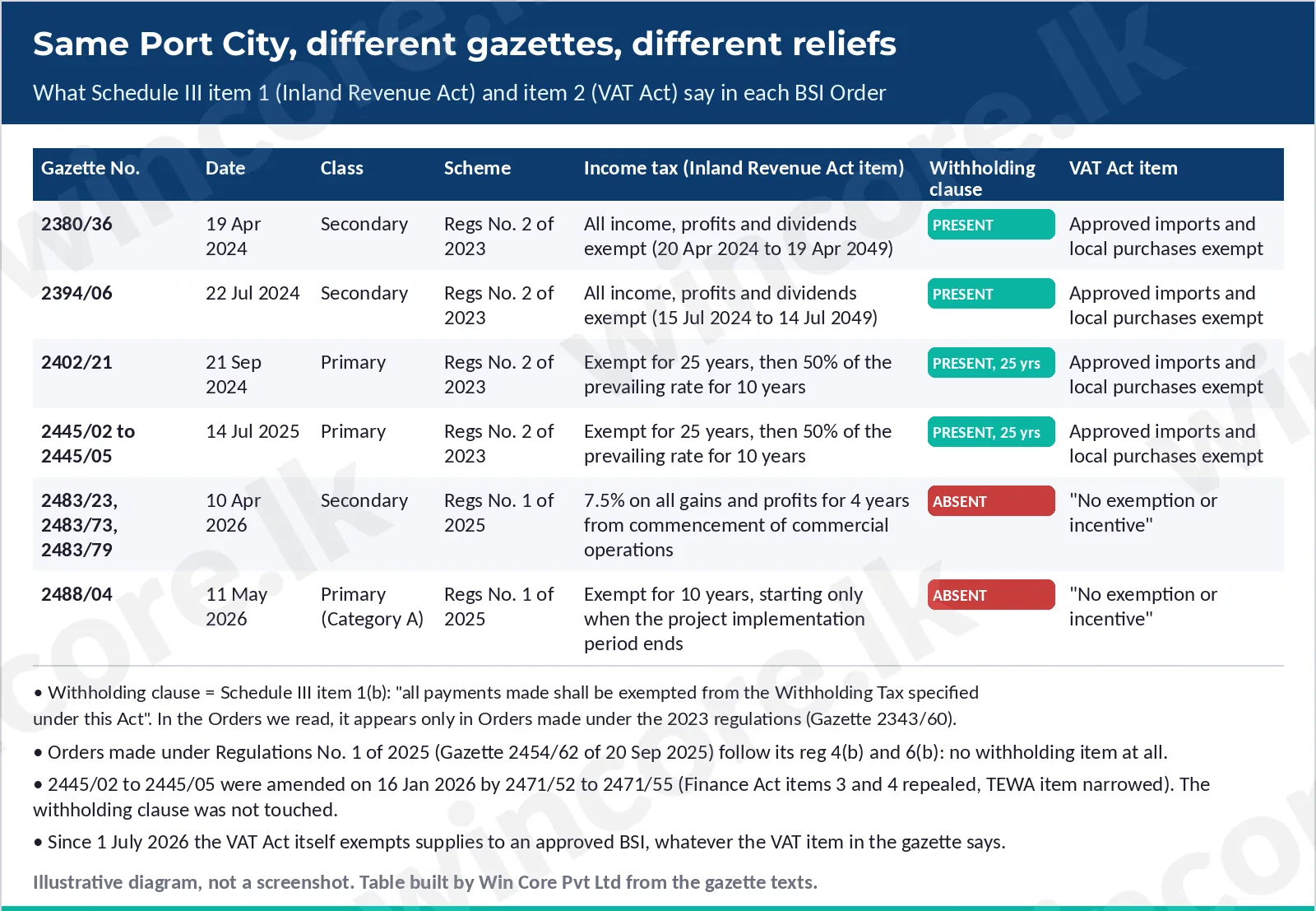
Two BSI schemes, two kinds of Order. Which Port City gazettes carry the withholding clause, which give 7.5 percent, and how to read yours.