
Budget 2027 VAT changes: what is proposed for Sri Lankan businesses?
See the proposed VAT treatment of books, exporters and input tax from April 2027 alongside the law that applies before any amendment.
On this page
Last verified against the primary sources on 12 November 2026.
Last updated 12 November 2026.
Budget 2027 VAT changes, in brief. The Ministry of Finance Budget Speech of 12 November 2026 proposes VAT exemptions for specified books and a more than 80 percent export turnover test for newly registered persons. Annexure V proposes 1 April 2027 as the general start date, subject to enacted law. The speech itself does not change VAT law. [1]
An invented cashew processor that registered for VAT in November 2026 has exports of Rs 4,873,221 and total sales of Rs 5,800,540 over its first six months, an export share of 84.01 percent. This is above the proposed test. A bookshop can check the listed classifications. Neither example makes the proposals law. [1] [2] [3]
What changed
12 November 2026: The Budget Speech set out the proposals and their general proposed commencement date. [1]
What do the budget 2027 VAT changes propose?
The table compares the speech with the law and official guidance available on 12 November 2026. The proposed date is 1 April 2027 unless the eventual legislation specifies otherwise. A Budget Speech is a policy announcement, not an amendment to the VAT Act. [1]
| Measure and speech item | Existing rule or position | Budget 2027 proposal | Proposed date |
|---|---|---|---|
| Books, item 2.1 | VAT applies to taxable supplies and imports subject to the Act's exemptions. The speech says printed books became taxable in January 2024 and exercise books were taxable before then. | Exempt import or supply of the seven listed classifications. | 1 April 2027 |
| Artemia eggs and coir pith, item 2.2 | The Act lists artemia eggs among specified exempt goods, subject to classification. The Customs import tariff marks coir pith under the named code as VAT exempt. | Remove the exemptions for the two specified classifications. | 1 April 2027 |
| Cinema tickets, item 2.3 | Section 5 addresses value of supply. The 2026 amendment already allows the stated Entertainment Tax deduction for a film exhibition ticket. | Determine liability using each named party's share, using ticket value after Entertainment Tax and before VAT. | 1 April 2027 |
| New exporters, item 2.4 | The section 83 definition looks at more than 50 percent zero rated supplies in the preceding calendar year. | Recognise newly registered persons with more than 80 percent export turnover in the preceding six months. | 1 April 2027 |
| Currency conversion, item 2.5 | The IRD invoice circular describes a Central Bank selling rate for specified approved foreign currency invoices; section 5 governs supply value. | Apply the Central Bank indicative rate as specified by the Commissioner General. | 1 April 2027 |
| Electronic invoices, item 2.6 | Section 20 governs when tax invoices are required and provides for a gazetted format. Existing digital invoice treatment depends on the applicable provision. | Recognise electronic invoices as legally valid and specify their format and requirements by gazetted order. | 1 April 2027 |
| Input tax and adjustments, item 7.9 | Section 22 links local and import claims to 12 and 24 month periods and return filing. Section 25 contains a six month condition for the specified input adjustment. | Retain 12 and 24 month claim periods irrespective of return date, align notes and clarify related matters. | 1 April 2027 |
| Pandemic returns, item 7.7 | The ordinary input tax limits and return rules apply unless a specific relief applies. | Recognise qualifying outstanding returns filed by 31 July 2026 for the described pandemic claims. | 1 April 2027, subject to the final legislation |
Source: Budget Speech 2027, Annexure V, items 2.1 to 2.6, 7.7, 7.9 and 9; VAT Act sections 5, 20, 22, 25 and 83; the 2026 amendment; IRD guidance and the Customs tariff. [1] [2] [4] [5] [6] [8]
The Budget 2027 tax proposals overview sets these measures alongside the other tax proposals. For VAT, keep the proposed and enacted positions in separate columns until the implementing law is available.
Which items would become VAT exempt?
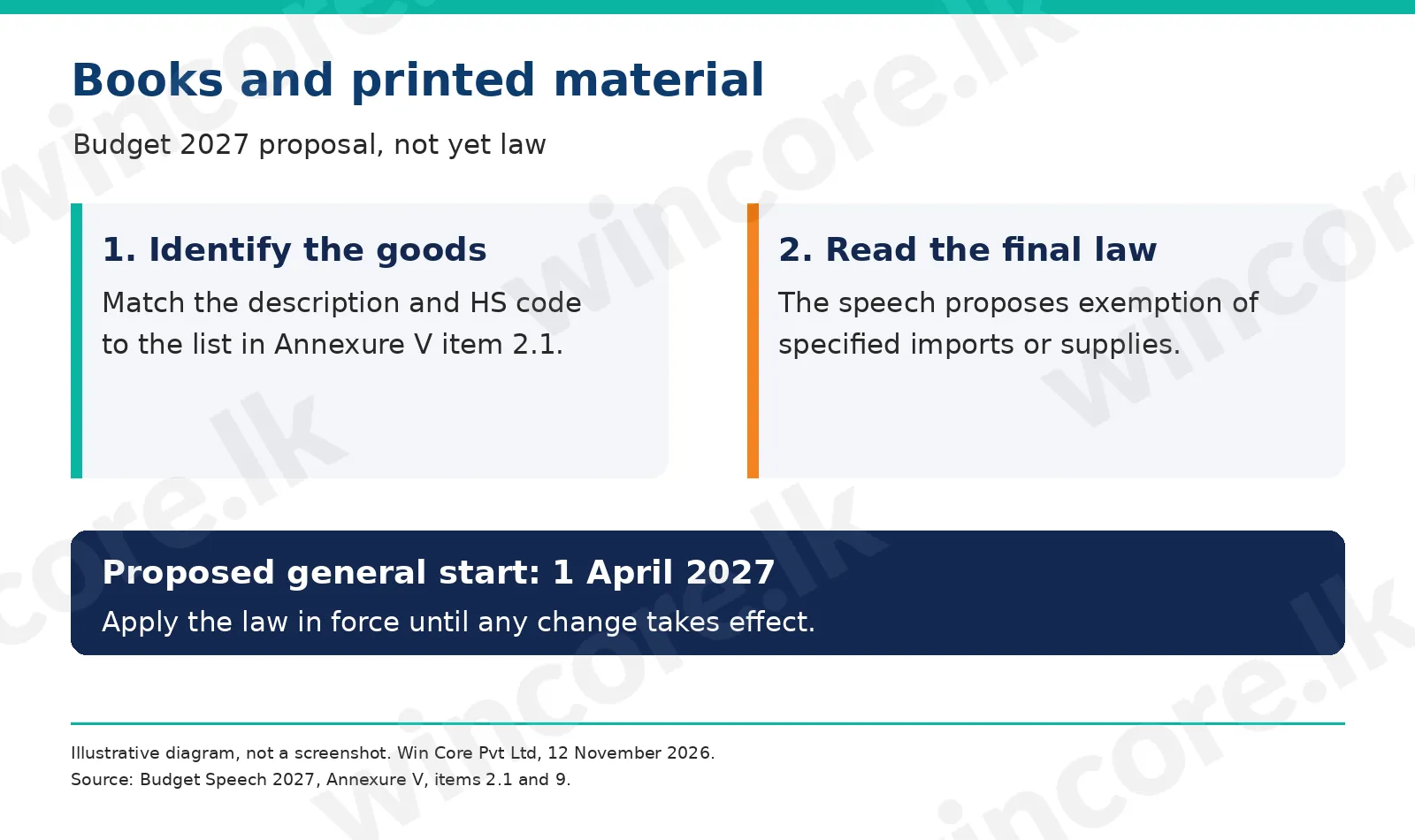
Budget 2027 proposes an exemption for the import or supply of the following books and printed materials, identified by the customs codes in Annexure V item 2.1. [1]
| HS code in the speech | Description in the speech |
|---|---|
| 4820.20 | Exercise books |
| 4901.99.10 | Printed books |
| 4901.91 | Dictionaries and encyclopaedias |
| 4903.00 | Children's picture, drawing or colouring books |
| 4901.10 | Printed matter in single sheets |
| 4904.00.10 | Music books or printed music |
| 4904.00.90 | Printed music other than in book form |
Source: Budget Speech 2027, Annexure V, item 2.1. Proposed from 1 April 2027 under item 9. [1]
Section 36.3 of the speech says printed books and other printed materials became subject to VAT from January 2024 and that exercise books were already subject to VAT. The proposal is based on listed classifications, so it should not be described as an exemption for every item a bookshop sells. The description and the classification both matter. [1]
For an invented bookshop, an exercise book classified under 4820.20 is within the list proposed for exemption. Until the proposal is implemented, apply the law governing the actual supply. If the exemption becomes law, an exempt sale is not the same as a zero rated sale: section 83 excludes exempt supplies from the definition of taxable supply, and input tax treatment depends on section 22 and the final amendment. [1] [2]
The VAT exemptions guide explains why classification and documentation matter. Keep the purchase and stock records that identify the goods, and review the final wording before changing sales or input tax treatment.
Which exemptions would end?
Budget 2027 proposes to remove the VAT exemptions for artemia eggs under HS 0511.91.20 and coconut coir pith under HS 1404.90.93. Annexure V item 2.2 identifies these two items, and item 9 supplies the general proposed date of 1 April 2027. [1]
The First Schedule Part III of the IRD consolidation lists artemia eggs among specified exempt goods, subject to classification. The 2026 Customs import tariff marks coir pith under HS 1404.90.93 as VAT exempt. The Customs guide addresses imports; it does not by itself settle every local supply. Do not assume the proposed change has taken effect. [1] [2] [6]
Removing an exemption changes the analysis of an item, not necessarily every transaction involving it. A business should identify whether it imports or supplies the item, the applicable classification, and its registration position. The text of the enacted amendment is what determines the final scope.
What changes for new exporters?
Budget 2027 proposes that a newly VAT registered person qualify as an eligible exporter when more than 80 percent of turnover in the preceding six months comes from exports. Exactly 80 percent does not satisfy the wording in Annexure V item 2.4. The proposal uses export turnover, and its final definition and evidence requirements are not yet set out in the speech. [1]
The existing section 83 definition, as substituted by the 2026 amendment, uses a different test: the person must be registered and the value of section 7 zero rated supplies in the preceding calendar year must be greater than 50 percent of total supplies in that same year. Zero rated supplies and exports are not interchangeable labels for every purpose. [2] [4]
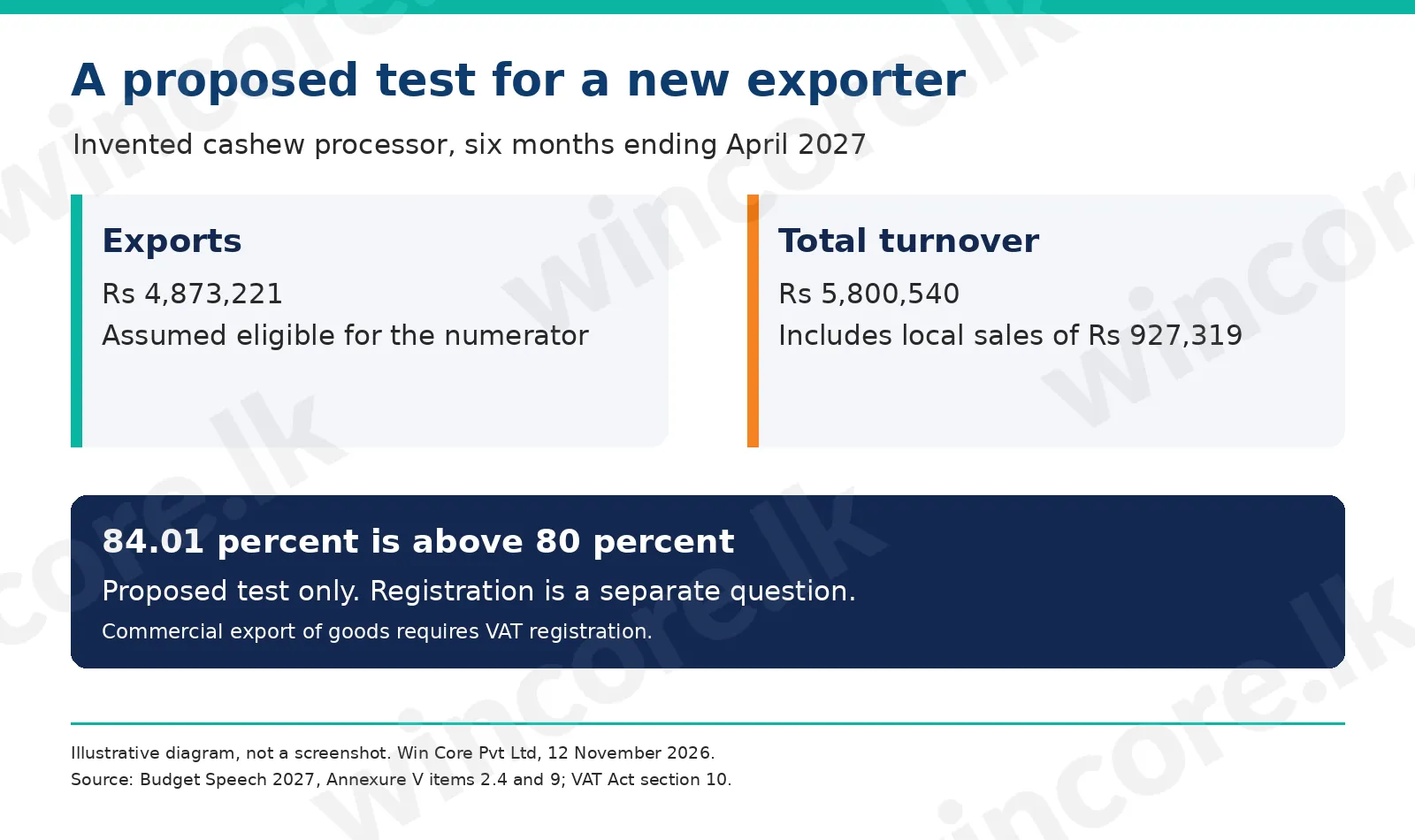
Consider an invented cashew processor that registered for VAT in November 2026, when it began exporting packed cashews for commercial purposes, as section 10 requires. In May 2027 it checks the proposed test. For illustration only, assume its records for November 2026 to April 2027 show the following totals and that all exports qualify for the proposed numerator. [1] [2] [3]
| Six month turnover | Invented amount |
|---|---|
| Exports | Rs 4,873,221 |
| Local sales | Rs 927,319 |
| Total | Rs 5,800,540 |
| Exports divided by total | 84.01 percent, rounded to two decimal places |
The calculation is Rs 4,873,221 divided by Rs 5,800,540, multiplied by 100. The result is approximately 84.013 percent, above the proposed 80 percent threshold. This illustrates the speech's arithmetic, not a grant of eligible exporter status. The final Act may specify how turnover and the six month period are measured. [1]
Registration comes first. Section 10 requires a person who exports goods for commercial purposes to be registered, irrespective of the general turnover thresholds, so the processor registered when its exports began. The table illustrates only the proposed percentage. It does not show that the person meets the final eligibility rules, which the implementing law will set. [2] [3]
The exporter VAT registration guide covers registration and the supporting records. The Budget proposal does not itself replace the registration requirements.
What changes for input tax claims?
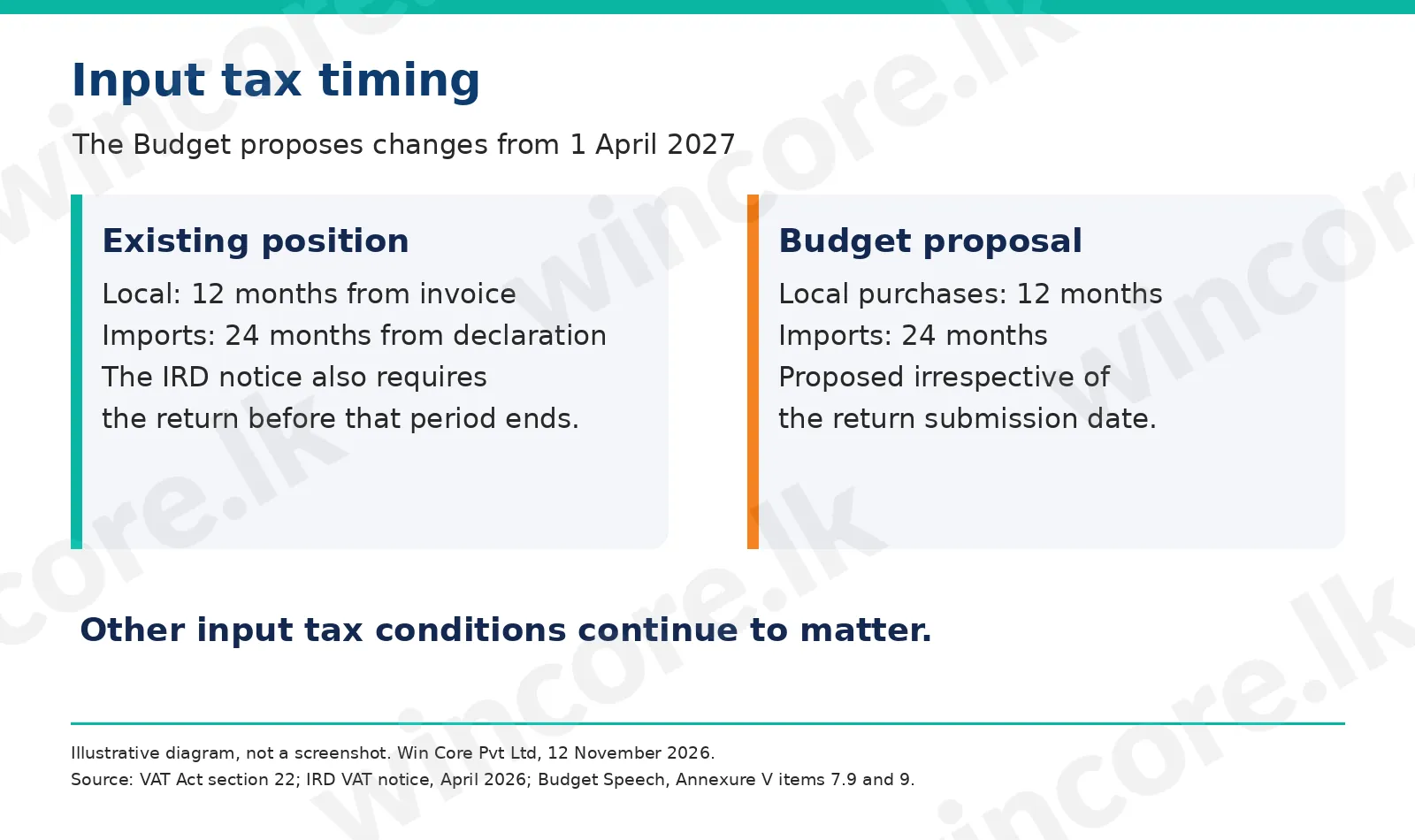
Budget 2027 proposes uniform claim periods of 12 months for local purchases and 24 months for imports, irrespective of the VAT return submission date. It also proposes to address differences between the Sinhala and English texts of the relevant provisions. These are proposals in Annexure V item 7.9, with the general proposed commencement of 1 April 2027. [1]
Section 22 contains the present conditions for deducting input tax. The IRD notice says the relevant return must be furnished before the applicable period expires: 12 months from the local tax invoice or 24 months from the customs declaration. The taxable period must end on or before that expiry. Other section 22 conditions also matter, including whether the cost relates to a taxable activity. The Budget proposes to resolve differences between language versions. Its wording is not permission to ignore the existing IRD filing position or a guarantee that every other condition will disappear. [1] [2] [5]
For credit and debit notes, section 25 addresses correction of incorrectly accounted tax after a tax invoice has been issued. Its proviso requires the relevant credit or debit note for an adjustment of input tax underclaimed on the original invoice to be issued no later than six months after that invoice. Budget 2027 proposes alignment with the timing of input tax claims and adjustments when tax invoices have not been issued. It does not supply a complete replacement rule. [1] [2]
The speech also proposes clarification of transactions on a non foreign exchange basis, transactions involving invoices that are not tax invoices, and consequences of exemptions. Section 22 has documentary conditions, including a valid tax invoice or customs declaration where applicable. The Budget text does not give a complete replacement rule or say that every transaction receives the same treatment. Preserve the documents and check the enacted text before changing the treatment. [1] [2]
What does the pandemic proposal say?
Annexure V item 7.7 proposes recognising outstanding pandemic period returns filed on or before 31 July 2026 as valid for eligible taxpayers whose input tax claims were disallowed because of filing delays. That date is before the speech on 12 November 2026. The proposal therefore does not announce a fresh opportunity to file by that date. Its scope, eligibility and effect must be read from the eventual amendment. [1]
Keep copies of the affected returns, filing acknowledgements and input documents. The speech alone does not establish that any particular claim has been restored or that a refund is due.
Are electronic invoices valid?
Budget 2027 proposes explicit legal recognition for digital or electronic invoices, with format, particulars and technical and procedural requirements set by an order published in the Gazette. It proposes this from 1 April 2027 under the general commencement provision. [1]
Section 20 already governs tax invoices, and the 2025 amendment empowers the Commissioner General to specify a format by gazetted order. The 2026 amendment also contains a specific provision concerning an invoice from a registered non resident digital service provider in defined circumstances. These existing provisions do not establish that every electronic invoice automatically meets every VAT requirement. [2] [3] [4]
Until any implementing amendment or valid order takes effect, use the applicable statutory and gazetted requirements. Check the invoice details, the transaction and the relevant input tax conditions together. The speech does not provide a final technical specification.
How would cinema tickets and exchange rates change?
For cinema tickets, Budget 2027 proposes that producers, distributors, the National Film Corporation and cinema hall operators calculate liability by reference to the share of ticket revenue received or appropriated by each party. The speech specifies a ticket value after Entertainment Tax and before VAT. [1]
There is an existing rule to keep alongside that proposal. Section 3 of the 2026 VAT amendment already added a proviso to section 5 concerning deduction of Entertainment Tax charged by a local authority where a film exhibition service is supplied on the issue of tickets. The proposed allocation by party is the distinct change described in the speech. [4]
For foreign currency supplies, item 2.5 proposes use of the Central Bank's indicative exchange rate as specified by the Commissioner General. Section 36.6 says the manner of application is to be specified by circular. The speech does not provide a conversion date or detailed method. [1]
For a registered person issuing a foreign currency tax invoice with the required Central Bank approval, the IRD invoice circular describes conversion using the Central Bank selling rate on the invoice date and specifies rupee amounts to display. This guidance is scoped to that invoice situation. Use the applicable invoice order and guidance for the transaction, and review the eventual instrument before changing a conversion process. [8]
Does the Budget change the VAT rate or registration threshold?
The 2027 speech's listed VAT proposals do not announce a change to the standard 18 percent VAT rate or the general registration thresholds. Under section 10, the general tests include taxable supplies exceeding Rs 15 million in the applicable taxable period or Rs 60 million in the preceding twelve months. The section also has prospective tests when supplies are likely to exceed those amounts. Different rules apply to financial services and specified categories, including commercial importers and exporters. [1] [2] [3] [7]
The speech also does not announce a general change to the corporate income tax rate, the general SSCL rate, EPF or ETF contribution rates, or the national minimum wage. It separately proposes an SSCL exemption for a specified fuel supply. This observation describes the speech, not a guarantee that no other law will change those rules. [1]
What this means for you
Separate the affected stock, sales, invoices and input tax records by issue. A bookshop can map its products to the listed HS codes, while an exporter can calculate the proposed six month share without treating that calculation as registration or approval. Keep applying the existing law until the relevant amendment or valid order takes effect. When the text is enacted, compare its commencement, definitions and transitional rules with the speech before changing the VAT treatment.
Checklist: documents needed
FAQ
Does Budget 2027 make books exempt immediately?
No. The speech proposes an exemption for the seven listed classifications from the general proposed date of 1 April 2027. A speech does not itself amend the VAT Act. Check the final legislation and the item's classification before changing the treatment of an import or sale. [1]
Does an export share above 80 percent mean automatic VAT registration?
No. The proposed test concerns eligible exporter status for newly registered persons, not the act of registering. Under the existing Act, commercial imports or exports can themselves create a registration duty. The proposal's final definitions, evidence requirements and commencement remain subject to the implementing law. [1] [2] [3]
Can a business file a pandemic return by 31 July 2027 under the proposal?
The speech does not give that date. Item 7.7 refers to returns filed on or before 31 July 2026, a date preceding the speech. It proposes relief for qualifying claims, but the text does not set out all eligibility conditions or create a new filing window ending in 2027. [1]
Does the proposal remove the need for a valid tax invoice?
No such general removal appears in the speech. It proposes clarification for transactions involving invoices that are not tax invoices and adjustments where tax invoices were not issued. Section 20 and the input tax conditions continue to matter until the law is amended, and the final details are not yet available. [1] [2]
The short version
Budget 2027 proposes targeted VAT changes, including specified book exemptions, a new test for newly registered exporters and changes to input tax administration. The general proposed start is 1 April 2027. The existing registration and invoice rules still matter. Follow the enacted text.
Talk to us. For help with VAT registration and returns, see our tax page or book a consultation at our contact page.
WinCore Pvt Ltd
This article is general information as at 12 November 2026 and is not tax, legal or accounting advice on your specific position.
Sources and references (11)
- Ministry of Finance, Planning and Economic Development. Budget Speech 2027, sections 36.3 to 36.6 and Annexure V items 2.1 to 2.6, 7.7, 7.9 and 9. https://www.treasury.gov.lk/api/file/ea495202-fcb1-4c78-b34e-58389cb20738 . Primary. Accessed 12 November 2026.
- Inland Revenue Department. Value Added Tax Act, No. 14 of 2002, IRD consolidation dated 26 December 2025, incorporating amendments up to 2025, sections 5, 10, 20, 22, 25 and 83 and First Schedule Part III. https://www.ird.gov.lk/en/publications/Value%20Added%20Tax_Acts/VAT_Act_No_14%5BE%5D_2002_%28Consolidation_2025%29.pdf . Primary, consolidation. Accessed 12 November 2026.
- Parliament of Sri Lanka. Value Added Tax (Amendment) Act, No. 4 of 2025, sections 1, 4 and 6. https://www.parliament.lk/uploads/acts/gbills/english/6380.pdf . Primary. Accessed 12 November 2026.
- Parliament of Sri Lanka. Value Added Tax (Amendment) Act, No. 14 of 2026, sections 3, 6, 8 and 16. https://www.parliament.lk/uploads/acts/gbills/english/6427.pdf . Primary. Accessed 12 November 2026.
- Inland Revenue Department. VAT payment and return notice for April 2026, input tax timing. https://www.ird.gov.lk/en/Lists/Latest%20News%20%20Notices/Attachments/785/VAT_18052026_26210_E.pdf . Primary, administrative. Accessed 12 November 2026.
- Sri Lanka Customs. National Imports Tariff Guide 2026, Chapter 14, HS 1404.90.93. https://www.customs.gov.lk/wp-content/uploads/2026/05/Tariff%202022%20Section%20I%20Final_Chap_14.pdf . Primary, tariff guidance. Accessed 12 November 2026.
- Inland Revenue Department. Tax chart 2025 to 2026, VAT rates and registration overview. https://www.ird.gov.lk/en/publications/SitePages/tax_chart_2526.aspx?menuid=140408 . Primary, administrative. Accessed 12 November 2026.
- Inland Revenue Department. Circular SEC/2026/E/03, section 4.7, revised tax invoice format. https://www.ird.gov.lk/en/publications/Circulars_Circulars/SEC_2026_E_03_E.pdf . Primary, administrative. Accessed 12 November 2026.
Related reading: Budget 2027 tax administration proposals; Budget 2027 import duty changes in Sri Lanka; E-invoicing Sri Lanka: the IRD phases.
Put these insights to work
WinCore specialists can review your current workflow, document gaps, and build a practical 90-day action plan.
Book a free consultationRecent articles



Continue reading
Explore more WinCore analysis to keep your finance, tax, and compliance roadmap moving.

A practical guide to the proposed Budget 2027 tax measures, their intended dates and the steps companies and employers can take.

VAT exemption errors create hidden tax leakage. Learn the exempt and zero-rated difference, the July 2026 changes, and the records needed to defend treatment.

Exporting goods makes VAT registration compulsory, whatever your turnover. What the Act requires, what the IRD's own guide asks for, and the fifteen days.