
How to hire employees in Sri Lanka: from job ad to probation
Hiring in Sri Lanka runs in two halves: a written process from job ad to letter, then day-one EPF, ETF and APIT duties and day 180 of probation.

On this page
Last verified against the primary sources on 26 October 2026.
How to hire employees in Sri Lanka comes down to a written process from job ad to signed letter, then statutory duties from the first payroll: EPF at 12 percent and ETF at 3 percent, both due by the last day of the following month, the employee's 8 percent EPF and APIT deducted, and a decision before day 180, after which the termination Act applies to workmen in scheduled employment (shops, offices, factories and Wages Board trades) of employers with fifteen or more workmen on average. The first half is mostly good practice, although shops and offices must give written particulars of employment, including any probation period, on the first day. This guide follows a logistics firm hiring a warehouse supervisor through both halves.
Scope. We cover a private employer hiring a resident citizen. We do not cover rules on discrimination or the wording of job advertisements, because we have not read a primary source on them for this piece. We also do not cover Wages Board minimum terms for particular trades.
The example
A Colombo logistics firm with 60 employees needs a warehouse supervisor. The budget is Rs 150,000 a month gross, all of it counting as earnings for EPF. The firm plans a six-month probation.
Write the job ad from the job and screen every applicant the same way
Write the ad from the job, not the person: duties, shift pattern, reporting line, location, and the salary band if you are willing to publish it. State the documents you will ask for at offer stage (national identity card, certificates, references). For checks on candidates, see what the PDPA lets employers do in a background check.
Screen against the same short list of criteria for every applicant, and keep the notes. For the supervisor role: years running a warehouse team, stock systems used, and a forklift or safety qualification if the role needs one. Interview with the same core questions, then a practical: walk the candidate through your own warehouse and ask how they would run the morning dispatch.
Keep records of who was shortlisted and why. They cost little and help if a decision is questioned later.
Our HR services page lists "Employee Recruitment" among its services [1].
Offer and letter of appointment
Put the offer in writing and follow it with a letter of appointment that covers, at least: job title, start date, place of work, salary and allowances (identify which count as earnings for EPF), hours, leave, the probation period and how confirmation happens, notice, and the documents the employee must provide. Our employment contract template is a starting point.
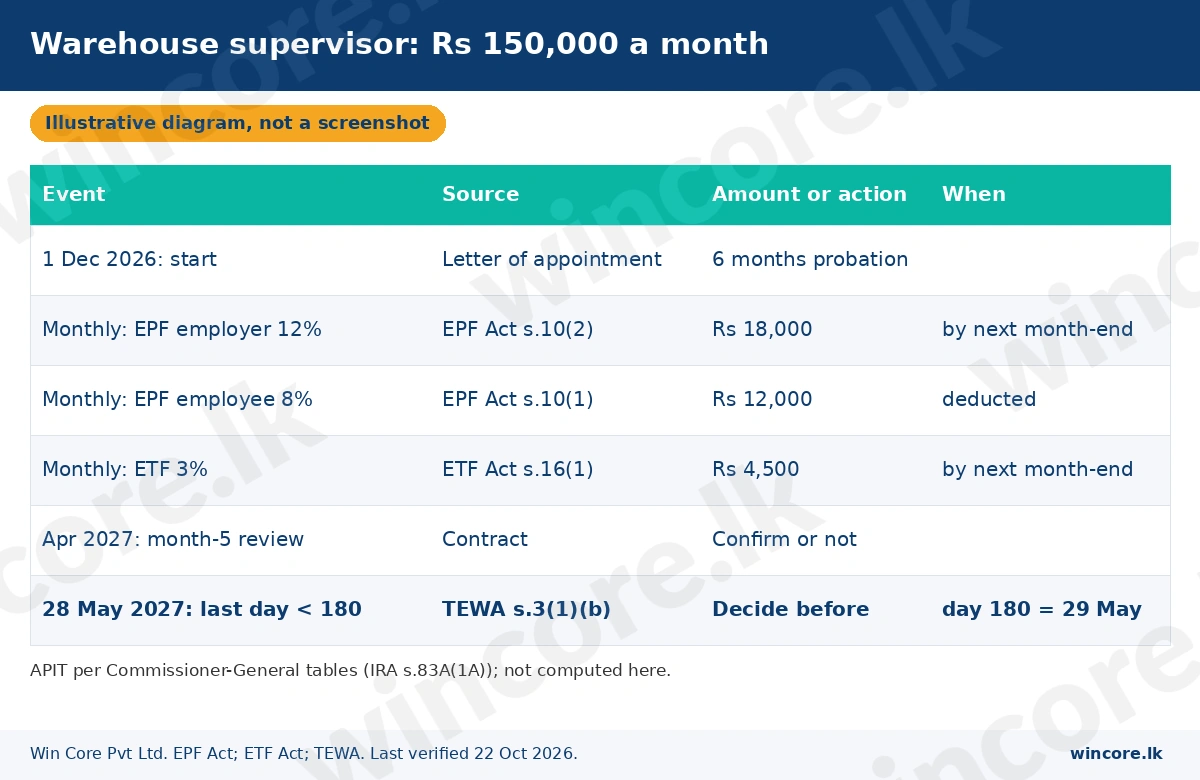
In the example: Rs 150,000 basic, start date 1 December 2026, six months' probation ending 31 May 2027, with a written review at month five.
How to hire employees Sri Lanka requires: the day-one duties
EPF
Section 10(2) of the Employees' Provident Fund Act makes the employer of every covered employee liable to pay, "on or before the last day of the succeeding month, a contribution of an amount equal to twelve per centum of such employee's total earnings" [2]. Section 10(1) sets the employee's own contribution at 8%. Both are "subject to the provisions of subsection (3) of this section and of section 27".
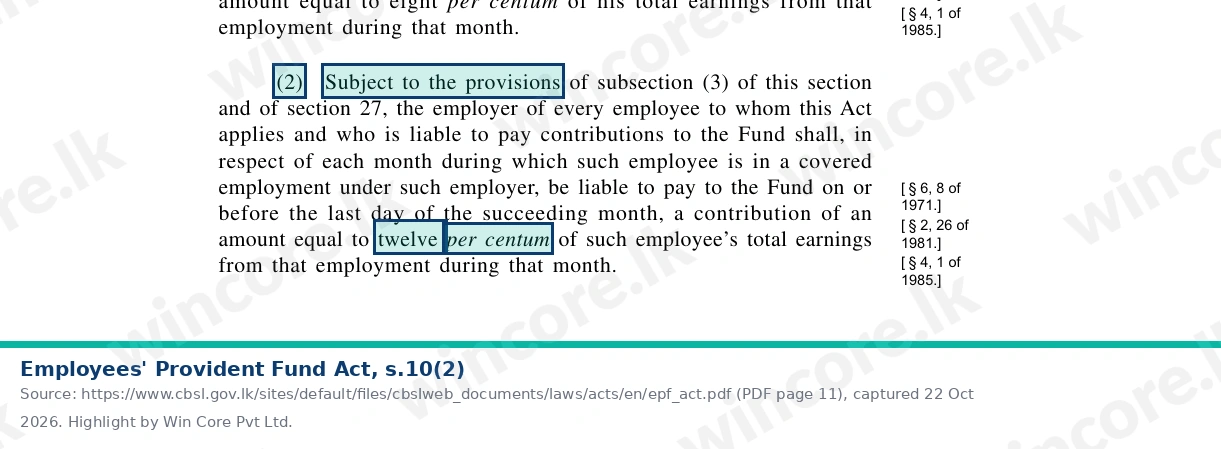
For the supervisor: employer 12% is Rs 18,000; employee 8% is Rs 12,000; total Rs 30,000 a month. December's contributions are due by 31 January 2027, which is a Sunday; paying by Friday 29 January is the safe practice. To try other salaries, use our EPF calculator.
The registration of the employer and of each new member is handled under the EPF regulations and the Labour Department's forms, which we did not read for this piece. See our EPF employer registration guide.
ETF
Section 16(1) of the Employees' Trust Fund Act makes the employer liable to pay "on or before the last day of the succeeding month, a contribution of an amount equal to three per centum of the total earnings" [3]. For the supervisor: Rs 4,500 a month, also due by 31 January 2027 for December.
What the supervisor costs the firm. Before APIT, the firm's monthly cost is Rs 172,500: Rs 150,000 gross, Rs 18,000 employer EPF and Rs 4,500 ETF. The supervisor's pay before APIT is Rs 138,000, which is Rs 150,000 less Rs 12,000 employee EPF. APIT comes off that figure under the Commissioner-General's tables and is not computed here.
APIT and the employee's TIN
Section 83A(1A) of the Inland Revenue Act says: "An employer shall deduct the Advance Personal Income Tax with effect from January 1, 2023 on any payment which falls under section 5 made to his employee, as specified by the Commissioner-General" [4]. The amount comes from the Commissioner-General's APIT tables, which we do not reproduce here; our APIT registration guide explains the employer's registration.
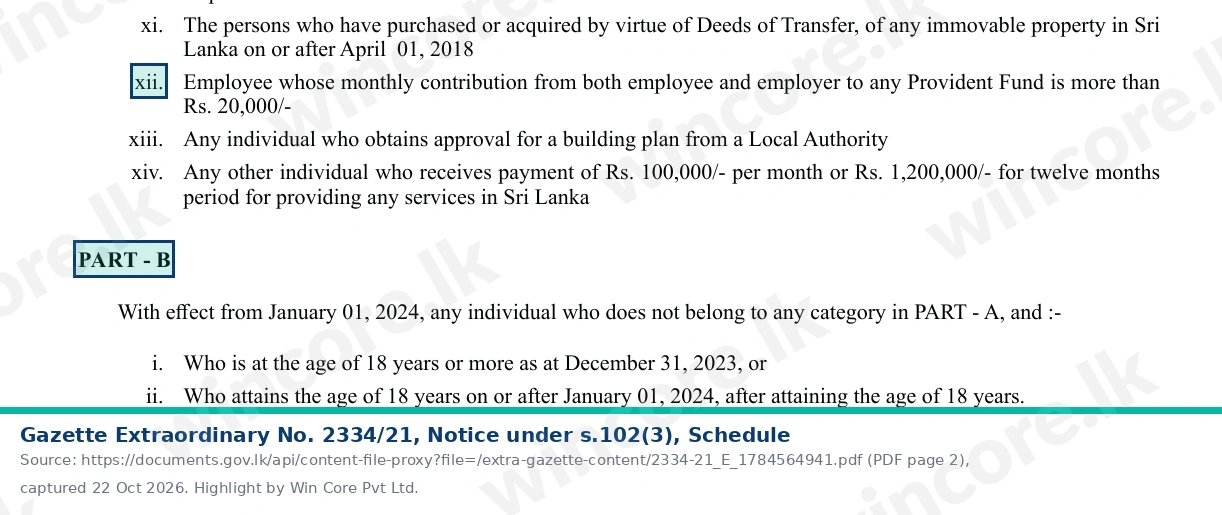
The employee's own registration matters too. Gazette Extraordinary No. 2334/21, a notice under s.102(3), lists as additional classes of "resident persons" required to register, from 1 June 2023, an "Employee whose monthly contribution from both employee and employer to any Provident Fund is more than Rs. 20,000/-", and from 1 January 2024 any individual aged 18 or more not otherwise listed [5]. The supervisor's Rs 30,000 combined EPF contribution puts him in the first class.
Probation is set by your letter, but day 180 changes the legal position
No Act we read sets a probation length for private employees. The period, the review and the confirmation are set by your letter of appointment. For a shop or office employee, section 17 of the Shop and Office Employees Act requires the employer to furnish the prescribed particulars "on the date of his employment", and regulation 15 of the 1954 Regulations lists them: they include "the period of probation or trial, if any, and the conditions governing such period", must be signed by the employer, and must be given in writing in a language the employee is "fully conversant" with [7]. Our guide to probation period rules covers practice.
What the statute does say is when the termination law starts to apply. Section 3(1)(b) of the Termination of Employment of Workmen (Special Provisions) Act takes out of the Act "the termination of employment of any workman who has been employed by an employer for a period of less than one hundred and eighty days", counted inclusive of approved absences, absences from work injury or a listed occupational disease, days on which the employer fails to provide work, up to thirty days of lockout or lawful strike, and holidays and leave the workman is entitled to by law, all "in the continuous period of twelve months commencing from the date of employment if such termination takes place within that period of twelve months". Section 3(1)(a) also excludes an employer "by whom less than fifteen workmen on an average have been employed during the period of six months preceding" [6].
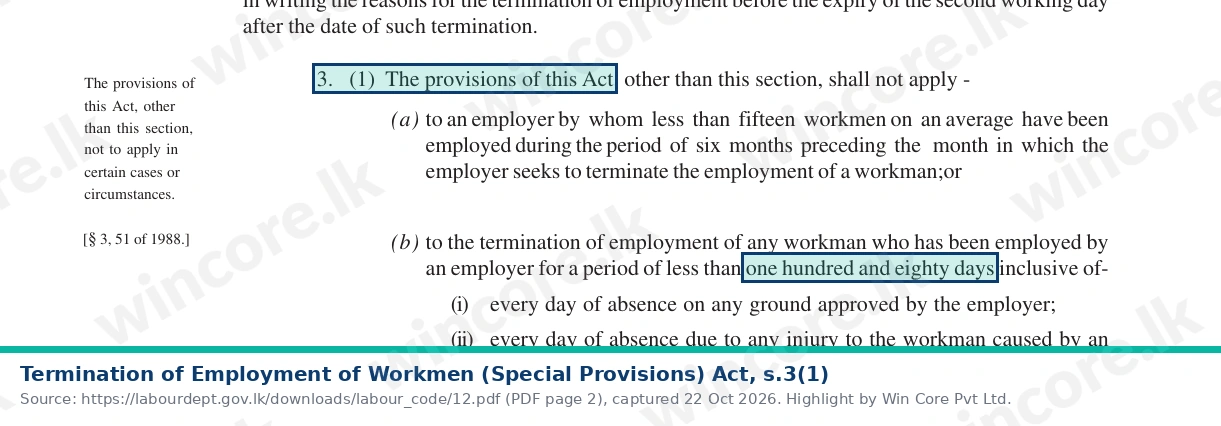
On our reading, the Act turns on days employed, not on the label "probation". A six-month probation starting 1 December 2026 runs to 31 May 2027, which is 182 days. The firm has 60 employees, so section 3(1)(a) does not help. If the firm wants to decline confirmation without the section 2 consent or approval route, it needs to decide and act while the supervisor has been employed for fewer than 180 days. Counting every calendar day from 1 December 2026 is the cautious reading: the listed absences and holidays count towards the 180, and only days outside the list, such as unapproved absence, could push the date later. On that count day 180 falls on 29 May 2027, so 28 May 2027 is the last safe date, and earlier is better. That is why the example review sits at month five.
When confirming, issue a confirmation letter. When not confirming, put the decision in writing and keep the review record. Our labour law guide for employers covers the wider rules.
What this means for you
- Keep the job ad, shortlist and interview notes for every hire.
- Put probation length, review and confirmation steps in the letter of appointment; no Act we read sets them, and for shop and office staff the 1954 Regulations require the letter to state any probation period and its conditions.
- Pay EPF at 12% and ETF at 3% by the last day of the following month, and deduct the employee's 8% EPF and APIT.
- Check whether the new employee falls in a TIN class under Gazette 2334/21.
- Diarise day 180. After it, the termination Act applies to employers with fifteen or more workmen on average, for workmen in "scheduled employment": a Wages Board trade, a shop or office, or a factory (s.19).
Checklist: documents needed
- Job description and approved salary band
- Shortlist and interview notes
- Signed offer and letter of appointment
- National identity card copy and certificates
- EPF and ETF member registration forms
- Employee TIN, if registered
- Probation review at month five
- Confirmation or non-confirmation letter
FAQ
What do I need to register on day one when I hire employees in Sri Lanka?
Plan for EPF, ETF and APIT from the first payroll. EPF Act s.10(2) makes you liable for 12% and ETF Act s.16(1) for 3%, both by the last day of the following month. Inland Revenue Act s.83A(1A) requires APIT deduction as specified by the Commissioner-General. Member registration forms come from the regulations, which this guide does not cover.
Is probation defined by law in Sri Lanka?
No Act we read sets a probation length; the letter of appointment does. For shop and office staff, regulation 15 of the 1954 Regulations requires that letter to state any probation period and its conditions. The termination Act does not apply while a workman has under 180 days in his first twelve months (s.3(1)(b)), or to employers averaging fewer than fifteen workmen (s.3(1)(a)).
Can I extend probation beyond six months?
Your contract can say so, but the termination Act counts days of employment, not the label. After 180 days, an employer with fifteen or more workmen on average, employing a workman in scheduled employment, needs the workman's written consent or the Commissioner's prior written approval for a non-disciplinary termination under s.2(1). Decide before day 180 if you may not confirm.
Does a new employee need a TIN?
Often, yes. Gazette 2334/21 lists resident employees whose combined monthly provident fund contribution exceeds Rs 20,000 as a class required to register from 1 June 2023, and any individual aged 18 or more from 1 January 2024. A supervisor on Rs 150,000 has Rs 30,000 a month in combined EPF contributions.
The short version
Recruit on written criteria, appoint in writing, pay EPF, ETF and APIT from the first month, and treat day 180 as the real end of probation.
Talk to us. If you are hiring and want the process set up, see our HR services.
WinCore Pvt Ltd
This page reflects the Acts and gazettes as read on 26 October 2026. It is general information and not advice on your specific situation.
Related reading
- Letter of appointment Sri Lanka: what the law requires
Sources and references (8)
- WinCore Pvt Ltd. HR Services page, "What's Included". https://wincore.lk/services/hr . Own service page. Accessed 26 October 2026.
- Employees' Provident Fund Act, No. 15 of 1958, s.10(1) and (2), Central Bank of Sri Lanka reprint with amendments to 31 December 1998 (not a statutory reprint). https://www.cbsl.gov.lk/sites/default/files/cbslweb_documents/laws/acts/en/epf_act.pdf . Primary. Accessed 22 October 2026.
- Employees' Trust Fund Act, No. 46 of 1980, s.16(1), ETF Board copy with amendments to Act No. 18 of 1993. https://etfb.lk/wp-content/uploads/2021/03/ETF-Act.pdf . Primary. Accessed 22 October 2026.
- Parliament of Sri Lanka. Inland Revenue (Amendment) Act, No. 45 of 2022 (certified 19 December 2022), s.15, inserting s.83A(1A) into the Inland Revenue Act, No. 24 of 2017. https://www.ird.gov.lk/en/publications/Acts_Income%20Tax_2017/IR_Act_No._45_2022_E.pdf . Primary. Inland Revenue (Amendment) Act, No. 11 of 2026 does not amend s.83A. Accessed 26 October 2026.
- Minister of Finance. Gazette Extraordinary No. 2334/21 (31 May 2023), Notice under section 102 of the Inland Revenue Act. https://documents.gov.lk/api/content-file-proxy?file=/extra-gazette-content/2334-21_E_1784564941.pdf . Primary. Accessed 22 October 2026.
- Termination of Employment of Workmen (Special Provisions) Act, No. 45 of 1971, ss.2(1), 2(4), 3(1) and 19, Department of Labour Labour Code (amendments to Act No. 20 of 2008). https://labourdept.gov.lk/downloads/labour_code/12.pdf . Primary. Later amending Acts No. 29 of 2021 (s.3(1)(c) only) and No. 23 of 2022 (fines and appeals) leave ss.2(1), 3(1)(a) and 3(1)(b) unchanged. Accessed 26 October 2026.
- Shop and Office Employees (Regulation of Employment and Remuneration) Act, s.17, and Shop and Office Employees (Regulation of Employment and Remuneration) Regulations, 1954, reg. 15, Department of Labour Labour Code. https://labourdept.gov.lk/downloads/labour_code/20.pdf and https://labourdept.gov.lk/downloads/labour_code/23.pdf . Primary. Accessed 26 October 2026.
Put these insights to work
WinCore specialists can review your current workflow, document gaps, and build a practical 90-day action plan.
Book a free consultationRecent articles


Continue reading
Explore more WinCore analysis to keep your finance, tax, and compliance roadmap moving.

How to register as an EPF employer in Sri Lanka: Form D, the employer number, why ETF needs no registration, Form C each month and what to do when details change.
How a Sri Lankan employer registers for APIT, the scheme that replaced PAYE: TIN and PIN first, the tax type on IRD e-Services, then the monthly and annual duties.

Sri Lanka's employment law sets no fixed probation duration, but the rules on termination, EPF from day one and TEWA's 180-day test carry real legal weight.