
Credit note VAT Sri Lanka: section 25 adjustments and timing
How tax credit and debit notes work, when the parties adjust VAT, what the six month proviso says, and how to keep a clear invoice trail.

On this page
Last verified against the primary sources on 2 November 2026.
Credit note VAT Sri Lanka, in brief. Section 25 of the Value Added Tax Act lets a registered supplier who issued a tax invoice and accounted for too much or too little tax issue a tax credit or debit note. The statutory adjustment relates to the period when the note is issued. Since 1 January 2007, a six month proviso has applied to adjustments for input tax under claimed on the original invoice [1] [3]. The Court of Appeal has also discussed that limit in a tax credit note case [7].
Our example is a hypothetical electrical contractor registered for VAT. It overbills a registered building owner for wiring work and separately supplies switchboard components that are later returned for a full refund. The example assumes both supplies are taxable at the standard rate, both businesses use an invoice basis and monthly taxable periods, and the buyer's input tax is fully allowable. For the original document, see our guide to VAT tax invoice requirements.
A credit note VAT Sri Lanka adjustment starts from an issued tax invoice
Section 25(1) applies where a registered person issued a tax invoice and accounted for an incorrect amount of tax by undercharging or overcharging tax on a supply made to another person. The person who issued the invoice may issue the appropriate tax debit note or tax credit note to that other person to adjust the tax. An invoice error and an incorrect amount of tax accounted for are not always the same thing. Check the supply and the VAT calculation first [1].
A buyer who spots a mistake can ask the supplier for the appropriate note. A document the buyer creates for its own accounts is not the supplier's tax credit or debit note under section 25. Keep the communication and match the supplier's note to the transaction. This is practice, not a legal requirement to use a particular communications system.
Section 25 refers to a tax invoice. Section 20(6)(a) generally requires an ordinary invoice for an unregistered recipient, but its proviso requires a tax invoice for specified Government institutions, Provincial Councils, local government institutions and public corporations, whether registered or not. Check the document and recipient rather than assuming that every unregistered recipient receives an ordinary invoice [2] [8].
The Court of Appeal distinguished ordinary commercial invoices from tax invoices and said section 25 does not apply to the former. It considered a post sale discount on commercial invoices separately. Do not assume that the tax note route or the same return entry applies to an ordinary invoice [7].
A change in the supply calls for a check of the tax charged
A tax credit note addresses an overcharge accounted for by the supplier; a tax debit note addresses an undercharge. The underlying calculation matters. An incorrect quantity or price, a return, or an agreed change in consideration can affect the amount to be examined. A separate additional supply should not automatically be treated as an error on an earlier invoice [1].
The Act does not list every kind of price change in section 25. On our reading, a genuine return of all goods with a full refund can make the tax previously accounted for on that supply excessive, as in the example below. Establish what was supplied, what was returned and what consideration remains. A cancelled future service needs its own facts checked, including any advance payment and the time of supply under section 4 [1].
For a later discount, the terms matter. In a case about quantity discounts, the Court of Appeal accepted an adjustment on the facts before it, including that the discount terms were known at the time of supply and available on equal terms to those who qualified. That decision does not establish that every later discount or price reduction qualifies automatically [7]. Keep the agreement and calculations with the invoice.
Section 4 has different timing rules for goods and services, with further rules for specified payment arrangements. For example, an advance payment can affect the time of supply. Do not assume that a job must be physically complete before VAT can arise, or use a note simply to shift the tax period [1].
The note must use the specified form
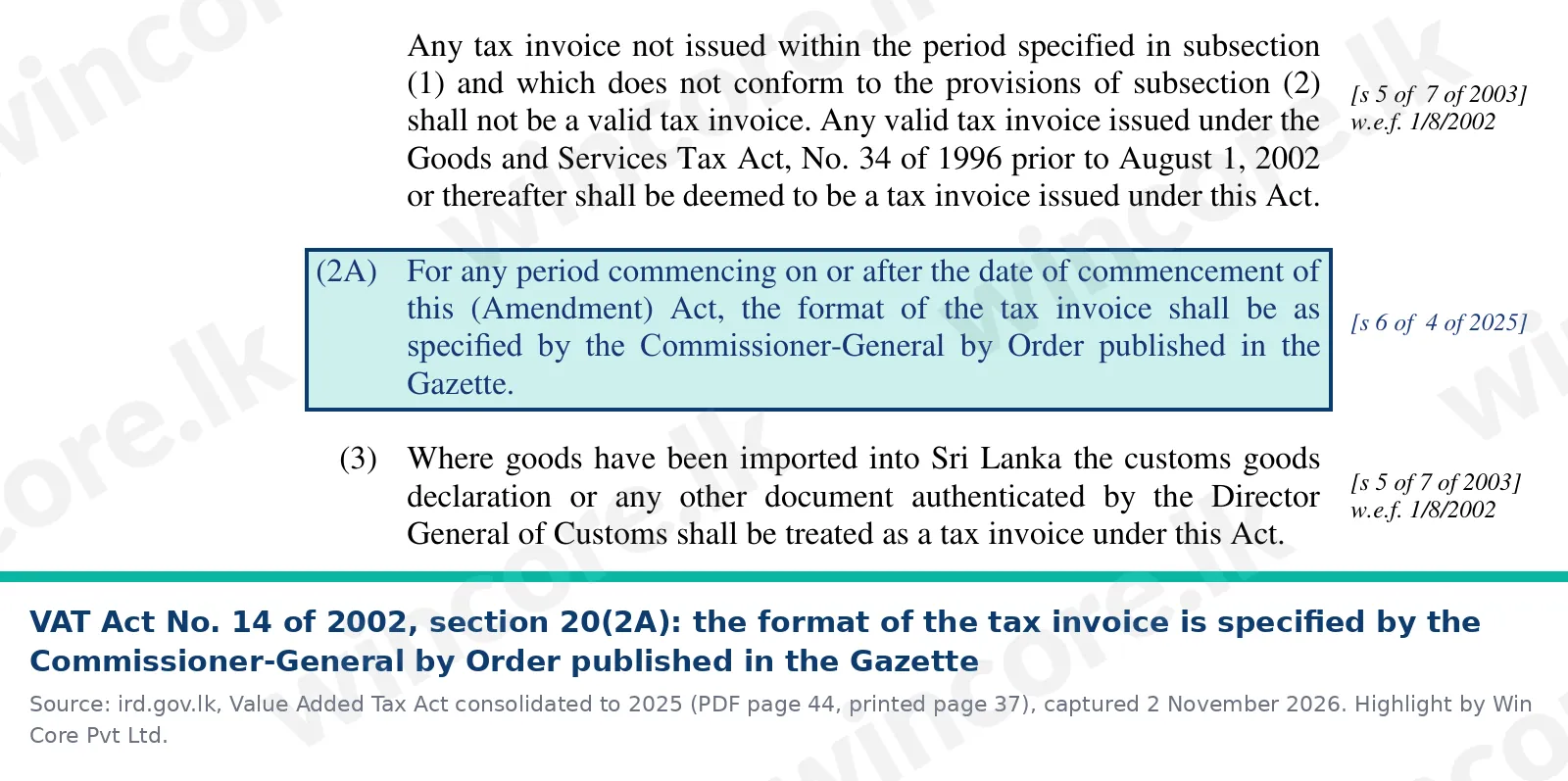
Section 25(3) says the tax debit note or tax credit note must be in the specified form [1]. Check the currently specified form and current Inland Revenue Department requirements before issuing a note. The form for a tax invoice and the form for a tax note are separate questions. Section 20(2A), inserted with effect from 11 April 2025, provides for the Commissioner General to specify the tax invoice format by Gazette order [2] [5].
Act No. 14 of 2026, certified on 30 June 2026, amended other provisions including sections 22 and 25C; it did not directly amend section 20 or section 25 [6].
For the tax invoice itself, see our post on Gazette 2481/22. Check the current IRD order and any later changes when preparing the invoice.
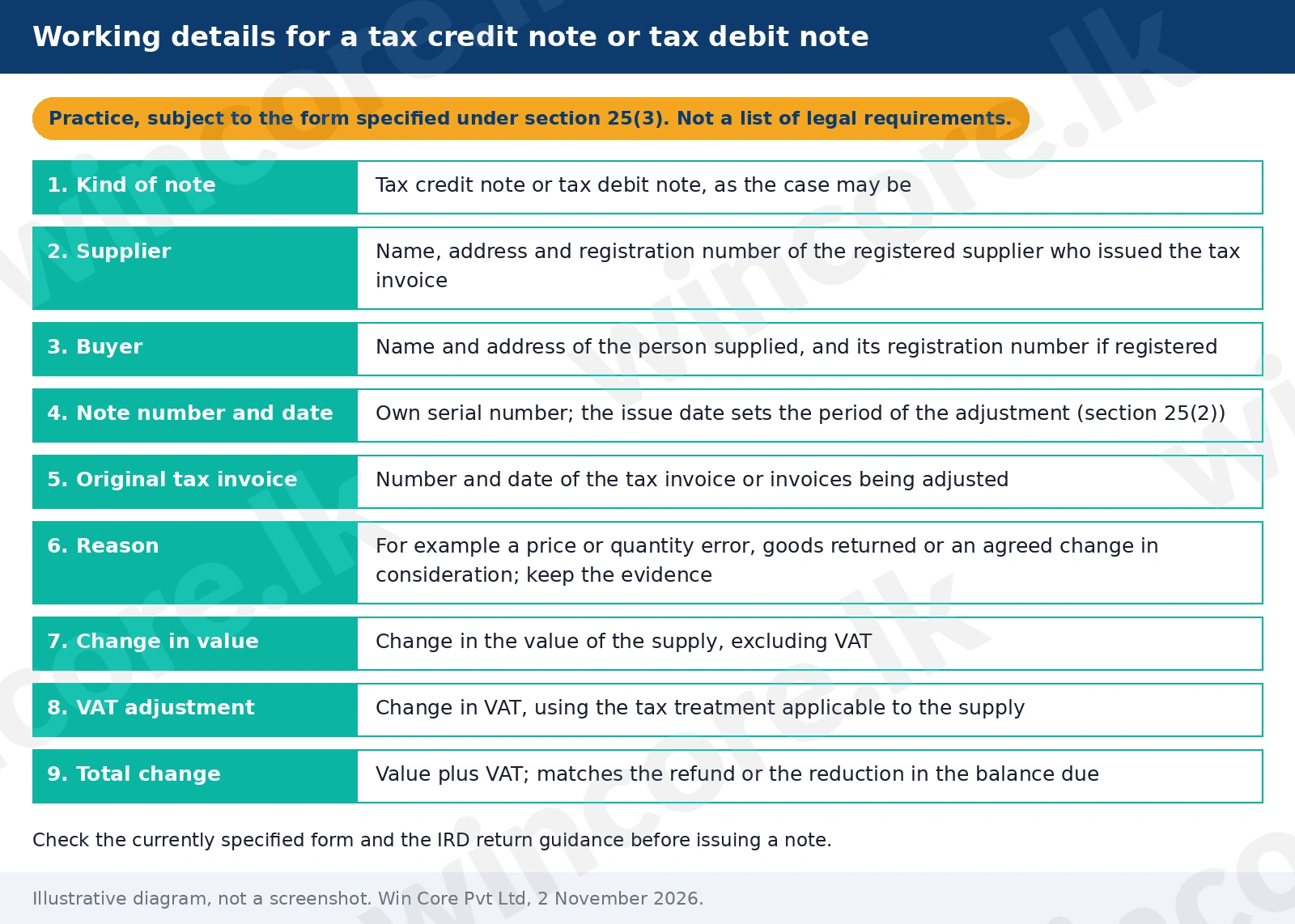
A working record can identify the kind of note, the supplier, the buyer, the note number and date, the original invoice number and date, the reason, the change in value, the VAT adjustment and the total change. This is practice, not a substitute for the specified form or a claim that these are the only legal requirements. Check the current IRD return guidance for the information to report.
Use the tax rate and treatment applicable to the particular supply when checking the amount; do not assume that every original supply used 18 percent. The worked example uses the standard rate of 18 percent for periods commencing on or after 1 January 2024 [2] [4]. Where an earlier invoice or another tax treatment is involved, examine the original supply and the current IRD guidance before calculating the note.
Both sides adjust in the period the note is issued
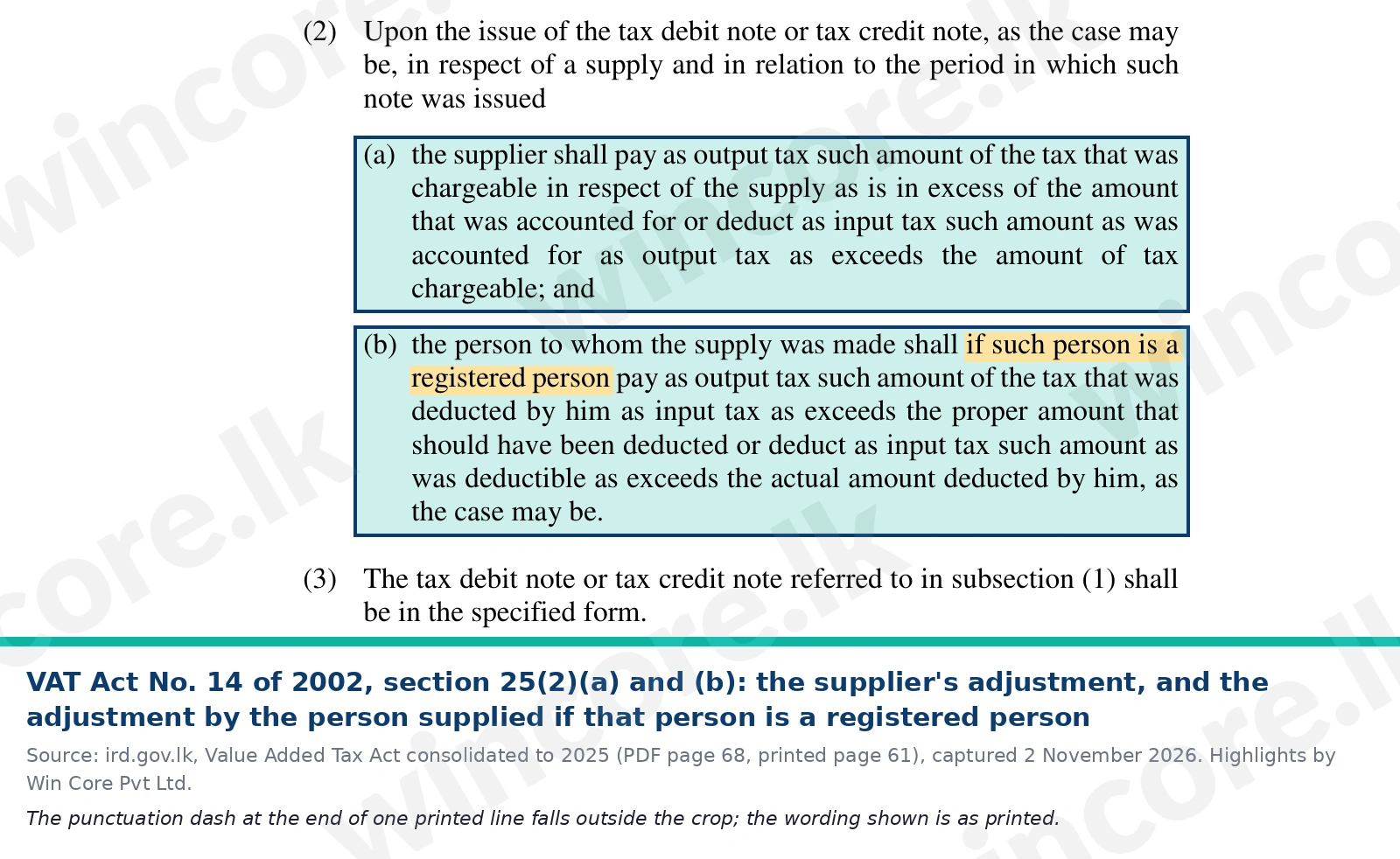
Section 25(2) relates the adjustment to the period in which the note was issued. For an undercharge, section 25(2)(a) says the supplier pays the excess tax chargeable as output tax. For an overcharge, it says the supplier deducts as input tax the amount accounted for as output tax above the tax chargeable [1].
For a registered recipient, section 25(2)(b) provides the corresponding treatment. Input tax previously deducted above the proper amount is paid as output tax. Where the amount deductible exceeds the amount actually deducted, the difference is deducted as input tax, subject to the Act's conditions, including the six month proviso where it applies [1] [3]. Registration alone does not make every purchase eligible for a full input tax deduction.
This is why the buyer's original claim matters. If the buyer deducted only part of the invoice VAT, compare that deduction with the amount properly deductible after the change. Section 22(3) provides for apportionment where a purchase is used partly for taxable activity and partly for other purposes [2]. See our post on input VAT apportionment.
For an unregistered recipient, section 25(2)(b) does not require the recipient to make a registered person's input tax adjustment. A commercial refund or reduction in the balance due is a separate matter to agree and document.
If a note arrives after the period in which it was issued, reconcile its issue date with the period and check the current IRD return and correction procedure. The statutory wording uses the issue period; do not change the date merely to fit a return [1].
The six month proviso needs attention on both kinds of note
The proviso to section 25(1), inserted by Act No. 14 of 2007 with effect from 1 January 2007, concerns an adjustment for input tax under claimed on the original tax invoice. It refers to a tax debit note or tax credit note issued not later than six months after the original invoice [3]. It does not say that every credit note is outside its scope.
In a decision on tax credit notes, the Court of Appeal referred to the six month limit and to invoices in a single taxable period when discussing more than one invoice on a note. It rejected the argument that every invoice necessarily needed its own separate note in the circumstances of that case [7]. The precise application of the proviso to every late credit adjustment remains an open point. On our reading, a late credit note should not be treated as unrestricted.
Issue a needed note promptly and, as a practical safeguard, within six months of the original invoice where possible. This is practice, not a statement that every late note has the same legal consequence. Check the facts and current requirements before relying on a note issued later.
Separate rules apply to an original invoice. Section 22(6)(iii) requires the relevant valid tax invoice to be received within twelve months from the end of the taxable period in which it was issued. Section 22(6)(iv)(a) also addresses deduction in a return for a taxable period ending within twelve months of the invoice date, with the return furnished within that period. The two tests have different starting points and are subject to the rest of section 22 [2] [8] [9].
Keep the correction linked to the original invoice
Section 25 provides the note route when its conditions are met. Do not simply overwrite an issued tax invoice or treat a replacement invoice as the section 25 adjustment. Section 20(5) also says more than one tax invoice for each supply is not lawful; it permits a copy marked as such where a registered person has lost the original [2].
Keep the original document, the note and the evidence of the correction together. Record the issue date and the amount on both sides, and reconcile the note to the applicable VAT period. Keep a copy of an invoice cancelled before it leaves the business as part of the sequence. These record controls are practice, not a claim that the Act prescribes each step.
Section 64(1) requires registered persons to keep records of their taxable activity so that the tax liability can be ascertained. Section 64(3)(a) includes tax invoices, tax credit notes and tax debit notes among the records. Section 20(4) separately requires the supplier to retain the duplicate tax invoice for five years after the expiry of the taxable period in which it was issued [2].
Worked example: Rs 126,000 of tax adjusted in month 2
The contractor issues two tax invoices to the registered building owner in month 1 and accounts for the tax shown. The supplies are assumed to be standard rated, the buyer has paid both invoices, its input tax is fully allowable, and it has deducted the amounts in the table. Each note is issued in month 2, within six months of its invoice. The components on invoice B are actually delivered, then all returned for a full refund with no remaining consideration.
| Item | Value (Rs) | VAT at 18 percent (Rs) | Total (Rs) |
|---|---|---|---|
| Invoice A, wiring works, as billed | 2,000,000 | 360,000 | 2,360,000 |
| Invoice A, agreed contract sum | 1,800,000 | 324,000 | 2,124,000 |
| Partial tax credit note on invoice A, month 2 | 200,000 | 36,000 | 236,000 |
| Invoice B, switchboard components supplied | 500,000 | 90,000 | 590,000 |
| Full tax credit note on invoice B, month 2, after return | 500,000 | 90,000 | 590,000 |
| Total credited in month 2 | 700,000 | 126,000 | 826,000 |
Hypothetical figures. The example assumes VAT at 18 percent [2] [4].
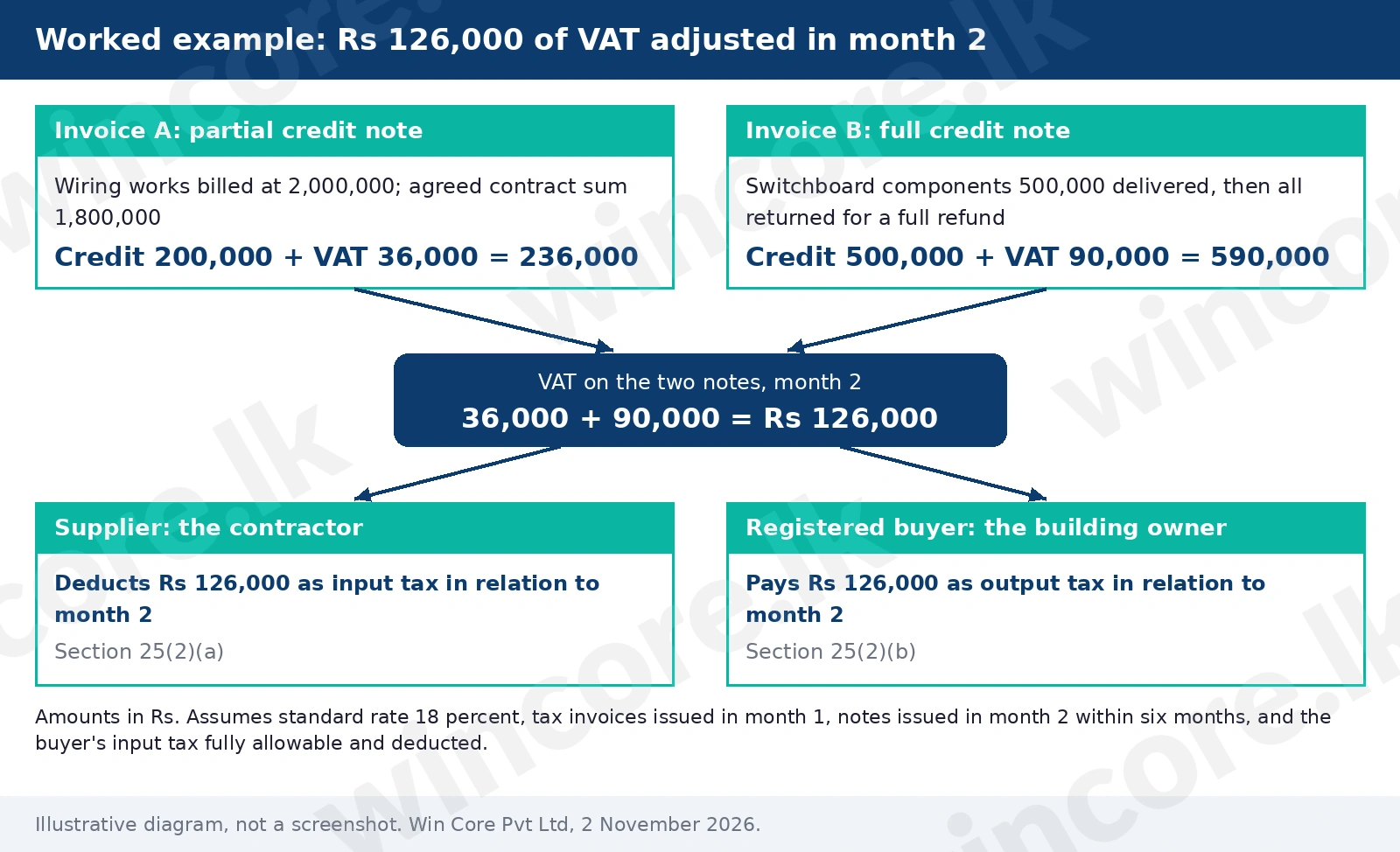
The contractor accounted for Rs 450,000 of output tax on the two invoices in month 1. On the assumptions above, it deducts Rs 126,000 as input tax in relation to month 2 under section 25(2)(a). The buyer pays Rs 126,000 as output tax in relation to month 2 under section 25(2)(b) [1]. This is the section 25 treatment; the net effect is to reduce the supplier's VAT liability and reverse the excess buyer deduction. It is not a statement that each party changes the original output or input line in its return.
After the notes, invoice A has a net value of Rs 1,800,000 and VAT of Rs 324,000. The return and full refund leave no consideration or VAT on invoice B in this example, on the reading stated above. The total credit of Rs 826,000 may be refunded or, if both parties agree, set against an amount otherwise due. Keep the settlement evidence with the notes.
What this means for you
Check that an issued tax invoice and an incorrect amount of tax accounted for fall within section 25. Identify the correct amount, issue the appropriate supplier note in the specified form, and check the six month proviso before relying on an adjustment. Use the period of issue and the statutory input or output tax treatment for each party. Match the note and its evidence to the original transaction and the VAT records.
Checklist: documents needed
- The original tax invoice, including its number and date
- The supplier's tax credit note or tax debit note
- Evidence of the reason, such as a return record or revised agreement
- The calculation of the change in value and VAT
- The VAT records for the period of the note
- For a registered buyer, the original input tax calculation and the adjustment
FAQ
Can a buyer issue a tax credit note under section 25?
No. Section 25(1) gives the registered person who issued the tax invoice the entitlement to issue the tax note to the recipient. A buyer can record its own accounting document or request a correction, but that document is not the supplier's section 25 tax note. Match the supplier's note to the original transaction [1].
Which VAT period does a tax credit note go into?
Section 25(2) relates the adjustment to the period in which the note is issued. The supplier deducts an overcharge as input tax, while a registered buyer pays as output tax any input tax deducted above the proper amount. If the note arrives later, check the current return correction procedure rather than changing its date [1].
Is there a six month limit for a tax credit note?
The six month proviso refers to both tax credit and tax debit notes where the specified input tax adjustment is involved. The Court of Appeal also discussed the limit in a credit note case. Do not assume a late credit note is unrestricted; check its facts, and issue needed notes promptly as a practical safeguard [3] [7].
Does the tax invoice format settle the format of a credit note?
No. Section 20(2A) addresses a Gazette specified tax invoice format, while section 25(3) requires the specified form for a tax credit or debit note. Check the current specified note form and IRD return guidance for the transaction. Keep the invoice and evidence of the correction together as a practical control [1] [5].
The short version
Section 25 lets the registered supplier adjust an incorrect amount of tax accounted for on an issued tax invoice by an appropriate tax note. The adjustment relates to the note's issue period, with the supplier and registered recipient using the input or output tax treatment in section 25(2). The six month proviso refers to both types of note for input tax under claimed; the Court of Appeal has also discussed it in a credit note case. Check the specified form and keep the note with its supporting records.
Talk to us. For help with VAT Registration & Filing and Compliance Monitoring, see our tax return filing services.
WinCore Pvt Ltd
This article is general information as at 2 November 2026 and is not tax, legal or accounting advice on your specific position.
Sources and references (7)
- Parliament of Sri Lanka. Value Added Tax Act, No. 14 of 2002, sections 4 and 25; effective 1 August 2002. Sections read in the Inland Revenue Department consolidation to 2025: https://www.ird.gov.lk/en/publications/Value%20Added%20Tax_Acts/VAT_Act_No_14%5BE%5D_2002_%28Consolidation_2025%29.pdf . Primary. Accessed 2 November 2026.
- Inland Revenue Department. Value Added Tax Act, No. 14 of 2002, consolidated to 2025, sections 2, 20, 22, 25 and 64. Non statutory official consolidation; read with the certified Acts. https://www.ird.gov.lk/en/publications/Value%20Added%20Tax_Acts/VAT_Act_No_14%5BE%5D_2002_%28Consolidation_2025%29.pdf . Primary official consolidation. Supplied PDF read 2 November 2026.
- Parliament of Sri Lanka. Value Added Tax (Amendment) Act, No. 14 of 2007, sections 1 and 5; deemed effective 1 January 2007. The proviso to section 25(1) inserted by section 5 is read in the Inland Revenue Department consolidation to 2025: https://www.ird.gov.lk/en/publications/Value%20Added%20Tax_Acts/VAT_Act_No_14%5BE%5D_2002_%28Consolidation_2025%29.pdf . Primary. Accessed 2 November 2026.
- Parliament of Sri Lanka. Value Added Tax (Amendment) Act, No. 16 of 2024, section 2(3); 18 percent applies to taxable periods commencing on or after 1 January 2024. https://www.ird.gov.lk/en/publications/Value%20Added%20Tax_Acts/VAT_%28Amd%29_Act_No_16%20of%202024_E.pdf . Primary. Accessed 2 November 2026.
- Parliament of Sri Lanka. Value Added Tax (Amendment) Act, No. 4 of 2025, sections 1 and 6; section 6 effective 11 April 2025. https://www.parliament.lk/uploads/acts/gbills/english/6380.pdf . Primary. Accessed 2 November 2026.
- Parliament of Sri Lanka. Value Added Tax (Amendment) Act, No. 14 of 2026, certified 30 June 2026; sections 5 to 7 and Act reviewed for amendments to sections 20 and 25. https://www.ird.gov.lk/en/publications/Value%20Added%20Tax_Acts/VAT_Act_No_14-2026_E.PDF . Primary. Supplied PDF and certified text read 2 November 2026.
- Court of Appeal of Sri Lanka. Commissioner General of Inland Revenue v Rhino Roofing Products Limited, CA/TAX/07/2019, decision of 20 July 2021, pages 14 to 18. https://lankalaw.net/wp-content/uploads/ca_judgements/2019/ca-tax-07-2019.pdf . Listed in the Court of Appeal judgments index: https://judgements.courtofappeal.lk/?page_id=14375 . Primary judgment. Accessed 2 November 2026.
- Parliament of Sri Lanka. Value Added Tax (Amendment) Act, No. 7 of 2003, sections 5(3), 7(4) and 23; the relevant changes are deemed effective 1 August 2002. Sections 20(6) and 22(6) as amended are read in the Inland Revenue Department consolidation to 2025: https://www.ird.gov.lk/en/publications/Value%20Added%20Tax_Acts/VAT_Act_No_14%5BE%5D_2002_%28Consolidation_2025%29.pdf . Primary. Accessed 2 November 2026.
- Parliament of Sri Lanka. Value Added Tax (Amendment) Act, No. 15 of 2009, sections 4(3) and 10(b); deemed effective 1 January 2009. Section 22(6)(iv)(a) as amended is read in the Inland Revenue Department consolidation to 2025: https://www.ird.gov.lk/en/publications/Value%20Added%20Tax_Acts/VAT_Act_No_14%5BE%5D_2002_%28Consolidation_2025%29.pdf . Primary. Accessed 2 November 2026.
Related reading: VAT on advance payment Sri Lanka: timing.
Put these insights to work
WinCore specialists can review your current workflow, document gaps, and build a practical 90-day action plan.
Book a free consultationRecent articles



Continue reading
Explore more WinCore analysis to keep your finance, tax, and compliance roadmap moving.

From 1 October 2026 every VAT tax invoice must follow the format in Gazette 2481/22 as amended. The fields, the serial number, the 28-day rule and the controls.
The IRD Order behind the new VAT tax invoice: the 1 October start, the serial number and date rules, and which default carries which penalty.

Room charges carry VAT and treatment does not. How a mixed hospital splits shared input tax, with the clause, the IRD circular and the arithmetic.