
Bad debt relief Sri Lanka: when a write-off cuts income tax and VAT
An unpaid invoice may lead to income tax and VAT relief. Compare impairment, write-off and later recovery, with a worked example and records checklist.
On this page
Last verified against the primary sources on 2 November 2026.
Bad debt relief Sri Lanka, in brief. Under section 24(4) to (6) of the Inland Revenue Act, an eligible debt previously included in income on an accrual basis can be deducted when written off as bad, after reasonable steps to collect and a reasonable belief that it will not be satisfied. The Act took effect on 1 April 2018 [1]. Under VAT Act section 24, a registered person can deduct the tax corresponding to a qualifying debt that becomes bad in the taxable period, up to the tax paid on it in an earlier period [2]. A later recovery has its own tax consequences under both Acts.
Our example is a hypothetical aluminium fabrication workshop, run as a VAT registered private company. A building contractor, an unrelated local customer, does not pay an invoice of Rs 1,180,000 including VAT. We cover the income tax rule and its conditions, recovery, the VAT rule and its provisos, impairment under SLFRS for SMEs Section 11, the records, and a worked example over three years.
Bad debt relief Sri Lanka under section 24 needs income first, then a write-off
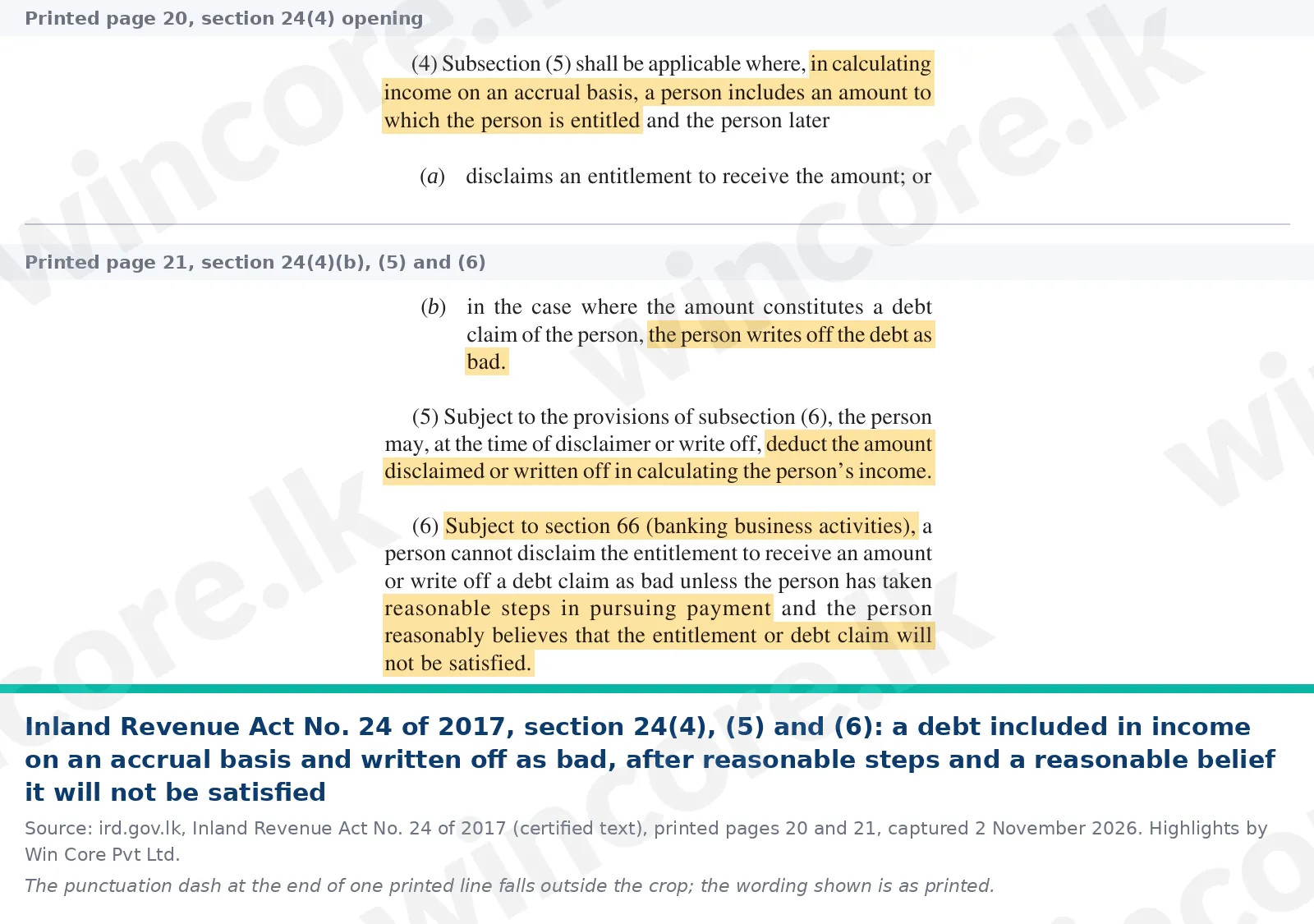
Section 24 of the Inland Revenue Act No. 24 of 2017 provides for reversal of amounts including bad debts [1]. Section 24(4) and (5) apply where a person included an amount to which the person was entitled in calculating income on an accrual basis and later writes off the debt as bad. The deduction is subject to subsection (6) and is made at the time of the write-off.
Two conditions are therefore important before the collection test in subsection (6):
- The amount was included in income on an accrual basis. In our example, the workshop included Rs 1,000,000 from the sale in income. An unpaid amount that has not been included in income on an accrual basis does not meet this section 24(4) condition.
- The debt has been written off as bad. The deduction is taken at the time of the qualifying write-off, rather than simply because the invoice is overdue. An estimate of possible loss and a write-off of the debt are different decisions.
A write-off counts only after reasonable steps and a reasonable belief
Section 24(6), subject to the special banking rule in section 66, requires both reasonable steps in pursuing payment and a reasonable belief that the entitlement or debt claim will not be satisfied [1]. An overdue invoice alone does not show that both tests have been met.
- Reasonable steps in pursuing payment. Written demands, follow-up statements and calls, and a final demand are examples of evidence to retain. The steps will depend on the facts of the debt. This is practice, not a legal requirement to use each of these particular steps.
- A reasonable belief that the debt will not be paid. Record the facts behind the belief, such as evidence that the customer has stopped trading or cannot meet its debts. A lack of response can be relevant, but consider the full collection history rather than assuming silence alone settles the question.
Section 66 contains a separate rule for a person conducting a banking business and making a specific provision in accordance with relevant Central Bank directives. The extent of a deductible provision and other conditions in that section require separate consideration [1] [5] [6]. The workshop in our example is not conducting a banking business.
For the workshop's example, the Rs 1,000,000 sale price was included in income and the Rs 180,000 VAT was accounted for as output tax. The income tax deduction is calculated by reference to the amount previously included in income; the VAT adjustment is considered separately. Our post on tax deductible expenses for a company explains the general deduction rules in sections 10 to 19; section 24 is a separate rule.
Money recovered after a write-off can be income again
Section 24(1) requires an expense deducted in calculating income to be included in income at the time it is recovered [1]. On our reading, this applies to a later recovery of a bad debt previously deducted under section 24(5), to the extent of the amount previously deducted. Record a part payment and reconcile it with any VAT arising on the recovery. Do not include the same recovery twice merely because it also appears in the accounts.
Provision versus write-off: the accounts and the tax return differ
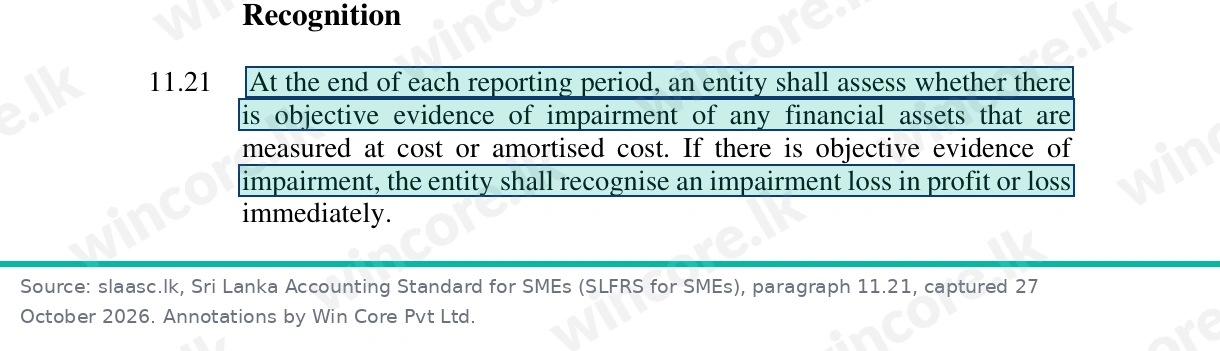
Accounting and tax use different tests. An entity applying SLFRS for SMEs assesses at the end of each reporting period whether objective evidence indicates impairment of financial assets measured at cost or amortised cost and recognises an impairment loss in profit or loss when the standard requires it [4]. Evidence under paragraph 11.22 includes significant financial difficulty and a breach such as a default. The 2015 amendments to the standard apply to the specified paragraphs for annual periods beginning on or after 1 January 2017 [4].
For a current debt instrument that is not in substance a financing transaction, paragraph 11.14(a) describes measurement at the undiscounted amount expected to be received, net of impairment. For an asset measured at amortised cost, paragraph 11.25(a) sets out the loss measurement. Paragraph 11.25(b) instead covers specified assets measured at cost less impairment, including certain loan commitments and equity investments. Paragraph 11.26 requires a reversal when a later decrease in impairment is objectively linked to a subsequent event, subject to the carrying amount limit [4].
For the workshop, a doubtful debt allowance estimates a loss in the accounts. On our reading, an allowance alone does not establish that the debt has been written off as bad for section 24(4) to (6). If the allowance has reduced accounting profit but the tax tests are not yet met, add it back in the income tax computation. When the debt is later written off and the tests are met, reconcile the earlier add-back with the deduction so the amount is not deducted twice. The accounting entries depend on how the allowance was recorded. Our post on accrued expenses and cut-off covers another difference between accounting and tax timing.
VAT bad debt relief is limited to the tax already paid on the debt
Section 24 of the Value Added Tax Act No. 14 of 2002 allows a deduction in calculating tax payable for a taxable period for tax corresponding to a bad debt incurred in a registered person's taxable activity. The debt must have been created on or after 1 April 1998 and become bad during that taxable period. The deduction cannot exceed the tax paid in a previous taxable period in respect of the bad debt to be written off [2]. The VAT Act took effect on 1 August 2002 [2]. The standard rate is 18 percent for taxable periods commencing on or after 1 January 2024 [3]. The VAT (Amendment) Acts No. 4 of 2025 and No. 14 of 2026 do not directly amend section 24 [9] [10].
| Condition in VAT Act section 24 | What it means for the workshop |
|---|---|
| A bad debt incurred in the taxable activity of a registered person | The unpaid debt relates to the workshop's taxable activity |
| Debt created on or after 1 April 1998 | The current invoice in the example meets this condition |
| Debt becomes bad during the taxable period | Identify the taxable period in which the debt became bad |
| Deduction capped at the tax paid on the bad debt in a previous taxable period | Keep evidence of the relevant tax and its earlier payment |
How the adjustment is made. Section 24 works by deduction in calculating tax payable for the taxable period [2]. Keep a record of the write-off and the corresponding tax. The VAT record keeping regulations include bad debt write-offs and recoveries in the records and show bad debt adjustments in their annexure [8]. Check the current IRD VAT return instructions for the reporting fields and supporting schedules.
Time limits. Section 24 links the deduction to the taxable period when the debt becomes bad [2]. If that period has passed, check the current IRD instructions and the applicable correction rules before making an adjustment. Do not assume that a later period can be chosen freely.
Recovery. The first proviso treats an amount later received on a debt written off as bad as a taxable supply in the period of receipt and makes it liable to tax [2]. The amount of tax depends on the applicable rate and whether the amount received is tax inclusive. Check the payment terms and current IRD guidance, particularly if the rate has changed.
The customer's side. Under the second proviso, where the supplier deducts tax corresponding to a bad debt, the amount deducted is output tax for the corresponding period of the person in respect of whom the debt was incurred, if that person is registered [2]. The wording does not say that this consequence applies only if that customer previously claimed input tax. Our VAT registration and compliance post covers the return itself.
Records support the deduction and explain the timing
Section 120(5) and (6) of the Inland Revenue Act requires source documentation to be retained and relevant transaction records to be kept for five years from the transaction or, where the section requires longer, until the assessment time limit expires and related proceedings are completed [1]. Under Companies Act sections 116(1)(k) and 148, in force from 3 May 2007 [11], a company keeps accounting records for the current accounting period and the last ten completed accounting periods; the Registrar may allow a shorter period under section 116(2) [7]. The VAT record keeping regulations require records to be preserved for five years from the end of the relevant taxable period, subject to the Commissioner General permitting earlier destruction on application [8].
For a bad debt, a useful file contains the invoice and evidence of delivery, the customer ledger and part payments, collection correspondence, and a dated record of the write-off and reasons. Retain the relevant VAT return, evidence of tax paid and the income tax computation. Keeping a dated approval and collection trail is practice, not a legal requirement to use a particular approval form.
Worked example: Rs 1,000,000 deducted, then Rs 200,000 recovered
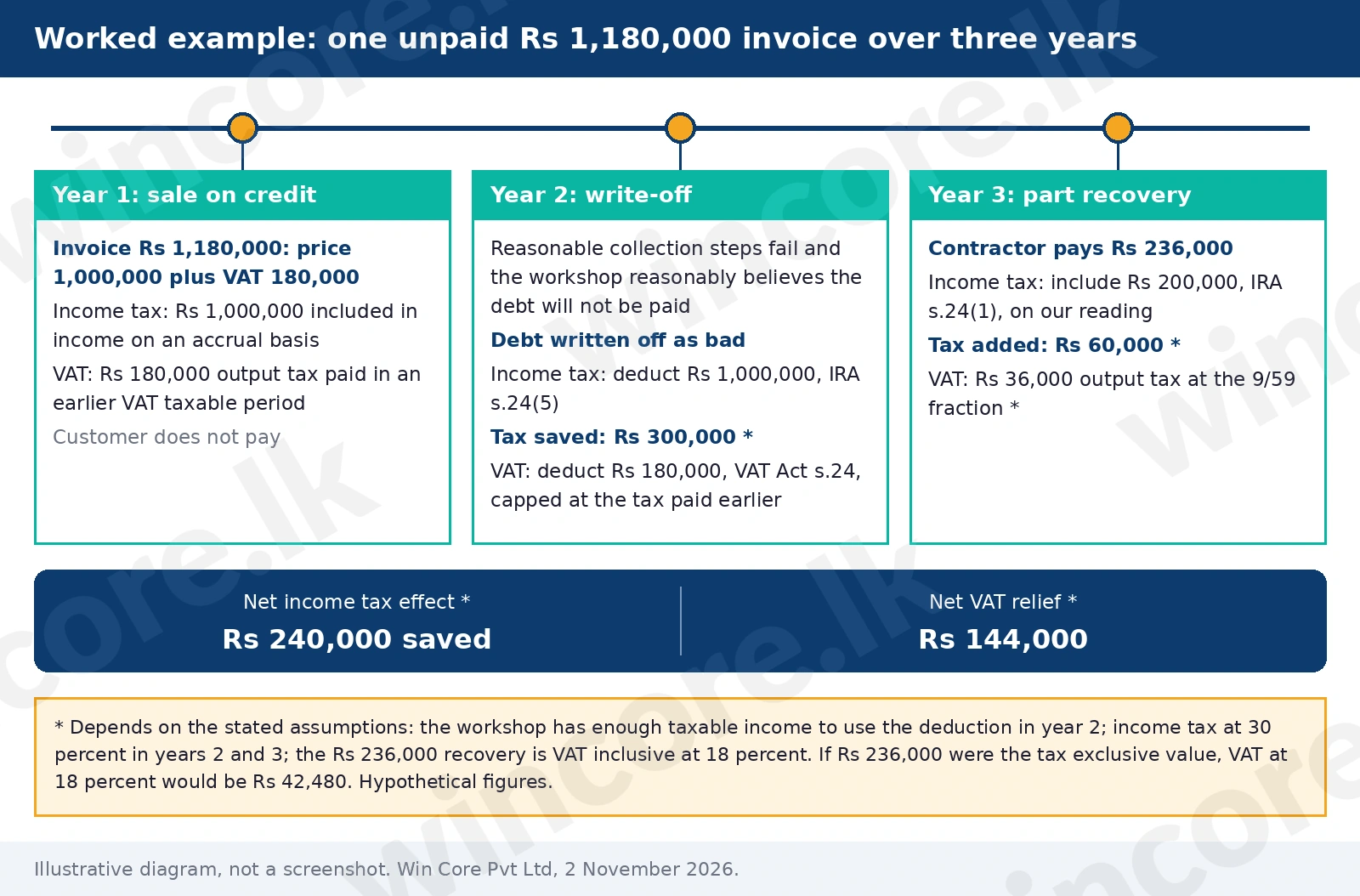
The workshop invoices the contractor in year 1. Assume the sale and recovery are liable at 18 percent VAT, the full Rs 180,000 output tax on the invoice was paid in an earlier VAT taxable period, the debt becomes bad and is written off in year 2, and the section 24 income tax conditions are met. Assume the workshop applies SLFRS for SMEs, has enough taxable income to use the deduction in year 2, and its relevant income is taxed at 30 percent in years 2 and 3 [3] [6]. The later payment of Rs 236,000 is assumed to include VAT at 18 percent.
| Year | Event | Income tax | VAT |
|---|---|---|---|
| 1 | Price Rs 1,000,000, VAT Rs 180,000, total Rs 1,180,000 | Rs 1,000,000 included in income on the accrual basis | Output tax Rs 180,000 accounted for and paid |
| 1 | Impairment allowance of Rs 500,000 against the sale price in the accounts | Add back the allowance because it is not yet a qualifying write-off | No bad debt deduction is assumed yet |
| 2 | Collection steps fail, a reasonable belief is formed and the debt becomes bad and is written off | Deduct Rs 1,000,000 under section 24(5), reconciling the earlier allowance | Deduct Rs 180,000 under section 24, subject to its conditions |
| 3 | Contractor pays Rs 236,000, assumed VAT inclusive | On our reading, include Rs 200,000 of the previously deducted amount | Rs 36,000 tax at the 9/59 fraction, on the stated assumption |
| Net | Position after the part recovery | Net deduction Rs 800,000 | Net VAT relief Rs 144,000 |
Hypothetical figures. VAT at 18 percent and the 9/59 tax fraction apply under section 2(1) for the relevant taxable periods stated in that section [3].
On those assumptions, the year 2 deduction reduces income tax by Rs 300,000 and the year 3 recovery adds Rs 60,000. The net income tax effect is Rs 240,000, and the net VAT effect is Rs 144,000. The combined arithmetic is Rs 384,000. A business without sufficient taxable income, or with a different applicable rate, may have a different immediate income tax result.
For the VAT recovery, Rs 236,000 x 9/59 is Rs 36,000 only because the example assumes the payment is VAT inclusive at 18 percent [2] [3]. If Rs 236,000 were instead the tax exclusive value, 18 percent of that value would be Rs 42,480. Which treatment applies to an actual recovery depends on its facts and the applicable law; check the current IRD guidance. On our reading, the net Rs 200,000 recovery in this example is included in income under section 24(1).
What this means for you
Keep a written trail of collection efforts and the facts supporting any decision to write off a debt. Where SLFRS for SMEs applies, assess impairment under the standard, and reconcile an allowance with the separate income tax write-off test. Check the VAT taxable period and evidence of the tax paid before calculating relief. Record any later recovery and reconcile its income tax and VAT treatment. Check the current IRD return instructions for how to report the VAT adjustment.
Checklist: documents needed
- Original tax invoice and delivery or completion evidence
- Customer ledger with balance and part payments
- Dated demands, statements and reminders
- Legal correspondence or advice on recovery, where obtained
- Dated write-off record with the reasons the debt will not be paid
- VAT return and evidence of the earlier tax payment
- Income tax computations reconciling the allowance and write-off deduction
- Receipts for any later recovery, and the returns that account for it
FAQ
Is a provision for doubtful debts tax deductible in Sri Lanka?
For the workshop's trading debt, an allowance alone does not meet the section 24 write-off test, on our reading. The debt must have been included in accrual income, written off as bad, and satisfy the reasonable steps and belief tests. Banking businesses have a separate rule under section 66 [1] [5].
What are reasonable steps to recover a debt before writing it off?
The Act requires reasonable steps but does not prescribe a fixed list in section 24(6). Written demands, statements, calls and a final demand can help evidence the collection history. Which steps are reasonable depends on the facts. Keeping a dated trail is practice, not a legal requirement to use each example [1].
Can I claim back the VAT on a bad debt in Sri Lanka?
A registered person can deduct the corresponding tax if the section 24 conditions are met. The debt must arise in the taxable activity, meet the creation date condition and become bad in the relevant taxable period. The deduction is capped at the tax paid on it in an earlier taxable period [2].
What happens if a written-off customer pays later?
A later recovery can have both income tax and VAT consequences. On our reading, section 24(1) of the Inland Revenue Act includes a recovery of a previously deducted bad debt in income. VAT Act section 24 treats the amount received as a taxable supply in the period of receipt [1] [2].
The short version
Income tax relief for a bad debt needs the amount in income on an accrual basis first, a write-off, reasonable steps to collect and a reasonable belief it will not be paid, subject to the banking rule [1]. VAT relief is a deduction in the taxable period the qualifying debt becomes bad, capped at the relevant tax paid in an earlier period [2]. An allowance alone is not the same as a qualifying write-off, on our reading. A later recovery can have consequences under both Acts.
Talk to us. For help through Tax Planning & Advisory and VAT Registration & Filing, see our income tax support.
WinCore Pvt Ltd
This article is general information as at 2 November 2026 and is not tax, legal or accounting advice on your specific position.
Sources and references (13)
- Parliament of Sri Lanka. Inland Revenue Act, No. 24 of 2017, sections 1, 24(1) to (6), 66 and 120(5) to (6). https://www.ird.gov.lk/en/publications/Acts_Income%20Tax_2017/IR_Act_No_24_2017_E.pdf . Primary. Read in supplied certified text 2 November 2026.
- Parliament of Sri Lanka. Value Added Tax Act, No. 14 of 2002, sections 1, 2(1), 23, 24 and 25, certified text compared with the Inland Revenue Department consolidation to 2025. https://www.ird.gov.lk/en/publications/Value%20Added%20Tax_Acts/VAT_Act_No_14%5BE%5D_2002_%28Consolidation_2025%29.pdf . Primary. Read 2 November 2026.
- Parliament of Sri Lanka. Value Added Tax (Amendment) Act, No. 16 of 2024, section 2(3), rate for periods from 1 January 2024. https://www.ird.gov.lk/en/publications/Value%20Added%20Tax_Acts/VAT_%28Amd%29_Act_No_16%20of%202024_E.pdf . Primary. Read via web cache 2 November 2026.
- Sri Lanka Accounting Standards Committee. Sri Lanka Accounting Standard for SMEs, 2015 text, paragraphs 11.14, 11.21 to 11.26 and Appendix A1. https://www.slaasc.lk/files/_SLFRS%20FOR%20SMEs%20-%202015.pdf . Primary. Read in supplied text 2 November 2026.
- Parliament of Sri Lanka. Inland Revenue (Amendment) Act, No. 10 of 2021, section 19 and commencement tables. https://www.ird.gov.lk/en/publications/Acts_Income%20Tax_2017/IR_Act_No._10_2021_E.pdf . Primary. Read via web cache 2 November 2026.
- Parliament of Sri Lanka. Inland Revenue (Amendment) Act, No. 45 of 2022, section 33 and commencement provisions, read with the Inland Revenue Act First Schedule paragraph 4(1), including the general company rate from 1 April 2023. https://www.ird.gov.lk/en/publications/Acts_Income%20Tax_2017/IR_Act_No._45_2022_E.pdf . Primary. Read via web cache 2 November 2026.
- Parliament of Sri Lanka. Companies Act, No. 7 of 2007, sections 116 and 148. https://www.parliament.lk/uploads/acts/gbills/english/3776.pdf . Primary. Read via web cache 2 November 2026.
- Government of Sri Lanka. Record Keeping Regulations No. 1 of 2017, regulations 5, 7 and 18 and annexure, Gazette Extraordinary 2042/21 of 26 October 2017. https://www.ird.gov.lk/en/publications/Gazette_Documents/2017_2042-21_E.pdf . Primary. Read via web cache 2 November 2026.
- Parliament of Sri Lanka. Value Added Tax (Amendment) Act, No. 4 of 2025, sections 1 to 15, generally effective 11 April 2025 with the exception in section 1(3). https://www.parliament.lk/uploads/acts/gbills/english/6380.pdf . Primary. Read via web cache 2 November 2026.
- Parliament of Sri Lanka. Value Added Tax (Amendment) Act, No. 14 of 2026, sections 1 to 18, certified 30 June 2026. https://www.ird.gov.lk/en/publications/Value%20Added%20Tax_Acts/VAT_Act_No_14-2026_E.PDF . Primary. Read in supplied certified text 2 November 2026.
- Department of the Registrar of Companies. Performance report 2016, introduction, commencement of the Companies Act on 3 May 2007. https://www.parliament.lk/uploads/documents/paperspresented/performance-report-department-of-registrar-of-companies-2016.pdf . Official report, secondary source for the commencement date. Read via web cache 2 November 2026.
Related reading: Provisions and contingent liabilities Sri Lanka; Accounts receivable ageing Sri Lanka.
Put these insights to work
WinCore specialists can review your current workflow, document gaps, and build a practical 90-day action plan.
Book a free consultationRecent articles


Continue reading
Explore more WinCore analysis to keep your finance, tax, and compliance roadmap moving.
Which company expenses the Inland Revenue Act allows under ss.10 to 19: the section 11 test, the never-deductible list, the interest cap and losses.
VAT guide for Sri Lanka covering who must register, zero rating and exemptions, tax invoices, filing and payment dates, input tax credits, penalties, and deregistration.
Bills arrive late, landlords recharge in bundles and one month goes missing. Four cut-off traps, the rule behind each and a six-step monthly routine.