
Input VAT apportionment in Sri Lanka: a hospital and pharmacy
Room charges carry VAT and treatment does not. How a mixed hospital splits shared input tax, with the clause, the IRD circular and the arithmetic.
On this page
Last verified against the primary sources on 23 October 2026.
Input VAT apportionment in Sri Lanka comes from section 22(3) of the VAT Act: where a purchase is used partly for taxable supplies and partly for other purposes, the tax on it "shall be apportioned", and only the part referable to the taxable activity counts as input tax. Input tax on purchases used only for exempt supplies is not deductible at all under s.22(6)(ii). The Act sets no method. The only IRD instruction we found, Circular No. 2011/07 of 9 September 2011, permits apportionment "only on input VAT incurred on Common Overheads". For a private hospital this matters because, for taxable periods from 1 January 2024, healthcare services are exempt "other than hospital room charges", which carry VAT at 18 percent [1] [2].
Every VAT invoice a mixed business receives lands in one of three places. Some costs belong only to what you sell with VAT. Some belong only to what you sell without it. The rest sit in the corridor between the two, and those corridor costs are the only ones you apportion. Sort the invoices into those three places and most of the problem is solved before any arithmetic starts.
Take a hypothetical private hospital with its own pharmacy counter. It treats patients, charges for rooms, fills prescriptions and sells over-the-counter items to walk-in customers. Some of that is exempt from VAT and some is not. Its electricity bill, its IT system and its security contract serve all of it.
The corridor is where the money is. The direct costs sort themselves; the shared ones need a method, and the Act does not give you one.
For sector-specific support, see our healthcare shared services page.
Hospital room charges carry VAT; treatment and prescription medicines do not
Exemptions live in the First Schedule to the Value Added Tax Act, No. 14 of 2002. For taxable periods from 1 January 2024 the list is Part III, headed "For any taxable period commencing on or after January 1, 2024" [1].
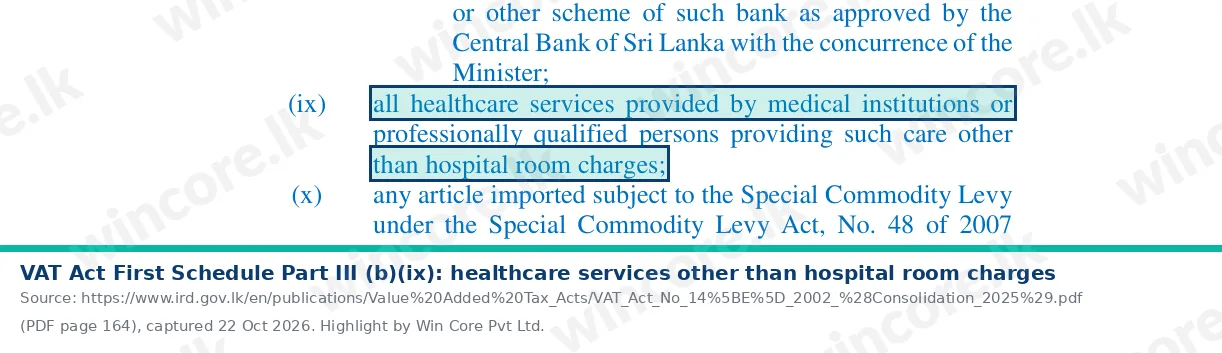
Healthcare. Part III, paragraph (b), item (ix) exempts the supply of "all healthcare services provided by medical institutions or professionally qualified persons providing such care other than hospital room charges" [1]. Read the last five words twice. On our reading, hospital room charges fall outside this exemption, so a VAT-registered hospital charges VAT on them unless another item covers them. We found no other Part III item that does.
The carve-out is not new. Act No. 25 of 2018, certified on 16 August 2018, put the same words into Part II of the Schedule "on or after the date of commencement" of that Act, and Act No. 32 of 2023 carried them into Part III [3] [1].
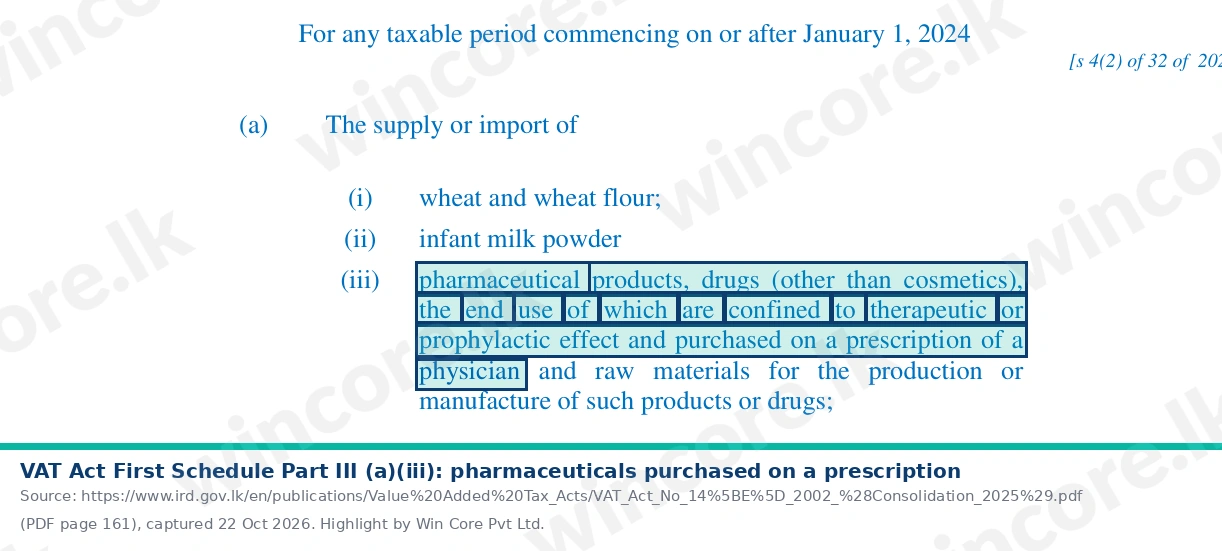
Pharmacy. Part III, paragraph (a), item (iii) exempts the supply or import of "pharmaceutical products, drugs (other than cosmetics), the end use of which are confined to therapeutic or prophylactic effect and purchased on a prescription of a physician" [1]. There are three conditions in that sentence: not cosmetics, a therapeutic or prophylactic end use, and a physician's prescription. On our reading, a pharmacy sale that does not meet all three is outside item (iii). Over-the-counter sales without a prescription are the obvious case. Whether some other item exempts a particular product is a product-by-product question: item (a)(iv), for example, covers ayurvedic, unani, siddha and homeopathic preparations identified by customs code, "with the recommendation of the Commissioner for Ayurveda" [1].
So our hospital has two exempt streams (treatment, prescription medicines) and two taxable ones (room charges, non-prescription sales). Our guide to VAT exemptions covers how to document an exempt line.
Did the VAT (Amendment) Act, No. 14 of 2026 change any of this? We read it. Section 17 amends Part III by adding item (xii) to paragraph (a), for supplies to a Business of Strategic Importance, and a new paragraph (e) for services supplied "through an electronic platform by a non-resident person", including "healthcare services including online consultations, digital prescriptions, AI-assisted diagnostic, digital health tracking and telemedicine" [4]. That new paragraph is about non-resident platforms. On our reading it does not touch a Sri Lankan hospital's own items (a)(iii) or (b)(ix). Act No. 4 of 2025, which closed the SVAT scheme for periods from 1 October 2025, amended refund and project provisos in s.22 but not these items [5]. The rest of the 2026 Act is in our guide to VAT Amendment Act No. 14 of 2026.
Section 22(3) is the rule for input VAT apportionment in Sri Lanka
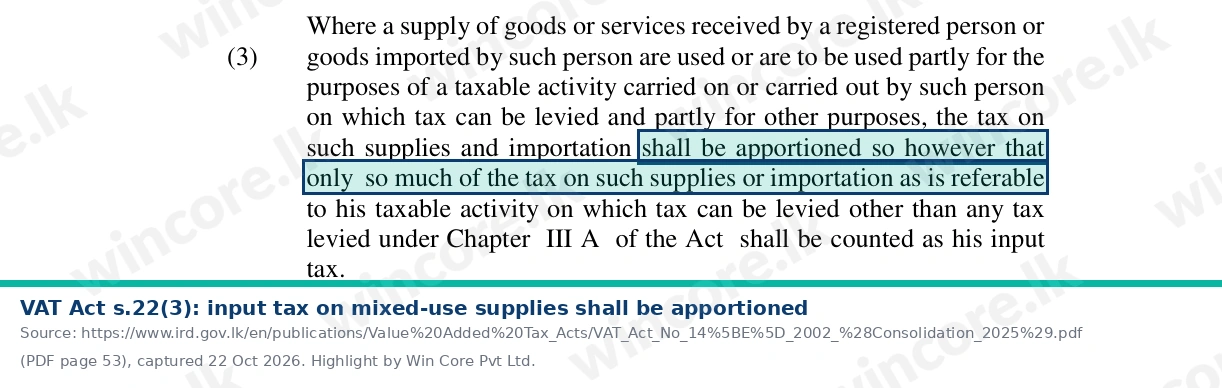
Section 22(2) gives a registered person credit "for so much of his input tax as is allowable under this Act" [1]. Section 22(3) then deals with mixed use:
"Where a supply of goods or services received by a registered person or goods imported by such person are used or are to be used partly for the purposes of a taxable activity carried on or carried out by such person on which tax can be levied and partly for other purposes, the tax on such supplies and importation shall be apportioned so however that only so much of the tax on such supplies or importation as is referable to his taxable activity on which tax can be levied other than any tax levied under Chapter III A of the Act shall be counted as his input tax" [1].
Section 22(3) carries several provisos. We read each one. They cover finance leases entered into from 1 July 2003 to 31 December 2003, output tax at ten percent or five percent, Fourth Schedule luxury-rate goods, and condominium housing units at six percent [1]. None of them, on our reading, applies to a hospital's ordinary costs today. They matter only because a rule with provisos should never be quoted as if it had none.
The other half of the rule is s.22(6). Input tax "shall not be deducted under subsection (2)" where, under item (ii), "the supply of goods or services received is not connected with the taxable activity or not included in the value of taxable supply" [1]. That is what shuts out input VAT on costs used only for exempt supplies.
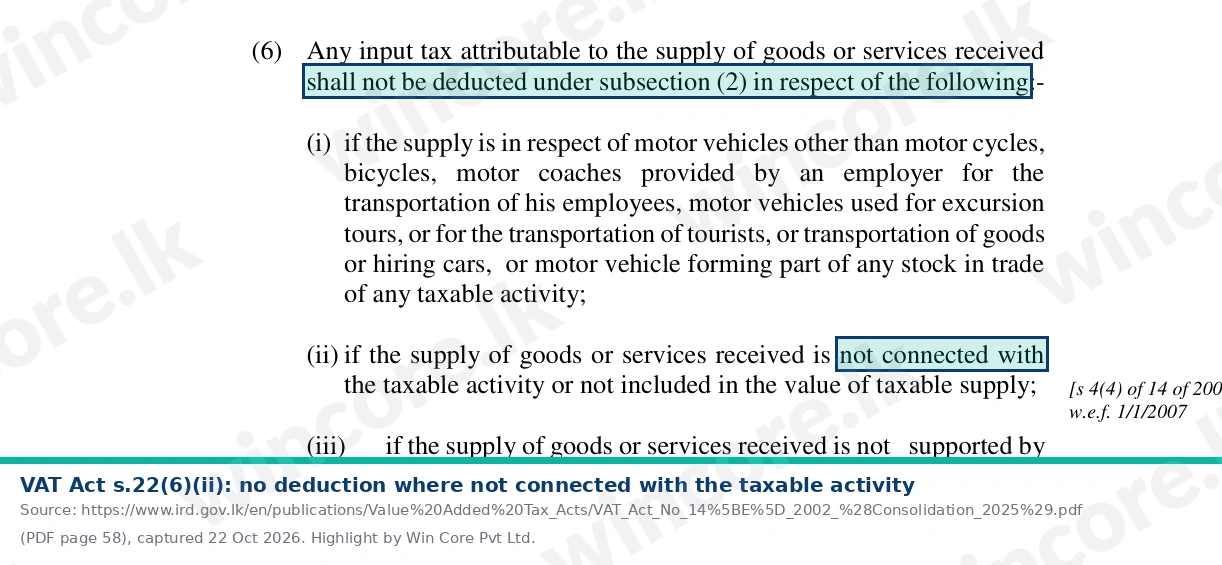
Act No. 14 of 2026, s.6, adds a new item (vii) to s.22(6), on deferred tax for project plant and machinery not re-exported [4]. It does not amend s.22(3). Purchases made before VAT registration follow a different door, s.22(7), covered in our guide to input VAT before registration.
The Act prescribes no method, so choose one and write it down
Section 22(3) says the tax "shall be apportioned". It does not say how. On 23 October 2026 we searched the Act text and the IRD site for a prescribed method and found none. We treat that as an open point, not proof that none exists.
The nearest IRD text is the Circular to VAT Registered Persons No. 2011/07, "Instructions: filing of VAT returns", dated 9 September 2011. It says: "Claim of input VAT on apportionment basis is permitted only on input VAT incurred on Common Overheads relevant to the mix of taxable, exempted/ excluded supplies" [2]. That matches the three-way sort above: direct costs are attributed, and only common overheads are split. The circular was written for the 2011 return form, with SVAT boxes that no longer exist, and it sets no ratio.
So what should a hospital use? We think a turnover ratio is the sensible default: taxable supplies divided by total supplies, applied to the shared input VAT. It is objective, it comes straight from the VAT returns, and the IRD can check it. A teaching deck hosted by CA Sri Lanka describes the same turnover basis and says the "Act does not provide a basis for apportioning the input credit" [6]. That deck is secondary and not authority. The method is still open: a floor-area or usage basis may fit better where turnover distorts the picture, and the Act does not forbid one.
Whatever you choose, use it consistently, write it down, and keep the workings with each return.
A turnover split lets the hospital claim 20 percent of its shared input VAT
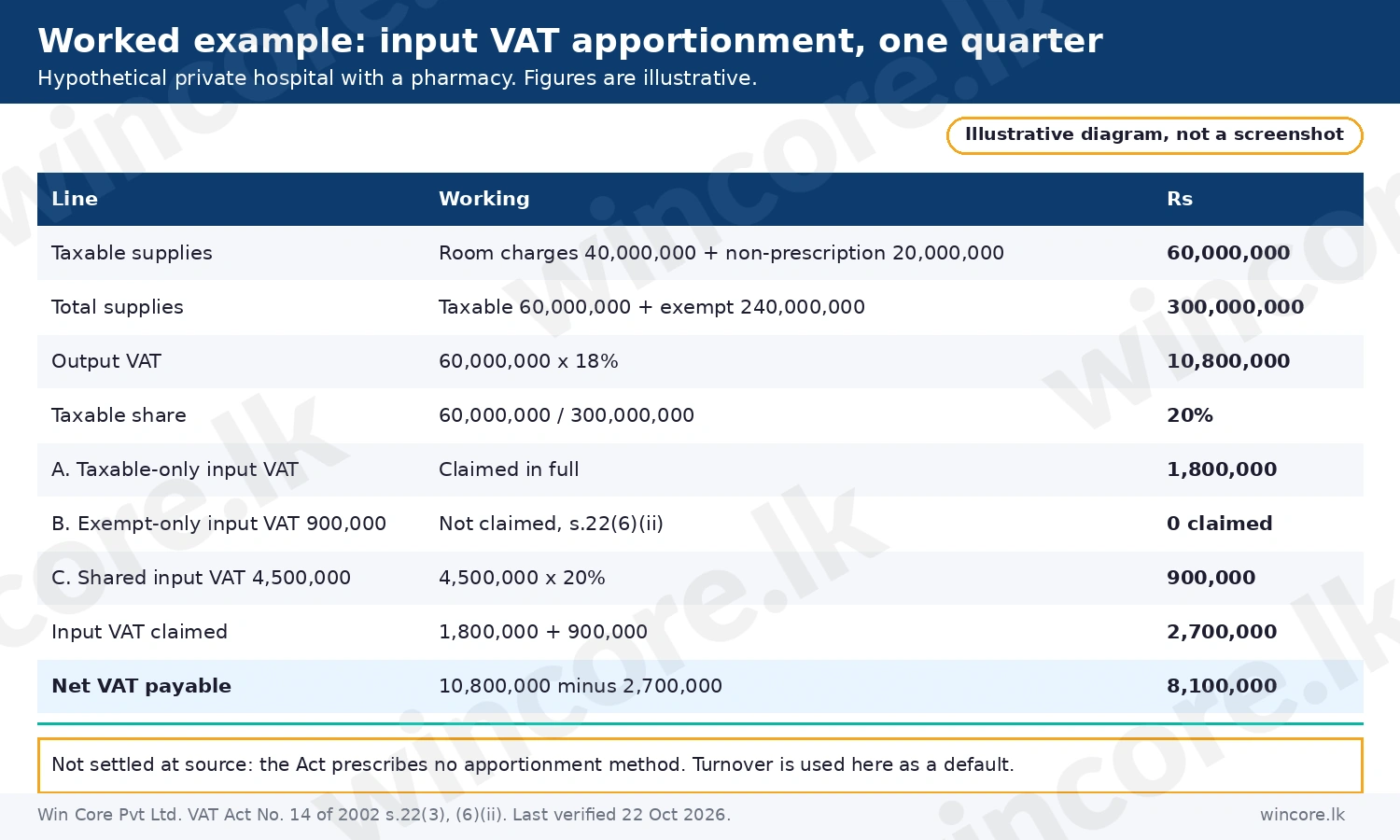
Hypothetical, with figures invented for illustration: a VAT-registered private hospital with a pharmacy counter, one quarter, all amounts VAT-exclusive.
| Line | Amount (Rs) |
|---|---|
| Room charges (taxable) | 40,000,000 |
| Non-prescription pharmacy sales (taxable) | 20,000,000 |
| Healthcare services (exempt, item (b)(ix)) | 180,000,000 |
| Prescription medicines (exempt, item (a)(iii)) | 60,000,000 |
| Total supplies | 300,000,000 |
Input VAT on purchases in the quarter:
- A. used only for taxable supplies (stock of products sold only without a prescription, room linen service): Rs 1,800,000;
- B. used only for exempt supplies (servicing of treatment equipment): Rs 900,000;
- C. shared (electricity, IT, security, building maintenance): Rs 4,500,000.
Working (our arithmetic):
- Output VAT: Rs 60,000,000 x 18% = Rs 10,800,000. The 18 percent rate is in s.2, "for any taxable period commencing on or after January 1, 2024" [1].
- Taxable share by turnover: 60,000,000 / 300,000,000 = 20%.
- Shared input VAT allowed: 4,500,000 x 20% = Rs 900,000.
- Input VAT claimed: A + allowed share of C = 1,800,000 + 900,000 = Rs 2,700,000.
- Not claimed: B + the rest of C = 900,000 + 3,600,000 = Rs 4,500,000. This becomes a cost.
- Net VAT payable: 10,800,000 minus 2,700,000 = Rs 8,100,000.
Now suppose the hospital argued for floor area instead, with rooms and the pharmacy counter taking 35 percent of the building. The shared claim would be 4,500,000 x 35% = Rs 1,575,000, the total claim Rs 3,375,000, and the net payable Rs 7,425,000. The difference is Rs 675,000 in one quarter (our arithmetic). That is why the method needs a written reason, not a preference. If your sales records are kept VAT-inclusive, our VAT calculator separates the tax from the gross figure.
One check before filing. Section 22(10)(b) limits allowable input tax for a period "to the lesser amount of hundred per centum of the output tax declared for that taxable period or the input tax allowable", with the residue carried forward [1]. A proviso lifts the limit for input tax attributable to zero rated supplies and to project supplies of a person registered under s.22(7). In this example Rs 2,700,000 is well under Rs 10,800,000, so the cap does not bite.
The pharmacy till decides whether the ratio holds
The pharmacy is where most hospitals get the split wrong, and the reason is the till, not the law. One counter sells both prescription and non-prescription items, often to the same customer in one transaction. Item (a)(iii) turns on whether the product was "purchased on a prescription of a physician" [1]. If the till does not record that, the turnover ratio has nothing reliable to stand on. It is not a VAT problem first. It is a data problem.
The same product can sit on both sides. A painkiller sold on a prescription in the morning and over the counter in the afternoon is a corridor item: any VAT paid on buying it serves a taxable sale and an exempt one, so on our reading it belongs in C, not A.
This will matter more once section 64B, added by Act No. 14 of 2026, takes effect. It requires every registered person to use secured point of sale machines "within three months from the date so prescribed" [4]. A till set up now to record the prescription saves rework later.
Which brings us back to the corridor: the ratio is only as good as the sales records feeding it.
What this means for you
- List every supply you make and match each to a Part III item, or record that none applies, citing the item number.
- Tag every purchase invoice as taxable-only, exempt-only or shared when it is entered, not at the return.
- Apportion only the shared costs, choose a method for them, write down why, and apply it each period.
- Make your pharmacy or sales system record whether each sale was on a prescription.
- Check the s.22(10)(b) cap each period before filing the return.
- Recheck Part III and s.22 after every VAT amending Act, starting with Act No. 14 of 2026.
Tagging at entry is a bookkeeping habit; our bookkeeping services team can build it into your purchase ledger, and our VAT and tax services team reviews supply lists and apportionment workings before a return goes in.
Checklist: documents needed
- Sales analysis by supply type for the period
- Tax invoices for every input VAT claim
- Purchase listing tagged taxable, exempt or shared
- Written note of the apportionment method and the reason for it
- Workings for the taxable share and the shared claim
- Prescription records supporting exempt pharmacy sales
FAQ
Are hospital room charges subject to VAT in Sri Lanka?
On our reading, yes, for a VAT-registered hospital. The healthcare exemption in First Schedule Part III item (b)(ix) covers "all healthcare services provided by medical institutions" but ends "other than hospital room charges". The same carve-out has applied since Act No. 25 of 2018. We found no other Part III item exempting room charges. If you bill a package that mixes treatment and room, split the price.
Is every pharmacy sale exempt from VAT?
No. Item (a)(iii) exempts pharmaceutical products and drugs other than cosmetics, with a therapeutic or prophylactic end use, "purchased on a prescription of a physician". A sale that fails any of those conditions is outside that item. Over-the-counter sales without a prescription are the usual case. Check each product line against the Schedule before treating it as exempt.
Does the VAT Act say which apportionment method to use?
No. Section 22(3) says the tax "shall be apportioned" but gives no method. IRD Circular No. 2011/07 allows apportionment only for common overheads and sets no ratio. A turnover ratio is the common default. Whatever you use, write down the reason and apply it consistently so it can be explained on review.
Can a hospital claim input VAT on equipment used only for treatment?
On our reading, no. Section 22(6)(ii) says input tax shall not be deducted where the supply received "is not connected with the taxable activity or not included in the value of taxable supply". Equipment used only for exempt treatment fits that description. Its VAT becomes part of the equipment's cost. If the same equipment also serves a taxable line, treat it as shared.
Did Act No. 14 of 2026 change the hospital exemptions?
Not on our reading. Section 17 of the Act adds supplies to a Business of Strategic Importance and a new paragraph for services supplied through an electronic platform by a non-resident person, which includes some digital health services. Section 6 adds a new item to s.22(6). Neither change touches items (a)(iii) or (b)(ix), or the s.22(3) rule itself.
Open points
- No apportionment method is prescribed in the Act. IRD Circular No. 2011/07 limits apportionment to common overheads but sets no ratio, and we found no later IRD rule or guide in a search of ird.gov.lk on 23 October 2026.
- "Medical institutions" in item (b)(ix): we did not find a definition and did not test where a clinic or nursing home sits.
- Whether a wholesaler's sale of medicines to a pharmacy is within item (a)(iii), which turns on a purchase "on a prescription of a physician". On our reading, any VAT a pharmacy does pay on stock later dispensed on a prescription relates to exempt supplies.
- We read Acts No. 4 of 2025 and No. 14 of 2026 in full. Neither changes items (a)(iii) or (b)(ix), s.22(3), s.22(6)(ii) or s.22(10)(b); Act No. 4 of 2025 amends only provisos to s.22(10). For Act No. 32 of 2023 and earlier Acts we rely on the IRD consolidation and its margin notes.
- Whether an annual true-up of the ratio is required or allowed: the Act is silent.
We recognise that "tag your invoices when you enter them" is not exciting advice. It rarely is. But it decides the answer more often than the law does. The ward and the counter can look after themselves. Apportion the corridor, and write down how.
Talk to us. If you would like us to review your supply list, your apportionment method and your workings before the next VAT return, see our income tax and VAT filing support.
WinCore Pvt Ltd
Related reading
- VAT on sale of business Sri Lanka: assets and VAT
Sources and references (6)
- Inland Revenue Department. Value Added Tax Act, No. 14 of 2002 (IRD consolidation to 2025), ss.2, 22(2), 22(3) and provisos, 22(6)(ii), 22(10)(b) and provisos; First Schedule Part II para (b) item (xii), Part III paras (a)(iii), (a)(iv) and (b)(ix). https://www.ird.gov.lk/en/publications/Value%20Added%20Tax_Acts/VAT_Act_No_14%5BE%5D_2002_%28Consolidation_2025%29.pdf . Primary (IRD consolidation, used to locate the sections; not itself the Act). Accessed 23 October 2026.
- Commissioner General of Inland Revenue. Circular to VAT Registered Persons No. 2011/07, Instructions: filing of VAT returns (9 September 2011), Part III item (ix) and item (x). https://www.ird.gov.lk/en/publications/Circulars_Circulars/VATCirNo2011_07%5BE%5D.pdf . Primary (IRD administrative circular, not law). Accessed 23 October 2026.
- Parliament of Sri Lanka. Value Added Tax (Amendment) Act, No. 25 of 2018 (certified 16 August 2018), s.7(2)(b). https://www.ird.gov.lk/en/publications/Value%20Added%20Tax_Acts/VAT_Act_No._25-2018_E.pdf . Primary. Accessed 23 October 2026.
- Parliament of Sri Lanka. Value Added Tax (Amendment) Act, No. 14 of 2026 (certified 30 June 2026), ss.6, 11 and 17. https://www.ird.gov.lk/en/publications/Value%20Added%20Tax_Acts/VAT_Act_No_14-2026_E.PDF . Primary. Accessed 23 October 2026.
- Parliament of Sri Lanka. Value Added Tax (Amendment) Act, No. 4 of 2025 (certified 11 April 2025), s.8. https://www.ird.gov.lk/en/publications/Value%20Added%20Tax_Acts/VAT_Act_No_04-2025_E.pdf . Primary. Accessed 23 October 2026.
- Mahesh Ranawaka. Management of Value Added Tax (teaching slides, undated), in the CA Sri Lanka file "Value Added Tax (VAT) Treatment on Leasing & Hire Purchases". https://www.casrilanka.com/casl/images/stories/EDBA/value%20added%20tax.pdf . Secondary (corroboration only). Accessed 23 October 2026.
Put these insights to work
WinCore specialists can review your current workflow, document gaps, and build a practical 90-day action plan.
Book a free consultationRecent articles


Continue reading
Explore more WinCore analysis to keep your finance, tax, and compliance roadmap moving.

VAT exemption errors create hidden tax leakage. Learn the exempt and zero-rated difference, the July 2026 changes, and the records needed to defend treatment.
From 1 July 2026 supplies to a Port City Business of Strategic Importance are VAT exempt. The legal basis, invoicing and the input VAT effect.
Digital services VAT, a 20.5 percent rate for financial services and Rs 1 million fines: each change in the 2026 VAT Act, with its own start date.