
Tax deductible expenses Sri Lanka company: the rules in ss.10 to 19
Which company expenses the Inland Revenue Act allows under ss.10 to 19: the section 11 test, the never-deductible list, the interest cap and losses.
On this page
Last verified against the primary sources on 26 October 2026.
Tax deductible expenses Sri Lanka company owners ask about come down to one general test, a list of things that are never deductible, and specific rules for interest, stock, repairs, research, marketing, assets and losses. Section 11 of the Inland Revenue Act No. 24 of 2017 allows an expense incurred in the production of income but not one of a capital nature. These rules sit in ss.10 to 19, with s.15A added in 2021; we cite each amending Act below.
The example
A hardware wholesaler, a private company, buys tools, fittings and building hardware and sells to retailers. In its year to 31 March 2026 it has a delivery van, leases a warehouse, sends staff on a stock-control course and runs a bank overdraft. Company and figures are invented.
Section 11 allows an expense incurred to produce income, but not a capital one
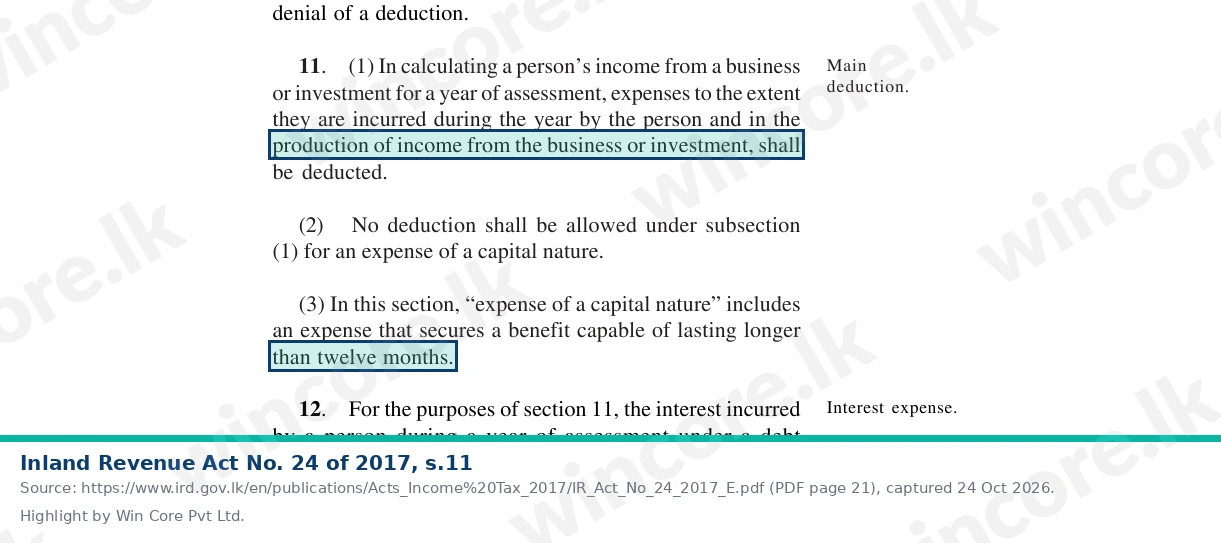
Section 11(1): "In calculating a person's income from a business or investment for a year of assessment, expenses to the extent they are incurred during the year by the person and in the production of income from the business or investment, shall be deducted" [1].
Section 11(2): "No deduction shall be allowed under subsection (1) for an expense of a capital nature." Section 11(3): that "includes an expense that secures a benefit capable of lasting longer than twelve months" [1].
Section 10(3): "No deduction shall be allowed except as expressly permitted by this Act." Section 10(4): "Where more than one deduction applies, the most specific deduction shall be applied even if that results in the denial of a deduction" [1].
Ten kinds of cost are never deductible under section 10(1)(b)
Section 10(1)(b) lists deductions that "shall not be made in calculating a person's income". Each limb, as amended:
- "(i) domestic expenses incurred by the person".
- "(ii) tax payable under this Act".
- "(iii) interest, penalties and fines payable to a government or a political subdivision of a government of any country for breach of any written law".
- "(iv) expenditure or any other deduction to the extent incurred by a person in deriving exempt amounts or final withholding payments" (the words "or any other deduction" added by Act No. 45 of 2022 s.3, from 1 April 2021) [3].
- "(v) retirement contributions", unless included in the employee's income or paid by an employer to an approved "pension, provident, gratuity or savings fund or a savings society" ("gratuity" added by Act No. 10 of 2021 s.5) [2].
- "(vi) dividends of a company".
- "(vii) outlays or expenses for entertainment".
- "(viii) an amount that a person has transferred, in his financial accounts, to a reserve or provision for expenditures or losses not yet incurred but expected to be incurred in a future year of assessment".
- "(ix) amounts incurred on lotteries, betting or gambling", other than in a business of lotteries, betting or gambling.
- "(x) taxes or other levies specified by the Commissioner-General and any tax or levy which is not allowed to be deducted in calculating a person's income in terms of any other written law" (extended by Act No. 45 of 2022 s.3) [1] [3].
Section 10 has two more rules:
- Withholding first. Section 10(2): where a deduction is for a payment from which tax must be withheld, "the deduction shall not be allowed until the tax withheld has been paid to the Commissioner-General" [1].
- Large cash payments. Section 10(2A), inserted by Act No. 4 of 2023 s.2 from 8 May 2023, denies any deduction for a payment of "Rs. 500,000 or more, in a day, or in respect of a single transaction, or in respect of a series of single transactions relating to one event", made otherwise than by account payee cheque or draft, card, or electronic payment through a bank account [4]. The amount paid "shall not be considered as cost of an asset" either (s.10(2A)(a)(ii)), so a van bought in cash at that level earns no capital allowance. The rule does not apply to payments by the Government or a Government institution, payments by a bank or financial institution, or classes the Minister prescribes (s.10(2A)(b)), and a "single transaction" means a purchase "on a single invoice, receipt or statement" (s.10(2A)(c)). Act No. 11 of 2026 s.3 adds "by depositing cash in the second mentioned person's bank account" to the permitted methods, and widens the government and bank exceptions to payments "to or by" them. The commencement table in its section 1(3) gives these changes the date of operation 8 May 2023, so they reach back to the day section 10(2A) itself began, not to 3 June 2026 [5].
Interest counts only if the borrowing is used in the business, and section 18 caps it
Section 12 deems interest under a debt obligation to be incurred in the production of income "to the extent that" (a) where money was borrowed, "the money borrowed under such debt obligation was used to acquire an asset that is used during the year in the production of income", and (b) "in any other case, the debt obligation was incurred in the production of income". Paragraph (a) was reworded by Act No. 45 of 2022 s.4, from 1 April 2022 under its Table A [1] [3]. An overdraft used to buy trading stock for the business passes on our reading; one used to lend to a shareholder does not.
Section 18 caps financial costs for a company (other than a financial institution) with an issued share capital, for years from 1 April 2021. As substituted by Act No. 10 of 2021 s.10 and restated by Act No. 45 of 2022 s.7, the limit is A divided by B, multiplied by C, where "'A' = financial cost of the year", "'B' = value of financial instruments on which the financial cost incurred during the year" and "'C' = 4 x total of the issued share capital and reserves of the company as at the end of the year" [2] [3]. Section 18(5): "reserves" exclude revaluation reserves.
Section 18(3): denied costs "may be carried forward and treated as incurred during any of the following six years of assessment, but only to the extent of any unused limitation". Act No. 45 of 2022 adds a proviso for a year with no financial cost: the limit is then worked out "by using the same amounts of the immediately preceding year" [3].
In the example, the overdraft averages Rs 40,000,000 and costs Rs 4,800,000. Share capital and reserves are Rs 8,000,000, so C is Rs 32,000,000. The limit is Rs 4,800,000 / Rs 40,000,000 x Rs 32,000,000 = Rs 3,840,000. Rs 960,000 is denied this year and carried forward. The Act does not say whether B is an average or a year-end figure, and on 26 October 2026 we found no IRD guidance on it on ird.gov.lk. We used an average; treat this as an open point.
Stock, repairs, research and marketing each have their own deduction rule
Trading stock: section 13
Section 13(2) gives an allowance of opening stock, plus expenses included in the cost of stock in the year, less closing stock. Section 13(4): closing stock is "the lower of" cost or market value at the year end, and under section 13(5) a write-down to market value resets cost [1].
The wholesaler opens with stock of Rs 40,000,000, buys Rs 130,000,000 and closes with stock costing Rs 46,000,000. One slow line of fittings costing Rs 3,000,000 is worth Rs 2,000,000; writing that line down item by item gives a closing value of Rs 45,000,000 and an allowance of Rs 40,000,000 + Rs 130,000,000 - Rs 45,000,000 = Rs 125,000,000. Section 13(4) compares "the cost of the trading stock" with "the market value of the trading stock" and does not say whether the test runs item by item or on the stock as a whole. On our reading item by item is the usual approach, but on a whole-stock test, with total market value above Rs 46,000,000, the closing value would stay at cost and the allowance would be Rs 124,000,000.
Repairs versus improvements: section 14
Section 14(1) deducts "Expenses for the repair or improvement of depreciable assets" that meet section 11(1), "irrespective of whether they are of a capital nature or not" [1]. Since Act No. 10 of 2021 s.7, the cap in section 14(2) applies only to "deductions of improvements" for years from 1 April 2021: 5% of the written down value for a Class 4 asset and 20% for others, with the excess added to the asset's depreciation basis [2]. The same Act defines "improvement" as expenditure "to make additions or alterations to a depreciable asset which enhances the value of such asset", excluding expenditure "to maintain or repair a depreciable asset which temporarily enhances the value". Act No. 45 of 2022 s.5 adds that where the written down value is zero, the improvement is deducted in equal amounts over twelve years for Class 4 and three years for other classes [3].
So the van's new clutch is a repair, deducted in full. Fitting the van with a refrigerated box would be an improvement, subject to the cap.
Research and development: section 15
Section 15(1): research and development expenses meeting section 11(1) "may be deducted irrespective of whether they are of a capital nature or not". The definition covers research "for the upgrading of the person's business through any institution in Sri Lanka" and "the process of developing the person's business and improving business products or process", in each case "which shall be beneficial to Sri Lanka", excluding amounts included in the cost of an asset [1].
Marketing: section 15A
Act No. 10 of 2021 s.8 inserted section 15A. For years from 1 April 2021, "marketing and communication expenses" incurred in the production of business income "shall be deducted irrespective of whether they are of a capital nature or not". The definition lists market research, campaigns "to the extent that such development or production is carried out in Sri Lanka", advertising "on mainstream media or social media", product launches, and "development and printing of point-of-sale material" [2]. On our reading, the wholesaler's printed catalogue falls here as print advertising or point-of-sale material. A trade fair stand is less clear: it fits only if it is a product launch or "campaign activation" under paragraph (d).
Assets get capital allowances, and losses carry forward for six years
Assets: capital allowances, not a deduction
The van and the warehouse racking are capital. Section 16 gives capital allowances under the Fourth Schedule instead of a deduction, and Act No. 45 of 2022 s.6 adds section 16(3A): total allowances for an asset "shall not exceed the cost of such depreciable asset in any circumstances" [3]. For how to classify a purchase, see our capitalise or expense guide.
Losses on business assets: section 17
Section 17(1) deducts "a loss of the person from the realisation during the year" of business capital assets "to the extent to which the assets were used in the production of income from the business", and of business liabilities on the same test [1]. Section 17 does not reach the racking or the van, because "capital asset" in section 195 "excludes trading stock or a depreciable asset". If the wholesaler sells old racking for less than its written down value, the shortfall is a balancing allowance under section 16(1)(b) and (4) and paragraph 4 of the Fourth Schedule, unless the racking took an enhanced allowance, when paragraph 4(4) gives no balancing allowance.
Carrying losses forward: section 19
Section 19(1)(b) deducts "an unrelieved loss of the person for any of the previous six years of assessment from the business or any other business" [1]. Section 19(2) says a loss that can be deducted "shall be deducted". Act No. 45 of 2022 s.8 adds section 19(4)(c): investment losses may be deducted "only within the six years of assessment commencing on the first date of the year of assessment immediately succeeding the year" of the loss [3]. Losses from income that would have been taxed at a reduced rate stay ring-fenced under section 19(3), subject to the provisos added in 2021 and 2022. We read Acts No. 14 of 2023, No. 2 of 2025 and No. 11 of 2026 in full on 26 October 2026. The first two do not touch sections 10 to 19; Act No. 11 of 2026 changes only section 10, in subsection (2A) and by a wording correction in subsection (1)(b)(viii).
Keep records in Sri Lanka for every deduction: section 120
Section 120(1) requires a taxpayer in business to "keep and maintain in Sri Lanka records and accounts sufficient to record all transactions and to ascertain the gains and profits made or the loss incurred" [1]. Section 120(6) requires records to be kept for five years from the transaction, or longer until the time limit for assessment of every period they relate to has expired and any related proceedings are complete; on our reading, records behind a loss or denied interest stay relevant until the later year that uses it.
Tax deductible expenses Sri Lanka company: the table
| Expense | Answer | Section |
|---|---|---|
| Warehouse lease rent | Deductible, once any tax withheld is paid | s.11, s.10(2) |
| Van fuel and repairs | Deductible | s.11, s.14(1) |
| Van purchase | Not deductible; capital allowance | s.11(2), s.16 |
| Improvement to the van | Depends: capped at 20% of written down value | s.14(2), (5) |
| Staff stock-control course | Deductible if in the production of income | s.11 |
| Overdraft interest | Depends: s.12 use test and s.18 cap | s.12, s.18 |
| Stock write-down to market value | Deductible through the stock allowance | s.13(4), (5) |
| Catalogue; trade fair stand used as a product launch | Deductible, even if capital (the stand on our reading) | s.15A |
| Customer entertainment | Not deductible | s.10(1)(b)(vii) |
| Traffic fine on the van | Not deductible | s.10(1)(b)(iii) |
| Income tax | Not deductible | s.10(1)(b)(ii) |
| Provision for future warranty claims | Not deductible | s.10(1)(b)(viii) |
| Payment of Rs 500,000 or more in cash, other than cash deposited into the payee's bank account | Not deductible, and not part of an asset's cost | s.10(2A) |
| Loss on selling old racking below written down value | Deductible as a balancing allowance | s.16(4), Fourth Schedule para 4 |
More detail: our education expense article on staff training, our director-paid expenses article, and our corporate income tax guide on rates.
What this means for you
- Start with the specific section; section 11 is the fallback, and section 10(4) makes the specific rule win.
- Check every expense against the ten limbs of section 10(1)(b).
- Pay large amounts through a bank, and pay over withheld tax before claiming the deduction.
- Model the section 18 cap before borrowing, and track denied interest and losses for six years.
Checklist: documents needed
- Supplier invoices and bank payment proof
- Warehouse lease and rent receipts, with any withholding paid
- Stock count and valuation at year end
- Van repair invoices, separated from improvements
- Training invoices and course outlines
- Overdraft facility letter and interest statements
- Schedule of denied interest and losses carried forward
FAQ
What is the main test for a deductible expense?
Section 11(1) of the Inland Revenue Act deducts expenses "to the extent they are incurred during the year by the person and in the production of income from the business or investment". Section 11(2) excludes expenses of a capital nature, which section 11(3) says include any expense securing a benefit capable of lasting longer than twelve months.
Is bank overdraft interest deductible for a company?
Under section 12, interest counts if the borrowed money was used to acquire an asset used in the production of income. Section 18 then caps a company's financial costs at A/B x C, where C is four times share capital and reserves at year end. Interest above the cap can be carried forward to the following six years of assessment, but only within any unused limit in those years.
How long can a company carry forward a business loss?
Section 19(1)(b) deducts an unrelieved loss for any of the previous six years of assessment, from the same business or any other business. A loss that can be deducted must be deducted. Losses on income that would have been taxed at a reduced rate are ring-fenced under section 19(3).
Are entertainment expenses deductible?
No. Section 10(1)(b)(vii) lists "outlays or expenses for entertainment" among the deductions that shall not be made in calculating a person's income. Section 10(3) adds that no deduction is allowed except as expressly permitted, so there is no fallback to the general test in section 11.
Talk to us. If you want your deductions reviewed before filing, see our income tax support.
WinCore Pvt Ltd
General information on the law as at 26 October 2026, not advice on your position.
Related reading
- Tax computation Sri Lanka: from accounting profit to company tax
Related reading: Income tax return loss year Sri Lanka.
- When is transfer pricing documentation needed in Sri Lanka?
Sources and references (5)
- Parliament of Sri Lanka. Inland Revenue Act, No. 24 of 2017 (certified 24 October 2017), ss.10, 11, 12, 13, 14, 15, 16, 17, 18, 19, 120 and 195, and Fourth Schedule paragraph 4. https://www.ird.gov.lk/en/publications/Acts_Income%20Tax_2017/IR_Act_No_24_2017_E.pdf . Primary. Accessed 24 October 2026.
- Parliament of Sri Lanka. Inland Revenue (Amendment) Act, No. 10 of 2021 (certified 13 May 2021), ss.5, 7, 8 (new s.15A) and 10. https://www.ird.gov.lk/en/publications/Acts_Income%20Tax_2017/IR_Act_No._10_2021_E.pdf . Primary. Accessed 24 October 2026.
- Parliament of Sri Lanka. Inland Revenue (Amendment) Act, No. 45 of 2022 (certified 19 December 2022), ss.1, 3, 4, 5, 6, 7 and 8 and Tables A and C. https://www.ird.gov.lk/en/publications/Acts_Income%20Tax_2017/IR_Act_No._45_2022_E.pdf . Primary. Accessed 24 October 2026.
- Parliament of Sri Lanka. Inland Revenue (Amendment) Act, No. 4 of 2023 (certified 8 May 2023), ss.1(2) and 2 (new s.10(2A)). https://www.ird.gov.lk/en/publications/Acts_Income%20Tax_2017/IR_Act_No._04_2023_E.pdf . Primary. Accessed 24 October 2026.
- Parliament of Sri Lanka. Inland Revenue (Amendment) Act, No. 11 of 2026 (certified 3 June 2026), s.1(3) and its Table (s.10(2A): 08.05.2023), and s.3. https://www.ird.gov.lk/en/publications/Acts_Income%20Tax_2017/IR_Act_No_11-2026_E.pdf . Primary. Accessed 24 October 2026.
Put these insights to work
WinCore specialists can review your current workflow, document gaps, and build a practical 90-day action plan.
Book a free consultationRecent articles
Continue reading
Explore more WinCore analysis to keep your finance, tax, and compliance roadmap moving.
No rupee threshold is set by the standard or the tax law. How to treat chairs, office fit-out, landscaping and software subscriptions in books and tax.

When a director pays a company bill, the company owes the director. How to book it, which Companies Act sections apply and when repayment is taxable.
Sri Lanka corporate income tax guide: rates, taxable income, quarterly instalments, deductions, capital allowances, and key compliance penalties.