
Budget 2027 tax administration: what is proposed?
See the proposed tax administration changes, including the 14% withholding clarification, cash compliance evidence and mergers.

On this page
Last updated 12 November 2026.
Last verified against the primary sources on 12 November 2026.
Budget 2027 tax administration, in brief. Budget 2027, presented on 12 November 2026, proposes to clarify section 85(1B) and its 14% withholding on certain Sri Lankan source fees paid to nonresidents. The Ministry of Finance Budget Speech sets out this and other administration proposals in Annexure V, generally from 1 April 2027. The proposals require legislation before they change the law. [1][2]
In an invented example, a construction contractor in Kandy has a gross fee of Rs 287,435 for landscape design services from an overseas consultant with no permanent establishment in Sri Lanka. Assuming the fee has a Sri Lankan source and no treaty relief or other exception changes the result, 14% withholding is Rs 40,240.90. The balance is Rs 247,194.10. The proposed clarification is about who falls within the rule, not a proposed increase in that rate. [1][2]
What changed
- 12 November 2026: The Budget Speech proposed the measures described below. The speech itself does not amend the Inland Revenue Act. [1]
| Point | Rule on 12 November 2026 | Budget proposal | Proposed date and source |
|---|---|---|---|
| Service fees and insurance premiums paid to nonresidents | Section 85(1B) provides for 14% withholding on a payment with a Sri Lankan source, subject to its statutory provisions. | Clarify that the 14% rule applies only to payments to nonresidents without a permanent establishment in Sri Lanka. | 1 April 2027; Annexure V, items 7.6 and 9. [1][2] |
| Cash transaction restriction | Section 10(2A) applies to qualifying aggregate payments of Rs 500,000 or more made outside the specified methods, subject to exceptions. | Accept a certificate from an approved accountant or a specified authorised person to verify compliance. | 1 April 2027; Annexure V, items 7.1 and 9. [1][3][4] |
| Mergers | Section 35 already contains a general rule on tax avoidance schemes when its conditions are met. | Introduce measures addressing potential avoidance in amalgamations and mergers while protecting genuine amalgamations from undue effects. | 1 April 2027; Annexure V, items 7.2 and 9. [1][5] |
Table: Rules and proposals; proposed effective date 1 April 2027. Sources: Budget Speech 2027, Annexure V, and the Inland Revenue Act as amended.
Who would the 14% WHT apply to under Budget 2027 tax administration proposals?
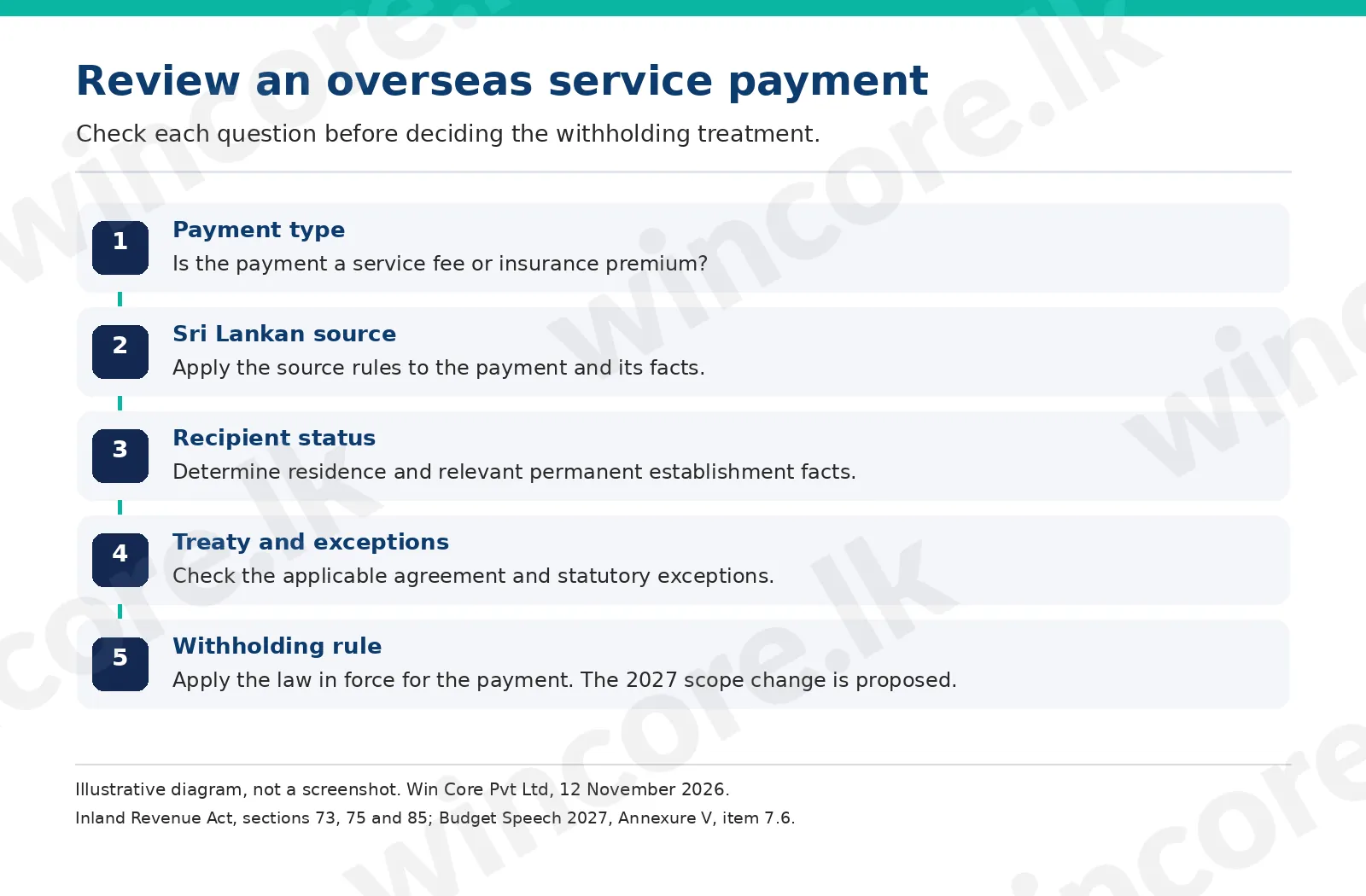
Budget 2027 proposes to clarify that the 14% withholding rule for service fees and insurance premiums applies only when the Sri Lankan payer pays a nonresident who has no permanent establishment in Sri Lanka. Item 7.6 identifies section 85(1B) as the provision to be amended. Item 9 gives 1 April 2027 as the general proposed effective date unless another date is specified. [1]
Section 85(1B), inserted by the 2022 amendment with effect from 1 January 2023, requires a payer to withhold 14% when paying a service fee or insurance premium with a Sri Lankan source to a nonresident, subject to subsections 85(2) and 85(3). Subsection 85(1B) does not itself contain the proposed permanent establishment limitation. Section 85(3) excludes, among other payments, exempt amounts and payments by individuals outside a business. The existing rules and any applicable treaty must be considered until an amendment takes legal effect. [2][5]
Section 85(4), inserted by the 2023 amendment with effect from 1 January 2023, separately addresses the inclusion of the Government as a payer for payments to nonresidents other than payments derived through a Sri Lankan permanent establishment. That provision must be read with the rest of section 85. The Budget wording is a proposal to amend subsection 85(1B). [1][3]
The distinction matters to the payer. A permanent establishment is a legal question that depends on the facts and the applicable provisions. The existence of an overseas address alone does not settle it. The proposal also does not say that every payment to a nonresident has a Sri Lankan source, or that no other withholding provision can apply.
Where a double taxation agreement has legal effect in Sri Lanka, section 75 addresses its relationship with the Act. A payer should consider the relevant agreement and its conditions before using a treaty rate or exemption. Do not assume a treaty result from the location of the supplier alone. [5][6]
Worked example: a service fee of Rs 287,435
The example assumes that the landscape design fee is a Sri Lankan source service fee, the recipient has no permanent establishment in Sri Lanka, and no treaty relief or other exception changes the result. It illustrates the 14% calculation; it does not establish the source or treaty treatment of every overseas design fee.
| Calculation | Amount |
|---|---|
| Gross service fee | Rs 287,435.00 |
| Withholding: Rs 287,435 × 14% | Rs 40,240.90 |
| Balance after withholding | Rs 247,194.10 |
The payer should retain the contract, invoice and evidence supporting the source and treaty analysis. Check the contract or agreement where it addresses whether the stated fee is before or after withholding.
For the wider Budget context, see the Budget tax proposals guide. The withholding registration guide covers the separate registration process.
How would cash transaction limits be shown?
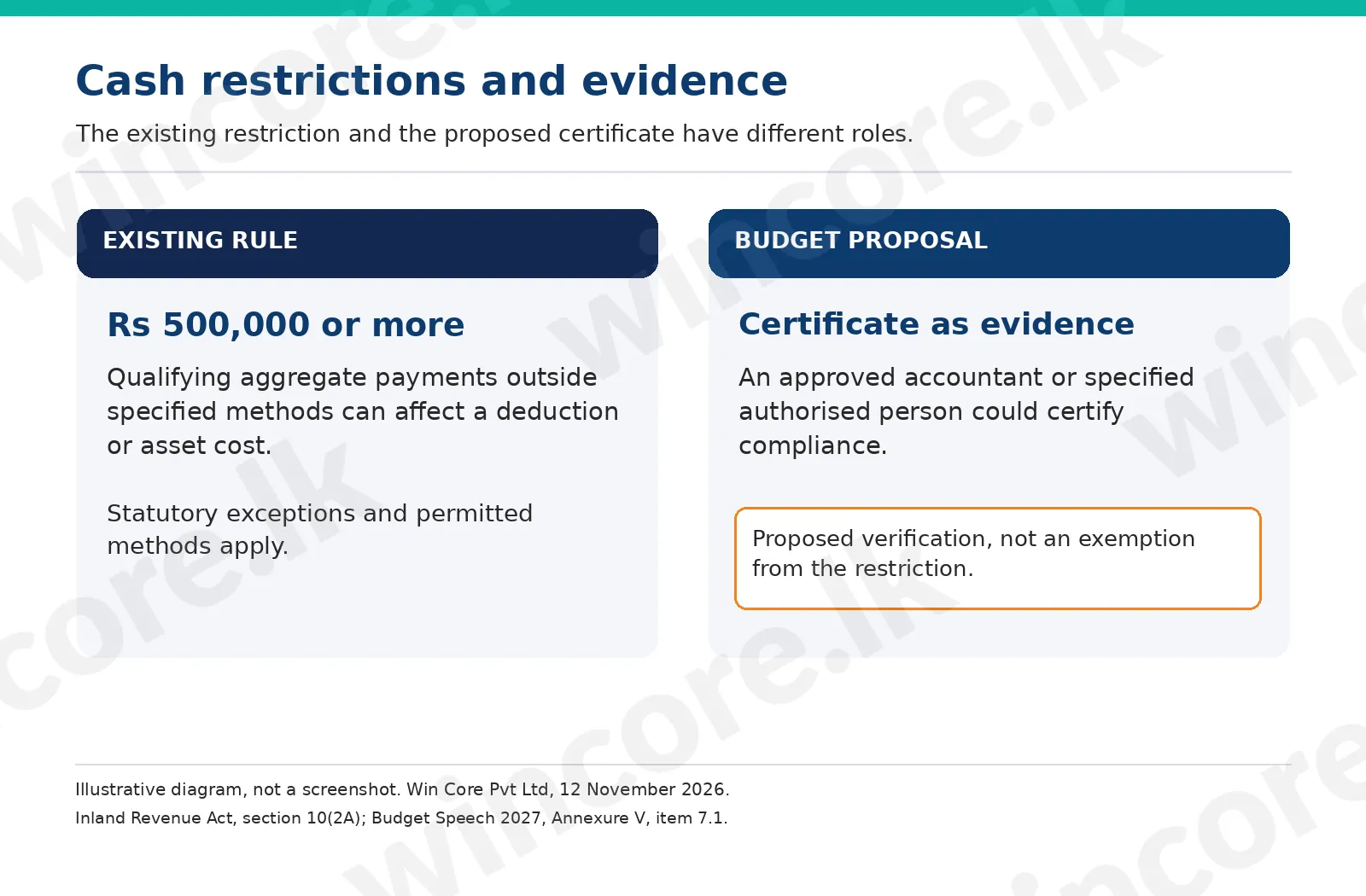
Budget 2027 proposes that the Commissioner General of Inland Revenue accept a certificate from an approved accountant or an authorised person who may be specified to verify compliance with the existing cash transaction restriction. The proposal does not itself specify the certificate format, the full approval process or a filing deadline. [1]
The restriction itself already exists. Section 10(2A), introduced by the Inland Revenue Amendment Act No. 4 of 2023 and amended by Act No. 11 of 2026, addresses a payment to another person amounting in aggregate to Rs 500,000 or more in a day, for a single transaction, or for a series of single transactions relating to one event. It applies where the payment is made outside the listed methods. Subject to the statutory exceptions, the affected amount is not allowed as a deduction in calculating income and is not treated as the payer's cost of an asset. [3][4]
The listed methods include an account payee cheque or account payee bank draft, a credit or debit card, an electronic payment system through a bank account, and a cash deposit to the bank account of the person entitled to payment. For this subsection, a bank account is an account maintained at a bank or financial institution in Sri Lanka. The 2026 amendment, treated as effective from 8 May 2023 for section 10(2A), added the cash deposit method and widened the listed exceptions to payments to or by the Government or a Government institution, and to or by a bank or financial institution. Prescribed classes of persons or payments must also be considered. [3][4]
The proposed certificate is evidence of compliance. The speech does not say that obtaining one makes an otherwise disallowed payment deductible, removes the statutory threshold, or replaces the underlying payment records. Keep the payment evidence and watch for the enacted wording and any specification of authorised persons. [1]
What changes for mergers?
Budget 2027 proposes rules to address potential tax avoidance in company amalgamations and mergers, while stating that genuine amalgamations should not be unduly affected. Annexure V does not set out the detailed test, a definition of a genuine amalgamation, or a filing procedure. [1]
The existing Act already contains a general tax avoidance rule in section 35. It applies where the Commissioner General is satisfied that the statutory conditions are met, including a scheme, a tax benefit and the required sole or dominant purpose. If the section applies, the Commissioner General has powers to determine liability on the basis stated in that section. It is not a rule that treats every merger as avoidance. [5]
Companies considering an amalgamation should retain the transaction documents and the reasons for the arrangement. The proposed merger measure should be assessed again when the actual amendment is available. The Budget description alone does not establish the final conditions or their effect on a particular transaction.
What else changes in tax administration?
Item 7.3 proposes provisions to prevent double taxation of donations between NGOs where proof is submitted that the original recipient NGO paid the tax. The speech does not set out the proof or the mechanics. [1]
Remote and digital services: item 7.4
Section 73 sets out rules for identifying payments with a Sri Lankan source. Section 73(1)(c) includes a technical service fee paid by a resident, subject to its exception for expenditure of a business carried on through a permanent establishment outside Sri Lanka. It also addresses such payments by a nonresident through a Sri Lankan permanent establishment and, following the 2022 amendment, payments by the Government including payments made on its behalf by an institution. Other limbs cover other services, and the section defines a technical service fee for this purpose. [2][5]
Budget 2027 proposes to amend section 73 so that the source of income from remote and digital services, including online advertising and cloud services, is determined by reference to the place of payment. The speech describes the direction of the proposed change, but it does not supply the detailed statutory definition of place of payment. A payer should apply the enacted source rules in force for the payment and revisit the point when the amendment is available. [1][5]
Tax treaty wording: item 7.5
Section 75(5), as amended in 2021, defines a double taxation agreement by reference to relief from double taxation and the prevention of fiscal evasion. Section 75(2) addresses conflicts between an agreement with legal effect in Sri Lanka and the Act, subject to the section's limitations. [5][6]
Budget 2027 proposes to replace the expression concerning prevention of fiscal evasion with wording concerning prevention of tax evasion and avoidance. The stated aim is alignment with terminology used in the model conventions of the OECD and the United Nations. This proposal changes the Act's wording if enacted; it does not by itself rewrite the text of each existing treaty. [1]
Foreign tax authority information: item 7.8
Section 100 imposes confidentiality obligations on persons administering the Act, subject to the disclosures and exceptions in that section. These include specified disclosures to foreign tax authorities under an international agreement. Amendments in 2023 and 2026 added other authorised recipients for specified purposes. The proposal concerns information received from foreign tax authorities. [3][4][5]
Budget 2027 proposes an amendment so that information received from foreign tax authorities is disclosed only to persons authorised under the Act and with the prior consent of the relevant foreign authority. The speech does not set out the detailed consent procedure. [1]
Delayed VAT returns: item 7.7
Item 7.7 proposes relief for eligible taxpayers whose input tax claims were disallowed because of delayed VAT returns during the pandemic. The wording refers to outstanding returns filed on or before 31 July 2026. That date precedes the Budget Speech. Eligibility, the interaction with existing VAT law and how this proposal would operate require confirmation in the implementing legislation. Do not assume the speech creates a fresh filing window. [1]
Technical corrections: item 10
Budget 2027 proposes technical and administrative amendments across several tax laws to address ambiguities and unintended effects, including differences in translations. The speech does not identify every clause to be corrected. For the Inland Revenue Act, section 200 addresses which language text prevails if the Sinhala and Tamil texts are inconsistent. The proposed corrections must be checked against the actual amending provisions when available. [1][5]
When would these apply?
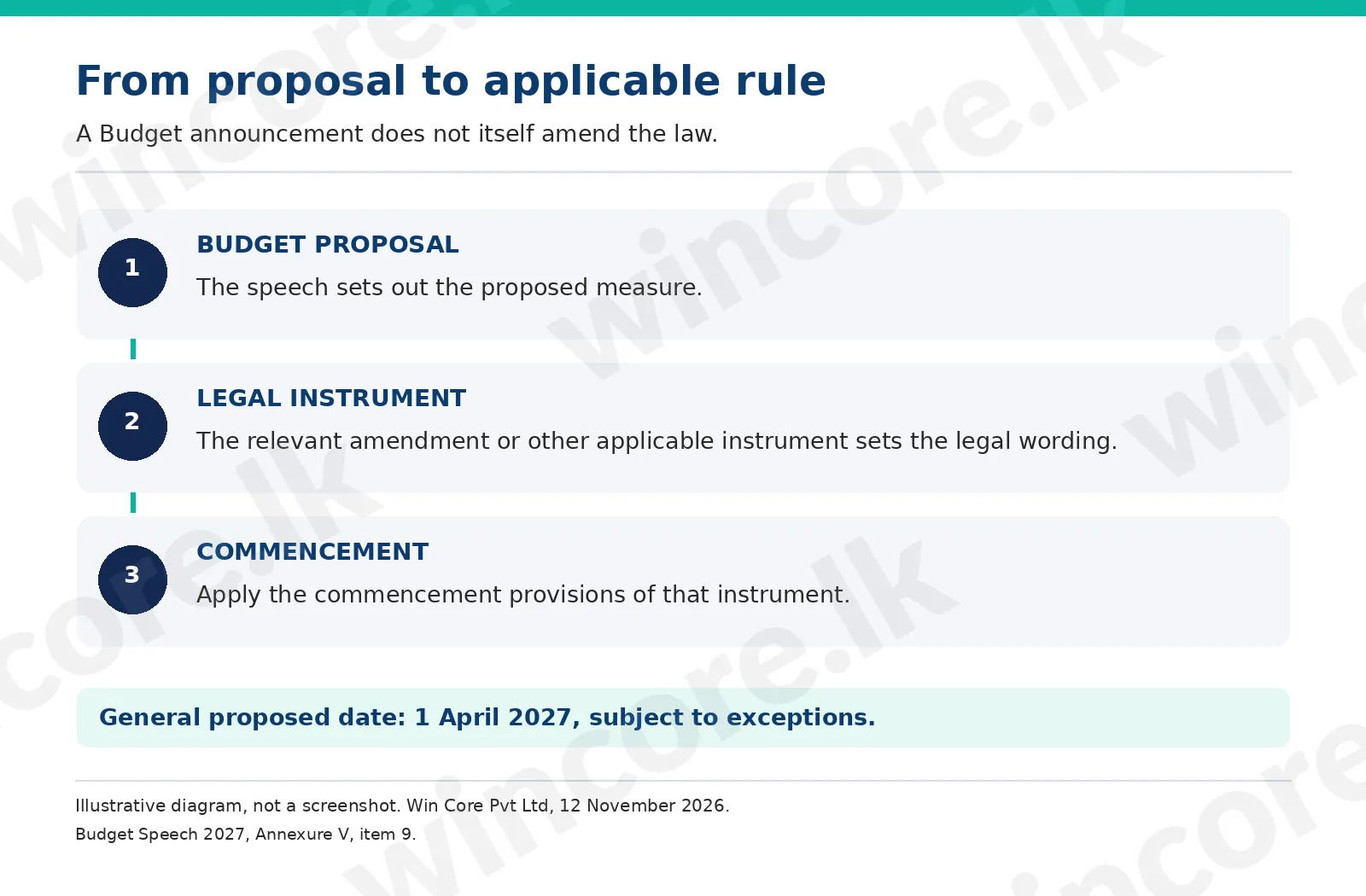
The general proposed date is 1 April 2027, unless the technical note or relevant tax legislation specifies otherwise. The speech is a proposal. A change takes effect through the applicable legal instrument and its commencement provisions, not simply because it appears in the Budget Speech. The final wording and date may differ. [1]
Section 36.9 states the policy aim: strengthen administration, improve legal certainty and facilitate compliance, while reviewing procedural requirements that may prevent legitimate refunds or input credits and retaining revenue safeguards. This statement of aim is not itself a new entitlement to a refund or credit. [1]
The tax sections and technical notes of the speech propose specified VAT and SSCL changes, including particular exemptions. Those sections do not propose a general change to the VAT rate or registration threshold, corporate income tax rate, SSCL rate, EPF, ETF or minimum wage. Check other Budget materials, relevant law and any later instruments separately. [1]
What this means for you
Identify payments to overseas service providers and insurers, then record the source, recipient status, permanent establishment facts and any relevant treaty analysis. Keep payment evidence for amounts covered by the cash transaction rule. If an amalgamation is relevant, keep the documents supporting the transaction. Monitor the amending legislation and any IRD directions before changing a process.
Checklist: documents needed
FAQ
Does Budget 2027 increase the 14% withholding rate?
No. Item 7.6 proposes to clarify the scope of the 14% rule, not increase the stated percentage. Section 85(1B) applies to a Sri Lankan source service fee or insurance premium paid to a nonresident, subject to the section and any applicable treaty. The proposed permanent establishment wording must still be enacted before it changes the rule. [1][2][3]
Does an accountant's certificate remove the cash restriction?
No such removal is stated in the speech. Item 7.1 proposes acceptance of a certificate to verify compliance with the existing restriction. Section 10(2A), its payment methods and exceptions remain relevant. The speech does not prescribe the certificate's complete format or say that it cures a payment made outside the statutory conditions. [1][3][4]
Can a payer apply the proposed permanent establishment rule immediately?
The proposal should not be treated as an enacted amendment. Annexure V gives 1 April 2027 as the general proposed date, subject to stated exceptions and the relevant legislation. Until the applicable amendment takes effect, a payer should apply the law and any relevant treaty that govern the particular payment. [1][2][5]
The short version
Budget 2027 proposes to clarify the 14% withholding rule and introduce other administration measures. The speech gives 1 April 2027 as the general proposed date. The final legislation and its commencement provisions determine the result. Keep the evidence.
Talk to us. WinCore Pvt Ltd helps with IRD audit and inquiry support. See our tax page or book a consultation at our contact page.
WinCore Pvt Ltd
This article is general information verified on 12 November 2026 and is not tax, legal or accounting advice on your specific position.
Sources and references (7)
- Ministry of Finance, Planning and Economic Development. Budget Speech 2027, section 36.9 and Annexure V, items 7.1 to 7.8, 9 and 10. https://www.treasury.gov.lk/api/file/ea495202-fcb1-4c78-b34e-58389cb20738 . Primary. Accessed 12 November 2026.
- Parliament of Sri Lanka. Inland Revenue Amendment Act, No. 45 of 2022, sections 14 and 17. https://www.ird.gov.lk/en/publications/Acts_Income%20Tax_2017/IR_Act_No._45_2022_E.pdf . Primary. Accessed 12 November 2026.
- Parliament of Sri Lanka. Inland Revenue Amendment Act, No. 4 of 2023, sections 1, 2, 4, 6 and 8. https://www.parliament.lk/uploads/acts/gbills/english/6293.pdf . Primary. Accessed 12 November 2026.
- Parliament of Sri Lanka. Inland Revenue Amendment Act, No. 11 of 2026, sections 1, 3, 13 and 22. https://www.parliament.lk/uploads/acts/gbills/english/6420.pdf . Primary. Accessed 12 November 2026.
- Parliament of Sri Lanka. Inland Revenue Act, No. 24 of 2017, sections 10, 35, 73, 75, 85, 100, 195 and 200. Read with the amending Acts. https://www.ird.gov.lk/en/publications/Acts_Income%20Tax_2017/IR_Act_No_24_2017_E.pdf . Primary. Accessed 12 November 2026.
- Parliament of Sri Lanka. Inland Revenue Amendment Act, No. 10 of 2021, sections 22 and 30. https://www.ird.gov.lk/en/publications/Acts_Income%20Tax_2017/IR_Act_No._10_2021_E.pdf . Primary. Accessed 12 November 2026.
Related reading: Budget 2027 import duty changes in Sri Lanka.
Put these insights to work
WinCore specialists can review your current workflow, document gaps, and build a practical 90-day action plan.
Book a free consultationRecent articles




Continue reading
Explore more WinCore analysis to keep your finance, tax, and compliance roadmap moving.

A practical guide to the proposed Budget 2027 tax measures, their intended dates and the steps companies and employers can take.

WHT registration works best when withholding-agent onboarding, payment mapping, deduction, and remittance controls are designed as one process.
The Budget proposes changes to food levies, newsprint and solar battery PAL, and selected CESS rates. See the dates and how to check a tariff line.