
Budget 2027 import duty: what could change?
The Budget proposes changes to food levies, newsprint and solar battery PAL, and selected CESS rates. See the dates and how to check a tariff line.
On this page
Last updated 12 November 2026.
Last verified against primary sources on 12 November 2026.
Budget 2027 import duty, in brief. Annexure V items 5 and 6 of the Ministry of Finance Budget Speech 2027 propose SCL of Rs 10 per kg on sprats and Maldive fish, plus changes for dried chillies and sugar, from 13 November 2026. The speech also proposes removing PAL on specified newsprint and solar storage batteries from 1 January 2027. The changes need implementing instruments. [1]
Consider an invented solar installation company in Kurunegala importing storage batteries. A comparison below starts with a Customs value of Rs 1,237,480 and shows how a possible removal of PAL can change both the levy and the import VAT base. The actual result depends on classification, eligibility and the final instrument.
What changed
- 12 November 2026: The Budget Speech proposed changes to SCL, PAL and selected CESS rates. [1]
Which levies would the Budget 2027 import duty proposals change and when?
The speech proposes changes on three different dates, and the applicable starting figure depends on the goods and tariff line. [1] The figures below are a comparison with the speech and the Customs chart available on 12 November 2026. They do not establish that a later gazette has taken effect.
Table: proposed dates and source, Budget Speech 2027 Annexure V items 5 and 6, Annexure I and Sri Lanka Customs SCL chart dated 3 November 2026.
| Goods or levy | Earlier reference | Budget proposal | Proposed date |
|---|---|---|---|
| Sprats | Rs 100 per kg | Rs 10 per kg | 13 November 2026 |
| Maldive fish | Rs 302 per kg | Rs 10 per kg | 13 November 2026 |
| Uncrushed dried chillies, HS 0904.21.10 | Rs 100 per kg | Reduce by Rs 50 per kg, giving Rs 50 if the same line is covered | 13 November 2026 |
| Crushed dried chillies, HS 0904.22.10 | Rs 125 per kg | Reduce by Rs 50 per kg, giving Rs 75 if the same line is covered | 13 November 2026 |
| Selected sugar lines | Rs 50 per kg in the chart | Increase by Rs 10 per kg, giving Rs 60 if the same line is covered | 13 November 2026 |
| Specified newsprint | The speech identifies 10% PAL | Remove PAL | 1 January 2027 |
| Solar storage batteries | Rate depends on classification; the Customs guide shows general PAL of 5% for HS 8507.60.90 | Remove PAL on qualifying imports | 1 January 2027 |
| CESS on selected lines | Existing rates vary by HS line | Reduce the existing rates by 25% across 800 selected lines | April 2027 |
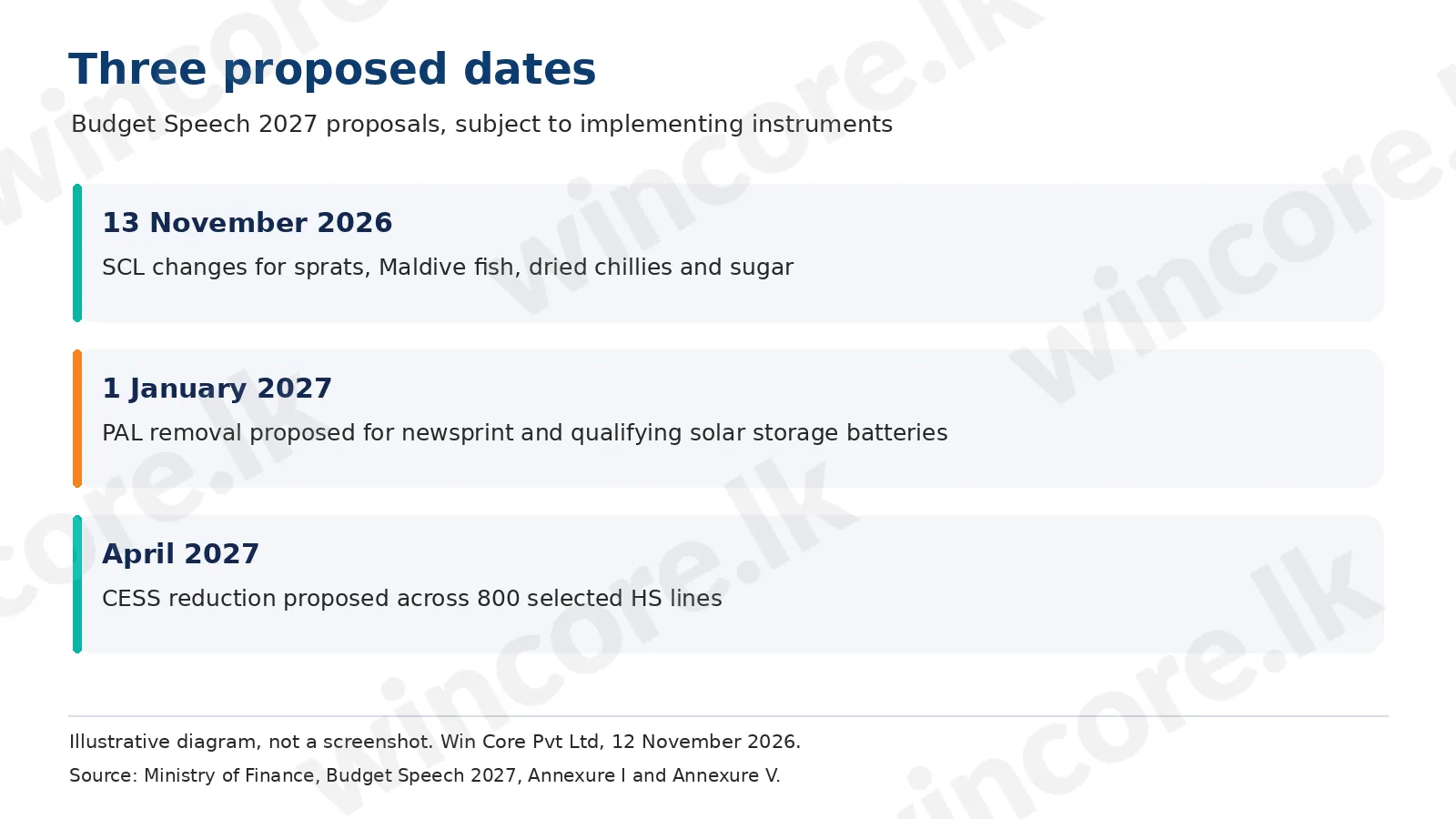
A Budget announcement is not itself the schedule to apply at Customs. Before relying on an amount, match the goods to the published instrument, its effective date and any later amendment. On 12 November the reviewed Customs and Treasury listings had not identified the implementing instruments for these particular proposals. [4] [5]
Which goods are affected by the proposed food levy changes?
The SCL proposals name sprats, Maldive fish, powdered and unpowdered dried chillies, and sugar. [1] The speech gives a proposed reduction from Rs 100 to Rs 10 per kg for sprats and from Rs 302 to Rs 10 per kg for Maldive fish. It describes the chilli and sugar changes as adjustments per kg, so the starting rate matters.
The Customs chart available for this comparison lists separate chilli descriptions and rates. It also lists several sugar lines at Rs 50 per kg. [2] The arithmetic in the table assumes the implementing schedule covers those exact lines and preserves the same starting rates until the change. The speech alone does not confirm either assumption for every shipment.
Do not assume all fish, all chilli products or every sugar preparation is covered. A product description can include details that affect classification, such as whether chillies are crushed or ground. Compare those details with the complete tariff description and the final schedule. If the goods are outside the announced scope, the proposed movement cannot simply be applied to them.
The SCL chart gives a rate and a validity date for each listed line. A validity date is not a promise that no later order could change that rate. Check later instruments before using an earlier chart for a shipment.
Which newsprint and solar batteries could qualify for PAL removal?
The proposed removal covers specified newsprint and batteries used for solar energy storage from 1 January 2027. [1] The speech describes the PAL on the specified newsprint as 10%. Its technical note also names solar storage batteries, but does not set out a battery HS list or say that every battery has a 10% starting rate.
The 3 November Customs tariff guide lists HS 8507.60.90, other lithium ion accumulators, with general PAL of 5%. [3] That line is an example of why the product and rate must be checked; it does not decide the classification or proposed eligibility of every battery used with a solar system. The implementing instrument may specify product descriptions, HS codes, evidence or conditions.
A battery's intended use and its tariff classification are distinct questions. Keep the technical description and the evidence of intended use alongside the proposed schedule. Do not promise a nil PAL figure to a customer merely because the product is described as a solar battery.
How do I check my HS code and the proposed CESS cut?
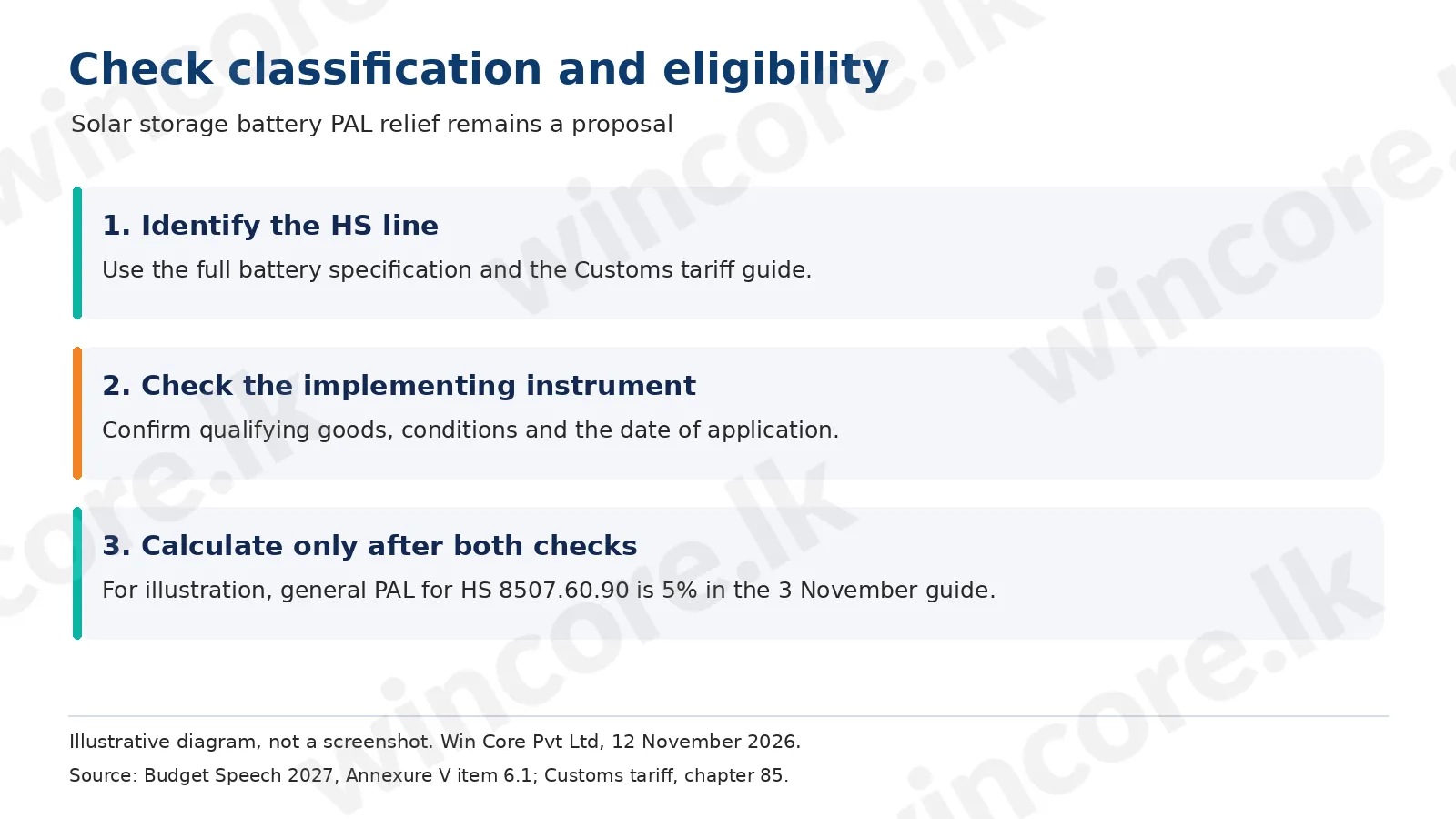
Start with the full product description and the Customs tariff, then compare the exact line with the eventual CESS schedule. Customs says an importer can seek an advance ruling from its Commodity Classification Branch where classification is uncertain. [6]
Find the line and the rates
Open the Sri Lanka Customs import tariff and locate the chapter and detailed description for the goods. Record the complete code, description, general and any relevant preferential columns, units and rates. Read notes and conditions attached to the line. A tariff guide is an aid; Customs states that its content is subject to the relevant laws and gazettes. [5]
For goods listed under SCL, open the SCL chart as well. For other goods, consider each applicable column instead of reading CESS, PAL or VAT in isolation. The tariff line can also point to other conditions or controls.
Compare the Budget with the implementing schedule
The speech proposes a reduction of 25% of the existing CESS rates across 800 selected HS lines. [1] That is a relative reduction in the existing rate, not a reduction of 25 percentage points. For example, a hypothetical rate of 8% reduced by one quarter would become 6%, if that line and rate were covered. This is arithmetic only, not a claim that a particular 8% line qualifies.
The speech extract does not identify the 800 lines. Until an applicable schedule can be checked, an importer cannot conclude that its own line is included or calculate a definite new CESS amount from the announcement. Annexure I places the phase in April 2027; item 9 of Annexure V states the general 1 April date. [1]
Keep the evidence together
Keep the product specification, the tariff page used, any classification ruling, the relevant gazette and the cost calculation together. Record the source date as well as the shipment date. If a supplier describes goods in broad terms, obtain enough product detail to test the description against the tariff rather than treating the commercial label as a classification decision.
How does a levy change affect landed cost and import VAT?
A reduction in PAL or CESS can affect both the levy itself and the VAT calculation where that levy forms part of the import VAT base. Section 6 of the Value Added Tax Act, as substituted by the 2019 amendment, describes the import value, subject to prescribed exceptions, as the Customs value increased by 10%, together with specified duties and levies. [7] [9] The Customs guide provides an import levy computation. [8]
The 10% increase in the VAT base is not itself a 10% VAT rate. It is an addition to Customs value used in the calculation described in the guide. The Customs guide also shows an SSCL calculation for imports. Whether a particular import is liable, exempt or otherwise subject to a special rule must be checked on its own facts. [8] [10]
There are specific SSCL exemptions to check. Part IA of the First Schedule to the SSCL Act covers imported articles subject to SCL and describes solar panel modules, accessories or solar home systems for generating solar power. Whether a particular storage battery falls within the solar exemption depends on its facts and classification. Do not apply the battery example below to food imports or assume the solar exemption covers every battery. [10] [11] [12]
Import VAT paid at the border and VAT that may qualify as an input tax credit are separate questions. A business should not assume recovery merely because VAT was paid. The guide to VAT exemptions explains why the treatment of the goods matters; eligibility, records and the applicable claim rules also matter.
What could the solar battery example cost?
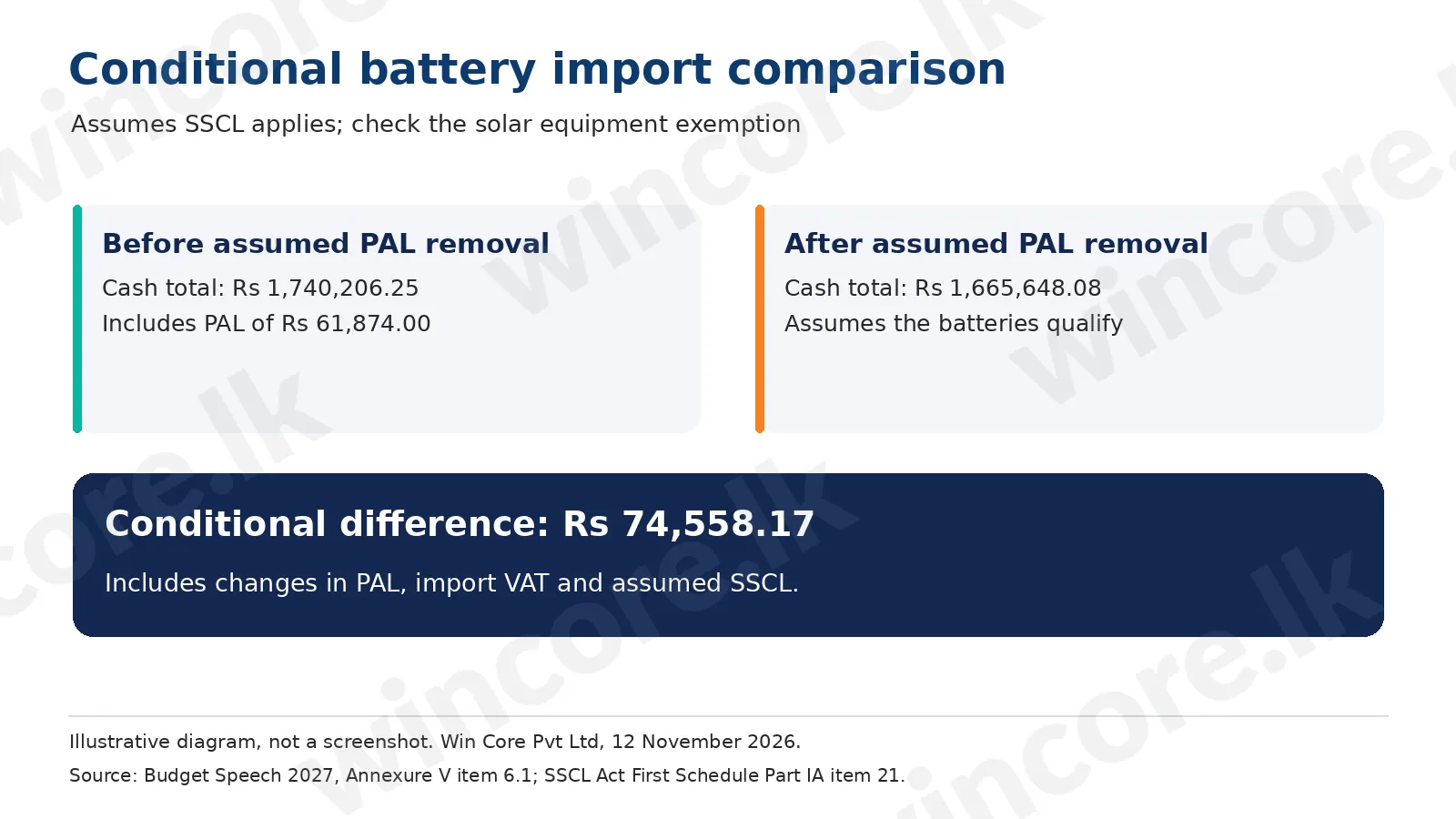
The following invented comparison isolates the proposed PAL change. It assumes the batteries are correctly classified under HS 8507.60.90, qualify under the final PAL instrument, receive the general tariff treatment shown in the Customs guide, and face no CESS, excise or surcharge. It also assumes that SSCL applies and that no solar equipment exemption covers these particular batteries. These are assumptions for the calculation, not a classification ruling or a statement of final eligibility. [1] [3] [8] [10]
The Customs value is Rs 1,237,480 in both columns. The example uses 10% general Customs duty, 5% general PAL before the proposal, 18% VAT and 2.5% SSCL, with PAL assumed to be removed in the second column. [3] Figures include rupees and cents. Other costs and any special treatment are excluded.
| Calculation | Before assumed removal | After assumed removal |
|---|---|---|
| Customs value | Rs 1,237,480.00 | Rs 1,237,480.00 |
| Customs duty, 10% of value | Rs 123,748.00 | Rs 123,748.00 |
| PAL, 5% of value before removal | Rs 61,874.00 | Rs 0.00 |
| VAT and SSCL base: 110% of value plus duty and PAL | Rs 1,546,850.00 | Rs 1,484,976.00 |
| Import VAT, 18% of base | Rs 278,433.00 | Rs 267,295.68 |
| SSCL, 2.5% of base | Rs 38,671.25 | Rs 37,124.40 |
| Value plus stated border charges | Rs 1,740,206.25 | Rs 1,665,648.08 |
On those assumptions, the difference in cash paid for the value and stated border charges is Rs 74,558.17: Rs 61,874.00 of PAL, Rs 11,137.32 of VAT and Rs 1,546.85 of SSCL. If the batteries qualify for an SSCL exemption instead, the comparable totals would be Rs 1,701,535.00 before and Rs 1,628,523.68 after the assumed PAL removal, a difference of Rs 73,011.32. Check the exemption before using either result. The cash difference is not automatically the final accounting cost: an eligible VAT input credit and other shipment costs can change that analysis. [7] [8] [10]
What else does the Budget speech leave unchanged?
The reviewed tax proposals do not announce a general change to the VAT rate or threshold, the corporate income tax rate, the general SSCL rate, EPF, ETF or the minimum wage. This is a reading of the speech, not a confirmation that no separate instrument changes any of them. [1]
For a wider view of the proposals and their legislative status, see the Budget tax proposals guide. For this import decision, the decisive next step is the product specific instrument and the tariff line.
What this means for you
Identify each product's exact HS line before changing a quote. Compare the last applicable tariff and SCL chart with any later gazette, and keep the effective date beside the rate. Where an announced change is not yet implemented, label the amount as a proposal in your costing. Recalculate VAT and any other applicable import levy from its own base, and distinguish cash paid at import from tax that may be creditable.
Checklist: documents needed
FAQ
Does the CESS proposal cut every import duty by 25%?
No. The speech proposes a 25% reduction in existing CESS rates on 800 selected HS lines. [1] It does not say that every import is covered, and it does not cut Customs duty, PAL and VAT by the same percentage. Check the final list and the rate for the precise line before quoting a saving.
Is PAL already removed from every solar battery?
No. The speech proposes removal from 1 January 2027 for batteries used for solar energy storage. [1] The implementing instrument and product conditions need checking. Battery rates differ by tariff line, so the newsprint figure of 10% should not be treated as the starting PAL rate for all batteries.
Does a lower PAL amount always reduce import VAT?
Not in every case. Where the import is taxable and PAL is included in its VAT base, reducing PAL reduces that base if all other components stay the same. [7] [8] Exemptions, valuation rules and other charges may change the calculation. VAT paid may also be creditable only if the applicable conditions are met.
Can an importer use the Budget date without checking a gazette?
No. The Budget date is the proposed start, and the relevant instrument must be checked for legal effect, scope and any conditions. [1] [5] Look for later amendments and an updated Customs chart too. The comparison in this guide records proposals and sources available on 12 November 2026.
The short version
The food SCL changes, PAL removal and CESS reduction have different proposed dates and cover different goods. The speech does not list the 800 CESS lines, and the battery relief needs its implementing details. Check the exact HS code and legal instrument before pricing an import. A proposal is not a tariff schedule.
Talk to us. For support with your accounts, see our accounting page or book a consultation at our contact page.
WinCore Pvt Ltd
This article is general information as at 12 November 2026 and is not tax, legal or accounting advice on your specific position.
Sources and references (13)
Sources: [1], [2], [3]. The figures derived for chillies and sugar are arithmetic comparisons, not a substitute for an implementing gazette. Annexure I gives April 2027 for the CESS phase, while Annexure V item 9 gives 1 April 2027 as the general proposed date unless specified otherwise. [1]
- Ministry of Finance. Budget Speech 2027, sections 36.10 to 36.12, Annexure I and Annexure V items 5, 6 and 9. https://www.treasury.gov.lk/api/file/ea495202-fcb1-4c78-b34e-58389cb20738 . Primary. Accessed 12 November 2026.
- Sri Lanka Customs. Complete SCL chart, 3 November 2026, relevant fish, chilli and sugar lines. https://www.customs.gov.lk/wp-content/uploads/2026/11/Complete-SCL-Chart-03.11.2026.pdf . Primary. Accessed 12 November 2026.
- Sri Lanka Customs. National imports tariff guide, chapter 85, line 8507.60.90. https://www.customs.gov.lk/wp-content/uploads/2026/11/Tariff%20Guide%20%20Updated%2003.11.2026/17.Tariff%202022%20Section%20XVI%20Final%20Printable%20%28Chapter%2084-85%29/Tariff%202022%20Section%20XVI%20%20Final%20Ed_Chap_85.pdf . Primary. Accessed 12 November 2026.
- Ministry of Finance. Trade and Investment Policy Department gazettes, 2026 listing. https://www.treasury.gov.lk/web/trade-and-investment-policy-department-gazette/section/2026 . Primary. Accessed 12 November 2026.
- Sri Lanka Customs. Import tariff and Customs tariff and tax changes. https://www.customs.gov.lk/customs-tariff/import-tariff/ and https://www.customs.gov.lk/customs-tariff/ . Primary. Accessed 12 November 2026.
- Sri Lanka Customs. Importing goods, finding the correct HS code. https://www.customs.gov.lk/services/importing-goods/ . Primary. Accessed 12 November 2026.
- Parliament of Sri Lanka. Value Added Tax Amendment Act No. 19 of 2019, section 2, substituting section 6 of the Value Added Tax Act No. 14 of 2002. https://www.ird.gov.lk/en/publications/Value%20Added%20Tax_Acts/VAT_Act_No._19_2019_E.pdf . Primary. Accessed 12 November 2026.
- Sri Lanka Customs. National imports tariff guide, preamble, computation of import levies. https://www.customs.gov.lk/wp-content/uploads/2026/11/Tariff%20Guide%20%20Updated%2003.11.2026/1.%20Preamble/Preamble%20intergrated.pdf . Primary. Accessed 12 November 2026.
- Parliament of Sri Lanka. Value Added Tax Amendment Act No. 14 of 2026, certified 30 June 2026. https://www.parliament.lk/uploads/acts/gbills/english/6427.pdf . Primary. Accessed 12 November 2026.
- Parliament of Sri Lanka. Social Security Contribution Levy Act No. 25 of 2022, sections 3 and 20, First Schedule Part IA items 8 and 21, and Second Schedule. https://www.ird.gov.lk/en/publications/Acts_SSCL/SSCL_Act_No.%2025_2022_E.pdf . Primary. Accessed 12 November 2026.
- Parliament of Sri Lanka. Social Security Contribution Levy Amendment Act No. 24 of 2025, section 2. https://www.parliament.lk/uploads/acts/gbills/english/6407.pdf . Primary. Accessed 12 November 2026.
- Parliament of Sri Lanka. Social Security Contribution Levy Amendment Act No. 10 of 2026, section 4. https://www.parliament.lk/uploads/acts/gbills/english/6418.pdf . Primary. Accessed 12 November 2026.
Put these insights to work
WinCore specialists can review your current workflow, document gaps, and build a practical 90-day action plan.
Book a free consultationRecent articles


Continue reading
Explore more WinCore analysis to keep your finance, tax, and compliance roadmap moving.
A practical guide to the proposed Budget 2027 tax measures, their intended dates and the steps companies and employers can take.
VAT exemption errors create hidden tax leakage. Learn the exempt and zero-rated difference, the July 2026 changes, and the records needed to defend treatment.
See the proposed tax administration changes, including the 14% withholding clarification, cash compliance evidence and mergers.