
Withholding tax rates Sri Lanka 2026: WHT and AIT
Compare the main WHT and AIT payment categories, thresholds and deadlines, then follow the evidence through to the annual statement.
On this page
Last verified against the primary sources on 5 November 2026.
WHT and AIT payment categories in Sri Lanka in 2026, in brief. As at 5 November 2026, the Inland Revenue Act provides 10% advance income tax on interest or discount from 1 April 2025, 10% on qualifying resident rent above the monthly threshold, and 5% withholding on specified service fees above the threshold. Sections 84A and 85 set the payment conditions; exemptions can change the result. [1][2][3][4]
For an invented example, a lift maintenance company receives Rs 47,300 of bank deposit interest. If the interest falls within section 84A and no exclusion applies, 10% of Rs 47,300 is Rs 4,730. The company receives Rs 42,570 after that deduction. It keeps the bank evidence for its tax computation. [1][2]
| Payment and recipient | Rate and key condition | Payer and provision | Date or source period |
|---|---|---|---|
| Interest or discount with a Sri Lankan source | 10%; subject to exclusions, including the specified self-declaration for a qualifying resident individual with no taxable income | Relevant payer; s.84A(1A), s.84(3), First Schedule para.10(1)(d)(ii) | 10% from 1 April 2025 [1][2][4] |
| Rent to a resident person | 0% where the aggregate monthly payment does not exceed Rs 100,000; 10% on the full amount where it exceeds Rs 100,000 | Relevant payer; s.84A(1A), First Schedule para.10(1)(d)(i), (iii) | AIT framework from 1 January 2023; the 2023 amendment to the threshold is deemed operative from 1 October 2022 [1][3][10] |
| Dividend | 15%, subject to applicable exemptions | Relevant payer; s.84A(1A), First Schedule para.10(1)(d)(v) | AIT framework from 1 January 2023; listed in the IRD chart effective 1 April 2025 [1][3][5] |
| Charge, natural resource payment, royalty or premium | 14%, subject to statutory scope and exclusions | Relevant payer; s.84A(1A), First Schedule para.10(1)(d)(iv) | AIT framework from 1 January 2023; listed in the IRD chart effective 1 April 2025 [1][3][5] |
| Lottery, reward, betting or gambling winnings | 14%, subject to the applicable exclusions | Person paying an in-scope winning; s.84(1)(a)(ii), First Schedule para.10(1)(b)(iv) | Listed in the IRD chart effective 1 April 2025 [1][5] |
| Specified service fee to a resident individual who is not the payer's employee | 5% on the full payment when the qualifying aggregate exceeds Rs 100,000 per month; subject to s.85(3) | Person paying the fee; s.85(1C) and (3) | Rule from 1 January 2023; specified additions from 3 June 2026 [1][3][4][5] |
| Gem sold at an auction conducted by the National Gem and Jewellery Authority | 2.5% of the sale price | The Authority, when paying the seller; s.84(2), First Schedule para.10(3) | Listed in the IRD chart effective 1 April 2025 [1][5] |
| Employment income | Use the applicable IRD APIT table; the deduction depends on the employee and payment | Employer; s.83A and First Schedule para.10(1)(a) | Employer APIT obligation from 1 January 2023; the IRD index consulted lists 2025/26 tables [3][6] |
| Interest or discount to a non-resident person | 10%, subject to Sri Lankan source, exclusions and any applicable tax agreement | Relevant payer; s.84A(1A), First Schedule para.10(1)(d)(ii) | 10% from 1 April 2025 [1][2][5] |
| Dividend to a non-resident person | 15%, subject to source, exclusions and any applicable tax agreement | Relevant payer; s.84A(1A), First Schedule para.10(1)(d)(v) | Listed in the IRD chart effective 1 April 2025 [1][3][5] |
| Rent, royalty, charge, natural resource payment or premium to a non-resident person | 14%, subject to source, exclusions and any applicable tax agreement | Relevant payer; s.84A(1A), First Schedule para.10(1)(d)(iv) | AIT framework from 1 January 2023; listed in the IRD chart effective 1 April 2025 [1][3][5] |
| Service fee or insurance premium to a non-resident person | 14%, subject to s.85(2), (3), source and any applicable tax agreement | Relevant payer; s.85(1B) | From 1 January 2023 [1][3][5] |
| Prescribed land, sea or air transport or telecommunication service payment to a non-resident person | 2%, subject to the regulation, statutory exclusions and any applicable tax agreement | Resident payer within s.85(2); Gazette 2064/51 reg.2 | Regulation effective 1 April 2018 [1][7] |
Effective dates and source periods are shown in the last column. Sources: Inland Revenue Act, amending Acts, IRD tax chart and Gazette 2064/51. A chart's starting date does not necessarily mark the first day a rate applied. IRD Circular SEC/2026/E/04, effective 8 June 2026, gives the same rates for these payments other than employment income; tax on payments to persons outside Sri Lanka is collected as specified in Extraordinary Gazette No. 2414/14. [1][2][3][4][5][7][13]
The table brings together the categories in the sources listed. It does not replace the Act's conditions, every exemption, or the separate APIT tables. A rate is only useful after the payment, payer and recipient have been identified. Section 84(3), as amended, and section 85(3) contain exclusions that can change whether a deduction is required. [1][4]
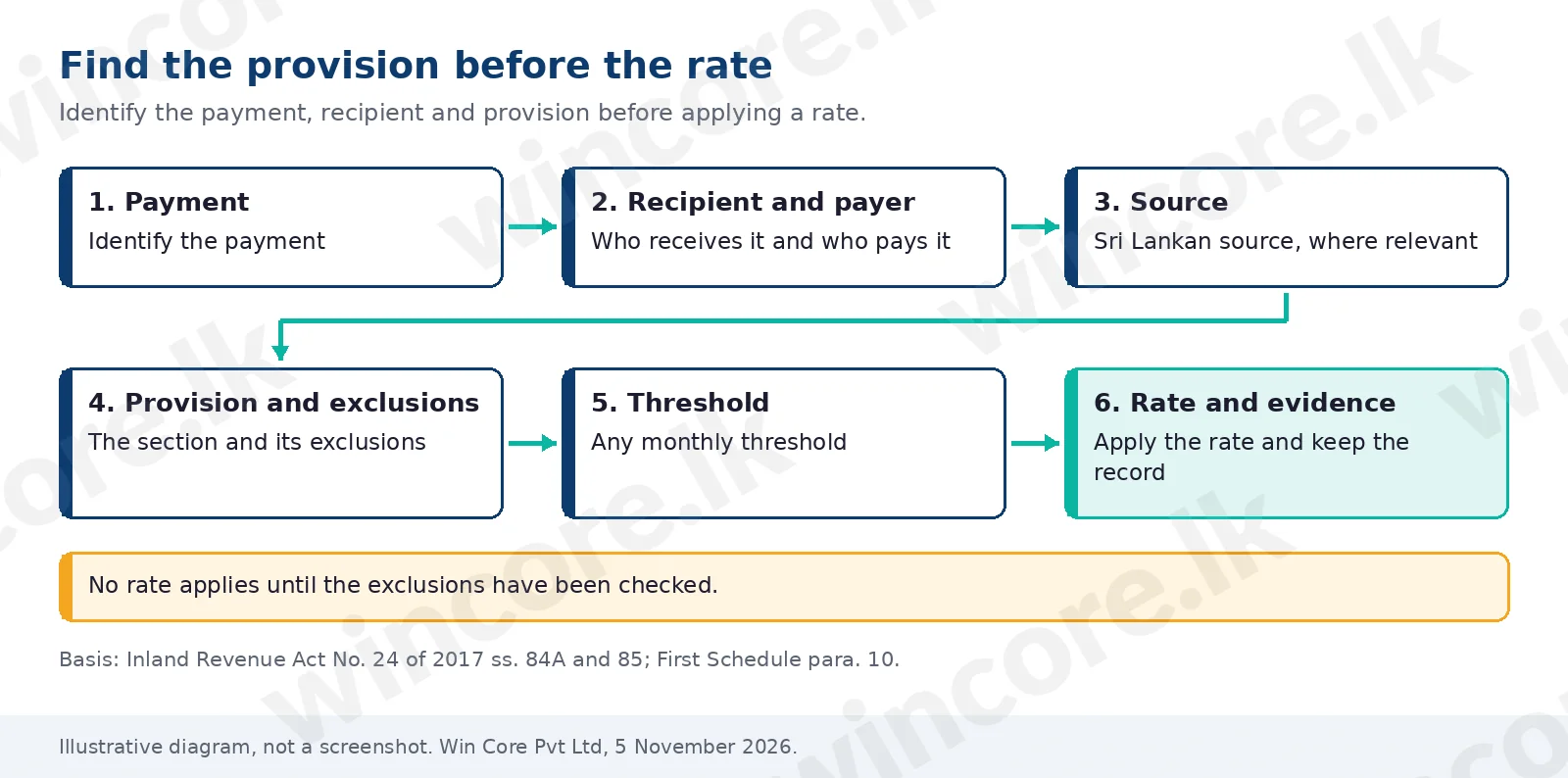
WHT and AIT payment categories in Sri Lanka in 2026: the payment determines the rate
There is no single rate for every transaction. The Act separates investment returns, specified services, employment income and other categories. The table gives a starting point for each listed payment, but the relevant section determines who deducts and which conditions must be met. Read the provision with the First Schedule and the applicable exclusions. [1][3]
Section 84A(1A) addresses specified payments with a Sri Lankan source, including dividends, interest, rent and royalties. It is subject to section 83A and section 84(3). After the 2026 amendment, section 84(3) expressly applies to section 84A too. Examples of its exclusions include payments by individuals other than in conducting a business, specified interest on ordinary loans and advances, and exempt amounts. [1][4]
Section 85 has its own exclusions. Among them, it does not apply to payments covered by sections 83, 83A or 84A, payments by individuals unless made in conducting a business, and exempt amounts. Do not assume that a percentage in a row applies before checking those conditions. The retained agreement, invoice and description of the payment help identify the correct provision. [1]
What are the withholding tables for 2026? Use the matching category
The IRD's tax chart for the year of assessment 2025/26 lists the WHT and AIT rates shown above from 1 April 2025. The 2026 amendment should be read alongside that historical chart, particularly for the expanded list in section 85(1C) and the deposit-interest declaration. The chart date identifies the period covered by the chart; it does not establish the original commencement of every rate. [2][4][5]
Employment income is a separate calculation. Section 83A requires an employer to deduct APIT as specified by the Commissioner General. The IRD publishes separate tables for regular primary employment, lump sums, terminal benefits, cumulative income and secondary employment. Select the table applicable to the payment and employee rather than applying the 5% service-fee rate to remuneration. [3][6]
The published table index consulted for this guide is labelled 2025/26. The IRD's APIT page directs employers to its tables, so the table for the relevant payment period matters. Do not treat a historical chart as proof that every later payroll table is unchanged. A source, rate and effective period belong together. [5][6]
How does AIT on interest work? The general rate is 10%
The First Schedule sets 10% for interest or discount from 1 April 2025. Section 84A applies to the specified Sri Lankan source payment, subject to the applicable exclusions. Before calculating, identify who receives the interest, the institution and the basis of the payment. [1][2]
Act No. 11 of 2026 added an exclusion for interest or discount on a deposit maintained at a financial institution by a resident individual who has no taxable income for the relevant year and gives the institution the prescribed self-declaration. The provision applies for years of assessment commencing on or after 1 April 2025. The IRD's declaration form for 2026/27 sets out the information to provide. [4][8]
The exclusion is not an automatic age-based rule and is not a blanket exemption for every account holder. The person's taxable income for the relevant assessment year and the prescribed declaration matter. The example at the start concerns a company, so it does not use the individual self-declaration. Its bank record should show the gross interest and the amount deducted. [4][8]
A deduction and the recipient's final tax position are separate questions. Keep the evidence with the relevant period and include it in the tax computation as applicable. For the individual treatment and refund discussion, read the withholding tax on interest guide. [1]
When does the rent threshold matter? It applies to the monthly aggregate
For rent paid to a resident person, the First Schedule sets 0% where the aggregate payment does not exceed Rs 100,000 per month and 10% on the full amount where it exceeds Rs 100,000. The exact threshold is therefore relevant. Check the recipient, the monthly aggregate and the section 84A exclusions before applying the rate. [1][5]
The reference to the full amount matters: the table does not say to deduct 10% only from the amount above the threshold. Record the calculation against the relevant payment and keep the agreement and payment evidence with it. The AIT on rent guide explains the operating steps in more detail. [1][5]
Which service fees attract 5%? Section 85(1C) limits the category
Section 85(1C) concerns a Sri Lankan source service fee paid to a resident individual who is not the payer's employee, for a listed category of work. The provision does not apply to a service payment that does not exceed Rs 100,000 per month. The IRD chart describes 5% on the full qualifying payment when the aggregate exceeds that threshold. Section 85(3) also applies. [1][5]
The categories include teaching and examination work, certain commission or brokerage, and services provided by a person in the capacity of an independent service provider under the statutory list. Act No. 11 of 2026 expanded the named occupations from 3 June 2026. A service description alone does not establish that the recipient is an in-scope individual, or that the monthly threshold has been exceeded. [1][4]
Identify the legal recipient before checking the service. The resident individual rule in section 85(1C) should not simply be copied onto a payment to a company or onto an employee's remuneration. Keep the description of the work and the relevant payments together. The 5% service fee guide covers the statutory list and conditions in greater detail. [1][4]
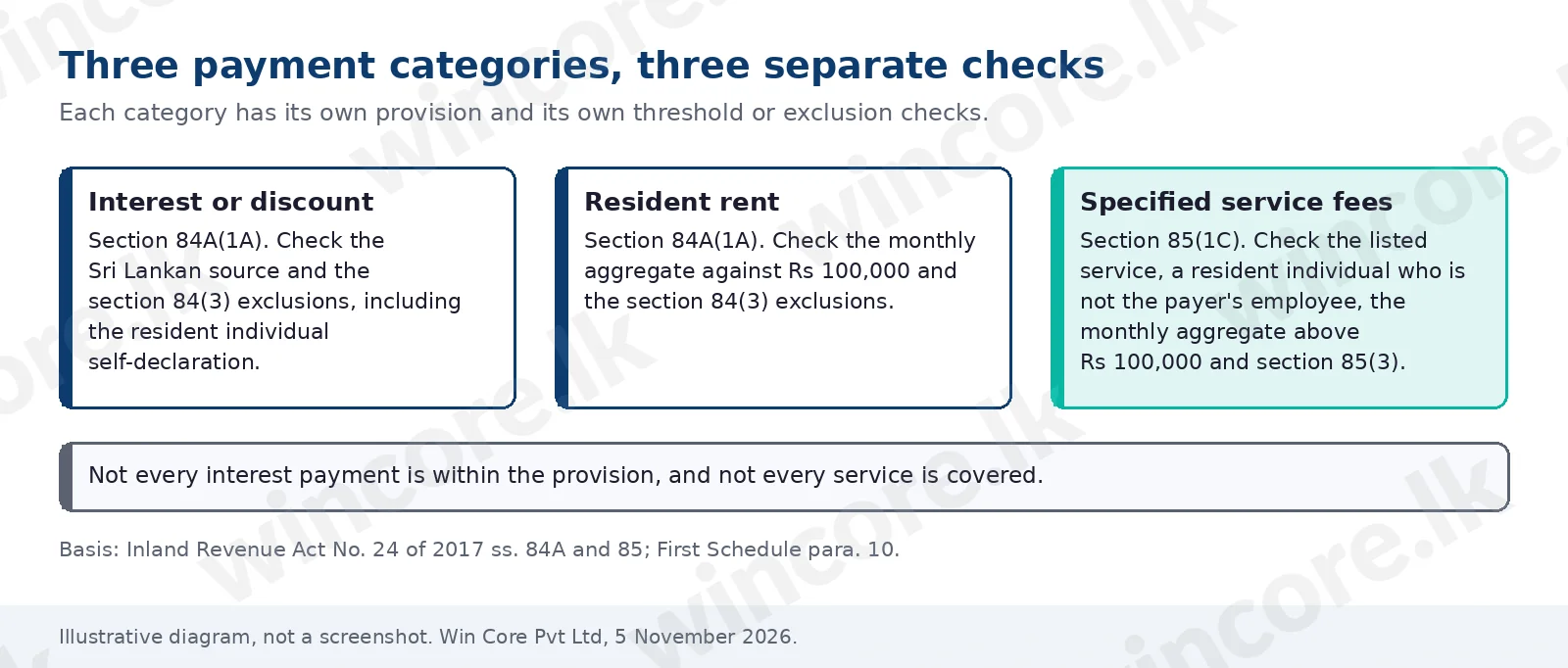
Who deducts withholding tax and when is it paid? The agent remits monthly
The applicable provision identifies the withholding agent. Depending on the category, that can be the payer of the interest, rent or qualifying service fee, the employer, or the National Gem and Jewellery Authority. First determine whether the particular payment falls within the section and whether an exclusion applies. [1][3]
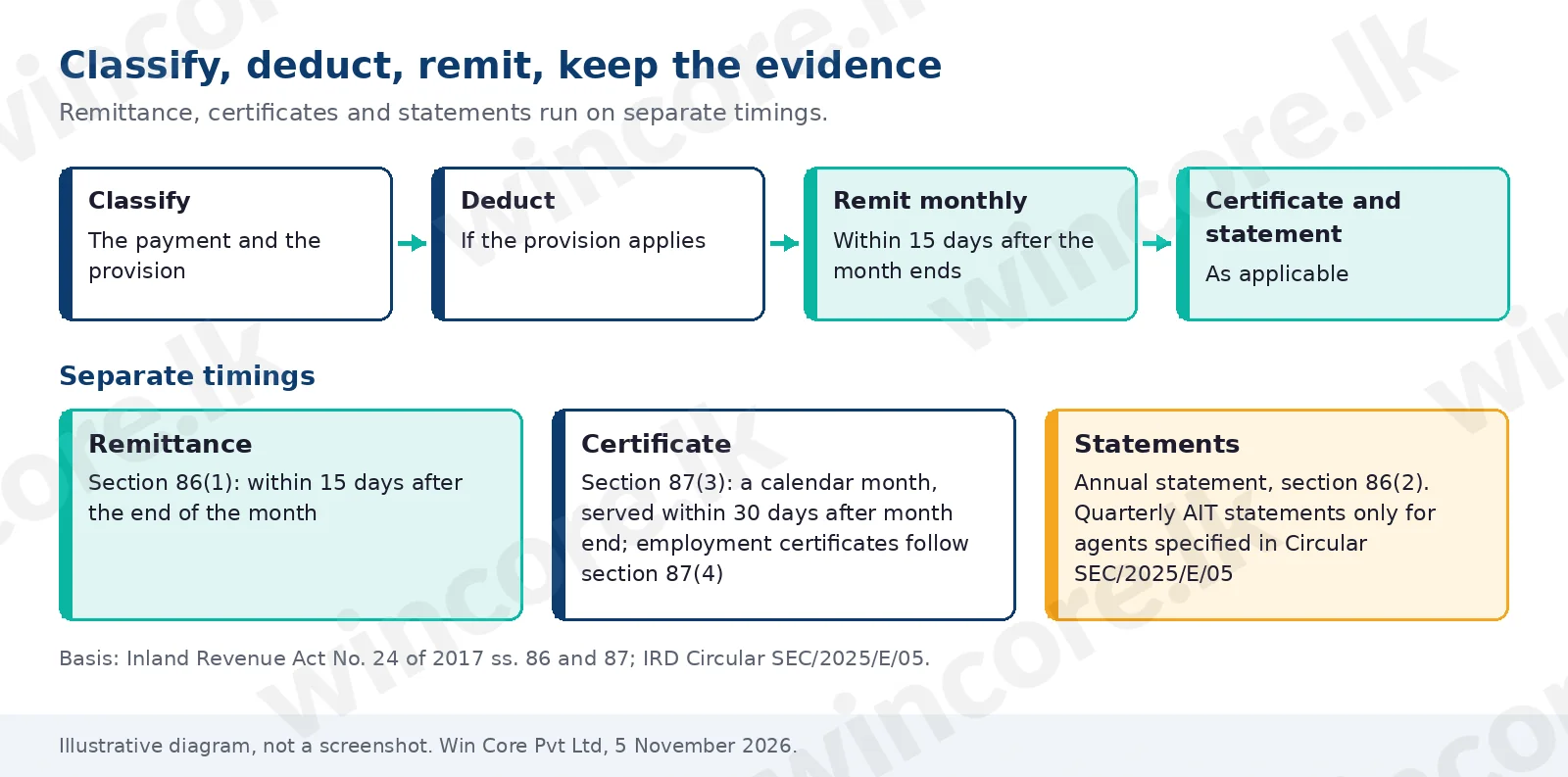
Section 86(1) requires a withholding agent to pay tax withheld during a calendar month to the Commissioner General within 15 days after that month ends. The IRD's APIT page also describes remittance by the 15th of the following month. Match the remittance to the amount, recipient and withholding period in the records. [1][6]
Section 86(3) provides that an agent who fails to withhold tax required under the Division must pay the amount that should have been withheld in the same manner and at the same time. Section 86(4) also addresses the withholdee's joint and several liability and payment timing. An internal payment review before release can help establish the classification; that review is a control, not a separate statutory filing. [1]
What evidence and statements are needed? Keep the certificate and records
Section 87 requires a withholding certificate to show the payments and tax withheld. Subject to the employment rule, section 87(3) says the certificate covers a calendar month and must be served within 30 days after month end. IRD Circular SEC/2026/E/04, effective 8 June 2026, also allows a certificate covering a longer period, not exceeding a full year of assessment, if the withholdee agrees to accept it; if the withholdee asks for a monthly or printed certificate, the agent must provide it. For tax withheld under sections 83 or 83A, section 87(4) provides an annual employment certificate by 30 April of the subsequent year, or within 30 days after employment ceases during the year. The 2026 amendment requires certificates to be served free of charge. [1][4][13]
Section 86(2) requires an annual statement within 30 days after the end of the year ending on 31 March. It requires the agent to report the payments, the withholdee's details, the tax withheld and other specified information. Section 86(9), added in 2026, permits the Commissioner General to specify procedures, formats and forms for the annual and quarterly statements. [1][4]
Section 86(8) concerns quarterly AIT statements for the quarters ending in June, September and December. IRD Circular SEC/2025/E/05 specifies banks and financial institutions that deducted 10% from the described deposit interest or discounts, and says agents not specified there are not required to file those quarterly statements under that circular. The final quarter is included in the annual statement under that instruction. [1][9]
The WHT certificate and annual statement guide covers the detailed workflow. Keep the certificate, payment confirmation and underlying transaction records together. The certificate and the remittance record answer different questions: one identifies the payment and deduction for the recipient; the other records the payment to the IRD. [1]
What happens if a specified filing requirement is missed? A warning comes first
Section 178A(1), inserted by Act No. 11 of 2026, addresses a withholding agent who fails to comply with the requirements specified under section 86(9). It provides for "a penalty of a sum not exceeding two hundred thousand rupees for a year of assessment", subject to subsection (2). Before assessment, the Commissioner General must issue a warning. No penalty is imposed under that subsection if the agent complies with the warning within 14 days of service. [4]
That provision is tied to the specified procedures, formats and forms. It is not a statement that every withholding error automatically attracts the maximum amount. Other consequences depend on the actual default and the applicable provision. The monthly remittance and certificate obligations are distinct from the procedures for filing statements. [1][4]
What this means for you
Start with the payment, the recipient and the relevant section. Check the monthly threshold and statutory exclusions before calculating a deduction, and keep the basis of the calculation with the supporting record. Reconcile the amount withheld to the monthly remittance, certificate and applicable statement. Use the IRD's table for the particular employment payment rather than treating payroll as a flat WHT rate. [1][5][6]
Checklist: documents needed
- Agreement, invoice or payment record identifying the recipient and payment category.
- Calculation showing the rate, base, applicable threshold and withholding period.
- Applicable declaration or other evidence supporting an exclusion.
- Withholding certificate and IRD payment confirmation.
- Annual statement and any applicable quarterly statement and schedules. [1][4][9]
FAQ
Is AIT automatically a final tax?
No. Section 88 identifies payments that are final withholding payments under the Act. The result depends on the payment and the recipient, so a deduction should not be treated as settling every recipient's tax position. Retain the certificate and apply the relevant provision in the tax computation. [1]
Is every deposit holder subject to 10% AIT?
No. The general interest or discount rate is 10%, but the Act contains exclusions. A resident individual with no taxable income for the relevant assessment year may meet the statutory deposit-interest exclusion by providing the prescribed self-declaration to the financial institution. The precise facts and declaration matter. [2][4][8]
Does the 5% service fee rule apply to a company supplier?
Section 85(1C) addresses specified services paid to a resident individual who is not an employee of the payer. A company is a different legal recipient, so do not apply that particular individual rule solely because the invoice says services. Check the payment and all applicable provisions. [1][4]
Is resident rent withholding charged only on the excess?
No. The First Schedule gives a 10% rate on the full amount when the aggregate payment to a resident person exceeds Rs 100,000 per month. At or below that threshold the listed rate is 0%. Check that section 84A applies and that no exclusion changes the result. [1][5]
When does withheld tax have to reach the IRD?
Section 86(1) requires the withholding agent to pay amounts withheld during a calendar month within 15 days after that month ends. Statement and certificate obligations are separate. Keep a record that links the remittance to the relevant period and the payments from which tax was deducted. [1]
The short version
The payment category, recipient and statutory exclusions determine the rate. The general interest or discount rate is 10%, and specified resident individual service fees can attract 5% when the monthly threshold is exceeded. The agent remits withheld tax within 15 days after month end and keeps the applicable evidence. [1][2][5]
Check the provision before paying.
Talk to us. WinCore Pvt Ltd offers RAMIS filing and portal management; see our income tax services or book a consultation at our contact page.
WinCore Pvt Ltd
This article is general information as at 5 November 2026 and is not tax, legal or accounting advice on your specific position.
Sources and references (14)
- Inland Revenue Department. Inland Revenue Act, No. 24 of 2017, consolidated to 31 March 2025, sections 83A to 88 and First Schedule paragraph 10. https://www.ird.gov.lk/en/publications/Acts_Income%20Tax_2017/IRA_Cons_Act_-_2025_Changes.pdf . Primary reference copy, read with the certified Acts and later amendment. Accessed 5 November 2026.
- Parliament of Sri Lanka. Inland Revenue (Amendment) Act, No. 2 of 2025, section 3, First Schedule paragraph 10. https://www.ird.gov.lk/en/publications/Acts_Income%20Tax_2017/IR_Act_No_02-2025_E.pdf . Primary. Accessed 5 November 2026.
- Parliament of Sri Lanka. Inland Revenue (Amendment) Act, No. 45 of 2022, sections 15 to 18 and 33. https://www.ird.gov.lk/en/publications/Acts_Income%20Tax_2017/IR_Act_No._45_2022_E.pdf . Primary. Accessed 5 November 2026.
- Parliament of Sri Lanka. Inland Revenue (Amendment) Act, No. 11 of 2026, sections 1, 12 to 15 and 30. https://www.ird.gov.lk/en/publications/Acts_Income%20Tax_2017/IR_Act_No_11-2026_E.pdf . Primary. Accessed 5 November 2026.
- Inland Revenue Department. Tax chart, year of assessment 2025/26, WHT and AIT table from 1 April 2025. https://www.ird.gov.lk/en/publications/SitePages/tax_chart_2526.aspx?menuid=140408 . Primary administrative guidance. Accessed 5 November 2026.
- Inland Revenue Department. Advance Personal Income Tax and APIT tax tables, index. https://www.ird.gov.lk/en/Type%20of%20Taxes/SitePages/Advance%20Personal%20Income%20Tax%20%28APIT%29.aspx and https://www.ird.gov.lk/en/publications/sitepages/apit_tax_tables.aspx?menuid=1502 . Primary. Accessed 5 November 2026.
- Government of Sri Lanka. Gazette Extraordinary No. 2064/51, regulation 2. https://www.ird.gov.lk/en/publications/gazette_documents/2018_2064-51_e.pdf . Primary. Accessed 5 November 2026.
- Inland Revenue Department. Declaration of non-taxable status by a resident individual, Form ISD/WHT/02-E for 2026/27. https://www.ird.gov.lk/en/Downloads/Forms_WHT_AIT/ISD_WHT_02_2026_E.pdf . Primary. Accessed 5 November 2026.
- Inland Revenue Department. Circular SEC/2025/E/05, quarterly AIT statements, paragraphs 1 and 2. https://www.ird.gov.lk/en/publications/Circulars_Circulars/SEC_2025_E_05_E.PDF . Primary. Accessed 5 November 2026.
- Parliament of Sri Lanka. Inland Revenue (Amendment) Act, No. 4 of 2023, sections 1 and 18(2). https://www.ird.gov.lk/en/publications/Acts_Income%20Tax_2017/IR_Act_No._04_2023_E.pdf . Primary. Accessed 5 November 2026.
- Parliament of Sri Lanka. Inland Revenue Act, No. 24 of 2017, sections 83 to 87 and First Schedule paragraph 10, as enacted and read with the amending Acts. https://www.ird.gov.lk/en/publications/Acts_Income%20Tax_2017/IR_Act_No_24_2017_E.pdf . Primary. Accessed 5 November 2026.
- Parliament of Sri Lanka. Inland Revenue (Amendment) Act, No. 10 of 2021, sections 27 to 31 and 51. https://www.ird.gov.lk/en/publications/Acts_Income%20Tax_2017/IR_Act_No._10_2021_E.pdf . Primary. Accessed 5 November 2026.
- Inland Revenue Department. Circular SEC/2026/E/04, Deduction of Withholding Tax and Advance Income Tax, effective 8 June 2026, paragraphs 1, 5 and 6. https://www.ird.gov.lk/en/publications/Circulars_Circulars/SEC_2026_E_04_E.PDF . Primary. Accessed 5 November 2026.
Put these insights to work
WinCore specialists can review your current workflow, document gaps, and build a practical 90-day action plan.
Book a free consultationRecent articles


Continue reading
Explore more WinCore analysis to keep your finance, tax, and compliance roadmap moving.

When a payer must withhold 5 percent on service fees, the services added in June 2026, payment within 15 days and the certificate rules.
How the 10 percent AIT on deposit interest works, who can use a self-declaration, and how a resident retiree can claim a credit and any excess.
When a tenant must deduct 10 percent AIT from rent, the base excluding VAT, payment within 15 days, certificates and worked examples.