
Withholding tax on interest Sri Lanka: 10 percent AIT and refunds
How the 10 percent AIT on deposit interest works, who can use a self-declaration, and how a resident retiree can claim a credit and any excess.
On this page
Last verified against the primary sources on 2 November 2026.
Withholding tax on interest Sri Lanka, in brief. A bank or finance company deducts Advance Income Tax (AIT) at 10 percent from Sri Lankan source interest paid from 1 April 2025, subject to the statutory exclusions [1][2][3][4]. A resident individual with no taxable income can provide the financial institution with a self-declaration specified by the Commissioner-General, so that the exclusion in section 84(3)(f) applies [3]. For a resident individual, interest AIT is a credit against income tax, and an excess can be claimed under section 150, subject to its conditions [4][5][6].
Our example is a hypothetical retired engineer, a resident individual over sixty, with two fixed deposits and a savings account at two institutions and no other income. We cover the rate, the self-declaration, the certificate, the credit and refund, senior citizens and resident companies.
Withholding tax on interest Sri Lanka is AIT at 10 percent under section 84A(1A)
Section 84A(1A) requires a person to deduct AIT from certain payments, including interest and discount with a source in Sri Lanka. It is subject to section 83A and the exclusions in section 84(3). Act No. 45 of 2022 inserted the subsection with effect from 1 January 2023. Section 84A(2) applies the withholding tax provisions to AIT with the necessary modifications [1][4][6].
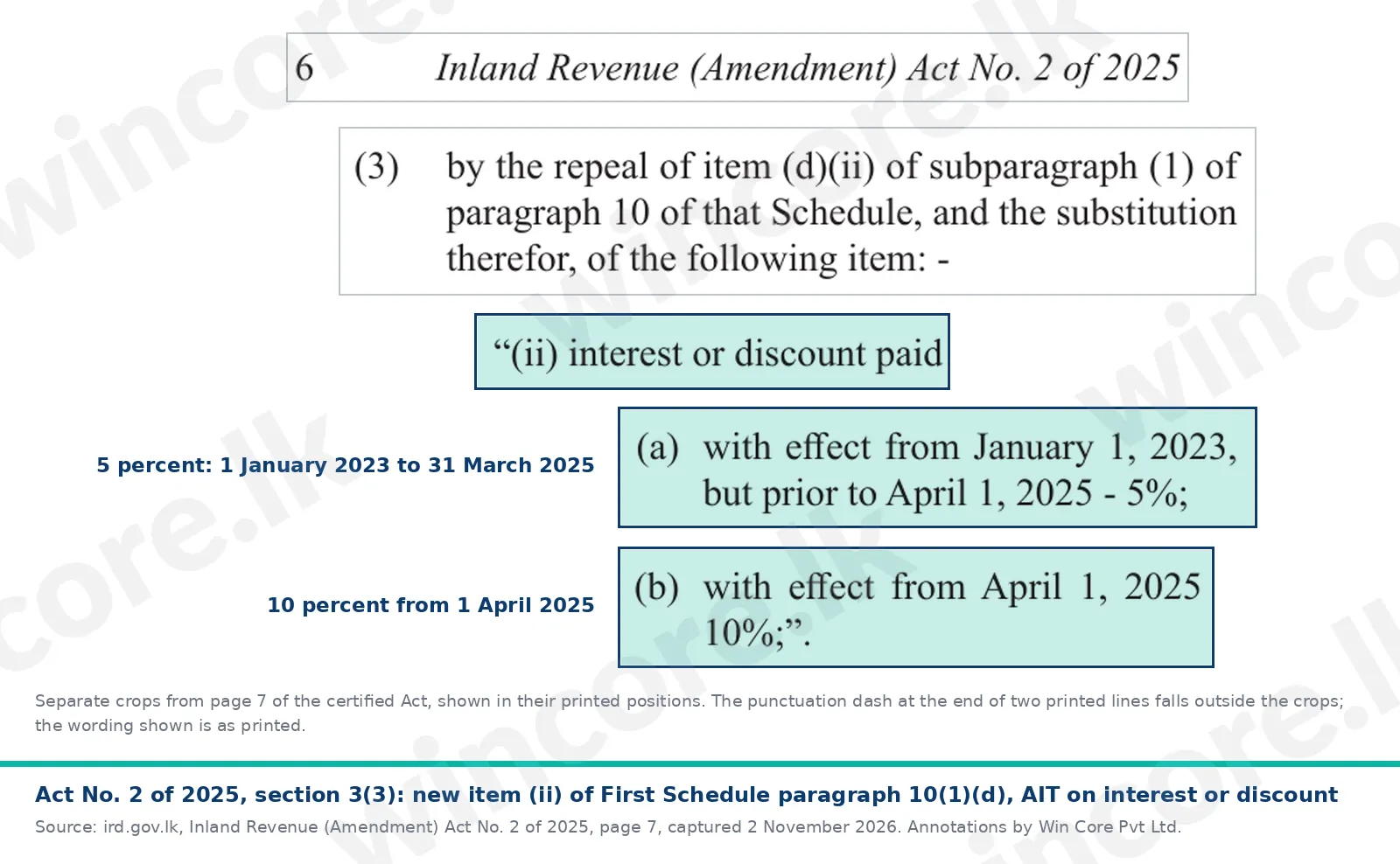
The rate is in First Schedule paragraph 10(1)(d)(ii). Act No. 2 of 2025 replaced that item: the rate was 5 percent from 1 January 2023 until 31 March 2025 and is 10 percent from 1 April 2025. Act No. 2 of 2025 came into operation on 1 April 2025 [2].
The 10 percent is the statutory rate for interest or discount falling under section 84A(1A). The item does not divide the rate by type of payee. Exemptions and, where relevant, an applicable tax treaty must be considered before treating that rate as applying to a particular payment [1][2][4].
What is and is not caught
Section 84(3) excludes certain payments, including interest paid to a financial institution on its ordinary loans and advances, interest or discount on the specified government securities, and payments that are exempt amounts under section 9. It also excludes payments made by individuals unless made in conducting a business. From 3 June 2026, Act No. 11 of 2026 changed the opening words of section 84(3) to refer expressly to both sections 84 and 84A [3][4].
The interest rate item has no monetary threshold of its own. On our reading, the separate rent threshold does not create one for interest. The statutory exclusions still apply. For interest credited, reinvested or capitalised, check the IRD circular on interest deductions, any later guidance and the deposit terms [1][2].
A self-declaration stops the deduction only if you have no taxable income
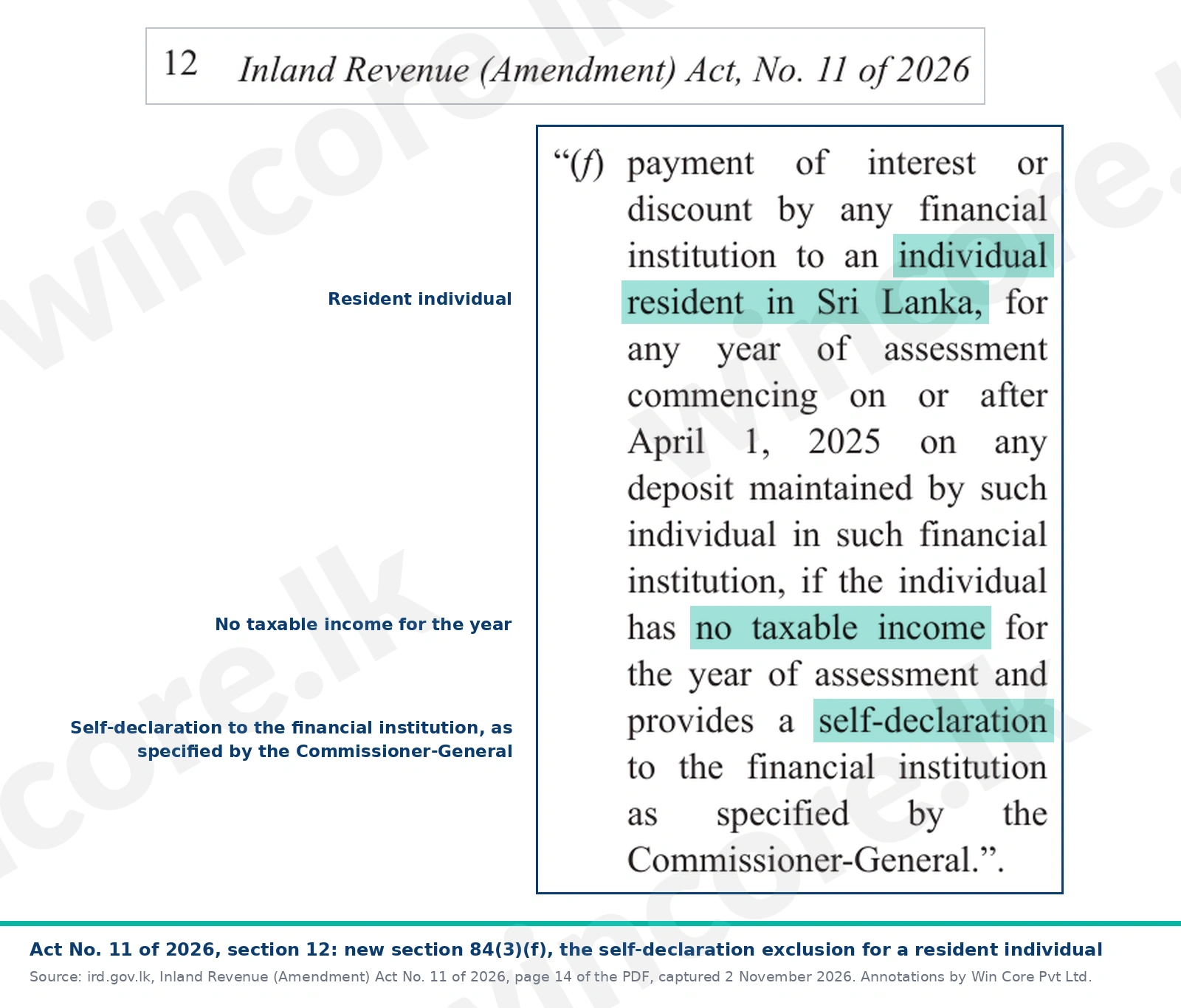
Act No. 11 of 2026 added section 84(3)(f), with effect from 1 April 2025. It excludes interest or discount paid by a financial institution on a deposit maintained there by a resident individual, for a year of assessment beginning on or after that date, if the individual has no taxable income for the year and provides the institution with a self-declaration as specified by the Commissioner-General [3].
Taxable income is total assessable income from employment, business, investment and other sources, after the qualifying payments and reliefs allowed under the Act. Assessable income can include interest at more than one institution [4][7].
For a resident individual, the personal relief is Rs 1,800,000 for a year of assessment commencing on or after 1 April 2025. Other qualifying payments and reliefs may be relevant, and restrictions apply to personal relief. Do not decide eligibility from interest at one bank alone [2][4].
IRD form ISD/WHT/02-E addresses a bank or financial institution, provides for multiple account numbers and a TIN, and asks the declarant to consider other interest and assessable income. It provides for a guardian to declare for a minor. Use the form for the relevant year, and check the IRD self-declaration circular and any later guidance for the procedure and treatment of tax already deducted [7].
Give the institution the declaration before interest is paid if you want it considered before deduction. This is a practical step, not a deadline stated in the Act. Review it if circumstances change. The form provides for a revised declaration and a new declaration when taxable income arises in a later year [7].
A false declaration has its own penalty
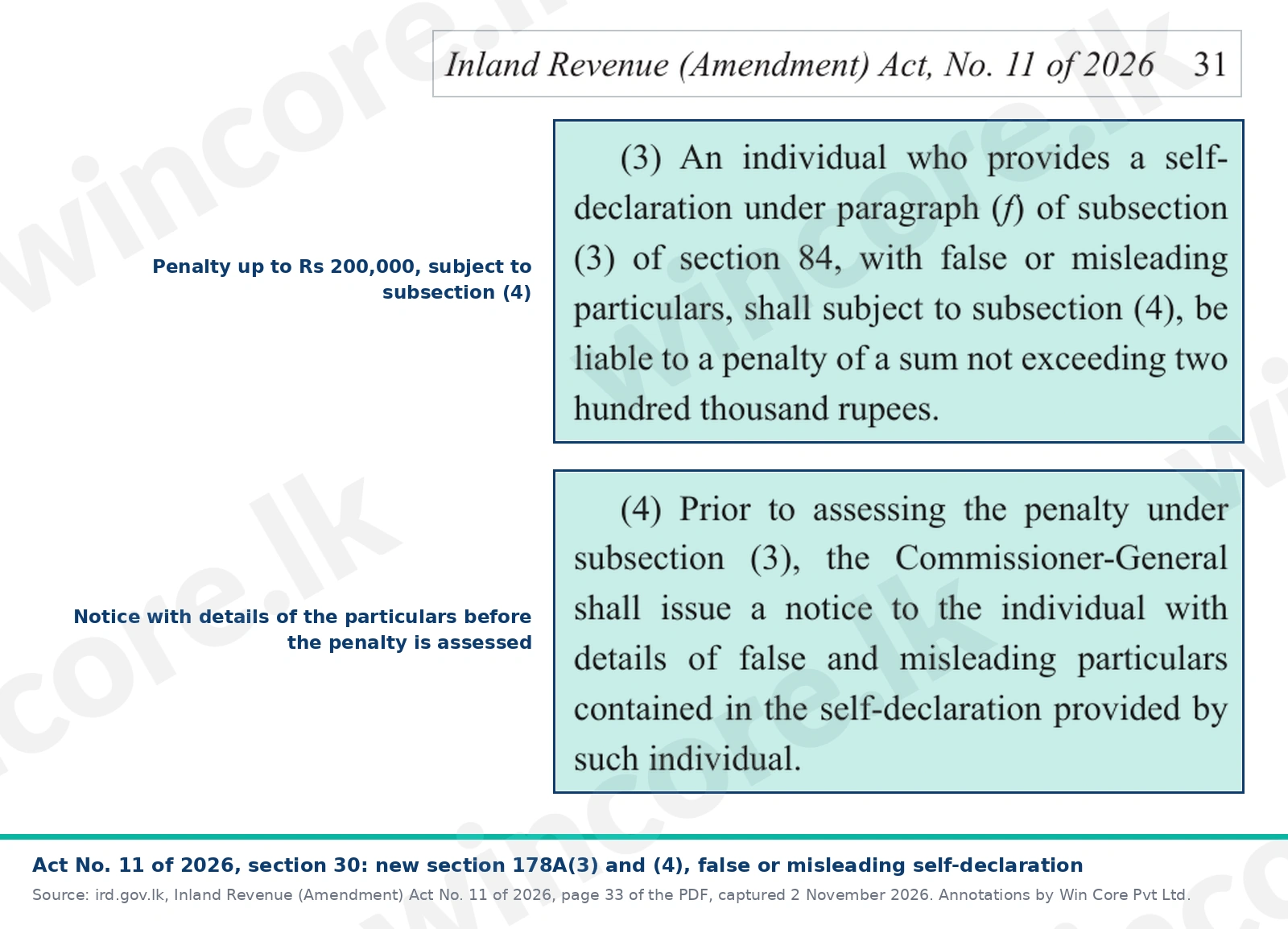
Section 178A(3) makes an individual who provides a self-declaration under section 84(3)(f) with false or misleading particulars liable to a penalty of up to Rs 200,000, subject to subsection (4). Before assessing it, the Commissioner-General must issue a notice with details of the false or misleading particulars. A person subjected to that penalty cannot submit a self-declaration in place of the declaration identified in the notice [3].
Section 176(9) also allows the Commissioner-General, if the person shows reasonable cause, to refrain from assessing a penalty in whole or part or to remit or waive an assessed penalty in whole or part. The penalty provision took effect on 3 June 2026, the date Act No. 11 of 2026 was certified [3][4].
The bank must give you a free AIT certificate for each month
Section 87 applies to AIT through section 84A(2). Subject to the employment certificate exception in section 87(4), section 87(3) requires a withholding certificate to cover a calendar month and be served within 30 days after that month ends. It sets out the payments and tax withheld. Section 87(6), added by Act No. 11 of 2026 from 3 June 2026, requires the certificate to be served free of charge [3][4][5].
Check the IRD certificate circular and any later guidance for arrangements for longer periods and printed or electronic copies. Keep the certificates supplied for the return [4]. Our guide to the WHT annual statement and certificate of deduction covers the agent's side.
AIT on interest is a credit in the return, not a final tax for residents
Interest paid to a resident individual is not listed as a final withholding payment in section 88(1A). Section 89 treats tax withheld from a non-final payment as paid by the withholdee and gives a credit for the year in which the payment is derived. Non-residents can be subject to different final withholding rules, so the resident individual's treatment should not be assumed for them [4][6].
Start the investment income calculation with taxable interest before AIT, apply any allowable deductions and reliefs, calculate income tax, and apply the AIT credit. For the year of assessment 2026/27, the ordinary individual rates are 6 percent on the first Rs 1,000,000 of taxable income, then 18, 24 and 30 percent on successive Rs 500,000 slices, and 36 percent above Rs 2,500,000. Some income has different statutory treatment [2]. Our post on income tax bands shows the bands in a table.
Investment income can also make a person an instalment payer under section 90. From years of assessment commencing on or after 1 April 2026, the instalment formula generally looks at tax payable for the preceding year, with a current estimate in the circumstances stated in the Act, and takes account of relevant tax withheld or to be withheld. Do not assume that a bank deduction settles every instalment obligation [3][4].
Where a return is required, section 93(1) makes it due eight months after the year ends. For the year of assessment ending 31 March 2027, that is 30 November 2027. Section 94 provides exceptions, subject to the Commissioner's power to require a return by notice. The steps are in our income tax return filing guide [3][4][5].
Excess AIT can be refunded under section 150 after applicable set-offs
Where tax paid exceeds the amount assessed or found payable, section 150 provides for the excess to be applied against assessed or payable tax, interest, late fees or penalties. Unless the taxpayer objects, the remaining amount may also be applied against advance tax becoming due within the next six months. At the taxpayer's request, 60 percent of the refundable amount may be set off against subsequent income tax before an audit. Subject to the statutory set-offs, the refundable amount is paid to the taxpayer [4][5].
The claim window. For years of assessment commencing on or after 1 April 2024, section 150(4)(a) requires a taxpayer who must file a return to apply for a refund or credit within 30 months of the last day of the relevant year. For the year ended 31 March 2027, the 30-month anniversary is Sunday, 30 September 2029. As a practical precaution, apply before that date and check IRD guidance for the filing method. Section 150(4)(b) separately addresses a refund or credit made on the Commissioner-General's initiative [2].
The three-month payment rule. Where the taxpayer is a resident individual and the refund claim does not exceed Rs 180,000 for a year of assessment commencing on or after 1 April 2025, section 150(2A)(a) requires the refund amount due to be paid within three months of the claim, before a tax audit. The Commissioner-General may specify the manner and procedure. A claim over Rs 180,000 is outside that particular rule [2][5].
The senior citizen quarterly refund proviso covers historical claims
For a year of assessment, section 195 defines a senior citizen as an individual who is a Sri Lankan citizen and resident for that year and is at least sixty at any time during it [4].
Act No. 11 of 2026 replaced the proviso to section 150(2A)(a) from 3 June 2026. The replacement concerns an eligible senior citizen who is not an instalment payer, refers to claims before 1 April 2025, and requires the claim to have been made before 30 June 2025. On our reading, that historical proviso does not establish a separate quarterly refund route for a new claim for 2026/27. The ordinary declaration, credit and refund rules remain relevant if their conditions are met [3].
The former separate senior citizen interest relief in Fifth Schedule paragraph 2(d) applied only up to 31 December 2019. Age alone does not satisfy the current self-declaration test: the resident individual must have no taxable income for the year and satisfy the other conditions in section 84(3)(f) [3][4].
Interest received by a resident company is included in its tax calculation
A company cannot use section 84(3)(f), because the exclusion is for an individual resident in Sri Lanka. A resident company includes taxable gross interest in its income calculation and can claim a credit for AIT on a non-final payment under section 89. The 10 percent rate remains subject to any applicable exclusion. The company's total tax depends on its own taxable income and applicable rates [2][3][4].
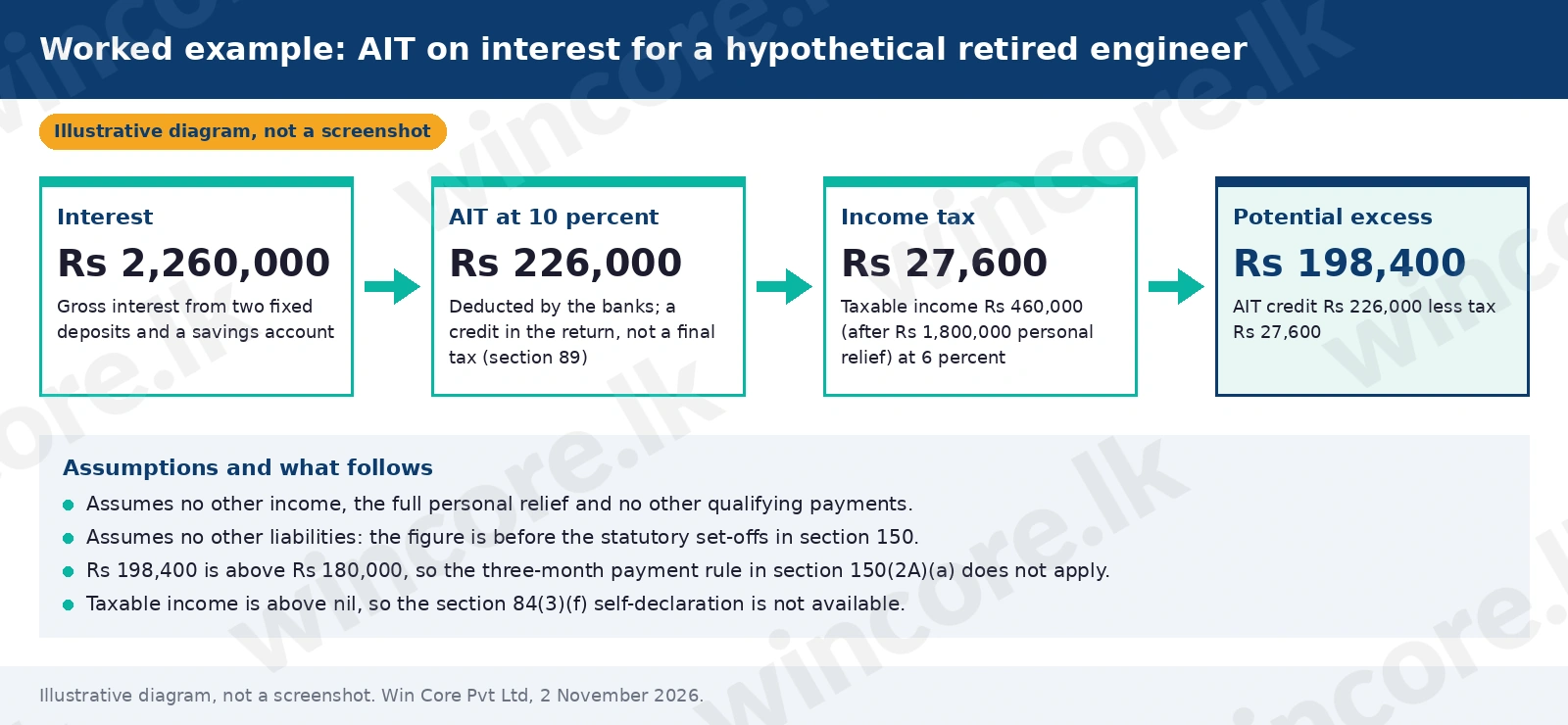
Worked example: Rs 226,000 deducted, Rs 198,400 potential excess
The hypothetical retired engineer has only taxable interest income for one year of assessment. Assume the stated personal relief applies in full, there are no other qualifying deductions or tax payments, and the relevant tax has been deducted:
| Item | Rs |
|---|---|
| Fixed deposit 1, interest credited at maturity | 1,200,000 |
| Fixed deposit 2, interest credited at maturity | 1,010,000 |
| Savings account, interest credited monthly | 50,000 |
| Total interest (assessable income) | 2,260,000 |
| AIT deducted at 10 percent | 226,000 |
| Less personal relief | (1,800,000) |
| Taxable income | 460,000 |
| Tax at 6 percent on the first Rs 1,000,000 band | 27,600 |
| Less AIT credit (section 89) | (226,000) |
| Potential excess before statutory set-offs | 198,400 |
Hypothetical figures. Rates from First Schedule paragraphs 1(1D) and 10(1)(d)(ii); relief from Fifth Schedule paragraph 2(a)(v).
He has taxable income of Rs 460,000 on these assumptions, so the no-taxable-income condition for a declaration is not met. The Rs 198,400 excess is above the Rs 180,000 limit for the particular three-month rule. If he has no other liabilities or applicable advance tax set-offs and makes a valid claim, the potential refund is Rs 198,400. Any required instalments and return must still be dealt with [2][3][4][5].
Now change one fact. If fixed deposit 2 had earned Rs 450,000, total interest would be Rs 1,700,000. With the same assumptions and a full Rs 1,800,000 personal relief, he would have no taxable income and could provide the prescribed self-declaration to the financial institutions. Check the current IRD circular for how to submit it and how to claim relief for tax already deducted [3][7].
What this means for you
Calculate your expected assessable income from every source and the qualifying payments and reliefs that apply to you. If you are a resident individual with no taxable income, consider the self-declaration and check the IRD procedure before giving it to each institution. If AIT is deducted, keep the certificates and calculate the credit and any refund. Check whether an instalment or return is required and, if a return is required, apply within the section 150(4)(a) window. Estimating income before interest is paid is a practical step; the Act's record-keeping duties still apply.
Checklist: documents needed
- TIN and relevant depositor or guardian details
- Calculation of assessable income, qualifying payments and reliefs for the year
- IRD self-declaration form ISD/WHT/02-E, if eligible
- AIT certificates supplied by each bank or finance company
- Fixed deposit maturity advices and savings account statements showing gross interest
- Income tax return, if required, and details for any refund claim
FAQ
What is the withholding tax rate on bank interest in Sri Lanka?
The statutory AIT rate is 10 percent for interest or discount paid from 1 April 2025 under section 84A(1A). That applies only where the payment falls within the section and no relevant exclusion applies. Section 84(3) includes exclusions for certain payments, including the qualifying self-declaration by a resident individual. A relevant tax treaty may also need consideration [1][2][3][4].
Who can submit a self-declaration to stop AIT on interest?
A resident individual with no taxable income for the year can provide the specified declaration for an eligible deposit. Include income from all relevant sources when calculating taxable income after qualifying payments and reliefs. Use the applicable IRD form and check the current circular for the procedure. False or misleading particulars can attract a penalty, subject to the statutory notice and remission provisions [3][4][7].
Is AIT on interest a final tax for individuals?
For a resident individual, AIT on interest is a credit rather than a final withholding payment. Include the taxable gross interest in the income calculation, determine the tax payable and apply the credit for the year the interest is derived. An eligible excess can be claimed under section 150, subject to its conditions and set-offs. Different rules can apply to non-residents [4][6].
How long do I have to claim a refund of AIT on interest?
If you are required to file a return, section 150(4)(a) requires the application within 30 months after the relevant year ends. For the year ended 31 March 2027, the anniversary is Sunday, 30 September 2029. Apply earlier as a precaution and check IRD filing guidance. A separate provision addresses refunds or credits on the Commissioner's initiative; statutory set-offs apply [2][4][5].
The short version
Banks and finance companies deduct 10 percent AIT from interest covered by section 84A(1A), subject to the statutory exclusions. A qualifying resident individual with no taxable income can provide the specified self-declaration. A resident individual can claim a credit for non-final AIT and an eligible excess under section 150, subject to its conditions and set-offs. If a return is required, the 30-month application window applies; the old senior citizen proviso concerns historical claims made before 30 June 2025.
Free download: the WHT Registration & Compliance Checklist (Sri Lanka) (PDF).
Talk to us. For Withholding Tax Management and Tax Planning & Advisory, see our income tax compliance services.
WinCore Pvt Ltd
This article is general information as at 2 November 2026 and is not tax, legal or accounting advice on your specific position.
Related reading
Sources and references (7)
- Parliament of Sri Lanka. Inland Revenue (Amendment) Act, No. 45 of 2022, sections 16 and 33, and commencement table, as amended by Act No. 4 of 2023. https://www.ird.gov.lk/en/publications/Acts_Income%20Tax_2017/IR_Act_No._45_2022_E.pdf . Primary. Accessed 2 November 2026.
- Parliament of Sri Lanka. Inland Revenue (Amendment) Act, No. 2 of 2025, sections 1 to 3 and 5. https://www.ird.gov.lk/en/publications/Acts_Income%20Tax_2017/IR_Act_No_02-2025_E.pdf . Primary, attached certified Act. Accessed 2 November 2026.
- Parliament of Sri Lanka. Inland Revenue (Amendment) Act, No. 11 of 2026, sections 1, 12, 15, 16, 19, 27 and 30. https://www.ird.gov.lk/en/publications/Acts_Income%20Tax_2017/IR_Act_No_11-2026_E.pdf . Primary, attached certified Act. Accessed 2 November 2026.
- Parliament of Sri Lanka. Inland Revenue Act, No. 24 of 2017, sections 3, 11, 52, 75, 84, 87, 89, 90, 93, 94, 150, 176 and 195 and Fifth Schedule, as amended by Acts No. 10 of 2021, No. 45 of 2022, No. 4 of 2023, No. 2 of 2025 and No. 11 of 2026. https://www.ird.gov.lk/en/publications/Acts_Income%20Tax_2017/IR_Act_No_24_2017_E.pdf . Primary, attached certified Act. Accessed 2 November 2026.
- Parliament of Sri Lanka. Inland Revenue (Amendment) Act, No. 4 of 2023, sections 5, 14 and 23 and commencement table. https://www.ird.gov.lk/en/publications/Acts_Income%20Tax_2017/IR_Act_No._04_2023_E.pdf . Primary. Accessed 2 November 2026.
- Parliament of Sri Lanka. Inland Revenue (Amendment) Act, No. 10 of 2021, sections 22, 29, 31, 32 and 34 and commencement tables. https://www.ird.gov.lk/en/publications/Acts_Income%20Tax_2017/IR_Act_No._10_2021_E.pdf . Primary. Accessed 2 November 2026.
- Inland Revenue Department. Form ISD/WHT/02-E, declaration for the year of assessment 2026/27 and subsequent years. https://www.ird.gov.lk/en/Downloads/Forms_WHT_AIT/ISD_WHT_02_2026_E.pdf . Primary. Accessed 2 November 2026.
Put these insights to work
WinCore specialists can review your current workflow, document gaps, and build a practical 90-day action plan.
Book a free consultationRecent articles


Continue reading
Explore more WinCore analysis to keep your finance, tax, and compliance roadmap moving.

Step-by-step guide to filing income tax returns in Sri Lanka: deadlines, RAMIS process, relief, bands, WHT credits, and common penalty traps.
WHT reporting breaks when certificates and annual statements are treated as year-end admin. Build a monthly evidence workflow that files cleanly.

Sri Lanka income tax bands for 2026 explained with current rates, worked examples, and practical APIT planning for employees and employers.