
Sole proprietor income tax Sri Lanka: bands, relief and the return
How a one-owner business is taxed: profit, capital allowances, personal relief, the bands, quarterly instalments, the TIN and the yearly return.
On this page
Last verified against the primary sources on 30 October 2026.
Sole proprietor income tax Sri Lanka, in brief. A sole proprietor's business income is assessed as the owner's income under section 6 of the Inland Revenue Act [1]. Under Act No. 2 of 2025, for each year of assessment from Y/A 2025/26, including Y/A 2026/27, the personal relief is Rs 1,800,000 for an eligible individual, and ordinary taxable income is taxed at rates from 6 to 36 percent; check for any later change for Y/A 2027/28 [2]. From Y/A 2026/27, quarterly instalments generally use the preceding year's tax, subject to statutory alternatives and credits [3]. For Y/A 2026/27, the tax balance is ordinarily due on 30 September 2027 and the return on 30 November 2027 [1].
Our hypothetical resident plumbing contractor has a sole proprietorship and no other income. We calculate tax for Y/A 2026/27 and cover the TIN, instalments, return and turnover taxes. For registering the business name itself, see our guide to sole proprietorship registration.
Sole proprietor income tax Sri Lanka is the owner's tax, not the business's
The Act taxes persons. An individual's assessable income can include income from employment, business, investment and other sources [1]. On our reading, registering a sole proprietor's business name does not create a separate company: the plumbing business's income is the owner's business income under section 6 [1].
Three things follow:
- The owner's TIN and return. When a return is required, the owner reports the business income in the individual return with other income that must be declared.
- Drawings are not business expenses. Money the owner takes for personal use is not a deduction in calculating business income. If drawings were charged as expenses in the accounts, add them back [1].
- The owner is not an employee of the sole proprietorship. On our reading, the owner's drawings are not employee remuneration for APIT purposes. Employees hired by the business are a separate matter, and their payroll obligations depend on their circumstances [1], [7].
Relief and bands apply to the individual, not separately to each business. Exempt income and final withholding payments have special treatment; an investment asset gain can require a separate return [1], [6]. For the tax taken from interest, see withholding tax on interest.
Business profit is income less deductible expenses and capital allowances
The steps for the business part of the return are:
Step 1: Start from the accounts
Take sales of plumbing work and materials for the year. Section 6 brings in the gains and profits from conducting the business [1]. Section 21(3) requires an individual conducting a business to use the accrual basis for income tax purposes [1]. Include amounts receivable and expenses incurred under the Act's timing rules.
Reconcile invoices, receipts, receivables and trading stock. Section 13 has a separate stock calculation; reconciliation is a practical control, not a separate filing requirement [1].
Step 2: Deduct the expenses the Act allows
Section 11(1) allows expenses to the extent incurred during the year in producing business or investment income, while section 11(2) excludes capital expenditure from that general deduction [1]. Other specific deductions, exclusions and limits must also be considered. They do not all apply identically to individuals and companies: section 18's financial cost limit, for example, has a specific company scope from 1 April 2021 [7]. See our post on tax deductible expenses for a company for the company rules.
For the contractor, job materials, assistants' wages, business van fuel and tool repairs can be deductible if the conditions are met. Domestic costs are not deductible [1]. Keep supporting invoices.
Step 3: Replace depreciation with capital allowances
Accounting depreciation is not itself a capital allowance. Section 16 permits capital allowances for qualifying depreciable assets, subject to its conditions and the applicable schedules [1], [6], [7]. A work van, pipe threading machine or drain camera may qualify if it meets the ownership, use and other conditions. Identify the asset class and applicable period in the Fourth Schedule, add back accounting depreciation included in expenses, and deduct the allowable amount.
Keep purchase and business use evidence. The Fourth Schedule also addresses partial use and disposals [1].
Personal relief of Rs 1,800,000 comes off before the bands
For each year of assessment from Y/A 2025/26 (from 1 April 2025), Act No. 2 of 2025 section 5(3) inserted the Rs 1,800,000 personal relief in Fifth Schedule paragraph 2(a)(v). The previous Rs 1,200,000 in item (iv) applies only to the years before 1 April 2025 that it states [2]. Section 52 allows the relief to a resident individual and to a nonresident individual who is a Sri Lankan citizen. The schedule restricts relief for a person acting as trustee, receiver, executor or liquidator in that capacity and does not permit it against gains from realising investment assets [1], [7].
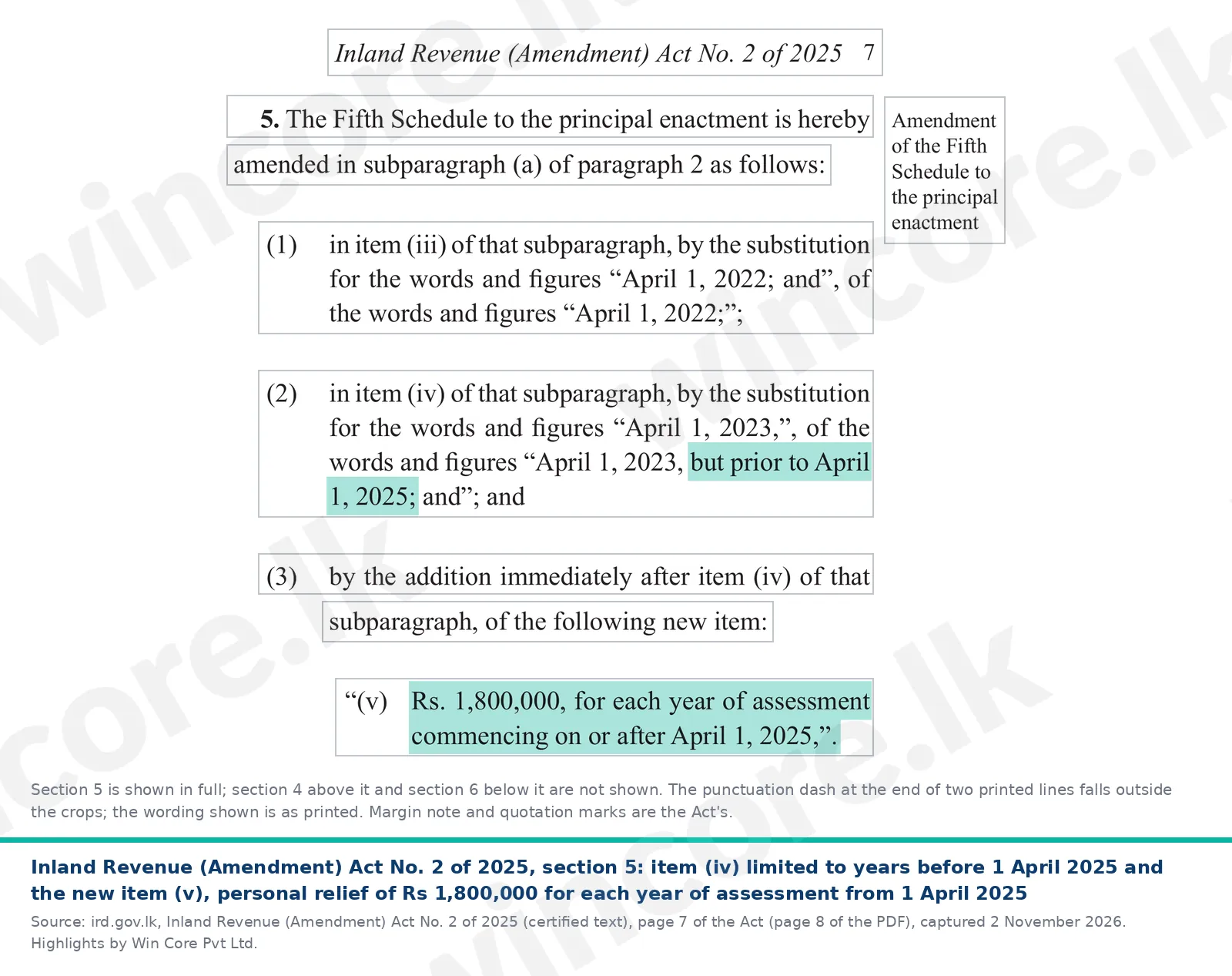
Section 52 deducts eligible reliefs and qualifying payments from assessable income to reach taxable income [1]. For each year of assessment from Y/A 2025/26, section 52(4) requires the unused amount of the qualifying payments in Fifth Schedule paragraph 1(b)(i) and (v) to be carried forward and deducted in the following year or a consecutive later year when insufficient assessable income prevents deduction. It does not make the personal relief a carry forward [3].
The bands for Y/A 2026/27 run from 6 to 36 percent
First Schedule paragraph 1(1D), inserted by Act No. 2 of 2025, sets these rates for each year of assessment from Y/A 2025/26, which includes Y/A 2026/27, subject to special rules for particular income. Check for any later change before applying them to Y/A 2027/28 [2]:
| Taxable income | Tax |
|---|---|
| First Rs 1,000,000 | 6 percent |
| Next Rs 500,000 (to Rs 1,500,000) | 18 percent |
| Next Rs 500,000 (to Rs 2,000,000) | 24 percent |
| Next Rs 500,000 (to Rs 2,500,000) | 30 percent |
| Above Rs 2,500,000 | 36 percent |
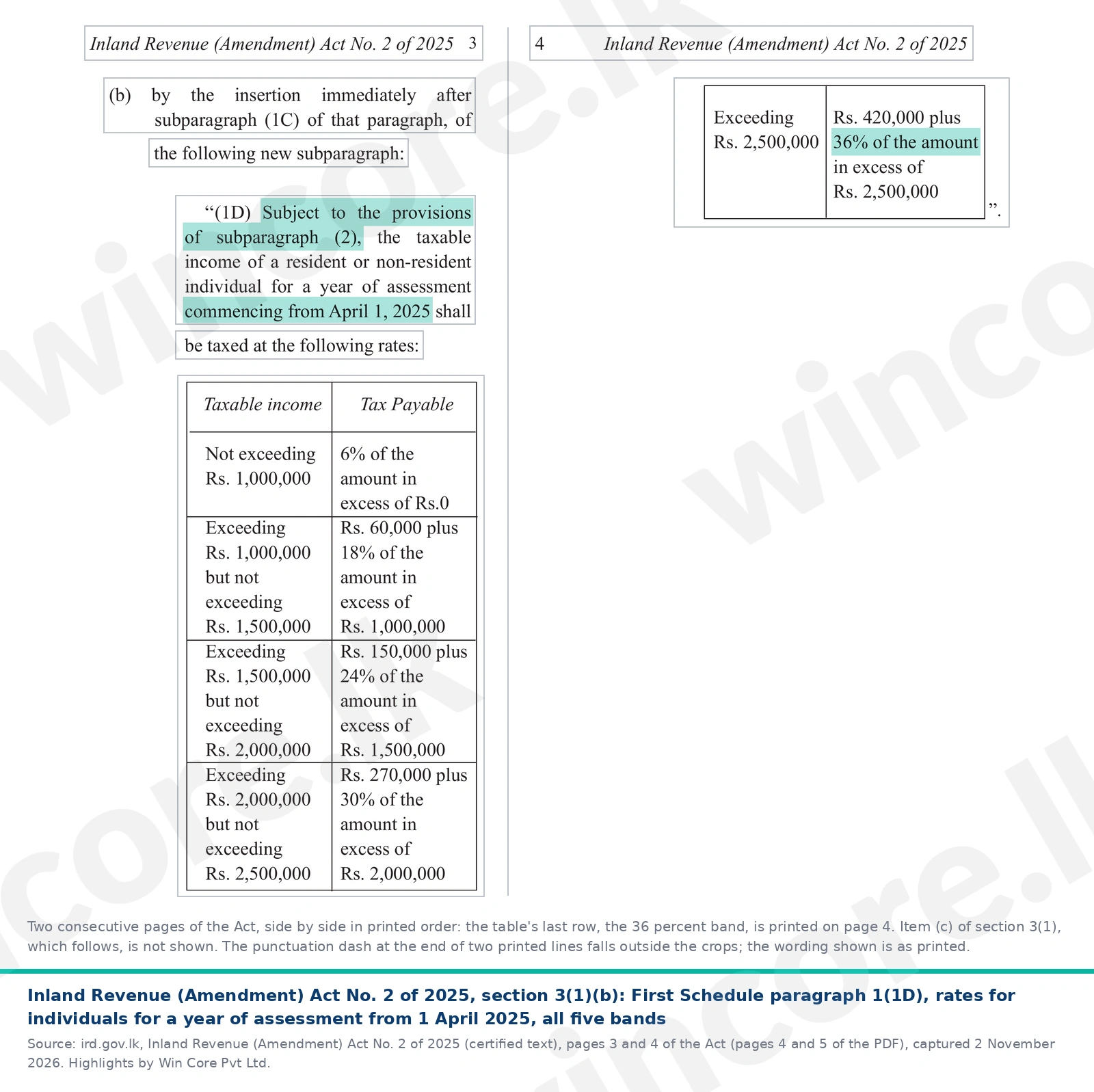
On our reading, the hypothetical local plumbing profit falls within the ordinary bands; investment asset gains and certain other business or foreign income have special rules [1], [2], [3]. Each rate applies only to income in its band. For more band examples, see our post on income tax bands.
A TIN is needed before the first return
Section 102(1) requires a person liable to furnish a return who has not already registered to register with the Commissioner General no later than thirty days after the end of the basis period for that year [1]. That is not the only registration rule. Gazette 2334/21 specifies resident persons with a business registered at a Divisional Secretariat from 1 June 2023, and resident individuals who were at least 18 on 31 December 2023 or turn 18 thereafter from 1 January 2024 [15], [17]. These classes may need a TIN before the section 102(1) deadline. The TIN identifies the owner as an individual.
Section 103(6)(b), inserted by Act No. 11 of 2026 section 24, refers to 1 April 2026 for specified transactions. IRD Circular SEC/2026/E/07 set its procedure to apply from 1 November 2026, and the IRD has deferred that to 1 April 2027 (IRD notice SEC/PN/IT/2026/06). Subject to its exceptions, it covers a resident adult opening an account at a financial institution or registering a business, among other specified transactions. A customer's request is not one of the listed purposes. The circular exempts entities other than individuals and specifies other exceptions, including nonresident individuals and those under 18; an official may accept an eligible TIN verification printout or a soft copy [3], [10].
Keeping the certificate with the records is practical, not a duty to send it to every customer.
Quarterly instalments from Y/A 2026/27 use last year's tax
Section 90(1)(a) makes a person deriving or expecting assessable business, investment or other income an instalment payer. The formula can produce no payment in a quarter [1], [6], [7]. Section 90(2) sets the ordinary instalment dates; for Y/A 2027/28 they are 15 August 2027, 15 November 2027, 15 February 2028 and 15 May 2028 [6].
For each year of assessment from Y/A 2026/27 (from 1 April 2026), Act No. 11 of 2026 section 16 replaced item A in section 90(3). The standard A is tax payable on the preceding year's taxable income. If the preceding year had no taxable income or lower taxable income is expected in the current year, A is the estimated current year tax calculated under the procedure and basis specified by the Commissioner General [3].
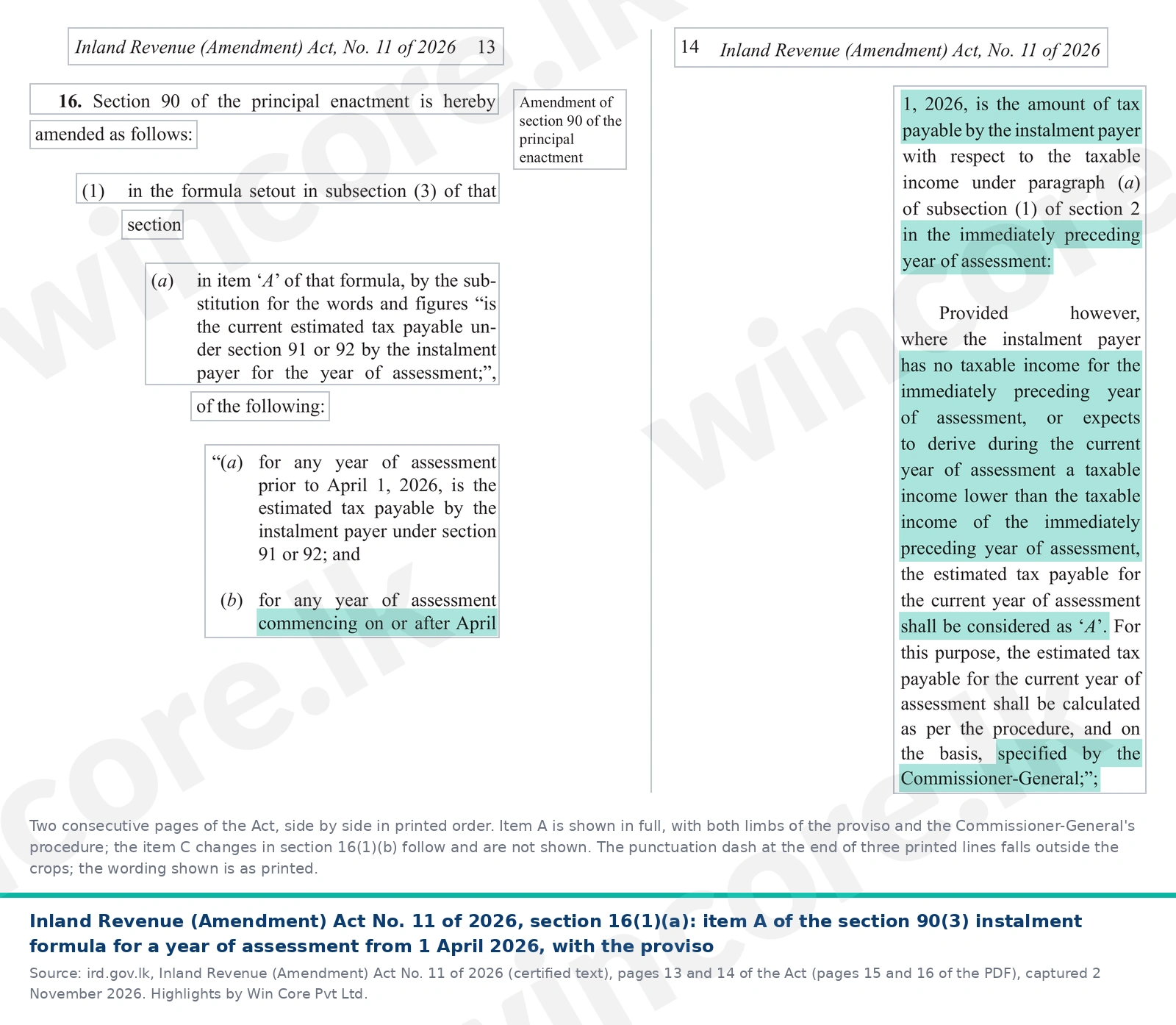
Each instalment is (A minus C) divided by B. B is the number of instalments left, including the current one. C includes earlier instalments paid before the due date and eligible withholding on income included in the computation, including amounts withheld or to be withheld during the relevant year; other amounts specified in section 90(3) may also apply [1], [3]. IRD Circular SEC/2026/E/06 describes the standard A as gross tax before tax credits [9].
For Y/A 2026/27, the re-revised circular dated 12 August 2026 sets procedures for alternative calculations, new taxpayers and credit schedules. It directs a taxpayer moving from the standard basis to a lower basis during the year to submit supporting information by 31 October 2026, 31 January 2027 or 30 April 2027, as relevant. Its procedural dates apply to Y/A 2026/27, not automatically to Y/A 2027/28 [9]. For the calculation method, see our post on how to calculate quarterly income tax instalments.
Under section 179(2), as at 30 October 2026, an instalment for Y/A 2026/27 or Y/A 2027/28 that remains unpaid beyond fourteen days after its due date carries a penalty of 10 percent of the unpaid amount; check for any later change. Interest can arise from the due date under sections 157 and 159, separately from a penalty. For reasonable cause, section 176(9) permits the Commissioner General to refrain from assessing or to remit or waive a penalty in whole or part [1], [6].
The return is due eight months after the year ends
Section 93(1), subject to the return exceptions, requires an income tax return no later than eight months after the year ends. For Y/A 2026/27, which ends on 31 March 2027, the ordinary return date is 30 November 2027 [1]. Tax payable on the annual assessment is ordinarily due six months after the year ends, on 30 September 2027, rather than on the return date [1]. Returns generally must be filed electronically; the Commissioner General may authorise a written return, and senior citizens may use either method [3], [8].
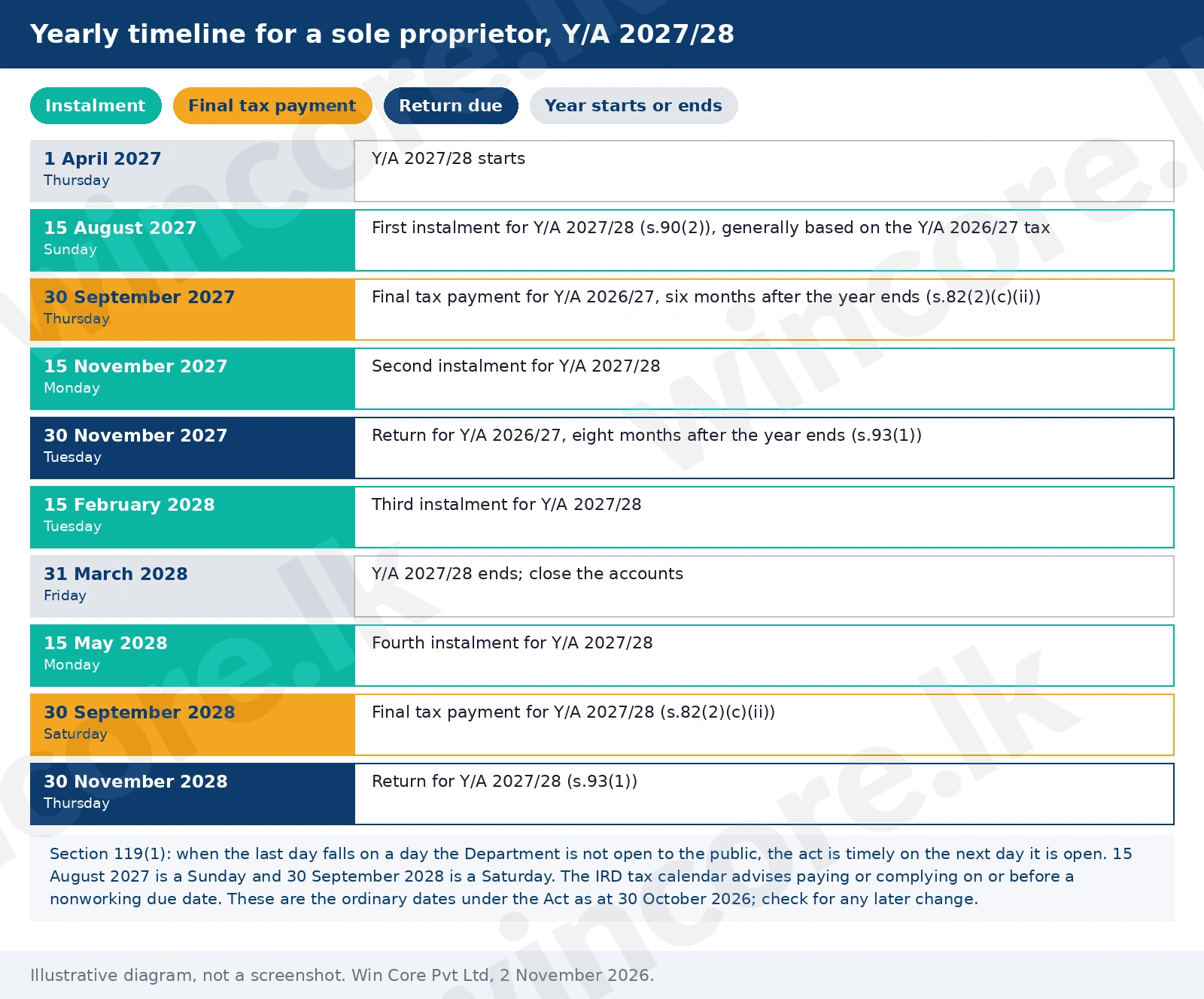
The yearly cycle for Y/A 2027/28 runs like this:
- 1 April 2027: the year of assessment starts.
- 15 August 2027: first instalment, generally based on the Y/A 2026/27 tax, subject to the alternative basis and credits.
- 30 September 2027: ordinary final tax payment date for Y/A 2026/27.
- 15 November 2027: second instalment for Y/A 2027/28.
- 30 November 2027: ordinary return date for Y/A 2026/27.
- 15 February 2028: third instalment for Y/A 2027/28.
- 31 March 2028: the year ends; close the accounts.
- 15 May 2028: fourth instalment for Y/A 2027/28.
- 30 September 2028: ordinary final tax payment date for Y/A 2027/28.
- 30 November 2028: ordinary return date for Y/A 2027/28.
Section 119(1) treats an act as timely on the next day the Department is open for business if its last day falls when the Department is not open to the public. The 15 August 2027 instalment date is a Sunday and 30 September 2028 is a Saturday. The IRD tax calendar advises arranging payment or compliance on or before a nonworking due date, so plan ahead rather than relying on an unconfirmed reopening date [1], [16].
For a late return, such as a Y/A 2026/27 return filed after 30 November 2027, section 178 (as at 30 October 2026; check for any later change) sets the greater of 5 percent of tax owing plus 1 percent for each month or part of a month the failure continues, and Rs 50,000 plus Rs 10,000 for each such month or part. The penalty for that return is capped at Rs 400,000. Section 176(9) permits the Commissioner General, for reasonable cause, to refrain from assessing or to remit or waive it in whole or part [1]. Interest and late payment penalties are separate from the filing penalty [1], [6].
Keep sufficient records, accounts and source documents. Section 120(6) requires transaction records for five years from the transaction date, or longer until the assessment time limit expires and related proceedings end [1]. Section 120(10) lists invoices, bank statements and contracts.
VAT and SSCL registration depend on the activity and turnover
VAT and SSCL are separate from the owner's income tax calculation. Under VAT Act section 10(1)(viii), as amended by Act No. 16 of 2024 and in force on 30 October 2026, the ordinary registration tests include taxable supplies exceeding Rs 15 million in a taxable period or Rs 60 million in the twelve months then ending, and a reasonable expectation of exceeding the respective amount in the succeeding taxable period or twelve months [4]. Section 10(1)(ix) separately requires commercial importers and exporters of goods to register [11]. A taxable period is not necessarily a quarter for every registrant [11], [12].
For SSCL, under Act No. 10 of 2026, from 1 July 2026 the registration provision applies to relevant persons when aggregate turnover for a quarter exceeds or is likely to exceed Rs 9 million, or turnover for four consecutive quarters exceeds or is likely to exceed Rs 36 million. The application deadline is fifteen days from the relevant date. Importers are treated separately, and exemptions and the definition of liable turnover matter [5], [13], [14]. Crossing a registration test does not mean every receipt is automatically taxable, and being below an annual figure alone does not settle the quarterly or prospective test. Check both sets of thresholds for any later change.
So the example's annual sales alone do not settle its VAT or SSCL position.
On moving to a company: a private company is a separate taxpayer under the Act, with its own tax computation and rates; what the owner then receives from the company, such as salary or dividends, is taxed according to its type [1], [7], [8]. Registration is under the Companies Act No. 7 of 2007.
Worked example: Rs 518,640 tax for Y/A 2026/27
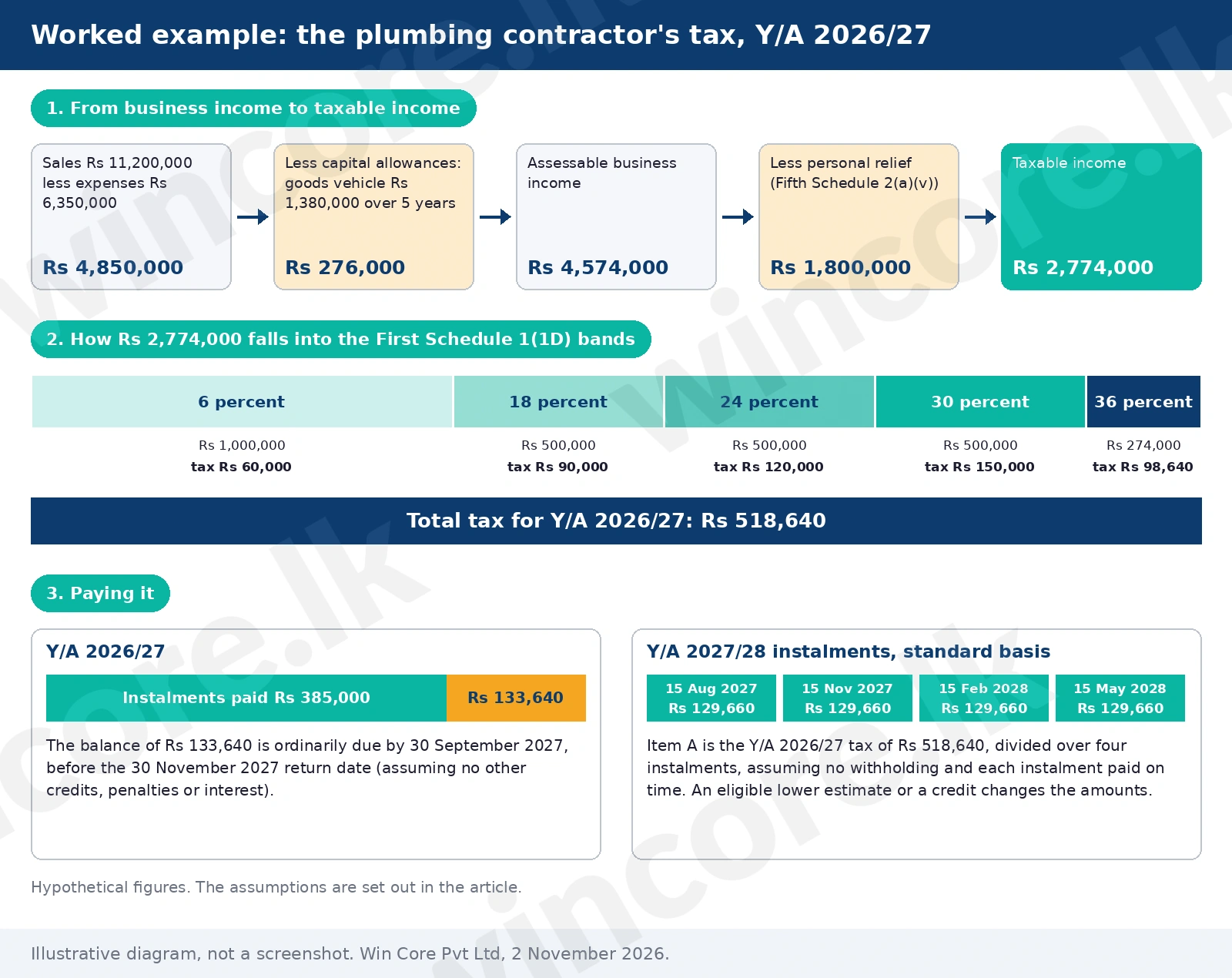
The plumbing contractor's figures for Y/A 2026/27 are hypothetical. Assume the owner is resident, has no other income, is entitled to personal relief, and has no other qualifying payments, withholding credits or special rate income. Assume allowable expenses and one qualifying goods vehicle costing Rs 1,380,000, owned and wholly used in the business at year end, with no prior allowances. Its five year straight line allowance (Fourth Schedule, class 2) is Rs 276,000 [1], [7].
| Step | Amount (Rs) |
|---|---|
| Sales of plumbing work and materials | 11,200,000 |
| Less deductible expenses (materials, assistants' wages, fuel, repairs) | 6,350,000 |
| Business receipts less those expenses, before capital allowances | 4,850,000 |
| Less capital allowances (Fourth Schedule) | 276,000 |
| Assessable business income | 4,574,000 |
| Less personal relief (Fifth Schedule 2(a)(v)) | 1,800,000 |
| Taxable income | 2,774,000 |
Tax band by band under paragraph 1(1D) [2]:
| Band | Taxable income in band (Rs) | Rate | Tax (Rs) |
|---|---|---|---|
| First | 1,000,000 | 6 percent | 60,000 |
| Second | 500,000 | 18 percent | 90,000 |
| Third | 500,000 | 24 percent | 120,000 |
| Fourth | 500,000 | 30 percent | 150,000 |
| Balance | 274,000 | 36 percent | 98,640 |
| Total | 2,774,000 | 518,640 |
If the owner has paid Rs 385,000 in eligible instalments for that year, the remaining tax is Rs 133,640, assuming no other credits, penalties or interest. The ordinary final payment date is 30 September 2027, six months after that year ends and before the 30 November 2027 return date [1]. For Y/A 2027/28, assume the standard basis applies, item A remains Rs 518,640, no withholding is available or expected, and each previous instalment was paid before the next due date. The calculation then produces four instalments of Rs 129,660 each [3]. A different credit or an eligible alternative basis changes the calculation.
What this means for you
- Treat the business income as your own and include it in your individual return when required.
- Add back any depreciation or drawings charged as expenses and calculate eligible capital allowances.
- Apply the personal relief if you qualify, then apply the relevant rates.
- Calculate instalments using the preceding year's tax or the applicable specified alternative, allowing for eligible credits.
- Pay the annual balance by its due date, file the return by its separate due date, and retain the records for the required period.
Checklist: documents needed
- TIN and, where relevant, TIN certificate or accepted verification evidence
- Sales records and bank statements for the year
- Expense invoices and wage records
- The fixed asset list with purchase invoices for capital allowances
- Proof of quarterly instalments and relevant withholding credits
- Last year's tax computation and supporting records for the instalment basis
FAQ
Does a sole proprietor pay income tax separately from the owner?
No, the owner's business income is assessed as the individual's income under section 6. The owner includes it with other income that must be declared, deducts any available relief and applies the applicable rates. Drawings for personal use are not a business expense, and employee payroll is a separate question [1].
What is the tax-free amount for a sole proprietor in Y/A 2026/27?
Under Act No. 2 of 2025, the personal relief is Rs 1,800,000 for an eligible individual for each year of assessment from Y/A 2025/26, including Y/A 2026/27. Residents and nonresident Sri Lankan citizens qualify subject to the statutory limits. For the resident contractor in this example, with no other income, taxable business income after the relief starts at the 6 percent band [1], [2], [7].
Does a sole proprietor have to pay quarterly instalments?
A person deriving or expecting assessable business income is an instalment payer, but the formula can produce no payment. From Y/A 2026/27 the standard basis uses the preceding year's tax, with specified alternatives and eligible credits. For Y/A 2027/28 the ordinary dates are 15 August 2027, 15 November 2027, 15 February 2028 and 15 May 2028 [3], [6].
When is the sole proprietor's income tax return due?
The ordinary return date is 30 November after the year of assessment ends, subject to the return exceptions and section 119. For Y/A 2026/27 it is 30 November 2027. The ordinary final tax payment date for that year is earlier, on 30 September 2027. Late filing can attract the section 178 penalty, subject to possible relief for reasonable cause [1].
The short version
A sole proprietor's business income is assessed as the owner's individual income. Deduct allowable expenses and capital allowances, then apply eligible relief and the relevant bands. From Y/A 2026/27, calculate instalments using the preceding year's tax or the specified alternative and eligible credits. For Y/A 2026/27, pay the balance by 30 September 2027 and file the return by 30 November 2027. VAT and SSCL registration depend on the activity, registration status and applicable turnover tests.
Talk to us. For Tax Planning & Advisory and RAMIS System Support, see our income tax services or book a consultation at our contact page.
WinCore Pvt Ltd
This article is general information as at 30 October 2026 and is not tax, legal or accounting advice on your specific position.
Sources and references (17)
- Parliament of Sri Lanka. Inland Revenue Act, No. 24 of 2017, sections 2 to 6, 10, 11, 13, 16, 20, 21, 52, 82, 90, 93, 94, 102, 119, 120, 151, 157, 159, 176, 178 and 179, First, Fourth and Fifth Schedules. Effective 1 April 2018. https://www.ird.gov.lk/en/publications/Acts_Income%20Tax_2017/IR_Act_No_24_2017_E.pdf . Primary. Accessed 30 October 2026.
- Parliament of Sri Lanka. Inland Revenue (Amendment) Act, No. 2 of 2025, sections 1, 3 and 5. Effective 1 April 2025. https://www.ird.gov.lk/en/publications/Acts_Income%20Tax_2017/IR_Act_No_02-2025_E.pdf . Primary. Accessed 30 October 2026.
- Parliament of Sri Lanka. Inland Revenue (Amendment) Act, No. 11 of 2026, sections 1, 5, 16 to 18, 24, 25 and 36. Section 5 operates from 1 April 2025; sections 16 to 18 from 1 April 2026; sections 24 and 36(1) operate from certification on 3 June 2026, with section 103(6)(b) specifying 1 April 2026. https://www.ird.gov.lk/en/publications/Acts_Income%20Tax_2017/IR_Act_No_11-2026_E.pdf . Primary. Accessed 30 October 2026.
- Parliament of Sri Lanka. Value Added Tax (Amendment) Act, No. 16 of 2024, section 3. Certified 20 March 2024; the tests refer to periods from 1 January 2024, and the registration requirement arises on certification. https://www.ird.gov.lk/en/publications/Value%20Added%20Tax_Acts/VAT_%28Amd%29_Act_No_16%20of%202024_E.pdf . Primary. Accessed 30 October 2026.
- Parliament of Sri Lanka. Social Security Contribution Levy (Amendment) Act, No. 10 of 2026, sections 1 to 3. Certified 9 April 2026; section 4(1)(d) of the principal Act applies to periods from 1 July 2026. https://www.ird.gov.lk/en/publications/Acts_SSCL/SSCL_Act_No_10-2026_E.pdf . Primary. Accessed 30 October 2026.
- Parliament of Sri Lanka. Inland Revenue (Amendment) Act, No. 10 of 2021, sections 1, 9, 33, 34, 44 and 46 and Table B. Sections 33(1) and (2) operate from 1 April 2018, and section 33(3) and (4) from 1 April 2020. https://www.ird.gov.lk/en/publications/Acts_Income%20Tax_2017/IR_Act_No._10_2021_E.pdf . Primary. Accessed 30 October 2026.
- Parliament of Sri Lanka. Inland Revenue (Amendment) Act, No. 45 of 2022, sections 1, 6, 7, 20, 30 and 36 and Tables A to C. Relevant section 18 amendments operate from 1 April 2021; the earlier Rs 1,200,000 relief applies to the years specified from 1 April 2023. https://www.ird.gov.lk/en/publications/Acts_Income%20Tax_2017/IR_Act_No._45_2022_E.pdf . Primary. Accessed 30 October 2026.
- Parliament of Sri Lanka. Inland Revenue (Amendment) Act, No. 4 of 2023, sections 1, 10 and 18 to 20. Section 10 operates from 1 April 2023; section 18 operates from 1 October 2022; section 19 operates from certification on 8 May 2023. https://www.ird.gov.lk/en/publications/Acts_Income%20Tax_2017/IR_Act_No._04_2023_E.pdf . Primary. Accessed 30 October 2026.
- Inland Revenue Department. Circular SEC/2026/E/06, re-revised, sections 1 to 3 and attachments, 12 August 2026, applicable to Y/A 2026/27. https://www.ird.gov.lk/en/publications/Circulars_Circulars/SEC_2026_E_06_ReRiv_E.pdf . Primary. Read from supplied PDF on 30 October 2026.
- Inland Revenue Department. Circular SEC/2026/E/07, sections 1 to 4, issued 22 September 2026; procedure effective 1 November 2026. https://www.ird.gov.lk/en/publications/Circulars_Circulars/SEC_2026_E_07_E.pdf . Primary. Accessed 30 October 2026.
- Parliament of Sri Lanka. Value Added Tax (Amendment) Act, No. 4 of 2025, sections 1, 4 and 13. Certified 11 April 2025; section 4 operates on certification. https://www.ird.gov.lk/en/publications/Value%20Added%20Tax_Acts/VAT_Act_No_04-2025_E.pdf . Primary. Accessed 30 October 2026.
- Parliament of Sri Lanka. Value Added Tax (Amendment) Act, No. 14 of 2026, sections 1, 2, 8 and 16. Certified 30 June 2026; individual provisions specify later or earlier dates where applicable. https://www.ird.gov.lk/en/publications/Value%20Added%20Tax_Acts/VAT_Act_No_14-2026_E.PDF . Primary. Accessed 30 October 2026.
- Parliament of Sri Lanka. Social Security Contribution Levy Act, No. 25 of 2022, sections 1 to 5 and Schedules. Effective 1 October 2022. https://www.ird.gov.lk/en/publications/Acts_SSCL/SSCL_Act_No.%2025_2022_E.pdf . Primary. Accessed 30 October 2026.
- Parliament of Sri Lanka. Social Security Contribution Levy (Amendment) Act, No. 24 of 2025, sections 1 and 2. Certified 17 December 2025; specified amendments operate from 18 February and 1 July 2025. https://www.ird.gov.lk/en/publications/Acts_SSCL/SSCL_Act_No_24_2025_E.pdf . Primary. Accessed 30 October 2026.
- Inland Revenue Department. Notice SEC/PN/IT/2026/05, 22 September 2026, on TIN registration and specified transactions from 1 November 2026. https://www.ird.gov.lk/en/Lists/Latest%20News%20%20Notices/Attachments/811/SEC_PN_IT_2026-05_E.pdf . Primary. Accessed 30 October 2026.
- Inland Revenue Department. Tax Calendar, nonworking day note. https://www.ird.gov.lk/en/publications/sitepages/tax%20calendar.aspx . Primary. Accessed 30 October 2026.
- Government of Sri Lanka. Gazette Extraordinary No. 2334/21, notice under section 102(3), Schedule Parts A and B, published 31 May 2023. Part A applies from 1 June 2023 and Part B from 1 January 2024. https://www.ird.gov.lk/en/publications/Gazette_Documents/2023_2334-21_E.pdf . Primary. Accessed 30 October 2026.
Put these insights to work
WinCore specialists can review your current workflow, document gaps, and build a practical 90-day action plan.
Book a free consultationRecent articles



Continue reading
Explore more WinCore analysis to keep your finance, tax, and compliance roadmap moving.

Registering a sole proprietorship in Sri Lanka: the business name at the Divisional Secretariat, the TIN certificate, income tax, VAT, SSCL and EPF.

Sri Lanka income tax bands for 2026 explained with current rates, worked examples, and practical APIT planning for employees and employers.
Five worked cases for 2026/27 instalments: expected WHT, an underpaid quarter, losses that ran out, a mid-year switch and a landlord on a salary.