
Profitable but no cash in Sri Lanka: where the money went
A healthy profit and an empty bank account usually have six causes. How to read the cash flow statement, and the tax dates that drain cash first.
On this page
Last verified against the primary sources on 22 October 2026.
A company can be profitable but have no cash in Sri Lanka for a plain reason: SLFRS for SMEs (2015) paragraph 2.36 requires financial statements, "except for cash flow information", to use the accrual basis, so profit counts sales when earned and costs when incurred, while the bank counts money when it moves. The gap is usually six things: customers who have not paid, stock, VAT that the VAT Act makes due by the 20th of the month after you invoice (ss.4 and 26), income tax instalments due on 15 August, 15 November, 15 February and 15 May (Inland Revenue Act s.90(2)), equipment, and loan or dividend payments. Section 7 of the standard, the statement of cash flows, is the tool that shows which of them took your cash. This is the law as consolidated to 2025 and read on 22 October 2026; the monitoring routine at the end is practice, not a legal requirement.
Profitable but no cash in Sri Lanka: profit is an accrual figure, cash is the bank
Under the accrual basis, items are recognised "when they satisfy the definitions and recognition criteria for those items" (2.36), not when cash is paid or received [1]. A sale invoiced on 28 March is March income even if the customer pays in June. A supplier bill for March is a March cost even if you pay it in May. Our sibling piece on accrued expenses and cut-off traps covers the month-end side of that.
Paragraph 7.1 says the statement of cash flows "provides information about the changes in cash and cash equivalents of an entity for a reporting period, showing separately changes from operating activities, investing activities and financing activities" [1]. Paragraph 7.3 requires that split. Operating cash flows "generally result from the transactions and other events and conditions that enter into the determination of profit or loss" (7.4). Investing is buying and selling long-term assets (7.5). Financing is changes in "contributed equity and borrowings" (7.6). The split matters: a business can look fine in total while operations consume cash and a new loan fills the hole.
Is the overdraft cash? Paragraph 7.2: "Bank overdrafts are normally considered financing activities similar to borrowings. However, if they are repayable on demand and form an integral part of an entity's cash management, bank overdrafts are a component of cash and cash equivalents" [1]. Where the second case applies, the statement can show cash going negative. Treat that as a warning, not a presentation quirk. If a bank asks for a project report with a loan application, see what a project report for a bank loan contains.
The cash flow statement shows where the money went
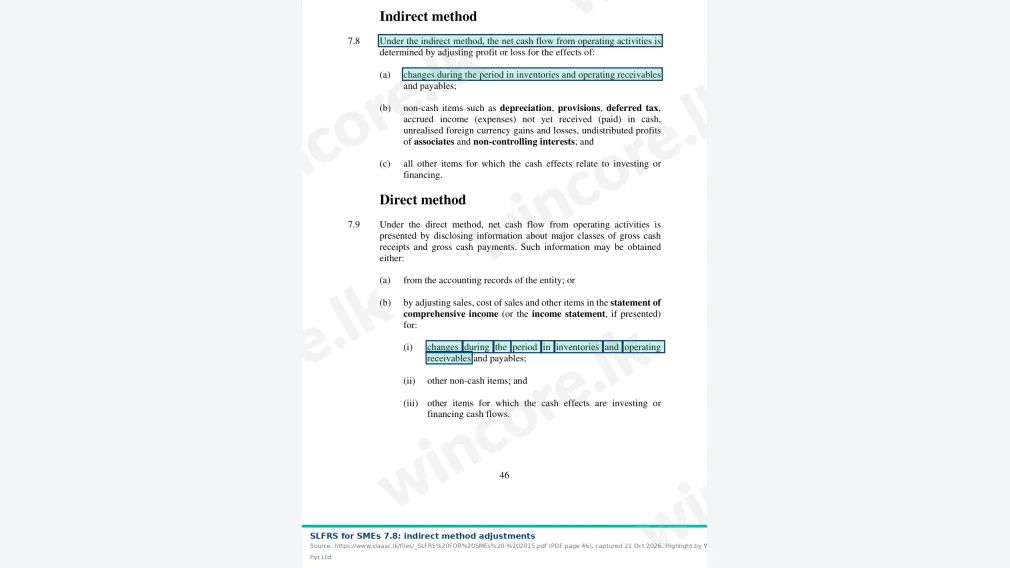
Paragraph 7.7 allows the direct method or the indirect method. The indirect method is the one that starts from profit, which is why it answers the question an owner actually asks. Paragraph 7.8: "the net cash flow from operating activities is determined by adjusting profit or loss for the effects of: (a) changes during the period in inventories and operating receivables and payables; (b) non-cash items such as depreciation, provisions, deferred tax, accrued income (expenses) not yet received (paid) in cash, unrealised foreign currency gains and losses, undistributed profits of associates and non-controlling interests; and (c) all other items for which the cash effects relate to investing or financing" [1].
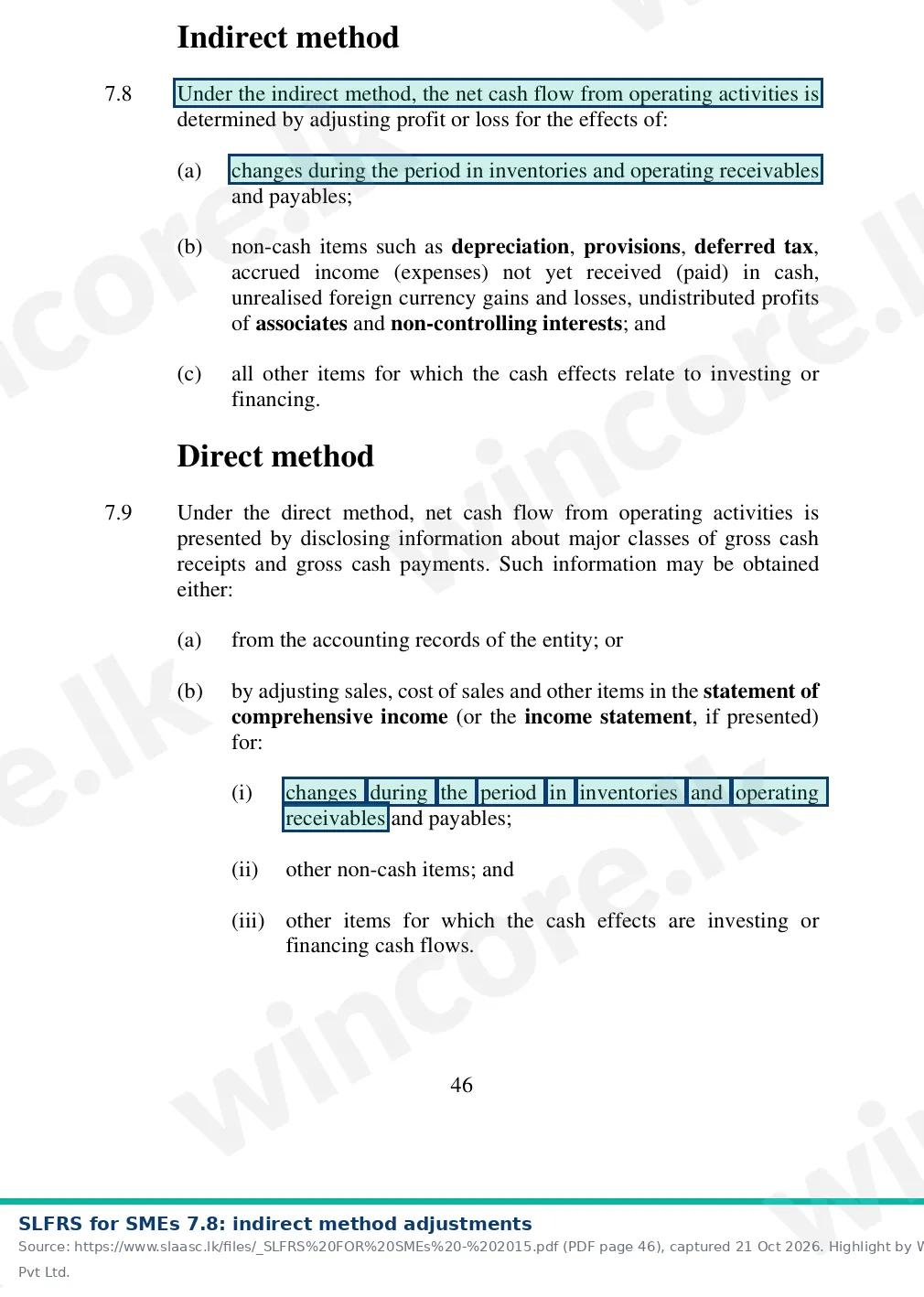
That list is a map of where the cash hides. Two classification rules matter for small companies. Income tax paid is an operating cash flow unless it can be "specifically identified with financing and investing activities" (7.17). Interest and dividends must be shown separately and classified consistently; dividends paid may be financing or operating (7.14 to 7.16) [1].
Here is a hypothetical year laid out in the 7.8 structure:
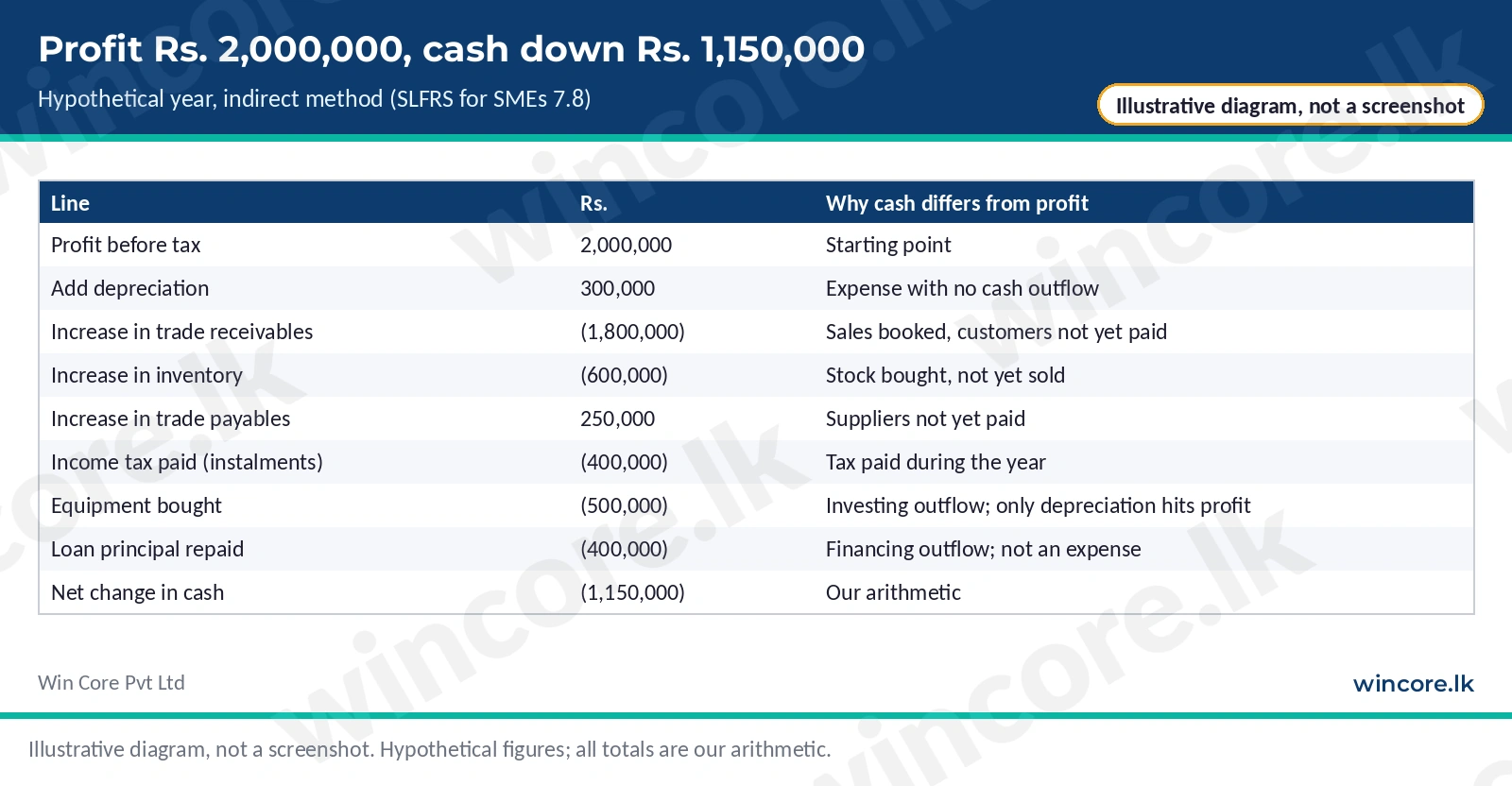
Profit of Rs. 2,000,000, plus depreciation of Rs. 300,000, less a Rs. 1,800,000 rise in receivables, less Rs. 600,000 more stock, plus Rs. 250,000 more owed to suppliers, less Rs. 400,000 of tax instalments, Rs. 500,000 of equipment and Rs. 400,000 of loan principal, gives a Rs. 1,150,000 fall in cash (our arithmetic). Nothing in the profit figure is wrong. The business has funded its customers, its stock, its tax, its equipment and its lender.
Customers, stock and suppliers decide most of the gap
Customers who have not paid. If customers take 60 or 90 days, a growing business is always funding them. Every rupee of extra credit sales adds a rupee of receivables before it adds a rupee of cash, so fast growth drains cash even when every sale is profitable.
Stock. Inventory bought but not yet sold is an asset. Cash leaves when you pay the supplier; the cost reaches profit only when the goods are sold. Over-ordering and slow lines tie up cash that the profit and loss account never shows.
Suppliers. Paying suppliers faster than customers pay you widens the gap; agreed credit from suppliers narrows it.
Three management ratios, not figures from any standard, put numbers on this:
| Ratio | Calculation | Hypothetical figures | Result |
|---|---|---|---|
| Debtor days | Trade receivables / credit sales x 365 | Rs. 4,500,000 / Rs. 18,250,000 | 90 days |
| Stock days | Inventory / cost of sales x 365 | Rs. 1,500,000 / Rs. 9,125,000 | 60 days |
| Creditor days | Trade payables / credit purchases x 365 | Rs. 750,000 / Rs. 9,125,000 | 30 days |
Debtor days plus stock days minus creditor days is 120 days: the time your own cash funds each sale (our arithmetic). Cut debtor days to 60 on the same sales and receivables fall to Rs. 3,000,000, releasing Rs. 1,500,000 (our arithmetic) without one extra rupee of profit. Our guide to cash flow management strategies goes deeper into collection tactics, supplier terms and stock control, and the cash flow tool lets you model the timing.
VAT is due on the invoice, often before the customer pays
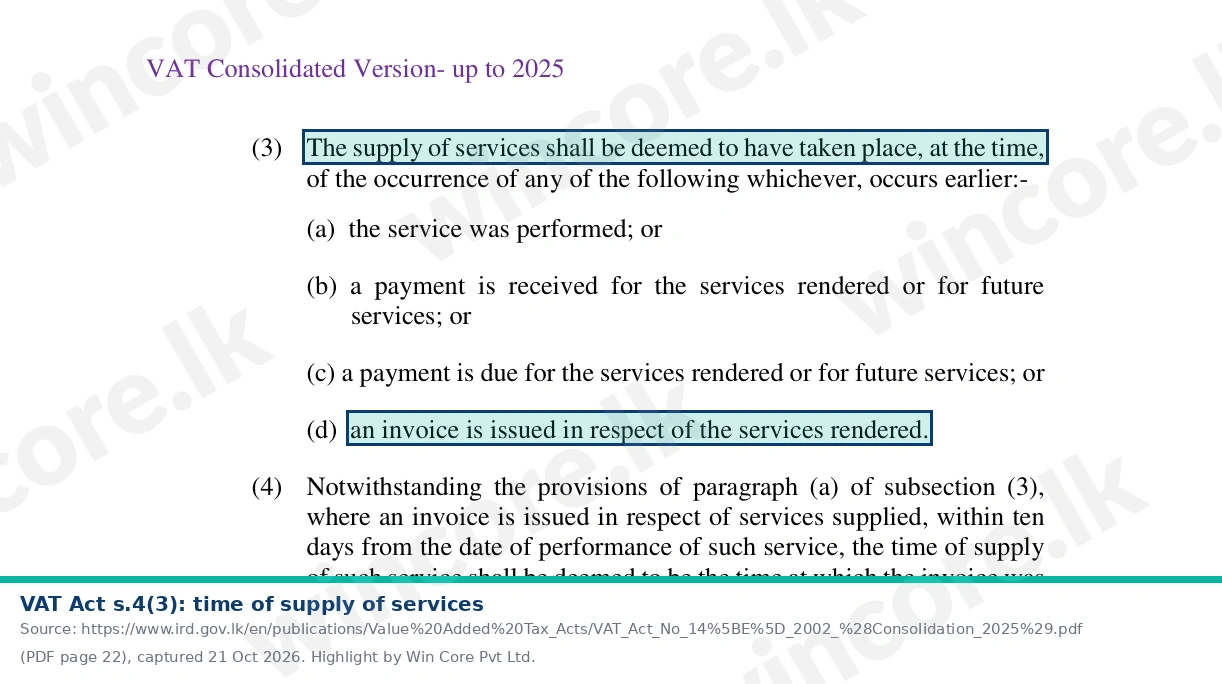
For a VAT-registered business, the VAT Act fixes when output tax arises, and it is usually not when the customer pays. Section 4(3) deems a supply of services to take place at the earliest of: "(a) the service was performed; or (b) a payment is received for the services rendered or for future services; or (c) a payment is due for the services rendered or for future services; or (d) an invoice is issued in respect of the services rendered" [2]. Section 4(1) has the same structure for goods: the earliest of the invoice, a payment received, a payment due, or delivery. Sections 4(2) and 4(4) let an invoice issued within ten days of delivery or performance fix the time instead.
Two further limbs change the answer for some businesses. Under s.4(5)(a), a supply under an agreement providing for periodical payments (other than hire purchase) takes place "when the payment is due or when the payment is received, whichever is earlier". Under s.4(6), where the Commissioner-General directs a registered person to account on a payment basis under s.23, the time of supply is when payment is received. Section 23 makes the invoice basis the rule: "Every registered person shall account for tax on an invoice basis", with payment basis only where the Commissioner-General directs it "on an application made in that behalf" [2].
The tax for a taxable period is payable "not later than the twentieth day of the month following the end of the taxable period" (s.26(1)) [2]. So, on the invoice basis, a company that invoices in March owes the March output VAT by 20 April even if the customer pays in June. The VAT is not your income, but you fund it until the customer pays. If a debt later goes bad, s.24 allows the VAT on it to be deducted in the period it becomes bad, capped at the tax already paid on that debt. Our VAT registration thresholds guide covers whether you need to register at all, and the VAT calculator splits VAT-inclusive amounts.
Instalments, equipment, loans and dividends take cash out of a profitable year
Income tax instalments. Companies pay income tax for the year in instalments "on or before the fifteenth day respectively of August, November and February in that year of assessment and the fifteenth day of May of the next succeeding year of assessment" (s.90(2), as substituted by Act No. 10 of 2021) [3]. A strong year means higher instalments while customers are still slow to pay. The computation changed in 2026; our article on quarterly income tax instalments under Circular SEC/2026/E/06 sets out the current method, and our income tax services team computes instalments as part of the year.
Equipment and fit-out. Capital purchases leave the bank in full on the day you pay but reach profit only as depreciation. The Rs. 500,000 of equipment in the bridge, depreciated over five years, costs Rs. 100,000 of profit a year but Rs. 500,000 of cash at once (our arithmetic). Our sibling piece on whether to capitalise or expense covers which costs go where.
Loan principal. Only the interest is an expense. Repaying principal reduces cash, not profit, and sits in financing (7.6(d)).
Dividends. A dividend is not an expense either, and the Companies Act puts a cash test in front of it. The board may authorise a distribution only where "it is satisfied that the company will, immediately after the distribution is made satisfy the solvency test, provided that such board obtains a certificate of solvency from the auditors" (s.56(2)), and the directors who vote for it sign a certificate (s.56(3)). The solvency test in s.57(1) has two limbs: the company "is able to pay its debts as they become due in the normal course of business", and its assets exceed its liabilities and its stated capital [4]. A profitable company with an empty bank account can fail the first limb. For the board steps and the solvency test, see how to declare a dividend.
What this means for you
Read the cash flow statement next to the profit and loss account; the difference is almost always receivables, stock, tax timing, capital spending and financing. The routine below is practice, not a legal requirement:
- Prepare the cash flow statement quarterly, not only at year end, in the 7.8 structure so the bridge from profit is visible.
- Track debtor, stock and creditor days every month.
- Keep a rolling 13-week cash forecast with receipts by customer and payments by due date, including VAT by the 20th, SSCL where it applies, EPF and ETF, salaries, instalments and loan repayments.
- Set tax money aside as you invoice, so the VAT and the instalment are there on the due date.
- Match funding to the asset. Finance equipment over its life, not from the overdraft.
- Invoice promptly and review credit terms yearly, and watch any single customer whose balance has grown large.
Our accounting services prepare the quarterly cash flow statement and ratios, and our virtual CFO services run the forecast and the funding conversation with your bank.
A hypothetical distributor
A distributor of building materials with a 31 March year end grows sales by forty percent. Profit rises to Rs. 2,000,000 and the director is surprised to need a larger overdraft. The bridge in Figure 2 is its year: receivables up Rs. 1,800,000 and stock up Rs. 600,000. It tightens credit terms for new customers, invoices on delivery, sets the next VAT and instalment amounts aside each month, and takes a term loan for the next delivery truck instead of using the overdraft. The profit figure does not change. The cash position does.
Checklist: documents needed
- Profit and loss account and balance sheet for this and the last period
- Statement of cash flows in the SLFRS for SMEs 7.8 format
- Aged receivables and payables listings
- Stock listing with ageing
- VAT returns and the dates invoices were issued (VAT Act ss.4 and 26)
- Income tax instalment schedule for the year (IRA s.90)
- Loan schedules showing principal and interest separately
- Fixed asset additions for the period
FAQ
Why is my business profitable but has no cash?
Because profit is measured on the accrual basis and cash is not. Sales count when earned even if customers have not paid, stock bought is an asset until sold, and equipment, loan principal and dividends leave the bank without passing through profit. Tax adds timing: VAT can fall due on the invoice date and income tax instalments are due during the year.
Is a profitable company with no cash insolvent?
Not necessarily, but cash matters to the law. The Companies Act solvency test in section 57 asks whether the company can pay its debts as they become due in the normal course of business, as well as whether assets exceed liabilities and stated capital. A dividend needs the board to be satisfied the test is met afterwards. A persistent shortage needs early advice.
Why do I owe VAT on invoices my customers have not paid?
Because section 4 of the VAT Act fixes the time of supply at the earliest of invoice, payment due, payment received or performance or delivery, and section 23 makes the invoice basis the default. The tax is then due by the 20th of the following month. A payment basis applies only where the Commissioner-General directs it on your application.
Does depreciation use cash?
No. Depreciation spreads the cost of an asset over its life, so it reduces profit without any cash leaving that year. In the indirect method it is added back to profit under paragraph 7.8(b). The cash left when the asset was bought, and it appears as an investing outflow under paragraph 7.5 in that period.
Are loan repayments an expense?
Only the interest is an expense. Repaying the principal reduces the liability, not profit, and is a financing cash flow under paragraph 7.6(d). Interest paid may be shown as operating or financing, as long as the company classifies it the same way each year (paragraphs 7.14 and 7.15). This is one reason a loan-funded business can show profit and falling cash.
Open points
- Standard edition. We read the 2015 SLFRS for SMEs; adoption of a later edition in Sri Lanka was not verified.
- Payment basis conditions. Section 23 leaves the conditions to the Commissioner-General; we did not find published conditions on ird.gov.lk on 22 October 2026, so check before applying.
- Instalment computation changes by Act and circular; this piece gives the due dates only.
Last verified 22 October 2026 against the sources listed in References.
This article is general information, not advice on your specific position.
Talk to us. If your profit and your bank balance are telling different stories, contact us at our contact page.
WinCore Pvt Ltd
References
- Institute of Chartered Accountants of Sri Lanka. Sri Lanka Accounting Standard for Small and Medium-sized Entities (SLFRS for SMEs), 2015, paras 2.36, 7.1 to 7.8, 7.14 to 7.17. https://www.slaasc.lk/files/_SLFRS%20FOR%20SMEs%20-%202015.pdf . Primary. Accessed 22 October 2026.
- Inland Revenue Department. Value Added Tax Act, No. 14 of 2002 (consolidated up to 2025), ss.4, 23, 24, 26. https://www.ird.gov.lk/en/publications/Value%20Added%20Tax_Acts/VAT_Act_No_14%5BE%5D_2002_%28Consolidation_2025%29.pdf . Primary (consolidation). Accessed 22 October 2026.
- Parliament of Sri Lanka. Inland Revenue (Amendment) Act, No. 10 of 2021, amending s.90(2) of the Inland Revenue Act No. 24 of 2017. https://www.ird.gov.lk/en/publications/Acts_Income%20Tax_2017/IR_Act_No._10_2021_E.pdf . Primary. Accessed 22 October 2026.
- Parliament of Sri Lanka. Companies Act, No. 7 of 2007, ss.56 and 57. http://www.drc.gov.lk/en/wp-content/uploads/2018/04/Act-7-of-2007-English.pdf . Primary. Accessed 22 October 2026.
Put these insights to work
WinCore specialists can review your current workflow, document gaps, and build a practical 90-day action plan.
Book a free consultationContinue reading
Explore more WinCore analysis to keep your finance, tax, and compliance roadmap moving.

Cash flow management for Sri Lankan SMEs: the cash conversion cycle, 13-week rolling forecasts, receivables and payables, factoring, and planning tax payments.
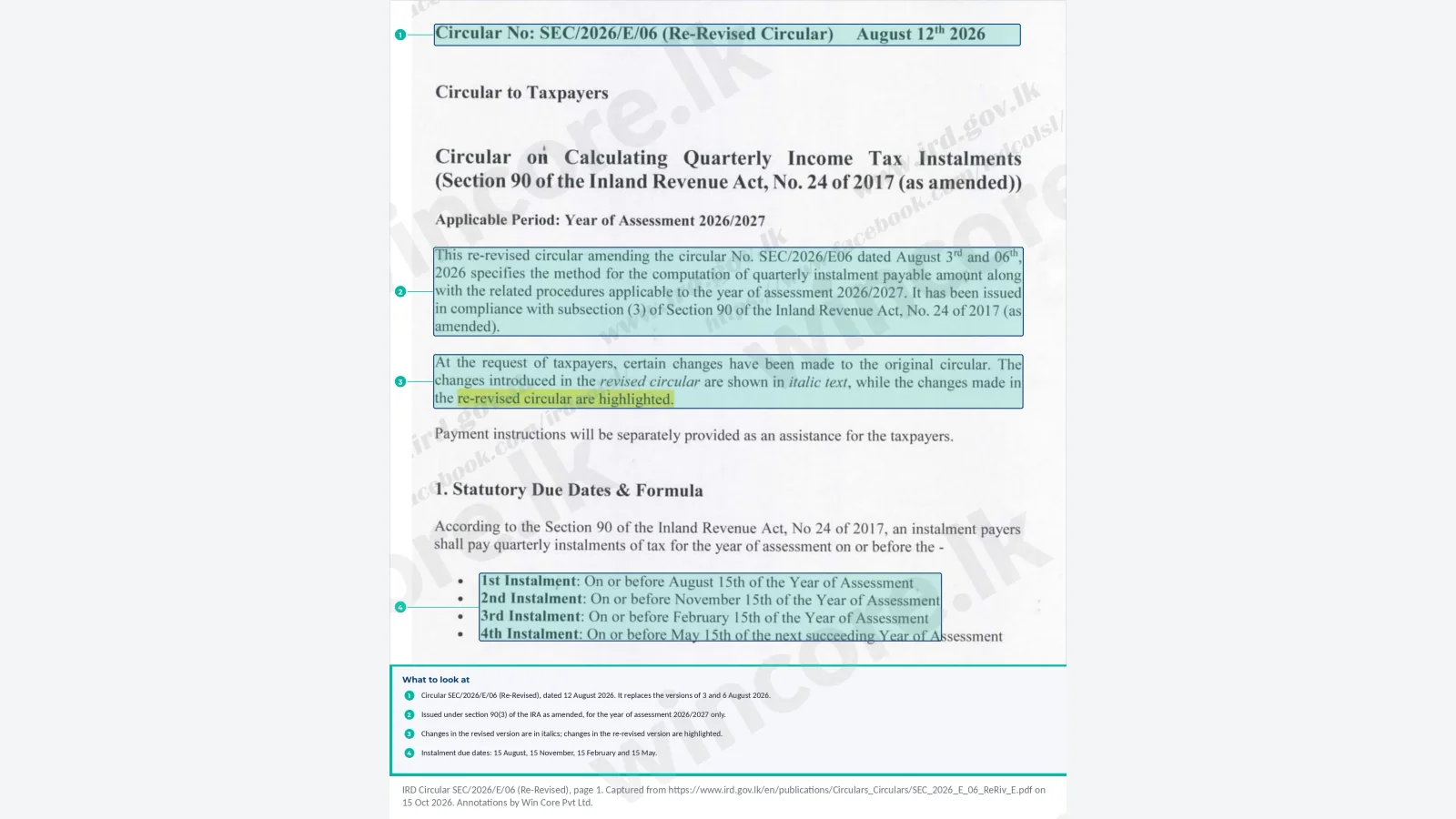
The IRD rewrote its instalment circular twice in nine days. What the 12 August version says on A, C, Method 2, the SET bridge and the November dates.
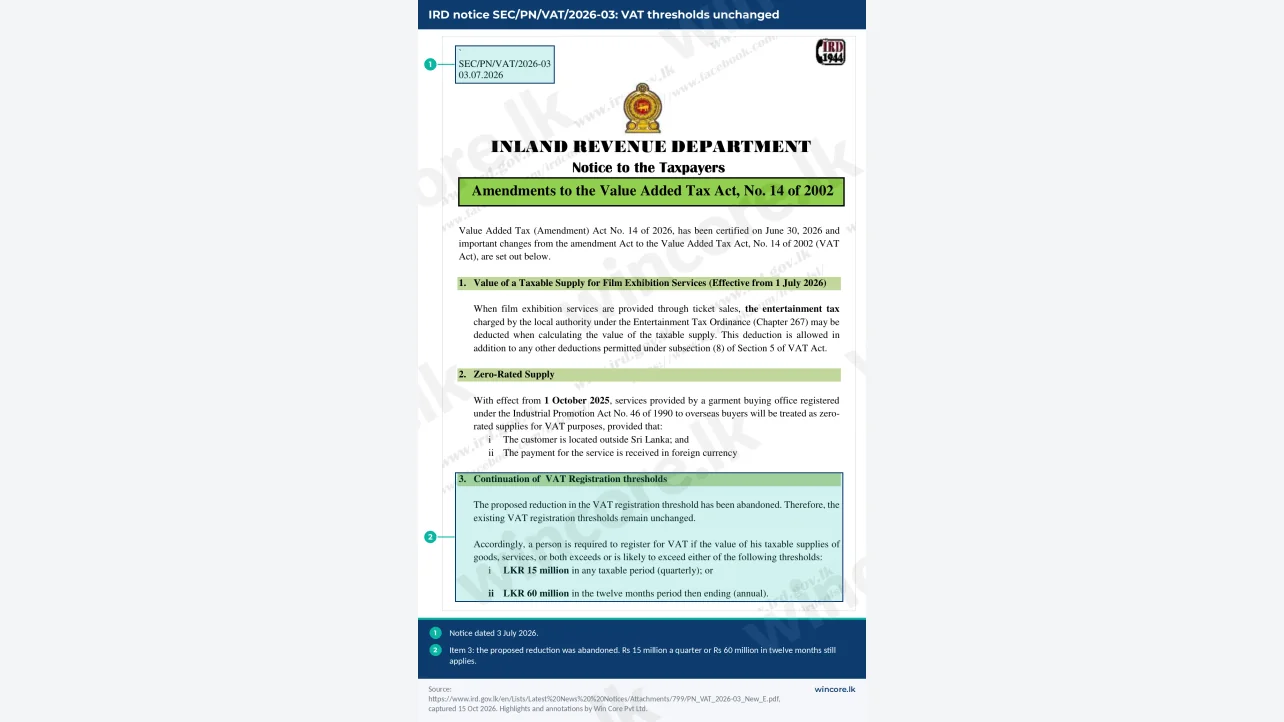
The VAT registration tests are Rs 15 million a quarter or Rs 60 million over 12 months. How the tests run, the 15 day rule and who must register.