
How would Budget 2027 change salary tax in Sri Lanka from April 2027?
Compare the salary tax bands in force with the Budget proposal and see worked monthly estimates for three invented salaries.
On this page
Last updated 12 November 2026.
Last verified against the available primary sources on 12 November 2026.
Income tax rates 2027 Sri Lanka, in brief. Budget Speech 2027 section 36.1 proposes raising personal relief from Rs 150,000 to Rs 162,500 a month, with revised income tax bands proposed from 1 April 2027. The speech is a proposal: employers should retain the applicable Inland Revenue Department APIT tables until legislation and implementing guidance support a change. [1] [2] [3]
For an invented logistics yard, the three salary estimates below show the arithmetic under the existing and proposed bands. Each calculation assumes a resident employee with one primary employment, the same salary for twelve months, no other income, allowances or benefits, and the full personal relief.
What changed
- 12 November 2026: Budget 2027 proposed a higher personal relief and a revised progressive rate structure. [1]
Effective dates and sources: existing relief applies from 1 April 2025; the proposed change is from 1 April 2027. Sources: Inland Revenue Act, Fifth Schedule, as amended; Budget Speech 2027 section 36.1 and Annexure V items 1.1 and 9. [1] [2]
| Item | Existing law | Budget proposal from 1 April 2027 |
|---|---|---|
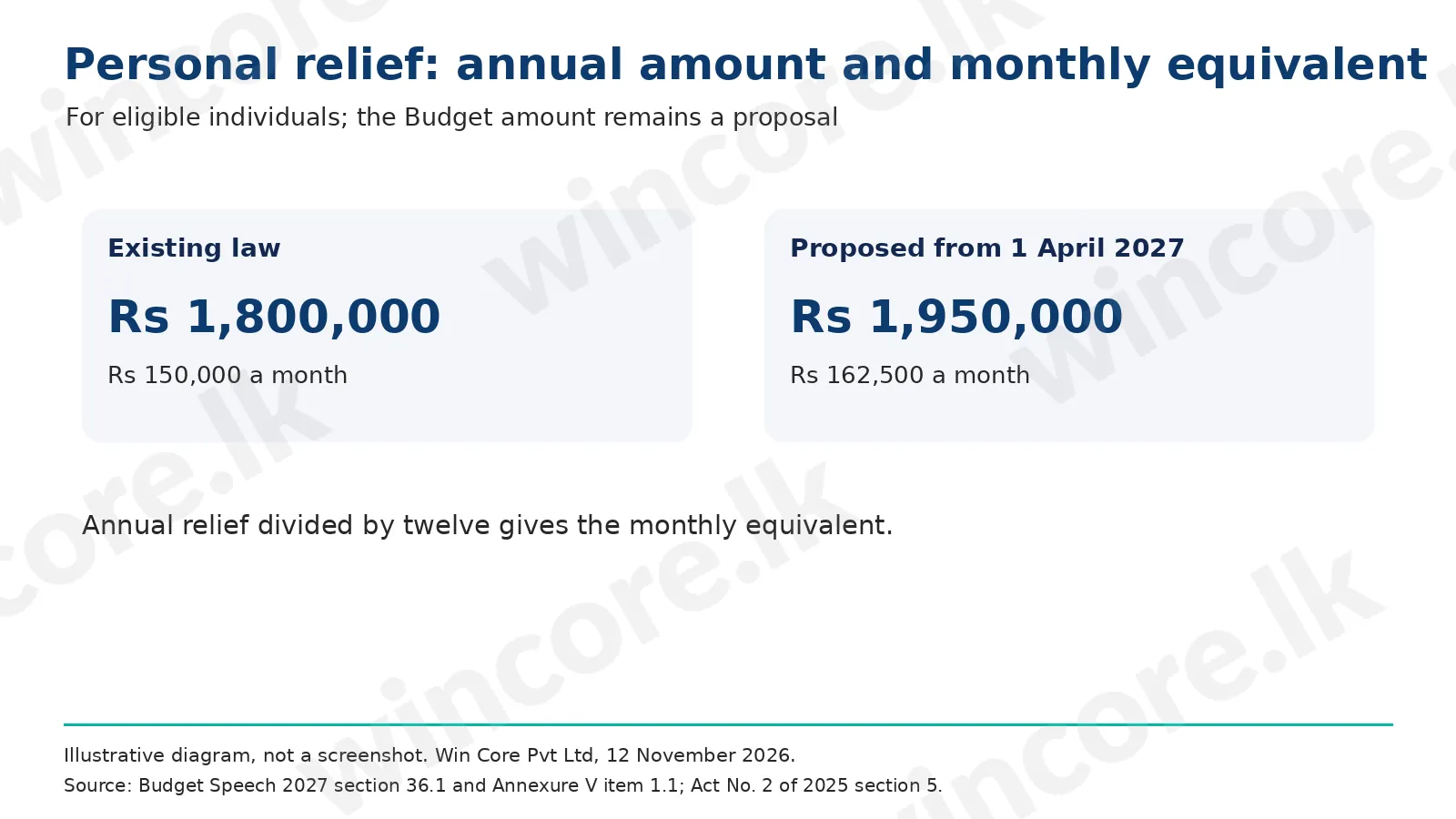
| Annual personal relief for an eligible individual | Rs 1,800,000 | Rs 1,950,000 |
| Equivalent monthly relief | Rs 150,000 | Rs 162,500 |
| First annual taxable band at 6% | Rs 1,000,000 | Rs 850,000 |
| Following rate | 18% | 12% |
What is the proposed tax free amount from April 2027?
Budget 2027 proposes annual personal relief of Rs 1,950,000, up from Rs 1,800,000, from 1 April 2027. That is Rs 162,500 rather than Rs 150,000 when divided evenly by twelve. The annual amount is a relief against eligible assessable income, not a payment to the taxpayer. [1] [2]
The existing personal relief applies to resident individuals and nonresident citizens of Sri Lanka. A nonresident who is not a citizen does not receive that relief under the IRD employment guidance. The examples assume eligibility, and the final legislation and guidance must be checked for the proposed measure. [3]
A salary at or below the monthly equivalent does not automatically settle the position for someone with other taxable income, irregular pay or a different residence status. Relief is considered in the wider annual computation. The employer's withholding calculation also depends on the applicable IRD table and the employee's circumstances. [3] [4]
Personal relief is an annual amount for the individual, not a separate allowance to subtract again for every source of income. The existing relief is not deducted against gains from the realisation of investment assets. Other reliefs and qualifying payments have their own conditions. The examples below do not assume any of those additional items. [5]
The monthly amount is useful when comparing regular salaries, but the annual relief is the starting point for the income tax calculation. If a person's payments do not stay the same throughout the year, dividing a single month's pay by a band will not establish the final annual tax. Check the complete income record and the table that applies to the payment. [3] [4]
What are the proposed tax bands?
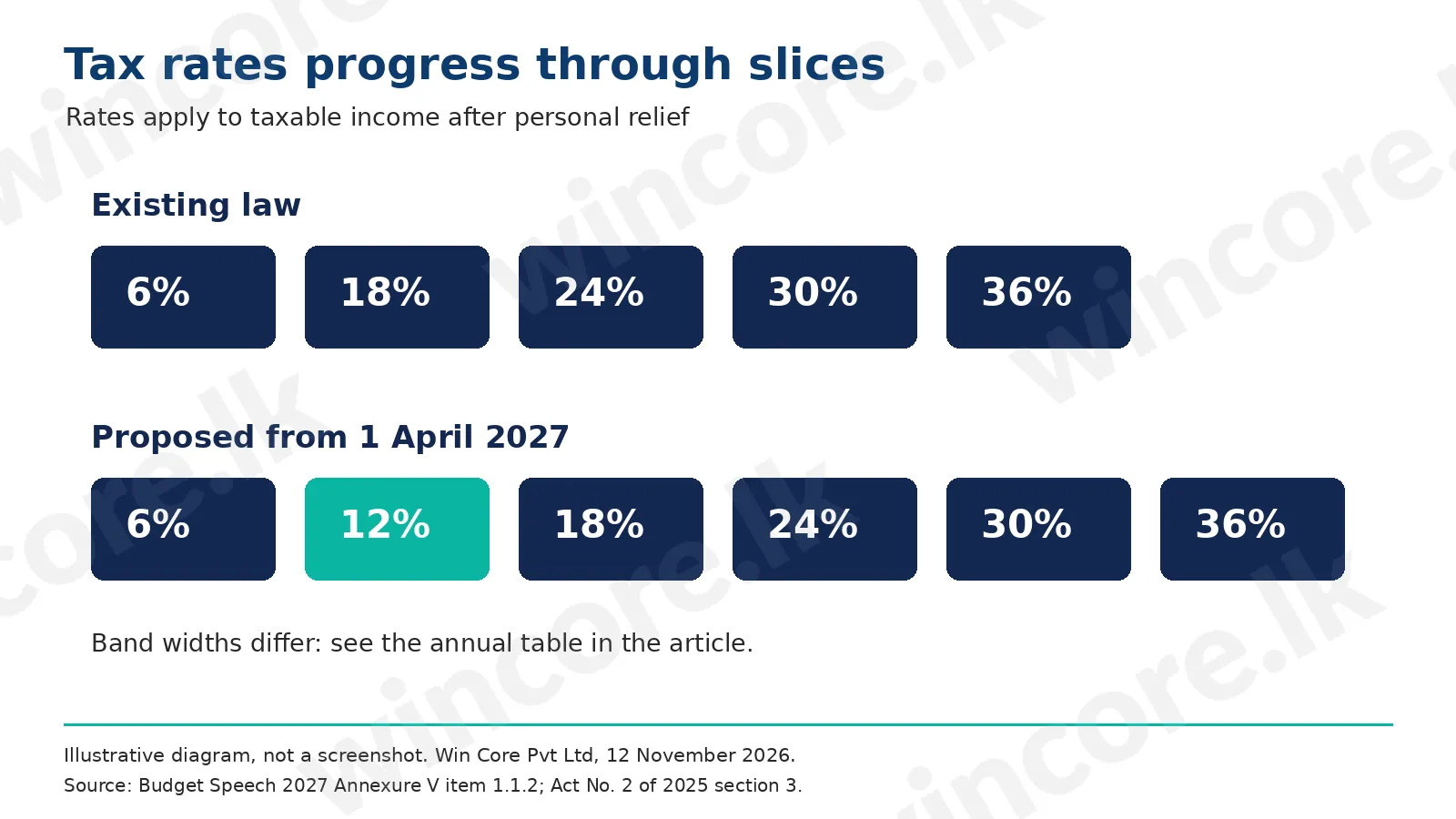
The proposal changes the size and sequence of progressive bands after personal relief. The first part is taxed at 6%, and a 12% band is proposed before 18%. The existing structure moves from 6% directly to 18%. [1] [2]
Annual taxable income bands after personal relief. Existing rates from 1 April 2025; proposed rates from 1 April 2027. Source: Inland Revenue Act First Schedule paragraph 1 and Budget Speech 2027 Annexure V item 1.1.2. [1] [2] [6]
| Band order | Existing taxable income | Existing rate | Proposed taxable income | Proposed rate |
|---|---|---|---|---|
| First | First Rs 1,000,000 | 6% | First Rs 850,000 | 6% |
| Second | Next Rs 500,000 | 18% | Next Rs 600,000 | 12% |
| Third | Next Rs 500,000 | 24% | Next Rs 600,000 | 18% |
| Fourth | Next Rs 500,000 | 30% | Next Rs 600,000 | 24% |
| Fifth | Balance | 36% | Next Rs 600,000 | 30% |
| Sixth | Not applicable | Not applicable | Balance | 36% |
Income tax rates 2027 Sri Lanka: how would the bands work?
Each rate applies only to the income in its own band. Crossing a band does not apply the higher rate to the whole salary. The table is annual and uses taxable income after relief; it is not a table of gross monthly salaries.
To use the comparison, identify the applicable annual income and relief first. Then allocate the taxable amount across the existing bands, starting with the first slice. Repeat the calculation using the proposed relief and proposed widths. Stop when all the taxable income has been allocated. A band can be only partly used; there is no requirement to fill every band. [1] [2]
The proposed 12% slice is an additional step in the progressive structure. Its appearance does not mean that every taxpayer pays 12% on all income above the personal relief. The rate for a slice depends on how much taxable income falls into that slice. The same principle applies to the existing schedule. [1] [2]
The speech expresses the proposed 6% slice as approximately Rs 70,833 a month and each of the next four slices as Rs 50,000 a month, compared with approximately Rs 41,667 for each existing Rs 500,000 band. The proposed 36% rate applies to the balance. The speech describes entry to the 36% rate as approximately Rs 433,000 rather than Rs 358,000 of monthly income. The annual thresholds translate to approximately Rs 433,333.33 and Rs 358,333.33 per month respectively when rounded to two decimal places; the highest rate applies to income above the relevant threshold. [1]
The speech describes additional monthly relief of Rs 750 to Rs 15,750. This should not be read as a guaranteed saving for every individual: a person with no tax under either calculation has no tax saving from these changes. The examples show three specific estimates, subject to the assumptions stated here. [1]
The separate guide to existing income tax bands explains the underlying structure. For the wider package, see the Budget 2027 tax proposals.
How much less tax would a salary pay?
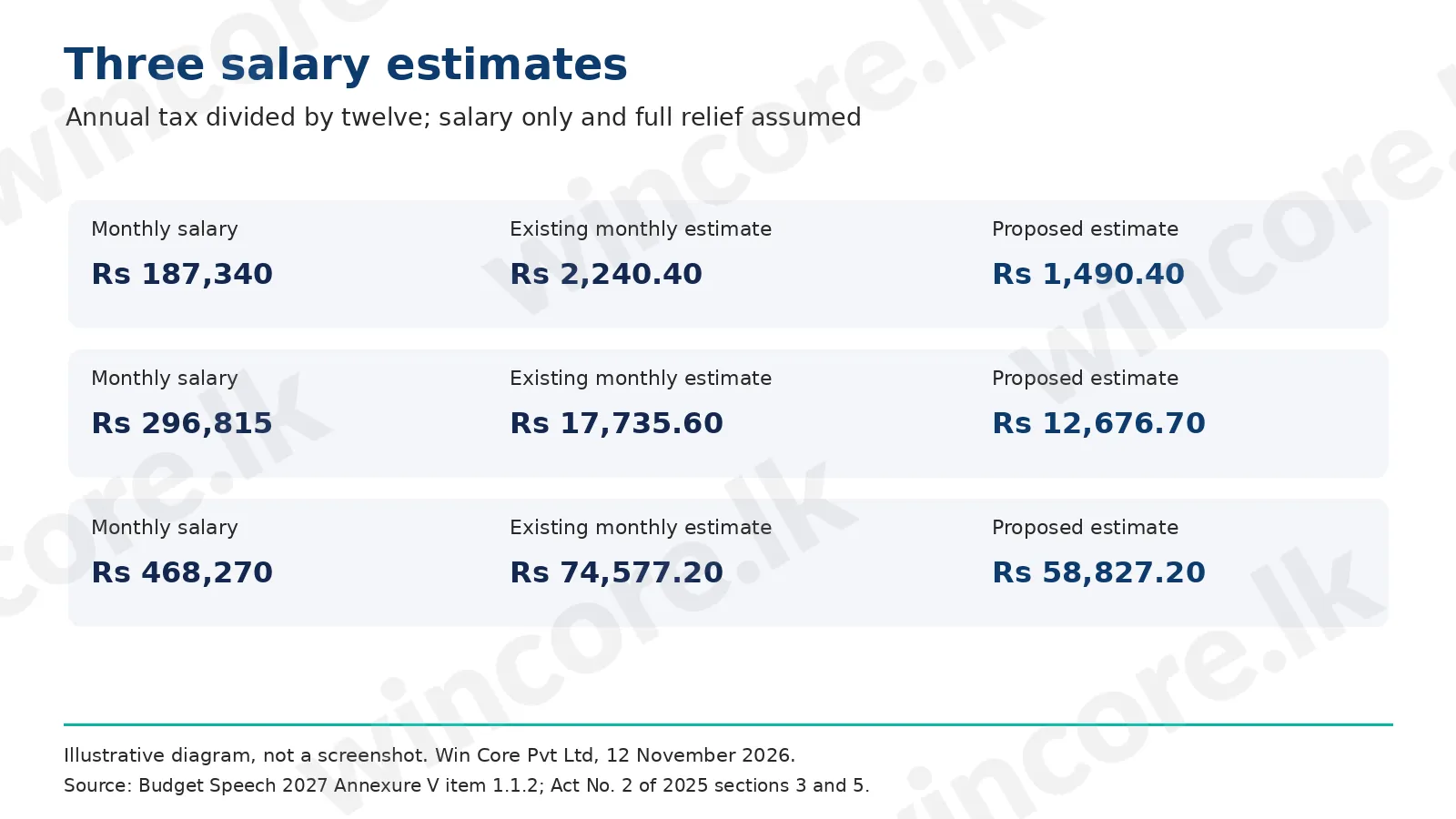
On the assumptions above, the estimates for the three invented monthly salaries are Rs 750, Rs 5,058.90 and Rs 15,750 lower per month respectively if the proposal takes effect as described. These are annual tax estimates divided by twelve, not promised APIT deductions. Payroll table rounding and individual circumstances may produce different deductions. [1] [3] [4]
First multiply monthly salary by twelve, subtract the relevant annual personal relief and allocate the remaining taxable income to the bands. The table shows each multiplication before the annual sum is divided by twelve. All amounts are in rupees.
| Monthly salary | Existing law: annual calculation and monthly estimate | Proposal: annual calculation and monthly estimate | Estimated monthly difference |
|---|---|---|---|
| 187,340 | Annual salary 2,248,080; taxable 448,080. 448,080 × 6% = 26,884.80; divided by 12 = 2,240.40 | Annual salary 2,248,080; proposed taxable 298,080. 298,080 × 6% = 17,884.80; divided by 12 = 1,490.40 | 750.00 lower |
| 296,815 | Annual salary 3,561,780; taxable 1,761,780. 1,000,000 × 6% + 500,000 × 18% + 261,780 × 24% = 212,827.20; divided by 12 = 17,735.60 | Annual salary 3,561,780; proposed taxable 1,611,780. 850,000 × 6% + 600,000 × 12% + 161,780 × 18% = 152,120.40; divided by 12 = 12,676.70 | 5,058.90 lower |
| 468,270 | Annual salary 5,619,240; taxable 3,819,240. 1,000,000 × 6% + 500,000 × 18% + 500,000 × 24% + 500,000 × 30% + 1,319,240 × 36% = 894,926.40; divided by 12 = 74,577.20 | Annual salary 5,619,240; proposed taxable 3,669,240. 850,000 × 6% + 600,000 × 12% + 600,000 × 18% + 600,000 × 24% + 600,000 × 30% + 419,240 × 36% = 705,926.40; divided by 12 = 58,827.20 | 15,750.00 lower |
For the middle salary, the proposed 12% slice changes the calculation as well as the higher relief. For the highest salary, both calculations reach the 36% band, but they reach it after different amounts have passed through the lower bands. These examples do not include bonuses, benefits or other income and should not be used as a payroll table.
The annual salary in each row is unchanged between the two calculations. The difference comes from the amount of relief and the band widths, not from a change in the employee's pay. The first employee's taxable income fits entirely within the first slice under both calculations. For the second employee, the proposed calculation reaches a different rate after the first slice is filled.
For the third employee, each schedule has a balance in its highest band. That does not make the highest rate the rate on the whole salary. The table adds the tax on each preceding slice before adding the tax on the balance. The monthly difference is the difference between the two annual totals divided by twelve. These illustrations assume the proposal is enacted in the form shown. [1] [2]
When would employers change APIT?
Employers should continue applying the applicable IRD APIT tables and guidance to payments under the law in force, and should not change payroll solely because of a Budget speech. Circular SEC/2025/E/01 is the IRD employer guideline effective from the year of assessment 2025 to 2026 onwards; the IRD publishes the tables and instructions separately. [3] [4]
The proposed income tax revisions are intended for 1 April 2027. Before changing deductions, compare the certified amendment and its commencement provisions with the revised IRD tables and instructions when issued. A speech does not provide a complete replacement payroll table. Record the effective date and which employee categories each table covers. [1] [3] [4]
The APIT deduction guide covers payroll deductions in more detail. A salary change, a bonus or a second employment can require a different calculation from the simple regular salary examples above. Refer to the table that fits the actual payment instead of dividing these examples into a payroll formula. [4]
The IRD publishes separate instructions for regular payments from primary employment, lump sums, cumulative employment income and secondary employment. It also identifies a separate table for nonresident employees who are not citizens. Identify the payment and employee category before selecting a table. The regular salary comparison above is not a substitute for the table or its instructions. [3] [4]
Keep a record of the table and instructions used for each payroll period. When an amendment and revised instructions are available, check the commencement provision, the relevant pay period and the employee categories covered before updating the calculation. The date stated in the Budget proposal is the proposed date; the final legal text could specify a different commencement or conditions. [1] [3]
Is this law yet?
The personal income tax changes are Budget proposals, not enacted changes merely because they appear in the speech. They require the relevant legislative process and commencement provisions. The proposal's stated start is 1 April 2027, but the final text and any IRD guidance must be checked before relying on its details. [1]
A sole proprietor's business income may be part of an individual's income tax calculation, so the proposed relief and bands could affect that person's total liability. Deductions and income from other sources affect the result. Rental income may also form part of an individual's calculation, with applicable rental relief and any withholding considered separately. Neither result can be established from salary alone. [5]
For a sole proprietor, the relevant starting point is the income from the business after applying the rules for that income. For a person receiving rent, the applicable rental relief and any tax already withheld need separate attention. These are not additional salary examples, and the salary table above does not calculate either person's total tax position. Special rates or other rules can affect particular income. [2] [5]
The speech's tax proposals do not announce a change to the VAT rate or registration threshold, the corporate income tax rate, the general SSCL rate, EPF, ETF or the minimum wage. The wider Budget contains separate proposals, and later instruments must be checked independently. [1]
What this means for you
Keep the existing APIT tables in use for applicable payments. Save the proposal alongside the annual and monthly comparison, but label any forecasts as provisional. Check the enacted text and new IRD instructions before changing payroll deductions, and recalculate for each employee's actual income and eligibility. Keep the estimate separate from the amount withheld through payroll.
Checklist: documents needed
FAQ
Does the proposed Rs 162,500 amount mean every employee pays no tax below it?
No. It is the monthly equivalent of proposed annual personal relief for an eligible individual. Other taxable income, employment benefits, residence status and the timing of payments can affect the annual result or withholding. The proposal must also become effective before an employer can apply a changed calculation. [1] [3]
Is the proposed 12% rate applied to the whole salary?
No. The proposed 12% rate applies to the specified slice of taxable income after personal relief, not to the entire salary. The earlier slice is proposed at 6%, and later slices carry higher rates. The annual band table above shows the widths before any monthly conversion. [1]
Can an employer apply the proposed APIT rates immediately?
No. A Budget speech is not a replacement for the legislation and applicable IRD tables. Continue using the table and guidance applicable to the payment, then review the final amendment, commencement date and any revised IRD instructions before changing the payroll calculation. [1] [3] [4]
Do these examples show the exact amount deducted from every payslip?
No. They are annual estimates divided by twelve for employees with one regular salary and the full relief, using the stated assumptions. Actual withholding can differ because the relevant IRD table, rounding, irregular payments, additional income and the employee's status can change the calculation. [3] [4]
The short version
Budget 2027 proposes higher personal relief and revised individual tax bands from 1 April 2027. The three estimates show the possible effect on regular salaries, not a new payroll instruction. Keep using the applicable IRD tables until the legal change and guidance support an update. Treat the figures as proposals.
Talk to us. See our payroll page for help with payroll, or book a consultation at our contact page.
WinCore Pvt Ltd
This article is general information based on sources verified on 12 November 2026 and is not tax, legal or accounting advice on your specific position.
Sources and references (9)
- Ministry of Finance, Planning and Economic Development. Budget Speech 2027, section 36.1, Annexure I and Annexure V items 1.1.1, 1.1.2 and 9. Official Budget Speech. Primary. Accessed 12 November 2026.
- Parliament of Sri Lanka. Inland Revenue Amendment Act No. 2 of 2025, sections 3 and 5. Act on the IRD website. Primary. Accessed 12 November 2026.
- Inland Revenue Department. Guideline for employers on deducting APIT, Circular SEC/2025/E/01, sections 2 to 7. Employer guideline. Primary. Accessed 12 November 2026.
- Inland Revenue Department. Advance Personal Income Tax Tables, table 1 and guidance. APIT table index. Primary. Accessed 12 November 2026.
- Inland Revenue Department. Income Tax, sources of income and personal relief; Tax Chart 2025 to 2026, individual reliefs and rates. Primary. Accessed 12 November 2026.
- Parliament of Sri Lanka. Inland Revenue Amendment Act No. 11 of 2026, sections 36 and 40. Act on the IRD website. Primary. Accessed 12 November 2026.
Related reading: Budget 2027 VAT changes for Sri Lankan businesses; Budget 2027 tax administration proposals.
Put these insights to work
WinCore specialists can review your current workflow, document gaps, and build a practical 90-day action plan.
Book a free consultationRecent articles



Continue reading
Explore more WinCore analysis to keep your finance, tax, and compliance roadmap moving.
A practical guide to the proposed Budget 2027 tax measures, their intended dates and the steps companies and employers can take.
Sri Lanka income tax bands for 2026 explained with current rates, worked examples, and practical APIT planning for employees and employers.
APIT deduction for Sri Lankan employers: the five bands, which IRD table applies to bonuses, joiners, second jobs and terminal pay, T-10s and annual statement.