
How we verify Sri Lanka tax rules before we rely on them
Official text before summaries, every proviso, the printed page over the PDF text, dated sources and a second check: the method behind our tax posts.

On this page
Last verified against the primary sources on 23 October 2026.
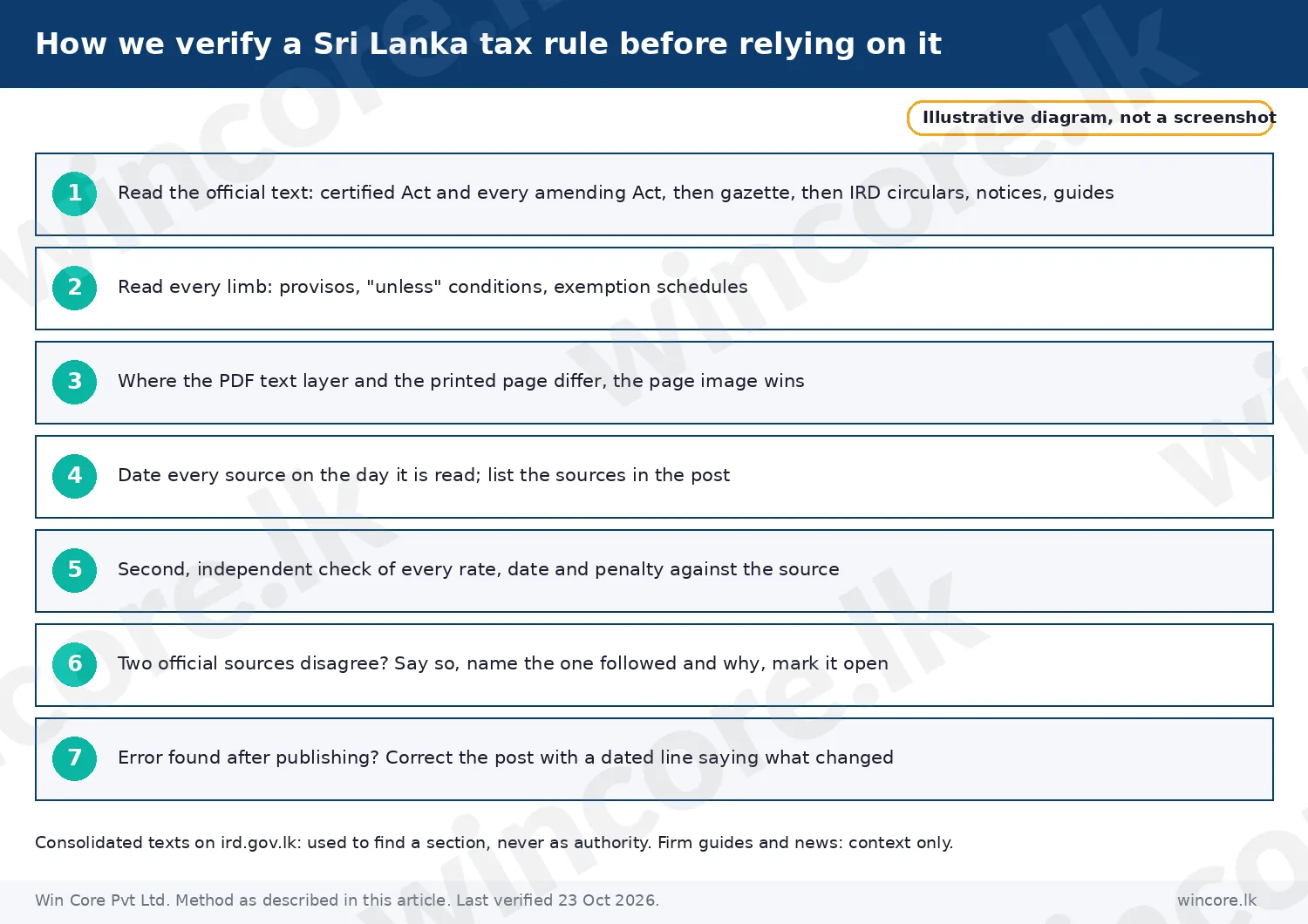
We verify Sri Lanka tax rules in a fixed order: the certified Act and every amending Act first, then the Gazette, then Inland Revenue Department (IRD) circulars, public notices and guides. We read every limb of a provision, including provisos, "unless" conditions and exemption schedules. Where a PDF's text layer and its printed page differ, the page wins. Every source is dated on the day we read it and listed in the post, and every rate, date and penalty gets a second, independent check before the post is published.
This page sets out that method, with real examples from the Value Added Tax Act No. 14 of 2002 and the Inland Revenue Act No. 24 of 2017. It is about what we do with the official texts. Where those texts are published, and how much weight each one carries, is covered in our guide to the Inland Revenue Act consolidated text.
We verify Sri Lanka tax rules in official text first, in a fixed order
Every rule we write about is read in this order:
- the certified Act, and every amending Act passed since;
- then the Gazette (Orders, regulations and notifications made under the Act);
- then IRD circulars, public notices and guides.
The order follows the weight of each document. An Act is passed by Parliament. A Gazette Order is made under a power the Act gives. A circular explains how the IRD administers the Act; it does not replace it.
Consolidated texts on ird.gov.lk have a limited place in this. We use them to find a section, never as the authority for it. The IRD says as much on the front page of its VAT consolidation: "This is not a statutory consolidation, but rather a convenient reference." The same page says it "includes all amendments made up to 2025" and is dated December 26, 2025 [1]. The Value Added Tax (Amendment) Act, No. 14 of 2026 was certified on 30 June 2026 [2], so it cannot be in that text. What that Act changed is set out in our post on the VAT Amendment Act No. 14 of 2026.
Firm guides, seminar slides and news reports are context only. They can tell us that something has changed, and where to look. They never supply the rate, date or section we rely on.
Every limb of a rule is read, including provisos and exemption schedules
A rule is rarely one sentence. It has a main limb, and then provisos, "unless" conditions, carve-outs and schedules that take part of it back. We read all of them.
A real example from the VAT Act: the First Schedule, Part III, item (b)(ix), as the IRD consolidation prints it, exempts "all healthcare services provided by medical institutions or professionally qualified persons providing such care other than hospital room charges" [1]. A summary that says "healthcare is exempt from VAT" is not false. It is incomplete in a way that changes an invoice, because the last five words take hospital room charges back out.
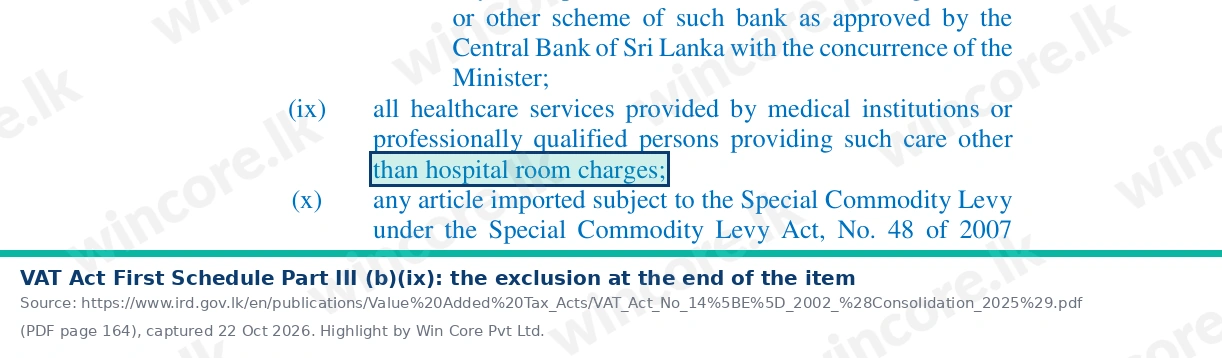
Because that wording came from a consolidation, the next step is the amending Act passed after it. Section 17 of Act No. 14 of 2026 amends Part III of the First Schedule. It leaves item (b)(ix) as it was, and adds a new paragraph (e) for services supplied through an electronic platform by a non-resident person, including "healthcare services including online consultations, digital prescriptions, AI-assisted diagnostic, digital health tracking and telemedicine" [2]. The healthcare position now sits in two places in the same Part, and a check that stopped at item (b)(ix) would miss the second.
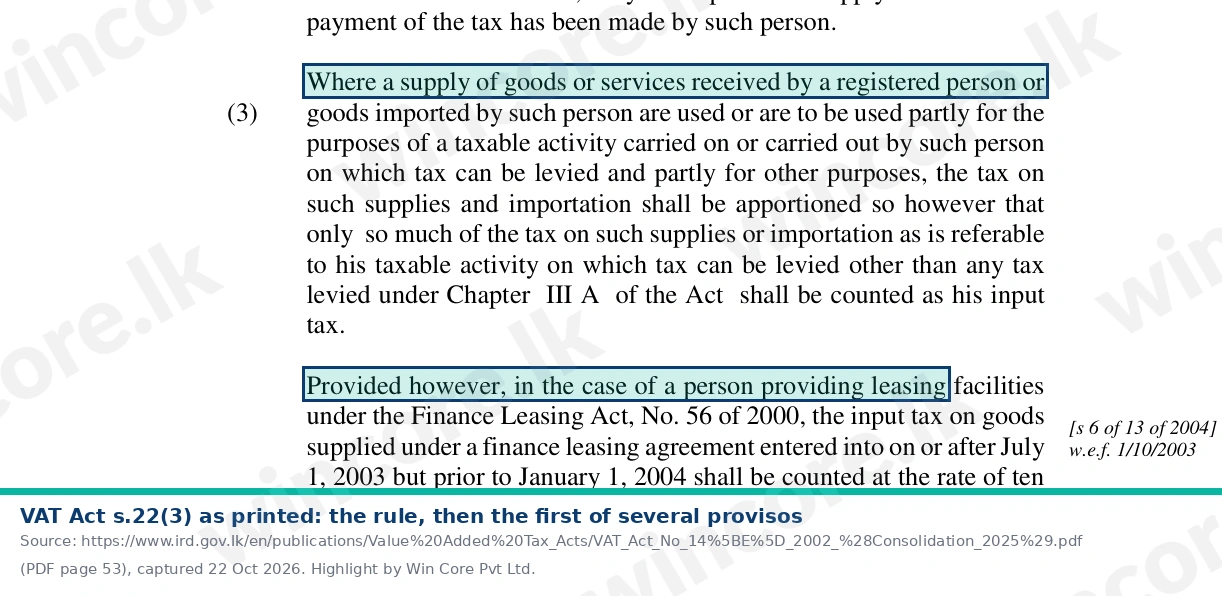
Provisos work the same way. Section 22(3) of the VAT Act sets the rule for apportioning input tax where a purchase is used partly for a taxable activity and partly for other purposes. A run of provisos follows it, the first beginning "Provided however, in the case of a person providing leasing facilities under the Finance Leasing Act, No. 56 of 2000" [1]. That first proviso deals only with finance leasing agreements entered into on or after 1 July 2003 but before 1 January 2004. Most provisos will not apply to a given business. We still read each one, because the only way to know a proviso does not apply is to read it. Act No. 14 of 2026 does amend section 22, but in subsection (6), not subsection (3) [2].
Rates get the same treatment. Before we write that a rate applies across the board, we look for the schedule, proviso or threshold that limits it.
The printed page wins when a PDF's text layer disagrees
Many government PDFs are scans, or carry a text layer generated separately from the printed page. When anyone searches a PDF, they search that text layer, and it can be wrong. Margin notes run into the body. A subsection number lands on the wrong line. Whole passages can drop out.
A real example. When we extracted the text of the IRD's 2025 consolidation of the Inland Revenue Act on 23 October 2026, section 179(1) did not come through: the extracted text ran from section 178 straight into section 179(2) [4]. A search of that text for the 20 percent late payment penalty finds nothing. The certified Act prints it in full: "A person who fails to pay all or part of a tax due for a tax period within fourteen days of the due date, or by the due date specified in the notice of assessment, if later, shall be liable to a penalty equal to twenty per cent of the amount of tax due but not paid" [3].
We read the rest of the section too. Subsection (2) sets 10 percent for an instalment not paid within fourteen days of its due date, and subsection (3) holds back the subsection (1) penalty while an extension granted under section 151 runs, unless that period ends without payment [3]. The consolidation's subsections (2) and (3) match the 2017 wording, and Act No. 11 of 2026 does not amend section 179 [4] [5]. Our tax penalty calculator uses these section 179 rates.
So the rule is short: when the text layer and the printed page differ, the page wins, and the quotation we rely on is the one on the page.
Every source is dated on the day we read it, and every figure is checked twice
Every source is dated on the day we read it: not the day we first found it, and not a date carried forward from an earlier post. Every post lists its sources with the link and that date, so a reader can open the same document and check us. The references at the end of this page follow the same rule.
Before a post is published, a second, independent check compares every rate, date and penalty in it with the source. The question it asks is narrow: does this number appear in the document, in this form, for this period? If not, it comes out, or it is marked open.
Each post is signed off by WinCore Pvt Ltd once that check is complete.
Where two official sources disagree, we say which one we follow and why
Sometimes two official sources point different ways. An IRD web page or printed calendar may lag behind an amending Act. A circular may set an administrative date that differs from the date in the Act.
When that happens, the post says so. It names the source we followed and explains why, usually because one is the Act and the other is not, and it marks the point as open until someone with the power to settle it does. Our post on the IRD tax calendar 2026 changes is built this way: it reads the IRD's printed calendar line by line against the amended Act.
Dates need the most care, because one rule can carry several. An Act is certified on one date, a section may operate from another, the IRD may apply a procedure from a third, and a budget speech may announce a fourth that never becomes law. The TIN certificate rule is a public example. Section 103(6)(b) of the Inland Revenue Act, as amended by Act No. 11 of 2026, opens "With effect from April 1, 2026" [5]. IRD Circular SEC/2026/E/07 of 22 September 2026 says the requirement applies "with effect from 1 November 2026" [6]. Then the IRD deferred the check to 1 April 2027 (IRD notice SEC/PN/IT/2026/06, 5 November 2026), a third date. None is wrong; they answer different questions. So when we write a date, we say which kind it is, and where the administrative date differs from the statutory one, we give both.
Where a rule is still unclear after that, the post keeps the point marked open. A reader who needs a settled answer can put the question to the department that administers the rule: the Inland Revenue Department for tax, or the Registrar of Companies for company law.
Errors and law changes get a dated correction line, never a silent edit
We will sometimes get something wrong. When we find an error in a published post, we correct it and add a dated line saying what changed. We do not quietly edit the text and leave the old version unexplained; a reader who relied on the earlier wording deserves to know it moved.
The same applies when the law moves under a post. Act No. 11 of 2026, for example, replaced the words "academic or any individual" in section 85(1C)(c) of the Inland Revenue Act with a much longer list of service providers, from auditors and valuers to photographers, translators and writers [5]. Any post on the 5 percent withholding tax on service fees written before that Act needed a dated line for it. Our current post on 5 percent WHT on service fees to resident individuals reads the amended list.
What this means for you
- Ask, of any rule you read, which Act, Gazette or circular it comes from, and open that document.
- Check the date on the source, and whether an amending Act has been passed since.
- Read to the end of the provision: the proviso, the "unless" and the exemption schedule.
- Treat a consolidated text as a finding aid, and confirm the wording in the Act.
- Where a PDF's searchable text and its printed page differ, rely on the page.
- Look for the sources list and "Last verified" date on any post you rely on, including ours.
- Raise an open point with your adviser before acting on it, not after.
If you want a rule read this way for your own business, that is part of our income tax services. You can also read more about WinCore.
Checklist: documents needed
- The Act and every amending Act for the rule
- Any Gazette Order or regulation made under it
- The current IRD circular or notice, with its date
- A note of the date each source was read
- The printed page for every quotation taken from a PDF
- A record of any conflict between sources and the one followed
FAQ
How do I check if a Sri Lanka tax rule is still current?
Open the Act the rule comes from, then read every amending Act passed since. A consolidation on ird.gov.lk helps you find the section, but it stops at a date: the VAT consolidation is dated 26 December 2025, and the VAT Amendment Act No. 14 of 2026 was certified later. Then read any IRD circular that sets a working date for the rule.
Can I rely on the IRD's consolidated Acts?
Use them to find a section, not as the law. The IRD's own VAT consolidation says it "is not a statutory consolidation, but rather a convenient reference" and includes amendments "up to 2025". Once you have found the section, read it in the certified Act and in every amending Act, including any passed after the consolidation's date.
What if an IRD circular and the Act give different dates?
Note both, and say which one you are acting on. The Act sets the legal start date; a circular often sets when officials begin applying a procedure. For TIN certificates, the amended Act says 1 April 2026 and Circular SEC/2026/E/07 says 1 November 2026, which the IRD has since deferred to 1 April 2027. Where the two cannot be reconciled, treat the point as open and take advice.
Why read provisos that do not apply to most businesses?
Because the only way to know a proviso does not apply is to read it. A rule quoted without its limbs can be quoted wrongly, as with the VAT healthcare exemption, which ends by excluding hospital room charges. We read every limb, including "unless" conditions and exemption schedules, and mention the ones that could change the answer for a reader.
What happens when you find a mistake in a post?
We correct the post and add a dated line saying what changed; we do not silently edit the wording. The same applies when the law changes after a post is published: the post gets a dated line naming the new Act, Gazette or circular, so a reader can see what applied before and what applies now.
This page describes how we work as at 23 October 2026. It is general information, not advice on your specific situation.
Talk to us. If you want a tax rule checked against the Act before you act on it, contact us at our contact page.
WinCore Pvt Ltd
Sources and references (7)
- Inland Revenue Department. Consolidated Text of the Value Added Tax Act, No. 14 of 2002 (December 26, 2025), front page; s.22(3) and provisos (PDF page 53); First Schedule Part III item (b)(ix) (PDF page 164). https://www.ird.gov.lk/en/publications/Value%20Added%20Tax_Acts/VAT_Act_No_14%5BE%5D_2002_%28Consolidation_2025%29.pdf . Primary (IRD consolidation, used here to locate the wording, not as authority). Accessed 23 October 2026.
- Parliament of Sri Lanka. Value Added Tax (Amendment) Act, No. 14 of 2026 (certified 30 June 2026), cover, ss.6 and 17. https://www.ird.gov.lk/en/publications/Value%20Added%20Tax_Acts/VAT_Act_No_14-2026_E.PDF . Primary. Accessed 23 October 2026.
- Parliament of Sri Lanka. Inland Revenue Act, No. 24 of 2017 (certified 24 October 2017), s.179. https://www.ird.gov.lk/en/publications/Acts_Income%20Tax_2017/IR_Act_No_24_2017_E.pdf . Primary. Accessed 23 October 2026.
- Inland Revenue Department. Inland Revenue Act, No. 24 of 2017, consolidated up to 2025, ss.178 and 179 (extracted text layer). https://www.ird.gov.lk/en/publications/Acts_Income%20Tax_2017/IRA_Cons_Act_-_2025_Changes.pdf . Primary (IRD consolidation). Accessed 23 October 2026.
- Parliament of Sri Lanka. Inland Revenue (Amendment) Act, No. 11 of 2026 (certified 3 June 2026), ss.13 and 24. https://www.ird.gov.lk/en/publications/Acts_Income%20Tax_2017/IR_Act_No_11-2026_E.pdf . Primary. Accessed 23 October 2026.
- Inland Revenue Department. Circular SEC/2026/E/07, Mandatory Submission of Taxpayer Identification Number (TIN) Certificate for Specified Transactions (22 September 2026), paras 1 and 4. https://www.ird.gov.lk/en/publications/Circulars_Circulars/SEC_2026_E_07_E.pdf . Primary. Accessed 23 October 2026.
Related reading: Private ruling IRD Sri Lanka: guide.
Put these insights to work
WinCore specialists can review your current workflow, document gaps, and build a practical 90-day action plan.
Book a free consultationRecent articles




Continue reading
Explore more WinCore analysis to keep your finance, tax, and compliance roadmap moving.

Acts, Gazettes, IRD consolidations and circulars do not carry the same weight. How to tell which text is the law, and which dates to check first.
Digital services VAT, a 20.5 percent rate for financial services and Rs 1 million fines: each change in the 2026 VAT Act, with its own start date.
The IRD's printed 2026 calendar predates Act No. 11. One line is obsolete, one statement is missing, and two November dates differ in kind.