
How is a foreign employee taxed in Sri Lanka?
How a foreign employee's pay is taxed: residence, Sri Lankan source pay, which APIT table applies, what a tax treaty changes and the year end steps.
On this page
Last verified against the primary sources on 14 November 2026.
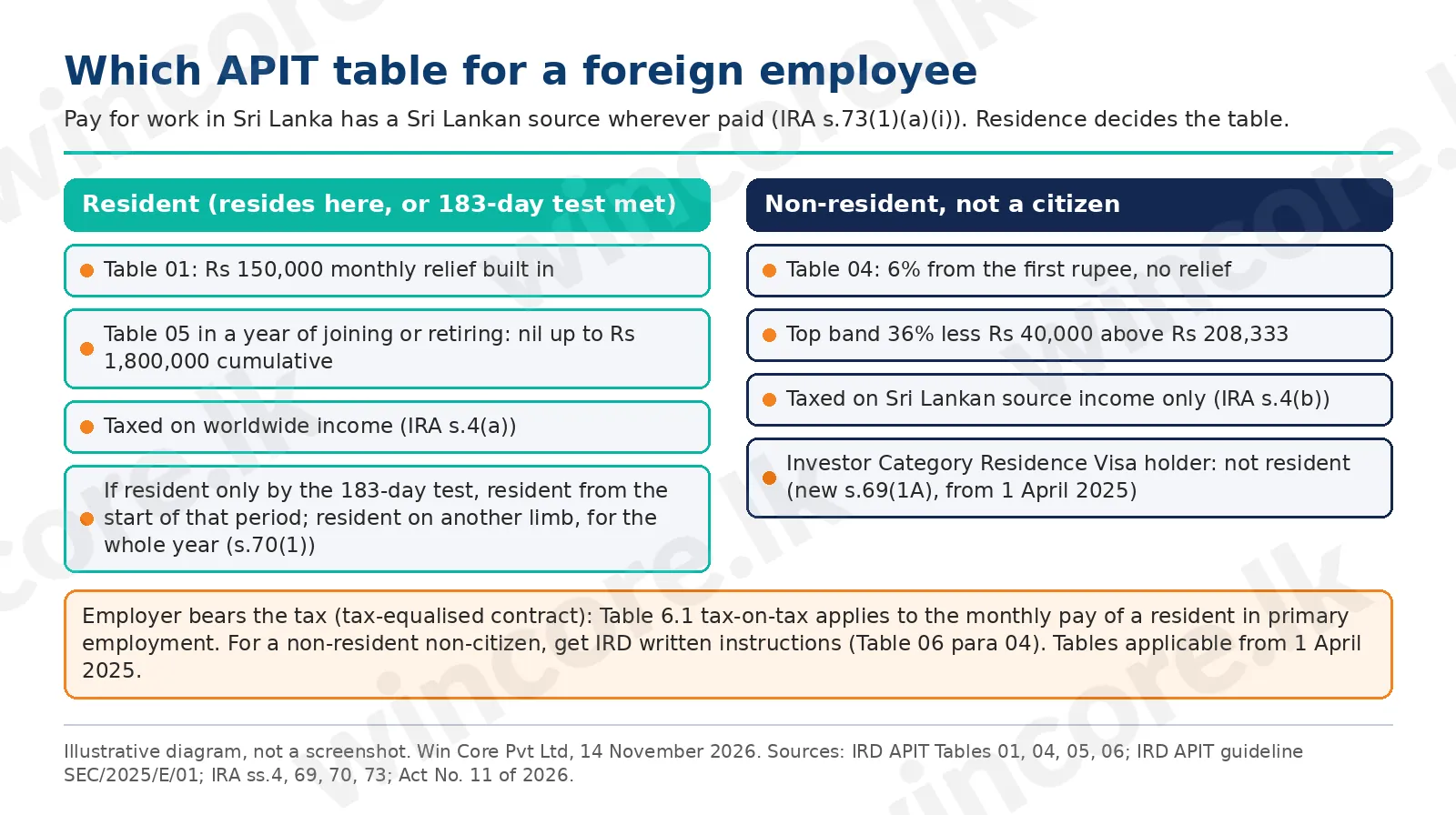
Expat tax Sri Lanka, in brief. Pay for work done in Sri Lanka is taxed here, and the employer deducts APIT on the local payroll. The IRD's APIT tables, applicable from 1 April 2025, use Table 01 for a resident employee, with Rs 150,000 a month of relief built in, and Table 04 for a non-resident who is not a citizen, with no relief [1][2][3]. Residence decides which applies.
Take an invented example used through this guide: a building contractor with 62 staff employs one foreign site safety officer on a 24-month contract at Rs 742,500 a month, paid in rupees through the local payroll, arriving on 9 February.
| Rule | Figure or date | Source |
|---|---|---|
| APIT tables in force | Applicable from 1 April 2025, and for later years unless new tables are specified; no later set on ird.gov.lk on 14 November 2026 | IRD APIT tables, issued 25 March 2025 under IRA s.83A(1A) [1] |
| Resident employee, primary employment | Table 01: nil up to Rs 150,000 a month; top band 36% less Rs 94,000 above Rs 358,333 | APIT Table 01 [2] |
| Non-resident, non-citizen employee | Table 04: from 6% on the first rupee; top band 36% less Rs 40,000 above Rs 208,333 | APIT Table 04 [3] |
| Joining or retiring during the year (resident or citizen) | Table 05, cumulative, nil up to Rs 1,800,000 | APIT Table 05 [4] |
| Employer pays the employee's tax | Table 06, tax-on-tax rates | APIT Table 06 [5] |
| Pay for work in Sri Lanka has a Sri Lankan source | Wherever paid, s.73(1)(a)(i) | Inland Revenue Act, No. 24 of 2017 [6] |
| APIT paid to the IRD | Within 15 days after the end of each month, s.86(1) | Inland Revenue Act [6] |
Table 1. Key figures. Sources as read on 14 November 2026.
Is a foreign employee taxed in Sri Lanka?
Yes, on pay for work done here. Section 4 of the Inland Revenue Act taxes a resident person on income "wherever the source arises" and a non-resident person on income "to the extent that the income arises in or is derived from a source in Sri Lanka" [6]. Section 73(1)(a)(i) gives employment payments a Sri Lankan source "to the extent derived in respect of employment in Sri Lanka, wherever paid" [6].
So the site safety officer's salary for work on the contractor's sites has a Sri Lankan source whether or not he is resident. Residence changes two things:
- The rates and relief. A resident individual gets the personal relief built into Table 01; a non-resident non-citizen does not.
- Foreign income. A resident is taxed on worldwide income; a non-resident only on Sri Lankan source income.
Residence is decided by section 69: an individual who resides in Sri Lanka, or who is present for 183 days or more in any twelve month period that starts or ends in the year, is resident. Our tax residency guide explains every limb; nationality does not decide it. Two points from the Act matter for an employer. Under section 70(1), an individual resident only because of the 183-day test "shall be so resident from the start of the one hundred and eighty three day period"; anyone resident on another limb, such as residing in Sri Lanka, "shall be treated as a resident for the whole of the year" [6]. And new section 69(1A), inserted by the Inland Revenue (Amendment) Act, No. 11 of 2026 with effect from 1 April 2025, says an individual holding an Investor Category Residence Visa is not resident for a year of assessment [7].
Which APIT table applies to a foreign employee?
The Commissioner-General issued the tables on 25 March 2025 under section 83A(1A), "for the year of assessment commencing on April 1, 2025", and for "every subsequent years of assessment unless other tables are specified" [1]. The index lists eight tables; four matter here.
| Employee | Table | What it does |
|---|---|---|
| Resident, or a non-resident citizen, primary employment | Table 01 | Monthly deduction with Rs 150,000 relief built in [2] |
| Non-resident, not a citizen | Table 04 | Monthly deduction from the first rupee, no relief [3] |
| Joins or retires during the year (resident or citizen) | Table 05 | Cumulative deduction for the year; nil up to Rs 1,800,000 [4] |
| Employer bears the employee's tax | Table 06 | Tax-on-tax rates on the monthly remuneration; Table 6.1 for a resident in primary employment [5] |
Table 2. APIT tables for a foreign employee, 2025/2026 set.
Table 01 "applies to: All resident employees, and All non-resident employees who are citizens of Sri Lanka" who have submitted their primary declaration or have only one employment [2]. Its top band is "36% of monthly regular profits from employment less Rs. 94,000" above Rs 358,333 [2]. To see the Table 01 deduction for a resident at other monthly salaries, use our APIT lookup.
Table 04 says "The deduction of tax should be made from all non-resident and non-citizen employees" [3]. Its bands start at "6% of monthly regular profits from employment" up to Rs 83,333 and reach "36% of monthly regular profits from employment less Rs. 40,000" above Rs 208,333 [3].
Table 05 applies "where an employee commences employment or retires within the year of assessment" [4]. Tax starts in the month cumulative pay for the year passes Rs 1,800,000 [4].
Table 06 covers tax-on-tax, which arises "when an employer or any other person settles income tax liability of an employee, without being deducted from his salary" or reimburses tax deducted [5]. For a tax-equalised contract, where the employer bears the tax, the employer applies Table 6.1 to the monthly remuneration it pays and reads off the tax it must pay; that tax is itself a taxable benefit, which is why the rates are higher. Table 6.1 has the Rs 150,000 monthly relief built in, so it fits a resident in primary employment. No Table 06 sub-table covers a non-resident non-citizen in primary employment (Table 6.3 is for secondary employment only), and Table 06 says that where its tables do not fit, the employer should obtain written instructions via tpl@ird.gov.lk [5]. Our APIT guide covers the deduction steps.
Does a tax treaty change anything?
It can, but rarely for an employee paid by a Sri Lankan employer. Section 75(1)(a) of the Inland Revenue Act gives a double taxation agreement approved by Parliament "the force of law in Sri Lanka", notwithstanding any other written law [6].
In general terms, the employment article in Sri Lanka's treaties lets the country where the work is done tax the pay. A short-stay exemption in such articles typically needs three conditions together: the employee is present for less than a set number of days, the employer is not resident in the work country, and the pay is not borne by a permanent establishment there. Pay from a Sri Lankan employer fails the second condition, so on our reading Sri Lanka keeps the right to tax.
Where a treaty does matter is in the employee's home country, which may give credit for the Sri Lankan tax. That is the employee's own matter; the employer's job is to deduct correctly and give the certificate. Read the specific treaty before relying on it.
Expat tax Sri Lanka: worked example
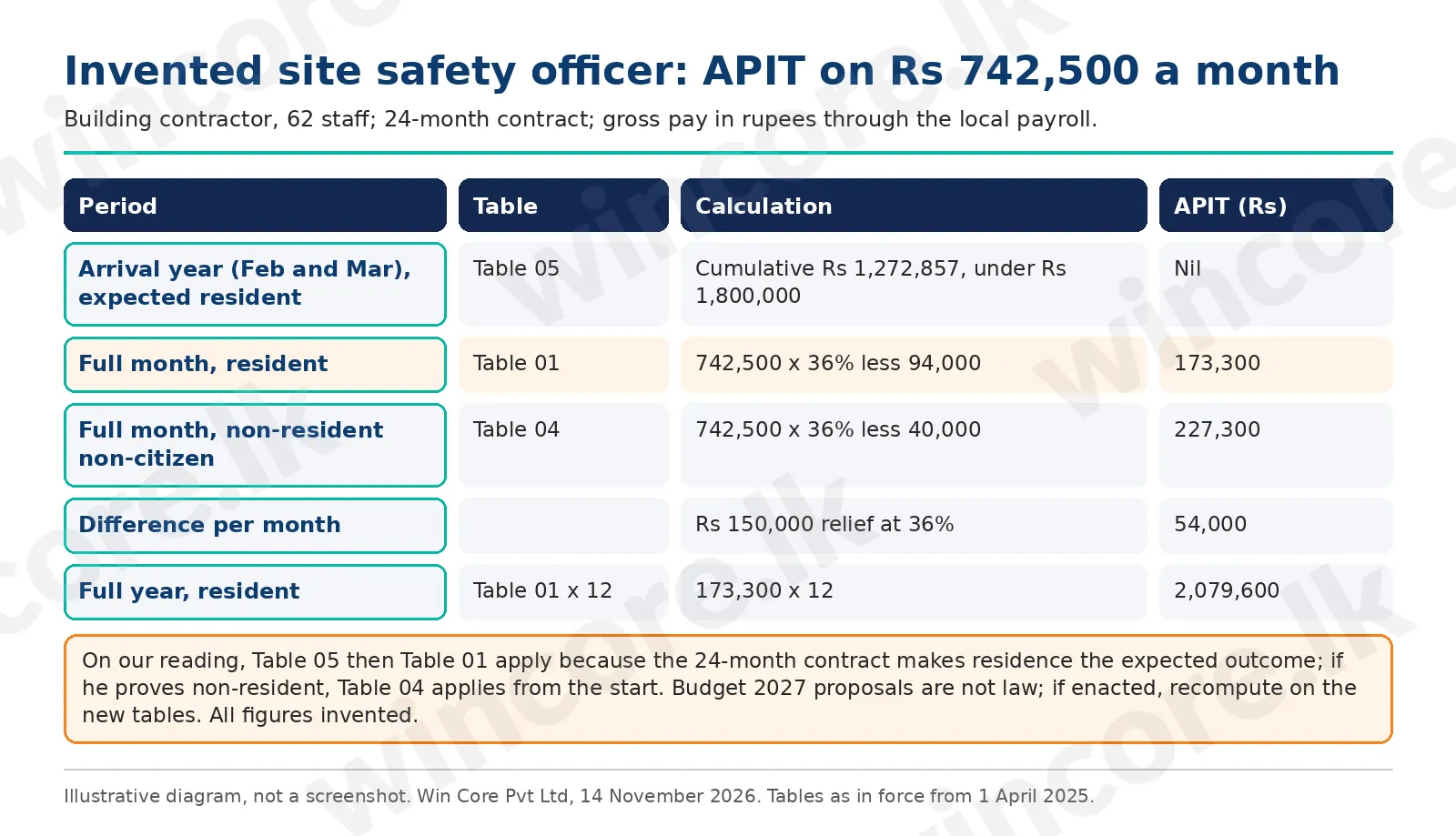
The invented site safety officer earns Rs 742,500 a month, gross, in rupees, through the contractor's payroll. He arrives on 9 February under a 24-month contract, so he expects to pass the 183-day test. If that is the only limb he meets, section 70(1) makes him resident from his arrival; if he is found to reside in Sri Lanka, he is resident for the whole year [6]. Either way, the payroll covers only his Sri Lankan pay.
| Month or period | Table | Calculation | APIT (Rs) |
|---|---|---|---|
| Arrival year, February and March | Table 05 (joiner) | Cumulative pay Rs 1,272,857 (February paid for 20 of 28 days, Rs 530,357, plus March) stays under Rs 1,800,000 | Nil |
| Each full month after, if resident | Table 01 | 742,500 x 36% less 94,000 | 173,300 |
| Each full month, if treated as non-resident non-citizen | Table 04 | 742,500 x 36% less 40,000 | 227,300 |
| Difference per month | Value of the Rs 150,000 relief at 36% | 54,000 | |
| Full year as resident | Table 01 x 12 | 173,300 x 12 | 2,079,600 |
Table 3. Worked example. All figures invented; tables as in force from 1 April 2025.
On our reading, the contractor applies Table 05 in the arrival year and Table 01 after, because the 24-month contract makes residence the expected outcome. If he leaves early and is not resident, Table 04 was the right table from the start. Under section 86(3) the contractor must pay any tax it should have withheld, and section 86(6) lets it recover that amount from him; for a non-resident non-citizen the APIT is a final withholding payment under section 88(1A)(b), so there is no return through which he settles it [6]. Keep his passport entry stamps and contract on the payroll file to support the residence position.
Two points remain open. The IRD has not said how an employer should treat a 183-day test that is expected but not yet met at the first payroll, so the Table 05 choice above is our reading; the IRD guideline route for written instructions is tpl@ird.gov.lk [9]. And Table 05 speaks of an employee who "retires", so whether the end of a fixed 24-month contract is a Table 05 case is not stated by the IRD; our Table 05 guide explains the "retires" wording.
The Budget Speech 2027, delivered on 12 November 2026, proposes raising personal relief from Rs 150,000 to Rs 162,500 a month from 1 April 2027, with revised bands that add a 12% rate after 6% [8]. It is a proposal, not law: on 14 November 2026 the IRD APIT tables page listed only the set applicable from 1 April 2025. If it is enacted, the figures above need recomputing on the new tables.
What does the employer do at the year end?
Three things:
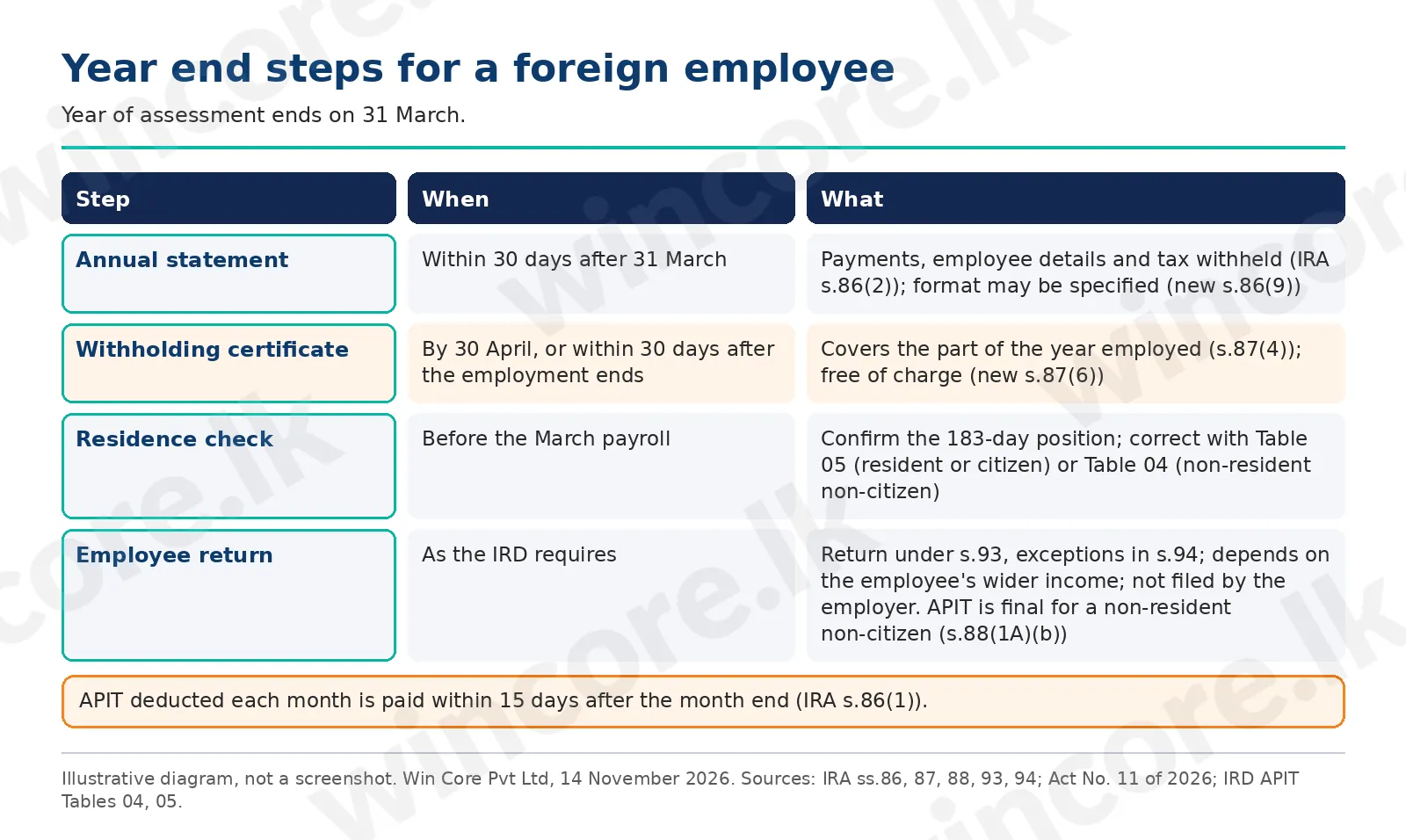
- Annual statement. Section 86(2) requires every withholding agent to file "within thirty days after the end of each year ending on the thirty first day of March an annual statement" of payments, the employee's details and tax withheld [6]. New section 86(9), from Act No. 11 of 2026, lets the Commissioner-General specify its format [7].
- Withholding certificate. Section 87(4) requires a certificate for APIT covering the year, served "not later than the thirtieth day of April of the subsequent year" or within thirty days after the employment ends [6]. New section 87(6) says it must be served "free of any charge or payment" [7].
- Residence check. Confirm whether the employee met the 183-day test for the year and that the right table was used; correct any under or over deduction in March: Table 05 for a resident or citizen, or Table 04 for an employee who turned out to be non-resident and not a citizen. Where the tables do not cover the case, the IRD guideline says to ask for written instructions via tpl@ird.gov.lk [4][9].
Whether the employee must also file a return under section 93 depends on their wider income, and section 94 lists who need not file; the employer does not file it for them. For a non-resident employee who is not a citizen, APIT is a final withholding payment under section 88(1A)(b) [6][9]. EPF and ETF are a separate question, and nationality is not the test; our guide to EPF for foreign nationals covers when contributions apply and the exclusions.
Common mistakes with a foreign employee's APIT
- Using Table 04 by nationality alone. Table 04 is for employees who are both non-resident and non-citizen [3]. A foreign national expected to pass the 183-day test is, on our reading, a Table 01 or Table 05 case. Decide on residence, not passport.
- Ignoring Table 05 in the joining year. A mid-year joiner who is resident or a citizen is deducted on the cumulative basis [4]. Applying Table 01 to the first month can over-deduct, because the full Rs 1,800,000 relief for the year is not used.
- Treating a net salary promise as gross. If the contract promises pay after tax, the employer bears the tax and Table 06 applies; for a non-resident non-citizen, get the IRD's written instructions first [5]. Read the contract's pay clause before the first payroll run.
- Missing the 15-day payment. APIT deducted from a foreign employee is paid like any other, within 15 days after the month under section 86(1) [6].
- No evidence of days. Without entry and exit records, the residence position cannot be shown if the IRD asks. Keep copies on the payroll file.
- Forgetting the certificate on early departure. If the contract ends early, section 87(4) requires the certificate within thirty days after the employment ends [6].
What this means for you
Tax a foreign employee's pay for work in Sri Lanka through the payroll from the first month. Decide the residence position at the start, apply Table 05 in a joining year and Table 01 after for a resident, or Table 04 from the first month for a non-resident non-citizen, and keep evidence of days in Sri Lanka. Use Table 06 only where the employer bears the tax. File the annual statement and serve the certificate free of charge by 30 April.
Checklist: documents needed
- Employment contract, with start date and length
- Passport entry and exit records for the 183-day test
- Primary employment declaration
- Monthly APIT workings showing the table used
- APIT payment records
- Annual statement and the withholding certificate served
- Note of any Investor Category Residence Visa
- Any written instructions obtained from the IRD
FAQ
Does a foreign employee pay tax in Sri Lanka from the first day?
Pay for work in Sri Lanka has a Sri Lankan source from the first day under section 73(1)(a)(i), so it is taxable whether or not the employee is resident. If the employee is treated as resident, Table 05 applies in a joining year and no APIT is due until cumulative pay for the year passes Rs 1,800,000; a non-resident non-citizen is on Table 04 from the first month.
Which APIT table is used for a non-resident foreign employee?
Table 04, which applies to "all non-resident and non-citizen employees". It has no personal relief: tax starts at 6% on the first rupee, and the top band is 36% of monthly pay less Rs 40,000 above Rs 208,333. A non-resident who is a Sri Lankan citizen uses Table 01 instead.
What is a tax-equalised salary and which table applies?
It is a contract where the employer bears the employee's Sri Lankan tax instead of deducting it from pay. That tax is itself a benefit, so the IRD's Table 06 tax-on-tax rates apply to the monthly remuneration paid. For a resident in primary employment, Table 6.1 gives the tax directly. For a non-resident non-citizen, no Table 06 sub-table fits primary employment, so obtain the IRD's written instructions via tpl@ird.gov.lk.
Can a tax treaty exempt a foreign employee paid by a Sri Lankan company?
On our reading, rarely. A treaty approved by Parliament has the force of law under section 75(1)(a), but the usual short-stay exemption in an employment article needs the employer to be outside Sri Lanka. Pay from a Sri Lankan employer does not meet that condition. Read the specific treaty before relying on it.
The short version
A foreign employee's pay for work in Sri Lanka is taxed here, and the employer deducts APIT. Residence decides the table: Table 01, with Rs 150,000 monthly relief, for a resident; Table 04, with no relief, for a non-resident non-citizen; Table 05 in a joining year for a resident or citizen; Table 06 where the employer bears the tax, with the IRD's written instructions for a non-resident non-citizen. File the annual statement and serve the certificate by 30 April.
Talk to us. For APIT computation and remittance and Year-end APIT and T10 certificates, see our payroll services or book a consultation at our contact page.
WinCore Pvt Ltd
This article is general information as at 14 November 2026 and is not tax, legal or accounting advice on your specific position.
Related reading
- Tax residency in Sri Lanka
- APIT deduction guide for payroll teams
- EPF for foreign nationals and directors
Sources and references (9)
- Inland Revenue Department. Advance Personal Income Tax (APIT) Tables, applicable with effect from 01.04.2025, index and notice dated 25 March 2025. https://www.ird.gov.lk/en/publications/APIT_Tax_Tables/2025-2026/Index/01.%20APIT_2526_Index.pdf . Primary. Accessed 14 November 2026.
- Inland Revenue Department. Tax Table No. 01, Monthly Tax Deductions from Regular Profits from Primary Employment. https://www.ird.gov.lk/en/publications/APIT_Tax_Tables/2025-2026/Table%20-%201/02.%20APIT_2526_Table_01_Text.pdf . Primary. Accessed 14 November 2026.
- Inland Revenue Department. Tax Table No. 04, Rates for the deduction of Tax from any profits from Employment made to Non-resident Employees who are Non-citizens in Sri Lanka. https://www.ird.gov.lk/en/publications/APIT_Tax_Tables/2025-2026/Table%20-%204/05.%20APIT_2526_Table_04_Text.pdf . Primary. Accessed 14 November 2026.
- Inland Revenue Department. Tax Table No. 05, Deduction of Tax on Cumulative Gains and Profits from Employment. https://www.ird.gov.lk/en/publications/APIT_Tax_Tables/2025-2026/Table%20-%205/06.%20APIT_2526_Table_05_Text.pdf . Primary. Accessed 14 November 2026.
- Inland Revenue Department. Tax Table No. 06, Tax-on-tax Rates. https://www.ird.gov.lk/en/publications/APIT_Tax_Tables/2025-2026/Table%20-%206/07.%20APIT_2526_Table_06_Text.pdf . Primary. Accessed 14 November 2026.
- Inland Revenue Department. Inland Revenue Act, No. 24 of 2017, consolidated with amendments, sections 4, 69(1), 70(1), 73(1)(a), 75(1)(a), 83A(1A), 86(1) to (4) and (6), 87(4), 88(1A), 93 and 94. https://www.ird.gov.lk/en/publications/Acts_Income%20Tax_2017/IRA_Cons_Act_-_2025_Changes.pdf . Primary. Accessed 14 November 2026.
- Parliament of Sri Lanka. Inland Revenue (Amendment) Act, No. 11 of 2026, certified 3 June 2026, sections 9 (new s.69(1A)), 14 (new s.86(9)) and 15 (new s.87(6)). https://www.ird.gov.lk/en/publications/Acts_Income%20Tax_2017/IR_Act_No_11-2026_E.pdf . Primary. Accessed 14 November 2026.
- Ministry of Finance. Budget Speech 2027, delivered 12 November 2026, section 36.1 and the table of revenue measures (Treasury copy). https://www.treasury.gov.lk/api/file/ea495202-fcb1-4c78-b34e-58389cb20738 . Primary (proposals; not law until enacted). Accessed 14 November 2026.
- Inland Revenue Department. Guideline for employers on deducting Advance Personal Income Tax (APIT) from employment income, SEC/2025/E/01, 25 March 2025, paragraphs 5, 7 and 11. https://www.ird.gov.lk/en/publications/APIT_Tax_Tables/2025-2026/Guide/APIT_2526_Guideline.pdf . Primary. Accessed 14 November 2026.
Put these insights to work
WinCore specialists can review your current workflow, document gaps, and build a practical 90-day action plan.
Book a free consultationRecent articles



Continue reading
Explore more WinCore analysis to keep your finance, tax, and compliance roadmap moving.

A citizen abroad can be non-resident and a foreigner here resident. The four limbs of s.69, the 2026 changes, and where citizenship still counts.
APIT deduction for Sri Lankan employers: the five bands, which IRD table applies to bonuses, joiners, second jobs and terminal pay, T-10s and annual statement.
A passport does not take anyone out of EPF. The four exclusions in the 1958 Regulations, the detached worker rule and how directors are treated.