
Dividend tax Sri Lanka: the 15% final AIT and the solvency test
A company paying a dividend keeps back 15% and that settles the shareholder's tax. What the board must check first, and which dividends carry no tax.
On this page
Last verified against the primary sources on 23 October 2026.
Dividend tax in Sri Lanka is collected at source. Since 1 January 2023, a resident company paying a dividend deducts Advance Income Tax (AIT) at 15%, pays it to the Inland Revenue Department (IRD) within fifteen days after the end of the month of payment, and gives the shareholder a free certificate. For the shareholder the dividend is a final withholding payment: no further tax, and no credit to claim. Before any of that, the board must be satisfied that the company passes the Companies Act solvency test and must hold an auditors' certificate of solvency.
This dividend tax Sri Lanka guide covers resident individual shareholders of a Sri Lankan company, with a note on company shareholders. It sets out the clauses, the dividends that are exempt, the dates, and a worked example.
Dividend tax Sri Lanka is 15% AIT, deducted by the paying company
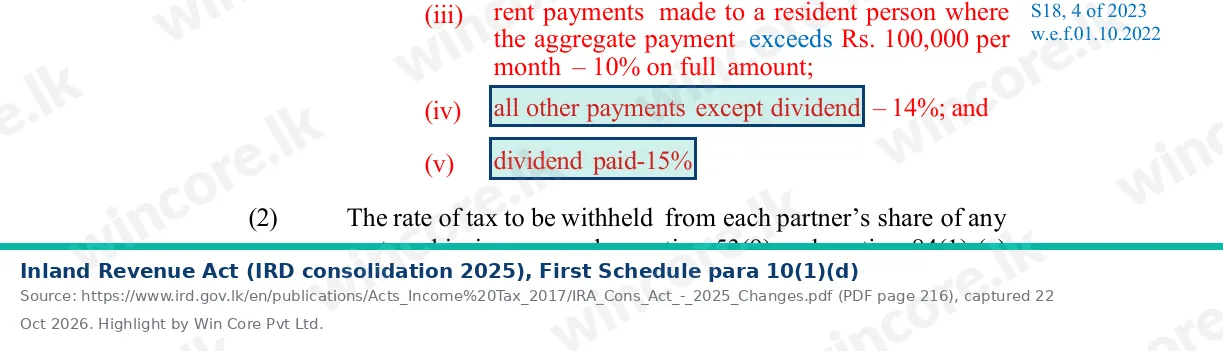
Section 84A(1A) of the Inland Revenue Act, No. 24 of 2017 (the IRA), inserted by section 16 of the Inland Revenue (Amendment) Act, No. 45 of 2022, reads: "Subject to section 83A and subsection (3) of section 84, with effect from January 1, 2023, a person shall deduct Advance Income Tax from the payment of dividend, interest, discount, charge, natural resource payment, rent, royalty or premium which has a source in Sri Lanka, at the rate provided in paragraph 10 of the First Schedule to this Act" [1]. Paragraph 10(1)(d) of the First Schedule, for payments under section 84A(1A), lists "(iv) all other payments except dividend - 14%; and (v) dividend paid-15%" [1].
Three points follow from the wording.
- The trigger is payment. The tax is deducted "from the payment of dividend", so the month that counts is the month the dividend is paid, not the month the board declared it.
- The company is the withholding agent. Section 84A(2) applies the withholding tax provisions to AIT "mutatis mutandis" [1]. If the company has never withheld tax before, our WHT registration guide covers registering as a withholding agent.
- The money is due by the 15th. Section 86(1): "Every withholding agent shall pay to the Commissioner General within fifteen days after the end of each calendar month any tax that has been withheld in accordance with this Division during the month" [1]. The year's payments then go into the annual statement due within thirty days after 31 March (s.86(2)).
Have later Acts changed the rate? No, on our reading. The Inland Revenue (Amendment) Act, No. 2 of 2025 changed the interest rate in paragraph 10 to 10% from 1 April 2025 and left the dividend item alone [2]. The Inland Revenue (Amendment) Act, No. 11 of 2026 (certified 3 June 2026) does not amend section 84A, section 88 or paragraph 10; it extends section 84(3) expressly to section 84A and makes withholding certificates free (s.87(6)) [3]. The IRD's tax chart for 2025/26 shows "Dividend 15%" [4].
If the company fails to deduct, it still owes the tax "in the same manner and at the same time" (s.86(3)), and the shareholder becomes jointly and severally liable for it, payable within fifteen days after the end of the month the dividend was received (s.86(4)) [1].
The 15% is final for the shareholder, not a credit
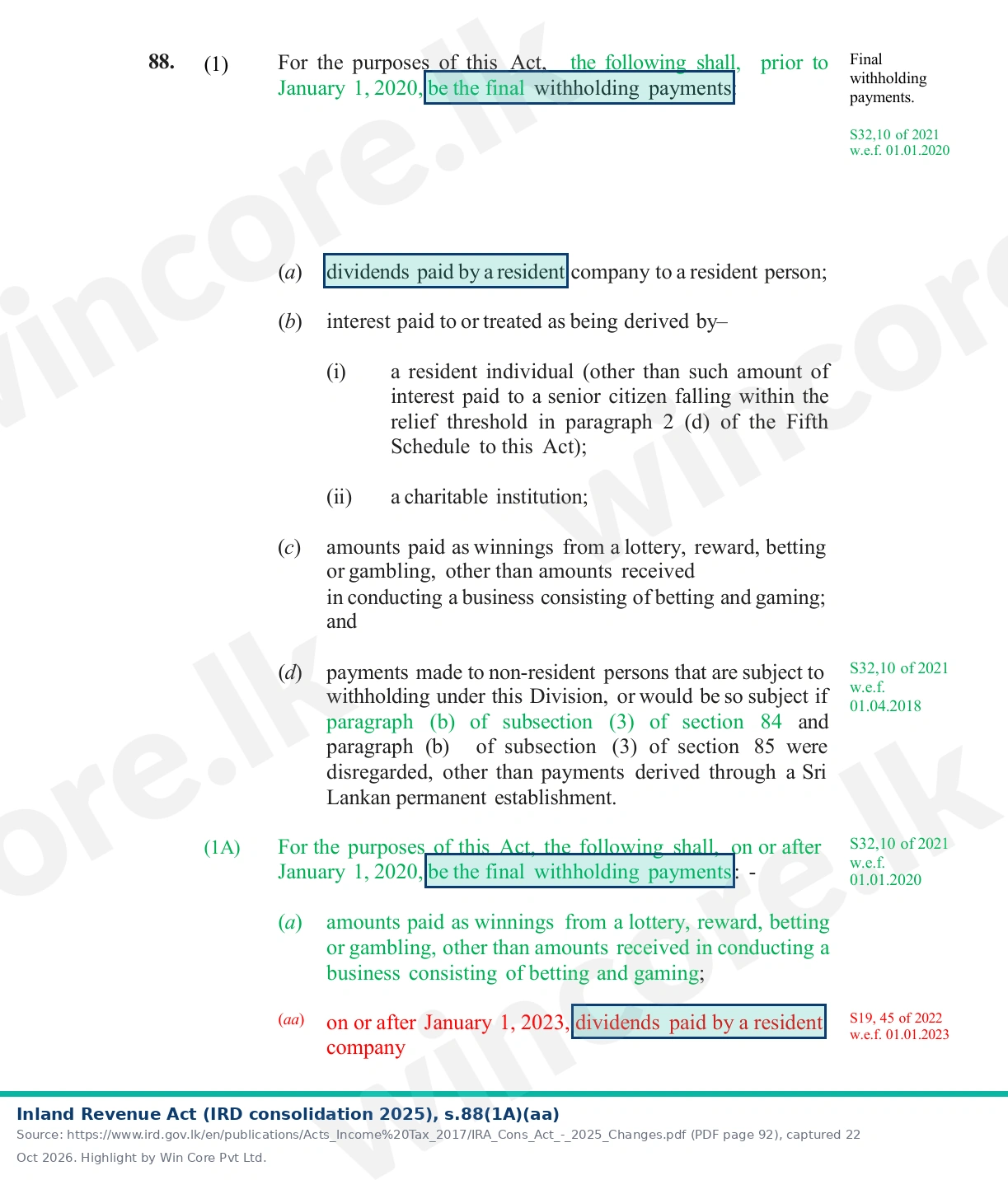
Section 88(1A), as amended by section 19 of Act No. 45 of 2022, lists the final withholding payments "on or after January 1, 2020". Paragraph (aa) adds "on or after January 1, 2023, dividends paid by a resident company" [1] [5]. Section 2(1)(b) then makes income tax payable by "a person who receives a final withholding payment during that year", and that liability is relieved by the tax withheld (s.88(2)). Section 7(3)(a) excludes "exempt amounts and final withholding payments" from a person's investment gains and profits, so the dividend does not go into assessable income [1].
The IRD reads it the same way. Annexure 4 of its guide to the individual return for 2025/2026 lists "Dividend (Dividend declared by a resident company on or after January 01, 2023 is a Final WHT)" at "15%(final)", and its worked example notes "No further tax is payable on dividend income, as it is subject to final withholding tax" [6].
Why some older guides say the opposite. From 1 January 2020 to 31 December 2022, dividends were not on the final withholding list. Section 88(1)(a), "dividends paid by a resident company to a resident person", applied only "prior to January 1, 2020", and the list in section 88(1A) as first inserted by Act No. 10 of 2021 did not include dividends. Paragraph (aa) brought them back from 1 January 2023 [1] [5]. Interest is different: interest paid to a resident is still not final, so the 10% withheld from interest is a credit in the return.
Do you still declare it? If you file a return, yes, but as a final withholding payment, not as income. The IRD's guide asks for each final withholding payment in Schedule 6A of the individual return, with the tax deducted, and in Schedule 6B where the company failed to deduct; only the Schedule 6B amount is carried to the tax calculation [6]. A dividend on its own does not add to your taxable income, and the 15% cannot be set off against tax on your salary, rent or business income. Our income tax return filing guide covers the rest of the return.
Some dividends are exempt, and they carry no AIT
The current exemption is paragraph (ooo) of the Third Schedule, inserted by Act No. 45 of 2022: "on or after October 1, 2022, a dividend paid by a resident company" [1] [5]:
- (i) which is engaged in businesses under Part IV of the Finance Act, No. 12 of 2012 and "has entered into an agreement with the Board of Investment of Sri Lanka": entrepot trade, offshore business, front-end services to clients abroad, headquarters operations of leading buyers, and "logistics services including bonded warehouse or multi-country consolidation in Sri Lanka";
- (ii) "to a member to the extent that such dividend payment is attributable to, or derived from, another dividend received by that resident company or another resident company";
- (iii) to a non-resident member "where such dividend is paid prior to January 1, 2023", which no longer applies.
Paragraphs (o) and (oo) cover only dividends before 1 October 2022.
An exempt dividend is not subject to AIT. Section 84A(1A) is "Subject to ... subsection (3) of section 84", and section 84(3)(c) excludes "payments that are exempt amounts" [1]. For item (ii), the paying company must serve a certificate "setting out the amount of the dividend that is attributable to or derived from, another dividend received by that resident company" (s.87(5)) [1].
Dividends to a company. There is no general exemption for a dividend paid to a resident company. On our reading, the 15% is deducted and section 88(1A)(aa) applies whoever the shareholder is, because it covers "dividends paid by a resident company" without limiting the recipient. The relief for a holding company is item (ii): when it passes the dividend on to its own members, that onward dividend is exempt to the extent it is derived from the dividend it received, so the same profit is not taxed twice. For the board steps and the solvency test, see how to declare a dividend.
The shareholder gets a free certificate within 30 days
Section 87(2): a withholding certificate "shall set out the amount of payments made to the withholdee during the period and tax withheld by the withholding agent from those payments". Section 87(3): it "shall cover a calendar month and shall be served within thirty days after the end of the month" [1]. Since Act No. 11 of 2026, section 87(6) adds that it is served "free of any charge or payment" [3].
The IRD's circular SEC/2026/E/04 lets a withholding agent issue one certificate for a longer period if the payee agrees; our note on the yearly WHT certificate under circular SEC/2026/E/04 sets out the conditions. For a one-off dividend the monthly certificate is the simple route. Our guide to the WHT annual statement and certificate of deduction covers what each certificate should show.
The board cannot pay a dividend without the solvency test
A dividend is a distribution, and the Companies Act, No. 7 of 2007 controls it before any tax arises.
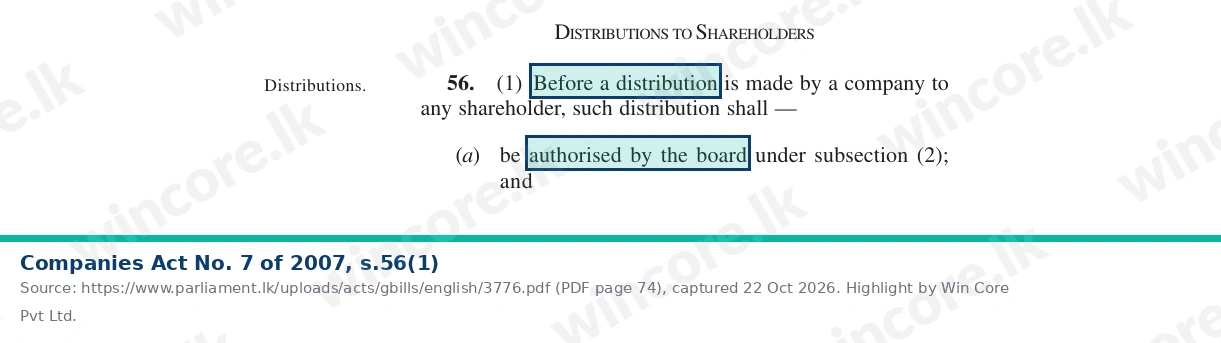
Section 56(1): before a distribution is made it shall "(a) be authorised by the board under subsection (2); and (b) unless the company's articles provide otherwise, be approved by the shareholders by ordinary resolution" [7].
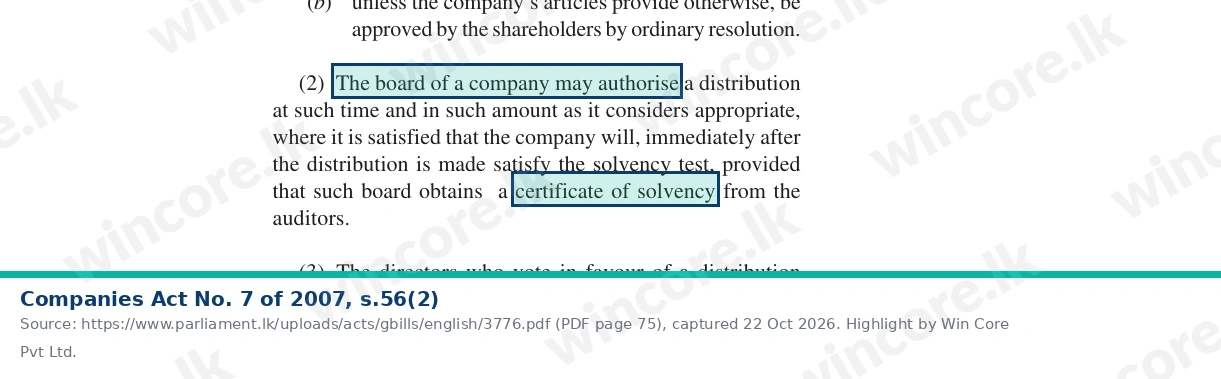
Section 56(2): "The board of a company may authorise a distribution at such time and in such amount as it considers appropriate, where it is satisfied that the company will, immediately after the distribution is made satisfy the solvency test, provided that such board obtains a certificate of solvency from the auditors." Under section 56(3) the directors who vote for it sign their own certificate that the company will satisfy the test. Section 56(4) counts fixed preferential returns on shares ranking ahead as "debts" in the test, unless they are expressed to be subject to the board's power to authorise distributions. Under section 56(5), "A director who fails to comply with the requirements of subsection (2) shall be guilty of an offence" and faces a fine "not exceeding two hundred thousand rupees" [7].
Section 57(1): a company "shall be deemed to have satisfied the solvency test" if "(a) it is able to pay its debts as they become due in the normal course of business; and (b) the value of the company's assets is greater than (i) the value of its liabilities; and (ii) the company's stated capital." Section 57(2) requires the board to consider the most recent financial statements and the circumstances the directors "know or ought to know", and allows a fair valuation [7].
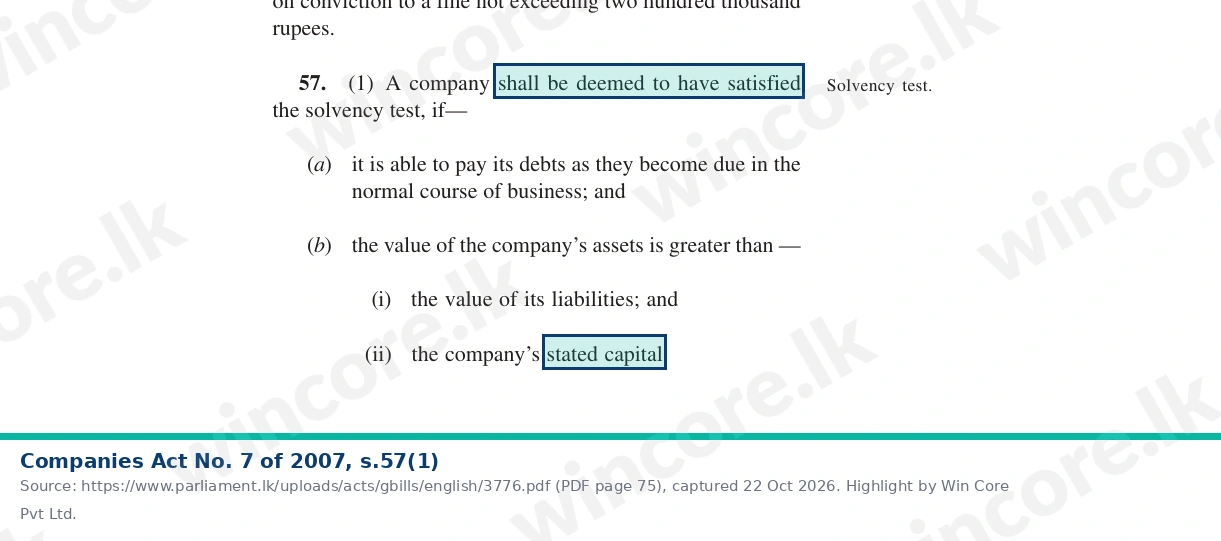
Limb (b) can be read two ways: assets greater than liabilities and, separately, greater than stated capital; or assets greater than the two added together. On our reading the second, stricter test is the safe one to apply, because it keeps stated capital out of the dividend. Limb (a) is a cash test, which is why a profitable company can still fail it. The Companies (Amendment) Act, No. 12 of 2025 did not change sections 56 or 57 [8].
Worked example: a pest control company pays Rs 10 million
A pest control company has assets of Rs 180,000,000, liabilities of Rs 95,000,000 and stated capital of Rs 40,000,000. It pays its debts as they fall due. On 10 November 2026 the board proposes a dividend of Rs 10,000,000, paid on 20 November 2026. No part of it comes from dividends the company itself received.
| Step | Working | Result |
|---|---|---|
| Assets after the dividend | Rs 180,000,000 less Rs 10,000,000 | Rs 170,000,000 |
| Liabilities plus stated capital | Rs 95,000,000 plus Rs 40,000,000 | Rs 135,000,000 |
| Limb (b), stricter reading | Rs 170,000,000 is greater than Rs 135,000,000 | Passes |
| Limb (a) | Debts paid as they fall due, on the facts | Passes |
| Shareholder holding 30% | 30% of Rs 10,000,000 | Rs 3,000,000 gross |
| AIT at 15% | 15% of Rs 3,000,000 | Rs 450,000 |
| Paid to the shareholder | Rs 3,000,000 less Rs 450,000 | Rs 2,550,000 |
| AIT on the whole dividend | 15% of Rs 10,000,000, if no holder is exempt | Rs 1,500,000 |
| AIT due to the IRD | 15 days after the end of November (s.86(1)) | By 15 December 2026 |
| Certificate to each shareholder | 30 days after the end of November (s.87(3)) | By 30 December 2026 |
Before 20 November the company needs the auditors' certificate of solvency (s.56(2)), the directors' certificate (s.56(3)), the board resolution, and an ordinary resolution of shareholders unless the articles say otherwise. The 30% shareholder, a resident individual, pays nothing more on the Rs 3,000,000 and claims no credit for the Rs 450,000. If they file a return, the payment and the tax go in Schedule 6A.
A variation. Suppose a resident holding company receives a dividend of Rs 8,000,000 from this pest control company, net Rs 6,800,000 after AIT, and pays that Rs 6,800,000 straight on to its own individual shareholders. On our reading the onward dividend is wholly derived from the dividend received, so it is exempt under item (ii), carries no AIT, and the holding company serves the section 87(5) certificate instead. Whether "attributable to" is measured on the gross or the net amount the Act does not say; we keep that open.
To run the deduction for other amounts and payment types, use our withholding tax calculator, which applies 15% to dividends.
What this means for you
If you are a director, settle the solvency test first, with both certificates on file before the payment date, and register as a withholding agent if the company has never withheld tax. Deduct 15% from every dividend that is not exempt, pay it by the 15th of the next month, and serve the certificates within 30 days. Check item (ii) of paragraph (ooo) whenever part of the dividend comes from dividends the company itself received.
If you are a resident individual shareholder, the 15% is the end of your tax on that dividend. Keep the certificate, list the payment as a final withholding payment if you file a return, and do not claim the 15% as a credit against other tax.
Checklist: documents needed
- Most recent financial statements and the solvency working for both limbs of s.57(1)
- Auditors' certificate of solvency (s.56(2))
- Directors' certificate signed by those voting in favour (s.56(3))
- Board resolution, and shareholder ordinary resolution unless the articles provide otherwise
- Shareholder list with TIN, residence and holdings
- Workings for any part of the dividend derived from dividends received, and the s.87(5) certificate
- AIT payment receipt and a withholding certificate for each shareholder
FAQ
What is the dividend tax rate in Sri Lanka?
The rate is 15% of the gross dividend, deducted by the paying company as Advance Income Tax. Section 84A(1A) of the Inland Revenue Act requires the deduction at the paragraph 10 rate, and paragraph 10(1)(d)(v) of the First Schedule sets "dividend paid-15%". It has applied since 1 January 2023 under Act No. 45 of 2022, and Act No. 11 of 2026 did not change it.
Is dividend tax a final tax for resident individuals in Sri Lanka?
Yes, for dividends paid by a resident company on or after 1 January 2023. Section 88(1A)(aa) makes them final withholding payments, and the IRD's 2025/2026 return guide marks dividends "15%(final)". The shareholder pays nothing more on the dividend and cannot claim the 15% as a credit. Between 1 January 2020 and 31 December 2022 the position was different.
Do I need to declare dividends in my income tax return?
If you file a return, you list the dividend as a final withholding payment, not as income. The IRD's guide puts it in Schedule 6A with the tax deducted, or Schedule 6B if the company did not deduct. Only a Schedule 6B amount adds tax to pay. The dividend does not increase your taxable income or your tax band.
Are any dividends exempt from the 15% tax?
Yes, a few under paragraph (ooo) of the Third Schedule. The main one is a dividend to the extent it is derived from another dividend the paying company received. Dividends from certain Board of Investment companies doing entrepot, offshore, front-end, headquarters or logistics business are also exempt. An exempt dividend carries no AIT under section 84(3)(c).
Does the board need an auditor's certificate to pay a dividend?
Yes. Section 56(2) of the Companies Act lets the board authorise a distribution only where it is satisfied the company will pass the solvency test immediately afterwards, "provided that such board obtains a certificate of solvency from the auditors". The directors voting in favour must also sign their own certificate under section 56(3). A director who breaches section 56(2) commits an offence under section 56(5).
Talk to us. If you are planning a dividend and want the solvency working, the AIT and the certificates handled, see our income tax services.
WinCore Pvt Ltd
This page reflects the Acts as read on 23 October 2026. It is general information, not advice on your situation.
Related reading
- WHT and AIT payment categories Sri Lanka
- How does a foreign shareholder take profits out of Sri Lanka?
Sources and references (8)
- Inland Revenue Department. Inland Revenue Act, No. 24 of 2017, consolidated text (amendments up to 2025), ss.2(1), 7(3), 84(3), 84A, 86, 87, 88; First Schedule para 10; Third Schedule paras (o), (oo), (ooo). https://www.ird.gov.lk/en/publications/Acts_Income%20Tax_2017/IRA_Cons_Act_-_2025_Changes.pdf . Primary (IRD consolidation, not the certified text). Accessed 23 October 2026.
- Inland Revenue (Amendment) Act, No. 2 of 2025 (certified 20 March 2025), s.3(3). https://www.ird.gov.lk/en/publications/Acts_Income%20Tax_2017/IR_Act_No_02-2025_E.pdf . Primary. Accessed 23 October 2026.
- Inland Revenue (Amendment) Act, No. 11 of 2026 (certified 3 June 2026), ss.12, 14, 15. https://www.ird.gov.lk/en/publications/Acts_Income%20Tax_2017/IR_Act_No_11-2026_E.pdf . Primary. Accessed 23 October 2026.
- Inland Revenue Department. Tax chart 2025/26, withholding tax and AIT rates with effect from 01.04.2025. https://www.ird.gov.lk/en/publications/SitePages/tax_chart_2526.aspx . Primary (IRD guidance). Accessed 23 October 2026.
- Inland Revenue (Amendment) Act, No. 45 of 2022 (certified 19 December 2022), amendments to s.88(1A) and the Third Schedule. https://www.ird.gov.lk/en/publications/Acts_Income%20Tax_2017/IR_Act_No._45_2022_E.pdf . Primary. Accessed 23 October 2026.
- Inland Revenue Department. Guide to fill the return of income, schedules and statement of assets and liabilities for individual, year of assessment 2025/2026, Schedule 6 and Annexure 4. https://www.ird.gov.lk/en/Downloads/IT_Individuals_Doc/Asmt_IIT_004_2025_2026_E.pdf . Primary (IRD guidance). Accessed 23 October 2026.
- Companies Act, No. 7 of 2007, ss.56 and 57. https://www.parliament.lk/uploads/acts/gbills/english/3776.pdf (as passed; text of ss.56 and 57 also read on drc.gov.lk, Act-7-of-2007-English.pdf). Primary. Accessed 23 October 2026.
- Companies (Amendment) Act, No. 12 of 2025 (certified 4 August 2025). https://www.parliament.lk/uploads/acts/gbills/english/6389.pdf . Primary. Accessed 23 October 2026.
Put these insights to work
WinCore specialists can review your current workflow, document gaps, and build a practical 90-day action plan.
Book a free consultationRecent articles



Continue reading
Explore more WinCore analysis to keep your finance, tax, and compliance roadmap moving.

WHT registration works best when withholding-agent onboarding, payment mapping, deduction, and remittance controls are designed as one process.
WHT reporting breaks when certificates and annual statements are treated as year-end admin. Build a monthly evidence workflow that files cleanly.

Step-by-step guide to filing income tax returns in Sri Lanka: deadlines, RAMIS process, relief, bands, WHT credits, and common penalty traps.