
Customer advance accounting Sri Lanka: a liability, not revenue
The deposit is in the bank, so it feels like a sale. It is not, until you deliver. Why it sits in liabilities, and why VAT is due on it anyway.
On this page
Last verified against the primary sources on 22 October 2026.
Customer advance accounting in Sri Lanka starts from one rule: money a customer pays before you deliver is a liability, not revenue. Under SLFRS for SMEs (2015) it meets the liability test in paragraph 2.39 and becomes revenue only on delivery for goods (paragraph 23.10) or as the work is done for services (paragraph 23.14); companies on full SLFRS call it a contract liability under SLFRS 15. VAT works the other way. Sections 4(1)(b) and 4(3)(b) of the Value Added Tax Act, No. 14 of 2002 make the advance itself a time of supply, so a registered supplier owes output VAT, at 18 percent since 1 January 2024, in the period the money arrives.
This article explains both sides, with the exact wording of the standard and the Act, and a worked example. The recording routines are practice, not legal requirements.
Customer advance accounting in Sri Lanka starts with a liability
The Sri Lanka Accounting Standard for Small and Medium-sized Entities (SLFRS for SMEs) defines a liability in paragraph 2.15(b) as "a present obligation of the entity arising from past events, the settlement of which is expected to result in an outflow from the entity of resources embodying economic benefits" [1].
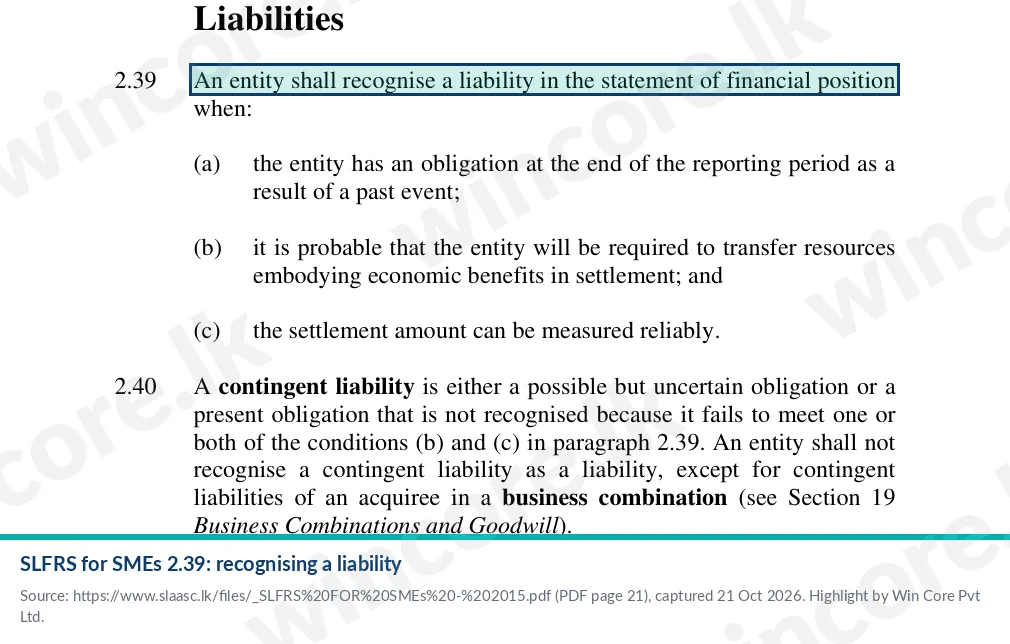
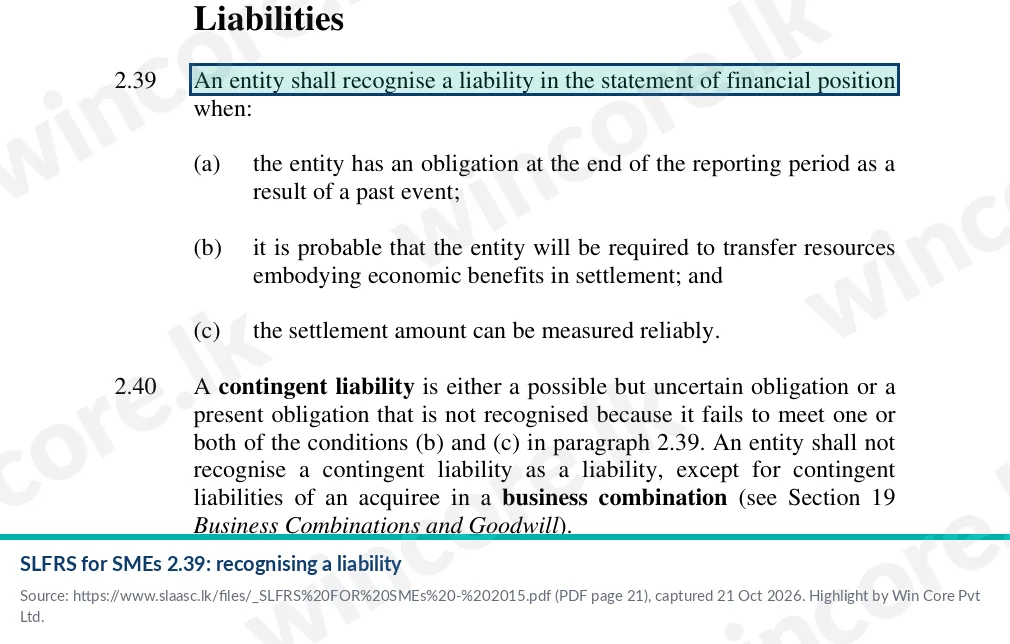
Paragraph 2.39 sets the recognition test: "An entity shall recognise a liability in the statement of financial position when: (a) the entity has an obligation at the end of the reporting period as a result of a past event; (b) it is probable that the entity will be required to transfer resources embodying economic benefits in settlement; and (c) the settlement amount can be measured reliably" [1].
On our reading, a customer advance meets all three. Taking the money creates the obligation (the past event). You expect to settle it by delivering goods or services, or by refunding the money if you do not. And the amount is known. Until delivery, it belongs in liabilities, often labelled "customer advances", "deposits received" or "income received in advance".
Companies that report under full SLFRS reach the same answer through SLFRS 15. Its Appendix A defines a contract liability as "An entity's obligation to transfer goods or services to a customer for which the entity has received consideration (or the amount is due) from the customer", and paragraph 106 deals with presenting a contract as a contract liability where the customer pays before the entity performs [3].
An advance becomes revenue on delivery or as the work is done
Goods
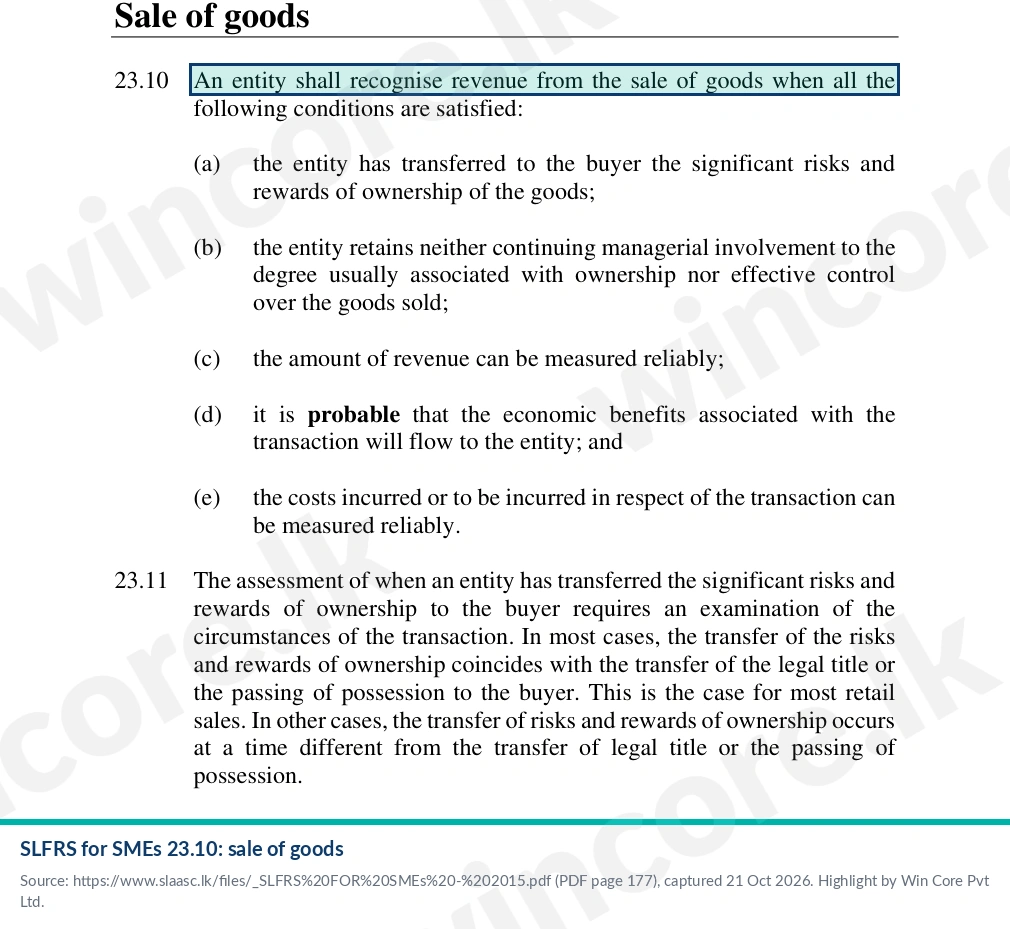
Paragraph 23.10 says an entity "shall recognise revenue from the sale of goods when all the following conditions are satisfied":
- "(a) the entity has transferred to the buyer the significant risks and rewards of ownership of the goods;"
- "(b) the entity retains neither continuing managerial involvement to the degree usually associated with ownership nor effective control over the goods sold;"
- "(c) the amount of revenue can be measured reliably;"
- "(d) it is probable that the economic benefits associated with the transaction will flow to the entity; and"
- "(e) the costs incurred or to be incurred in respect of the transaction can be measured reliably" [1].
Receiving cash is not on the list. Condition (d) is about whether payment will come, not whether it has come. A deposit for goods you have not yet delivered usually fails condition (a), because risks and rewards have not passed.
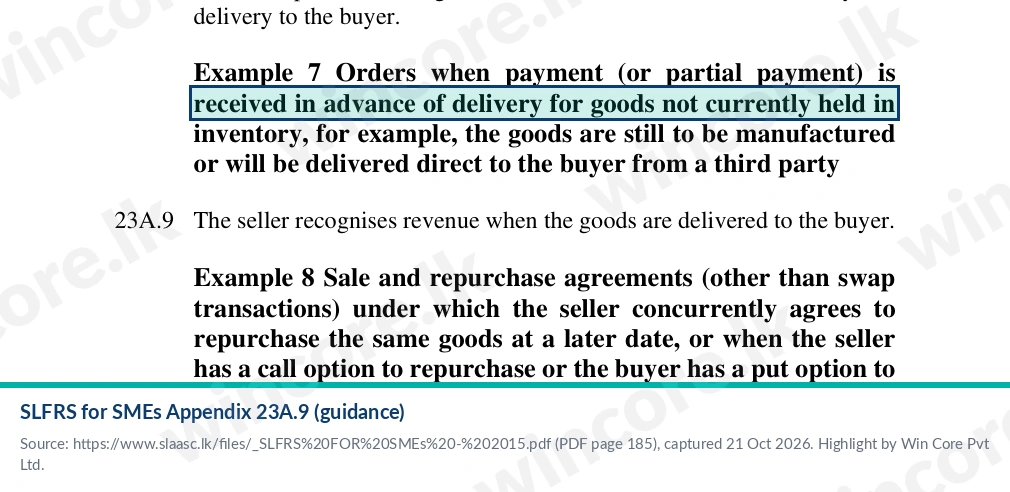
The appendix to Section 23 gives illustrations. It "accompanies, but is not part of, Section 23", so it is guidance rather than a requirement [1]. Its Example 7 covers "Orders when payment (or partial payment) is received in advance of delivery for goods not currently held in inventory", and paragraph 23A.9 says: "The seller recognises revenue when the goods are delivered to the buyer" [1].
Services
For services, paragraph 23.14 requires revenue "by reference to the stage of completion of the transaction at the end of the reporting period (sometimes referred to as the percentage of completion method)", where the outcome can be estimated reliably [1]. An advance for a six-month project becomes revenue as the work is done, not when the money arrives. The appendix gives the same answer for tuition fees: "The seller recognises revenue over the period of instruction" (23A.23), and for subscriptions of similar value each period, "on a straight-line basis over the period in which the items are dispatched" (23A.12) [1].
The VAT inside an advance is never revenue
Paragraph 23.4 adds that an entity "shall exclude from revenue all amounts collected on behalf of third parties such as sales taxes, goods and services taxes and value added taxes" [1]. The VAT element of an advance is owed to the Inland Revenue Department (IRD), not to you.
For VAT, the advance itself is a time of supply under section 4
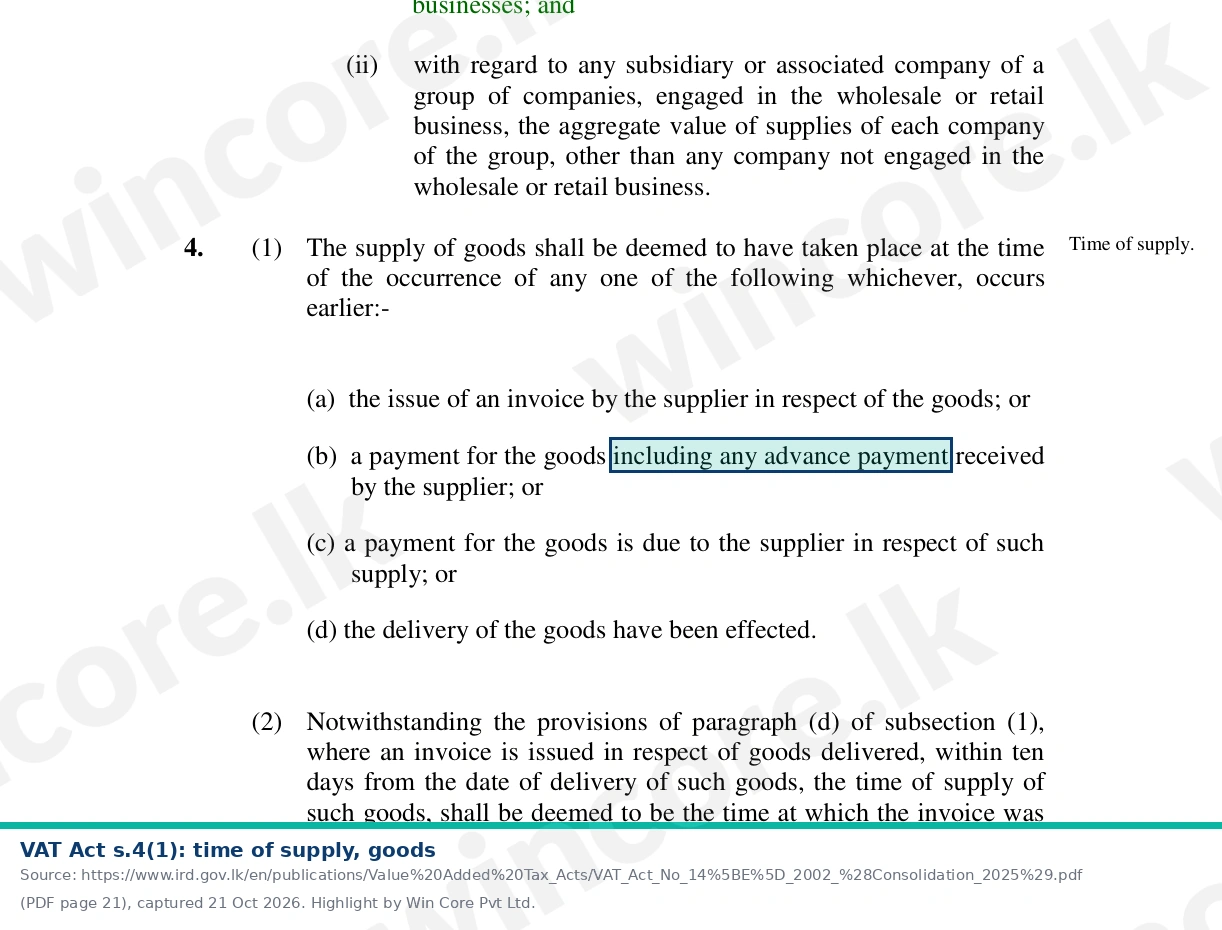
The Value Added Tax Act, No. 14 of 2002 fixes the time of supply. For goods, section 4(1) says the supply "shall be deemed to have taken place at the time of the occurrence of any one of the following whichever, occurs earlier": "(a) the issue of an invoice by the supplier in respect of the goods; or (b) a payment for the goods including any advance payment received by the supplier; or (c) a payment for the goods is due to the supplier in respect of such supply; or (d) the delivery of the goods have been effected" [2].
For services, section 4(3) lists "(a) the service was performed; or (b) a payment is received for the services rendered or for future services; or (c) a payment is due for the services rendered or for future services; or (d) an invoice is issued in respect of the services rendered", whichever is earliest [2].
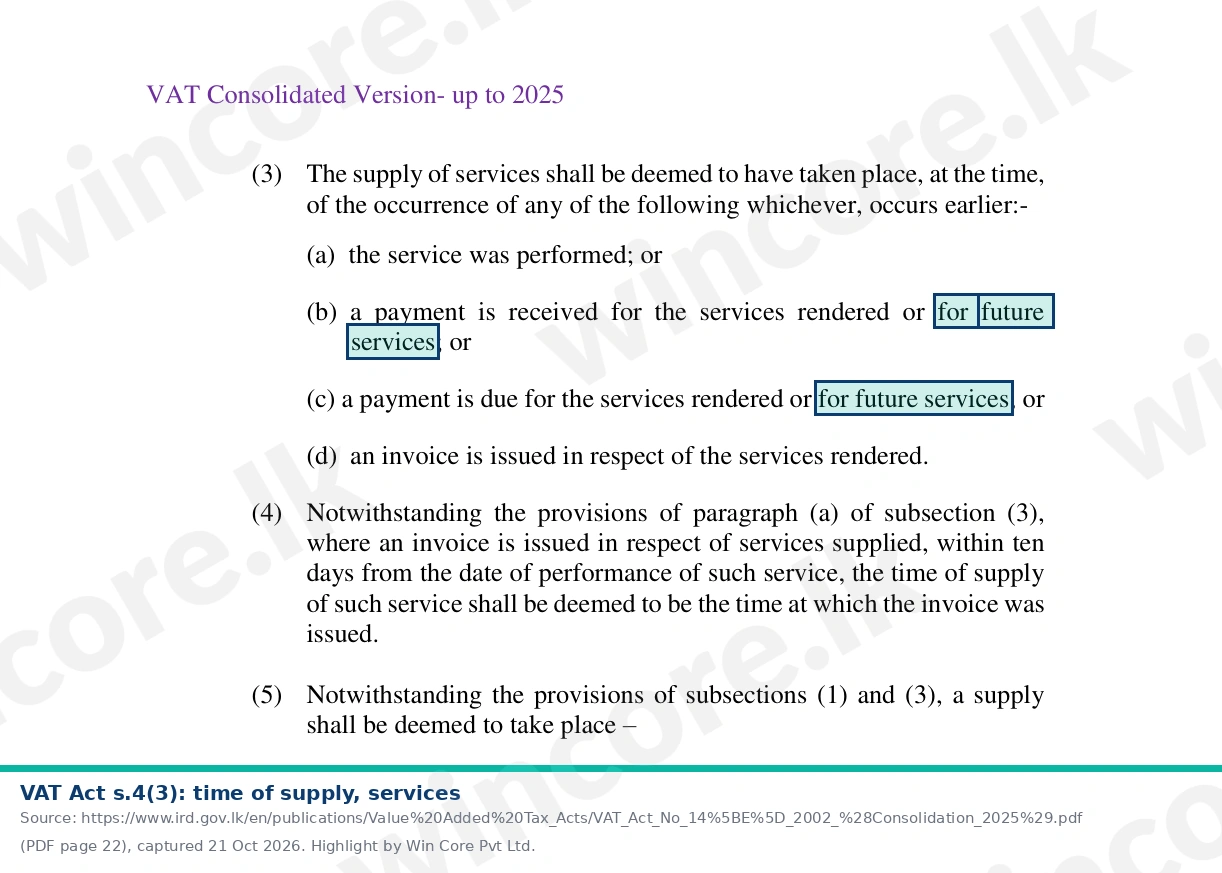
The words "including any advance payment" and "for future services" are explicit. On our reading, if you are VAT-registered, receiving an advance is a time of supply, so output VAT falls into the period in which the advance is received, even though the accounts show no revenue yet. The rate under s.2(1) is 18 percent "for any taxable period commencing on or after January 1, 2024", with a tax fraction of 9/59 [2]; our VAT calculator splits a VAT-inclusive deposit. Section 4(6) and s.23 provide a separate payment basis for suppliers the Commissioner-General approves; we have not covered it here.
Sections 4(2) and 4(4) contain a ten-day invoice rule. They apply "notwithstanding" paragraph (d) of subsection (1) and paragraph (a) of subsection (3), the delivery and performance limbs [2]. On our reading they do not displace the advance payment limb, which is a separate paragraph.
How much VAT?
The time-of-supply rule says when. Section 5 values a supply at its consideration, and neither section says, on its face, whether an advance brings the whole contract value or only the amount received into tax at that time. The IRD's own illustration points to the amount received: its 2015 rate-change circular SEC/2015/01 taxed a 20 percent rent advance on the advance alone and deducted that advance when the later rent was invoiced [4]. That circular dealt with a rate change and is administrative guidance, not the Act, so we keep the question open; our worked example follows the circular's approach.
For the tax invoice requirements when you invoice an advance, see our article on the VAT tax invoice format. If you are not yet registered, our income tax services team also handles VAT registration and returns.
A hypothetical furniture deposit shows the accounts and the VAT side by side
Hypothetical. A furniture maker takes a 50% deposit on a custom order. The price is Rs. 1,000,000 plus VAT at 18% (Rs. 180,000), a total of Rs. 1,180,000 (our arithmetic, at the s.2(1) rate). The customer pays Rs. 590,000 on 20 March. The furniture is delivered on 15 May, when the balance is paid. The year ends on 31 March.
At 31 March:
- Accounts. Revenue is nil. The VAT inside the deposit is Rs. 590,000 x 18/118 = Rs. 90,000 (our arithmetic), shown as VAT payable. The remaining Rs. 500,000 is a customer advance in liabilities.
- VAT. On our reading of s.4(1)(b), the deposit is a time of supply in March. Following the approach in the IRD's 2015 circular, output VAT of Rs. 90,000 belongs in the return for the period that includes March; the open point above concerns whether the full contract value is also triggered.
- Cash. The bank shows Rs. 590,000, of which Rs. 90,000 is owed to the IRD. Our companion piece on profitable-on-paper, out-of-cash businesses (publishing in this series) explains why cash and profit diverge.
On 15 May, revenue of Rs. 1,000,000 is recognised, the Rs. 500,000 advance is released against it, and the balance of Rs. 500,000 plus VAT of Rs. 90,000 is invoiced and received (our arithmetic).
If the order is cancelled and the deposit refunded, the liability is settled in cash and no revenue arises. If the deposit is forfeited under the contract, the forfeited amount is income at that point; what VAT adjustment applies then is outside this article.
Booking advances as sales distorts profit, cut-off and cash
This section is practice, not a legal requirement.
- Year-end profit. Booking advances as sales overstates revenue and profit in the year received, and understates the next year. That distorts tax, management decisions and loan covenants. Income tax timing follows the accounts under s.21(1) of the Inland Revenue Act unless the Act says otherwise, so the error usually carries into the return (on our reading).
- Cut-off. Advances received shortly before year-end are a frequent cut-off error. Our article on accrued expenses and cut-off traps covers the cost side of the same year-end check.
- Refund risk. A liability makes clear that you may have to give the money back. A business that spends deposits as if they were profit has no buffer if orders are cancelled. Our virtual CFO service builds cash plans that keep open deposits ring-fenced.
- Foreign currency advances. If the advance is in foreign currency, the rate question is covered in our article on exchange gains and losses on dollar sales.
Record advances in their own account and review them monthly
This section is practice, not a legal requirement.
- Create a liability account for customer advances, separate from trade receivables. Our guide to bookkeeping basics shows where it sits in a small company chart of accounts.
- Record each advance against the customer and order, so it can be matched when the final invoice is raised.
- Review the advances list at every month-end. Old advances may mean stalled orders, unclaimed refunds or revenue that should have been released.
- If VAT-registered, check that the VAT on advances is in the right return period.
- Reconcile the advances account to a list of open orders as part of the month-end close. Our bookkeeping services team keeps the advances list and the VAT periods aligned each month.
What this means for you
Treat customer deposits and advances as liabilities until you deliver. Release them to revenue on delivery for goods, or as work progresses for services. If you are VAT-registered, the advance is likely to be a time of supply, so output VAT may be due in the month you receive it, even though the accounts show no sale. Keep the VAT element separate, keep a list of open advances, and review it every month. Our accounting services team prepares year-end accounts with advances released on the right basis.
Checklist: documents needed
- Customer orders or contracts showing deposit and delivery terms
- Receipts or tax invoices issued for advances
- Bank statements showing advances received
- A list of open advances by customer and order
- Delivery notes or completion records
- VAT returns for the periods in which advances were received
- Refund or cancellation records
Frequently asked questions
Is a non-refundable deposit revenue when it is received?
Not by itself. Under paragraph 23.10, revenue from goods depends on transferring the significant risks and rewards of ownership, usually on delivery, and the appendix to Section 23 says the same for advance orders. If the order is cancelled and the deposit is forfeited under the contract, the forfeited amount becomes income at that point, not before.
Do we charge VAT on a customer advance in Sri Lanka?
Yes, if you are VAT-registered. Sections 4(1)(b) and 4(3)(b) of the VAT Act make an advance payment a time of supply, so on our reading output VAT is due for the period in which you receive it. Whether that covers only the advance or the full contract value is open; the IRD's 2015 illustration taxed the advance alone.
Where does a customer advance go in the accounts?
In liabilities, as customer advances or income received in advance, net of the VAT element. The VAT is shown separately as VAT payable, because paragraph 23.4 excludes value added tax from revenue. When you deliver, release the advance against the revenue and the final invoice, so the customer's balance clears to nil.
How do we treat a service paid a year in advance?
Recognise the revenue as the service is delivered over the year, by stage of completion under paragraph 23.14. For a service of similar value each month, the appendix to Section 23 illustrates straight-line recognition for subscriptions. At each month end, the unexpired part stays in liabilities as income received in advance.
Is a customer advance taxable for income tax when received?
On our reading, not if the accounts properly treat it as a liability. Section 21(1) of the Inland Revenue Act times income according to generally accepted accounting principles unless the Act provides otherwise. We have not found an IRD ruling on advances specifically, so treat this as our reading and check large advances with your adviser.
Open points we are keeping open
- VAT on the full value or the advance. Section 4 fixes the time of supply and s.5 the value; neither says whether an advance triggers VAT on the whole contract value. The IRD's 2015 circular taxed the advance alone, but it is old, administrative and about a rate change.
- Income tax timing. Our reading under s.21(1) is that income tax follows the accounting treatment; no IRD ruling on advances specifically was found.
- SSCL. The timing of the Social Security Contribution Levy on advances was not reviewed.
- Forfeited deposits. VAT adjustments on forfeited or refunded advances were not reviewed.
- Standard edition. We read the 2015 SLFRS for SMEs. The IASB issued a third edition of the IFRS for SMEs Accounting Standard in 2025 (Secondary: ifrs.org listing), which rewrites Section 23; whether and from when CA Sri Lanka adopts it we did not verify.
- Paragraphs not re-read today. 2.15, 23.4, 23.14, 23A.12 and 23A.23 come from the reading of 21 October 2026; our text extraction today stopped at Section 9. SLFRS 15 paragraph 106 was read only in part.
- VAT amendments. Our earlier check of the VAT (Amendment) Act No. 14 of 2026 found no amendment to the principal Act's s.4; not re-checked in full for this piece.
This article is general information, not advice for your specific situation.
Talk to us. If customer deposits are sitting in your sales, or you need the VAT on advances checked before the next return, reach us at our contact page.
WinCore Pvt Ltd
References
- Institute of Chartered Accountants of Sri Lanka. Sri Lanka Accounting Standard for Small and Medium-sized Entities (SLFRS for SMEs), 2015, paras 2.15, 2.39, 23.4, 23.10, 23.14 and Appendix to Section 23. https://www.slaasc.lk/files/_SLFRS%20FOR%20SMEs%20-%202015.pdf . Primary. Accessed 21 October 2026; 2.39, 23.10 and 23A.9 re-read from the captures on 22 October 2026.
- Inland Revenue Department. Value Added Tax Act, No. 14 of 2002 (consolidated up to 2025), ss.2(1), 4, 5. https://www.ird.gov.lk/en/publications/Value%20Added%20Tax_Acts/VAT_Act_No_14%5BE%5D_2002_%28Consolidation_2025%29.pdf . Primary (IRD consolidation, not a statutory text). Accessed 22 October 2026.
- Institute of Chartered Accountants of Sri Lanka. SLFRS 15 Revenue from Contracts with Customers, para 106 and Appendix A. https://www.casrilanka.com/casl/images/stories/content/publications/publications/accounting_standards/slfrs_15_revenue_from_contracts_with_customers.pdf . Primary (standard; read through a search extract, the PDF fetch failed on 22 October 2026). Accessed 22 October 2026.
- Inland Revenue Department. SEC/2015/01: Value Added Tax, VAT rate change effective from 01/01/2015, part (2) Advance Payments and illustration. https://www.ird.gov.lk/en/publications/Circulars_Circulars/Sec-2015-01_-_VAT_Rate_Changes_Circular_-_2015_E.PDF . Primary (administrative guidance). Accessed 22 October 2026.
Put these insights to work
WinCore specialists can review your current workflow, document gaps, and build a practical 90-day action plan.
Book a free consultationContinue reading
Explore more WinCore analysis to keep your finance, tax, and compliance roadmap moving.
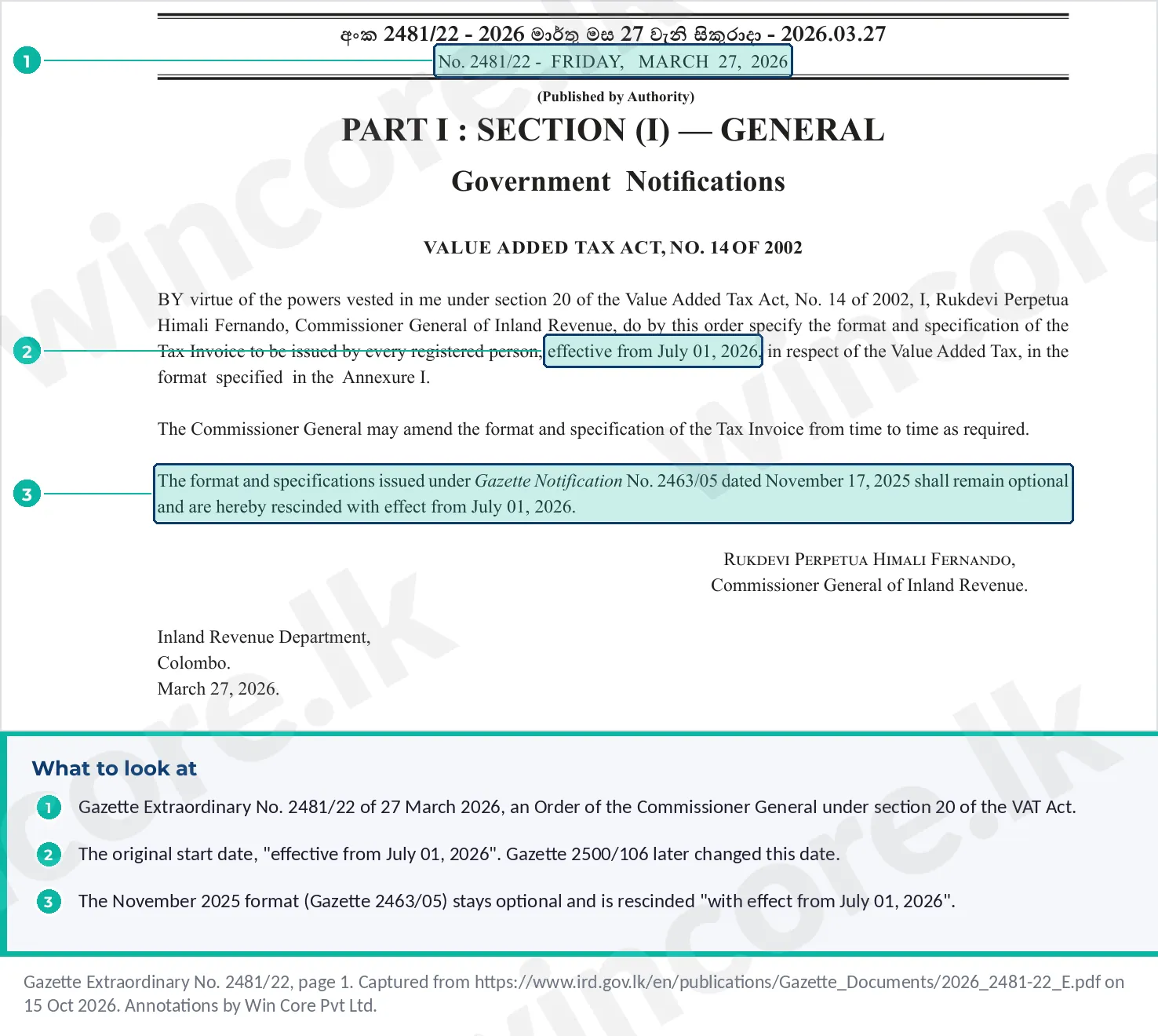
The IRD Order behind the new VAT tax invoice: the 1 October start, the serial number and date rules, and which default carries which penalty.

Bookkeeping guide for Sri Lankan small businesses: legal requirements, chart of accounts, source documents, 5-year retention rule, and monthly routines.
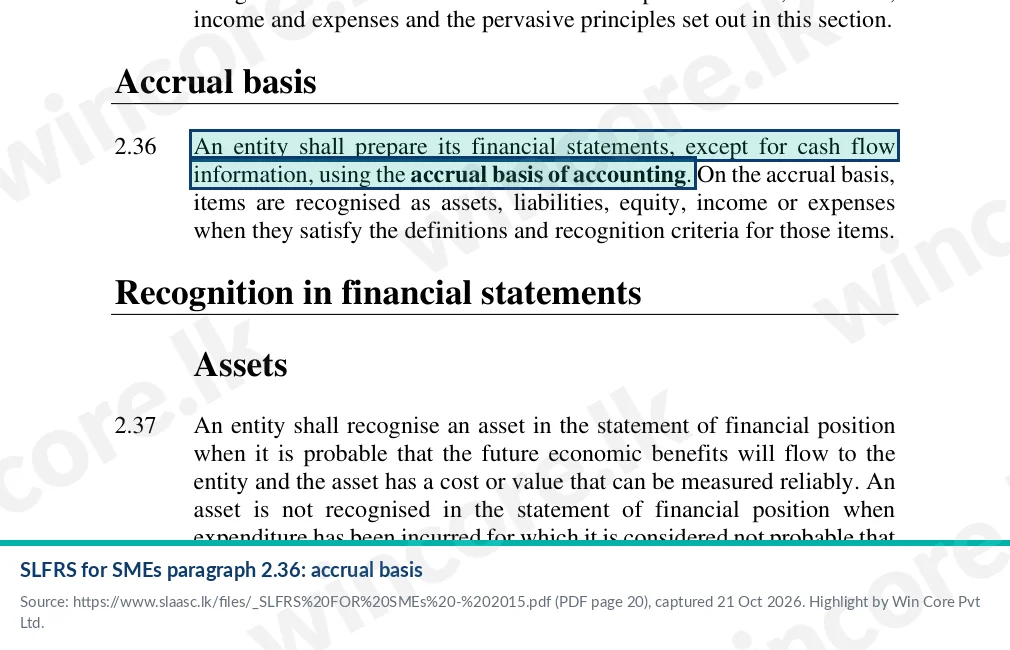
Bills arrive late, landlords recharge in bundles and one month goes missing. Four cut-off traps, the rule behind each and a six-step monthly routine.