
Trade licence Sri Lanka: council permits, EPL and order to apply
A trade licence is a local authority permit for a trade at an address. Each council sets its own list, fees and renewal dates, so ask yours first.
On this page
Last verified against the primary sources on 26 October 2026.
Trade licence Sri Lanka, in brief. A trade licence (also spelled trade license) is a permit from the local authority, meaning the Municipal Council, Urban Council or Pradeshiya Sabha, allowing a listed trade to operate at a particular address. It is not an import or export licence. In Colombo the licence runs from 1 January to 31 December, and a new business should apply before it starts operations.
It is separate from registering the business and from registering for tax. Each council sets its own list of licensable trades, its fees and its renewal cycle, so one council's rules are not another's.
This guide uses the Colombo Municipal Council's published handbook as a worked example. It also covers building and use approvals, the environmental protection licence (EPL) under the Central Environmental Authority list, and the questions to ask your own council.
A trade licence is a local authority permit for one trade at one address
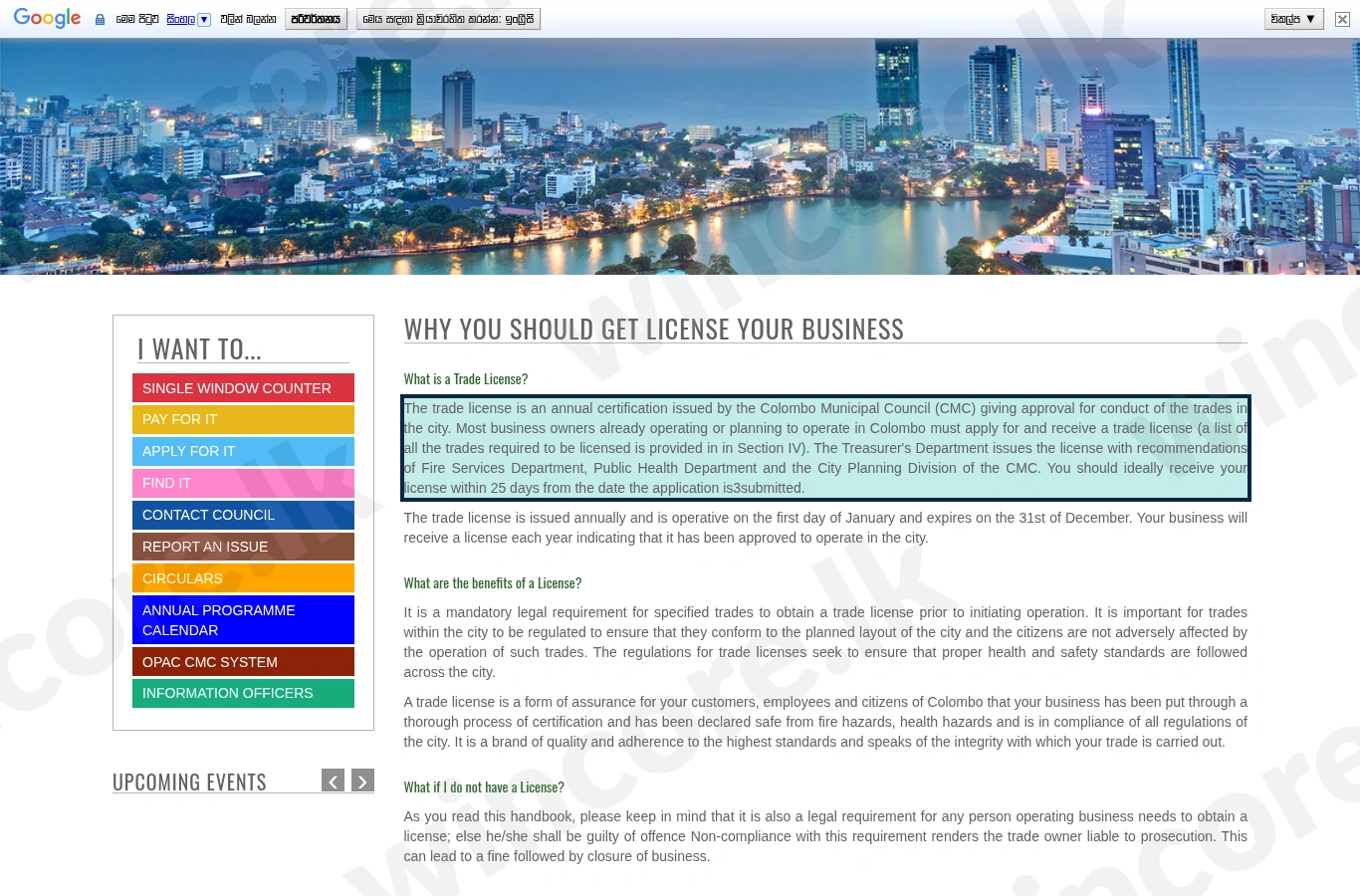
The Colombo Municipal Council (CMC) describes it this way: "The trade license is an annual certification issued by the Colombo Municipal Council (CMC) giving approval for conduct of the trades in the city." It adds that "The Treasurer's Department issues the license with recommendations of Fire Services Department, Public Health Department and the City Planning Division of the CMC" [1].
On timing, the CMC says the licence "is operative on the first day of January and expires on the 31st of December" [1]. A new business "should apply for and obtain a trade license prior to starting operations" [2].
It also lists three changes that need a new licence before the old one expires [2]:
- a move of premises within city limits;
- a change of ownership;
- a change in the nature of the business.
Other councils use different names, forms and lists. On our reading there is no single national trade licence: each council licenses under its own law and by-laws. For example, the Municipal Councils Ordinance requires a council licence for offensive or dangerous trades and for trades its by-laws declare to be so (s.147), and lets the council levy a duty on the licences it issues (s.247A) [6]. The Pradeshiya Sabhas Act has matching licence duty and by-law powers (ss.149 and 126) [8]. Councils may also levy an annual trade tax by resolution (Municipal Councils Ordinance s.247B, Pradeshiya Sabhas Act s.150); in a Municipal Council area, s.247B does not apply to a trade that needs a licence. The CMC handbook itself uses 2009 examples when describing renewal, so treat it as a guide to the kind of questions asked, not as current rules for your area.
Each council sets its own fees and renewal dates, so ask for them in writing
Trade licence fees are set by each local authority. The laws tie the licence duty to the annual value of the premises and, for a trade, also to its turnover, likely profit and the essential nature of the goods or services supplied (Municipal Councils Ordinance s.247A(2), Urban Councils Ordinance s.164(2), Pradeshiya Sabhas Act s.149) [7] [8]. We have not quoted any council fee here, because no single official schedule applies across the country.
Ask your council for its current fee table in writing, and ask when renewals open. The CMC says it starts renewals "by the September of the preceding year", and that renewal is typically completed "latest by March 31 of the year for which the license is valid" [2].
A council asks for registration, identity and building papers before it issues a licence
The CMC's list of documents "Mandatory for all trades" includes [2]:
- "Copy of Business Registration Certificate";
- "Copy of National I.D Card";
- "Copy of Certificate of Conformity";
- "Copy of Water bill";
- proof of the solid waste arrangement.
Depending on the trade, it also asks for:
- a "Change of Use certificate", where "the existing usage of the building/ premises differs from the approved usage";
- a "Machinery Permit", for trades "using machinery and/ or generating a noise level of 50 decibels or above", with a noise level report;
- registration with the Labour Department for factories;
- "the Environment Protection License from the Central Environmental Authority", for trades defined under the National Environmental Act.
The CMC says you can expect the licence "within 25 days from the date on which the application was submitted" [2].
Trade licence Sri Lanka depends on the building being approved for the use
Building and use. A licence attaches to premises, so the building has to be approved for the use. The CMC application asks for the "Reference number and Date of Approved Building Plan and Certificate of Conformity", any "Deviations from approved building", and a "change of use certificate" [2].
A house turned into a workshop is the common problem. The approved use is residential, so a change of use and, in Colombo, a "Certificate for Change of Occupancy" from the Fire Services Department may be needed. See our guide to using a rented house as the registered office. A registered office is not the same as a licensed workshop.
Name board. Ask the council whether a shop sign or name board needs its own permit or fee, and whether there are size or placement rules. Councils can make by-laws on advertisements visible from a road and charge fees for them (for a Pradeshiya Sabha, s.126(xxx) of the Pradeshiya Sabhas Act) [8], so the answer is in your council's by-laws.
An EPL applies only to activities listed in Gazette 2264/18, graded by pollution potential
Section 23A of the National Environmental Act No. 47 of 1980 bars anyone from carrying on a prescribed activity without a licence, and section 23B provides for the licence itself [9]. The activities that need one are listed in Gazette Extraordinary No. 2264/18 of 27 January 2022, in Parts A to D by pollution potential [3].
The CEA explains the split [4]:
- "EPL for industries in lists 'A', 'B' and 'C' have to be obtained from the relevant Provincial Offices or District Offices of the CEA".
- "Part 'D' comprises of 39 low polluting industrial activities which have been delegated to Local Government Authorities". For these, the "EPL for the industries in List 'D' has to be obtained from the respective Local Authorities".
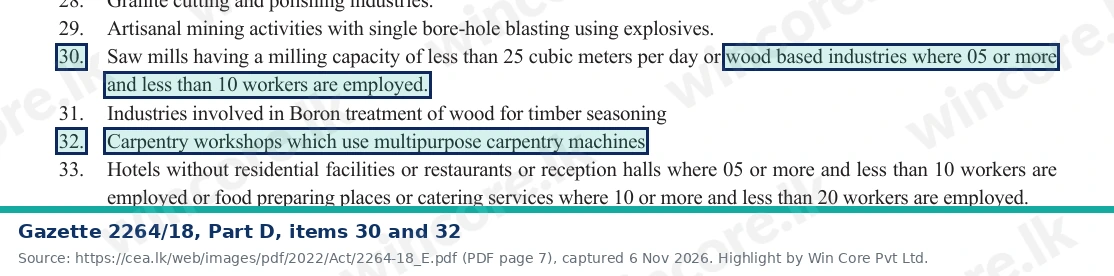
Woodworking shows how the list grades one trade by its size [3]:
- Part D, item 32: "Carpentry workshops which use multipurpose carpentry machines."
- Part D, item 30: "Saw mills having a milling capacity of less than 25 cubic meters per day or wood based industries where 05 or more and less than 10 workers are employed."
- Part C, item 54: "Saw mills having a milling capacity of 25 or more and less than 50 cubic meters per day or wood based industries where 10 or more and less than 25 workers are employed."
- Part B, item 54: "Saw mills having a milling capacity of 50 or more cubic meters per day or wood based industries where 25 or more workers are employed."
Other entries catch businesses by size rather than trade. For example, Part D item 39 covers "Any activity/ industry not included in Part D of the schedule, where 10 or more and less than 50 workers per shift are employed."

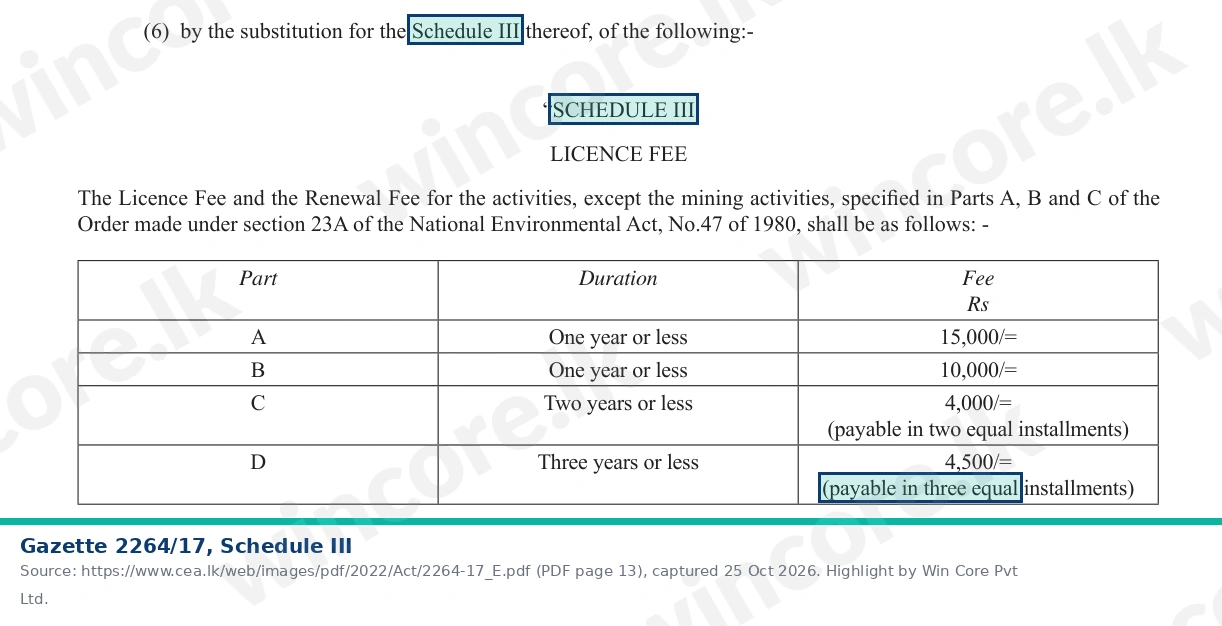
EPL fees. Schedule III, as substituted by Gazette Extraordinary No. 2264/17 of 27 January 2022, sets the licence and renewal fees for activities other than mining (mining has its own table) [5]:
| Part | Licence period | Fee |
|---|---|---|
| A | "One year or less" | Rs 15,000 |
| B | "One year or less" | Rs 10,000 |
| C | "Two years or less" | Rs 4,000, "payable in two equal installments" |
| D | "Three years or less" | Rs 4,500, "payable in three equal installments" |
The lead-in to the schedule refers to Parts A, B and C, while the table also lists Part D. The CEA's own page applies the Rs 4,500 fee to List D licences and says an inspection fee is charged before the field inspection [4]. Confirm both with your local authority.
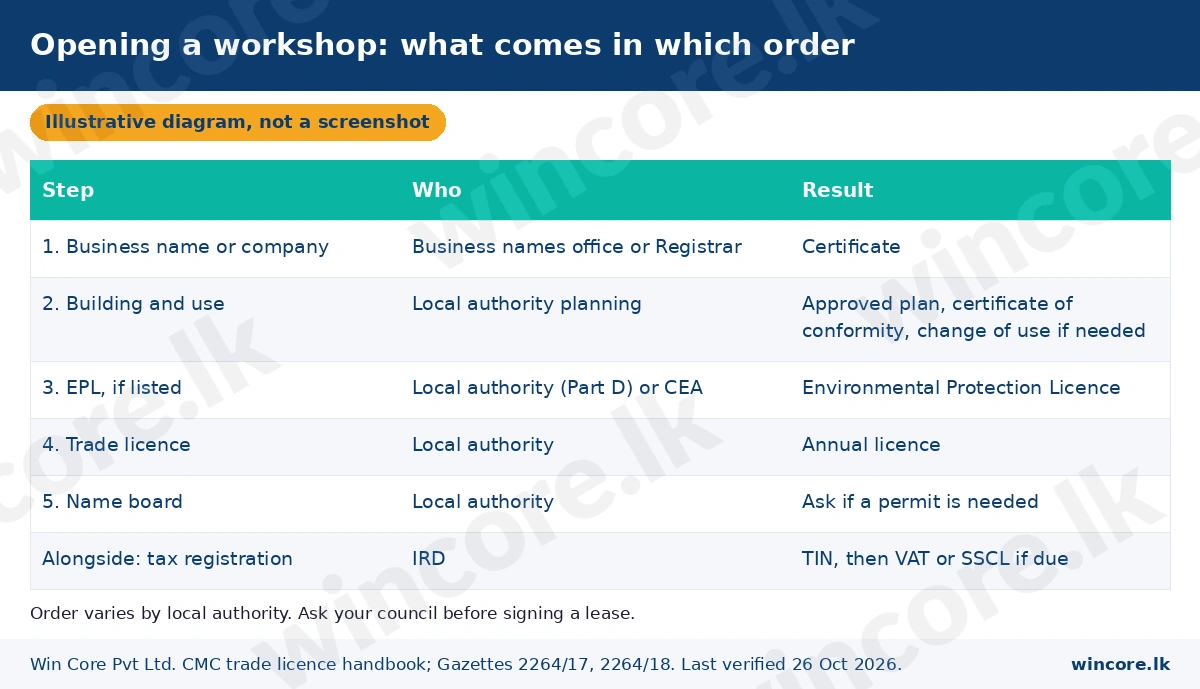
Register the business first, because councils ask for the certificate
Councils ask for the registration certificate, so this comes first:
- a business name for a sole proprietor or partnership (see our sole proprietorship guide);
- or a company (see how to register a company).
Then settle the building approvals, any EPL and the trade licence. Tax registration with the IRD runs alongside; see our tax registration checklist. A trade licence does not register you for tax, and a TIN does not licence the premises.
Worked example: a construction company checks the council before it signs a workshop lease
This is an invented example. A construction company, registered as a private company, rents a ground-floor unit in a Pradeshiya Sabha area for a joinery workshop. It installs two multipurpose carpentry machines, with six staff on one shift, and has budgeted Rs 6,000,000 for the fit-out.
- Before signing the lease, it asks the Pradeshiya Sabha whether a joinery workshop is a licensable trade there and whether the building's approved use allows light industry.
- On the EPL, it checks the list. Part D item 32 names "Carpentry workshops which use multipurpose carpentry machines", and item 30 covers wood-based industries with 5 or more and fewer than 10 workers, so with six workers the activity sits in Part D. Item 39 does not apply, because it covers only activities not already listed in Part D. On our reading, 10 or more workers would bring in Part C item 54 (wood-based industries with 10 or more and fewer than 25 workers), which the CEA issues. The Part D EPL comes from the Pradeshiya Sabha. Schedule III sets Rs 4,500 for a licence of up to three years, payable in three equal instalments, and the authority also charges an inspection fee. The CEA asks for the application 30 days before the activity starts.
- For the trade licence, it gathers its certificate of incorporation, the director's NIC, the lease, the approved plan and certificate of conformity, a machinery and noise report if asked, and the EPL.
- It asks about the name board before ordering it.
- It updates its IRD records for the new place of business.
Ask your council eight questions before you commit to premises
- Is my trade on your licensable list, and under which category?
- What is the current fee, and is there a separate trade tax?
- When does the licence year run, and when do renewals open?
- Does the building's approved use cover my activity, or do I need a change of use?
- Do I need a machinery permit or noise report?
- Is my activity on Part D of Gazette 2264/18, and do you issue that EPL?
- Does my name board need a permit?
- How long does processing take, and who inspects?
What this means for you
- Ask the council before signing a lease. Use and licensing problems are expensive after fit-out.
- Check Gazette 2264/18 for your activity and size.
- Budget the council's fee from its own written table, not from another council's rates.
- Diary the renewal: in Colombo the licence runs for the calendar year.
- Keep the licence, EPL and approvals with your company records.
Checklist: documents needed
- Business registration or incorporation certificate
- NIC of the owner or director
- Lease or deed for the premises, and owner's consent if asked
- Approved building plan and certificate of conformity
- Change of use or occupancy certificate, if the use has changed
- Machinery permit and noise report, if required
- EPL, if the activity is on Gazette 2264/18
- Water bill and waste collection arrangement
- Name board permit, if your council requires one
FAQ
Who issues a trade licence in Sri Lanka?
The local authority for the business address issues it: the Municipal Council, Urban Council or Pradeshiya Sabha. In Colombo, the CMC Treasurer's Department issues it on recommendations from the Fire Services, Public Health and City Planning divisions. Each council sets its own list of licensable trades, forms and fees, so check with yours before opening.
How often must a trade licence be renewed?
In Colombo, the licence runs from 1 January to 31 December and is renewed each year. Other councils may use the same calendar year or a different cycle. A new licence may be needed before expiry if you move premises, change ownership or change the nature of the business. Ask your council for its renewal dates.
Does a small workshop need an environmental protection licence?
Possibly. Gazette 2264/18 puts some small workshops in Part D, issued by the local authority, such as "Carpentry workshops which use multipurpose carpentry machines" (item 32) and wood-based industries with 5 to 9 workers (item 30). On our reading, 10 or more workers take a wood-based industry to Part C (item 54), issued by the CEA, and 25 or more to Part B.
Is a trade licence the same as business registration?
No. Business name or company registration creates the legal record of the business. Tax registration with the IRD gives a TIN. The trade licence is a local authority permit for a particular trade at a particular address. Councils usually ask for the business registration certificate before they issue the licence.
The short version
A trade licence is a local authority permit for a trade at an address. Rules, fees and renewal dates differ by council, so ask yours. Get the building use right, check Gazette 2264/18 for an EPL, and keep business and tax registration in step. For a small joinery workshop with fewer than 10 workers, Part D (items 30 and 32) is the entry to check first.
Talk to us. To register the business before you apply for a licence, see our registration services.
WinCore Pvt Ltd
This article is general information as at 26 October 2026. Local authority rules change; confirm with your council.
Related reading
- How do you start an import business in Sri Lanka?
- Feasibility study Sri Lanka: what should a project include?
Sources and references (9)
- Colombo Municipal Council. Why you should get license your business. https://www.colombo.mc.gov.lk/why-get-license.php . Primary (administrative). Accessed 25 October 2026.
- Colombo Municipal Council. How to obtain your trade license. https://www.colombo.mc.gov.lk/obtain-trade-license.php . Primary (administrative; handbook uses 2009 examples). Accessed 25 October 2026.
- Gazette Extraordinary No. 2264/18 of 27 January 2022, National Environmental Act No. 47 of 1980, Order under section 23A. https://cea.lk/web/images/pdf/2022/Act/2264-18_E.pdf . Primary. Accessed 25 October 2026.
- Central Environmental Authority. Implementation of Environmental Protection License Scheme. https://www.cea.lk/web/implementation-of-environmental-protection-license-scheme . Primary (administrative). Accessed 25 October 2026.
- Gazette Extraordinary No. 2264/17 of 27 January 2022, National Environmental (Protection and Quality) Regulations amendment, Schedule III. https://www.cea.lk/web/images/pdf/2022/Act/2264-17_E.pdf . Primary. Accessed 25 October 2026.
- Municipal Councils Ordinance (Cap. 576), ss.147, 247A, 247B. https://www.parliament.lk/files/ca/19._Municipal_Councils_Ordinance.pdf . Primary (revised edition; later amending Acts apply). Accessed 26 October 2026.
- Municipal Councils and Urban Councils (Amendment) Act, No. 20 of 1985, ss.3, 8. https://lankalaw.net/wp-content/uploads/2024/02/3263.pdf . Secondary (copy of the certified Act). Accessed 26 October 2026.
- Pradeshiya Sabhas Act, No. 15 of 1987, ss.126, 149, 150. https://www.commonlii.org/lk/legis/num_act/psa15o1987207/ . Secondary (text as enacted). Accessed 26 October 2026.
- National Environmental Act, No. 47 of 1980, ss.23A, 23B. https://lankalaw.net/wp-content/uploads/2025/02/1980Y0V0C47A.html . Secondary. Accessed 26 October 2026.
Put these insights to work
WinCore specialists can review your current workflow, document gaps, and build a practical 90-day action plan.
Book a free consultationRecent articles


Continue reading
Explore more WinCore analysis to keep your finance, tax, and compliance roadmap moving.

Practical tax registration checklist for Sri Lankan businesses covering sequence, ownership, document controls, and setup errors that delay compliance.

Registering a sole proprietorship in Sri Lanka: the business name at the Divisional Secretariat, the TIN certificate, income tax, VAT, SSCL and EPF.
A rented house can be your company's registered office. What the address then carries, what to ask an address service, and how a move takes effect.