
How to declare dividend Sri Lanka: board, solvency test and tax
Follow the usual private company dividend steps, from profits and solvency certificates to approval, shareholder payment, tax and records.

On this page
Last verified against the primary sources on 2 November 2026.
How to declare dividend Sri Lanka, in brief. Under the usual section 56 route in the Companies Act, the board authorises the distribution after obtaining an auditors' solvency certificate and being satisfied that the company will pass the solvency test immediately afterwards. Directors voting in favour sign their own certificate, and shareholders approve by ordinary resolution unless the articles say otherwise. A separate rule applies when every shareholder of a private company agrees in writing under section 31 [1]. A taxable dividend from a resident company to a resident individual is subject to 15 percent advance income tax, with the dividend treated as a final withholding payment under the rules applicable from 1 January 2023 [3] [4].
Our example is a hypothetical air conditioning service company, a private company owned by two resident individuals. We cover the board's role, the solvency test, the certificates, shareholder approval, interim and final dividends, recovery, records, tax, a worked test, a timeline and a checklist. This article describes the law verified on 2 November 2026; check for changes before making a payment.
How to declare dividend Sri Lanka starts with section 56
Section 60(1) describes a dividend as a distribution out of the company's profits, other than the company's acquisition or redemption of its own shares [1]. Under the usual section 56 route, before the company makes a distribution, the board must authorise it and, unless the articles provide otherwise, the shareholders must approve it by ordinary resolution [1] [2]. Section 31 provides a separate route for a private company when all shareholders agree in writing to the action, discussed below. For the notice when shares are bought back or redeemed, see the Form 9 filing.
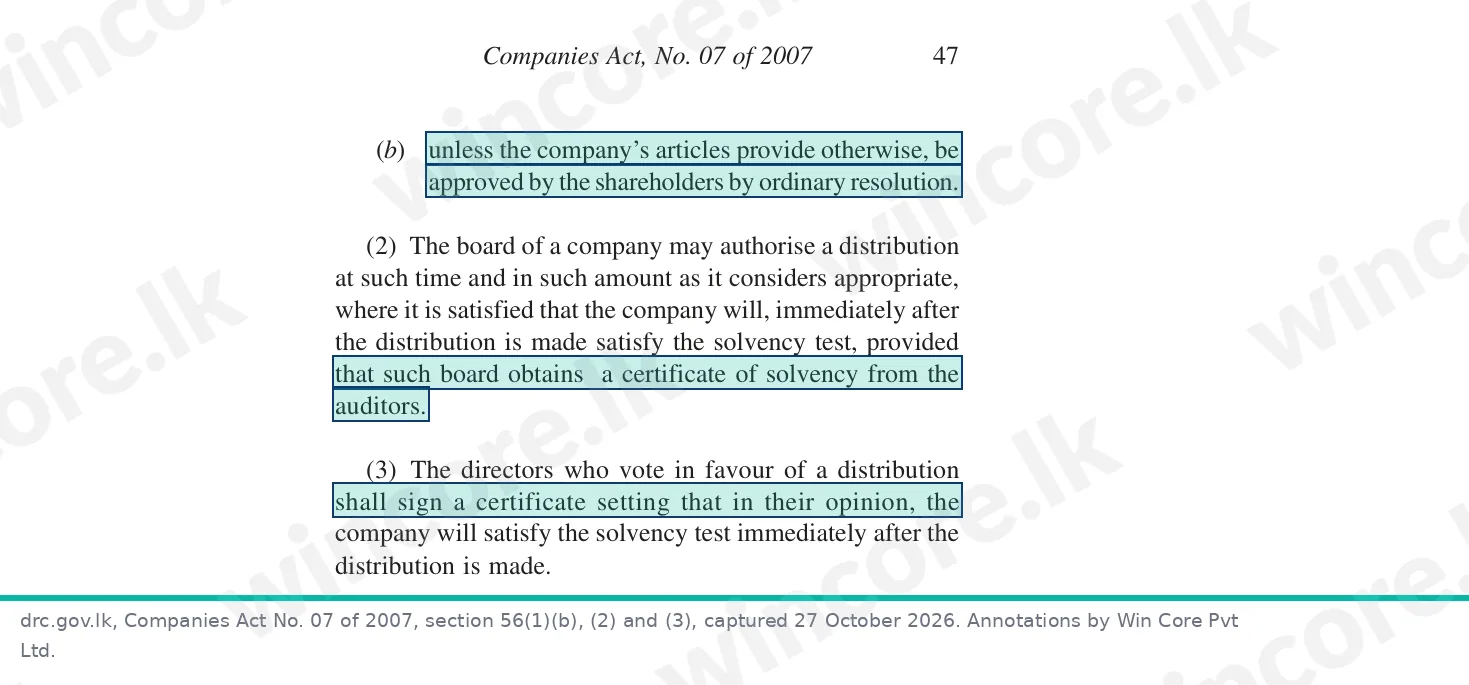
Under section 56(2), the board may authorise a distribution at the time and in the amount it considers appropriate if it is satisfied that the company will pass the solvency test immediately after the distribution and obtains a certificate of solvency from the auditors. Under section 56(3), the directors who vote in favour must sign a certificate stating their opinion that the company will satisfy the test immediately afterwards [1]. These are two different certificates.
A director who fails to comply with section 56(2) commits an offence and is liable on conviction to a fine not exceeding Rs 200,000 [1]. Section 514 concerns compounding specified defaults involving documents or notices to the Registrar; it does not make the section 56(2) offence a compoundable filing default [1].
Under section 60(2), the board must not authorise a dividend for only some shares in a class, or authorise a greater amount for some than others, except where an amount is reduced in proportion to a liability attached to the shares under the articles, or a shareholder agrees in writing to receive less or nothing [1]. This describes the usual route, subject to section 31 where applicable.
The solvency test has a cash limb and a balance sheet limb
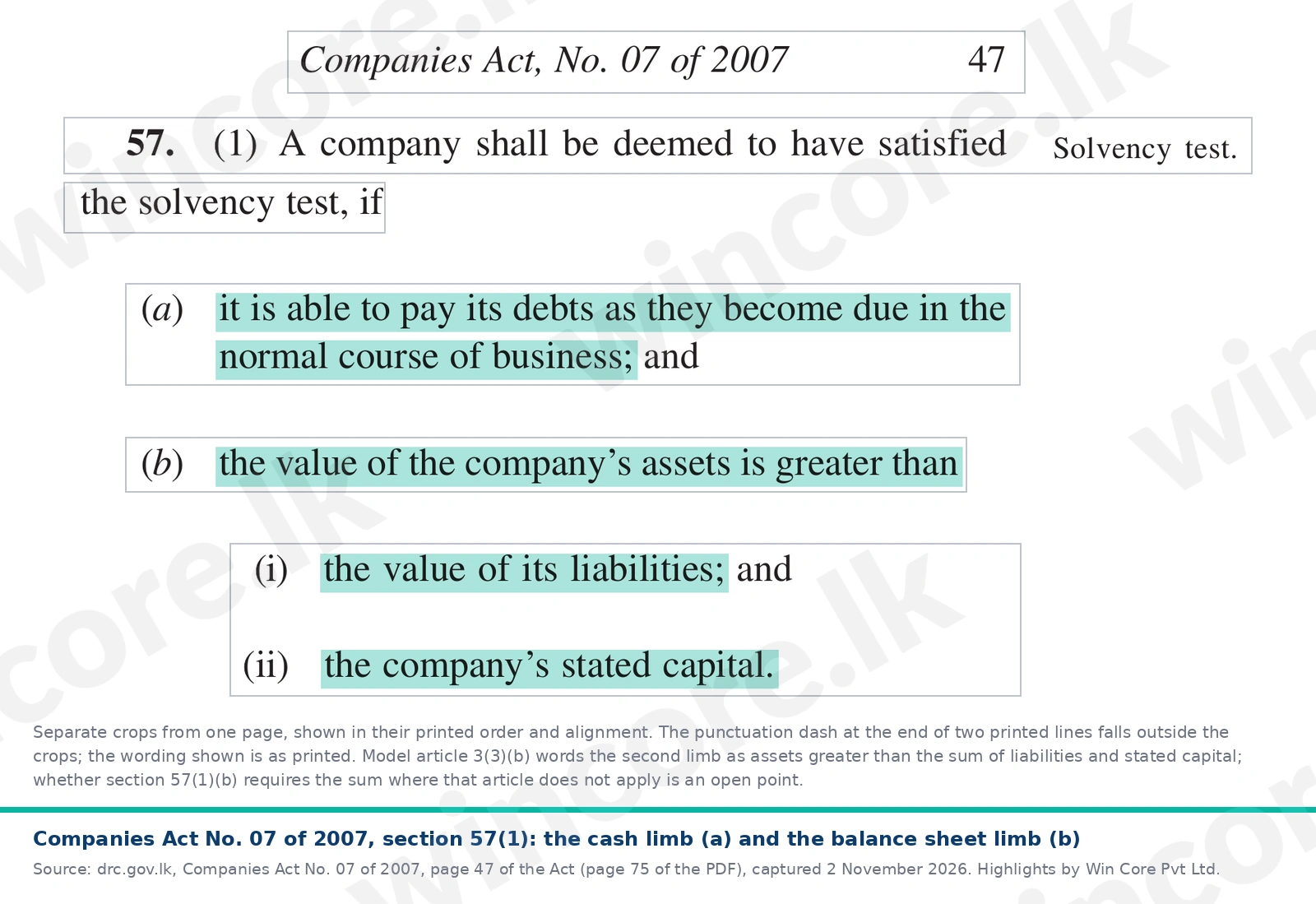
Section 57(1) says a company satisfies the test if it is able to pay its debts as they become due in the normal course of business and meets the second limb. Its second limb says the value of the company's assets must be greater than the value of its liabilities and its stated capital [1]. The assessment is of the position immediately after the proposed distribution.
Section 57(2) requires the board to take account of the most recent financial statements prepared under section 151 and circumstances the directors know or ought to know that affect asset and liability values. The board may also use a fair valuation or another method to assess those values. For the section 56 test, debts include fixed preferential returns on shares ranking ahead of the shares receiving the distribution, unless those returns are expressly subject to the board's power to authorise distributions [1].
The model articles express the second limb as assets greater than the sum of liabilities and stated capital. Open point: section 57(1)(b) uses different wording, so whether it requires the sum when model article 3(3) does not apply is a question of interpretation. On our reading, comparing assets with the sum is the conservative approach; it also applies the express wording of model article 3(3) where that article applies [1]. For more on stated capital, see our guide to the share capital requirement.
Shareholder approval depends on the articles
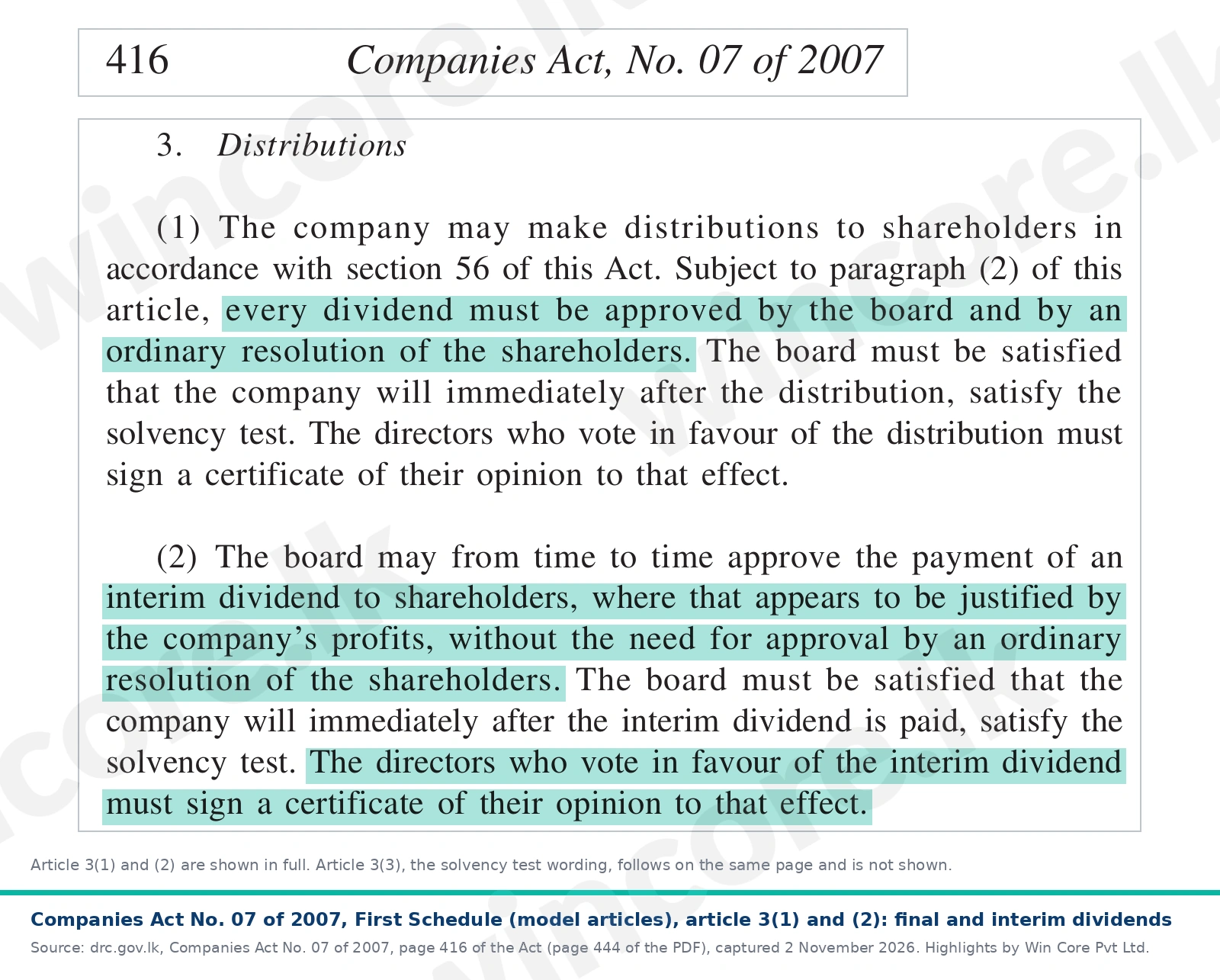
Under section 14, the model articles apply except to the extent a company adopts articles that exclude, modify or are inconsistent with them [1]. Model article 3(1) requires board approval and an ordinary resolution for a dividend, subject to article 3(2). Article 3(2) permits the board to approve an interim dividend without an ordinary resolution where the company's profits appear to justify it; the board must be satisfied about post payment solvency, and the directors voting in favour must sign their certificate. The auditors' certificate remains required under the usual section 56 route [1].
Read the company's own articles as well. Section 56(1)(b) permits the articles to provide otherwise than for shareholder approval by ordinary resolution. A company should distinguish the ordinary resolution required by its applicable articles from the separate unanimous written agreement described in section 31 [1].
Under section 31(1), when all shareholders of a private company agree in writing to an action already taken or to be taken, that action is deemed validly authorised by the company, and the sections listed in the Second Schedule do not apply to that action. The list includes sections 56, 60 and 61. Section 31(2) expressly includes a distribution [1].
That separate route does not make a failed solvency test harmless. Section 31(3) deems a distribution invalid if the company fails the test as a consequence. Sections 31(4) to (6) provide for recovery from shareholders, subject to the stated protection, potential liability of agreeing shareholders where reasonable grounds for believing the test would be met did not exist, and possible court relief for an amount that could properly have been distributed [1].
A failed test affects authorisation and recovery
The normal route requires profits for a dividend and the board's satisfaction about post distribution solvency. A company with accumulated losses may need to examine whether profits are available; a positive figure in a single line of the accounts does not answer the solvency test. If the board is not satisfied that the company will pass the test immediately after the proposed distribution, section 56(2) does not permit that board authorisation [1].
Under section 61(1), a distribution made when the company did not satisfy the test immediately afterwards may be recovered from the shareholder, unless all three protections apply: the shareholder received it in good faith without knowledge of the failure, changed position in reliance on its validity, and repayment in full or at all would be unreasonable in the circumstances [1].
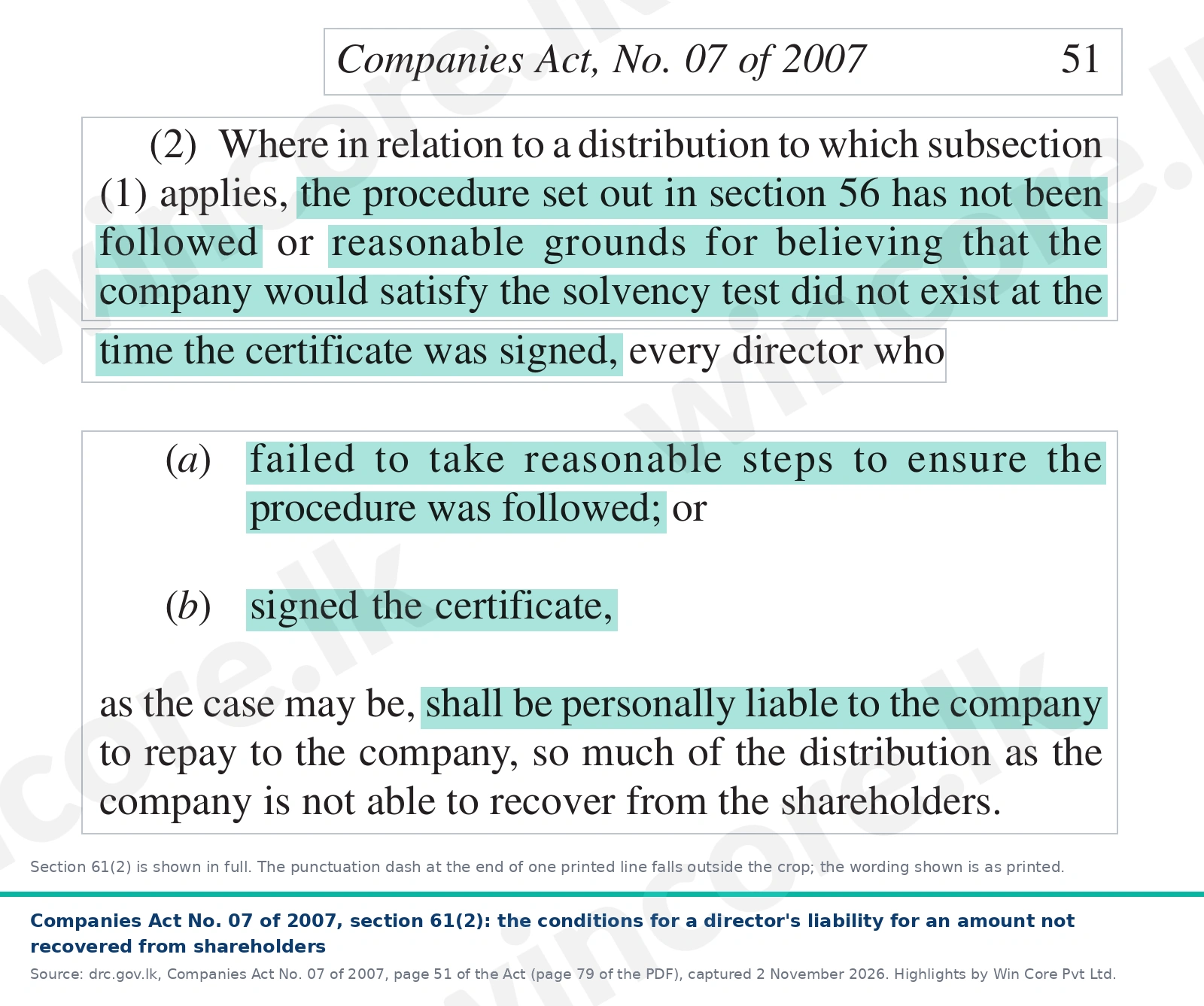
For a distribution covered by section 61(1), section 61(2) can make a director personally liable to the company for the amount it cannot recover from shareholders. This applies where the section 56 procedure was not followed or reasonable grounds for believing the company would satisfy the test did not exist when the certificate was signed, and the director either failed to take reasonable steps to ensure the procedure was followed or signed the certificate, as applicable [1].
Under section 61(3), in an action against a director or shareholder, the court may permit a shareholder to retain, or relieve a director of liability for, an amount that could properly have been distributed while satisfying the test [1]. The separate recovery provisions of section 31 apply to a distribution made under that section.
The records support the decision and payment
Under the usual section 56 route, obtain the auditors' certificate and have the directors who vote in favour sign their certificate. Section 116 requires the company to keep the specified shareholder and directors' meeting minutes and resolutions, and directors' certificates required by the Act, for the periods it states. It also requires specified financial statements and accounting records; the section permits other locations subject to its conditions and allows the Registrar to reduce the stated retention periods [1].
A solvency working, a board minute recording the amount per share and intended dates, and a dividend voucher showing gross dividend, tax withheld and net payment help explain the decision and its execution. These details are practice, not a separate legal requirement to use that particular format. Keep the applicable shareholder resolution or unanimous written agreement with the relevant records. Section 148 also requires accounting records that correctly record and explain company transactions [1].
Our post on redeemable preference shares and director fees covers other payments that follow different rules.
Tax is 15 percent for the taxable example
Under section 84A(1A) of the Inland Revenue Act and paragraph 10(1)(d)(v) of its First Schedule, advance income tax at 15 percent applies to a Sri Lankan source dividend payment subject to the statutory exceptions. Section 88(1A)(aa) treats dividends paid by a resident company on or after 1 January 2023 as final withholding payments [3] [4]. In the example below, the company pays resident individuals from its own trading profits and no stated exemption applies. For those payments, the 15 percent withholding is final.
Our post on dividend tax in Sri Lanka covers the tax rules in more detail. Acts No. 2 of 2025 and No. 11 of 2026 amended other provisions but did not amend the dividend withholding rate in paragraph 10(1)(d)(v) [6] [7].
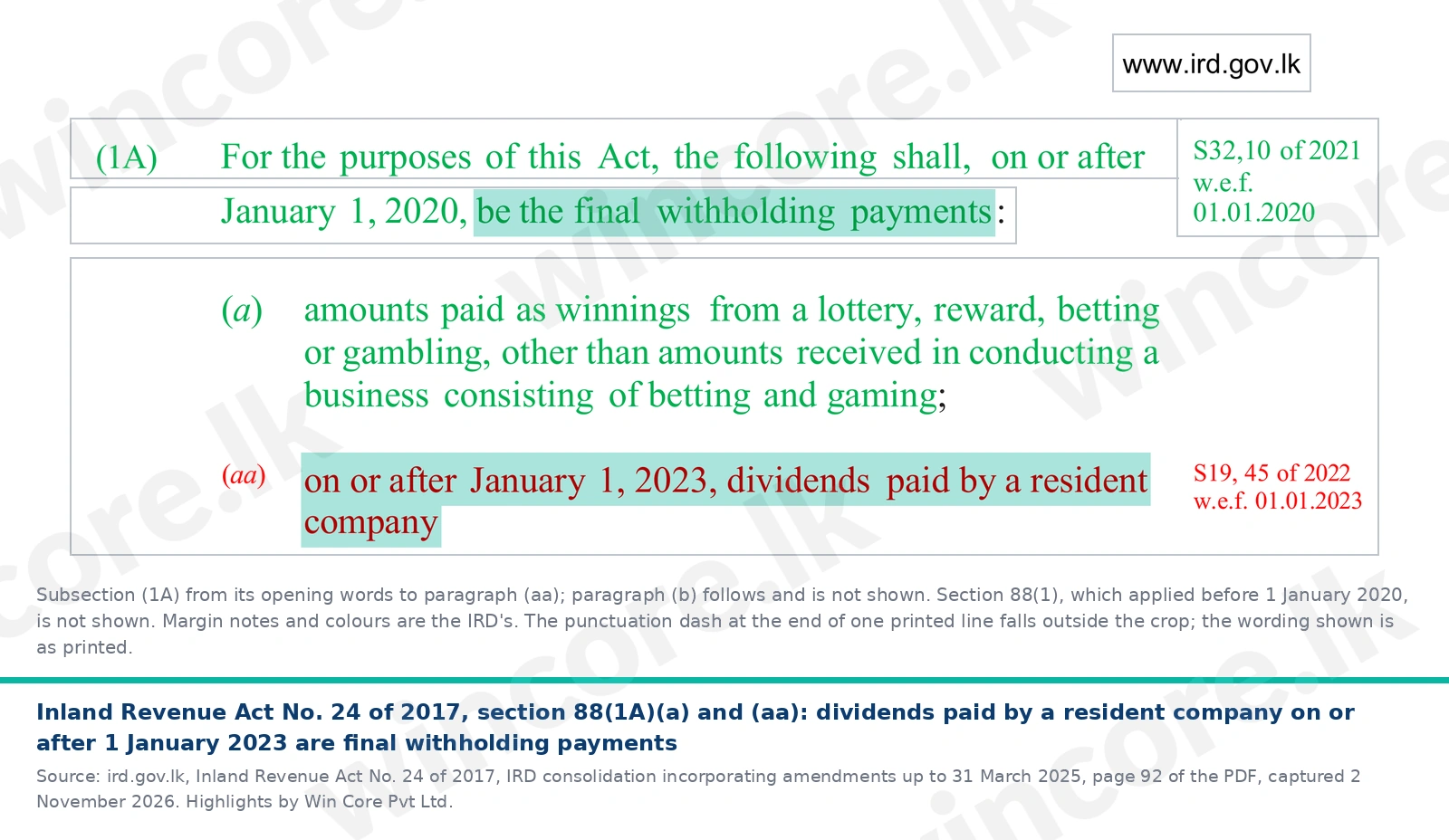
When an exemption applies. Under section 84(3)(e), read with section 84A and section 9, withholding does not apply to an exempt amount. The Third Schedule, paragraph (ooo)(ii), exempts a dividend paid by a resident company to a member to the extent it is attributable to or derived from another dividend received by that company or another resident company [3] [4] [5]. Other specific exemptions and conditions may apply. Identify the source of the dividend and the applicable provision before deducting tax; do not apply an exemption to the whole payment without establishing its scope.
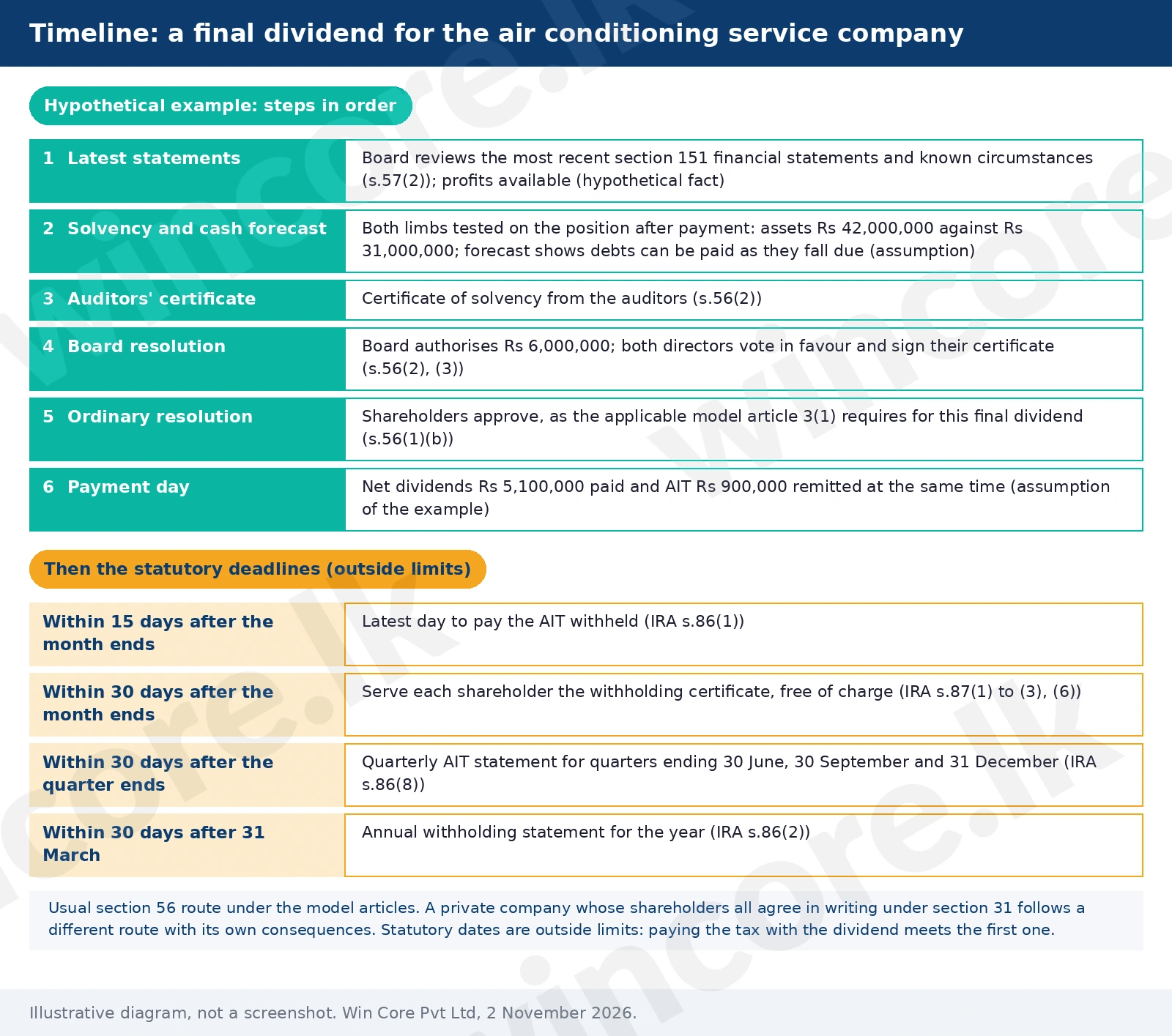
The payer's duties. A payment is not limited to handing over cash: section 195 includes making money available in its definition of payment, and its definition of received includes amounts credited or made available for a person. Identify when the dividend is paid on the facts [3]. Section 86(1) requires the withholding agent to pay tax withheld within fifteen days after the end of the calendar month of withholding. For this dividend withholding, section 87(1) to (3) requires a certificate for the calendar month to be served within thirty days after that month ends. Section 87(6), effective from 3 June 2026, requires it to be free of charge [3] [7]. Where relevant, section 87(5) also requires a resident company paying a member a dividend to certify the amount attributable to another dividend with the withholding or certificate history stated in that subsection [3].
Section 86(2) requires an annual withholding statement within thirty days after the year ending 31 March. Section 86(8) also specifies quarterly statements for AIT deducted under section 84A for the quarters ending 30 June, 30 September and 31 December, within thirty days after the end of each such quarter. Follow the Commissioner's specified forms and procedures [3] [5] [7]. Our guide to the WHT annual statement and certificate covers the annual filing.
Step 1: Profits and figures
Review the company's financial statements and establish the profits available for the proposed dividend. Check its articles and share rights, and identify any liabilities or events affecting the proposed post payment position.
Step 2: Solvency test and auditors' certificate
For the usual section 56 route, the board applies both limbs of the test to the position immediately after the proposed distribution and obtains the auditors' certificate of solvency. Consider the most recent section 151 statements and the circumstances the directors know or ought to know.
Step 3: Board resolution and directors' certificate
The board authorises the distribution when satisfied about post distribution solvency. The directors voting in favour sign the certificate of their opinion. Record the amount, the relevant share class and the intended payment arrangements.
Step 4: Shareholder approval
Under the usual section 56 route, obtain an ordinary resolution unless the articles provide otherwise. Model article 3(2) provides an exception for a qualifying interim dividend. The separate section 31 route requires written agreement of all shareholders and has its own consequences.
Step 5: Payment and tax
For a taxable dividend like the example, deduct 15 percent, pay each shareholder the net amount and pay the withheld tax within fifteen days after the month ends. Serve the monthly withholding certificates free of charge within thirty days after that month ends, and meet the applicable statement requirements.
Worked example: Rs 6,000,000 gross leaves Rs 5,100,000 net
The hypothetical company has two resident individual shareholders who hold 60 and 40 percent of its fully paid ordinary shares in the same class. Both directors vote in favour. Its figures immediately before the dividend are: assets Rs 48,000,000, including Rs 10,000,000 cash, liabilities Rs 21,000,000 and stated capital Rs 10,000,000. It has profits available and proposes a final cash dividend of Rs 6,000,000 from its own trading profits. No exemption applies.
The company pays the net dividends and remits the withheld tax at the same time. Its post payment forecast shows that the remaining Rs 4,000,000 cash and expected receipts cover debts as they fall due. That forecast is an assumption for the example, not a conclusion that follows from the balance sheet figures alone.
| Line | Rule | Figure (Rs) |
|---|---|---|
| Assets after the dividend and tax remittance | 48,000,000 less 6,000,000 | 42,000,000 |
| Liabilities | unchanged after the simultaneous remittance | 21,000,000 |
| Stated capital | unchanged | 10,000,000 |
| Liabilities plus stated capital | model article 3(3)(b) | 31,000,000 |
| Balance sheet limb | 42,000,000 is greater than 31,000,000 | Passes |
| Cash limb | forecast assumes debts can be paid as they fall due | Passes |
| Shareholder A gross, 60 percent | 6,000,000 x 60 percent | 3,600,000 |
| Tax withheld at 15 percent | 3,600,000 x 15 percent | 540,000 |
| Shareholder A net | 3,600,000 less 540,000 | 3,060,000 |
| Shareholder B gross, 40 percent | 6,000,000 x 40 percent | 2,400,000 |
| Tax withheld at 15 percent | 2,400,000 x 15 percent | 360,000 |
| Shareholder B net | 2,400,000 less 360,000 | 2,040,000 |
| Total tax paid to the IRD | 540,000 plus 360,000 | 900,000 |
Hypothetical figures.
On these assumptions the company passes both limbs, with Rs 11,000,000 above the sum in the balance sheet comparison. Under the applicable model article and usual section 56 route, the board obtains the auditors' certificate, both directors voting in favour sign their certificate, and the shareholders pass an ordinary resolution. The company pays Rs 5,100,000 net and remits Rs 900,000 tax, a total cash outflow of Rs 6,000,000.
What this means for you
Confirm the proposed dividend's source and check the applicable articles and share rights. For the usual section 56 route, test the position after payment, obtain the auditors' certificate and have the directors voting in favour sign their certificate. Obtain shareholder approval where required, or consider whether the separate unanimous agreement rule applies. For a taxable dividend to a resident individual, deduct 15 percent, pay and certify it on time, and file the applicable statements.
Checklist: documents needed
- Financial statements and evidence of profits available
- Post distribution solvency working and cash forecast
- Auditors' certificate for the usual section 56 route
- Board resolution and certificate signed by directors voting in favour
- Shareholder resolution where required, or the section 31 written agreement where used
- Dividend vouchers and payment records
- Tax payment record, withholding certificates and applicable statements
FAQ
Who declares a dividend in a Sri Lankan private company?
Under the usual section 56 route, the board authorises it after obtaining the auditors' certificate and being satisfied about post distribution solvency. Directors voting in favour sign their own certificate. Shareholders approve by ordinary resolution unless the articles provide otherwise. A private company may instead meet the conditions of the separate unanimous written agreement rule in section 31 [1].
What is the solvency test for a dividend?
The company must be able to pay debts as they become due in the normal course of business, and section 57 also compares assets with liabilities and stated capital. Model article 3(3) expressly compares assets with their sum. Apply the assessment to the position immediately after the distribution and consider the statutory information requirements [1].
What happens if a dividend is paid when the company is not solvent?
The company may recover a distribution under section 61, subject to the three conditions protecting a shareholder. A director's liability for an unrecovered amount also depends on the procedure or reasonable grounds condition and the director's role. The court has the limited relief power in section 61(3). Section 31 has separate rules for its route [1].
Is tax deducted from a dividend to a resident individual?
Yes, where the dividend is taxable and the withholding rules apply. A resident company deducts 15 percent AIT from the kind of dividend in our example, and section 88 treats it as a final withholding payment. The company pays the tax within fifteen days after the month ends and serves the monthly certificate free of charge within thirty days after month end [3] [4] [7].
The short version
Under the usual section 56 route, the board obtains an auditors' solvency certificate, authorises the distribution and has directors voting in favour sign their own certificate; shareholder approval depends on the articles. Assess both limbs immediately after the payment, using the applicable articles. Section 31 provides a separate unanimous written agreement route for a private company, with its own solvency and recovery consequences. For the taxable resident individual example, deduct 15 percent, pay the tax within fifteen days after month end, serve the certificate free within thirty days and file the applicable statements.
Talk to us. For Board Meeting Management, see our company secretarial services or book a consultation at wincore.lk/contact.
WinCore Pvt Ltd
This article is general information as at 2 November 2026 and is not tax, legal or accounting advice on your specific position.
Sources and references (9)
- Parliament of Sri Lanka. Companies Act, No. 07 of 2007, sections 14, 31, 56, 57, 60, 61, 116, 148 and 514, First Schedule article 3 and Second Schedule. https://www.parliament.lk/uploads/acts/gbills/english/3776.pdf . Primary. Accessed 2 November 2026.
- Parliament of Sri Lanka. Companies (Amendment) Act, No. 12 of 2025, section 21 and Schedule; Gazette Extraordinary No. 2480/47, commencement order. https://www.parliament.lk/uploads/acts/gbills/english/6389.pdf . Primary. Accessed 2 November 2026.
- Parliament of Sri Lanka. Inland Revenue Act, No. 24 of 2017, sections 9, 86, 87, 88 and 195 and Schedules, as amended; IRD consolidation to 31 March 2025, used for navigation and Figure 5: https://www.ird.gov.lk/en/publications/Acts_Income%20Tax_2017/IRA_Cons_Act_-_2025_Changes.pdf ; Act as enacted: https://www.ird.gov.lk/en/publications/Acts_Income%20Tax_2017/IR_Act_No_24_2017_E.pdf . Primary. Accessed 2 November 2026.
- Parliament of Sri Lanka. Inland Revenue (Amendment) Act, No. 45 of 2022, sections 16, 19, 33(6), 35(4) and commencement table, as corrected by Act No. 4 of 2023. https://www.ird.gov.lk/en/publications/Acts_Income%20Tax_2017/IR_Act_No._45_2022_E.pdf . Primary. Accessed 2 November 2026.
- Parliament of Sri Lanka. Inland Revenue (Amendment) Act, No. 4 of 2023, sections 7, 20 and 23 and commencement table. https://www.ird.gov.lk/en/publications/Acts_Income%20Tax_2017/IR_Act_No._04_2023_E.pdf . Primary. Accessed 2 November 2026.
- Parliament of Sri Lanka. Inland Revenue (Amendment) Act, No. 2 of 2025, sections 1, 3 and 4. https://www.ird.gov.lk/en/publications/Acts_Income%20Tax_2017/IR_Act_No_02-2025_E.pdf . Primary. Accessed 2 November 2026.
- Parliament of Sri Lanka. Inland Revenue (Amendment) Act, No. 11 of 2026, sections 1, 12, 14, 15, 36 and 38. https://www.ird.gov.lk/en/publications/Acts_Income%20Tax_2017/IR_Act_No_11-2026_E.pdf . Primary. Accessed 2 November 2026.
Related reading: Amalgamation Companies Act Sri Lanka: the steps.
Put these insights to work
WinCore specialists can review your current workflow, document gaps, and build a practical 90-day action plan.
Book a free consultationRecent articles



Continue reading
Explore more WinCore analysis to keep your finance, tax, and compliance roadmap moving.
A company paying a dividend keeps back 15% and that settles the shareholder's tax. What the board must check first, and which dividends carry no tax.

No minimum share capital applies to a resident private company. How much to put in as stated capital, how much to lend, and the half-of-capital test.
WHT reporting breaks when certificates and annual statements are treated as year-end admin. Build a monthly evidence workflow that files cleanly.