
Share certificate Sri Lanka: issuing one and replacing a lost one
How to prepare share certificates, check the register and replace a lost certificate, including the stamp duty and beneficial ownership rules.

On this page
Last verified against the primary sources on 2 November 2026.
Share certificate Sri Lanka, in brief. Section 78(1) of the Companies Act, No. 7 of 2007 requires a company to complete and have share certificates ready for delivery within two months of allotment or a qualifying transfer being lodged, unless the conditions of issue provide otherwise [1]. A certificate signed as described in section 79 and a share register entry are each prima facie evidence of title, not conclusive proof [1]. A separate stamp duty exemption for a certificate issued in place of one lost or destroyed has applied since 6 October 2006 [3].
Our example is a hypothetical boatyard company, a private company, one of whose shareholders has lost the certificate for 2,000 ordinary shares. We cover the duty to have certificates ready, what a certificate shows, the register, replacement, certificates after an issue or transfer, stamp duty, beneficial ownership reporting and a checklist.
Share certificate Sri Lanka: ready within two months unless issue terms differ
Section 78(1) applies to every company and covers both new shares and transfers [1]. The company must complete and have the certificate ready for delivery within two months from the date of allotment, or within two months from the date a qualifying transfer is lodged with the company, unless the conditions of issue provide otherwise. The section's definition of transfer requires it to be duly stamped and otherwise valid; it excludes a transfer which the company is entitled to refuse to register and does not register [1].
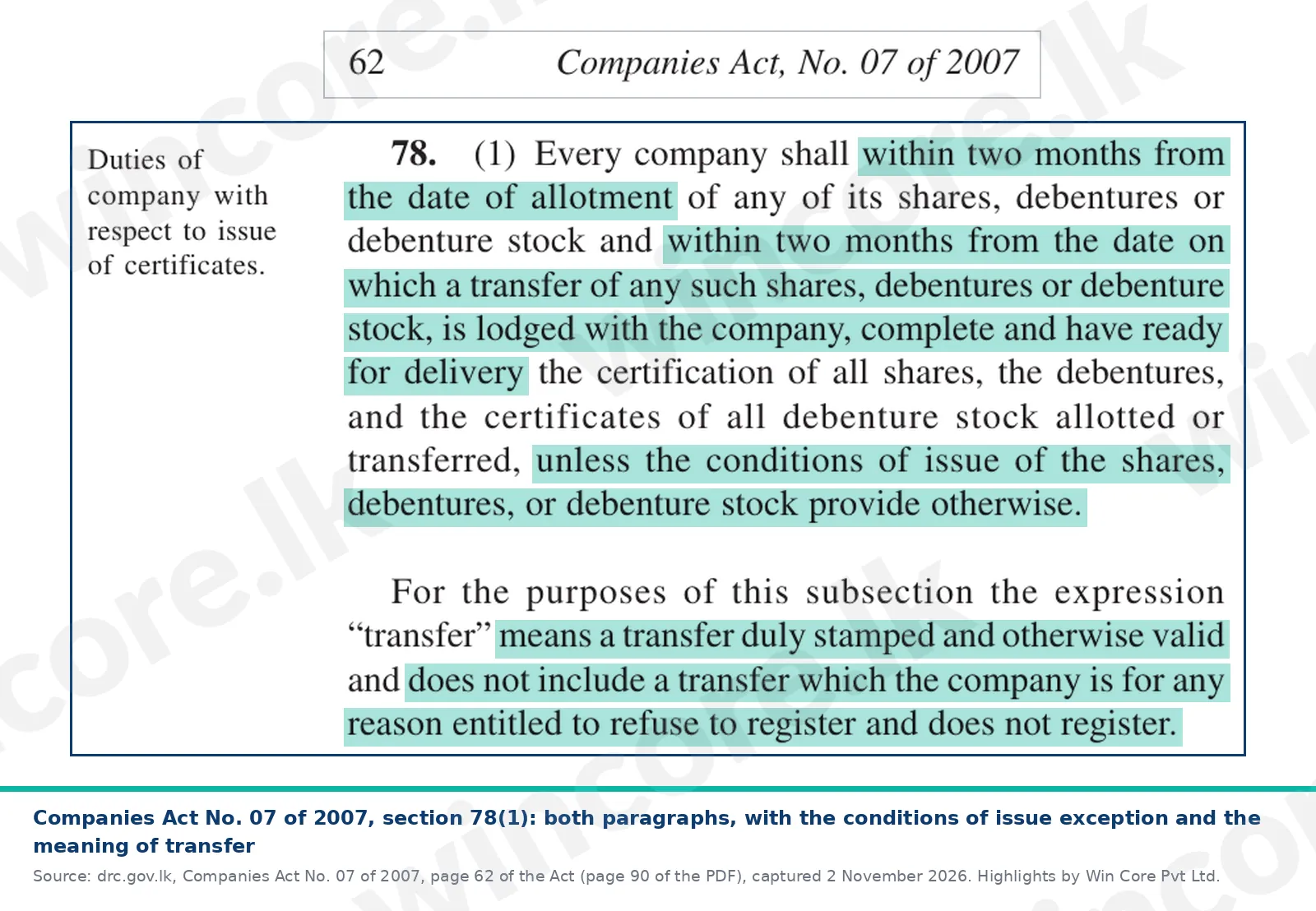
The obligation is to complete the certificate and have it ready for delivery. It is not worded as a requirement to deliver it to the shareholder within those two months. Record the allotment date or the date a qualifying transfer is lodged, check the issue conditions, and track when the certificate is complete and ready. Keeping that record is practice, not a separate requirement stated in section 78.
If the company fails to comply, section 78(2) makes both the company and every officer in default guilty of an offence. On conviction, the fine is up to Rs 50,000 for the company and up to Rs 50,000 for each officer in default [1]. For this purpose, an officer in default is a director, manager, secretary or other officer who knowingly and wilfully authorises or permits the default [1]. Section 514's composition power concerns defaults in documents or notices to the Registrar; it does not, by its wording, cover the section 78 certificate default [1].
Under section 78(3), if a notice requiring the company to make good the default is served and the company fails to do so within ten days of service, the person entitled to delivery may apply to court. The court may order the company and an officer to make good the default within a specified time and may make an order about the application costs [1]. First Schedule model article 4(6), where applicable, also provides for a certificate to be ready within two months after an issue or entry of a transfer on the register [1].
A certificate signed by a director and the secretary is evidence of title
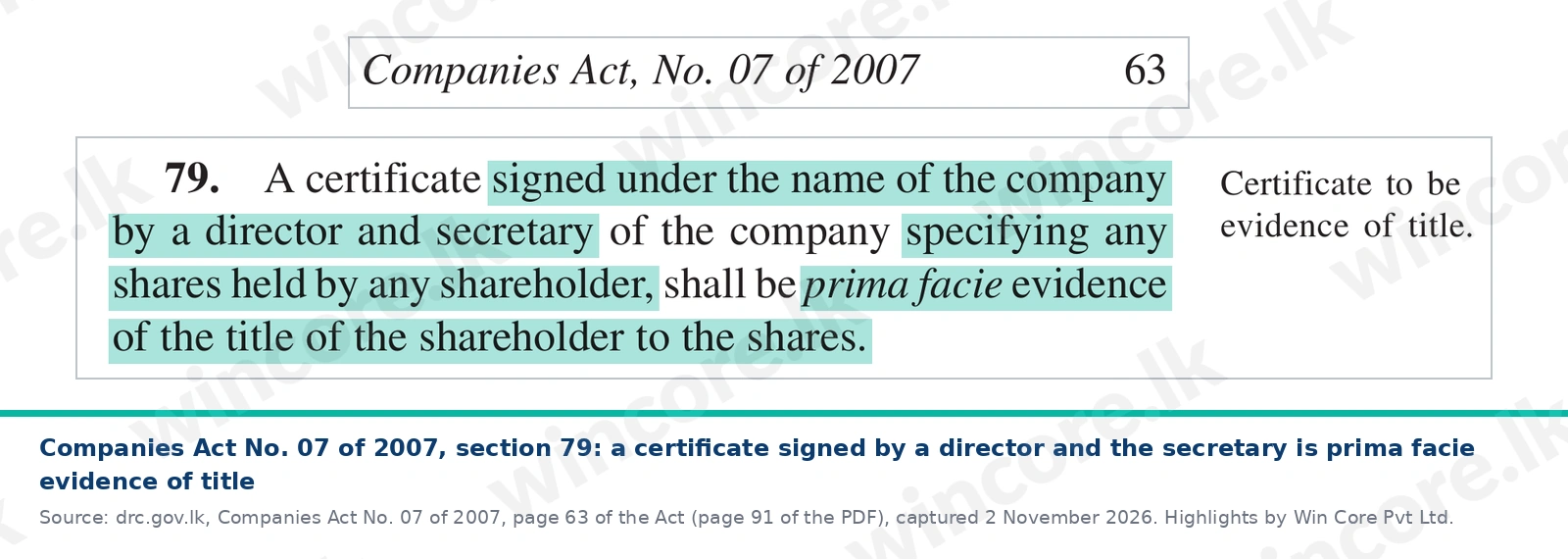
Section 79 says that a certificate signed under the company's name by a director and the secretary, specifying shares held by a shareholder, is prima facie evidence of that shareholder's title [1]. Prima facie evidence supports the stated title, but it can be challenged. It is not the same as conclusive proof.
Section 79 describes the certificate that has this evidential effect. It does not set out a complete certificate layout. The company can identify the holder and shares clearly and use a certificate number, the share class and a cross reference to its records. These additional details are practical controls, not requirements expressly listed in section 79. Check the company's articles and the conditions of issue as well.
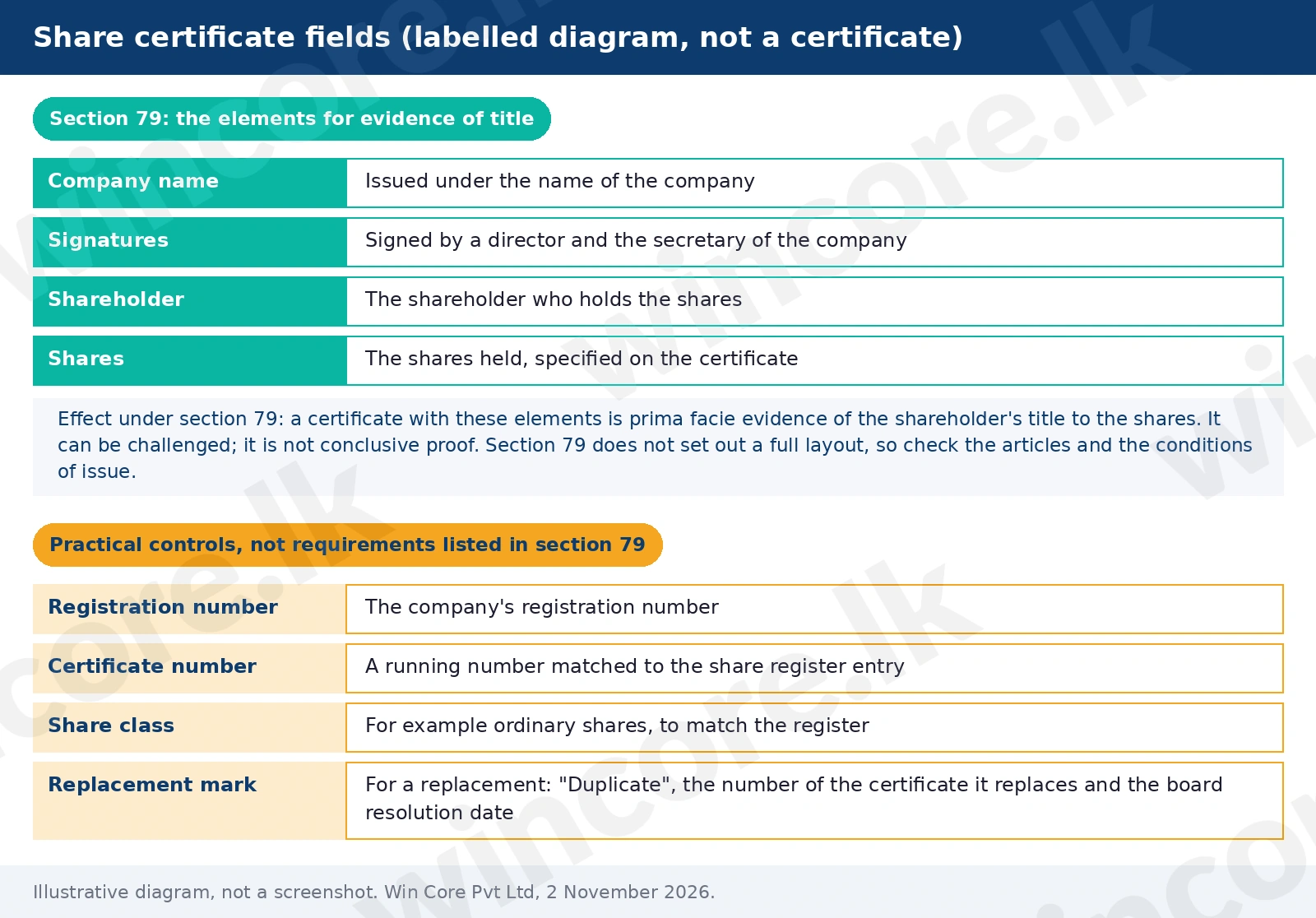
A certificate number helps the company distinguish one document from another when it later records a replacement. A share class helps the reader identify the holding against the register. The company should compare the details and the signatures against its records before having the certificate ready. These checks are practice, not additional statutory requirements under section 79.
The share register entry is also evidence of title
Section 123(1) requires a company that has issued shares to maintain a share register. It records each current shareholder and anyone who has been a shareholder within the last ten years, with their latest known address, the number of shares of each class held within that period, and the dates of issues, repurchases, redemptions and transfers. For a transfer it also records the other party's name [1].
Section 130(1) makes the entry of a person's name as holder prima facie evidence that title to the share is vested in that person [1].
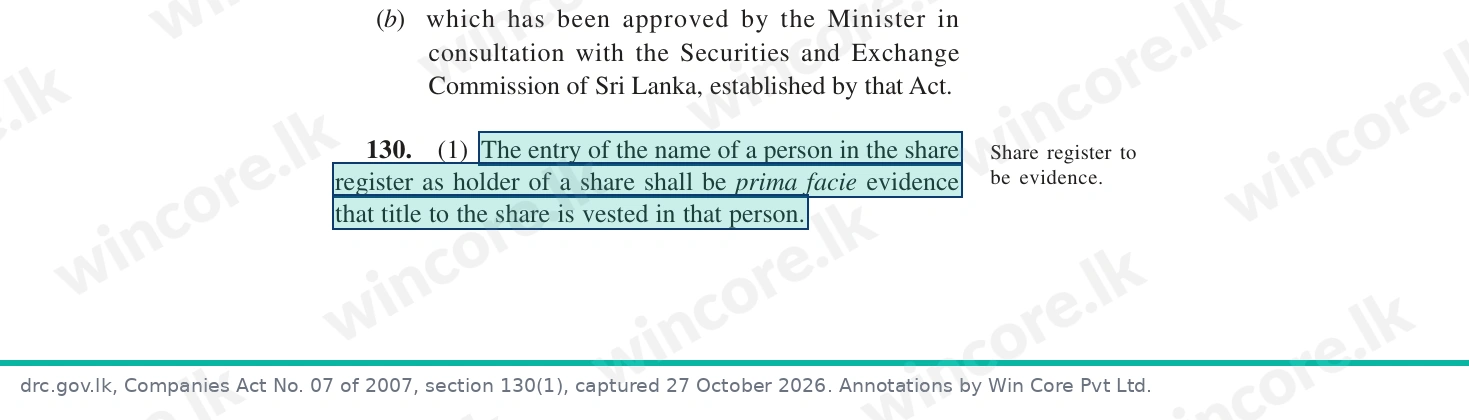
Losing the paper certificate does not by itself mean that the shareholder has lost the shares. The register entry remains evidence of title, although it is not conclusive and can be disputed or corrected under the Act [1]. Compare the lost certificate's details, if available, with the register before preparing its replacement. See our guide to statutory registers for how the register is kept.
The register and a certificate have different uses. The company maintains the register as its record of issued shares; the certificate is a document describing a shareholder's holding. Neither should be treated as immune from a correction if the underlying entry or stated holding is wrong. The board should resolve a discrepancy before it prepares a new document rather than copying an error into it.
Replacing a lost or damaged certificate follows the articles and practice
A search of the Companies Act and its model articles on 2 November 2026 for lost, defaced, damaged, destroyed, duplicate and replacement certificates found no general procedure for replacing a lost share certificate [1]. The company's own articles may set a procedure, so check them first. Where they are silent, the steps below are possible practice, not a legal requirement imposed by those sections. The company should adapt them to its circumstances.
Step 1: Written request and declaration
The shareholder can write to the company explaining the loss or damage. The company can ask for a damaged certificate to be returned or, for a lost one, a statutory declaration or affidavit describing the loss. It can compare the request with the share register and investigate a discrepancy before proceeding.
Step 2: Indemnity
The company can ask the shareholder to sign an indemnity in its favour against a claim connected with the original certificate. The wording and whether an indemnity is appropriate depend on the circumstances and the company's articles. An indemnity is a practical safeguard, not a requirement stated in section 79.
Step 3: Board resolution
The board can consider the request and resolve to record the old certificate as cancelled and prepare a replacement. The resolution can identify the shareholder, the holding and the reason for replacement. Recording a certificate as cancelled does not itself cancel the shares or determine a disputed title.
Step 4: Issue the replacement
A replacement that is signed under the company's name by a director and the secretary and specifies the holder's shares has the evidential effect described in section 79 [1]. As a practical control, mark it as a duplicate, cross refer to the old number and record the old number as cancelled. Keep the request and decision with the company's records.
Section 78's two month period expressly concerns allotments and qualifying lodged transfers. The company should not assume that it is a separate statutory deadline for a replacement of a certificate for the same unchanged holding. It can agree a practical timetable for dealing with the request.
Certificates follow a new issue or a qualifying transfer
On a new issue, the section 78 period runs from allotment, alongside the separate notice under section 51(4); see our post on the issue of shares and Form 6. On a qualifying transfer, it runs from lodgement with the company, subject to the conditions of issue and the section's definition of transfer. See our guide to share transfers in a private company.
A change in holder requires the underlying transaction and register to be considered. Simply writing a different name on a replacement certificate is not a substitute for a valid transfer or other basis for the change. The company should check the instrument, any relevant restrictions and its register before preparing the certificate [1].
Stamp duty and beneficial ownership depend on the event
Item 35, added to the exemption Order by Gazette Extraordinary No. 1947/46, exempts a share certificate issued consequent to an issue, transfer or assignment of any number of shares of any company [2]. The Inland Revenue Department states that this exemption applies from 1 January 2016 [2].

Separately, item 5 of the exemption Order in Gazette No. 1465/20 exempts a share certificate issued in place of one lost or destroyed. The same item also addresses a new certificate for a greater or smaller number of shares in place of existing certificates, with the value limit stated in the Order. It took effect on 6 October 2006 [3]. A damaged certificate is not necessarily lost or destroyed, so check the circumstances against the wording of item 5. The exemption for a certificate should not be confused with the treatment of a separate transfer instrument. See our post on the Stamp Duty Act No. 12 of 2006.
The Companies (Beneficial Ownership) Regulations, No. 1(I) of 2026, in force from 9 October 2026, require a company to notify beneficial owner details in Form BO 2 within twenty working days of an issue of shares or Form BO 3 within twenty working days of a transfer. Regulation 7 requires notification of changes to beneficial owner information in Form BO 8 within fourteen working days of the change [4]. Under section 130A, in force from 30 March 2026, every shareholder has a separate duty to give the details specified in section 130A(1) to the company within ten working days of a subscription or transfer. Section 130A(7) also requires the company to notify the Registrar within fourteen working days of receiving details that a person holds, acquires or subsequently changes beneficial ownership [5].
On our reading, replacing a lost certificate for the same unchanged holding is not itself an issue or transfer of shares and does not itself change beneficial owner information. It therefore does not by itself trigger those event based notifications. Check separately for a real transfer, a change in beneficial owner information or another outstanding reporting obligation. Issuing a certificate to a different person does not by itself establish that a transfer has taken place.
Worked example: replacing the certificate for 2,000 shares
| Step | Rule or practice | Detail |
|---|---|---|
| Check the holding | Sections 123 and 130(1) | Register shows 2,000 ordinary shares in the shareholder's name |
| Request and declaration | Possible practice | Letter and statutory declaration of loss |
| Indemnity | Possible practice | Signed in favour of the company if requested |
| Board resolution | Articles and possible practice | Record old certificate as cancelled and prepare a duplicate |
| New certificate | Section 79 and possible practice | Director and secretary sign; mark duplicate as a control |
| Stamp duty | Gazette 1465/20 item 5 | Certificate issued in place of the lost certificate is exempt [3] |
| BO form | Regulations 2(2), 7 and section 130A(7) | On our reading, the replacement alone triggers none of those event based notifications |
Hypothetical example.
The company records that the shareholder still holds the same 2,000 ordinary shares. It prepares a replacement after checking the request and its articles. The certificate and the register entry provide prima facie evidence of title; neither is conclusive. A separate issue, transfer or change in beneficial owner information would need its own reporting review.
What this means for you
- Track the date of allotment or lodgement of a qualifying transfer and the relevant issue conditions.
- Have the certificate complete and ready for delivery within the applicable period.
- Use the signatures and share details described in section 79 for its evidential effect, and keep the register current.
- Check the company's articles and select practical safeguards before replacing a lost certificate.
- Distinguish a replacement of the same holding from a separate issue, transfer or change in beneficial ownership information.
Checklist: documents needed
- Share register entry for the holding
- Company's articles and relevant conditions of issue
- Shareholder's written request, if used
- Declaration or affidavit of loss, or damaged certificate, if requested
- Indemnity and board resolution, if used
- Replacement certificate and certificate records
FAQ
How long does a company have to issue a share certificate?
Section 78(1) gives the company two months to complete and have the certificate ready for delivery after an allotment or lodgement of a qualifying transfer, unless the conditions of issue provide otherwise. The transfer must meet the section's definition. The statutory wording concerns readiness for delivery, not a separate deadline to deliver it [1].
What happens if a share certificate is lost?
Losing the certificate does not by itself mean the shares are lost. The share register entry remains prima facie evidence of title under section 130(1), although it is not conclusive. Check the company's articles for a replacement process. A written request, declaration, indemnity and board decision are possible safeguards, not universal statutory requirements [1].
Is stamp duty payable on a share certificate?
A certificate issued consequent to an issue, transfer or assignment of shares is exempt under item 35 of the exemption Order. Item 5 separately exempts a certificate issued in place of one lost or destroyed. A damaged certificate needs its own fact specific check against item 5. A separate transfer instrument is a different question [2] [3].
Does a replacement certificate need a BO form?
On our reading, a replacement alone for the same unchanged holding does not trigger the issue, transfer or change notifications described above. An actual issue or transfer requires a separate review under Form BO 2 or BO 3, and a change in beneficial owner information has its own reporting rule. Existing outstanding obligations still need attention [4] [5].
The short version
A company has two months from allotment or lodgement of a qualifying transfer to complete and have a certificate ready for delivery, unless the conditions of issue provide otherwise. A certificate signed as section 79 describes and a share register entry are each prima facie evidence of title. Follow the articles and choose practical safeguards when replacing a lost certificate. A certificate issued in place of one lost or destroyed is exempt under item 5, and, on our reading, replacement alone for the same unchanged holding does not trigger the specified BO event notifications.
Talk to us. For Share Transfer Management and Corporate Document Maintenance, see our secretarial and compliance help.
WinCore Pvt Ltd
This article is general information as at 2 November 2026 and is not tax, legal or accounting advice on your specific position.
Related reading
- Bonus shares Sri Lanka: how does a private company issue them?
Sources and references (6)
- Department of the Registrar of Companies. Companies Act, No. 07 of 2007, sections 14, 51, 73, 78, 79, 123, 128, 130, 514 and 529, and First Schedule article 4. https://www.parliament.lk/uploads/acts/gbills/english/3776.pdf . Primary. Accessed 2 November 2026.
- Inland Revenue Department. Gazette Extraordinary No. 1947/46, Order under section 5 of the Stamp Duty (Special Provisions) Act, No. 12 of 2006, item 35; and IRD notice of implementation from 1 January 2016. https://www.ird.gov.lk/en/publications/Gazette_Documents/2016_1947_46_E.pdf and https://www.ird.gov.lk/en/Lists/Latest%20News%20%20Notices/Attachments/48/SD01012016_E.pdf . Primary. Accessed 2 November 2026.
- Inland Revenue Department. Gazette Extraordinary No. 1465/20, Order under section 5 of the Stamp Duty (Special Provisions) Act, No. 12 of 2006, item 5 and commencement. https://www.ird.gov.lk/en/publications/Gazette_Documents/2006_1465-20_E.pdf . Primary. Accessed 2 November 2026.
- Department of the Registrar of Companies. Companies (Beneficial Ownership) Regulations, No. 1(I) of 2026, Gazette Extraordinary No. 2509/67, regulations 1, 2(2), 7 and 11. https://drc.gov.lk/en/?p=5001 . Primary. Official scan reviewed 2 November 2026.
- Parliament of Sri Lanka. Companies (Amendment) Act, No. 12 of 2025, section 7 inserting section 130A, and the commencement Order in Gazette Extraordinary No. 2480/47. https://www.parliament.lk/uploads/acts/gbills/english/6389.pdf . Primary. Accessed 2 November 2026.
Put these insights to work
WinCore specialists can review your current workflow, document gaps, and build a practical 90-day action plan.
Book a free consultationRecent articles




Continue reading
Explore more WinCore analysis to keep your finance, tax, and compliance roadmap moving.
Issue new shares under the Companies Act: the board resolution, pre-emption, the twenty-working-day Form 6 and BO 2 deadlines, and stamp duty.

The steps to move shares between two people in a private company, from the instrument and the board to TIN certificates, BO 3 and the seller's gains tax.
Which registers a Sri Lankan company must keep, where they may be kept, who can inspect them, how long to keep them and the ten-working-day notices.