
After company registration Sri Lanka: the first 90 days
The first 90 days after company registration in Sri Lanka, in date order: registers, board meeting, bank and TIN, tax, EPF and ETF, APIT and bookkeeping.

On this page
Last verified against the primary sources on 26 October 2026.
After company registration Sri Lanka, in brief. The certificate of incorporation is the start, not the finish. In the first 90 days a new company should set up its minute book and registers, hold its first board meeting, open a bank account, register for its TIN within 30 days, register with EPF within two weeks of its first hire, set up APIT, keep its beneficial ownership filings (Forms BO 1 and BO 5) in order, and start bookkeeping from day one. The first AGM and annual return come later, but the dates are set now.
Take a hypothetical engineering consultancy, incorporated by two resident engineers. Day 0 is the date on its certificate of incorporation. This hub post lists each step in date order and links to the detailed guide for each. It does not repeat them.
Day 0 to 7: set up the minute book and registers, with Forms BO 1 and BO 5 filed at incorporation
What to do. Keep the certificate of incorporation, the registered articles and the incorporation forms in one place. Open a minute book for board and shareholder decisions, and set up the statutory registers (share register, directors, secretary, and the register of beneficial owners).
Beneficial ownership, Forms BO 1 and BO 5. The Companies (Amendment) Act, No. 12 of 2025 requires every company to appoint "a natural person residing in Sri Lanka as the authorised person" responsible "for the safe keeping of the register of the beneficial owners of the company" (section 130C(1)) [2]. Section 130C(2) requires the company to disclose that person's details "at the time of incorporation and any subsequent changes to such authorised person in a form as may be prescribed". Regulation 4(1) of the Beneficial Ownership Regulations in Gazette 2509/67 prescribes Form BO 5, and regulation 2(1) requires the company to notify its beneficial owners on Form BO 1 "at the time of its incorporation" [3]. A late beneficial ownership form costs Rs 1,000 for each week or part of a week (Gazette 2511/47, from 22 October 2026).
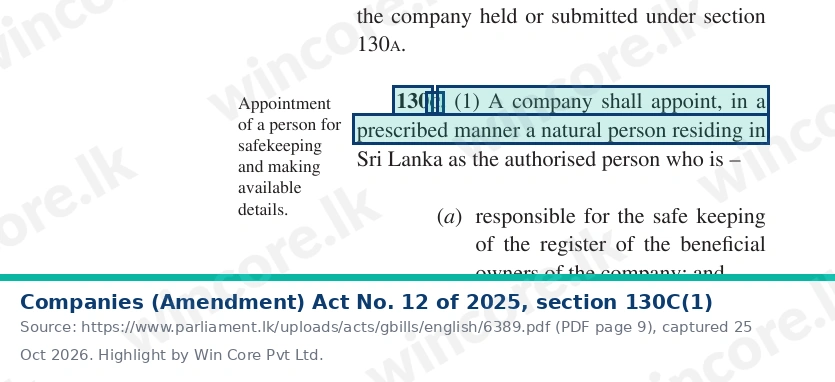
Detail: how to register a company.
Day 1 to 14: hold the first board meeting and pass six resolutions in one sitting
What to do. Hold the first board meeting and minute the decisions. Typical resolutions:
- Open a bank account and name the signatories.
- Confirm the company secretary. Every company must have one (s.221(1)), and where stated capital is Rs 500,000 or more or annual turnover Rs 1 million or more, the secretary must meet the qualification rules in the Companies (Secretaries) Regulations No. 1 of 2023.
- Adopt a financial year end.
- Appoint the first auditor. Section 159(1) of the Companies Act says the first auditor "may be appointed by the board of the company before the first annual general meeting" [1].
- Issue share certificates and enter shareholders in the share register.
- Authorise a director to register the company for tax and with EPF.
For the consultancy, the board meets on day 3 and passes these resolutions in one sitting.
Day 3 to 21: open the bank account; the TIN Certificate rule binds the founders, not the company
What to do. Take the board resolution, certificate of incorporation, articles and directors' identity documents to the bank.
The TIN Certificate, deferred to 1 April 2027. The IRD notice SEC/PN/IT/2026/05 says that, under the Inland Revenue (Amendment) Act No. 11 of 2026, every person specified under section 102(3) "shall, with effect from 1 November 2026, be required to submit a valid TIN Certificate" for listed transactions, including "To open any account at any bank or financial institution", "To register a business" and "To transfer shares of a company incorporated in Sri Lanka, by the transferee and transferor" [4]. The notice says a TIN is mandatory for resident individuals aged 18 or over, under Gazette 2334/21 issued in terms of section 102(3). The Act itself says "with effect from April 1, 2026" (s.103(6)(b)); the IRD set the check for 1 November 2026 and has deferred it to 1 April 2027 (IRD notice SEC/PN/IT/2026/06, 5 November 2026). The IRD's circular to banks and other officials, SEC/2026/E/07, exempts "Any Entity other than an individual", including a company, so the company's own account is outside the rule on its terms. The founders need certificates for their own accounts and for any share transfer, and on our reading a bank may still ask signatories for theirs. The notice says "A printout of the verification result, clearly showing the individual's National Identity Card (NIC) number and TIN, may also be accepted" [4].
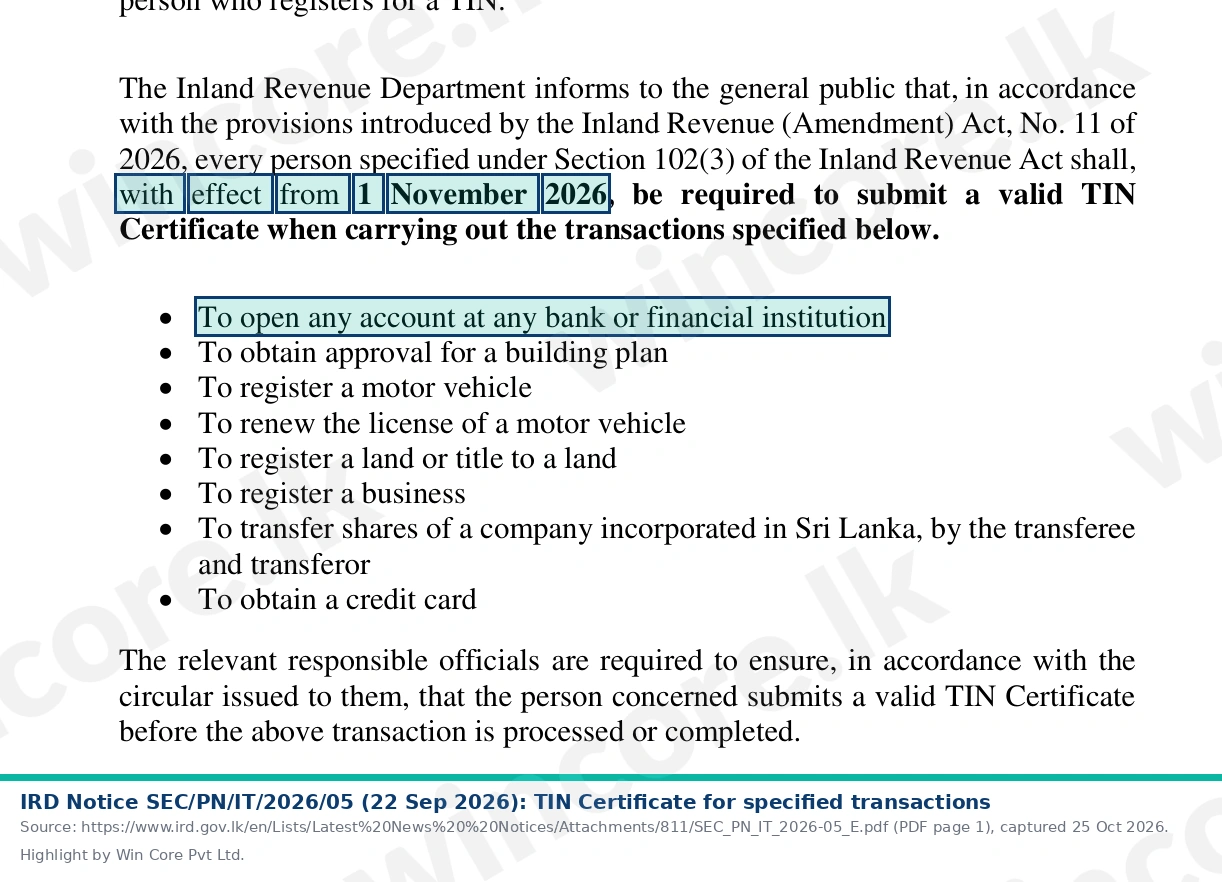
Detail: the TIN Certificate and its deferral.
Day 7 to 30: register the company's TIN by day 30, and VAT and SSCL only if they apply
Income tax. Register the company with the IRD "not later than thirty days from the date of such incorporation" (Inland Revenue Act s.102(1A), inserted by Act No. 11 of 2026 and in force from 3 June 2026) [5]. For the consultancy, that is by day 30. Once the company has its TIN, corporate income tax is registered automatically; VAT, SSCL and APIT are separate registrations.
VAT, only if the threshold applies. Section 10(1) of the VAT Act requires registration where the value of taxable supplies in a taxable period "has exceeded fifteen million rupees" or, in twelve months, "has exceeded sixty million rupees", or is likely to exceed either [6]. A company that imports or exports goods for commercial purposes must register whatever its turnover (s.10(1)(ix)). A new consultancy usually starts below the thresholds; check each period.
SSCL, only if the threshold applies. From 1 July 2026, the IRD notice on Act No. 10 of 2026 says the SSCL registration threshold "has been reduced from Rs. 15 million to Rs. 9 million for a quarter, and from Rs. 60 million to Rs. 36 million for a period of four consecutive quarters [Section 4(1) (d)]" [7].
First hire: EPF Form D within two weeks, then APIT before the first salary
EPF registration (ETF has none)
What to do. Register the company as an EPF employer by sending Form D to the Commissioner of Labour "within two weeks from the date he becomes so liable" to pay contributions, which is when the first employee starts (EPF Regulations 1958, reg 8) [10]. Registering before the first payroll is good practice. ETF has no separate registration: the ETF Board uses the EPF number, or a temporary number until it arrives [11].
Contributions start with the first month of employment. EPF Act section 10(2) makes the employer liable for 12 percent of each employee's total earnings, payable "on or before the last day of the succeeding month" [8]. ETF Act section 16(1) adds 3 percent, on the same timing [9]. Our EPF calculator shows the 12 percent and 3 percent employer amounts, and the 8 percent employee share, for a given salary. The consultancy hires a draughtsman about a month after incorporation, so its Form D is due within two weeks of his first day, and the contributions for his first month of work by the last day of the following month.
Detail: EPF employer registration.
APIT set-up
What to do. Before the first salary, set up Advance Personal Income Tax (APIT) deduction under section 83A of the Inland Revenue Act [5], using the IRD's current APIT tables, and record each employee's details.
From day one: record every receipt and payment from the first transaction
What to do. Record every receipt and payment from the first day. Section 148(1) of the Companies Act requires accounting records "which correctly record and explain the company's transactions" [1]. Keep the incorporation costs, share capital receipts and first bank charges in the books from the start.
Detail: startup accounting guide.
Day 30 to 90: confirm the year end, then diarise the first AGM and the first annual return
First financial year. Choose a year end and check how long the first financial period will be.
First AGM. Section 133(2) of the Companies Act says "A company is not required to hold its first annual general meeting in the calendar year of its incorporation, but shall hold that meeting within eighteen months of its incorporation" [1]. For the consultancy, that is 18 months after the date on its certificate of incorporation. Section 133(1)(a) also says an AGM is held "not later than six months after the balance sheet date". If the consultancy was incorporated in November and chooses a 31 March year end, its first balance sheet date is the following 31 March, and six months later is 30 September, the date its financial statements must be completed by anyway (s.150(1)). On our reading the eighteen months governs the first AGM, but holding it by the earlier date avoids any argument.

First annual return. Section 131(3) says the annual return rule "shall not apply to a company in the year of its incorporation" [1]. After that, section 131(2) requires the return "within thirty working days from the date of the Annual General Meeting". Section 130A(8), added by Act No. 12 of 2025, requires beneficial ownership details to be delivered "together with the annual return" [2].
After company registration Sri Lanka, 90 days is enough for eight steps in a fixed order
| When | Step |
|---|---|
| Day 0 to 7 | Certificates, minute book, registers; Forms BO 1 and BO 5 filed at incorporation |
| Day 1 to 14 | First board meeting: bank, secretary, year end, first auditor, share certificates |
| Day 3 to 21 | Bank account; founders' own TIN Certificates (from 1 April 2027, deferred) |
| Day 7 to 30 | Company TIN by day 30 (s.102(1A)); VAT and SSCL only if a threshold or the VAT import or export rule applies |
| Within two weeks of the first hire | EPF registration on Form D; ETF uses the EPF number |
| Before first salary | APIT set-up |
| From day one | Bookkeeping |
| By day 90 | Year end confirmed; AGM and annual return dates diarised |
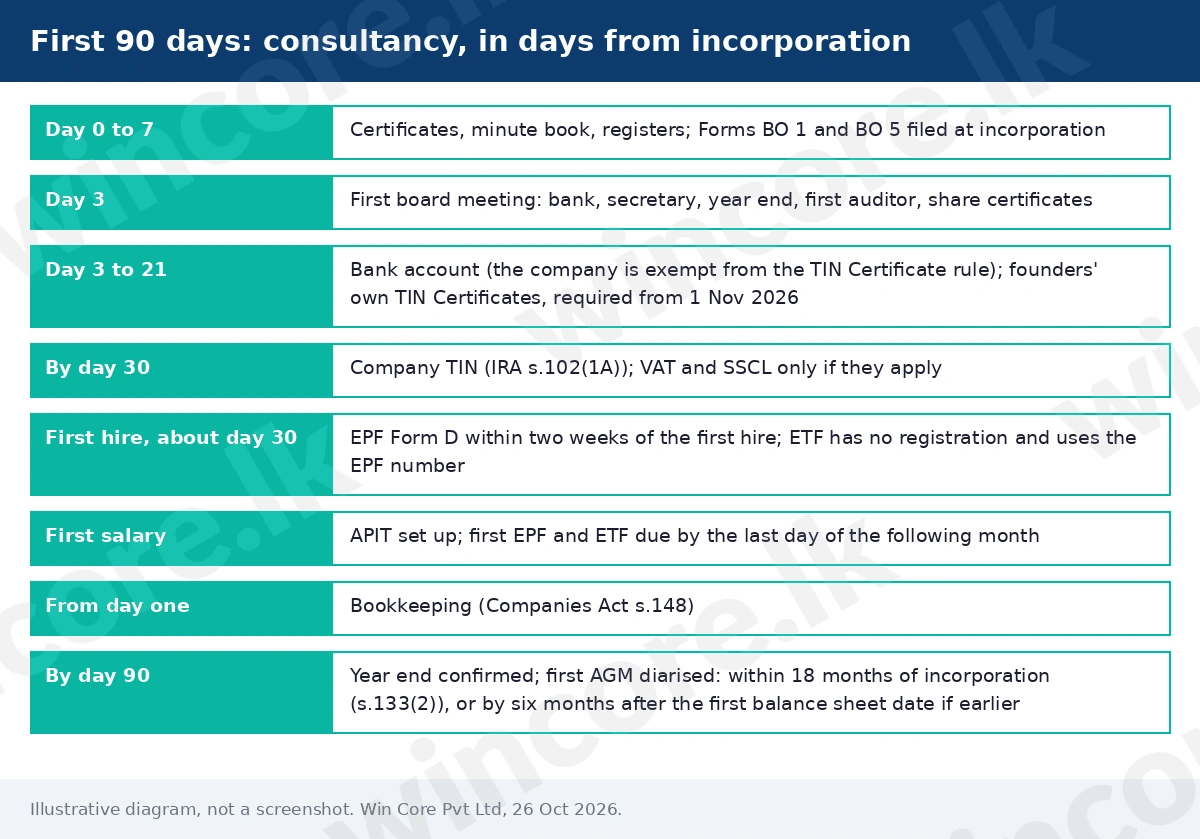
What this means for you
Work through the list in order and keep evidence of each step in the minute book or company file. The steps with legal deadlines are Forms BO 1 and BO 5 at incorporation, the company's TIN within thirty days, EPF Form D within two weeks of the first hire with contributions by the end of the following month, and bookkeeping from day one. The first AGM and annual return are later, but put the dates in the diary now. If the business needs a council permit for its premises, see how a trade licence works.
Checklist: documents needed
- Certificate of incorporation, registered articles and incorporation forms, kept in one place
- Minute book and statutory registers, including the register of beneficial owners
- Form BO 1 for the beneficial owners and Form BO 5 for the authorised person, at incorporation
- First board meeting minutes and resolutions: bank, secretary, year end, first auditor, share certificates
- Bank account papers and the founders' TIN Certificates
- Company TIN within 30 days of incorporation, and VAT or SSCL if they apply
- EPF Form D within two weeks of the first hire (ETF uses the EPF number)
- APIT set-up before the first salary
- Bookkeeping records from the first day
- Diarised dates for the first AGM and the first annual return
FAQ
What should I do first after company registration in Sri Lanka?
Set up the minute book and statutory registers, make sure Forms BO 1 and BO 5 were filed at incorporation, and hold the first board meeting. Then open the bank account and register the company's TIN within 30 days. Register with EPF within two weeks of the first hire, and start bookkeeping from the first transaction.
When must a new company hold its first AGM?
Within eighteen months of incorporation, under section 133(2) of the Companies Act, and not necessarily in the calendar year of incorporation. If six months after the first balance sheet date comes sooner, holding the AGM by then avoids argument. No annual return is due in the year of incorporation (section 131(3)); later returns are due within thirty working days of each AGM.
Do founders need a TIN Certificate to open the company's bank account?
Not for the company's own account: IRD Circular SEC/2026/E/07 exempts companies and other entities from the TIN Certificate rule. From 1 April 2027, the IRD's deferred date, each resident founder aged 18 or over needs one for their own accounts and for any share transfer, and a bank may still ask signatories for theirs. The company itself must register for its own TIN within thirty days.
Does a new company have to register for VAT and SSCL straight away?
Only if it crosses, or is likely to cross, the thresholds. For VAT, section 10(1) uses Rs 15 million in a taxable period or Rs 60 million in twelve months. For SSCL, the IRD says the threshold from 1 July 2026 is Rs 9 million a quarter or Rs 36 million over four quarters. Check each period as the business grows.
The short version
In the first 90 days: registers, minute book and Form BO 5; first board meeting; bank account with founders' TIN Certificates; the company's TIN within 30 days, with VAT and SSCL only if they apply; EPF Form D within two weeks of the first hire and APIT before the first salary; and bookkeeping from day one. Diarise the first AGM and annual return now.
Talk to us. If you want the first 90 days after registration handled in date order, from the minute book to the first AGM, see our company secretarial services or book a consultation at our contact page.
WinCore Pvt Ltd
This article is general information as at 26 October 2026 and is not legal or tax advice on your specific position.
Sources and references (15)
- Parliament of Sri Lanka. Companies Act, No. 7 of 2007, ss.131(2), (3), 133(1), (2), 148(1), 150(1), 159(1), 171(2), 221(1). https://www.parliament.lk/uploads/acts/gbills/english/3776.pdf . Primary. Accessed 25 October 2026.
- Parliament of Sri Lanka. Companies (Amendment) Act, No. 12 of 2025, new ss.130A(8), 130C. https://www.parliament.lk/uploads/acts/gbills/english/6389.pdf . Primary. Accessed 25 October 2026.
- Companies (Beneficial Ownership) Regulations, No. 1(I) of 2026, Gazette Extraordinary 2509/67, reg 4(1). https://drive.google.com/file/d/1v3jBw9yrmEX3U1g-dvD_q_jtAq5lL5hH/view (linked from https://drc.gov.lk/en/?p=5001). Primary. Accessed 25 October 2026.
- Inland Revenue Department. Notice SEC/PN/IT/2026/05: Mandatory Submission of the TIN Certificate for Specified Transactions (22 September 2026). https://www.ird.gov.lk/en/Lists/Latest%20News%20%20Notices/Attachments/811/SEC_PN_IT_2026-05_E.pdf ; and Circular SEC/2026/E/07 (22 September 2026), https://www.ird.gov.lk/en/publications/Circulars_Circulars/SEC_2026_E_07_E.pdf . Primary. Accessed 26 October 2026.
- Inland Revenue Department. Inland Revenue Act, No. 24 of 2017, consolidated to 31 March 2025, s.83A, https://www.ird.gov.lk/en/publications/Acts_Income%20Tax_2017/IRA_Cons_Act_-_2025_Changes.pdf ; with Inland Revenue (Amendment) Act, No. 11 of 2026, ss.1, 23 (new s.102(1A)) and 24 (new s.103(6)), https://www.ird.gov.lk/en/publications/Acts_Income%20Tax_2017/IR_Act_No_11-2026_E.pdf . Primary. Accessed 26 October 2026.
- Inland Revenue Department. Value Added Tax Act, No. 14 of 2002, consolidated to 2025, s.10(1). https://www.ird.gov.lk/en/publications/Value%20Added%20Tax_Acts/VAT_Act_No_14%5BE%5D_2002_%28Consolidation_2025%29.pdf . Primary. Accessed 25 October 2026.
- Inland Revenue Department. Notice to Taxpayers PN/SSCL/2026-04/1. https://www.ird.gov.lk/en/Lists/Latest%20News%20%20Notices/Attachments/780/PN_SSCL_2026-04_1_E.pdf . Primary. Accessed 25 October 2026.
- Parliament of Sri Lanka. Employees' Provident Fund Act, No. 15 of 1958, CBSL reprint, s.10(2). https://www.cbsl.gov.lk/sites/default/files/cbslweb_documents/laws/acts/en/epf_act.pdf . Primary. Accessed 25 October 2026.
- Parliament of Sri Lanka. Employees' Trust Fund Act, No. 46 of 1980, s.16(1). https://etfb.lk/wp-content/uploads/2021/03/ETF-Act.pdf . Primary. Accessed 26 October 2026.
- Department of Labour. Employees' Provident Fund Regulations, 1958, regulation 8 (Form D). https://labourdept.gov.lk/downloads/labour_code/48.pdf . Primary. Accessed 26 October 2026.
- Employees' Trust Fund Board. Payment of contributions: registration of employers with the ETF. https://etfb.lk/payment-of-contributions/ . Primary (administrative). Accessed 26 October 2026.
Related reading: Company seal Sri Lanka: is one required?; CIDA registration Sri Lanka: contractor guide.
Put these insights to work
WinCore specialists can review your current workflow, document gaps, and build a practical 90-day action plan.
Book a free consultationRecent articles




Continue reading
Explore more WinCore analysis to keep your finance, tax, and compliance roadmap moving.

Registering a private limited company in Sri Lanka in 2026: structure, name approval, the eROC filing with BO 1 and BO 5, the TIN and the first year.

New-employer payroll checklist for Sri Lanka covering TIN, APIT, EPF, ETF, salary structure, payslips, evidence packs, and first-run controls.

A new company's first year end, counted from incorporation: when the Companies Act allows a long first period, and why the tax year does not stretch.