
Project report for bank loan Sri Lanka: contents and ratios
What a bank asks for in a project report: three linked projections, a repayment schedule on its terms, the ratios it checks and the documents to attach.
On this page
Last verified against the primary sources on 26 October 2026.
Project report for bank loan Sri Lanka, in brief. A project report explains the business, the project, what it costs and how it is funded, and shows with projections that the business can repay the loan. Banks usually ask for one for a term loan, a leasing facility or a larger working capital line. The core is three linked projections (income, cash flow and balance sheet), a loan repayment schedule, a few ratios and the assumptions behind them, with the last accounts, tax returns, bank statements and quotations attached.
Take a hypothetical construction company that plans to buy a new excavator. This guide covers when a bank asks for a report, the usual contents, the ratios banks look at, the documents to attach, common reasons a report is sent back, a checklist and a ratio table.
Banks ask for a project report for a term loan, a leasing facility or a larger working capital line
Banks set their own credit policies, and requirements differ from bank to bank. What follows is common practice, not a legal requirement. A project report is commonly asked for when:
- A term loan will fund a specific asset or expansion, repaid from the extra cash it generates.
- A leasing facility will fund machinery or vehicles, and the lender wants to see that the business can pay the lease rentals.
- A working capital line is new or much larger, and the lender wants to see the trading cycle behind it.
For the construction company, the excavator is a term loan or lease decision. Either way, the bank will want to see that the excavator earns enough extra cash to cover the instalments.
Project report for bank loan Sri Lanka: nine sections, from the business to the sensitivity case
| Section | What it should show |
|---|---|
| The business | Legal form, owners and directors, history, products, customers, premises, staff |
| The project | What is being bought or built, why, supplier, delivery and start-up dates |
| Cost and funding | Total cost with quotations; how much is the owners' money and how much is borrowed |
| Market | Who will buy the extra output, at what price, and the evidence (orders, contracts, enquiries) |
| Operations | Capacity, shifts, staff, materials, suppliers, maintenance |
| Financial projections | Income statement, cash flow and balance sheet for the loan period, usually monthly for the first year and yearly after |
| Loan repayment schedule | Instalments, grace period, and principal and interest by period, as in the bank's terms |
| Ratios | Debt service cover, gearing, current ratio and the trend over the loan period |
| Assumptions and sensitivity | Each key assumption stated, and what happens if sales fall or costs rise |
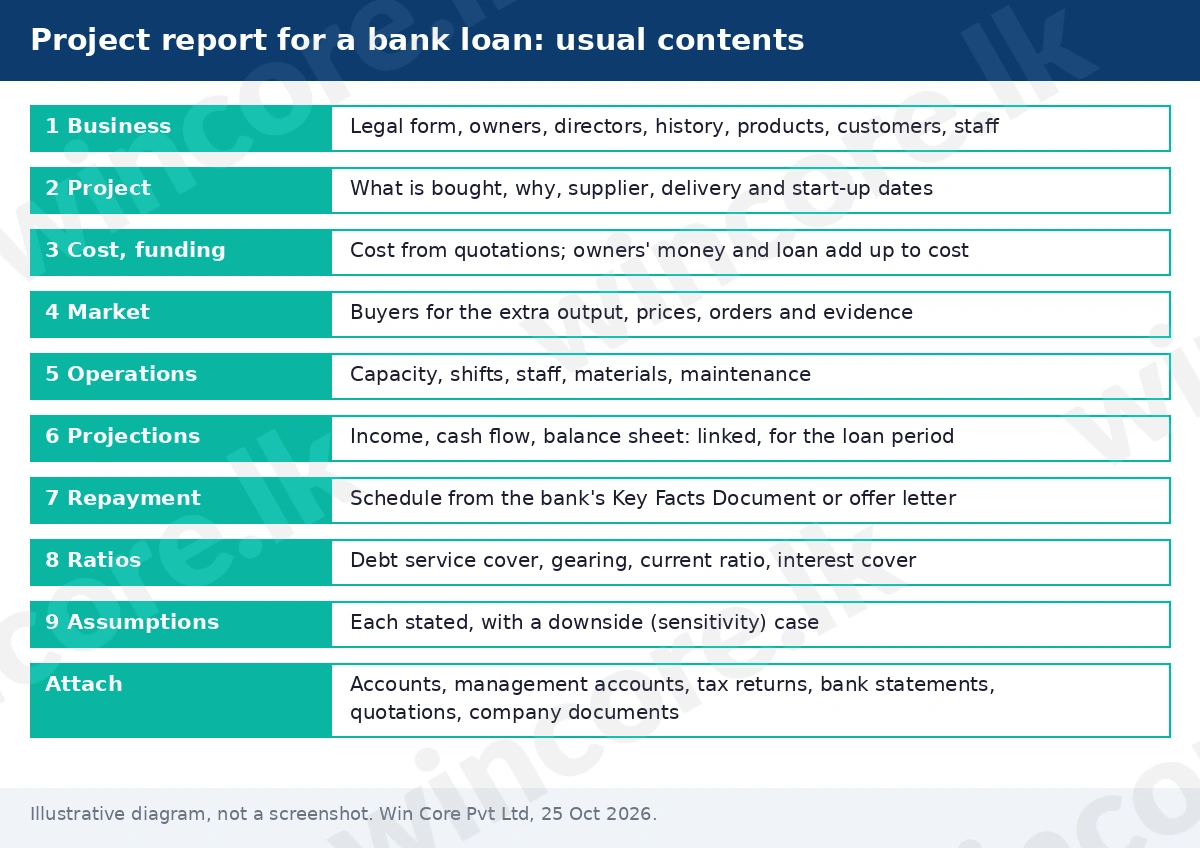
The three projections must link, and the cash flow decides whether the loan can be repaid
The three projections must link. Profit from the income statement flows into the balance sheet; the cash flow explains the change in the bank balance; the loan balance in the balance sheet falls in line with the repayment schedule. A report where these do not agree is the first thing a credit officer will notice.
The cash flow is the statement that matters most for repayment. SLFRS for SMEs paragraph 7.1 describes a statement of cash flows as showing "separately changes from operating activities, investing activities and financing activities" [4]. Lay out the projection the same way: operating cash from the excavator, the excavator purchase as investing, and the loan drawdown and repayments as financing.
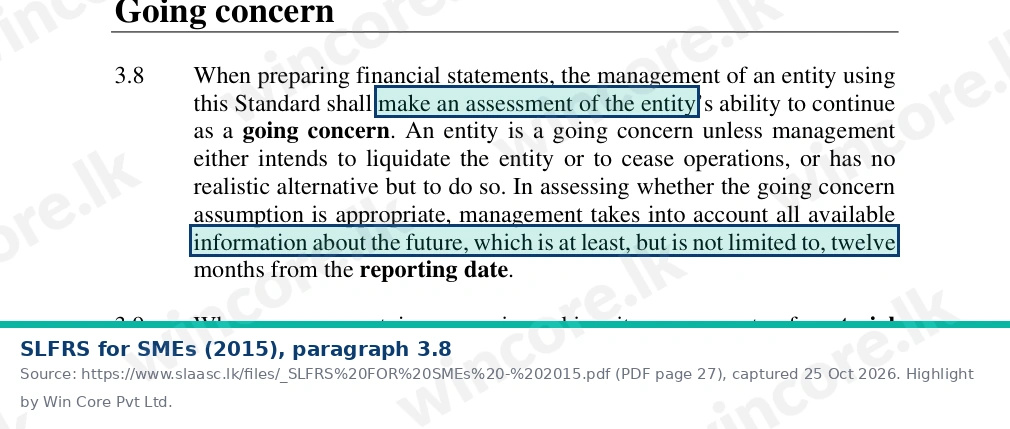
Banks also look at whether the business is sound beyond the project. Paragraph 3.8 asks management to assess the entity's ability to continue as a going concern, taking into account "all available information about the future, which is at least, but is not limited to, twelve months from the reporting date" [4]. A project report is, in effect, a longer version of the same question.
Our guide on building a cash flow forecast covers the mechanics.
Build the repayment schedule from the bank's own terms, not from an assumed rate
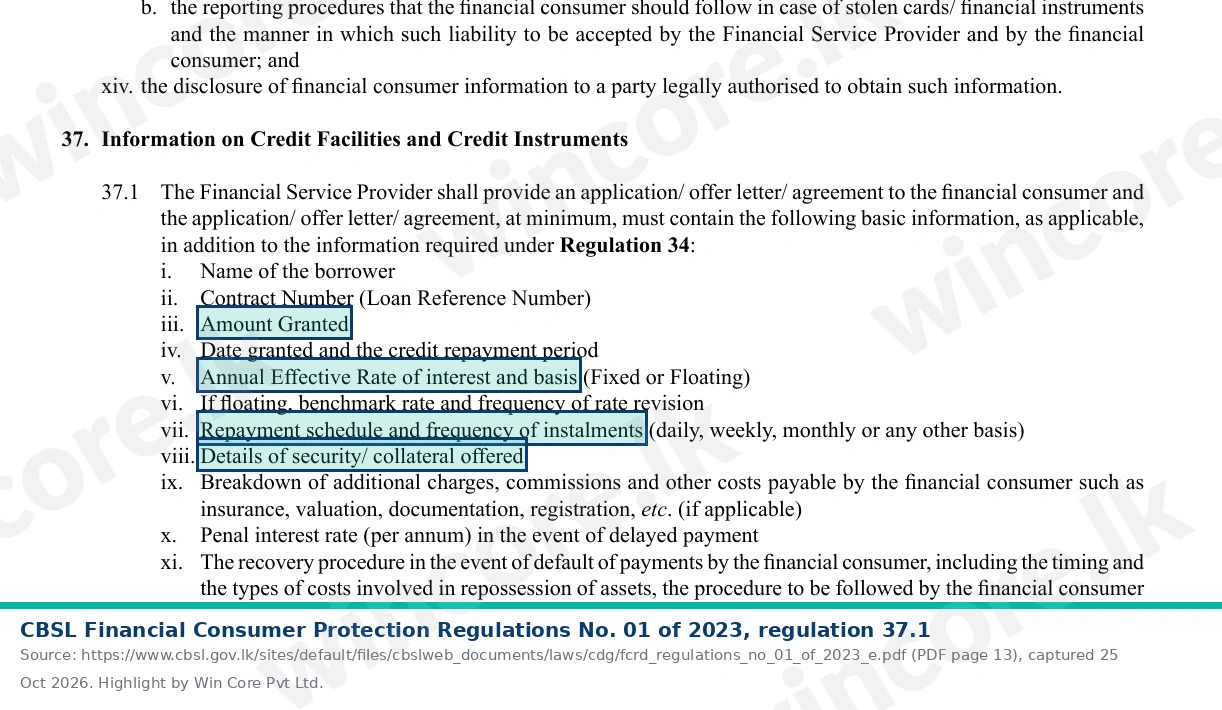
Use the bank's own terms. The CBSL Financial Consumer Protection Regulations No. 01 of 2023 (Gazette Extraordinary No. 2344/17 of 9 August 2023, in operation six months after the regulations' date of 8 August 2023) [3] apply to banks, finance companies, specialised leasing companies and other providers the CBSL regulates. They require the provider's application, offer letter or agreement to state, as applicable and among other things, the "Amount Granted", the "Annual Effective Rate of interest and basis (Fixed or Floating)", the "Repayment schedule and frequency of instalments (daily, weekly, monthly or any other basis)" and the "Details of security/ collateral offered" (regulation 37.1) [1]. Regulation 35 requires a Key Facts Document for loan products, showing the "annual effective rate of interest, penalties, other charges and fees and commissions" [1].
The regulations define a "Financial Consumer" as "a person or entity or legal body" that uses or may use a financial product, so a company borrower is covered [1]. A CBSL note on the regulations says loan documents "should include specific details about the borrower, loan terms, interest rates, penalties, and the security arrangements" [2]. Ask for the Key Facts Document before you finish the projections, and build the schedule from it. Do not guess a rate: put the rate from the offer letter into the model. Our business loan calculator guide shows how an instalment is worked out, and if the bank quotes equal monthly instalments, our loan calculator gives the figure for a given amount, rate and term.
Banks check five ratios: debt service cover, gearing, current ratio, interest cover and owner's contribution
| Ratio | How it is worked out | What it tells the bank |
|---|---|---|
| Debt service cover | Cash available for debt service (operating profit before depreciation and interest, less tax) / loan instalments (principal plus interest) for the year | Whether the business earns enough cash to pay the loan, with a margin |
| Gearing | Total borrowings / equity (or borrowings / borrowings plus equity) | How much of the business is funded by lenders rather than owners |
| Current ratio | Current assets / current liabilities | Whether short-term assets cover short-term debts |
| Interest cover | Operating profit / interest | How many times profit covers interest |
| Owner's contribution | Owners' money / total project cost | How much risk the owners carry |
Each bank sets its own minimum levels. Ask the bank what it expects rather than assuming a figure.
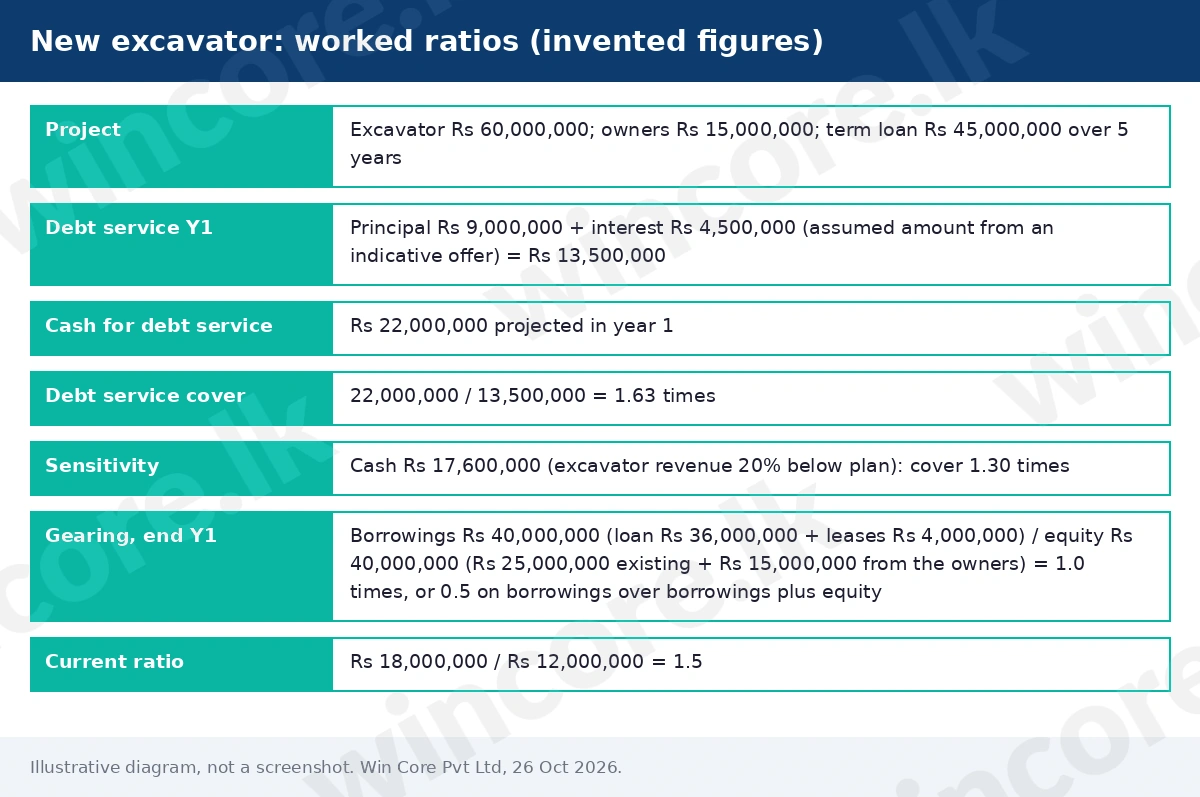
Worked example: a construction company's excavator loan gives debt service cover of 1.63 times
The figures below are invented for illustration.
| Item | Rupees |
|---|---|
| Excavator, delivered (supplier quotation) | 60,000,000 |
| Owners' contribution | 15,000,000 |
| Term loan requested, 5 years | 45,000,000 |
| Principal repaid each year | 9,000,000 |
| Interest in year 1, from the bank's indicative offer letter (assumed amount) | 4,500,000 |
| Debt service in year 1 | 13,500,000 |
| Projected cash available for debt service, year 1 | 22,000,000 |
| Debt service cover, year 1 | 1.63 times |
At the end of year 1, borrowings are Rs 36,000,000 on the new loan plus Rs 4,000,000 of existing leases, Rs 40,000,000 in all. Equity is also Rs 40,000,000: Rs 25,000,000 already in the business, including profit kept in year 1, plus the owners' Rs 15,000,000 for the excavator. Gearing is 40,000,000 / 40,000,000 = 1.0 times, or 0.5 on the borrowings over borrowings plus equity measure. Current assets of Rs 18,000,000 against current liabilities of Rs 12,000,000 give a current ratio of 1.5.
Sensitivity. If revenue from the excavator is 20 percent below plan and the cash available falls to Rs 17,600,000, debt service cover falls to 1.30 times. Show the bank this table; it shows you have thought about the downside.
Attach accounts, tax returns, bank statements, quotations and company documents
- Audited or certified financial statements for the last two or three years. Section 150(1) of the Companies Act requires a company's board to have financial statements completed "within six months or within such extended period as may be determined by the Registrar after the balance sheet date" [5]. A bank will notice if they are late.
- Management accounts for the current year to date. Our note on the basis of preparation of management accounts explains what to state.
- Income tax returns and IRD acknowledgements. Section 93(1) of the Inland Revenue Act requires a return "not later than eight months after the end of each year of assessment" [6].
- Bank statements, usually for six or twelve months.
- Quotations for the asset. If the supplier and your company are both VAT registered, ask for a tax invoice at purchase. VAT Act section 20(1) requires one where the buyer asks in writing within fourteen days of the supply, or asks stating that it is registered, "not later than twenty eight days after the time of such supply"; an unregistered buyer gets an ordinary invoice instead (s.20(6)) [7].
- Company documents: certificate of incorporation, articles, the list of directors and shareholders, and board resolution to borrow.
- Identity documents for directors and guarantors, and the company's TIN. Banks often ask for the individuals' TINs too, as their own practice. The statutory TIN Certificate rule (Inland Revenue Act s.103(6), added by Act No. 11 of 2026 from 1 April 2026, which the IRD set for 1 November 2026 and has deferred to 1 April 2027, IRD notice SEC/PN/IT/2026/06) covers resident individuals who must register under s.102(3), for listed transactions such as "To open any account at any bank or financial institution". It excludes companies, and on our reading a loan to the company is not on the list [8] [9].
Eight avoidable faults send a project report back
- The three projections do not agree with each other.
- Sales growth is assumed with no evidence (no orders, contracts or market data).
- The repayment schedule does not match the bank's terms.
- Working capital is left out, so the cash flow looks better than it will be.
- The latest accounts or tax returns are missing or late.
- Quotations are old, unsigned or do not match the project cost.
- No sensitivity: the report shows only the best case.
- Owners' contribution is not shown in the bank statements.
What this means for you
Build the report around one question: can the project pay the loan, with a margin, even if things go less well than planned? Link the three statements, use the bank's own terms, show the ratios and attach the documents. A bank can then judge the project, not chase missing papers.
Checklist: documents needed
- Business and project described in two pages or less.
- Project cost agreed to signed quotations.
- Funding table: owners' money and loan add up to cost.
- Three linked projections for the full loan period.
- Repayment schedule from the bank's Key Facts Document or offer.
- Ratio table with year-by-year figures.
- Assumptions listed, with a sensitivity case.
- Accounts, management accounts, tax returns, bank statements and company documents attached.
FAQ
What should a project report for a bank loan in Sri Lanka include?
It should describe the business and project, the cost and how it is funded, the market and operations, and give income, cash flow and balance sheet projections for the loan period. Add a repayment schedule from the bank's terms, a ratio table and the key assumptions with a sensitivity case. Attach recent accounts, tax returns, bank statements and quotations.
What is debt service cover and why does it matter?
Debt service cover compares the cash a business has available to pay its loans with the principal and interest due in the same period. A figure above one means the cash covers the instalments; the higher it is, the bigger the margin. Each bank sets its own minimum, so ask the bank rather than assume a level.
Which interest rate should I use in the projections?
Use the rate from the bank's Key Facts Document or indicative offer. CBSL Financial Consumer Protection Regulations No. 01 of 2023 require banks and other CBSL-regulated lenders to state the annual effective rate and whether it is fixed or floating, with the repayment schedule. Do not take a rate from a news report or a rival's offer, because it may not match your facility.
Why do banks send project reports back?
The most common reasons are projections that do not link, sales growth with no evidence, a repayment schedule that does not match the bank's terms, working capital left out, missing or late accounts and tax returns, and no sensitivity case. Checking each of these before submission saves a second round with the credit team.
The short version
A project report must show the bank that the project can repay the loan. Link the income, cash flow and balance sheet projections, build the schedule from the bank's own terms, show the ratios and a downside case, and attach the accounts, tax returns, statements and quotations.
Talk to us. If you are preparing a project report for a bank loan and need the projections, ratios and repayment schedule built, see our virtual CFO services or book a consultation at our contact page.
WinCore Pvt Ltd
This article is general information as at 26 October 2026 and is not financial advice on your specific position.
Related reading
- Construction contract accounting Sri Lanka: guide
- CIDA registration Sri Lanka: contractor guide
- Bank loan accounting Sri Lanka: instalments
- Feasibility study Sri Lanka: what should a project include?
Sources and references (8)
- Central Bank of Sri Lanka. Financial Consumer Protection Regulations No. 01 of 2023, regs 35, 37.1 and definitions. https://www.cbsl.gov.lk/sites/default/files/cbslweb_documents/laws/cdg/fcrd_regulations_no_01_of_2023_e.pdf . Primary. Accessed 25 October 2026.
- Central Bank of Sri Lanka. Securing Your Rights: The Power of Regulations on Financial Consumer Protection, Part II (information series note, 4 March 2025). https://www.cbsl.gov.lk/sites/default/files/cbslweb_documents/statistics/otherpub/information_series_note_20250304_securing_your_rights_the_power_of_financial_consumer_protection_regulations_part_II_e.pdf . Primary. Accessed 25 October 2026.
- Central Bank of Sri Lanka. Financial Consumer Protection Regulations No. 01 of 2023, Gazette Extraordinary No. 2344/17 of 9 August 2023, regulations 1.1 and 1.2. https://www.cbsl.gov.lk/sites/default/files/cbslweb_documents/laws/cdg/fcrd_regulations_no_01_of_2023_e.pdf . Primary. Accessed 26 October 2026.
- CA Sri Lanka. SLFRS for SMEs (2015), paras 3.8, 7.1. https://www.slaasc.lk/files/_SLFRS%20FOR%20SMEs%20-%202015.pdf . Primary. Accessed 25 October 2026.
- Parliament of Sri Lanka. Companies Act, No. 7 of 2007, s.150(1). https://www.parliament.lk/uploads/acts/gbills/english/3776.pdf . Primary. Accessed 25 October 2026.
- Inland Revenue Department. Inland Revenue Act, No. 24 of 2017, consolidated to 31 March 2025, s.93(1). https://www.ird.gov.lk/en/publications/Acts_Income%20Tax_2017/IRA_Cons_Act_-_2025_Changes.pdf . Primary. Accessed 25 October 2026.
- Inland Revenue Department. Value Added Tax Act, No. 14 of 2002, consolidated to 2025, s.20(1). https://www.ird.gov.lk/en/publications/Value%20Added%20Tax_Acts/VAT_Act_No_14%5BE%5D_2002_%28Consolidation_2025%29.pdf . Primary. Accessed 25 October 2026.
- Inland Revenue Department. Notice SEC/PN/IT/2026/05: Mandatory Submission of the TIN Certificate for Specified Transactions (22 September 2026). https://www.ird.gov.lk/en/Lists/Latest%20News%20%20Notices/Attachments/811/SEC_PN_IT_2026-05_E.pdf . Primary. Accessed 25 October 2026.
- Inland Revenue Department. Circular SEC/2026/E/07: Mandatory Submission of Taxpayer Identification Number (TIN) Certificate for Specified Transactions (22 September 2026), sections 1 to 4. https://www.ird.gov.lk/en/publications/Circulars_Circulars/SEC_2026_E_07_E.pdf . Primary. Accessed 26 October 2026.
Put these insights to work
WinCore specialists can review your current workflow, document gaps, and build a practical 90-day action plan.
Book a free consultationRecent articles




Continue reading
Explore more WinCore analysis to keep your finance, tax, and compliance roadmap moving.

How Sri Lankan SMEs can build a 13-week rolling cash flow forecast that puts VAT, EPF and ETF payments in the right week and shows seasonal dips before they hit.

A healthy profit and an empty bank account usually have six causes. How to read the cash flow statement, and the tax dates that drain cash first.
A short block at the front of a monthly pack tells directors, banks and investors what the numbers are, what was estimated and what was not checked.