
Payroll journal entries Sri Lanka: where do EPF, ETF and APIT go?
Four entries record a month's payroll: what to debit and credit for EPF, ETF and APIT, when each liability is paid, and how to prove each balance.
On this page
Last verified against the primary sources on 17 November 2026.
Payroll journal entries Sri Lanka, in brief. Expense gross pay, crediting employee EPF at 8%, APIT and net pay. Expense employer EPF at 12% and ETF at 3% against their liabilities [1][2]. APIT, deducted under Inland Revenue Act section 83A(1A) from 1 January 2023, is paid within 15 days after the end of the month in which it is withheld [3]. Then clear each liability as it is paid.
The rates come from EPF Act section 10 and ETF Act section 16 (Table 1). Each liability sits in its own account until it is paid, so the balances at month end tell you what is owed. This guide uses an invented bookshop chain with 26 staff and Rs 2,148,300 of EPF-liable earnings for the month.
| Item | Rate or deadline | Source |
|---|---|---|
| Employee EPF | 8% of total earnings, s.10(1) | Employees' Provident Fund Act, No. 15 of 1958 [1] |
| Employer EPF | 12% of total earnings, paid on or before the last day of the next month, s.10(2) | EPF Act [1] |
| Employee EPF deducted and paid by the employer | Before the last day of the next month, s.15 | EPF Act [1] |
| EPF payment date set by the EPF Department | On or before the last working day of the next month, an administrative date that is earlier than the Act's when the month ends on a non-working day | EPF Department [5] |
| Employer cannot recover its own share from the employee | EPF Act s.20; for ETF, ETF Act s.30 | EPF Act [1]; ETF Act [2] |
| ETF | 3% of total earnings, on or before the last day of the next month, s.16(1) | Employees' Trust Fund Act, No. 46 of 1980 [2] |
| ETF paid electronically | Employers with 15 or more employees: required by the regulation from 1 February 2023; enforced by the ETF Board, with no cheques, cash or manual returns, from contributions for July 2026 (payable by 31 August 2026) | ETF Board notice and Gazette 2311/39 [4] |
| APIT | Deducted under s.83A(1A) from 1 January 2023 when the pay is paid; tax withheld during a month is paid within 15 days after the end of that month, s.86(1) | Inland Revenue Act, No. 24 of 2017 [3] |
Table 1. Key figures. Sources as read on 17 November 2026.
A monthly payroll needs four journal entries
Four entries cover a standard month:
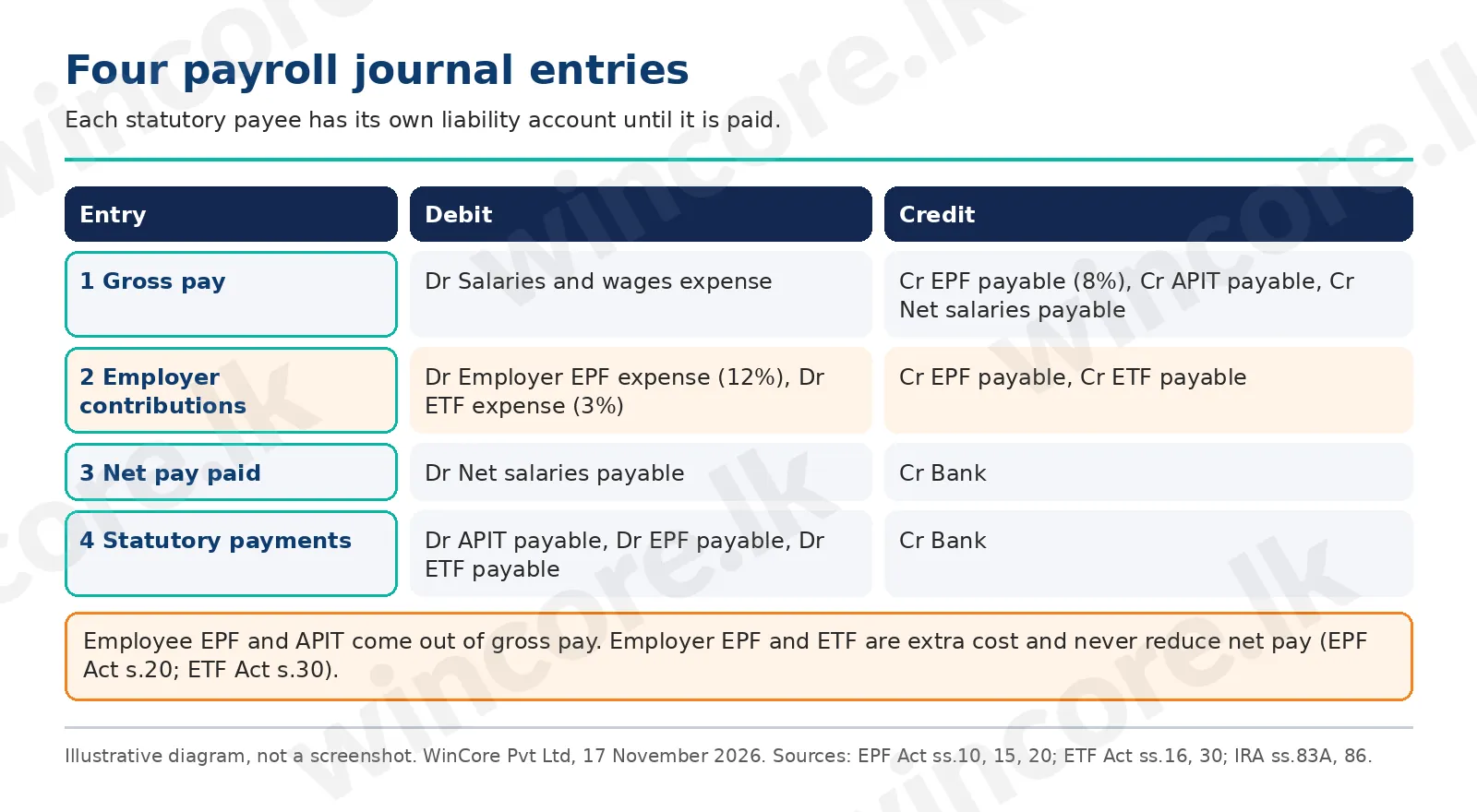
- Gross pay and deductions. Expense the gross pay and credit what is owed to each party: the employee's EPF share, APIT withheld and net pay.
- Employer contributions. Expense employer EPF and ETF and credit the liabilities.
- Net pay paid. Clear the net salaries account when wages are paid.
- Contributions and APIT paid. Clear each liability when it is paid to the EPF, ETF Board or Inland Revenue.
Use separate liability accounts: Net salaries payable, EPF payable, ETF payable and APIT payable. Our bookkeeping basics guide covers how control accounts work.
Payroll journal entries Sri Lanka use one liability account per payee
Set up these accounts before the first payroll is posted. Each statutory payee gets its own liability account, so a balance can be traced to one return and one payment. The account names and the month end dating in this guide are bookkeeping practice, not a legal requirement; the law fixes the rates and payment dates in Table 1.
| Account | Type | What it holds |
|---|---|---|
| Salaries and wages expense | Expense | Gross pay for the month |
| Employer EPF expense | Expense | Employer's 12% |
| ETF expense | Expense | Employer's 3% |
| Net salaries payable | Current liability | Pay owed to employees until pay day |
| EPF payable | Current liability | Employee 8% plus employer 12% until paid to the Fund |
| ETF payable | Current liability | 3% until paid to the ETF Board |
| APIT payable | Current liability | Tax withheld until paid to Inland Revenue |
Table 2. Payroll accounts. Keep APIT payable separate from any other withholding tax account.
Entry 1: gross pay and deductions (bookshop chain example)
| Account | Debit (Rs) | Credit (Rs) |
|---|---|---|
| Salaries and wages expense | 2,148,300 | |
| EPF payable (employee 8%) | 171,864 | |
| APIT payable | 38,750 | |
| Net salaries payable | 1,937,686 | |
| Total | 2,148,300 | 2,148,300 |
Table 3. Entry 1. Net pay is Rs 2,148,300 less Rs 171,864 less Rs 38,750.
The employee's 8% is part of gross pay, not an extra cost. Section 15 of the EPF Act requires the employer to "deduct and pay to the Fund the contribution for each month of such employee ... from the earnings of such employee", and a payment made this way "shall be deemed to have been paid to the Fund by such employee" [1].
Employer EPF and ETF are expenses on top of gross pay
Each has its own liability account. Section 10(2) of the EPF Act makes the employer liable to pay "a contribution of an amount equal to twelve per centum of such employee's total earnings" "on or before the last day of the succeeding month" [1]. Section 16(1) of the ETF Act sets "three per centum of the total earnings", also "on or before the last day of the succeeding month" [2]. The EPF and ETF calculator shows the 8%, 12% and 3% for one employee's pay.
Entry 2: employer contributions
| Account | Debit (Rs) | Credit (Rs) |
|---|---|---|
| Employer EPF expense (12%) | 257,796 | |
| ETF expense (3%) | 64,449 | |
| EPF payable (employer 12%) | 257,796 | |
| ETF payable | 64,449 | |
| Total | 322,245 | 322,245 |
Table 4. Entry 2. Employer cost for the month is Rs 2,148,300 plus Rs 322,245, or Rs 2,470,545.
Section 20 of the EPF Act bars the employer from deducting its own contribution from the employee's earnings, and makes any contract shifting that liability to the employee "null and void" [1]. Section 30 of the ETF Act has the same bar for ETF [2]. So employer EPF and ETF never reduce net pay.
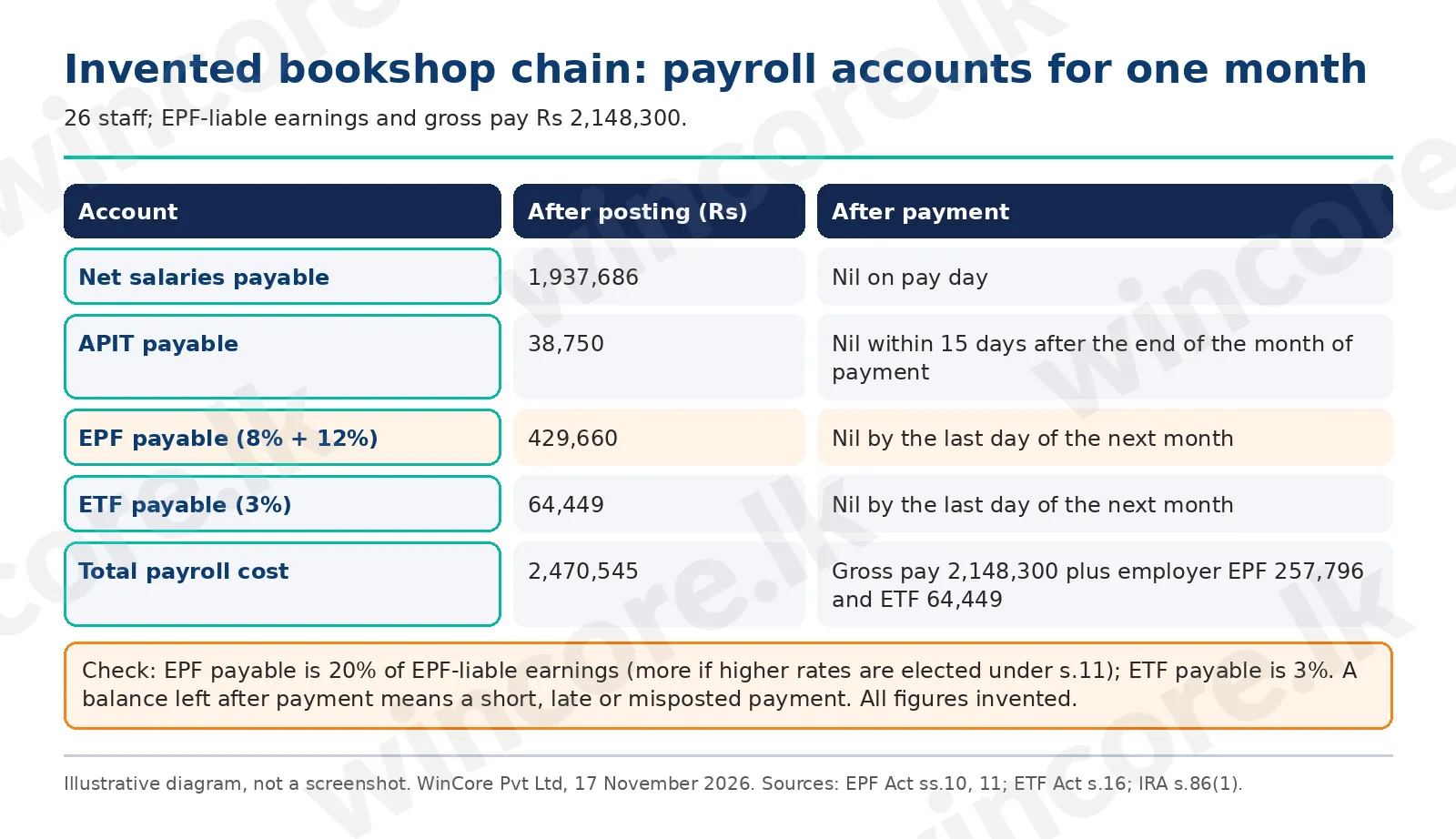
After entry 2, the EPF payable account holds Rs 429,660: Rs 171,864 from the employee and Rs 257,796 from the employer. Both are paid together.
APIT sits in a liability account until it is paid
The account is APIT payable, credited in entry 1 and cleared when paid. Section 83A(1A) of the Inland Revenue Act requires an employer to deduct Advance Personal Income Tax "with effect from January 1, 2023 on any payment which falls under section 5 made to his employee, as specified by the Commissioner-General" [3]. Section 86(1) requires every withholding agent to pay "within fifteen days after the end of each calendar month any tax that has been withheld in accordance with this Division during the month" [3]. The IRD's APIT guideline says the tax is deducted "at the time of such remuneration is paid or credited" [6]. So if a month's wages are paid in the next month, on our reading the APIT on them is due within 15 days after the end of the month of payment, not the month worked.
APIT withheld from pay is not an expense of the employer. It is part of gross pay withheld for the employee. There are two exceptions. Where the employer bears the employee's tax instead of deducting it, the IRD's APIT Table 06 (tax-on-tax) applies and the tax the employer pays is its own cost [6]. Where it fails to deduct, it must still pay the tax under section 86(3) and may recover it from the employee under section 86(6) [3]. If the employer pays late, any penalty or interest is an expense, posted separately. Our APIT guide covers how the deduction is worked out.
Entries 3 and 4: payments
| Date | Account | Debit (Rs) | Credit (Rs) |
|---|---|---|---|
| Pay day | Net salaries payable | 1,937,686 | |
| Bank | 1,937,686 | ||
| Within 15 days after the end of the month the pay is paid | APIT payable | 38,750 | |
| Bank | 38,750 | ||
| By the last day of the next month | EPF payable | 429,660 | |
| Bank | 429,660 | ||
| By the last day of the next month | ETF payable | 64,449 | |
| Bank | 64,449 |
Table 5. Entries 3 and 4. After all four payments, each payroll liability is nil.
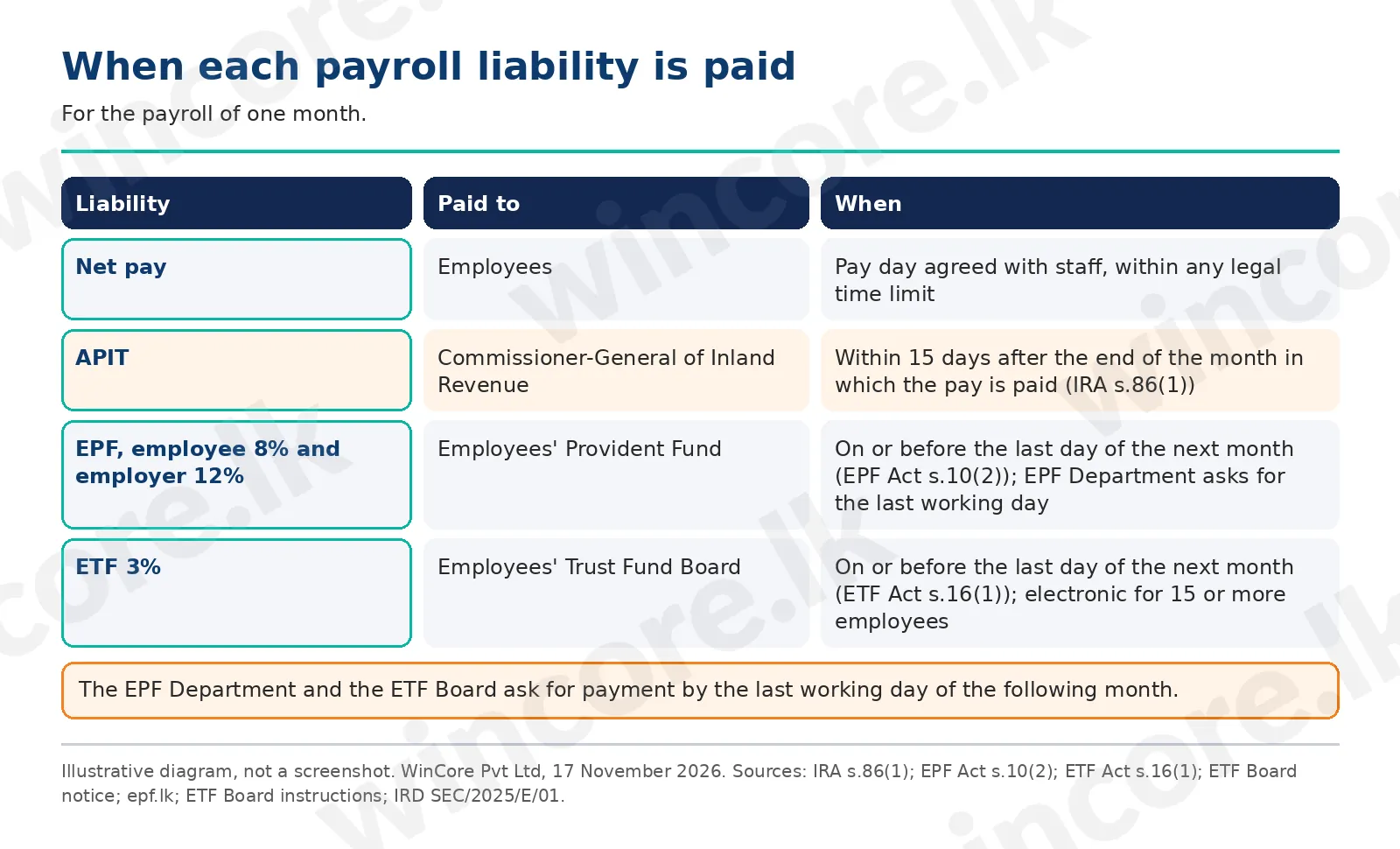
The EPF Department says contributions "should be received to EPF on or before the last working day of the following succeeding month" [5], and the ETF Board's instructions say a month's contribution "should be sent to reach the E.T.F. Board on or before the last working day of the following month" [4]. These administrative dates fall before the Acts' last day when the month ends on a weekend or holiday, so pay by the last working day. With 26 staff, the bookshop chain must also pay and file electronically: the ETF Board notice says employers with 15 or more employees must remit and submit returns electronically "with effect from contributions relating to July 2026 (payable on or before 31 August 2026)" [4].
Payroll is accrued on the last day of the month worked
If wages are paid after the month end, entries 1 and 2 still belong to the month the work was done. Post them on the last day of the month so the expense and the liabilities sit in that month. Net salaries payable, EPF payable, ETF payable and APIT payable then appear as current liabilities in the month end balance sheet. EPF and ETF stay due by the last day of the next month, because they follow the month the earnings relate to. APIT follows the payment: on our reading it is due within 15 days after the end of the month in which the wages are paid [3][6].
At a financial year end, the same rule applies: unpaid EPF, ETF and APIT for the final month are liabilities at the year end, cleared on the dates in Table 5.
Five checks prove the payroll accounts at month end
Each check is against an outside document:
- Gross pay. Salaries and wages expense equals the payroll register total.
- EPF payable. The balance equals 20% of EPF-liable earnings for the month (8% plus 12%), or more where the employer and employee have elected higher rates under section 11 [1], and the amount on the EPF return.
- ETF payable. The balance equals 3% of earnings and the ETF return.
- APIT payable. The balance equals the APIT deducted per the payroll and the amount paid to Inland Revenue.
- Net salaries payable. Nil after pay day, matching the bank transfer total.
After the statutory payments on the dates in Table 5, EPF, ETF and APIT payable for the month should be nil. A balance left over means a payment was short, late or posted to the wrong account. Our payroll reconciliation guide covers checking the bank transfer before EPF is paid.
Six common posting errors
- Employee EPF posted as an expense. It double counts cost: the 8% is already inside gross pay. Credit it to EPF payable out of gross pay.
- Employer EPF netted off pay. Section 20 of the EPF Act bars it [1]. Net pay should equal gross pay less the employee's 8%, APIT and any other deduction the law allows. Written agreement alone is not always enough: for shop and office staff, section 19(1)(a) of the Shop and Office Employees Act allows only authorised deductions made with consent, capped at 60 percent of the pay due [7].
- One account for all payroll liabilities. The balance cannot be matched to the EPF return, the ETF return and the APIT payment separately. Split it.
- APIT withheld posted to expense. Tax withheld from pay belongs to the employee. The employer's own expense is limited to penalties or interest for late payment and any tax it bears for the employee under APIT Table 06 [6].
- Payment posted to expense. When EPF is paid, debit EPF payable, not the expense account; otherwise the expense is counted twice and the liability never clears.
- Entries dated on pay day. If pay day falls in the next month, the expense moves to the wrong month. Date entries 1 and 2 on the last day of the month worked.
Worked example: a bookshop chain's payroll accounts clear to nil
The invented bookshop chain has 26 staff and Rs 2,148,300 of EPF-liable earnings for the month, which is also its gross pay. APIT is deducted under the IRD's APIT tables, and only staff paid above the tax-free amount in those tables have any deducted [6]. The payroll gives:
- Employee EPF at 8%: Rs 171,864.
- Employer EPF at 12%: Rs 257,796.
- ETF at 3%: Rs 64,449.
- APIT deducted: Rs 38,750.
- Net pay: Rs 1,937,686.
The chain pays wages on the last day of the month. That day the bookkeeper posts entries 1 and 2, and the net pay transfer of Rs 1,937,686 clears Net salaries payable. Because the pay and the APIT deduction fall in the same month, the chain pays the Rs 38,750 of APIT within 15 days after that month end. By the last day of the next month it pays Rs 429,660 to the EPF and Rs 64,449 to the ETF Board electronically. At the next month end, each payroll liability account for that month is nil, and the payroll cost in the accounts is Rs 2,470,545.
What this means for you
Keep four payroll liability accounts and post the two payroll entries on the last day of each month, then clear each liability when you pay it. Check each balance against the payroll register, the EPF and ETF returns and the APIT payment, and investigate any balance left after the statutory payments.
Checklist: documents needed
- Monthly payroll register with gross pay, EPF-liable earnings and APIT
- Journal entries 1 and 2, dated the last day of the month worked
- Bank evidence of net pay, EPF, ETF and APIT payments
- EPF and ETF monthly returns
- APIT payment record
- Month end reconciliation of each payroll liability account
FAQ
How do you record payroll journal entries for EPF, ETF and APIT?
With four entries. Debit gross pay to salaries expense and credit EPF payable with the employee's 8%, APIT payable and net salaries payable. Debit employer EPF at 12% and ETF at 3% to expense and credit EPF payable and ETF payable. When net pay, APIT, EPF and ETF are paid, debit each liability and credit bank, so each account returns to nil.
Is employee EPF an expense of the employer?
No. The employee's 8% under section 10(1) of the EPF Act is part of gross pay. The employer deducts it from earnings and pays it to the Fund under section 15, so it is credited to EPF payable out of gross pay. In a standard month, the employer's extra statutory costs are its 12% under section 10(2) and the 3% ETF.
Should employer EPF and ETF be one account or two?
Two liability accounts work best: EPF payable and ETF payable. EPF goes to the Employees' Provident Fund and ETF to the ETF Board, on separate returns. EPF payable holds both the employee's 8% and the employer's 12%, which are paid together, so its balance should equal 20% of the month's EPF-liable earnings, unless higher rates have been elected under section 11.
When is APIT paid, and what if it is paid late?
Section 86(1) of the Inland Revenue Act requires tax withheld during a calendar month to be paid within fifteen days after the end of that month, which the IRD states as on or before the 15th of the next month [3][6]. If it is paid late, any penalty or interest charged is an expense of the employer, posted separately, not added to APIT payable.
What if the payroll is paid after the month end?
Post the gross pay and employer contribution entries on the last day of the month the work was done. The unpaid net pay, EPF, ETF and APIT then show as liabilities at the month end. Clear EPF and ETF by the last day of the next month. APIT, on our reading, falls due within 15 days after the end of the month in which the wages are paid.
Does the way ETF is paid change the journal entry?
No. The entries are the same whether ETF is paid electronically or otherwise. What changes is the evidence: an employer with 15 or more employees must pay and file returns electronically under the ETF Regulations as amended by Gazette 2311/39, so keep the electronic payment confirmation and the return with the month's payroll file.
The short version
Post gross pay to expense, crediting employee EPF at 8%, APIT and net pay; then post employer EPF at 12% and ETF at 3% as expense and liabilities. Pay APIT within 15 days after the end of the month the pay is paid, and EPF and ETF by the last day of the next month (the EPF Department and the ETF Board ask for the last working day). Check each liability against the payroll and returns; after payment, each should be nil.
Free download: the EPF & ETF Record-Keeping Audit Checklist (Sri Lanka) (PDF).
Talk to us. For Monthly salary processing, EPF/ETF calculation and remittance and APIT computation and remittance, see our payroll services; for Daily Transaction Recording and Monthly Bookkeeping Summary, see our bookkeeping services, or book a consultation at our contact page.
WinCore Pvt Ltd
This article is general information as at 17 November 2026 and is not tax, legal or accounting advice on your specific position.
Related reading
- Payroll reconciliation in Sri Lanka: check the transfer before EPF
- Bookkeeping basics for Sri Lankan small businesses
- APIT deduction guide for Sri Lankan payroll teams
Sources and references (11)
- Department of Labour. Employees' Provident Fund Act, No. 15 of 1958, consolidated (Labour Code Chapter 5), sections 10(1) and (2), 11, 15 and 20. Consolidated to Act No. 14 of 1992; the later Employees' Provident Fund (Amendment) Act No. 2 of 2012 and the 2021 amendment of section 47 do not change these sections. https://labourdept.gov.lk/downloads/labour_code/47.pdf . Primary (consolidation). Accessed 17 November 2026.
- Department of Labour. Employees' Trust Fund Act, No. 46 of 1980, consolidated (Labour Code Chapter 5), sections 16(1) and 30. https://labourdept.gov.lk/downloads/labour_code/51.pdf . Primary (consolidation). Accessed 17 November 2026.
- Inland Revenue Department. Inland Revenue Act, No. 24 of 2017, consolidated with amendments, sections 83A(1A), 86(1), 86(3) and 86(6). https://www.ird.gov.lk/en/publications/Acts_Income%20Tax_2017/IRA_Cons_Act_-_2025_Changes.pdf . Amending Act No. 11 of 2026, which adds section 86(9) and section 87(6) but does not change section 83A or sections 86(1) to (6): https://www.ird.gov.lk/en/publications/Acts_Income%20Tax_2017/IR_Act_No_11-2026_E.pdf . Primary. Accessed 17 November 2026.
- Employees' Trust Fund Board. Notice to employers: Mandatory Electronic Payment of Contributions and Submission of Monthly Returns; Instructions for using R1 and R4 forms; Gazette Extraordinary No. 2311/39 of 22 December 2022. https://etfb.lk/wp-content/uploads/2026/04/NOTICE-Mandatory-Electronic-Payment-English.pdf , https://etfb.lk/wp-content/uploads/2021/03/Instructions-for-using-R1-and-R4-Forms-Eng.pdf and https://etfb.lk/wp-content/uploads/2026/04/Regulation-Gazette-2311-39-special-English-1.pdf . Primary. Accessed 17 November 2026.
- Employees' Provident Fund Department, Central Bank of Sri Lanka. Remitting Contributions. https://epf.lk/?p=171 . Primary. Accessed 17 November 2026.
- Inland Revenue Department. Guideline for employers on deducting Advance Personal Income Tax (APIT) from employment income, SEC/2025/E/01 of 25 March 2025 (opening paragraph, item (f) and paragraph 10); APIT Tax Table No. 06, Tax-on-tax rates, 2025/2026. https://www.ird.gov.lk/en/publications/Circulars_Circulars/SEC_2025_E_01_E.pdf and https://www.ird.gov.lk/en/publications/APIT_Tax_Tables/2025-2026/Table%20-%206/07.%20APIT_2526_Table_06_Text.pdf . Primary. Accessed 17 November 2026.
- Department of Labour. Shop and Office Employees (Regulation of Employment and Remuneration) Act, consolidated (Labour Code), section 19(1). https://labourdept.gov.lk/downloads/labour_code/20.pdf . Primary (consolidation). Accessed 17 November 2026.
Put these insights to work
WinCore specialists can review your current workflow, document gaps, and build a practical 90-day action plan.
Book a free consultationRecent articles




Continue reading
Explore more WinCore analysis to keep your finance, tax, and compliance roadmap moving.
The salary file and the payroll should agree before EPF and ETF go. Why the Acts make total earnings the base, and a seven-step check that is practice.

Bookkeeping guide for Sri Lankan small businesses: legal requirements, chart of accounts, source documents, 5-year retention rule, and monthly routines.
APIT deduction for Sri Lankan employers: the five bands, which IRD table applies to bonuses, joiners, second jobs and terminal pay, T-10s and annual statement.