
Registration of charges Sri Lanka: a company's mortgage or security
Which charges go to the Registrar, the 21 working day limit, the certificate, the consequences, the company's own register and release.

On this page
Last verified against the primary sources on 30 October 2026.
Registration of charges Sri Lanka, in brief. Under sections 102(1) and 102(3) of the Companies Act, No. 7 of 2007, a company must cause the instrument for a covered charge executed in Sri Lanka to be registered within 21 working days of execution and deliver a copy with the prescribed certificate [1]. The Act came into operation on 3 May 2007 [4]. Subject to Part VI and any court extension, an unregistered charge is void against the liquidator and creditors to the extent set out in section 103 [1]. Gazette Extraordinary No. 2496/03 sets the registration fee at Rs 9,900 excluding VAT from 6 July 2026; check for any later change. If VAT applies at 18 percent, the total is Rs 11,682 [2] [5].
Our example is a hypothetical road marking contractor, a private company, that borrows to buy a line marking truck and gives the lender security over it. We cover which charges must be registered, the certificate and time limit, who may apply, what happens if the statutory requirements are not met, the company's own register, release, fees, the link to the loan application, a timeline and a checklist. The discussion reflects the Companies Act as amended up to the Companies (Amendment) Act, No. 12 of 2025 [3] and the fee schedule, checked on 30 October 2026; check for any later change.
Registration of charges Sri Lanka covers ten kinds of charge
Section 102(2) lists the charges that must be registered [1]:
- (a) a charge securing an issue of debentures;
- (b) a charge on uncalled share capital;
- (c) a charge created or evidenced by an instrument which, "if executed by an individual, would require registration as a bill of sale";
- (d) a charge on land wherever situated or any interest in land;
- (e) a charge on book debts;
- (f) "a floating charge on the undertaking or property of the company";
- (g) a charge on calls made but not paid;
- (h) a charge on a ship or aircraft, or on a share in one;
- (i) a charge on goodwill or intellectual property within the meaning of the Intellectual Property Act, No. 36 of 2003; and
- (j) a trust receipt covered by section 4 of the Trust Receipts Ordinance or an inland trust receipt within the meaning of the Inland Trust Receipts Act, No. 14 of 1990.
Section 102(13) says charge includes a mortgage [1]. On our reading, a vehicle mortgage may fall within paragraph (c), but its application depends on whether the particular instrument would require registration as a bill of sale if executed by an individual. That classification remains an open point. A separate floating charge, if created, is covered by paragraph (f).
Section 102(12) says the section is "in addition to and not in substitution of" any other law on registering a charge [1]. Registration with the Registrar of Companies does not replace any separate registration the other law requires.
A covered local instrument must be registered within 21 working days
Section 102(1) requires the company to cause a copy of the instrument creating or evidencing the charge to be delivered to the Registrar for registration [1]. A director, the company secretary or an attorney at law issues the prescribed certificate, verifying the copy as true and containing the prescribed particulars. On our reading, Form 10 may be relevant, but the current prescribed form and submission process remain open points.
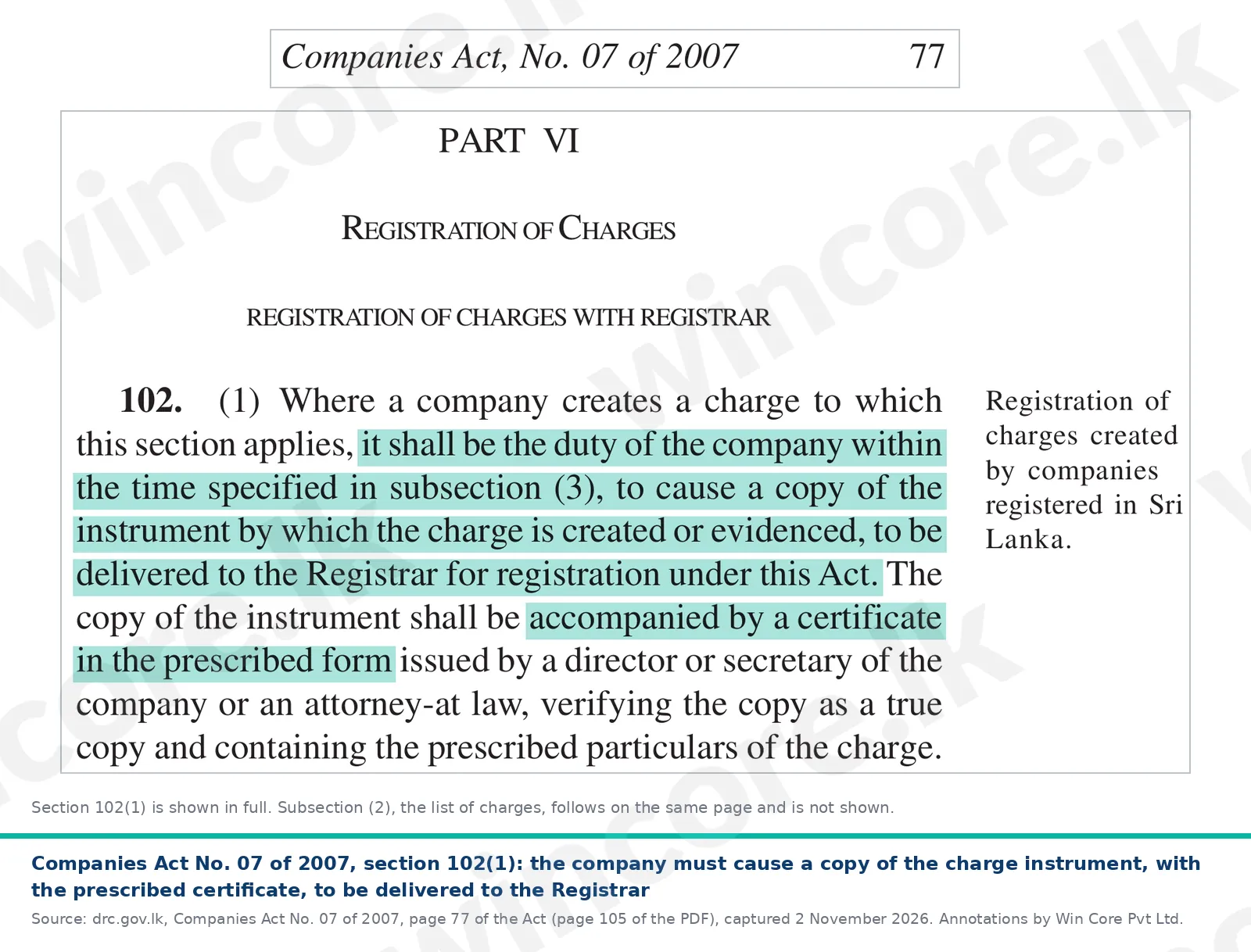
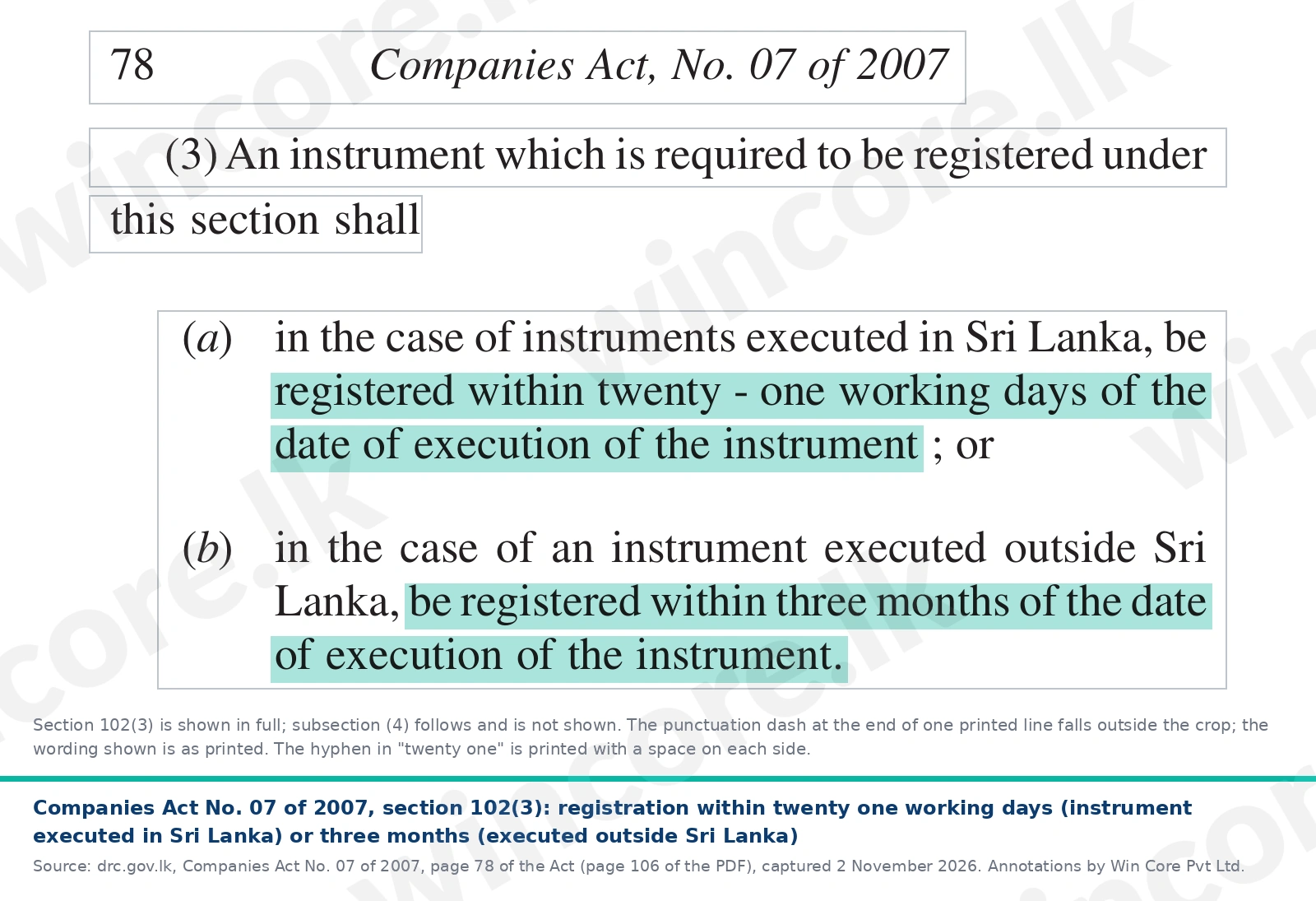
The general rule in section 102(3) says a covered instrument executed in Sri Lanka must be registered within 21 working days of execution. An instrument executed outside Sri Lanka must be registered within three months of execution [1]. A working day excludes Saturday, Sunday and a public holiday under section 529(1). Deliver the documents early enough for registration to be completed on time; delivery on the final day alone does not establish timely registration.
Where a company acquires property already subject to a charge that would have required registration if created by the company after acquisition, section 104 requires delivery of prescribed particulars and a correctly certified copy of the instrument, if any, for registration. Delivery is within three months of completion if both the property is situated and the charge was created outside Sri Lanka; in all other cases it is within 21 working days of completion [1]. This is a delivery deadline, distinct from the registration wording in section 102(3).
For a qualifying series of debentures with holders entitled equally to the benefit of the charge, section 102(7) provides that delivery or receipt of the specified particulars and verified deed or a debenture within 15 working days is sufficient for that section. The period runs from execution of the deed containing the charge, or, if there is no such deed, from execution of a debenture in the series. The proviso separately addresses particulars of later issues; omission of those issue particulars does not affect the validity of debentures issued [1]. For a series of debentures, see the Form 10A filing.
The lender may register, and recover the fee
Section 102(10) says registration "may be effected on the application of any person interested in it", and a person other than the company who registers "shall be entitled to recover from the company the amount of any fees paid by him to the Registrar" [1]. The lender may prepare the documents, but the company's duty remains. Having the lender prepare them is practice, not a legal requirement.
If the company fails to send the required particulars and registration has not been effected on another person's application, section 102(11) provides that the company and each officer in default are separately liable on conviction to a fine of up to Rs 50,000 each [1]. An officer in default is defined in section 529(2)(b) by reference to a knowing and wilful authorisation or permission. Under section 514, for a qualifying filing or delivery offence, the Registrar may instead accept a composition sum at the Registrar's discretion; if accepted, proceedings for that offence must not be started or continued. Composition is not automatic and is separate from court relief for registration [1].
Missing registration can make the security void against creditors
Subject to Part VI, section 103(1) makes a charge void against the liquidator and any creditor only to the extent that it confers security on the company's property or undertaking, unless registered in the prescribed manner and time or within a court extended period where applicable [1]. The section also recognises the corresponding rules under the 1982 Act for qualifying older charges.
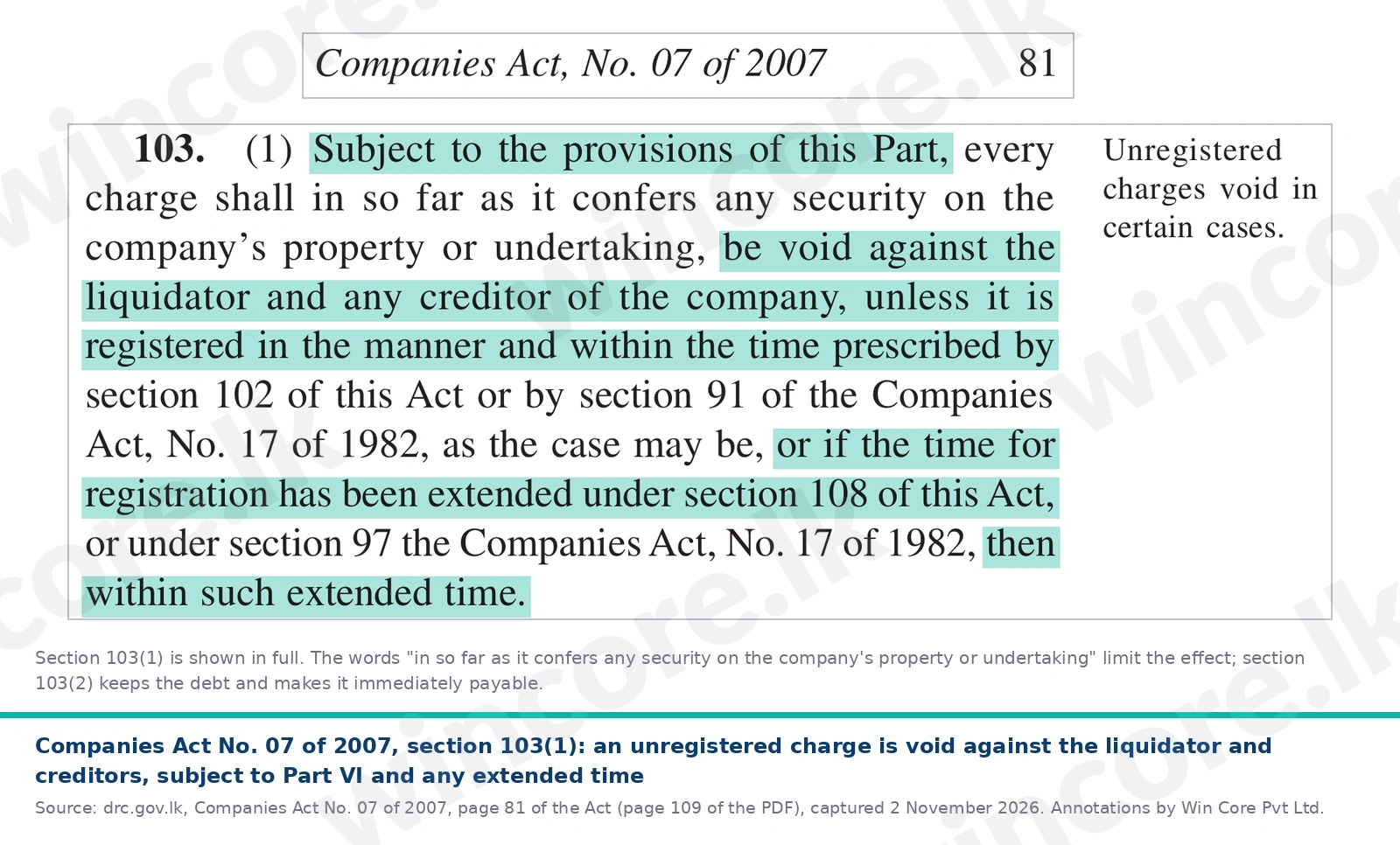
Section 103(2) preserves the repayment obligation. If the charge becomes void under section 103, the money secured by it becomes immediately payable [1].
Section 108 permits the court, on an application by the company or any interested person, to extend registration time or rectify an omission or misstatement on terms it considers just and expedient. The court must be satisfied that the omission or misstatement was accidental, due to inadvertence or another sufficient cause, not of a nature to prejudice creditors or shareholders, or otherwise just and equitable to relieve [1]. An application does not automatically grant an extension.
The company keeps its own register and a copy of the instrument
Section 109 requires every company to keep a copy of every instrument creating a charge requiring registration at its registered office or another place notified under section 116. For a series of uniform debentures, one copy is sufficient [1]. Section 110 requires every limited company to record charges specifically affecting company property and floating charges, with a short description of the property and amount of the charge and, except for securities to bearer, the names of those entitled. An officer who knowingly and wilfully authorises or permits an omission of a required entry is liable on conviction to a fine of up to Rs 200,000 [1]. On our reading, section 514 does not automatically cover this company register omission: its wording concerns a default in filing, delivering or sending documents, or giving notice to the Registrar.
The Registrar keeps a separate register and issues a certificate stating the amount secured. Section 105(2) makes the certificate conclusive evidence that the registration requirements of Part VI have been complied with [1]. Section 116(1)(i) lists the company's copies and its own register, not the Registrar's separate register; see our guide to statutory registers.
Releasing the charge uses a memorandum of satisfaction
Section 107 permits the Registrar, when satisfied that the debt has been paid or satisfied in whole or in part, or that part of the charged property has been released or has ceased to form part of the company's property, to enter the corresponding memorandum or fact [1]. On our reading, Form 12A may be relevant; the applicable form and process remain open points. Section 107 itself specifies no deadline for the entry. Taking the steps needed to update the register promptly is practice, not a legal requirement stated in section 107.
The fee is Rs 9,900 excluding VAT under Gazette 2496/03
The Companies (Fees) Orders as amended by Gazette Extraordinary No. 2496/03 of 6 July 2026 list, at item 5, "For registration of mortgage, charges and debentures" at Rs 9,900.00, shown as "Amended Fee (excluding VAT)" [2]. On our reading, the amended schedule took effect on 6 July 2026, its publication date, under section 527(2) of the Companies Act [1] [2]; check for any later Fees Order.
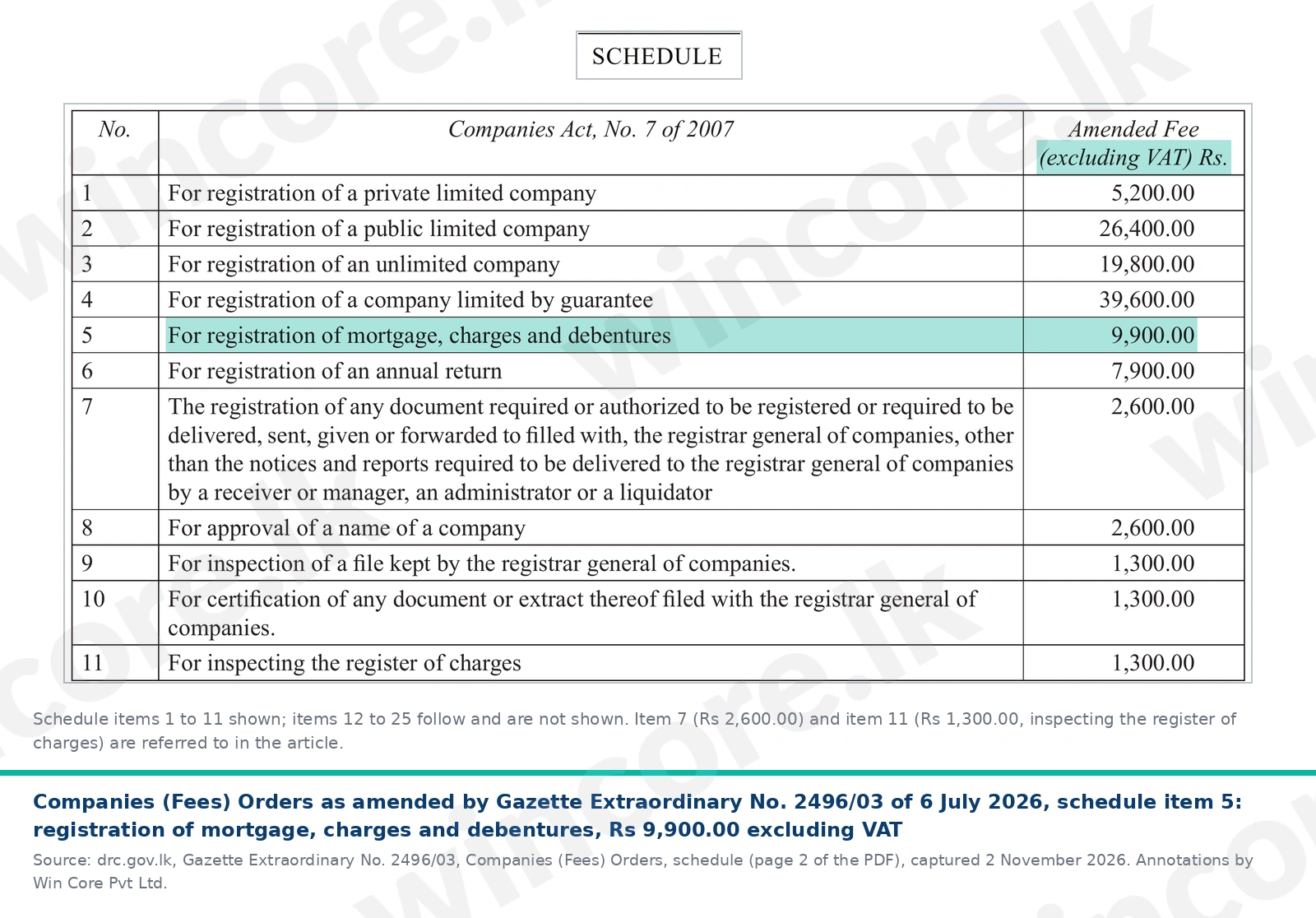
If VAT applies at the standard rate of 18 percent (the rate from 1 January 2024; check for any later change), the calculation for one registration is Rs 9,900 plus Rs 1,782, a total of Rs 11,682 [2] [5]. Item 11 sets Rs 1,300 excluding VAT for inspecting the Registrar's register of charges [2]. On our reading, item 7, Rs 2,600 excluding VAT for documents within its stated scope, may apply to a satisfaction document, but the applicable charge remains an open point. Our post on the Companies Fees Orders in Gazette 2496/03 covers the other fees.
Prepare the charge as part of the loan
Our guide to the project report for a bank loan covers the application. For this example, the company documents the board's decision on the borrowing and the proposed security before signing; that sequence is practice, not a legal requirement stated in section 102. Our loan calculator can help estimate repayments for your own figures.
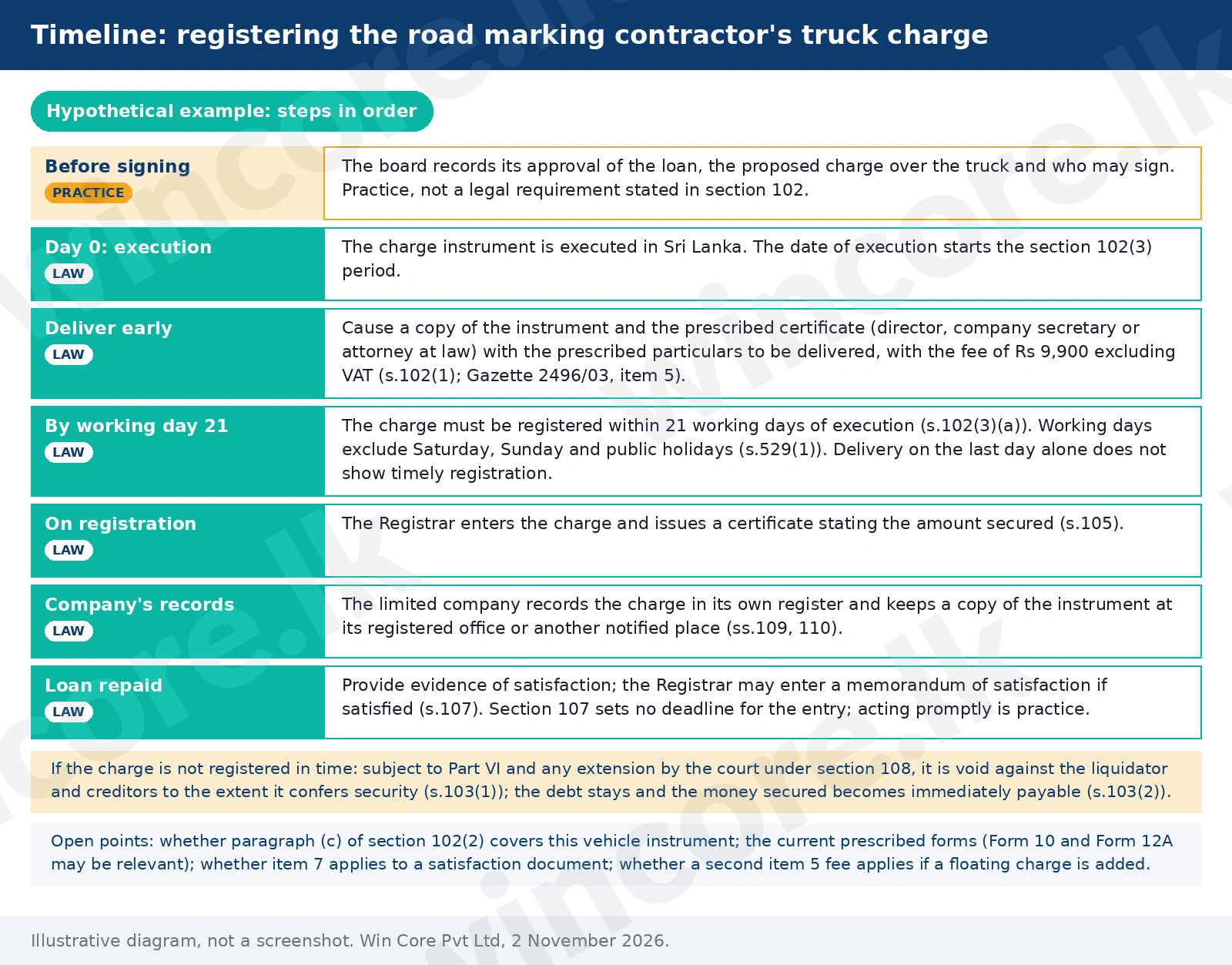
Step 1: Before signing
The hypothetical board records its approval of the loan, the proposed charge over the truck and who may sign. This is an example of practice, not a legal requirement stated in section 102.
Step 2: Execution
The authorised signatories execute the charge instrument in Sri Lanka. Record the date of execution as the starting point for the section 102(3) period.
Step 3: Registration within 21 working days
Arrange delivery of the copy and the prescribed certificate with the prescribed particulars and fee early enough for registration within 21 working days. The current prescribed form remains an open point; Form 10 may be relevant.
Step 4: Certificate and the company's register
The Registrar enters a registered charge and issues the certificate. The limited company records the charge in its own register and keeps a copy of the instrument at its registered office or another notified place [1].
Step 5: Release at the end
When the loan is repaid, provide evidence of satisfaction so the Registrar may enter a memorandum if satisfied, and update the company's records. Form 12A may be relevant, but the current process remains an open point [1].
The truck example shows the registration cost
The road marking contractor signs a charge instrument giving the lender security over a new line marking truck. All facts are hypothetical.
| Item | Rule | Detail |
|---|---|---|
| Charge type | s.102(2)(c), and (f) if a floating charge is added | Paragraph (c) may apply; the classification remains open |
| Time limit | s.102(3)(a) | Registration within 21 working days of execution |
| Certificate | s.102(1) | Prescribed certificate by a director, company secretary or attorney at law; Form 10 may be relevant (open point) |
| Fee | Gazette 2496/03, item 5 | Rs 9,900; if VAT applies at 18 percent, plus Rs 1,782 = Rs 11,682 |
| If a second item 5 fee applies to the floating charge | Gazette 2496/03, item 5 | Two fees total Rs 19,800 excluding VAT, or Rs 23,364 if VAT applies at 18 percent; the fee application is an open point |
| Company's records | ss.109, 110 | Copy of instrument; register entry |
| Release | s.107 | Registrar may enter satisfaction when satisfied; Form 12A may be relevant (open point) |
Hypothetical figures.
What this means for you
- Identify whether the charge falls within section 102(2), keeping the vehicle classification open where relevant.
- Arrange for a covered instrument executed in Sri Lanka to be registered within 21 working days of execution.
- Deliver the copy and prescribed certificate early and allow Rs 9,900 excluding VAT for one item 5 registration.
- Enter the relevant charge in the limited company's own register and keep a copy of the instrument.
- When the debt is repaid, take the steps needed for the Registrar to consider entering satisfaction.
Checklist: documents needed
- Board record of the loan and proposed charge, where used
- Executed charge instrument and its date of execution
- Copy and prescribed certificate with the prescribed particulars
- Fee payment of Rs 9,900 excluding VAT; Rs 11,682 if VAT applies at 18 percent
- Registrar's certificate of registration
- Company register of charges entry and a retained copy of the instrument
- Evidence of satisfaction or release when applicable
FAQ
What is the time limit to register a charge in Sri Lanka?
For a covered instrument executed in Sri Lanka, section 102(3) requires registration within 21 working days of execution. The period is three months for an instrument executed outside Sri Lanka; a court may extend time under section 108. Section 104 instead requires delivery for qualifying acquired property within three months if both the property and charge creation were outside Sri Lanka, or 21 working days otherwise [1].
What happens if a company charge is not registered?
Subject to Part VI and a relevant court extension, section 103(1) makes the charge void against the liquidator and creditors to the extent it gives security over the company's property or undertaking. If it becomes void, the debt remains and the secured money is immediately payable. Section 102(11) provides for conviction fines; section 514 also permits discretionary composition of a qualifying filing offence [1].
Can the lender register the charge instead of the company?
Yes. Section 102(10) allows registration on the application of any person interested in the charge, and a person other than the company who registers can recover the Registrar's fees from the company. The duty still sits with the company, so it should confirm that registration has actually been done within the time limit.
How much does it cost to register a charge?
From 6 July 2026, the amended Companies (Fees) Orders set Rs 9,900 excluding VAT for registration of a mortgage, charge or debenture. If VAT applies at 18 percent, the total for one registration is Rs 11,682. Item 11 sets Rs 1,300 excluding VAT for inspecting the Registrar's register of charges. The applicable fee for a satisfaction document remains an open point [2] [5].
The short version
A covered instrument executed in Sri Lanka must be registered within 21 working days of execution, and the company must cause the copy and prescribed certificate to be delivered. Subject to Part VI and any applicable court extension, an unregistered charge is void against the liquidator and creditors to the extent it confers security; if it becomes void, the secured money becomes immediately payable [1]. The fee for one registration is Rs 9,900 excluding VAT, or Rs 11,682 if VAT applies at 18 percent [2] [5]. Keep the limited company's register and the instrument copy, and seek entry of satisfaction when appropriate; the relevant forms remain open points.
Talk to us. For Statutory Compliance and Corporate Document Maintenance, see our secretarial and compliance help.
WinCore Pvt Ltd
This article is general information as at 30 October 2026 and is not tax, legal or accounting advice on your specific position.
Sources and references (5)
- Department of the Registrar of Companies. Companies Act, No. 07 of 2007, sections 1, 102 to 111, 116, 428, 514, 527 and 529. https://www.parliament.lk/uploads/acts/gbills/english/3776.pdf . Primary. Accessed 30 October 2026.
- Government of Sri Lanka. Gazette Extraordinary No. 2496/03 of 6 July 2026, Companies (Fees) Orders, schedule items 5, 7 and 11. https://drc.gov.lk/en/wp-content/uploads/2026/07/2496-03_E.pdf . Primary. Accessed 30 October 2026.
- Parliament of Sri Lanka. Companies (Amendment) Act, No. 12 of 2025, section 1, section 21 and Schedule. Certified 4 August 2025. https://www.parliament.lk/uploads/acts/gbills/english/6389.pdf . Primary. Accessed 30 October 2026.
- Department of the Registrar of Companies. Performance Report and Annual Accounts 2018, introduction, Act commencement. https://www.parliament.lk/uploads/documents/paperspresented/performance-report-department-of-the-registrar-of-companies-2018.pdf . Official report, secondary source for the commencement date. Accessed 30 October 2026.
- Inland Revenue Department. Tax Chart 2025/2026, Value Added Tax standard rate from 1 January 2024. https://www.ird.gov.lk/en/publications/SitePages/Tax_Chart_2526.aspx?menuid=140407 . Primary. Accessed 30 October 2026.
Put these insights to work
WinCore specialists can review your current workflow, document gaps, and build a practical 90-day action plan.
Book a free consultationRecent articles




Continue reading
Explore more WinCore analysis to keep your finance, tax, and compliance roadmap moving.

What a bank asks for in a project report: three linked projections, a repayment schedule on its terms, the ratios it checks and the documents to attach.
Which registers a Sri Lankan company must keep, where they may be kept, who can inspect them, how long to keep them and the ten-working-day notices.

The instrument behind this year's Registrar of Companies fee rise: what it amends, when it took effect, the Parliament step still open and the odd item 13.